Showing posts with label battery fire. Show all posts

Ethiopian Airlines reports record profits, stands behind Dreamliner despite fire

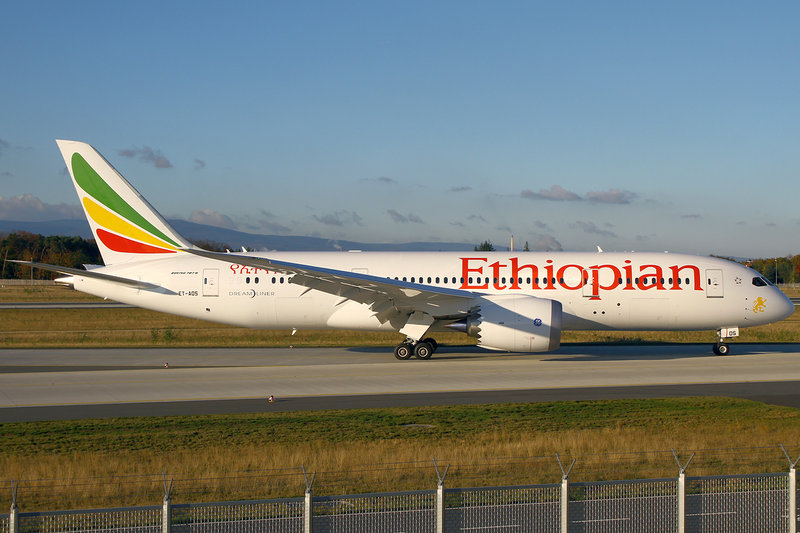
Image Credit: Konstantin von Wedelstaedt
by Vinay Bhaskara

African carrier Ethiopian Airlines has announced a record net profit of 2.03 billion birr (US $107.6 million) for the period from July 2012 - June 2013, up 178% from 734 million birr (US $39.2 million)year-over-year (YOY). Operating profitability also rose a healthy 170% YOY to 2.7 billion birr (US $143.1 billion), from 1 billion birr (US $53.0 million). While the carrier has not yet formally released its financial results, CEO Tewolde Gebremariam presented these figures as coming from Ethiopian's un-audited results for the period. The formal announcement of results should come soon.

Interestingly, Gebremariam attributed Ethiopian's profitability in part to the troubled Boeing 787-8 Dreamliners, citing the fuel savings driven by the aircraft's increased fuel efficiency. His comments come just a month and a half after an Ethiopian Dreamliner memorably caught fire at London's Heathrow Airport in early July (an incident later attributed to a Honeywell Emergency Locator Transmitter), and a three month long grounding of the aircraft due to battery issues earlier this year. Gebremariam admitted that the Dreamliners had caused some issues for Ethiopian this past financial year:
Definitely the incidents and grounding have some impact. We were very fortunate that coincidentally the grounding of the planes were in what we call slack season. It's a slow demand season. So were able to minimize the level of the impact.
However, he also said that the carrier has seen a demand boost from the Dreamliners:
Whenever we introduce the aircraft in any route, the load factor immediately increases, which means our customers love the plane, they are enjoying its features
Ethiopian says that it will take delivery of its remaining 8 Dreamliners on order (5 direct orders and 3 leases), bringing the carrier's active fleet of 787-8 Dreamliners to 12 (13 frames on the books but one is currently indisposed at Heathrow Airport). Ethiopian currently operates a fleet of 54 passenger aircraft (with 31 more on order - 14 Airbus A350-900s, 8 Boeing 787-8 Dreamliners, 4 Boeing 777-300ERs, and 5 Boeing 737-800s) serving 80 passenger destinations around the globe. Based in Addis Ababa, Ethiopian is a member of the Star Alliance partnership of global airlines, and is one of the world's fastest growing airlines.
Read more »

Post 787 fire, UK air accident investigator recommends review of all Lithium powered ELTs on all aircraft

by Devesh Agarwal

The United Kingdom's Air Accidents Investigation Branch (AAIB) has issued a special bulletin (read PDF here) on the fire that broke out on Ethiopian Airline's Boeing 787-8 Dreamliner ET-AOP, parked at London's Heathrow airport last Friday.

In the report, the AAIB said the fire occurred in the rear upper fuselage where the fixed Emergency Locator Transmitter (ELT) is located. The ELT model RESCU406AFN is made by US aviation major, Honeywell International.

The report says
Detailed examination of the ELT has shown some indications of disruption to the battery cells. It is not clear however, whether the combustion in the area of the ELT was initiated by a release of energy within the batteries or by an external mechanism such as an electrical short. In the case of an electrical short, the same batteries could provide the energy for an ignition and suffer damage in the subsequent fire.
There are no other aircraft system in this area of the plane which, with the aircraft unpowered, contained stored energy capable of causing such a fire,
However, the report also gives some benefit of doubt to Honeywell, saying
The ELT manufacturer has produced some 6,000 units of this design which are fitted to a wide range of aircraft and, to date, the incident on 12 July 2013 has been the only significant thermal event
The AAIB has made two safety recommendations in its report:
Safety Recommendation 2013-016
It is recommended that the Federal Aviation Administration initiate action for making inert the Honeywell International RESCU406AFN fixed Emergency Locator Transmitter system in Boeing 787 aircraft until appropriate airworthiness actions can be completed.

Safety Recommendation 2013-017
It is recommended that the Federal Aviation Administration, in association with other regulatory authorities, conduct a safety review of installations of Lithium-powered Emergency Locator Transmitter systems in other aircraft types and, where appropriate, initiate airworthiness action.
Aircraft manufacturer Boeing released a statement saying
As a party to the investigation, Boeing supports the two recommendations from the UK Air Accidents Investigation Branch (AAIB), which we think are reasonable precautionary measures to take as the investigation proceeds. We are working proactively to support the regulatory authorities in taking appropriate action in response to these recommendations, in coordination with our customers, suppliers, and other commercial airplane manufacturers.

We are confident the 787 is safe and we stand behind its overall integrity.
Read more »

Opinion: After Ethiopian Airlines incident at Heathrow Airport; 787 remains safe

by Vinay Bhaskara

Last Friday, a pair of incidents occurred with the Boeing 787 Dreamliner. Smoke was observed billowing from an Ethiopian Airlines Boeing 787 parked on the ground at London Heathrow International Airport with no passengers on board, while a Thomson Airways Dreamliner operating between Manchester and Sanford, Florida (SFB) was forced to return to Manchester due to a routine maintenance problem.

Turning first to the Ethiopian 787, the facts are as follow:

Around 16:30 B.S.T, the Ethiopian 787, registration ET-AOP, was observed with smoke billowing throughout the aircraft. Fire response crews at Heathrow rushed to the aircraft and doused it with fire retardant foam from at least 3 vehicles

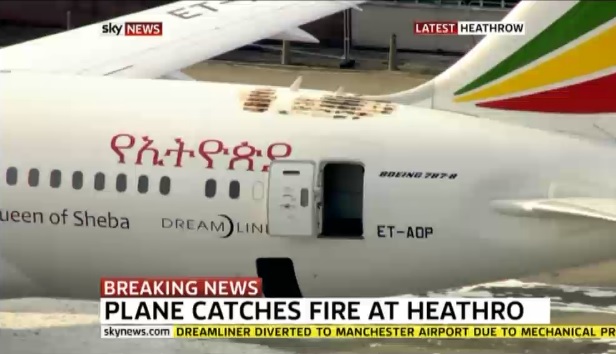
787 damage at Heathrow Airport - via Sky News
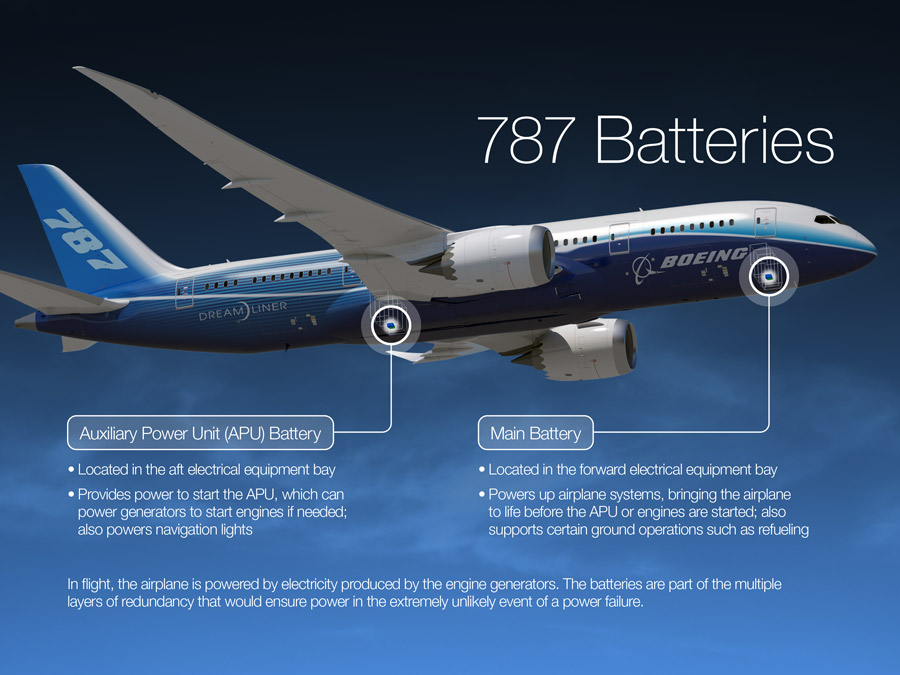
There was significant smoke/fire damage to the carbon fiber reinforced polymer (CFRP) skin of the Ethiopian 787, in the crown of the fuselage just forward of door 4 (the aft door). The damage was in a different location than that caused by the issues with the 787’s lithium-ion batteries that caused the Dreamliner to be grounded worldwide for more than 3 months. In fact, the British Air Accidents Investigation Branch (AAIB) has ruled out a direct causal relationship between the 787’s batteries and/or auxiliary power unit (APU) and the fire damage. The graphic below from Boeing shows that the damage from the 787 batteries occurred in a different location entirely.

Graphic showing location of 787 batteries - Image Credit: Boeing
The 787 was on Fixed Electrical Ground Power (FEGP) at the time of the incident. A report in the Financial Times quoted an Ethiopian Airlines source as stating that a problem had been observed in the aircraft’s air-conditioning system, and that “sparks were observed,” but this report has not been corroborated anywhere else. The 787’s aft ceiling contains Remote Data Concentrators (RDCs) and Remote Power Distribution Units (RPDUs) with significant amounts of wire, and there is a galley station (but no crew rest) beneath the section of the roof where damage occurred.

The National Transportation Safety Board (NTSB), European Air and Space Agency (EASA), AAIB, Boeing, and Ethiopian are all investigating the incident. The damage represents a massive aircraft on ground (AOG) challenge, and a good testing case for composites repair, which presents its own set of challenges (find more information on composite repair here). The cause of the damage is unknown at this point.

These are the facts we know; full stop.

All of the speculation about design problems with the 787 and maintenance issues is exactly that, speculation.

For their part, Boeing, Ethiopian Airlines, and (importantly) the assorted aviation safety agencies are all treating this as a one-off event. Ethiopian Airlines issued a statement saying that the incident was “unrelated to flight safety.”  Ethiopian is scheduled to take delivery of its 5th 787 this week, and plans to do so as scheduled and keep its entire remaining fleet of Dreamliners operational.

To their credit, the DGCA is taking a similar approach with national carrier Air India’s fleet of 787s. "We are keeping a close watch in the investigations (at Heathrow). We will take a view (on Air India's fleet) only after we receive reports of the inquiry and know the causes behind these incidents," DCGA chief Arun Mishra told the Press Trust of India (PTI). To date, Air India has taken delivery of 7 Dreamliners out of a total order of 27.

Air India should keep its Dreamliner fleet operational
This is the correct tactic. While many in the media, especially (albeit understandably) among the British press, have used this as an opportunity to question the 787’s safety, the fact is that this incident is unrelated to any prior ones on the 787. Aviation is not a perfect process; things can go wrong. And even the best of aircraft have one off issues from time to time (see the recent 777 crash or the Air France A330 crash in 2009). When the safety authorities whose job it is to separate isolated incidents from chronic safety problems are treating the 787 as a safe, airworthy aircraft; you should too.

Every aircraft, especially one with such a large degree of new and advanced technology, will suffer its fair share of teething issues. Remember the A380s wing rib cracks? Or the myriad issues that the 747, 777, 767, A340, and A300 all faced on their respective entries into service (EIS). Give Boeing and other involved parties some time to work out the kinks; because when they do, the 787 is set to revolutionize air travel.

Read more »

Boeing to begin modifying 787s for return to service

Boeing image
Today's approval of battery system improvements for the 787 Dreamliner by the U.S. Federal Aviation Administration (FAA) clears the way for Boeing and its customers to install the approved modifications and will lead to a return to service and resumption of new production deliveries.

The FAA's action will permit the return to service of 787s in the United States upon installation of the improvements. For 787s based and modified outside the United States, local regulatory authorities provide the final approval on return to service, but it is expected the local bodies will follow the FAA's lead.

Approval of the improved 787 battery system was granted by the FAA after the agency conducted an extensive review of certification tests. The tests were designed to validate that individual components of the battery, as well as its integration with the charging system and a new enclosure, all performed as expected during normal operation and under failure conditions. Testing was conducted under the supervision of the FAA over a month-long period beginning in early March.

Boeing, in collaboration with its supplier partners and in support of the investigations of the National Transportation Safety Board and the Japan Transport Safety Board, conducted extensive engineering analysis and testing to develop a thorough understanding of the factors that could have caused the 787's batteries to fail and overheat in two incidents last January. The team spent more than 100,000 hours developing test plans, building test rigs, conducting tests and analyzing the results to ensure the proposed solutions met all requirements.

Boeing also engaged a team of more than a dozen battery experts from across multiple industries, government, academia and consumer safety to review and validate the company's assumptions, findings, proposed solution and test plan.

The improved battery system includes design changes to both prevent and isolate a fault should it occur. In addition, improved production, operating and testing processes have been implemented. The new steel enclosure system is designed to keep any level of battery overheating from affecting the airplane or even being noticed by passengers.

Boeing has deployed teams to locations around the world to begin installing improved battery systems on 787s. Kits with the parts needed for the new battery systems are staged for shipment and new batteries also will be shipped immediately. Teams have been assigned to customer locations to install the new systems. Airplanes will be modified in approximately the order they were delivered.

Boeing will also begin installing the changes on new airplanes at the company's two 787 final-assembly plants, with deliveries expected to resume in the weeks ahead. Despite the disruption in deliveries that began in January, Boeing expects to complete all planned 2013 deliveries by the end of the year. Boeing further expects that the 787 battery issue will have no significant impact to its 2013 financial guidance.
Read more »

FAA Approves Boeing 787 Battery System Design Changes

The long grounded Boeing 787 fleet across the world are expected to soon return to the skies, as the US Federal Aviation Administration (FAA) today took the next step in returning the Boeing 787 to flight by approving Boeing's design for modifications to the 787 battery system. The changes are designed to address risks at the battery cell level, the battery level and the aircraft level.

Next week, the FAA will issue instructions to operators for making changes to the aircraft and will publish in the Federal Register the final directive that will allow the 787 to return to service with the battery system modifications. The directive will take effect upon publication. The FAA will require airlines that operate the 787 to install containment and venting systems for the main and auxiliary system batteries, and to replace the batteries and their chargers with modified components.

US Transportation Secretary Ray LaHood said
“Safety of the traveling public is our number one priority. These changes to the 787 battery will ensure the safety of the aircraft and its passengers,”
FAA Administrator Michael Huerta said
“A team of FAA certification specialists observed rigorous tests we required Boeing to perform and devoted weeks to reviewing detailed analysis of the design changes to reach this decision,”
To assure proper installation of the new design, the FAA will closely monitor modifications of the aircraft in the U.S. fleet. The FAA will stage teams of inspectors at the modification locations. Any return to service of the modified 787 will only take place after the FAA accepts the work.

As the certifying authority, the FAA will continue to support other authorities around the world as they finalize their own acceptance procedures.
Read more »

Japan Airlines faces much smaller impact of Boeing 787 grounding

by Devesh Agarwal

The impact of the month old grounding of their Boeing 787 Dreamliners on Japan Airlines (JAL) appears to much smaller when compared to fellow Japanese carrier All Nippon Airways (ANA). "We operated only six Dreamliners out of a fleet of 200 aircraft, so the total impact of the Dreamliner grounding on us is very small" JAL CEO Masaru Onishi told Bangalore Aviation on the sidelines of the Oneworld event to mark the entry of Malaysia Airlines in to the alliance, on January 31.

Onishi-san explained that JAL operated six Dreamliners to Boston, San Diego, Singapore and Moscow, keeping one aircraft spare, a much smaller number when compared to the 24 Dreamliners in the fleet of fellow Japanese carrier ANA.

Keeping in mind his airline's focus on passenger convenience, he went on to say, that JAL had minimised disruptions by deploying Boeing 777s on the higher demand routes serviced by the 787, and 767s on the lower demand routes. JAL had also transferred some of its passengers on to fellow oneworld member American Airlines. While JAL did not transfer any passenger on to ANA, they did receive transferred passengers of ANA.

One route that was affected was Tokyo Narita - San Diego, which was specifically planned for 787 operations only. For JAL to operate the flight using 777s, the airline had to take specific certifications which take about three weeks. The airline has already commenced the certification process, but the San Diego flight is suspended till JAL completes the formalities and obtains the certification. [Editor's note: This morning Japan Airlines announced that it was indefinitely delaying the launch of its Narita Helsinki route, scheduled to commence on February 25.]

On operating costs, Onishi san conceded that airline was taking a hit. "With [Boeing] 777s we achieve about 60% passenger load factor compared to 80%+ in the 787s."

Onishi-san also appeared to be resigned to the fact, that the battery problem, which has resulted in the grounding of the global 787 fleet, is not going to be resolved any time soon. "We have had discussions with Boeing and they are doing their best to fix it [the problem], and we hope they do it within two months, but I cannot say for sure".

When asked what will be Japan Airlines' stand on compensation or their order book especially if the fix took longer than the anticipated two months, Onishi san refused to speculate, saying "Let us not focus on such issues right now. More important is the fix."

Onishi-san also indicated that JAL is committed to its 787 orders.
Read more »