Showing posts with label Runway. Show all posts

Bangalore airport shut down as IndiGo flight veers off runway

by Devesh Agarwal
IndiGo Airbus A320 VT-IGV at Bengaluru International Airport. Photo copyright Vedant Agarwal. Used with permission.
At approximately 20:10 (14:40Z), an IndiGo Airbus A320-232 registration VT-IGV performing flight 6E-125 from New Delhi to Bangalore, with 110 passengers and six crew (two pilots, four cabin crew), veered off the runway 27 while attempting to land at Bengaluru International Airport (BIA) during heavy rains and cross-winds.

The aircraft damaged five runway lights and suffered burst tyres, finally stopping near taxiway Foxtrot, and blocking the sole runway 09/27. There were no injuries.

All flight operations at the airport were suspended till repairs to the aircraft were carried out and it was towed to the apron. Flight operations resumed almost three hours later at 22:55 (17:25Z).

A number of flights both domestic and international were diverted to neighbouring airports like Chennai.

The airline released this statement
IndiGo flight 6E–125 from Delhi to Bengaluru, while landing on runway 27 at the Bengaluru airport at 20:10 pm, landed to the right of the center line, while experiencing heavy rains upon landing. The aircraft veered to the right and contacted 5 runway edge lights which led to deflation of the right main tyres. The aircraft was controlled and was taxied off the runway onto taxi track ‘’Foxtrot” and stopped.

All 110 passengers and six crew on board are safe with no injuries reported and have been de-planed safely from the aircraft to the terminal.

As per the operating procedure, the aircraft will be grounded for maintenance work. The matter has been reported to the DGCA and the safety department of IndiGo and DGCA will inquire further into the matter at the earliest.

At IndiGo, we are committed to passenger comfort, and safety is our highest priority. Hence, there can be absolutely no compromise on safety.
In April 2009, in a very similar incident, a Kingfisher Airlines Airbus A320-232 VT-KFT also veered off runway 27 in heavy rain and winds, and damaged runway lights. (Read that story here). At that time the runway was shut for less than 55 minutes. A shut down of three hours with the aircraft stopping on the taxiway suggests significantly more damage to the aircraft than IndiGo is claiming.
Read more »

ATR approved for unpaved runway operations in Russia’s Siberia and Far East

Turboprop manufacturer ATR has won approval from the Russian Interstate Aviation Committee (IAC) to operate from four unpaved runways in remote areas of Russia: Mys Kamenny, Lensk, Bodaibo and Igrim. Find out more details in the press release below:

26th August 2013

ATR obtained the company’s receipt of fleet-wide approval for new generation ATR aircraft to operate from 3 more unpaved runways in the remote parts of Russia. Russian Interstate Aviation Committee (IAC) delivered the approval in late June this year. This certification brings to 4 a total number of runways already approved for use and operations: Mys Kamenny, Lensk, Bodaibo and Igrim, the latest being certified last year. 

The certification allows ATR aircraft to operate from gravel, dirt and grass strips. This significant upgrade to ATR's outstanding performance package was accomplished runway per runway, each of which had undergone extensive and thorough operational expertise and testing performed by ATR engineering team. More unpaved air strips are being assessed to gain approval for ATR operations.

Today, with this additional performance advantage, ATR aircraft are the only in-production foreign turboprops above 50 seats having received the certification for unpaved runway operations from IAC. “The ability to land and depart from unpaved runways adds increased operating flexibility to an already outstanding and robust ATR aircraft requiring minimal airframe modifications,” said Carmine Orsi, ATR Senior Vice President Technical.

With its expanded performance and the ability to operate from unpaved surfaces, ATR proves its commitment and enthusiasm to further invest in Russia’s high potential market. ATR turboprops aim to improve communications with Russia’s most remote regions where harsh environmental conditions and country’s vast territory make road transportation impracticable.

Read more »

Video: Plane spotting at New Delhi Airport - Songs of Runway 28

Hope you had a good holiday. Turn the volume up for this one. Another of our videos from New Delhi's Indira Gandhi International Airport, thanks to the team at Delhi International Airport Ltd.

This one focusses on the sounds heard at the runway from various aircraft and their many engines. Hope you enjoy.


As usual comments, praises, or brick-bats are always welcome.
Read more »

Video: From the ramp to the runway. On the ground at New Delhi IGI airport

As we wind down the week, and the year, we present a video showing the action on the ground. In the world of aviation, a lot needs to happen on mother earth, before the beautiful birds take to the sky.


Special thanks to the friends at Delhi International Airport (P) Ltd. who made this happen.

For our readers who subscribe by e-mail, you may need to use this link to see the video.
Read more »

50 flights diverted due to Dubai airport closure

Air Traffic at the middle-east's busiest hub experience major snarls due to the fog and loss of power to a critical runway backup system.

The closures were caused this morning when reduced runway visibility. About 06:45 there was a loss of power to a critical runway backup system required to maintain runway lights during foggy conditions. While actual power was not disrupted, it is essential, for reasons of safety that the backup system remains functional.

This prompted Dubai International airport administrators to suspend flight operations. About 50 flights were diverted to a number of area airports in the Persian Gulf region including Dubai World Central, Al Ain, Doha in Qatar, Abu Dhabi, Dammam in Saudi Arabia, Muscat in Oman, and Bahrain, among others.

Runway operations were restored by 08:30. The airport operator is working with airlines, air traffic and ground services staff to restore operations, clear the backlog and limit customer inconvenience.

Further flight delays are anticipated as a result of the disruption, and so passengers are advised to check with their airline or airline websites for further information on flight arrival and departure time.

Image courtesy Dubai International airports
Read more »

Opinion: Bangalore airport should disclose full details of premature runway surface failure

Late last month, the airport operators of the Bengaluru International Airport announced a closure of the sole runway (09-27) starting from March 11, which will result in a suspension of all flight operations during the day, effectively shutting down the whole airport.
Runway 09 at Bangalore airport

The operators, Bengaluru International Airport Ltd. (BIAL), indicated the runway closure was being done to facilitate "runway maintenance work" on the advice of a world leading consultant who "monitor the airfield pavement surface and its performance".


The runway will be shut down in three phases. The first phase will see a full runway closure between 10:30 to 17:30 IST (5:30pm) from March 11, 2012 to April 3, 2012. Phases two and three will see partial runway closures. The shorter runway length will allow for operations of lighter aircraft (turbo-props or flights of shorter distances which will carry less fuel and therefore less weight). Full details are available in the AIP supplement.
For detailed information on runways, numbering, thresholds, loads, etc. read this article and its second part.
AIPS 2012 08 BIA Runway Closure

When The Hindu Business Line reported of a possible full scale runway closure the aviation community in Bangalore was abuzz on the possible reasons. A full scale runway closure is a major event, and for a runway to be closed for "maintenance" implies serious repairs. Serious repairs on a spanking new runway, at a new airport which has commenced operations less than four years ago, clearly implies something extra-ordinary.

A source with extensive knowledge of the Bangalore airport project, expressed extreme surprise on the timing of the repairs, as the runway surface was originally specified to last for at least twelve years.

Another source, also closely involved with the airport project, confirmed the failure, indicating the top layer of the 450mm thick runway has "been determined to be not as structurally strong as should be", calling the failure a "major civil engineering deficiency". This will require the complete top surface to be removed and re-laid. Sources cannot be named as they are not authorised to speak to the media.

The runway was constructured by former BIAL promoter and share-holder Larsen and Toubro, known as India's largest engineering and construction company. In 2005, Larsen and Toubro invested 55.54 crore for a 17% share in the airport project, which it sold in December 2009 for a hefty 1,100% profit to GVK Power and Infrastructure for Rs. 686 crore (Rs. 6.86 billion) and exited.

In its operations, BIAL behaves responsibly, performing runway maintenance with the regular consistency and efficiency of a finely tuned Swiss watch, but all these efforts appear derailed by this failure.

Failure began two years ago
The cracking of the runway surface apparently began in 2010, when the airport was just two years old and in the midst of the eonomic recession which saw domestic traffic levels plunge 20%.

Airport sources inform that BIAL brought in Applied Pavement Technology, Inc. (APTech), a world renowned engineering consulting firm specialising in airport pavement technology, to consult on the prematurely failing runway.

Repeated attempts to repair the runway over the last two years have not been succesful. It is learnt, that the degradation of the runway surface has reached such a serious level, that the effect of the monsoon on the pavement is no longer predictable, thus forcing BIAL to proceed with the maintenance work on a war footing so as to complete the activity before the onset of monsoons in May.

Commenting on this decision, an official spokesperson of BIAL said
“This is a proactive decision taken by BIAL. It recognizes its responsibility as the custodian of a key asset of the state and country and is committed to the safe and secure upkeep of this infrastructure. Passengers and airline operators top BIAL's priority list and we will work closely with them in our proactive efforts to ensure that any discomfort caused as a result of this closure remains minimal.”
Despite many requests, none of the BIAL spokespersons commented on the premature degradation of the runway surface, or its possible causes.

BIAL cannot escape blame
Regardless of the reason(s) for the runway failure, from an innocent oversight to malicious intent, none of them speak well to the reputation of Larsen and Toubro. The stain is even deeper considering the company is supposed to the best in India. In the same coin, while it is also a victim of sorts, BIAL cannot escape blame.

If it is a genuine omisson or mistake, one may even consider forgiving Larsen and Toubro. After all Bangalore was one of the first runways they ever built; but the three private promoters of BIAL were the leading icons in their respective areas of specialisation. As the "trusted custodian of a key national asset" where was this collective skill? Does it not speak to BIAL's oversight and monitoring at the time of construction? Is this a case of poor quality control? or were things taken on a little too much on trust just because the runway construction contractor was also a promoter?

Time to come clean
BIAL is an honourable organisation, and Larsen and Toubro could be doing the right thing in repairing the runway at its expense, but the inconvenience to be suffered by the various stake-holders of the airport -- airlines, staff, passengers, concession operators, industries, even taxi drivers, is all too real. The monetary and business impact is going to run in to crores and crores of Rupees with thousands of man-hours lost.

The citizens of Bangalore may not demand compensation, but answers they are.

BIAL should determine and fully disclose the precise reason(s) for the failure, the associated costs, and corrective action reports. If for no other reason, to ensure it does not happen again, and for the reputation of Public-Private-Partnership to be retained.
Read more »

Mumbai airport upgrades runway for Airbus A380 compliance; will Emirates bring the first scheduled A380 to India?

Between October 2009 and April 2010, passengers and airlines alike, had to put up with runway closures as Mumbai Airport International Ltd. (MIAL), the operators of the Chhatrapati Shivaji International Airport (CSIA) at India's financial capital, Mumbai, re-carpeted and re-built the secondary runway 14-32. (For details on runway numbering please read this article).

The runway now boasts a smoother surface, new centre line and Barrette approach lights. Six new taxiways including two new rapid exit taxiways have also been constructed to reduce runway occupation time and improve the operational capacity of the runway.

Mumbai VABB CSIA BOM ICAO Aerodrome Chart Airport Map
A key point of the secondary runway improvement has been to make it compliant for operations by Code F aircraft such as the Airbus A380 superjumbo. Now MIAL would like to repeat the whole exercise for the main runway 09-27.

The upgrade, subject to approval by Indian regulator the Directorate General of Civil Aviation (DGCA), is planned for commencement around October 2010, and will continue till the middle of the summer schedule i.e. till about June 2011. Shutting down 09-27 is going to have a significant impact on Mumbai's operations. However, we can expect MIAL to keep the runway operational during the peak hours of 06:00~09:00 and from 18:00 onwards.

Two aspects seem to have driven what appears to be a good decision.

Competition
Over the last year, CSIA has lost its long held premier ranking as India's busiest airport to the rapidly expanding Indira Gandhi International Airport (IGIA) at India's capital New Delhi, and its soon to be operational mega Terminal 3 (T3).

While CSIA is constructing new terminals, the airport simply does not have the space to make a 500,000 m2 integrated terminal, a crucial advantage airlines desire for hub operations. As the map shows, passengers are required to take a tortuous 30 minute ride to transit between the domestic and international terminals, and there is precious little the airport operator can do about it. The national carrier, Air India, currently based at Mumbai and one of CSIA's largest customers, has already announced plans to make Delhi's T3 as its hub to connect the airline's domestic and international network. Kingfisher Airlines too operates more international flights from Delhi than Mumbai. Jet Airways is the only major carrier to be still firmly rooted in Mumbai.

Additionally, while Delhi airport still faces no competition within a two hour flying time (Kolkata, Mumbai, Hyderabad) thus giving it a huge hinterland, Mumbai has seen new or upgraded airports coming up within 60~75 minutes flying time at Hyderabad, Bangalore, Ahmedabad to a small extent).

With no integrated terminal, MIAL needs to have some other aces up its sleeve to lure airlines. Without a doubt Mumbai has the traffic potential, but Mumbai is facing a shortage of air-side operational capacity, specifically its two crossing runways.

Runway capacity
Mumbai airport is facing severe capacity constraints on its runways. With its two crossing runways the number of aircraft movements per hour is limited. Vested political forces have ensured Mumbai airport has not been able to re-claim any of hundreds of acres of airport land encroached on by slum dwellers, which could be used to build new runways.

Adding to the woes of the airport operators are the regulatory authorities and the airlines.

Thanks to the current rules, the AAI run ATC can only handle about 32~34 movements per runway per hour. Compare this will the 55+ movements per hour achieved regularly at London's Gatwick airport. People in the know, say the authorities are moving much too slow on proposals which leverage on newer technology including performance based navigation, which will permit reduction of aircraft separation which in turn will allow for increased movements per hour thus increasing runway capacity.

With a constraint on the number of flight movements, to increase annual passenger traffic from about 26 million currently to a target 40 million, Mumbai needs airlines to change the aircraft patterns.

Airlines are not helping MIAL's case, choosing to operate multiple narrow body flights on trunk routes, instead of consolidating in to fewer wide body flights. For example, the busiest route in India is between Mumbai and Delhi. Domestic carriers operate no less than 17 flights in each direction, every morning between 06:00 and 09:00, all of them narrow bodies. The three full service carriers Air India, Kingfisher, and Jet, all of whom have wide body fleets, each operate at least four flights in each direction with separations as little at 30 minutes with either a Boeing 737 (Jet) or an Airbus A320 (Air India, Kingfisher) family aircraft. Add to this mix, numerous flights operated by smaller turbo-props like the ATR72-500 and there is very little room for the airport operators to manoeuvre.

With the number of movements limited, sooner or later, airlines are going to have to increase the size of aircraft they operate at Mumbai.

The Airbus A380
The A380, most definitely, has a strong passenger pull factor. The two airports in India capable of generating traffic volumes to justify A380 operations are Mumbai and Delhi. Till the upgrade of runway 14-32, Mumbai was loosing out to Delhi, and now this selling point of Delhi has been nullified.

Mumbai has still not received formal approval by the DGCA to commence A380 operations, but expects to shortly.

The airline most likely to commence a scheduled A380 operation at Mumbai will be Emirates. The Dubai based carrier has ordered 90 of the double-decker behemoths and already operates five flights daily between Mumbai and Dubai. Rumours are circulating the carrier is trying for a sixth daily flight, but is not receiving the needed permissions. The other airline which is keen to bring its A380 to India is Lufthansa. However, while Emirates can operate its three hour Mumbai Dubai flight on the shorter 14-32 runway, it remains to be seen if Lufthansa could operate a heavily fuelled aircraft for its ten hour journey. May be Lufthansa will have to wait for runway 09-27 to be upgraded to Code F compliance.

All this remains speculative, as the Ministry of Civil Aviation is still not giving permission to any foreign airline to operate the A380 to India. Kingfisher, the only Indian airline to have ordered the super jumbo does not expect its aircraft before 2015~16, and that it much too long for Indians to wait.

One can only hope that the ministry sees common sense, and the citizens of Mumbai can rejoice that they will see an A380 in their city soon.
Read more »

Airport runways: All you wanted to know but were afraid to ask - Part 2

In the first part of this two part series on airport runways, we covered the basics of runway terminology, runway numbering, etc.

Today we focus on the runway itself. The sections and parts of the runway, and terms very few outside the core aviation industry know significant details about.

Common measurement terms
Apart from the length and width of the runway, pilots depend on some key runway data.

TORA - TakeOff Run Available i.e. the length of runway declared available and suitable for the ground run of an airplane taking off.

LDA - Landing Distance Available i.e. the length of runway which is declared available and suitable for the ground run of an airplane landing.

Sections of the runway
This is a generic drawing of a runway.
generic runway diagram
The area marked with yellow chevrons (V shapes) are the blast pads, also referred to as overrun areas or stopways. These areas are often constructed before the start of a runway to reduce the erosion of earth by the jet blast produced by large planes when they power up for take-off (the GE90-115B found on all Boeing 777-300ERs produces over 115,000 lbs of force at full power). Overrun areas can also be used by landing aircraft as an emergency stopping space. Blast pads are often not as strong as the main paved surface of the runway and aircraft are not allowed to use it except in extreme emergencies.

On precision instrument runways which have an ILS system i.e. at most medium and large airports in the world in addition to the blast pad/stopway there are markings for threshold, designator, centerline, aiming point, and 500 ft (152 m), 1,000 ft (305 m)/1,500 ft (457 m), 2,000 ft (610 m), 2,500 ft (762 m), and 3,000 ft (914 m) touchdown zone marks. The are variations from country to country on runway marking.

The main parts of the runway are detailed in the diagram below. The threshold is essentially the start or end of the actual runway itself. The touch down zone is the target area for pilots to stick the wheels of their aircraft on to the runway.


Many a time, one can find a displaced threshold. A displaced threshold is a runway threshold located at a point other than the physical beginning or end of the runway.
Displaced thresholds are marked with V head arrow marks before the threshold of the runway. Displaced thresholds are normally implemented when there is an encroachment in the landing path (typically outside the airport) that prevents aircraft from touching down at the start of the runway when descending at a normal three degrees angle.

To clear the obstruction the actual threshold is displaced or moved forward or the angle of descent is increased. The portion of the runway in the displaced threshold may be used for takeoff but not for landing. If there is a displaced threshold on the opposite side of the runway, landing aircraft may use the displaced area on the opposite end for roll out and stopping. If the angle of descent is increased beyond three degrees then the runway cannot be qualified for low visibility operations other than Cat I ILS.

The most famous case of displaced threshold in India is at the newest runway 11-29 of New Delhi's Indira Gandhi International airport whose threshold is displaced by a mind numbing 1,610m reducing LDA to only 64% of the total runway length, thanks to encroachments. In Mumbai where there is no space for extending the runway, the glide slope is increased to clear obstacles and hence the runway is limited to Cat I ILS visibility norms and has to stop operations in periods of extremely low visibility.

Runway lighting
Runway 28 lighting at IGI airport, New Delhi, India.
In a globalised world most airports today operate 24x7 or at least from dawn well in to the night.

Runway lighting which allows for operations in the dark or at times of low visibility forms an integral part of any runway at a modern airport.

Most runways will have some if not all, of the below lighting systems.

Approach Lighting System (ALS) – the lighting system installed on the approach end of a runway consisting of a series of lightbars, strobe lights extending outward from the runway end.

Runway End Identification Lights (REIL) – unidirectional facing approach direction or omnidirectional pair of synchronized flashing lights (normally two yellows blinking alternately) installed at the runway threshold, one on each side.

Runway end lights – lights on each side of the runway on precision instrument runways, extending along the full width of the runway showing green when viewed by aircraft approaching to land and red when seen from the runway.

Runway edge lights – white elevated lights that run the length of the runway on either side. On precision instrument runways, the edge-lighting becomes yellow in the last 2,000 ft (610 m) of the runway as an alert to pilots. Active runways are always marked with white lights. No other aircraft path at an airport may use white lighting.

Taxiways have blue colour edge lights, and modern airports have green centre lights. Of course this is dependant on the width of the taxiway, and the complexity of the taxiway pattern.

Confusion over lighting was at the centre of the controversy following the crash of Singapore Airlines Flight 006 at Taipei, Taiwan on 31 October 2000.

Runway Centerline Lighting System (RCLS) – white lights embedded along the centre-line the runway at 50 ft (15 m), except the last 3,000 ft (914 m), where red is alternated with white for next 2,000 ft (610 m) and red for last 1,000 ft (305 m). RCLS is optional for ILS Cat I but mandatory for ILS Cat II and Cat III.

Touchdown Zone Lights (TDZL) – rows of bars of three white lights on either side of the centerline over the first 3,000 ft (914 m) of the runway, or to the midpoint in case the runway is less than 6,000ft (1,828 m).

Taxiway Centre-line Lead-Off Lights – installed to indicate turn-offs for taxiways, alternate green and yellow lights, starting at the runway centre-line and curving to the first centre-line light beyond holding position on the taxiway.

Taxiway Centre-line Lead-On Lights – installed the same way as taxiway centre-line lead-off Lights.

Land and Hold Short Lights – a row of white pulsating lights installed across the runway to indicate hold short position on some runways which are facilitating land and hold short operations (LAHSO).

PAPI
While not part of the runway lighting system per se, almost all passengers have seen four red lights by the side of the runway. These are Precision Approach Path Indicators (PAPI) used in conjunction with the ILS for ensuring a smooth descent in line to the runway. The initial wrong installation of the PAPI at Bengaluru International Airport and Rajiv Gandhi International Airport and its resultant impact on airport operational efficiency is covered in this article by Capt. Ranganathan an airline instructor pilot on Boeing 737 with a flying experience of 20,000 hrs. The re-alignment of the ILS and the PAPI runway 27 at Bangalore has been completed and runway 09 should be completed very soon.

Runway Construction, PCN, ACN
Most modern runways are constructed using concrete. In areas not susceptible to freezing weather, post-tensioned concrete allows for thinner slabs.

Runways have to be extremely strong. An Airbus A380 weighs about 380 tonnes (about 32 fully loaded trucks) and lands at a speed of 300 kmph. At take off the aircraft weighs 560 tonnes. The forces involved just scramble the mind.

Runway strength is measured in Pavement Classification Number (PCN) which is an International Civil Aviation Organization (ICAO) standard. Bengaluru International Airport runway 09-27 has a PCN of 80 F/B/W/T which means means that the pavement has a bearing strength of 80, it is flexible (F) made of asphalt, it is on a medium sub-grade (B), has no limit on tire pressure (W), and this has been calculated through technical evaluation (T).

PCN is used in combination with the Aircraft Classification Number (ACN) which indicates the load a particular aircraft exerts on to the pavement, to help ensure that the airport runways, taxiways, and ramp are not subjected to excessive wear and tear. The Airbus A380 superjumbo has an ACN of 68 for medium sub-grade pavements.

Runway pavement surfaces are made and and maintained to maximize friction for best possible braking performance. To minimize hydroplaning following heavy rain, the pavement surface is usually grooved. Very high quality drainage is also a must to prevent water from stagnating on the surface. A runway which has patches of standing water is considered contaminated.

To maintain this surface, airports perform routine maintenance where crews remove the tyre rubber that accumulates and also re-mark the runway surfaces as required. Bengaluru International Airport has a very strong runway maintenance regime.

I hope this primer has been of help. Feel free to ask questions, leave comments, praise or brickbats. If you would like any other topic covered, please do let all Bangalore Aviation readers know via a comment.
Read more »

Airport runways: All you wanted to know but were afraid to ask - Part 1

Hi,

I have seen runway number like 29/11.

What's the meaning of it and who issues it?
An innocent question on one of the aviation forums I visit, got me thinking. Runway numbers are very commonly used in aviation related stories and many a frequent flier knows which runway they land or take-off from, especially at their home and other frequented airports. Yet, what are the various terms associated with runways?

Bengaluru International Airport Runway 09 Bangalore IndiaRunway 09 at Bengaluru International Airport

A runway is a strip of land where aircraft take-off and land. It forms an integral part of an airport's aircraft movement area.

Runway numbers
Runways are numbered between 01 and 36. The number indicates the runway's heading. On a compass North is 360°, East is 90° South is 180° and West is 270°. You cannot have a runway zero. The two digit number is essentially 1/10th of the magnetic heading of the runway ±5° i.e. one digit per ten degrees. A runway pointing to the north with a heading from 355° to 004° will be generally given the number 36 (1/10th of 360° ±5°), similarly runway 09 points east (85°~94°), runway 18 is south (175°~184°), and runway 27 points west (265°~274°).

Since a runway can be normally used in two directions (there are always exceptions), it will have a second number which will always differ by 18 (180° or half way across the compass). In India most airports have an east-west runway 09-27.

Correct pronunciation
For better clarity in radio communications, each digit of a runway number is pronounced individually i.e. runway three six, runway two seven, etc. In case of runways with a single digit number, a leading zero is added, for example runway zero niner. (In aviation radio communications the number nine is pronounced niner for better clarity and to avoid confusion with the number five when spoken).

Left, Centre, Right ?
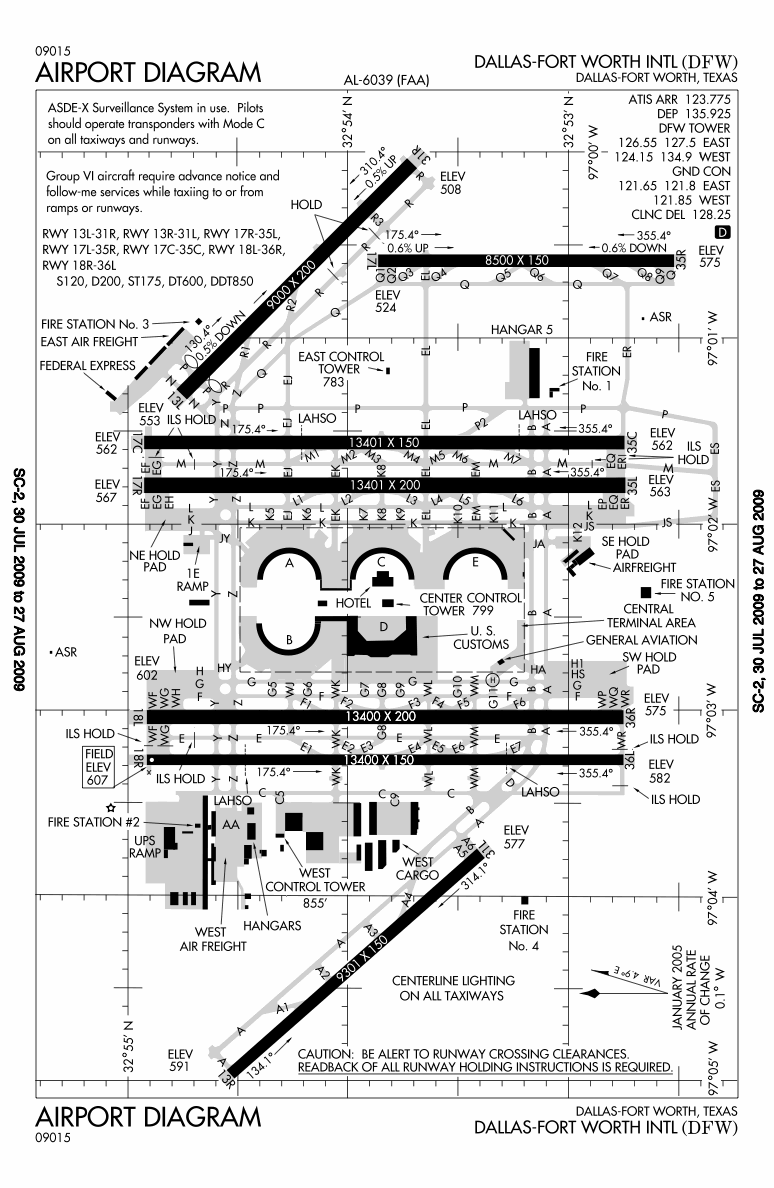
Dallas Fort Worth KDFW Airport Runway Taxiway DiagramWhen an airport has two or three parallel runways pointing in the same direction, each runway is identified by appending Left (L), Right (R) and if there is a third runway, Centre (C), to the number — for example Dallas-Fort Worth International airport, has Runways One Seven Left (17L), One Seven Centre (17C), and One Seven Right (17R).

In the reverse direction the Left and Right get reversed. Runway One Seven Left (17L) becomes Runway Three Five Right (35R).

More than three parallel runways ?
Certain ultra-large airports most notably Atlanta Hartsfield-Jackson (ATL), Los Angeles International (LAX) and Dallas-Fort Worth (DFW) have more than three parallel runways. In such cases the traditional left, centre, right designations cannot be used and the the runway identifiers are shifted by 10 degrees or 1 digit on the runway number). At Dallas-Fort Worth, there are five parallel runways, named 17L, 17C, 17R (on the east side of the airport), and 18L, and 18R (on the west side of the airport), even though all five runways are oriented at a heading of 175.4°.

How is runway orientation decided ?
For normal fixed-wing aircraft it is advantageous to perform take-offs and landings into the wind. This is to increase the speed of air over the wings i.e. flying speed, at a relatively lower ground speed which reduces the actual take-off or landing distance needed. Thus, runway orientations are decided on the historical winds and directions. If the winds are more variable in direction and the airport is large enough to financially justify the investment, airports can have several runways in different directions, so that a runway can be selected that is most nearly aligned with the wind. A typical example will be Chicago's O'Hare (ORD) airport which has seven runways aligned in 04-22 (L,R), 09-27 (L,R), 10-28, and 14-32 (L,R).

Runway lengths and widths
Runway dimensions vary greatly. However a typical runway is about 10,000 ft long. Bigger jets and fighter aircraft require longer runways. The width of the runway is dictated by the largest aircraft the airport would like to handle. Passenger jetliners are classified based on the width of their wings, and undercarriage width, as Code C (single aisle Airbus A320, Boeing 737 family), Code D (twin aisle Airbus A330, 340, Boeing 767, 777), Code E (Boeing 747) to Code F (Airbus A380 and Antonov An-124, An-225). Code F aircraft require runways to be at least 60m wide with another 7.5m of shoulders on each side i.e. 75m wide. There should also be no obstruction for a minimum 77.5m on either side of the runway.

The largest runway in the world is the huge 11,917 m (39,098 ft) long, 274 m (899 ft) wide lake bed runway 17-35 at Edwards Air Force Base in California - a landing site for the Space Shuttle amongst other aircraft.

Please do take the time to return tomorrow for Part 2 , where we cover more aspects of runways, including displaced thresholds, TORAs, LDAs, PCNs, ACNs, etc.

Airport Maps courtesy Wikipedia. Airport maps may not be used for actual navigation or flight operations purposes. Bengaluru International Airport runway 09 photo courtesy Devesh Agarwal. All rights reserved by the individual copyright owners.

Read more »

Encroachments cramp one of Asia's best runways at Delhi airport

Thanks to rampant encroachment, over one-third of one of Asia's longest and best runways, 11-29 at New Delhi's Indira Gandhi International Airport cannot be used.

At any airport, two measurements are crucial for pilots for every runway. Landing Distance Available (LDA) and Take Off Run Available i.e. how much of the runway length is actually usable for flight operations.

The newest runway at Delhi, 11-29, which cost a whopping 1,000 Cr ($ 200 million) is fitted with the fog busting Cat IIIB ILS landing system, which requires the airplanes to descend at a gentle 3 degrees angle.


However, rampant encroachment by new construction in the flight path is forcing the aircraft to fly higher and land further down the runway which effectively lowers the capacity of the runway.

As per AIP data available on Runway 29, which flies over the posh enclaves of Vasant Kunj and Mehrauli known to house the elite power brokers of the country, is the worst affected -- with over 36% of the runway not being usable i.e. from 4.4km to a mere 2.8km.

Rwy 11-29 – Category F (A380, AN 225)
Length – 4,430m. LDA 11 – 3,465m (78% of total length). LDA 29 – 2,820m (64% of total length)

In comparison the two older runways at Delhi (09-27 and 10-28) are almost fully usable since development and resultant encroachment has been restricted. It does not hurt that the elite politicians and bureaucrats do not live in the flight path of these two older runways or else Delhi would have never got in to the jet age.

Rwy 09-27 – Category E certified (B747, A340, MD11)
Length – 2,813m. LDA 27 – 2,661m. LDA 09 – 2,813m.

Rwy 10-28 – Category E certified (B747, A340, MD11)
Length – 3810m. LDA / TORA both ends 3810m

Delhi Airport Map Google Satellite view with approaches for runway 10-28 and 11-29 Vasant Kunj, Munirka, Dwarka, Vasant Vihar and Basant Lok
Clearly there is a lack of coordination between the aviation regulators like DGCA and the Delhi municipal authorities. Liberal interpretation of height restrictions by the building regulators only adds to the problems.

The new airports at Bangalore and Hyderabad do not suffer any encroachment, as of now, and offer 100% of their runway.

Mumbai's Chhatrapati Shivaji International Airport has an increased glide slope angle which requires steeper descents but despite this, they too suffer the consequences of encroachment resulting in a usability loss of about 15% of the runway length.

Civic authorities across India's cities have a poor record. Corruption, power broking, and sycophancy is rampant and real estate is the favourite money parking destination.

Runways are an expensive part of an airport's already expensive infrastructure. By not curbing encroachment, the cost of building and operating airports only increase; and that burden is first borne by passengers, but ultimately the Indian economy.

Recently, Lufthansa's Director South Asia, Axel Hilgers told me that Lufthansa would definitely consider Delhi as an Airbus A380 destination. Given this rampant encroachment the A380 will fit on to Delhi's runway, but only just. In the long term, one has to ask the question -- how long will it be before the Superjumbo gets crowded out?

Related article
Read more »

Official report of Presidential helicopter near miss at Mumbai in February

The Joint Investigation team constituted on February 19, 2009 to investigate the serious incident of a near miss between the Presidential Indian Air Force (IAF) helicopter and a Air India flight IC-866 on February 9, 2009 at Mumbai airport has submitted it report to the Ministry of Civil Aviation.

To translate the official findings (shown below), the Presidential formation called Pratap (comprising of three helicopters Pratap 1, Pratap 2 and Pratap 3) landed on the active runway without reference to or permission from the Air Traffic Controllers causing the Air India Airbus A321 VT-PPV to perform a high speed take-off reject.

As in this article by 737 instructor pilot Captain A. Ranganathan, the team has also criticised the lack of modern recording and safety equipment like DFDR (Digital Flight Data Recorder), CVR (Cockpit Voice Recorder), GPWS (Ground Proximity Warning System), TCAS (Traffic Collision Avoidance System) on many Indian Air Force equipment.

The lack of such equipment on many official government aircraft is widespread and was also considered responsible for another near miss between an Ilyushin IL-76MD and an Air India flight just two days after the Mumbai incident. It was later discovered that the IL-76 did not belong to the Indian Air Force but the Aviation Research Centre which is directly under the Prime Minister’s Office. There is no release of information on that incident.

With apologies in advance for the plethora of acronyms, the findings of the Committee were:
  • Pilot of IC-866 were appropriately licensed and aircraft was airworthy and maintained as per the Regulations of DGCA.
  • Pilots of the IAF helicopter were authorized as per Indian Air Force Regulations and Helicopter was maintained as per Regulations and was airworthy.
  • Air Traffic Control Officers (ATCOs) on duty had proper expertise and rating of their units.
  • Weather at Mumbai airport at the time of incident was not suitable for VFR [Visual Flight Rules] Operations but it is not considered as a contributory factor.
  • The coordination among various agencies was unsatisfactory and coordination meeting was not carried out as per the existing instructions.
  • There is no common SOP [Standard Operating Procedure] between the Indian Air Force [IAF] and Airports Authority of India [AAI] for VVIP [Very Very Important Persons] operations.
  • RT reporting procedure for formation is not satisfactorily documented. There was a difference of opinion between Airports Authority of India [AAI] and Indian Air Force [IAF] on procedure to be followed.
  • Transfer of control from approach to Tower should have been earlier.
  • Helicopter was given direct routing from INS Shikra (Kunjali) to Mumbai which was as per the regulations.
  • There was a difference of opinion and understanding about the VFR circuit to be followed especially for Helicopters between Indian Air Force and Airports Authority of India.
  • No closure of airport is required for VVIP flights at present as per the instructions of Home Ministry. VVIP flights are however to be given priority landing. There was a lack of common understanding on the concept of priority landing between AAI and IAF.
  • IC-866 rejected take off at high speed after sighting Helicopter on the side of Runway and turned to taxi track ‘W’ to avoid direct collision with the Helicopter which was in front of him at distance of 30-40 meters.
  • MI-8 and MI-17 Helicopters are not equipped with FDR and other safety equipments which are installed on civil version of these Helicopters.
  • Pratap formation (all three helicopters) landed without landing clearance from ATC.
  • According to the Committee the following factors can be attributed to the serious incident. These factors are listed according to sequence of events and not in terms of gravity:
    • Unsatisfactory coordination among various agencies, involved in the incident.
    • The late transfer of control of aircraft from approach to tower.
    • Landing of Pratap 2 directly at the place of landing on Runway 27 by making a very short circuit.
    • Landing of Pratap 2 without landing clearance from ATC even before Pratap formation reported the finals.
    • Landing Pratap 1 and Pratap 3 without landing clearance.
In typical bureaucratic form the recommendations of the Committee are wide-spread, with no central agency responsible, and no fixed time frame for implementation.
  • The instructions given in the Home Ministry’s Bluebook for coordination procedure should be strictly followed and all Members be invited for Coordination Meetings. The minutes of meeting should be documented and circulated to all concerned for compliance.
  • Last minute local changes, if required, can be carried out after consultations among Aerodrome Operator, ATC, IAF and Security Agencies which should be documented and should be duly informed to Protocol Department of State Government.
  • Airport Level coordination Meeting should be conducted to discuss the operational issues between AAI, IAF, DGCA [Directorate General of Civil Aviation] and Security agencies.
  • Ministry of Home Affairs should send a copy of Bluebook to AAI in case it is not done at present. Based on the same, AAI will make internal confidential circulars for use of their own officers.
  • AAI and Indian Air Force shall designate senior level officers for effective coordination for VVIP movements.
  • AAI shall issue a Standard Operating Procedure for handling of VVIP flights incorporating all instructions already issued, to make a comprehensive document. IAF and AAI will mutually share SOPs.
  • An Airport specific Standard Operating Procedure for VVIP movement in case of AAI managed airports be prepared by AAI and will be approved by AAI headquarters. In respect of IAF airfields, the Standard Operating Procedure shall be prepared and approved by IAF. For private airports, the Standard Operating Procedure for VVIP movement will be prepared by aerodrome Operator and shall be approved by DGCA. The standard operating procedure so prepared will be used by Indian Air Force, Airports Authority of India and Aerodrome operator jointly, covering all phases of operations. This task may be accomplished at the earliest.
  • The two organizations namely IAF and AAI should exchange, documents in connection with VVIP flights whenever required.
  • Priority landing and privileges attached with it may be defined and documented.
  • Issue regarding routing, special VFR, position reporting etc. should be discussed and resolved at Airport Level Committee 24-48 hours before commencement of VVIP flights.
  • The formation shall report position of lead Helicopter even during entering the aerodrome circuit or for asking permission for landing. However, vacation report of runway etc. will be that of last Helicopter. This procedure should be documented by Indian Air Force and Airports Authority of India in respective Standard Operating Procedures and in common Standard Operating Procedure, for correct understanding of procedure.
  • Helicopters and aircraft used for VVIP flights must have a DFDR, CVR with multi channels, GPWS, TCAS and other safety equipments used on similar civil aircraft/helicopters, once these equipments are installed, regular monitoring of these flights be carried out on the lines of FOQA (Flight operations quality assurance), by other airlines for safety oversight.
  • The Helicopter Committee set up by MOCA/DGCA [Ministry of Civil Aviation/Directorate General of Civil Aviation] should expedite identification of landing places for Helicopter at Delhi and Mumbai and to work out the traffic circuit for Helicopters.
  • Till the time the above recommendation is implemented, all Helicopters will report finals at the beginning of Runway and thereafter land at desired spot on the runway. This should be immediately documented and circulated by both Indian Air Force and Airports Authority of India.
  • Three minutes before and after ETA/ETD of VVIP operations, airspace should be closed. This closure should be informed by issuing a NOTAM.
  • Existing Regulations of aircraft landing only after obtaining permission from ATC units should be strictly enforced and circulated to all concerned including pilots of VVIP flights.
  • The Airport Committee comprising AAI, IAF and Aerodrome Operator should work out airport specific operational issues 24-48 hours before actual operations of VVIP flights.
  • The existing laid down procedure for missed approach will remain in-force. However, the consequences of missed approach on the security, health and other aspect of VVIP on board need separate examination. In this regard MOCA in consultation with MHA may examine this aspect to asses whether any other procedure can be evolved in such an eventuality of missed approach.
  • The committee re-emphasizes that Transfer of control from Approach to Tower and vice versa, should be followed strictly as per ICAO [International Civil Aviation Organisation] DOC 4444.
  • Visual surveillance before landing, especially for VFR flights should be re-emphasized on all aircrew members and ATCO.
The report has been accepted by the Ministry of Civil Aviation.
Read more »

Politics forces under-utilisation of Delhi airport's latest biggest and best runway

In a major step the Government of India has imposed the first night curfew at an Indian airport.

To allow the residents of the neighbouring and very upmarket Vasant Kunj area to have a peaceful night, the Directorate General of Civil Aviation (DGCA) has restricted with immediate effect any aircraft movement, at New Delhi's Indira Gandhi International Airport's (IGIA) newest runway 29-11 between 22:00 and 06:00 local (16:30Z-00:30Z).

The Working Group on Noise Abatement procedures constituted by Directorate General of Civil Aviation (DGCA) has recommended the following procedures.
  • The use of Runway 29 for landings has been restricted between 2200 hrs and 0600 hrs. This would benefit residents of localities in the approach path of runway as there would be no flight landing movement during the night. Runway 29 will be used only for take-offs and all landing will be done at Runway 28 during this restrictive period. However, in emergency cases landings may be allowed on Runway 29.
  • Pilots landing on Runway 29 between 2000 hrs and 2200 hrs have been advised to avoid using thrust reversers. However, pilots shall have authority to use thrust reverses in case of need depending on his judgment.
This move has significant ramifications both at New Delhi as well as across the country.

Most international flights to and from India either land or take-off between 22:00 and 02:00. These allows for a night departure and an early morning arrival in either Europe, ASEAN (Singapore, Malaysia, Thailand), Hong Kong, and Japan. Even flights between India and the middle-east have a 03:00-05:00 arrival and departure window for a similar early morning arrival. This action by the DGCA is going to open a pandora's box in Mumbai, Chennai, Kolkata and other legacy international airports in India.

In Delhi, 11-29 is a state of the art runway, one of the longest in Asia at 4430 meters, and at 75 meter width, specifically constructed to cater to Code F aircraft like the Airbus A380 and Antonov AN-225 which will operate international routes. Inaugurated in August 2008 it cost Rs. 10 billion ($200 million) and features the advanced Cat IIIB instrument landing system which is utilised, during the notorious Delhi fog, mostly by international airlines with their Cat IIIB certified pilots.

While the press release from airport operator DIAL says
These remedial steps were suggested to the Working Group by DIAL in consultation with various stakeholders such as Airlines, AAI / ATC, DGCA while keeping in mind the interest of the residents of neighbourhoods around the airport.
I cannot help but notice that the noise reduction is benefiting only the very upmarket and politically super connected residents of the Vasant Kunj area which is due east of the airport i.e. along runway 11 for take-off and runway 29 for landing. The more middle class and politically unconnected area of Dwarka which is west of the airport will have to bear the brunt. Similarly the middle class neighbourhoods of Munirka, RK Puram and Basant Lok will bear the brunt of noise of aircraft landing on runway 28.

Delhi Airport Map Google Satellite view with approaches for runway 10-28 and 11-29 Vasant Kunj, Munirka, Dwarka, Vasant Vihar and Basant Lok
This whole exercise reeks of the worst form of politics that plagues India.

It is the DGCA which has to approve plans for construction and upon construction certify a runway ready for use.
  • Where were they and their master the Minister of Civil Aviation during the approvals for construction of runway 11-29?
  • Why was construction and this massive expenditure permitted if it was not going to be used?
  • Why no noise reduction for the less "connected" residents of the other neighbourhoods? Are they any less citizens of Delhi? Or are we living in Goerge Orwell's 1984 with some citizens more equal than others?
This forced under-utilisation of the Rs. 1,000 Crore runway will translate to higher costs to us air travellers and industry who use air freight. Is the government willing to impose a "night curfew tax" on the Vasant Kunj residents to recover the Rs. 1,000 Crore spent on the runway? I am sure they can well afford it.

Citizens of Delhi are a meek lot. They took no action to challenge the very dubious introduction of the Airport Development Fee, I doubt very much the residents of the affected neighbourhoods will have the guts to challenge this move by the DGCA.

Jai Ho!!!!!!
Read more »

Air India flight in near miss incident at Mumbai airport with presidential helicopter - Update 4

Read the official investigation report here.

February 9, 2009, 10:00 IST (04:30 GMT)


TV channels are reporting that an Air India Airbus A321 performing flight IC866 was involved in a rejected take-off/near miss at Mumbai Chhatrapati Shivaji International Airport earlier this morning.

The flight had commenced its take-off run, when a helicopter which was given permission to land, strayed across the runway to land on the helipad. On sighting the helicopter the flight crew of IC866, rejected the take-off, applying emergency braking.

All passengers on board, estimated at 148 are safe. The tires of the aircraft require changing which is being done right now.

Initially it appears a fault of the air traffic control, which appears to have given permission to the helicopter to land, while at the same time, giving permission to the Air India flight to take-off.

Update 1 - 10:55 IST (05:25 GMT)

The shocker. The army helicopter was part a three helicopter convoy of Indian President Pratibha Patil.

The presidential convoy was conveying the President from the Governor's mansion, The Raj Bhavan, along with the top most leadership of the state of Maharashtra, to the airport. Due to security procedures, it is unknown whether the President was on board the chopper which strayed on to the runway.

Clearly a major mishap has been avoided, and there is bound to be a major investigation.

Information from aviation experts indicate the plane was at V-1 speed (around 100 knots). This is why the plane was able to perform a "rejected take-off", with the autobrake system kicking in. In another few seconds, the plane would have crossed the V-2 threshold, at which point the aircraft is travelling just to fast for it to stop on the runway. That would have surely resulted in a disaster of epic proportions.

The wheels of the Airbus A321 aircraft jammed after the rejected take-off, and the aircraft tyres burst due to the excess heat caused by the emergency braking. It has been taken back to the terminal. The passengers have been dis-embarked and are in the terminal. Arrangements for an alternate aircraft are being made.

Update 2 - 13:25 IST (07:55 GMT)

A Mumbai Airport official told news agencies.
"At around 09.00 hrs today, an Air Force chopper landed on the same runway from which Air India flight IC 866 (with 150 passengers on board) was taking off for Delhi, forcing the pilot of the plane to abort take off at the last minute,"
However there is some confusion. News reports claim
the Air India aircraft was taxiing to reach the main runway for the take off when the Air Traffic Control talked to the pilot regarding the helicopter. The pilot applied the brake to bring the aircraft to a halt
Whereas, all reports indicate a high speed take-off reject, resulting in the nose wheel tyre blowing out, indicating the pilot had commenced the take-off run and was not taxiing.

Credit is being given to the alertness of Captain SS Kohli, pilot of IC 866, who aborted the take off. Captain Kohli said,
"The the chopper and our aircraft got the clearence from the ATC at the same time. The ATC had lost contact with the chopper."

"The chopper just landed without taking a landing clearance. I cannot say much more,"
Meanwhile, an official spokesperson of the President told news agencies that "Everything is perfectly fine. The President was attending her normal functions."

As per Timesnow TV.
A fleet of three helicopters including the one carrying Patil, along with Maharashtra Governor SC Jamir and some other dignitaries, had taken off from Mumbai's Naval base 'INS Kunjali' and were on their way to the airport since the President was to fly to Gondia by her special Indian Air Force Plane (IAF) plane to attend a function.

A probe into the incident has been ordered by the Directorate General of Civil Aviation, the sources said. A senior DGCA official is coming from New Delhi to Mumbai to join the investigation, they said.

An IAF spokesman said, "the pilots of the chopper had followed the instructions from Bombay approach meliculously. The Presidential entourage was cleared to take off from INS Kunjali and land at Santa Cruz between two taxiways". An inquiry has been ordered by the IAF into the incident, he said.
While full information is not yet available, this appears to be the most likely situation based on past knowledge, historic traffic patterns, and information.


Update 3 - 17:00 IST (11:30 GMT)

The Indian Directorate General of Civil Aviation (DGCA) released a statement at 16:10IST ((10:40 GMT)
Mumbai Airport, the busiest airport in India was witnessing heavy air traffic and operations today morning. The ATC Mumbai was aware of the Presidential visit and were watching the approach movement of the Presidential convoy of helicopters. At that time an aircraft of Air India was on the active runway-27. The ATC, noticing movement of the aircraft on the runway, asked the aircraft to immediately apply brakes and exit through the taxiway. The aircraft exited immediately and the helicopters landed safely.

Director General Civil Aviation has ordered an investigation of the incident under rule 77 and appointed Jt. DGCA as the Inquiry Officer for the purpose of carrying out the investigation. Jt. DGCA has reached Mumabi and started investigation proceedings.
Considering this incident involved the President of India, the poor controller on duty is in for a very rough time.

Update 4 - 20:00 IST (14:30 GMT)

The Air India aircraft is registration VT-PPF. An Airbus A321-211 construction number 3340, it did it first test flight on December 5, 2007, and was delivered by Airbus on December 14, 2007. It is powered by the CFM56-5B3/3 engines.

Image copyright Flickr user Pallav105
Read more »

Erroneous glideslope at BIA

Monday June 16 2008

Monica Jha

BANGALORE: Pilots from two airlines (one domestic and one international) have reportedly complained about problems in landing using instrument landing system (ILS) at the Bengaluru International Airport.

The runway (27 orientation, which is being used presently) at the new airport has a 3.4 degree glideslope for an ILS approach while the international standard for the same is 3 degree. The 3 degree glideslope (the angle of descend with respect to horizontal plane) is an acceptable descent profile world over and, therefore, auto pilots are designed for this profile. At BIA, which has a glideslope of more than 3 degrees, auto pilots do not work and pilots need to resort to manual landing, that can cause hard landing at times.

A three-degree glideslope gives a descent of approximately 318 feet per nautical mile (NM) while for a 3.4-degree glideslope, the descent would be about 370 feet per mile which means an aircraft would descend at a higher speed than recommended.

When an aircraft on ILS follows a 3 degree glideslope, passengers do not feel any discomfort but a 3.4 degree glideslope may result in a steep landing causing discomfort to passengers. The operator of BIA, Bangalore International Airport Limited (BIAL), apparently made a mistake in assessing the elevation of glide path location.

On a continuous descent, an aircraft must maintain a height of 50 feet at the threshold of a runway. Due to errors in calculating the elevation this height at BIA was found to be less than 50 feet. So, BIA had to increase the glideslope to maintain a height of 50 feet at the threshold of runway. However, the glideslope for runway when used in 09 orientation is 3 degrees.

To ratify the problem, BIA would need to relocate its glide path antenna further up, an expert from the aviation industry told this website's newspaper. "But, changing the position of glide path antenna at a live airport and a live runway is not possible as landing without ILS for a few days that would be necessitated for calibrations, would be extremely difficult. BIAL can do it when they change from 27 to 09 runway in November," he added.

Source : The New Indian Express
Read more »