Showing posts with label Crash. Show all posts

Video of Asiana crash shows plane cart-wheeling after impact

by Devesh Agarwal

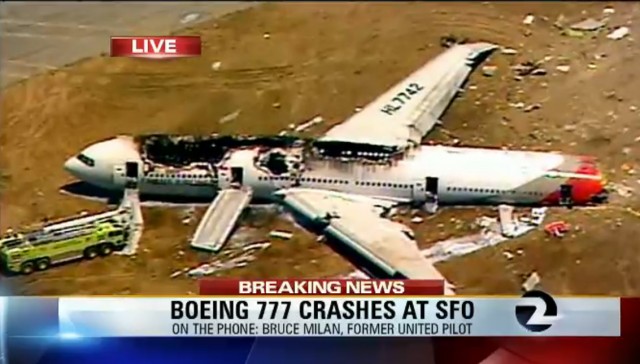
A dramatic video recently released by the United States National Transportation Safety Board (NTSB), of the crash of Asiana Airlines Boeing 777 HL7742 performing flight OZ-214 at San Francisco airport shows the plane cart-wheeling after it impacted the sea-wall of the runway.


Update December 13, 2013

Another video of the incident.
Read more »

ATR 72-600 suffers first fatal crash

by Devesh Agarwal

Lao Airline ATR72-600. Photo courtesy ATR.
Airbus joint-venture subsidiary ATR (Aerei da Trasporto Regionale or Avions de transport régional) suffered the first fatal crash of the ATR 72-600 aircraft it manufactures.

The airframer confirmed that an ATR 72-600 operated by Lao Airlines as flight QV301 from capital Vientiane to Pakse crashed at around 16:00 (09:00 UTC) near Pakse (Laos).

All 44 passengers and 5 crew members on board perished.

The aircraft, registered RDPL-34233, was MSN (Manufacturing Serial Number) 1071, was delivered from the production line in March 2013.

At this time, the circumstances of the accident are still to be determined. Official sources of Lao Airlines declared that “the aircraft ran into extreme bad weather conditions and was reportedly crashed into the Mekong river. There were no news of survivors at this time”.

The Laos' Authorities will lead the investigation. In line with the ICAO (International Civil Aviation Organization) Annex 13 convention, ATR will provide full assistance and the French Bureau d'Enquêtes et Analyses (BEA), safety investigation authority representing the country of the aircraft manufacturer will join the investigation.

The ATR 72-600 is a 68-to-74-seat twin turboprop engine aircraft which is the most recent variant of the ATR72-500 being operated around the world, including India;s Jet Airways group.

For more information on the accident, visit avherald.
Read more »

Videos: All the NTSB media briefings on the crash of UPS Airbus A300-600F at Birmingham, Alabama, USA

The United States National Transportation Safety Board which is investigating the fatal crash of a UPS flight 5X-1354, an Airbus A300-600 aircraft registration N155UP at Birmingham, Alabama, USA, on August 14, 2013, held four briefings for the media. Below are the videos of the briefings all together for your continuous viewing.
UPS Airbus A300-600F freighter registration N162UP approaches Boston Logan Airport in rainy weather


For an in-depth report of the crash, we recommend Simon Hradecky's Aviation Herald.
Read more »

NTSB says no mechanical failures found in Southwest Airline's New York crash

The United States National Transportation Safety Board has developed the following factual information on the July 22, 2013 accident in which a Southwest Airlines flight 345, a B-737-700, landed hard at New York’s LaGuardia Airport (LGA), and the nose-wheel of the aircraft collapsed.

The captain has been with Southwest for almost 13 years and has been a captain for six of those years. The captain has over 12,000 total flight hours, over 7,000 of which are as pilot-in-command. In 737s, the captain has over 7,900 hours, with more than 2,600 as the pilot-in-command.

The first officer has been with Southwest for about 18 months. The pilot has about 5,200 total flight hours, with 4,000 of those as pilot-in-command. In 737s, the first officer has about 1,100 hours, none of which are as the pilot-in-command.

This was the first trip the flight crew had flown together and it was the second leg of the trip. The first officer had previous operational experience at LGA, including six flights in 2013. The captain reported having flown into LGA twice, including the accident flight, serving as the pilot monitoring for both flights.

The en route phase of the flight, which originated in Nashville, was characterized by the flight crew as routine. On approach into LGA, the first officer was the pilot flying and the captain was the pilot monitoring. SWA 345 was cleared for the ILS Runway 04 approach.

The weather in the New York area caused the accident flight to enter a holding pattern for about 15 minutes. The crew reported that they saw the airport from about 5-10 miles out and that the airplane was on speed, course and glideslope down to about 200-400 feet.

The crew reported that below 1,000 feet, the tailwind was about 11 knots. They also reported that the wind on the runway was a headwind of about 11 knots.

SWA 345 proceeded on the approach when at a point below 400 feet, there was an exchange of control of the airplane and the captain became the flying pilot and made the landing.

The jetliner touched down on the runway nose first followed by the collapse of the nose gear; the airplane was substantially damaged.

At this point in the investigation, no mechanical anomalies or malfunctions have been found. A preliminary examination of the nose gear indicated that it failed due to stress overload.

Investigators have collected five videos showing various aspects of the crash landing. The team will be analyzing these recordings in the coming months.

Parties to the investigation are the Federal Aviation Administration, Boeing Commercial Airplanes, Southwest Airlines, and the Southwest Airlines Pilots Association.
Read more »

Infographic: The Boeing 777 is Safe

by Bangalore Aviation Staff

After the crash of Asiana Flight 214 at San Francisco International airport this past Saturday, a media firestorm erupted around the Boeing 777 aircraft involved in the crash. Fears grew among much of the traveling public and non-aviation media that the 777 was in fact an unsafe aircraft to fly. This is simply not the case. Bangalore Aviation has prepared the following infographic to help allay some of the safety concerns that have arisen around the aircraft.
Read more »

Infographic: Boeing 777 engine manufacturers' shares

by Devesh Agarwal

The Asiana Boeing 777-200ER which crashed at San Francisco International airport was powered by Pratt and Whitney PW4090 series engines.

Three engine manufacturers have offered power plants for the Boeing 777. Pratt and Whitney offered the PW4000 series. Rolls Royce offered its Trent 800 and General Electric offered its GE90 series.

The infographic below shows the share of market each manufacturer has on the 1,113 Boeing 777s delivered till date.

Since the last few years, GE90-115B and GE90-110B are the exclusive engine series for the currently manufactured 777 variants - the 777-300ER, 777-200LR, and the 777F freighter. So eventually it will have a 100% share of the market. Even on the upcoming 777X project, GE is expected to remain the sole source supplier with a new upgraded engine.

Boeing 777 - share of market for engine manufacturers

Read more »

BREAKING: Asiana Airlines 777 crash lands at San Francisco International Airport

[Last updated on 04:30 UTC]
by Vinay Bhaskara and Devesh Agarwal

Asiana 777-200ER Image Credit: Wikimedia
Earlier today, Asiana Airlines Flight 214 with service from Seoul Incheon Airport to San Francisco crash landed on arrival at San Francisco.

The flight was carrying 291 passengers and 16 crew members. Latest reports put the death toll at two.

Initial reports are that the aircraft had just touched down around 11:20 am local time, when the empennage was sheared off rear of the aft pressure bulkhead of the 777, and the tail, gear, and engine of the plane separated. The plane turned around nearly 180 degrees and came to a stop to the right of the runway facing eastwards. Photos show debris before runway 28L; implying that the aircraft hit the ground before making it over the runway. Passengers were evacuated before the aircraft caught fire. The National Transportation Safety Board [NTSB] has been dispatched to the scene to investigate.

Image of the crash from news outlet KTVU
The aircraft is a Boeing 777-200ER with registration HL7742. The aircraft, with line number MSN-29171 is powered by 2 Pratt&Whitney 4090 engines and is configured with either 296 or 300 seats on board and was delivered on March 7th, 2006. Asiana Airlines operates 9 Boeing 777-200ER aircraft in 6 different configurations.

291 passengers (19 business, 272 economy) and 16 crew members were on board, reports are that all  of the 307 passengers are accounted for. According to the San Francisco fire department, 2 people have been reported dead, with 230 injuries of some sort. However, in situations such as this crash, the numbers in terms of passengers According to Asiana Airlines, the passengers on board “were comprised of 77 Korean citizens, 141 Chinese citizens, 61 US citizens, 1 Japanese citizen.”

Asiana's official press release related to the incident can be found here. San Francisco International Airport has been updating the media constantly with intermittent press conferences as it can release information.

The incident is the first fatal incident involving passengers and a Boeing 777. The last (and only other) major crash of a Boeing 777 aircraft occurred on January 17, 2008, when British Airways Flight 38 crashed on arrival at London Heathrow after flying in from Beijing. However, on September 5th, 2001, a ground fire broke out on a British Airways 777-236 at Denver, and one re-fueling operative was killed.

Asiana flight 214 is the first airline crash on US soil since Colgan Airlines flight 3407 on February 12, 2009, which killed 49 passengers on a Bombardier Dash 8 aircraft. The last mainline crash in the United States occurred on November 12, 2001, when American Airlines Flight 587, an Airbus A300 crashed at New York's JFK International Airport, killing 265 (260 passengers, 5 on the ground)

The following picture from passenger David Eun shows passengers disembarking the aircraft, and the fuselage appears to be intact, though burning.

The following videos were taken by a passenger at San Francisco Airport


Videos credit to @360kid

The ATC feed can be heard here on the LiveATC site archive. Asiana 214 is given a landing clearance to runway 28L around 21m20s into the recording. The crash occurs around 22m02s. Shouting can be heard in the background of the tower controller's transmission at the time of the crash.

Image via Ben Sandilands showing emergency response
The airline put out a statement around 2130 UTC
The following information has been confirmed.

Asiana Airlines flight OZ214 (Aircraft Registration HL7742) departed Incheon International Airport on July 6, 2013 at 16:35 (Korea time) bound for San Francisco. Only July 6, 2013 at 11:28 (Local time) an accident occurred as OZ214 was making a landing on San Francisco International Airport's runway 28.

There were a total of 291 passengers (19 business class, 272 travel class) and 16 cabin crew aboard. The majority of the passengers were comprised of 77 Korean citizens, 141 Chinese citizens, 61 US citizens, 1 Japanese citizen, etc. for a total of 291 people.

Asiana Airlines is currently investigating the specific cause of the incident as well as any injuries that may have been sustained to passengers as a result. Asiana Airlines will continue to cooperate fully with the investigation of all associated government agencies and to facilitate this cooperation has established an emergency response center at its headquarters.

At this point no additional information has been confirmed. New developments will be announced as more information becomes available.

*For further information regarding OZ213/214, please contact 02-2669-4015 (for overseas calls : 82-2-2669-4015).
Read more »

Asiana Airlines Boeing 777-200ER crashes at San Francisco airport

by Devesh Agarwal

Asiana Boeing 777-200ER. Image courtesy Wikimedia
An Asiana Airlines Boeing 777-200ER bearing registration HL7742 has crash landed at San Francisco International airport (SFO).

Flight OZ 214 from Incheon airport Seoul, South Korea to San Francisco, California, USA, appears to have touched down short of runway 28L. Major portions of the aircraft broke apart, fuselage, tail, landing gear, and engines at the landing. The aircraft fuselage burst into flames and is burned out.

Emergency services responded and there appears to be no fatalities at present. Flight operations at the airport are disrupted due to the shutdown of runway 28L.

A video from a ground observer took this video.

Read more »

IAF Sukhoi Su-30MKI crashes at Pokhran range. Fourth crash of frontline fighter. Crew safe.

IAF Su-30MKI in a flypast at AeroIndia 2011
A Su-30MKI air superiority fighter of the Indian Air Force (IAF) crashed at Pokharan range, Rajasthan, earlier today around 1920 IST (1350Z). Both the crew ejected safely and there is no damage reported to any civilian property of any casualties on the ground. A spokesperson for the IAF could not divulge details of the fighter, the squadron it belonged to, or details of the crew members.

This is the fourth crash of the front-line air superiority fighter of the IAF. The first crash of a Su-30MKI occurred in 2009, again over the desert of Rajasthan in 2009. Later that year another SU-30MKI crashed, again in Rajasthan. The third crash occurred in 2011 at Pune.

Sources inform Bangalore Aviation, the crash occurred during the full dress rehearsal for Iron Fist, a massive day and night fire power exercise of Indian Air Force at the Pokhran range, to demonstrate its integrated combat capabilities.

Eyewitnesses say the fighter, which was "fairly high, may be around 7,000ft", released flares, a standard procedure during night exercises, followed by the firing of a missile from the aircraft. Soon after the launch, the Su-30MKI caught fire mid-air, and the crew ejected. The aircraft broke in to two major pieces before crashing to the earth in two balls of fire.

Apart from marking the debut of the indigenously developed Light Combat Aircraft (LCA) Tejas, the 'Iron Fist' exercise will feature over 100 aircraft from across the IAF including the Sukhoi Su-30MKI, Mirage 2000, Jaguar, MiG 27, MiG 21, MiG 29, various helicopters, UAVs, and AWACS and early warning platforms.

The exercise is to be witnessed on February 22, by Indian President Pranab Mukherjee, Defence Minister A.K. Antony, Chief of Air Staff, Air Chief Marshal N.A.C. Browne, senior officials from across the government and armed forces, military attaches of various countries and the national media. At this time, it is not known whether the exercise will proceed, but we speculate that it will.

As per Wikipedia the Indian Air Force bases with the Su-30MKI are:
  • Bareilly AFS: 15 Wing’s 8 Squadron (Sqn) Eight Pursoots and 24 Hunting Hawks
  • Bhatinda AFS: 34 Wing – 17 Sqn. Golden Arrows
  • Chabua AFS: 14 Wing – 102 Sqn. Trisonics
  • Halwara AFS: 34 Wing – 220 Sqn. Desert Tigers
  • Jodhpur AFS: 32 Wing – 31 Sqn. Lions
  • Pune (Lohegaon) AFS: 2 Wing – 20 Sqn. Lightning and 30 Sqn. Rhinos
  • Tezpur AFS: 11 Wing – 2 Sqn. Winged Arrows
Read more »

Sita Air Dornier 228 crashes on take-off in Nepal. 19 dead.

Media reports say a twin-engined turbo-prop, a Dornier Do 228, operated by Sita Air, crashed minutes after take-off from Nepal's capital, Kathmandu, around 06:19 local (06:02IST 00:32Z). All 19 people on board, 13 foreign tourist, three Nepali passengers, and three crew, are feared dead.

The plane was on its way to Lukla, a popular hub for trekking in the Everest region.

Police spokesman Binod Singh told AFP news agency
"The pilots seem to have tried to land it safely on the banks of the river but unfortunately the plane caught fire,"
See photo of the crash at Nepali Blogger site.

Nepal does not have a large road network and the country's domestic airlines which most operate small turbo-props, provide critical linkage to numerous "airports" within the country, most of these airports in remote areas, are just basic airstrips.

This is the sixth fatal crash in Nepal, in less than two years.
Read more »

Opinion: DGCA fiasco highlights need to resolve conflicts of interests in civil aviation ministry

The abrupt removal of India's chief civil aviation regulator, the Director General of Civil Aviation, Mr. E.K. Bharat Bhushan, earlier this month, once again brings forth the cross-workings within the ministry of civil aviation, caused by contradictory roles, many of which are driven by political agendas, and the urgent need to re-structure this mammoth ministry to correct the malaise.

Indian civil aviation minister Ajit Singh. PIB Photo.
Mr. Bharat Bhushan, an Indian Administrative Service (IAS) officer of the 1979 batch from Kerala, who took over the role of DGCA from Mr. Syed Nasim Ahmad Zaidi in December 2010. He enjoys the highest levels of respect for his integrity, ethics and generally apolitical decision making.

The reasons behind his sudden dismissal have fuelled speculation on the reasons. Within aviation industry circles, there is a strong sense of certainty that Bharat Bhushan was done in, partially due to a political turf war between the ministry and the Prime Minister's Office (PMO), and in large part due to his strong ethical stand on a variety of issues plaguing the industry.

During his tenure Bharat Bhushan brought in stringent measures to prevent airlines and the DGCA itself, from compromising on safety. He prosecuted a variety of flying schools and government officials in the fake pilots scam, and took on two holy cows, Air India and Kingfisher Airlines. He has repeated told both the financially plagued carriers to shape up and pay employees overdue salaries saying that safety could be adversely affected by a demotivated staff.

Post his departure, news reports have appeared showing his purported note to his successor Prashant Sukul that he had prepared for taking action against cash-strapped Kingfisher Airlines on safety grounds. The cat has been set amongst the pigeons with the ministry saying it cannot find the note and will ask Bhushan for the note.

This wrangling is nothing new. The civil aviation is a behemoth with many departments and entities under it, most of which, have contradictory roles and by the very nature of their function, work at cross purposes to each other. Even in Utopian conditions it is impossible make all these roles co-exist within one ministry and still perform true to their charter, and at optimal levels, and this is the Government of India, one not highly rated on governance.

The ministry itself is a policy maker, but also an airport operator through Airports Authority of India (AAI), and airline operator through Air India (AI). Within AAI, there are airport operations and a monopoly air traffic control, navigation, and communications system which is used for further cross-subsidy.

Global competitiveness have forced aviation operations to operate on extremely high levels of efficiency, not the forte of any government. This naturally demands some concessions for government run operations, and the Indian airline industry is already sick thanks to skewed policies designed to protect AAI and AI.

In its natural role, the ministry is a promoter of air travel which requires easing of regulation, but via the DGCA it is also the regulator and in most cases, also the investigator. You will observe that I have deliberately left out the role of enforcer or prosecutor. The most basic rules of administration demand a separation of policy formulation, operation, regulation, audit, investigation, and enforcement. In all publicly listed companies there is always a separate audit committee within the Board of Directors.

Yet ministry officials are routinely shifted across roles. Let us take the current acting DGCA Mr. Sukul. He is a Joint Secretary in the ministry. In addition to the regulator, auditor, enforcer role at DGCA, Mr. Sukul is also a member of the board of Air India, an airline, the DGCA has to regulate, audit, and enforce the rules on. Similarly, the joint DGCA Mr. Anil Srivastava, is also the Chairman and Managing Director of state owned helicopter operator, Pawan Hans Helicopters. These are conflicts of interest at the most basic level. We have to be delusional not to expect compromises being forced on these and other officials within the ministry.

On these obvious conflicts of interest, the civil aviation ministry seems to be a law unto itself. It has ignored calls from no less a body, than the Appointments Committee of the Cabinet, which is the government's apex body for high level bureaucratic appointments, and headed by the Prime Minister, which had asked the ministry to relieve Anil Srivastava from his leadership of Pawan Hans to resolve the blatant conflict of interest.

A lot of this cross working was exposed in the report on the crash of Air India Express Boeing 737-800 VT-AXV at Mangalore Bajpe airport in 2010.

Despite significant short-comings none of the ministry controlled entities were faulted. AAI, the airport operator, which did not construct frangible buildings at the runway, as required at every major airport in India, nor the DCGA, which conducts the inspections, and ensures these facilities before approval, were both let off with the gentlest of slaps on the wrist, for not performing their duties.

The question before us, is what caused these officers to under-perform? Which of these four C's is most plausible? (in)competence? callousness? corruption? conflict (of interest)?

It is imperative that Indian aviation be protected. Various entities within the ministry need to be made truly independent and taken out of its control.

The recommendation, in the crash report, for an independent investigative board, remains a distant dream. The board may come one day, but we can be certain, that a truly independent board, not reporting within, controlled by, and therefore subservient to the civil aviation ministry, and its political shenanigans, will never be implemented.
Read more »

BEA's final report on the crash of Air France AF-447

Image courtesy BEA
France's Bureau of Investigations and Analysis’ (BEA) submitted its final report on the crash of Air France flight AF-447 flying from Rio de Janeiro to Paris, killing all 228 passengers and crew on-board.

The final report essentially re-states what has already been released till date.

The crash commenced with ice crystals blocking the pitot tubes, sending false information to the flight computers and causing the autopilot to shut down while the plane was at cruising altitude, and a reconfiguration of flight controls to alternate law.

A confluence of factors, including a barrage of alarms coupled with inadequate training of the flight crew, and false sensor readings, completely surprised the crew. As per the report "The crew likely never understood that it was faced with a ‘simple’ loss of all three sources of airspeed information.”

In a series of errors, the pilots relying on erroneous readings never recognised they were in a stall and kept nosing the Airbus A330 aircraft upward, rather than downward as was necessary. Chief investigator Alain Bouillard said "The crew was in a state of near-total loss of control". Ironically the flight captain, who was on a rest break, did not return to the cockpit until it was too late.

The BEA has passed the blame all around and its recommendations call for more training of pilots, an improved layout of cockpit instruments and warning systems to help crew better recognise and manage unusual flight situations, and thorough review of the flight director software..

Investigators recommended that the European Aviation Safety Agency (EASA) require the aircraft manufacturer Airbus S.A.S. to review the flight director’s design and to possibly modify the software so that it either disengages permanently in the event of a stall or displays “appropriate orders” when a stall warning is set off.

Read more details at the BEA's page for AF-447.
Read the final report here.
Read the final report summary here.

Read more »

127 feared dead as Bhoja Airlines Boeing 737 crashes near Islamabad Pakistan

All 127 people, 118 passengers and nine crew, on board a Bhoja Air flight are feared dead in a crash near the national capital of Islamabad in Pakistan. Bhoja flight B4-213 had departed from the commercial capital of Pakistan, Karachi.

There was severe weather in the area of the crash. The aircraft last made contact around 18:20 local (13:20Z) and reportedly crashed at 18:40 local in a residential area around Hussain Abad village near Rawalpindi, 5nm from Islamabad airport

Rescue teams have been dispatched to the scene.

Bhoja Air has commenced operations just a few days ago. The aircraft, The aircraft was Boeing 737-236 advanced, registration AP-BKD, line number 635, was built in 1980, had its first flight on February 13, 1980. The aircraft was delivered to British Airways as G-BGDD on February 23, 1980. It was delivered to Bhoja Air, February 24, 2012.

This is the second crash in less than two years. In July 2010, an Airbus A321 operated by Airblue crashed into hills overlooking Islamabad, killing 152 people on board.
Read more »

Wall of shame: NDTV steals my picture of a crashed Kingfisher Airlines aircraft

Theft of intellectual property.NDTV has joined the my "wall of shame" by stealing my picture of a Kingfisher Airlines aircraft VT-KAC and displaying it on a story sourced from Agence France Presse (AFP) without taking my permission or even acknowledging my intellectual property rights.

The NDTV web page in question is here. A screen shot is posted just in case NDTV decides to change the page.
NDTV steals pirate my Kingfisher Airlines picture
NDTV using my picture of VT-KAC without my permission or giving me credit. Screen shot taken on Dec 20, 2011.
The original picture is here.

On its Facebook page, NDTV claims "NDTV - India's most credible source of news".

Dear viewers and readers of NDTV please note -- in a ringing endorsement of its high and ethical standards, its in-depth and painstaking research and broad knowledge of the aviation industry  knowledge, the picture used to highlight a current story, of Kingfisher Airlines, is of VT-KAC the plane that crashed at Mumbai in November 2009 and was subsequently written off. The picture being used in 2011 is of an aircraft that was scrapped in 2009. See the DGCA investigation report and photograph of the crash here.

This is India's most credible source? Somehow this claim rings hollow does it not?

In 2009, this same NDTV and its editor Ms. Barkha Dutt who used all their legal and financial clout to sue an Indian blogger name Chyetanya Kunte for defamation on a post he wrote. They hounded him in to submission. (Full details in this story here. Or just google it).

Wow Mr. Kunte actually defamed the editor and an organisation which blatantly indulges in the theft of intellectual property. Oh, it was unintentional was it? The bold copyright notice in my picture establishing my IPR, just happened to be "unintentionally" erased in the process of cropping. How does one defame one who has no shame?

Burkha Dutt who has also been involved in the Radia tapes scandal is the same person who used her bully pulpit at NDTV to question the ethics of bloggers and whether we should be regulated.


To the readers of this article, I ask, and invite comments on what should be the regulation, law, and punishment for this self-appointed bombastic queen of hypocritical actions.

Update
As if this was not enough, I found out some more plagarism by NDTVProfit. This video at timestamp 1:57 uses this photo of mine without permission. It also appears to use photos from others as well, with or without their permission is not known.
Read more »

Indian Air Force Sukhoi Su-30MKI frontline fighter aircraft crashes near Pune

IANS is reporting that a Sukhoi Su-30MKI the frontline air superiority fighter of the Indian Air Force (IAF) crashed near Pune around 13:15 local (07:45Z) today. Both the pilots bailed out to safety, an officer said.

The fighter belongs to a squadron of the Su-30MKI which is based at the Lohegaon Air Force Base to protect amongst others, the economic capital of India, Mumbai. The part of the base also serves as the civil airport serving the city of Pune.

Base commander, Air Commodore V. R. Chaudhry told reporters
‘Today at around 1.15 p.m. a Sukhoi fighter jet, which took off from the Lohegaon Air Force Base for a sortie, presumably developed a technical snag and crashed,’

‘Two officers – Wing Commander Suhail, who was the pilot and Flight Lieutenant Nautiyal, who was the weapons system operator – ejected out of the aircraft after manoeuvring it over barren land,’

‘While the preliminary circumstantial reason could be a technical snag, we are investigating the matter. Both the officers were highly competent. They showed great presence of mind and courage by steering the aircraft towards a safe location and thus avoiding any civilian damage,’

Both the officers have been taken to the Command Hospital in Pune.

The aircraft crashed at Wade-Bholai village, 20 kms from here. The search for the aircraft’s black box is on.

This is the third crash of a Sukhoi Su-30 since its induction in 1997.
Read more »

Buddha Air Beechcraft 1900D crashes. All 19 aboard feared dead.

A Beechcraft 1900D belonging to Kathmandu, Nepal based Buddha Air crashed while attempting to land, in dense fog, near the national capital Kathmandu earlier this morning.

The plane with 16 passengers and three crew was on a flight from the capital to view Mount Everest and crashed on its return around Bisankunarayan village, just a few kilometres south of Kathmandu. All aboard are feared dead. Ten Indians are amongst the 16 passengers.

Police officials near the crash site said rescuers had reached the crash site, but would not comment on causalities. The aircraft last made contact with the Kathmandu air traffic control at 07:31 local (07:15 IST, 01:45Z).

Update 1 - (10:30IST, 05:00Z)
The aircraft registration is 9N-AEK. Photos of the aircraft including the Mount Everest trip can be seen here.
Read more »

HAL Intermediate Jet Trainer (IJT) HJT-36 Sitara crashes near Bangalore

A prototype of the Hindustan Aeronautics Ltd. Intermediate Jet Trainer HJT-36 Sitara serial number S-3466 crashed near Krishnagiri about 80km (50mi) south-east of Bangalore around 15:10 local (09:40 UTC).

HAL Intermediate Jet Trainer HJT-36 Sitara S-3466 at Aero India 2011HAL HJT-36 Intermediate Jet Trainer S-3466 at Aero India 2011. Photo by Vedant Agarwal.

Both pilots Wg Cdr. Patra and Mathur (rank not sure) ejected safely, though one of them has suffered some injuries.

HAL has constituted a Court of Inquiry to examine the crash.

S-3466 was the same aircraft that crashed at Aero India in February 2007. The aircraft was repaired and put back in to service about a year later.

Thanks to some friends (who prefer to remain anonymous) for the heads-up. Hat tip SS.
Read more »

Feature: Major plane accidents in the 100 years of Indian civil aviation - Part 2

Continuing our series of major scheduled civil aviation accidents with fatalities in the 100 years of Indian civil aviation. Yesterday we covered till the year 1952, today we continue forward till 1957.

The early 1950's were a torrid time for Indian aviation from a safety perspective, and 1953 continued the high rates of accidents in India. The war surplus Douglas DC3/C-47 Dakota continued to remain the main stay of the civil aviation fleet as well as the crashes. The newly created Indian Airlines Corporation which was formed in 1953, by nationalising seven private airlines, inherited a fleet of 99 aircraft including 74 Douglas DC-3 Dakotas, 12 Vickers Vikings, 3 Douglas DC-4s and various smaller types from the seven airlines that made it up. However, 1953 also saw the first crash of a jetliner in India.

On March 14, 1953, a Convair CV-240 AP-AEG of Orient Airways with 11 passengers and 5 crew, on a flight from New Delhi Safdarjang to Dhaka, East Pakistan, crashed in to mountain after the pilot descended in poor visibility to determine his location visually. All aboard died.

On April 14, 1953, a cargo Douglas DC3/C-47 Dakota VT-AUG of Airways India with 3 crew, disintegrated mid-air in the Khasi hills of Meghalaya on a flight from Guwahati to Calcutta. Structural failure was suspected. All aboard died.

Just a fortnight later, on May 2, 1953, about 16:30 (4:30pm) India witnessed the first crash of a jetliner, when a De Havilland DH-106 Comet-1 G-ALVY of British Overseas Airways Corporation (which subsequently became British Airways) with 37 passengers and 6 crew, burst in to flames soon after take-off from Calcutta Dum Dum on a flight to New Delhi. Structural failure was suspected. All aboard died.

In immediate succession, on May 9, 1953, a Douglas DC3/C-47 Dakota VT-AUD of Air India with 13 passengers and 5 crew crashed just five minutes after take-off from Delhi Safdarjang airport bound for Ahmedabad. The cause is suspected to have been caused by an in-experienced pilot who over-banked the aircraft in to a turn and flew it in to the ground. All aboard died.

On December 12, 1953, a Douglas DC3/C-47 Dakota VT-CHF of the newly created Indian Airlines with 10 passengers and 4 crew crashed soon after take-off from Nagpur, in very similar circumstances to the Delhi crash. A false engine fire indication panicked the flight crew who over-banked the aircraft at too low a speed and too low an altitude in their haste to return to the airport and flew the aircraft into the ground. Only one person, a crew member, survived the crash.

1954, began on an ironical note. On February 25, 1954, in an attempt to understand the reasons behind the Nagpur crash, Indian Airlines attempted a test flight to re-create the incident using one of its Douglas DC3/C-47 Dakota VT-ATU near Delhi with 3 crew on-board. During the test flight, this aircraft too crashed, killing all aboard.

On April 30, 1954, a Douglas DC3/C-47 Dakota VT-DEM of Darbhanga Aviation with 8 passengers and 3 crew crashed soon after take-off from Calcutta, when its left engine caught fire and the plane stalled. Two passengers and all three crew perished.

On January 21, 1955, a cargo Douglas DC3/C-47 Dakota VT-COZ of Indian Airlines with 3 crew had a CFIT (controlled flight into terrain) crash while approaching Guwahati airport during foggy conditions. No one survived.

On February 2, 1955, a Douglas DC3/C-47 Dakota VT-CVB of Indian Airlines with 6 passengers and 4 crew crashed soon after take-off from Nagpur at around 04:00 (4am). Again the flight crew was blamed for over-banking the aircraft causing it to fly into the ground. All aboard were killed.

On April 11, 1955, Air India had its first experience with terrorism. Its Lockheed L-749A Constellation registration VT-DEP and named Kashmir Princess 11 passengers and 8 crew was the victim of a time-bomb near the Natuna islands in the south China sea, on a flight from Hong Kong Kai Tak airport to Jakarta, Indonesia. The target of the assassination was the Chinese Premier, Zhou Enlai, who changed his travel plans at the last moment and was not on-board. Only 3 crew members survived the crash. All passengers mainly journalists, to the Asia-Afro Bandung Conference perished. The captain of the plane, D.K. Jatar who perished in the crash, later along with Co-Captain M.C Dixit and flight engineer Anant Karnik, became the first civilians to be awarded the Ashoka Chakra for "most conspicuous bravery, daring and self-sacrifice".

On March 21, 1956, a Douglas DC3/C-47 Dakota VT-CGN of Indian Airlines with 18 passengers and 3 crew crashed while landing at Tezpur, in the North East. Two passengers were killed and the aircraft hull was written-off.

On March 31, 1956, a cargo Douglas DC3/C-47 Dakota VT-DCM of National Air Operators with 3 crew crashed about 30 miles from Bagdogra. An overloaded aircraft flying in to turbulent weather was the suspect cause. All aboard were killed.

On May 15, 1956, a Douglas DC3/C-47 Dakota VT-DBA of Indian Airlines with 30 passengers and 3 crew over-ran the runway at Kathmandu, Nepal. 14 passengers and one person on the ground were killed. This was the first crash of the domestic carrier in a foreign country.

On October 19, 1956, a cargo Douglas DC3/C-47 Dakota VT-DGK of Indian Airlines with 3 crew crashed while repeatedly attempting to land in poor visibility at Agartala. All aboard were killed.

On March 13, 1957, a Douglas DC3/C-47 Dakota VT-CFB of Indian Airlines with 2 crew crashed at Kingsway camp near Delhi during a training flight for a captain. Both crew and 3 persons on the ground died.

On May 15, 1957, a cargo Douglas DC3/C-47 Dakota VT-AUV of Indian Airlines with 3 crew crashed soon after taking off from Silchar in a severe thunderstorm. One crew member perished.

On August 20, 1957, a cargo Douglas DC3/C-53 VT-ARH of Indamer with 8 crew stalled and crashed in to mountains while dropping relief supplies in Assam. All members were killed.

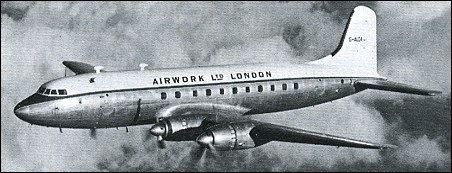
On September 1, 1957, the first case of a two aircraft collision occurred in India, when a Handley Page HP.81 Hermes G-AKFP of Airwork Ltd., with 58 passengers and 6 crew on a special flight from the United Kingdom to Singapore via Delhi and Calcutta, landed on the wrong runway at Calcutta Dum Dum, and crashed in to a cargo Douglas DC3/C-47 Dakota VT-AUA of Indian Airlines with 4 crew. All aboard the Hermes survived while the 4 crew aboard the Dakota died. The captain of the Hermes was found responsible for the accident. Both aircraft were written-off.

The saga continues next week.
Read more »

Feature: Major plane accidents in the 100 years of Indian civil aviation - Part 1

Yesterday we focussed on the highlights of the last 100 years of Indian civil aviation. Today we focus on the tragedies.

We are listing the major scheduled commercial civil aviation accidents with fatalities that have occurred to Indian carriers or within the geographic confines of India. Military, non-scheduled, and private/business jet/charter aircraft are excluded or the list will be too long. For a full list of accidents in India please visit the Aviation Safety Network which has been a valuable source of information for this article along with other sources like Wikipedia and Simon Hradecky at Aviation Herald which along with ASN, I consider as one of the finest websites for all aviation incident related news.

This list is by no means exhaustive, and if you are aware of any accidents that have been missed, please do help us spread the information via a comment.

Part 1 (till 1952)

The early days of Indian aviation were dominated by war related accidents and incidents of military aircraft during World War II.

The earliest recorded crash with fatalities was soon after independence on December 27, 1947, when a Douglas DC-3 Dakota VT-AUG of Air India crashed at Korangi Creek in Pakistan on a flight from Karachi to Bombay killing all 19 passengers and 4 crew.

On January 16, 1949, another Douglas DC-3/C-47 Dakota VT-CDZ of Dalmia Jain Airways crashed at Banihal Pass in India while enroute to Srinagar killing all 9 passengers and 4 crew.

On July 12, 1949, in the worst accident of the Constellation aircraft, at the time, a KLM Royal Dutch Airlines Lockheed L-749 Constellation PH-TDF from flight from Jakarta to Amsterdam via Delhi and Bombay, with 34 passengers and 11 crew, was flown in to a hill side (a situation today called CFIT - Controlled Flight Into Terrain) while on approach to Bombay Santa Cruz airport (today known as Mumbai Chhatrapati Shivaji International Airport). All aboard perished.

On July 17, 1950, near Pathankot, Punjab, the port wing of a Douglas DC-3/C-47 Dakota VT-ATS of Indian National Airways failed in turbulence during a flight from New Delhi Safdarjang airport to Srinagar. All 18 passengers and 4 crew lost their lives.

On November 3, 1950, the first accident of an Indian carrier outside the sub-continent. An Air India Lockheed L-749 Constellation VT-CQP with 40 passengers and 8 crew had a CFIT (controlled flight into terrain) when it was flown in to the side of Mont Blanc in France at an elevation of 15,000 feet, while performing flight AI-245 from Bombay to London via Cairo and Geneva. The plane and the bodies were located only after 2 days.

Just a month later, on December 13, 1950, in another case of CFIT, a Douglas DC-3/C-47 Dakota VT-CFK of Air India was flown in to the side of Kotagiri, the highest peak in the Nilgiri mountain range on a flight from Bombay to Coimbatore. All 17 passengers and 4 crew were killed.

On July 12, 1951, a Douglas DC-3/C-47 Dakota VT-CHT of cargo operator Indamer crashed about 50km NW of Tezpur. The 3 crew aboard were killed.

On September 15, 1951, a Douglas DC-3/C-47 Dakota VT-CCA of Air India with 23 passengers and 4 crew lost control while taking off from Bangalore HAL airport bound for Trivandrum. The cause was attributed as "lost control and crashed when attempting to take off with the autopilot engaged". 1 crew member was killed. The hull was damaged beyond repair and written off.

On November 21, 1951, a Douglas DC-3/C-47 Dakota VT-AUO of Deccan Airways with 13 passengers and 4 crew crashed in to trees while attempting to land in poor visibility at Calcutta Dum Dum airport on a flight from Bombay Santa Cruz via Nagpur. The lone survivor was a passenger, Mr. C.N. Mehta. Read the Indian Express newspaper of the day here.

A month later, on December 31, 1951, a Douglas DC-3/C-47 Dakota VT-COA of Kalinga Airlines performing a cargo flight crashed in to trees when climbing out of Calcutta Dum Dum airport. The 3 crew aboard were killed.

On February 19, 1952, a Douglas DC-3/C-47 Dakota VT-AXE of Deccan Airways with 12 passengers and 4 crew crashed in to trees while attempting to land at night at Nagpur. One passenger and two crew perished. The cause was attributed to pilot error due to a wrong altimeter setting. [Note: the VT-AXx series of registration is now currently used by Air India Express.]

On April 10, 1952, a cargo Douglas DC-3/C-47 Dakota VT-DFN of Kalinga Airlines with 4 crew crashed at Agartala in north east India, while attempting an emergency landing following an engine failure. All aboard were killed.

On April 30, 1952, a Douglas DC-3/C-47 Dakota VT-AUN of Deccan Airways with 5 passengers and 4 crew crashed while approaching New Delhi Safdarjung airport on a flight from Madras. All aboard were killed. The cause was attributed to fuel starvation of the port engine due a fuel imbalance during a steep turn causing the pilot to lose control.

On October 22, 1952, a cargo Douglas DC-3/C-47 Dakota AP-AAZ of Orient Airways with 3 crew on a flight from Dhaka, East Pakistan to Karachi, Pakistan, crashed while attempting a forced landing at Jamshedpur (the home of Tata Steel). One crew member died in the accident. The aircraft hull was a total loss.

The torrid decade in Indian Aviation will continue tomorrow. Stay tuned for Part 2.
Read more »

Full DGCA investigation report of Kingfisher Airlines VT-KAC crash at Mumbai

In follow-up to our story yesterday about the "serious incident" [read crash] of the Kingfisher Airlines ATR-72-500 VT-KAC at Mumbai on November 10, 2009, and thanks to well wishers, Bangalore Aviation has obtained a copy of the final investigation report by the Directorate General of Civil Aviation. It can be read here.


The synopsis in the front of the report, and the findings on the last two pages of the report give a quick overview. Simon Hradecky of The Aviation Herald has done an excellent analysis of the report and we strongly recommend reading it.

The Mint newspaper continues with the feeling in Indian aviation circles that rules were circumvented to classify this accident as a "serious incident" to keep an accident free record in 2009 for Indian civil aviation. In its report, the paper claims
This finding is a deviation from DGCA rules, according to an official of the regulator and Mohan Ranganathan, a Chennai-based safety expert and member of the government-established Civil Aviation Safety Advisory Council.

The assessment will keep 2009 as an accident-free year for India’s civil aviation sector, said a DGCA official, requesting anonymity.
Read more »