Showing posts with label Russia. Show all posts

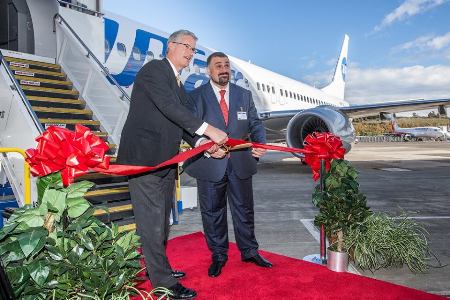
Boeing delivers first 737-800 to Russia's UTair

By BA Staff

Boeing delivered to UTair, one of Russia's leading national carriers, its first directly purchased Next-Generation 737-800. The airline currently has 40 Next-Generation 737s on order to be delivered in the next several years.

Andrey Martirosov, CEO of UTair said:
"Next-Generation Boeing 737 airplanes meet today's development needs of the airline by their optimized operating performance and value-for-money proposition. We successfully operate aircraft of this type and new airplanes will allow us to continue enhancing efficiency of our route network and drive customer appeal for both domestic and international flights."
Marty Bentrott, vice president of Sales for the Middle East, Russia & Central Asia, Boeing Commercial Airplanes said:
 "The new airplanes will help UTair deliver an unmatched level of service for passengers and dramatically reduce operating costs, fuel costs and environmental impact. We are very proud of our relationship with UTair, a valued business partner in the region."
UTair's new 737-800 seats 162 passengers and features the new Boeing Sky Interior. This interior is the latest in a series of enhancements for both airlines and passengers. It introduces LED lighting and curved architecture that welcomes passengers onboard and creates a greater sense of spaciousness and comfort in the cabin. The interior also features modern, sculpted sidewalls and overhead bins that disappear into the ceiling, yet carry more bags.


Based in Russia, UTair is an integrated air carrier and aircraft services company with over 40 years of experience. Today, UTair operates one of the largest aircraft fleets in Russia and ranks among the top three largest Russian carriers by passenger volume.      
Read more »

Rostec and Airbus launch Russian sustainable aviation fuels at MAKS

Airbus and Rostec Group have signed a cooperation agreement at the MAKS air show in Moscow to work together on analyzing Russian feedstock with an eye at expanding Russian sustainable fuels for aviation. Find more details below.

28th August 2013

Airbus and RT-Biotekhprom (Rostec Group) signed a cooperation agreement to launch a large-scale analysis of Russian feedstock, and to evaluate how to speed up the development and commercialization of Sustainable Fuels for aviation. This breakthrough agreement was signed at the International Aviation and Space Salon MAKS-2013.

The partnership is aimed at assessing suitable feedstocks to comply with ecological, economic and social sustainability criteria. The sustainability analysis will be managed by Airbus in close collaboration with RT-Biotekhprom.

The goal of the study is to select a number of local sources of sustainable raw materials suitable for the production of aviation fuel.. By the end of 2014, the aim is to complete a full sustainability analysis. Airbus will have a key role in supporting RT-Biotekhprom in ensuring that the fuel produced meets international aviation standards, alongside completing relevant flight test campaigns.

“We are delighted to be working with our Russian partners RT-Biotekhprom. ” - said Christopher Buckley, Executive Vice-President Sales. “Sustainable fuels are a crucial part of the roadmap to meet the aviation industry’s ambitious CO2 targets. We believe that the findings of this important study, which will be done for the first time in Russia, will contribute to a sustainable aviation sector in Russia. Additionally, we will be able to share our expertise in this area for the benefit of Russian industry. “

"The project will help us to improve the understanding of aviation Biofuels commercialization in Russia, identify the opportunities and challenges, and evaluate the possibility of social, economic, market and technology change and its cost, obstacles and challenges. We believe that the research will have positive effects on energy conservation, emissions reduction and climate change addressing in the Russian aviation sector." – said General Director RT-Biothekhprom Sergey Kraevoj

“We are delighted to be working with Airbus in this project. The decision for this partnership was based on the fact that we had necessary technologies and findings with regards to biomass recycling”, - said the project leader and advisor to General Director RT-Biothekhprom Konstantin Diespersov.

This partnership is part of an initiative to develop a complete sustainable aviation fuel production capability in Russia, using only sustainable resources. It is part of Airbus' goal to have in place such a 'value chain' in every continent. So far Airbus has value chains in Latin America, Australia, Europe, the Middle East, and China.

Read more »

Airbus and Aerolia celebrate 500th ship-set from Irkut Corporation at MAKS

Airbus and Aerolia earlier today at the MAKS air show in Moscow celebrated the delivery of the 500th ship-set of the nose landing gear bay for the Airbus A320 family of aircraft. Find out more details below.

28th August 2013

Airbus and Aerolia celebrate the delivery of the 500th ship-set of the nose landing gear bay for the A320 Family. The event took place at the International Aviation and Space Salon MAKS-2013 with the participation of Christopher Buckley, Executive Vice-president Sales Europe, Asia, Africa and the Pacific, Oleg Demchenko, President of Irkut Corporation and Raphael Duflos, AEROLIA Chief Procurement Officer.

Airbus started its partnership with Irkut Corporation in 2004 by signing an agreement for components supply as part of the strategic industrial partnership for the A320 programme. Irkut received major work packages which included the supply of keel beam, flap track and the nose landing gear bay for the A320 Family. The first ship-set of the nose-landing gear bay was delivered first to Airbus in 2007 then to Aerolia from 2009 when the company took over the production for Airbus of the nose landing gear bay. Ever since Irkut has been gradually increasing the production rates of this very complex component and is currently supplying 12 ship-sets per month.

“For over 20 years of cooperation with the Russian industry Airbus has developed a unique cooperation programme, which includes all stages of aircraft development processes: from R&T and design to materials supply and component manufacturing”, said Christopher Buckley, Executive Vice-president Sales. “Now every third A320 Family aircraft has components produced in Russia. We are committed to develop a trustworthy and long-term partnership with Irkut”.

“Producing A320 Family components for Airbus, the leading aircraft manufacturer, guided us towards playing a key role in international industrial cooperation. During our long term partnership, Irkut Corporation demonstrated to produce to a high level of quality components, fully in line with international standards,” said Oleg Demchenko, President of Irkut Corporation.

“Since 2007 Irkut delivered on time and quality the nose landing gear bay for the Airbus Single Aisle Programme. As a strategic partner, Aerolia wanted to further strengthen the business with Irkut by increasing the required quantity of the nose landing gear bays and involving Irkut in new work-packages. Today we are celebrating this major event of 500 ship-sets produced in six years. In the next three years, Irkut will deliver the same quantity of ship-sets, this is a clear evidence of our growing partnership”, highlighted Raphael Duflos, AEROLIA Chief Procurement Officer.
Read more »

Sberbank and UAC build up operating leasing of Sukhoi Superjet 100 aircraft at MAKS air show

Skerbank and UAC have signed a Memorandum of Intent (MoI) to collaborate on the leasing of the Sukhoi Superjet 100. Find more details below.

27th August 2013

UAC, represented by JSC Sukhoi Civil Aircraft and JSC Sberbank Leasing, are planning to perform joint promotion of Russian aircraft Sukhoi Superjet 100 in Russian and international markets. The respective Memorandum of Intent on join collaboration was signed by the companies at MAKS-2013 Airshow on August 27 in the city of Zhukovskiy.

The joint venture will consolidate SCAC expertise in creation of state-of-the-art aircraft and their subsequent technical support with the current expertise and opportunities of Sberbank Leasing Group in the market of operative leasing using the best world practices.

Consolidation of SCAC and Sberbank Leasing efforts in creation of financial infrastructure for promotion of Sukhoi Superjet 100 aircraft will make it possible to fulfill comprehensive tasks aimed at development of operative leasing in the Russian Federation, including building up of legal framework for operative leasing, creation of sources and tools of financing and government support, forming liquid market of Russian aircraft.

According to the operating plan of the joint leasing company, in the territory of Russia and other countries at the initial phase customers will be provided with operating lease for up to 50 aircraft to the total amount of about two billion US dollars at catalogue price. Establishment of joint venture is aimed at smoothing the way for active promotion of Sukhoi Superjet 100 in the domestic and overseas markets.

"As of today Sukhoi Superjet 100 is the most state-of-the-art aircraft built in Russia. We believe that this aircraft has a very good perspectives in the sphere of leasing, – comments Dmitry Eroshok, General Director of Sberbank Leasing. – Work with Russia-made aircraft is one of the priority areas of JSC Sberbank Leasing operations. At the moment we are ready to offer one of the most favorable terms and conditions for financial and operating leasing of these aircraft".

"Collaboration with JSC Sberbank Leasing offers great long-term opportunities for the project, because extensive branch network of our partners will open a new window of opportunity for joint promotion Sukhoi Superjet 100 aircraft not only in the Russian market but also in the international market", – notes Andrey Kalinovskiy, President of JSC Sukhoi Civil Aircraft.


Read more »

Sukhoi confirms order for 20 Superjets from Ilyushin Finance Co

Earlier today at the MAKS air show in Moscow, Sukhoi announced that lessor Ilyushin Finance Co (IFC) has ordered 20 Sukhoi Superjet 100 aircraft. Find more details below.

27th August 2013

On August 27 2013 in the framework of the International Aviation and Space Salon МAKS Sukhoi Civil Aircraft Company and Ilyushin Finance Co (IFC) signed two firm contracts for the delivery of 20 Sukhoi Superjet 100 aircraft.

The first contract included five SSJ100 LR aircraft in 103-seat configuration. An increased passenger capacity will be provided by means of slimmer seats installation. The first deliveries are expected at the end of 2015. The customer is still negotiated at the moment.

The second contract for customers in the South-East Asia and the Middle East region was concluded for fifteen Sukhoi Superjet 100 aircraft in its Basic version. The first deliveries are expected in 2015 as well.

"The support provided by the largest financial institutes to Sukhoi Superjet 100 project demonstrates its steady and successful development. Our partners placed the order for two SSJ100 modifications: basic and long range, and we hope that customers will appreciate opportunities provided by the two versions of the aircraft", said Andrey Kalinovsky, the President of the Sukhoi Civil Aircraft Company.

Sukhoi Superjet 100 LR version differs from the Basic in several respects: it can reach 4578 km and has an increased take-off weight – up to 49.45 tons compensated by the strengthened wing. The SSJ100 LR is equipped with a SaM146 engine with a 5% increased thrust compared to SSJ100 Basic version.

The deliveries will be financed through the support of the Russian Government on financing Russian industrial exports and high-tech products. This support is provided by the Government to banks extending credits to customers buying Russian products.

In June 2013 in the framework of the 50th International Paris Air Show (Le Bourget, France) Sukhoi Civil Aircraft Company and Ilyushin Finance Co (IFC) signed the Heads of Agreement (HoA) for the delivery of twenty Sukhoi Superjet 100 aircraft. The HoA now has been converted to firm order.

Read more »

ATR approved for unpaved runway operations in Russia’s Siberia and Far East

Turboprop manufacturer ATR has won approval from the Russian Interstate Aviation Committee (IAC) to operate from four unpaved runways in remote areas of Russia: Mys Kamenny, Lensk, Bodaibo and Igrim. Find out more details in the press release below:

26th August 2013

ATR obtained the company’s receipt of fleet-wide approval for new generation ATR aircraft to operate from 3 more unpaved runways in the remote parts of Russia. Russian Interstate Aviation Committee (IAC) delivered the approval in late June this year. This certification brings to 4 a total number of runways already approved for use and operations: Mys Kamenny, Lensk, Bodaibo and Igrim, the latest being certified last year. 

The certification allows ATR aircraft to operate from gravel, dirt and grass strips. This significant upgrade to ATR's outstanding performance package was accomplished runway per runway, each of which had undergone extensive and thorough operational expertise and testing performed by ATR engineering team. More unpaved air strips are being assessed to gain approval for ATR operations.

Today, with this additional performance advantage, ATR aircraft are the only in-production foreign turboprops above 50 seats having received the certification for unpaved runway operations from IAC. “The ability to land and depart from unpaved runways adds increased operating flexibility to an already outstanding and robust ATR aircraft requiring minimal airframe modifications,” said Carmine Orsi, ATR Senior Vice President Technical.

With its expanded performance and the ability to operate from unpaved surfaces, ATR proves its commitment and enthusiasm to further invest in Russia’s high potential market. ATR turboprops aim to improve communications with Russia’s most remote regions where harsh environmental conditions and country’s vast territory make road transportation impracticable.

Read more »

Photo Essay: Aero India 2013 - third day

The third day of Aero India 2013 showed some performers who were sorely missed from the beginning of the show. Most notably, the Russian Knights, who finally arrived after being delayed in New Delhi, and the flight of the Boeing C-17 Globemaster III which was grounded due to technical problems for the first two days of the show.

A photo essay on some of the performers on the third day.
A United States Air Force Lockheed Martin F-16 Block 50 based at Misawa, Japan, lands after completing its display

The Boeing C-17 Globemaster III, shows its short length take-off performance as it makes its first departure of the show after being grounded due to technical problems for the first two days.

The Flying Bulls aerobatic team is a favourite of every show attendee


One team member loops around the other two who are flying inverted


The Flying Bulls in formation


The venerable HS-748 Avro is the mainstay of the light transport fleet of the Indian Air Force


The Bell 407 in action


The Russian Knights arrive at Aero India 2013


The Russian Knights perform one of their three fly-pasts. On each fly past team members peeled off to land.


Deploying the parachute to slow down. Fighters do not have reverse thrusters like commercial jetliners.


The marshal guiding one of the Knights in to its parking slot. Su-27 and F-16, former foes side by side.


A flurry of activity to get the chocks on to the wheels of the Su-27 Flankers of the Russian Knights.


The IL-76 support aircraft of the Russian Knights, which acts like an in-flight tanker and carries the ground crew and equipment.
Read more »

Photos: Russian Knights finally arrive at Aero India 2013 in Bangalore

The long awaited Russian Knights aerobatic demonstration team finally arrived at Air Force Station Yelahanka, on the outskirts of Bangalore, at around 12:30pm today, the third day, of Aero India 2013.

The arrival of the Knights was delayed after a three-day delay that a member of the Russian delegation confirmed was caused “by delay in internal security clearance” at the Indian home ministry.

The usual bureaucratic tap-dance back and forth between the home ministry, defence ministry and Indian Air Force was going on for the last three days, forcing Russian ambassador Alexander M. Kadakin to request India's national security adviser Shiv Shankar Menon to intervene.

After their landing, a spokesperson for the Russian Knights team confirmed the situation, saying
“We were held up in Delhi for legal issues raised by the government of India and we could come here only because of diplomatic intervention.”
The Knights flew four passes over the runway before landing. The first pass was along with their IL-76 support aircraft, after which the five Su-27 fighters of the team flew three passes more passes.

Some pictures of their arrival at the show.


Read more »

Editorial: European Union's Emissions Trading Scheme is Flawed

This week on Monday, I read an editorial in favor of the European Union's Emissions Trading Scheme (ETS) in the New York Times, and decided to respond with a op-ed.

In your editorial published on Monday, February 27th, your paper made the claim that Washington and other critics of the European Union's (EU’s) new Emissions Trading Scheme (ETS). Your editorial, while well intentioned, contained numerous misconceptions, and is, I believe, flawed at its core. Reduction of greenhouse gas emissions is an admirable goal, but doing it through this particular design is erroneous for both economic and sociopolitical reasons.

In the first case, air travel helps power the global economy, in multiple ways. If facilitates quick and easy transport of human capital and goods around the world, while simultaneously enhancing interpersonal relations and global awareness by transporting passengers to vacation and visit family around the world. The economic impact of the air transport is huge, accounting through direct, indirect, induced, and catalytic forces, for $2.5-$3.5 trillion annually, or 5-7.5% of global GDP. Our industry generates some 32 million jobs globally through the same confluence. Yet despite its position as a vital economic engine, the airline industry is a highly unprofitable venture; global commercial airlines lost a cumulative $5.5 billion between 2003 and 2011. And the European Union is no different. The region already has some of the highest aviation taxes in the world, with a myriad of passenger duties, entrance tariffs, and general taxes that have rendered its airline industry stagnant. The fallout from the EU’s misguided policies have already manifested themselves this year in the collapse of Spanair and Malev, and ETS will only serve to continue that trend.

In your piece, you claim that because the added cost increases would be of magnitude less than the $25 typically charged for checked baggage (though they will almost certainly be greater than the $2.60 claimed by the EU), they are not of consequence. While this relationship might hold true in most industries, the airlines are a special case. Airline flights are marginal at best; the profit margin on individual flights is often as low as 20 or 30 dollars in total. And because air travel demand, especially for long haul flights, is highly price elastic (meaning that a 1 % increase in price will decrease quantity demanded by greater than 1%). According to a compilation of estimates from various government sources and industry bodies, the price elasticity of air travel ranges from 1 to 1.1. Given that the price increases created by ETS range from 3-6% on most flights, the EU is facing a worst case scenario of losing up to 66 million passengers or $2 billion in revenue, or a best case scenario of losing 33 million passengers and a billion dollars of revenue. Can Europe’s tottering airlines afford such losses? The most likely answer, especially for marginal airlines, is no. Whenever taxes are increased, businesses at the margins suffer the most, and in the EU, that could mean the loss of dozens of valuable air service providers.

Secondly, and more importantly in most eyes, ETS represents a violation of the national sovereignty of other nations. Under the ETS, the EU will tax not only the portions of the flight that occur over its airspace, but all portions of a flight. This is akin to the US government taxing Chinese companies that sell in the US for their pollution in China; it is overstepping logical and legal boundaries. Moreover, the EU’s member nations (if not the EU itself because it is a trans-national body) are all signatories to various conventions of the air, none of which allow it to regulate the airspace outside of its borders as the ETS attempts to do. Thus Russia, China, India, and the United States are right to band together and denounce the European Union for this violation of their sovereign rights to the airspace in their country.

The worst part about ETS is that it hurts the EU’s own airlines the most. With emissions surcharges being levied on the whole portions of intercontinental flights, fast growing airlines such as Emirates and Turkish Airlines would have an advantage in transporting long haul European passengers because their flights would only face EU surcharges on less than half of the total distance of many itineraries. Europe’s economy is already tottering under the weight of its unbalanced debt structure. Is now really the time to be choking off a vital economic engine, especially with the threat of a double dip still looming?
Read more »

India and Russia sign fifth generation fighter aircraft design contract

India's Ministry of Defence controlled Hindustan Aeronautics Ltd. (HAL) and Russia's Rosoboronexport and Sukhoi signed a contract todday for the preliminary design of the Indo-Russian Fifth Generation Fighter Aircraft (FGFA).

The FGFA aircraft to be jointly developed is termed Perspective Multi-role Fighter (PMF). The PMF draws upon the basic structural and system design of the Russian FGFA Technology Demonstrator PAK-FA with modifications to meet the more stringent specifications of the Indian Air Force.

The fighter will have advanced features such as stealth, supercruise, ultra-manoeuvrability, highly integrated avionics suite, enhanced situational awareness, internal carriage of weapons and Network Centric Warfare capabilities.

The broad scope of bilateral cooperation during the joint project covers the design and development of the PMF, its production-ising, and joint marketing to third countries. Options include the design and development of a twin-seater variant and the integration of an advanced engine with higher thrust at a later stage.

With an expected outlay running in to the hundreds of billions, the total cost including options and the value of production aircraft will make FGFA/PMF, the biggest defence programme in the history of India.
Read more »