Showing posts with label KLM. Show all posts

KLM improves its business class

By BA Staff

KLM, the Royal Dutch Airline has upgraded its business class and now provides fully flat beds on its daily 747 flights from New Delhi to Amsterdam.

Commenting on the occasion, Mr. Yeshwant Pawar, General Manager South Asia said
“KLM continues to invest in customer comfort across the world as this has been our top most priority. The guiding principle to introduce fully flat beds is a step towards enhancing customer comfort and privacy as befits KLM. The new full-flat seat also plays an important role in helping to strengthen our position as a preferred airline in the Indian market.”
The new 180 degree horizontally reclining seats in the World Business Class are longer with 2.07 meters in length, wider with 63 inches in pitch. Every seat has an integrated 17 inch video monitor for in-flight entertainment. There is in-seat power and also storage compartments in the seat behind the passenger as well as under the television screen.
Read more »

KLM launches quiz contest to promote Business Class

By BA Staff

KLM has launched a quiz contest on their KLM India Facebook page that would give one winner a chance to win an all inclusive ticket to Amsterdam in their Business Class. The quiz contest is about answering five questions on the new KLM World Business Class.

KLM launched its fully flat beds on its international long-haul destination flights served by Boeing 747-400. The seat can be horizontally reclined at 180 degrees providing more legroom and no middle seat. Every seat is installed with a 17 inch screen video monitor for in-flight entertainment and storage compartments.

Read more »

Air France launches A380 flights to Shanghai

by BA Staff

European SkyTeam member Air France has launched Airbus A380 flights to Shanghai's Pudong International Airport today (2nd September 2013), beating Star Alliance rival Lufthansa as the first European carrier to offer A380 services from Shanghai by 24 days. The flight is currently (as of 8:00 am Bangalore time) in the air as the following screen cap from Flight Aware shows.


Air France plans to operate its A380s, configured with 516 seats in a 4-class configuration (9F / 80J / 38Y+ / 389Y), on three of its fourteen flights per week to Shanghai. Flight schedules for the two daily flights are as follow:

AF 116: Leaves Paris-Charles de Gaulle at 23:20, arrives in Shanghai-Pudong at 16:20 the following day AF 111: Leaves Shanghai-Pudong at 23:20, arrives in Paris-Charles de Gaulle at 5:35 the following day

Flight 116, the red-eye, will have A380 services on three of seven days each week.

Frédéric Gagey, Chairman and CEO of Air France, had this to say about the launch:
The arrival of our superjumbo in Shanghai illustrates Air France’s intention to continue its expansion in China, a strategic and fast-growing region. With the A380, our customers can enjoy an optimum travel experience in all cabin classes, as well as services specially adapted to the Chinese culture
Air France-KLM group has the largest European presence in China amongst European carriers, with 93 flights per week from its two European hubs at Paris and Amsterdam to nine Greater Chinese destinations: Beijing, Shanghai, Hong Kong,Guangzhou, Chengdu, Hangzhou, Wuhan, Xiamen and Taipei.

Shanghai becomes the sixth A380 destination for Air France, after New York JFK, Washington Dulles, and Los Angeles in the US, Johannesburg in Africa, and Tokyo Narita in Asia. Air France operates a fleet of 8 Airbus A380-800s as part of its passenger fleet of 245 aircraft, used to serve 199 destinations around the globe. 
Read more »

Routes Analysis: British Airways grows Hyderabad - London

by Vinay Bhaskara

British Airways wide-bodies on the ramp at their global hub at London Heathrow
From October 27th, London based full service carrier British Airways will be up-gauging its services between Hyderabad and its global hub at London Heathrow to daily flights utilizing Boeing 777-200ER aircraft configured in a 275 seat 3-class configuration (48J/24Y+/203Y), including flat beds in Club World. The flights are currently served with 3-class Boeing 767-300ER aircraft configured with 189 seats (24J/24Y+/141Y) 6 times per week, and an up-gauge was already planned to 6 weekly flights on the 777-200ER for IATA Winter 2013-14.

Said Christopher Fordyce, British Airways Regional Commercial Manager India:
For British Airways, Hyderabad is truly a key market in our South Asian network. We have witnessed tremendous growth in the market since 2008, resulting in concerted growth in the outbound business and leisure tourism.... Our customers from Hyderabad will now be able to enjoy daily service to the UK whilst enjoying British Airways' unmatched inflight services and flying experience,
British Airways is the only European carrier remaining with service to Hyderabad, where yields for long haul connections to Europe and North America are coming under increasing pressure from the MEB3 carriers Emirates, Etihad Airways, and Qatar Airways (plus potentially an entrance from Turkish Airlines). Since the Global Financial Crisis in 2008-9, business traffic to and from Hyderabad has largely plateaued while leisure and VFR traffic has continued to grow. But such traffic is by and large, too low-yielding to sustain the European carriers with their ever increasing cost bases. KLM ended its short-lived Hyderabad services in 2008 after launching in 2005, while Lufthansa ended its Frankfurt - Hyderabad flights in 2011.

Hyderabad is still a massive demand center for services to North America. In 2011, Hyderabad had 481,748 passengers worth of origin and destination demand (O&D) demand to and from the United States. With 21 North American destinations served through its London Heathrow hub (plus Raleigh Durham through the joint venture partnership with American Airlines) - British Airways appears to be doing good business connecting passengers between Hyderabad and the US, and it has an advantage over the MEB3 who only serve 7-8 passenger destinations in North America. 
Read more »

Jet Airways request slots at Amsterdam for Winter 2013 season; no flights to Newark

by Vinay Bhaskara

As Bangalore Aviation reported last month, Indian full service carrier Jet Airways is likely to move its long standing trans-Atlantic scissors hub to Amsterdam in conjunction with its new part-owner Etihad Airways. Late last week, Jet applied for the following slots at Amsterdam for the IATA Winter 2013/14 season.

9W 224 - DEL - AMS --> arr: 09.40 333 daily
9W 224 - AMS - YYZ --> dep: 12.10 333 daily

9W 223 - YYZ - AMS --> arr: 09.40 333 daily 
9W 223 -  AMS - DEL --> dep: 12.10 333 daily

9W 231 - BOM - AMS --> arr: 09.40 333 daily

9W 232 - AMS - BOM --> dep: 12.10 333 daily

Interestingly, Jet Airways has not requested slots between Amsterdam and Newark. Currently, Mumbai-Brussels-Newark is the best performing of Jet Airways' North American routes, and it is surprising that Jet Airways has not requested slots for Amsterdam-Newark, though the route is already served by both United Airlines and Delta Air Lines.

Of course, Jet Airways could be moving towards participation in the trans-Atlantic joint venture partnership with Delta, KLM, Air France, and Alitalia. This partnership allows member airlines to proportionally share costs and revenues, jointly discuss strategy, and generally act as one airline across the Atlantic.

Delta's existing flight 35 between Amsterdam and Newark departs at 12:50 pm daily (the return arrives into Amsterdam at 7:35 am) and is locked into that time by slot constraints at Newark Airport. However, this timing fits perfectly with the slots Jet has requested at Amsterdam and would allow for an effective scissors hub while only allocating three aircraft (one each for DEL-AMS-YYZ, YYZ-AMS-DEL, BOM-AMS-BOM) as opposed to the current four, freeing up one aircraft for use by Etihad. On Delta's end, their existing Amsterdam-Mumbai service could be passed off 

However, it also brings up the question of what will happen to Jet Airway's current slots in Newark. They can be potentially used by Etihad to launch Newark services; in fact a Mumbai-Abu Dhabi-Newark routing utilizing a Jet 777-300ER would be highly effective and help boost Etihad's connectivity whilst also ensuring Newark access on Jet Airways metal. 
Read more »

Air France and KLM partner with Jet Airways to expand India connectivity

Air France and KLM Royal Dutch Airlines, have entered in to a unilateral code-share agreement with India's Jet Airways which will allow them to extend their connectivity to Indian cities which are currently not served by them.

At present Air France and KLM operate 27 flights a week to India. Air France has flights from Paris Charles De Gaulle (CDG) to Bangalore, Mumbai and New Delhi, while KLM operates from Amsterdam Schipol to New Delhi. From June 19, 2013, Air France will place its marketing code (AF) on Jet Airways’ domestic flights to Chennai from Bangalore, New Delhi or Mumbai and Kolkata and Hyderabad via Bangalore and Mumbai. Likewise, KLM will place its marketing code (KL) on Jet Airways’ domestic flights to Bangalore, Chennai, Hyderabad and Mumbai via New Delhi.

The three airlines already have a full fledged network-wide accrual and redemption partnership for their frequent flyer programs, Jet Airways’ JetPrivilege and Air France-KLM’s Flying Blue, for many years.

The announcement did not indicate if there will be a reciprocal code-share arrangement where Jet Airways would put its flight numbers on Air France and KLM operated flights between India and Europe. A spokesperson for Air France indicated the agreement was unilateral. Jet Airways did not respond.

Read more »

Night photos from Delhi Indira Gandhi international airport - the Airbus collection

Continuing our photo essay (see part two) on the night photography at Indira Gandhi International Airport (IGIA), thanks to the support of the kind friends at Delhi International Airport (P) Ltd. (DIAL) and the DGCA, today is the Airbus collection.

Unlike Bangalore where the mid-sized Airbus (since the A380 is not permitted) is the dominant aircraft type, Delhi with its higher traffic volumes, commands the larger aircraft of Boeing, the 777 and 747.

Yet, one does get to see the Airbus of mostly Indian and European airlines.

IndiGo Airbus A320-232 VT-IES. Used for international flights at night and domestic during the day.

Jet Airways Airbus A330-200 VT-JWM.


Aeroflot Airbus A330-200 VP-BLY


SWISS Airbus A330-300 (the longer brother of the -200) HB-JHI


KLM Royal Dutch Airlines Airbus A330-200 PH-AOK


We request you to please encourage these photographers via a comment on the photo site.

Photos are used with permission of the photographers who retain full copyright. Pictures may not be used without their specific permission.

Hope you enjoyed this photo-essay series.
Read more »

Post your views: Topic of the week: Global alliances accept the Middle East Big 3 (MEB 3)

This topic this week is focussed on the Gulf region home of the fast rising behemoths Emirates, Qatar Airways, and Etihad.

The last few days have been startling to say the least. From competing head-on, the airlines of the world, have accepted, nay welcomed, the Middle East Big 3 (MEB3) of Emirates, Qatar, and Etihad.

A few weeks back the shocker of an announcement, Australia's QANTAS was dumping oneworld partner, and virtual cousin, British Airways, in favour of (gasp) Emirates!!!! and.... QANTAS, the second largest airline at Singapore Changi airport, will shift its base to Dubai!!!!!

Then the week began with news that Abu Dhabi based Etihad is signing a long term partnership with SkyTeam founders Air France-KLM and in a rare instance of cross alliance cooperation, Air France and KLM will code share with oneworld member airberlin, in which, Etihad, has an almost 29% stake. SkyTeam cooperating with oneworld cooperating with MEB3 mon dieu!!!! H'as the world gone mad?!?!?

On Tuesday came the announcement that Qatar Airways is joining the oneworld alliance and its mentor is, yes you guessed it, British Airways. Willie Walsh to Alan Joyce, I say, good show. What chaps??

What are your thoughts?

Have the MEB3 become mainstream? With their global footprint, will they benefit or wreak havoc on their partners over the long term? Can the oneworld CEOs contain Mr. Akbar Al Baker?

Share your views. Talk back to your fellow readers.

Read more »

Air France-KLM, Etihad, Air Berlin enter in to a code share agreement


The Air France-KLM Group, Etihad Airways, and airberlin will implement code-share agreements as of October 28, 2012, which will offer their respective customers more destinations.

Air France, KLM, and Etihad code-shares

On the routes between Europe and Abu Dhabi, Etihad Airways customers will be able to fly on the Amsterdam-Abu Dhabi daily flight operated by KLM.

Air France customers will be able to travel everyday between Paris-Charles de Gaulle and Abu Dhabi on Etihad Airways operated flights.

Beyond their gateways, the code-share agreement offers five destinations each to Air France and KLM passengers on the Asian and Australian market and ten European destinations to Etihad passengers on Air France and KLM.
  • Air France passengers will be able to connect through Abu Dhabi for flights to Colombo (Sri Lanka), Dhaka (Bangladesh), Katmandu* (Nepal), Mahe (Seychelles), and Male (Maldives).
  • KLM passengers will be able to connect through Abu Dhabi for flights to Colombo (Sri Lanka), Islamabad (Pakistan), Lahore (Pakistan), Melbourne (Australia), and Sydney (Australia).
  • Etihad Airways passengers will be able to connect through Paris-CDG airport for flights to
  • Bordeaux, Copenhagen, Madrid, Nice and Toulouse under an Air France operated flight, and through Amsterdam-Schiphol to Billund, Cardiff, Newcastle, Oslo, and Stavanger under a KLM operated flight.
airberlin, Air France, KLM code-shares

Air France and airberlin announce a mutual codeshare agreement, allowing customers of either carrier to fly on all the routes operated by the other between France and Germany. Passengers will also be able to connect to some selected destinations via Paris for airberlin, and via Berlin or Düsseldorf for Air France.
  • Air France passengers will be able to connect through Berlin-Tegel airport to Krakow (Poland), Gdansk (Poland), Graz (Austria) and from Düsseldorf to Dresden (Germany) on services
  • operated by airberlin.
  • airberlin passengers will be able to transfer through Paris-CDG and Paris-Orly to Bordeaux, Lyon, Marseilles, Montpellier, Nantes, Nice, and Toulouse on services operated by Air France.
  • KLM will codeshare with airberlin on three destinations beyond Berlin: Krakow (Poland), Gdansk (Poland) and Kaliningrad (Russia).
  • airberlin will codeshare with KLM on Berlin-Amsterdam routes as well as on Edinburgh (UK), Glasgow (UK) and Manchester (UK) beyond Amsterdam.
James Hogan, Etihad Airways’ President and Chief Executive Officer, said
“Partnerships are delivering a major source of our revenue growth, by extending our network reach and putting our brand directly in front of millions of new customers. This year to date, they are providing 18 per cent of our revenues and will be a major contributor to our sustained profitability growth this year and into the future.”
The new strategic partners will work together on the proposed integration of frequent flyer programs which includes reciprocal ‘earn-and-burn’ privileges for 1.5 million Etihad Guest members and 21 million Air France-KLM Flying Blue frequent flyers across the combined networks.

Other potential areas of co-operation include joint procurement, as well as maintenance and repair collaboration, as both carriers identify cost savings and seek to benefit from economies of scale, as Etihad Airways is doing with its other strategic partners.
Read more »

Mumbai airport commences trials of automated ATC departure clearance system

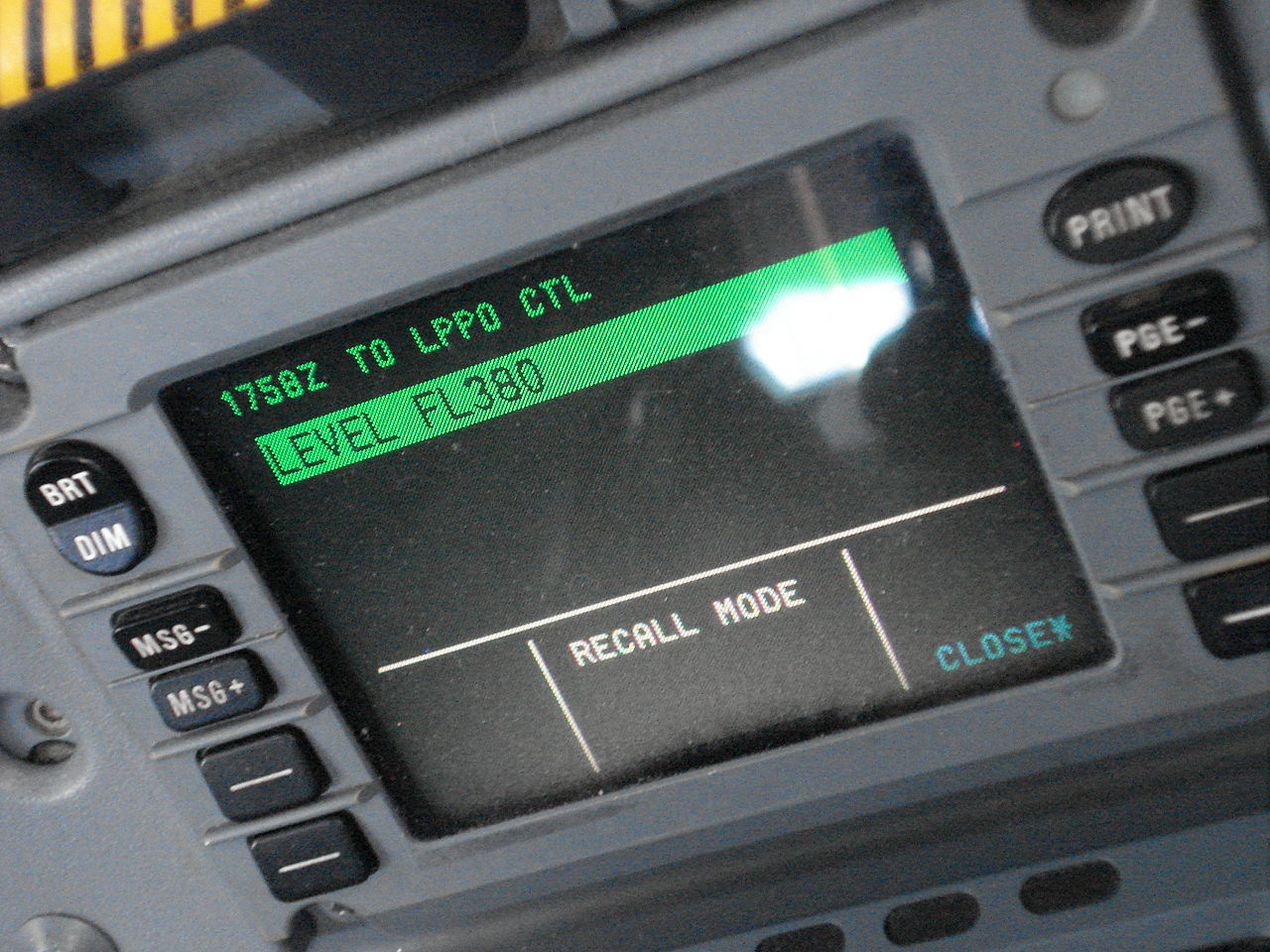
The congested Air Traffic Control (ATC) system at Mumbai airport is under-going a major leap forward with trials of the SITA Departure Clearance System (DCL) through Data Link Communication (DLC).
The Datalink Control and Display Unit (DCDU) the pilot interface for CPDLC messages. Image courtesy Wikipedia.
The Airports Authority of India (AAI) which manages civilian ATC operations across most of India, has begun has begun trial operations of Data Link Communication for pre-departure clearance. This new system is expected to significantly reduce workload of ATC controllers by automating the transmission of routine information like clearance delivery, Automatic Terminal Information Service (ATIS), meteorological (weather etc.) information (VOLMET) etc.  The system is supplied by SITA and its components at Mumbai are :
  1. PDC (Pre Departure Clearance delivery) through data link using ACARS (Aircraft Communications Addressing and Reporting System) capability.
  2. Centralised d-ATIS
  3. d-VOLMET
however, initially only the automated PDC system will be operated.
Read this SITA PDF document for more information on this technology.
Pre-departure clearance is an authorisation issued by ATC to a pilot regarding the runway to be used, route to be flown right from take-off to destination, including use of SIDs (Standard Instrument Departure), and cruising level that the aircraft is expected to maintain. The PDC system can be extended to include taxi information i.e. the route the aircraft is expected to take from its parking bay to the runway.

At present, pilots obtain their PDCs from the ATC through voice radio communication. The pilots then read back the entire clearance to confirm correct receipt of the PDC. (See and hear this clearance delivery at Long Beach airport in Los Angeles). This is a time consuming exercise leading to increased communication workload, along with having the potential of misunderstanding.

In the new system the pilot requests pre-departure clearance using the Flight Management Computer (FMC) in the cockpit. The request is transmitted via data-link to the air traffic controller (ATCO), who then selects the appropriate clearance sends the PDC back to the aircraft at the press of a button, again via an ACARS data link. At the aircraft, the PDC can be printed out.

Getting the information both on screen and print saves on both the radio chatter and time for both the controller and the pilot, and eliminates human errors enhancing safety and operational efficiency. For the passenger this translates to quick departures as pilots do not have to wait in a queue for obtaining clearance.

Image courtesy Wikipedia. 
In case you are wondering on the importance of clear communications between the pilot and controller, the worst accident in the history of aviation occurred on the ground, due to mis-understanding and mis-communication. 583 people died when a KLM 747 collided in to a Pan Am 747 at Los Rodeos Airport, Tenerife.

See a 84 minute video on this incident at the end of this article.

Kingfisher and IndiGo to benefit most
This system is dependent on the aircraft having the data link capability. Bangalore Aviation contacted the major domestic airlines to determine their fleet capability.

Air India confirmed that their wide body fleet i.e. Boeing 747-400 and Boeing 777-200LR and 777-300ER fleet is fully equipped up to a higher level of data link called CPDLC (Controller Pilot Data Link Communication) which is part of FANS. However their narrow body fleet Boeing 737-800 of Air India Express, and Airbus A319/A320/A321 of the erstwhile Indian Airlines is not equipped with any data link capability.

Kingfisher confirmed their Airbus A320/A319/A321 fleet is equipped to receive PDCs via ACARS. Their ATR-72 "are also capable of receiving PDC messages, when ACARS is activated."

Jet Airways, SpiceJet and IndiGo did not respond to our requests.


IndiGo advertises its use of ACARS, so it is safe to assume their aircraft will have the ability to benefit from this system. Airline sources indicated that SpiceJet aircraft are not equipped with data link, and technical airport sources indicated that narrow body aircraft at Jet Airways and Jet Airways Konnect may not have data link capability. It is not clear if Jet's wide-body aircraft are data link capable.

In addition to Mumbai, such Data Link Departure Clearance (DLC) systems are also being deployed at Delhi, Kolkata, Chennai, Bangalore and Hyderabad airports.

Sources at Bangalore Airport informed that the DLC system is already built-in to their Selex air traffic control equipment from the time of its delivery almost five years ago. It is awaiting activation pending some software updates from the manufacturer and a green light from the AAI operated ATC.

Read more »

KLM's Christmas gift ideas: 24ct gold Dino iPad 2 with T-Rex bone, 40MP digital camera, Sapphire Iridium razor

If money is no object what could you get your loved ones this Christmas?

How about a 24 carat, diamond encrusted iPad 2, with a frame of Ammolite a stone over 75 million years old and containing bones of a Tyrannosaurus Rex dinosaur?

Yes, its $5 million but it is unique. Do you know anyone who has a DinoPad? I sure don't.


How about a shaving razor whose blades are made out of sapphire iridium crystal and will never dull?

In case any reader is feeling generous, can I request for a 40 mega-pixel Hasselblad H4D-60 camera?

These are just few of the ultra-luxurious Christmas gifts featured in the new edition of Dutch airline KLM's, iFly magazine. Check out some of the other gifts here.

A big hat-tip to British senior spotter and dear friend M. Azizul Islam for the lead. Check out some his amazing photographs here.
Read more »

Jet Airways in talks with Air France-KLM, Delta, and Alitalia. To finally join SkyTeam?

Both Bloomberg and The Wall Street Journal are reporting that India's largest carrier Jet Airways is in talks with Air France-KLM, Alitalia and Delta Air Lines Inc. about joining the SkyTeam alliance.

Jet has long practised a policy of bi-lateral and code-share agreements and officially, its management has steadfastly refuted any speculation of carrier joining an alliance, but with Air India finally clearing its hurdles to enter the Star Alliance, and Kingfisher Airlines making progress as a member-elect of oneworld, Jet may not be able resist any longer. A source at Jet Airways said joining an alliance was now "inevitable".

Skyteam will be a good fit for Jet Airways. The Mumbai based carrier already flies to New York JFK, and Milan, major hubs for existing SkyTeam members Delta and Alitalia, in addition to Newark and twice daily to London Heathrow.

Jet Airways international expansion fitting with SkyTeam.
How Jet's international expansion fits with SkyTeam. Click on image for a larger view.

With Alitalia, Jet has also forged code-share agreements for onward connections to Europe. Its 2011 expansion includes Seoul Incheon, Amsterdam, and Rome again hubs for Korean Air Lines, KLM, and Alitalia.

While it has been denied permission, for now, by the Indian government to fly to Paris, the hub for Air France, industry insiders know that Jet will obtain the Paris permission soon enough.

Unlike Kingfisher which is a weak entrant and is being forced to compromise in return for entry in to oneworld, Jet will be in a strong negotiating position with SkyTeam. Jet offers a formidable pan-India network in both the full service and low cost segments, and more importantly, Jet fills a crucial void current missing in the Skyteam network, with its good network from the middle east to south-east Asia, which will also connect to existing SkyTeam members like China Southern and Vietnam Airlines and with Garuda Indonesia when it joins the alliance.

A possible demonstration of this strong position can be obtain from Dutch news site luchtvaartnieuws, which is reporting that Jet will move its Brussels hub to Amsterdam and take over one India USA route from KLM.

I have been long espousing that Jet should join SkyTeam sooner rather than later. Do you agree or disagree with my views? Please post a comment. Let's have a discussion.
Read more »

Air France-KLM and Delta announce special fare promotion for September

Sky Team alliance members Air France-KLM and Delta announced a special promotion called the ‘Early Bird offer’ for passengers flying economy class from September 10 to October 10, 2010. To avail the offer, customer needs to book the tickets by August 15, 2010. The offer is subject to availability of seats.

The fares are inclusive of all applicable taxes and fuel surcharge, but may vary due currency fluctuation

AIR FRANCE
Delhi – Paris - Delhi INR 33950*
Mumbai - Paris – Mumbai INR 33250*
Bengaluru – Paris - Bengaluru INR 33800*

KLM
Delhi – Amsterdam - Delhi INR 32950*

KLM/Delta
Mumbai - Amsterdam – Mumbai INR 32250*
Read more »

Boeing delivers KLM a 777-300ER in special chrome-free Skyteam livery

Boeing has delivered a 777-300ER (Extended Range) to KLM Royal Dutch Airlines in a special chrome-free paint and primer SkyTeam livery which celebrates the alliance's 10th anniversary.

Aircraft registration PH-BVD.

Boeing image. Click on image for a high resolution view.

Boeing has introduced this chrome-free primer and chrome-free exterior decorative paint in response to environmental requests from various airlines. In addition to simplified health and safety monitoring requirements, a chrome-free primer reduces the environmental impact of the paint and stripping process, since removing chrome from the paint and primer eliminates the need for special handling of paint waste and clean-up, and designated off-site disposal areas.

Boeing will apply this non-chrome paint and primer on up to 14 airplanes across various airplane models for in-service evaluation with the intention of making it a standard option in the future.
Read more »

Air France-KLM, GOL-Varig sign cooperation and code-sharing agreement

Air France KLM and GOL Linhas Aéreas Inteligentes S.A., which comprises the GOL and VARIG brands, have signed a commercial cooperation agreement which will enable the 15 million customers who are members of AIR FRANCE and KLM’s “Flying Blue” and GOL’s 6 million “Smiles” frequent flyer programmes to have access to new Frequent Flyers benefits and destinations.

Beginning May 1, Flying Blue members can earn Miles on all GOL and Varig flights and Smiles cardholders can earn Miles on Air France and KLM’s networks. From July 1, all Flying Blue and Smiles members be able to use their miles as award tickets on all three airlines (Air France, KLM, GOL/Varig). Also from May 1 to July 31 2009, Flying Blue cardholders will earn double miles on all GOL/VARIG flights and Smiles members will earn double miles when travelling on Air France and KLM flights.

The agreement has provisioned for code-sharing. By mid 2009, Air France will be adding its code to GOL flights between Sao Paulo and Rio de Janeiro and thirteen major Brazilian cities: Belem, Brasilia, Belo Horizonte, Campinas, Curitiba, Florianopolis, Fortaleza, Iguassu Falls, Manaus, Porto Alegre, Recife, Salvador and Vitoria. More cities could be added later. A similar agreement is being prepared between KLM and GOL.
Read more »

The best wine cellars in the sky

Very rarely do I get an opportunity to combine my two passions of aviation and wine and write about it.

A very special thanks to the In-flight Supervisor on a recent Singapore Airlines flight who went in to the first class cellar and served me a superlative Chateau Leoville Poyferre, St. Julien, Bordeaux. Even at 35,000ft, it was one the best airborne wine experiences I had.

Recently Business Traveller magazine, judged and presented its "Cellars in the Sky" awards to various airlines.

A special congratulations to the folks at Jet Airways at making the grade.

What did surprise me is that while many wines from producing powerhouses like France, Italy, South Africa, Australia, New Zealand, Spain, Portugal, and Chile, made the grade, the airlines from these respective countries did not. Also missing were producers and airlines from the United States.

Cellars in the Sky: Results for 2008

Business class

Business class sparkling
  1. Charles Heidsieck (Mis en Bouteille 2008), Champagne, France. Joint winners: KLM, Singapore Airlines
  2. Henriot Souverain NV, Champagne, France. Joint winners: Emirates, LAN
  3. Charles Heidsieck (Mis en Bouteille 2007), Champagne, France. Joint winners: Asiana, British Airways, Qantas
  4. Piper-Hiedsieck NV, Champagne, France. Korean Air
  5. Dom Pérignon 2000, Champagne, France. Jet Airways
Business class white
  1. Bernkasteler Doctor Riesling Kabinett 2005, Mosel, Germany. Qatar Airways
  2. Coldstream Hills Chardonnay 2006, Yarra Valley, Australia. Qantas
  3. Highfield Sauvignon Blanc 2007, Marlborough, New Zealand. Air New Zealand
  4. Bernhard Ott Fass 4 Gruner Veltliner 2007, Wagram, Austria. Austrian Airlines
  5. Anakena Ona 2007, Alto Cachapoal, Chile. LAN
Business class red
  1. Palliser Estate Martinborough Pinot Noir 2005, Wellington, New Zealand. Cathay Pacific
  2. Cline Cellars Cool Climate Syrah 2005, Sonoma Coast, California. British Airways
  3. Luis Canas Reserva 2002, Rioja, Spain. Iberia
  4. Corbières Gerard Bertrand 2006, Languedoc, France. Lufthansa
  5. Casa Silva Los Lingues Gran Reserva Carmenère 2005, Colchagua, Chile. KLM
Business class fortified / dessert
  1. Forrest Estate Botrytised Riesling 2007, Marlborough, New Zealand. Air New Zealand
  2. Niepoort Late Bottled Vintage Port 2004, Douro, Portugal. Lufthansa
  3. Baileys of Glenrowan Founder Series Liqueur Muscat NV, Glenrowan, Australia. Qantas
  4. Taylor’s 20-year-old Tawny Port NV, Douro, Portugal. Qatar Airways
  5. Jurancon Prestige Cave de Gran Jurancon NV, Jurancon, France. Delta
Best business class cellar
  1. KLM
  2. Qantas
  3. Air New Zealand
  4. LAN
  5. Qatar Airways
First class

First class sparkling
  1. Piper Heidsieck Cuvée Rare NV, Champagne, France. Lufthansa
  2. Krug Grande Cuvée, Champagne, France. Joint winners: ANA, Jet Airways
  3. Taittinger Comtes de Champagne Blanc de Blancs 1998, Champagne, France. Joint winners: LAN, Asiana
  4. Charles Heidsieck 1995, Champagne, France. Qantas
  5. Salon Blanc de Blancs 1997, Champagne, France. JAL
First class white
  1. Wente Riva Ranch Chardonnay 2005, Monterey, California. Lufthansa
  2. Coldstream Hills Reserve Chardonnay 2006, Yarra Valley, Australia. Qantas
  3. Spy Valley Marlborough Sauvignon Blanc 2006, Marlborough, New Zealand. American Airlines
  4. Joint winners: Selbach-Oster Wehlener Sonnenuhr Riesling Kabinett 2004, Mosel, Germany. TAM; Wegeler Bernkasteler Doctor Riesling Spatlese 2005, Mosel, Germany. American Airlines
  5. Manz Riesling Auslese Trocken 2005, Mosel-Saar-Ruwer, Germany. Korean Air
First class red
  1. Morton Estate Pinot Noir 2005, Marlborough, New Zealand. Qatar Airways
  2. Shotfire Shiraz 2005, Barossa, Australia. Lufthansa
  3. Château de Beaucastel Châteauneuf-du-Pape 2005, Rhône. France, Air France
  4. Mungo Park Shiraz 2008, Barossa, Australia. Emirates
  5. Pyrenees Ridge Reserve Shiraz 2005, Victoria, Australia. ANA
First class fortified / dessert
  1. Morris of Rutherglen Old Premium Liqueur Tokay Muscat, NV, Rutherglen, Australia. Qantas
  2. Graham’s Late Bottled Vintage Port 2003, Douro, Portugal. Singapore Airlines
  3. Weingut Neef-Emmich Bacchus Beerenauslese 2007, Rheinhessen, Germany. Lufthansa
  4. Tio Pepe Fino Sherry, NV, Andalusia, Spain. Korean Air
  5. Ramos Pinto Quinta da Ervamoira Porto Ten Anos NV, Porto, Portugal. Cathay Pacific
Best first class cellar
  1. Lufthansa
  2. Qantas
  3. TAM
  4. Emirates
  5. Qatar
To locate these wines, I recommend wine-searcher.com.

I have written a book entitled Wines Demystified. Please download your free copy in Adobe Acrobat format here.

Read more about the programme including judging procedures here.

Image : Wikipedia
Read more »

Air France-KLM edges out Lufthansa to buy 25% stake in Alitalia

Air France-KLM Group, the world's second largest airline, has agreed to pay 323 million euro ($432 million) for a 25 per cent stake of Alitalia SpA.

Alitalia was put into bankruptcy on August 29, after two years of attempts to sell the 49.9 percent state owned airline. On December 12, CAI agreed to buy Alitalia’s main assets and to combine it with smaller rival Air One SpA before bringing in a foreign airline as a minority investor.

From tomorrow, Alitalia will operate as a new company. Air France-KLM will get three out of 19 seats on Alitalia’s board and two out of nine on the executive committee.

The tie-up is expected to deliver 720 million euro in savings and additional revenue over three years.

The press release from Air France-KLM
AIR FRANCE KLM reinforces its co-operation with Alitalia

Air France-KLM and Alitalia have reached an agreement to strengthen their partnership cemented by Air France-KLM taking a minority stake in Alitalia. This agreement will give Air France-KLM greater access to the Italian market thanks to Alitalia which, following its acquisition of Air One, has reinforced its position on the domestic market. It also links Alitalia to the world’s leading air transport group, thereby offering its passengers access to the most powerful network linking Europe to the rest of the world, henceforth organised around a unique combination of hubs from North to Southern Europe.

Jean-Cyril Spinetta, Chairman and Pierre-Henri Gourgeon, Chief Executive Officer of Air France-KLM stated “In view of the numerous challenges facing our sector, cooperation between airlines is becoming increasingly necessary, and this partnership represents an important milestone. We are happy with this reinforced partnership with Alitalia, which represents a compelling development opportunity for both our companies, and is in the interest of our shareholders, our customers and our employees”.

Terms of the operation

Air France-KLM will subscribe to a reserved capital increase for an amount of some 323 million euros. As a result of this operation, Air France-KLM will own 25% of the capital of Alitalia. Alitalia’s other main industrial and financial shareholders include the Riva Group, IMSSI, Banca Intesa and the Benetton group.

A lock-up agreement will be implemented for a period of 4 years up to 12 January 2013., During this time, no Italian shareholder will be able to transfer shares externally to the Alitalia shareholder group or to Air France-KLM. During the fifth year – between 13 January and 28 October 2013 – the transfer of shares to third parties will be possible, but only on condition that the other shareholders have not exercised their pre-emption rights and that the transfer is approved by Board of Directors of Alitalia. The lock-up will cease to apply only in the case of a stock market quotation starting as of the third year.

Air France-KLM’s holding in Alitalia will be accounted under the equity method.

Synergies

Air France-KLM and Alitalia have estimated a level of potential synergies which will feed through progressively. They should derive mainly from the optimization of the networks and revenue management as well as the extension of the JV between Air France and Alitalia and the implementation of a JV between Alitalia and KLM. These JVs will cover all traffic between the three countries.

For Air France-KLM, these synergies are estimated at around 90 million euros per annum by Year 2 or 3 at the EBIT level. Alitalia will generate total synergies of around 280 million euros per annum by Year 2 or 3 on its side, of which Air France-KLM will consolidate 25% by the equity method.

The operation will be earnings accretive for Air France-KLM as early as Year 2. Return on Equity on Air France-KLM’s investment will be in the region of 15% as of Year 3, excluding the positive impact of its own synergies.

Governance

Air France-KLM will be represented on the Alitalia Board by three members out of a total of 19 and on the Executive Committee of the Board by two members out of a total of nine. Elsewhere, a Partnership Manager responsible for implementing the partnership strategy and overseeing the generation of synergies will be appointed for a term of three years, renewable once, and will be appointed on a rotating basis by the two groups. The first such Partnership Manager will be designated by Air France-KLM.

Suspensive conditions

The implementation of this agreement is subject, amongst others, to the approval of the various competition authorities, including the EU, which could be forthcoming before the end of the first quarter of 2009.
Read more »

British Airways and Qantas in merger talks

While airlines have seen one of their biggest expenses, fuel, come down in price, they are still struggling to find demand as the world's major economies contract, and tis the season of industry consolidation.

British Airways on Tuesday said it's holding merger talks with Australian national carrier and fellow OneWorld alliance partner, Qantas Airways, in a deal that could combine two of the world's best-known international carriers.

British Airways, in a brief statement, said
In response to recent media speculation, British Airways Plc confirms that it is exploring a potential merger with Qantas Airways Limited via a dual-listed company structure.

The discussions between British Airways and Iberia are continuing.

There is no guarantee that any transaction will be forthcoming and a further announcement will be made in due course, if appropriate.
British Airways shares shot up 12.1% in London. Qantas shares ended 4.3% lower in Sydney.
Iberia shares added 5.3% in Madrid.

British Airway possessed a 25% stake in the early 1990s which it sold in 2004. The British Airways talks with Iberia have languished because of Iberia's concerns about the U.K. airline's pension liabilities.

British Airways has been a very busy airline lately. In addition to the Qantas and Iberia negotiations, it is seeking antitrust immunity, from U.S. and European regulators, on its proposed partnership with American Airlines for which it is seeking. A proposal vehemently opposed by arch rival Virgin Atlantic.

Virgin has a presence in Australia in the form of low cost carrier, Virgin Blue. It will be interesting to see how the rivalry will carry over down under.

Like in the United States, Australia limits foreign ownership of domestic carriers. But the BBC was reporting that that may change:
It [the merger statement] follows indications from the Australian government earlier in the day that it may be prepared to relax the rules on foreign ownership.

Under current Australian law, Qantas must be at least 51% Australian-owned.

Any individual foreign airline can only own up to 25% of it and only a total of 35% may be owned by foreign airlines.

Transport Minister Anthony Albanese proposed earlier on Tuesday that the rules be changed so that while 51% must still be Australian-owned, the remaining 49% may be owned by a single foreign airline.
The Australian government recently released a key industry blueprint that would cap foreign ownership at 49% in a bid to keep Singapore Airlines out of the lucrative U.S-to-Australia route.

The possible BA-Qantas link-up occurs as the industry consolidates. Delta has recently merged with Northwest, and on Monday, Ryanair Holdings launched a fresh offer for fellow Irish carrier Aer Lingus, which was rejected by the Aer Lingus board.

The Air France-KLM combine have shown the aviation industry how to combine functions while maintaining separate brands.
Read more »

Air France KLM flights to Phuket instead of Bangkok

As per a press release Air France and KLM will operate "rescue" flights to Phuket on 1 and 2 December from Amsterdam and Paris-CDG respectively.

Due to the closure of Bankok's Suvarnabhumi international airport, Air France and KLM will operate one flight on 1st December and one flight on 2 December 2008 from Phuket Airport.


Departure from Phuket on 1 December:
Boeing 747-400 flight operated by KLM to Amsterdam
Departure from Phuket: 7pm
Arrival in Amsterdam: 4am on the next day.

Departure from Phuket on 2 December:
Boeing 747-400 flight operated by Air France to Paris-Charles de Gaulle
Departure from Phuket: 11:30pm on 2 December.
Arrival in Paris: 5:50am on the next day.

All passengers holding an Air France or KLM ticket may take one or other flight. For passengers booked on one of these flights, Air France and KLM will arrange for a bus transfer from Bangkok to Phuket (please contact Air France/KLM Agency in Bangkok).

FOR FURTHER INFORMATION:

- IN THAILAND: CONTACT THE AIR FRANCE/KLM AGENCY IN BANGKOK: Vorawat Building 20th floor 849 Silom Road or the Call Center: 66 (0)2635 11 91

- IN FRANCE: 3654

LOG ON TO THE AIRFRANCE WEBSITE

Air France is keeping a close watch on the situation and will keep customers informed of any changes to the flight schedule in the next few days.

Read more »

2008: The year reality struck home for airlines in India

The turmoil in the Indian airline industry during the month of October has produced results that can be, only mildly described as, significant. In just four weeks, castles built over the last four or more years, have come crashing down.

By the end of 2008, the Indian airline industry which accounts for less than 2% of the global airline market, will contribute about $2 billion, or over 33%, of the total global losses. This dire, lop-sided situation, which can be attributed to only primary factor – gross imbalance. It is ironic, that the demand – supply imbalance in the Indian airline industry, is resulting in this imbalance between market share and losses share.

How did the situation become so dire?

Over the last 4 years, the Indian airline industry has created this imbalance thanks to rampant and blind expansion. It was all on auto-pilot, thanks to low fuel prices and a robust economy.

In 2008, along came the “perfect storm” and the reality struck home. Skyrocketing fuel prices since late 2007, married to a populist fuel pricing policy by the central and state governments in India which grossly overtaxed aviation turbine fuel (ATF), and sent the already high fuel prices in to the stratosphere, followed by a slowing economy thanks to the global financial credit crises and subsequent meltdown of demand, and uncontrolled costs.

Capt. G.R. Gopinath’s Air Deccan believed in bring airlines to the masses. To expand customer base Air Deccan expanded in to the smallest of cities, and given that, India is an extremely price sensitive country, offered fares that were at par with, or just marginally above, that of the Indian Railways, known to be one of the most economical railways in the world.

Along with with Air Deccan (now Kingfisher Red), low cost carriers (LCCs) Air Sahara (now JetLite), SpiceJet, IndiGo, and GoAir commenced. India seemed destined for low cost paradise, as even full service carriers, Indian Airlines (now Air India), Jet Airways, and Kingfisher Airlines, scrambled to develop low cost fare models of their own.

Thanks to the unbridled expansion, HR costs went in to orbit. From expatriate flight crews to the ground handlers, people were at a premium, and airlines paid, and paid way to well.

Another problem is, India does not have adequate full service airports, let alone, separate low cost airports like Europe and North America.

At all major airports across the country the skies became heavily congested, and it was not uncommon to hear an announcement from the Captain “Ladies and Gentlemen, welcome to Delhi. We are 25th in line for landing, and should land 2 hours from now”. This on a 1.5 hour flight.

The higher costs of full service airports, these delays, and systemic inefficiencies eroded the advantage LCCs in Europe and North America enjoy, i.e., making 9+ flights per day per aircraft, compared to 6 or less in India, and only added to the operating cost burden on all airlines, particularly the LCCs.

As global fuel prices rose, thanks to the fuel taxation policy in India, which makes ATF about 70% costlier than global standards, the impact on airlines was even more severe.

The airlines began to bleed profusely. Unable to sustain, airlines have been raising their prices over the last year, in some non-metro routes, by over 100%. The price sensitive Indian market, particularly in Tier II cities began to slow down.

In parallel, along came the economic slowdown. Demand slowed, and passengers across the board began tightening their belts. The bottom fell out of the market, as passengers shifted from the skies back to rail and bus. At the same time, new airports at Hyderabad and Bangalore were commissioned in the first half of 2008, these airports are far away from the city, and the long and costly commute, along with the rising air fares, totally erased demand in the regional routes, the demand-strength on which LCCs had based their massive expansion plans.

Domestic traffic has contracted over the last four months, declining by as much as 19% in Sep-08. Growth has fallen from 33%+ to over -20% within the span of just six months.

Indian domestic passenger numbers and passenger numbers growth: Jan-07 to Sep-08

Source: Centre for Asia Pacific Aviation & Ministry of Civil Aviation

In desperation, airlines have been resorting to steps, hitherto unthinkable, to stop their bleeding and cash burn.

To bolster yields per flight, airlines have cut capacity by 17% in the six months Apr to Sep 2008, and the further increase in prices have had even more impact on demand. Jet and Kingfisher entered in to an alliance, which left the jaws of most Indians agape on the floor, given the severe competition between them. Staff, including precious flight crew, started getting the axe. CEOs of three airlines are no longer there. Despite a 20%+ reduction in fuel prices (thanks to taxation cuts and falling crude prices), no fare reductions are being passed on to the passenger. The massive fleet expansions have been put on hold. Aircraft deliveries are being delayed. Aircraft already produced are being sold off to other global airlines. Aircraft in the fleet are being returned back. Disagreements and litigations will ensue, but the airlines have no choice. Their backs are against the wall.

The reduction in fuel prices will provide short term relief, but the outstanding fuel bills of the airlines are gigantic. Capacity reduction will have its impact only if properly rationalised with demand.

While, domestic demand crashed through the floor, the one bright spot was international traffic growth, which has remained consistently robust at 10% year-on-year for the first half of FY 2008-09. However, as the global economic slowdown has started taking its toll on international travel, many carriers, such as Singapore Airlines, Finnair, Austrian, British Airways, and KLM have announced capacity cuts and withdrawal of service. At the same time, with the Middle East being a robust market, Gulf carriers continue to grow. Emirates has become the largest foreign carrier in India and will aggressively expand from 132 to 163 weekly services over the next six months.

I am reminded of the Chinese saying “may you live in interesting times”. The rest of 2008 and whole of 2009 is going to be very interesting indeed. The medium term growth for the Indian airline industry is bright, but only for those who survive.

Kapil Kaul, CEO, Indian Subcontinent & Middle East, The Centre for Asia Pacific Aviation, gives us a look behind the scenes…

Jet-Kingfisher alliance - the unthinkable happens

The Jet Airways-Kingfisher alliance, which although unthinkable just a few weeks ago, is a reflection of the current fragile state of the market. The primary objective of this arrangement is to bring together the two largest players in the market, with overlapping networks, to reduce capacity and align it with demand, whilst at the same time being in a position to influence fares. At this stage, it would appear that this alliance will lead to extensive engagement and integration between the two carriers.

Key elements of the alliance will include code-sharing; interline and special prorate agreements; network rationalisation; joint fuel management; common ground handling; GDS integration; frequent flyer reciprocity and human resource sharing.

The alliance is yet to take-off in any meaningful way, to date there have been some initial meetings, but it is too soon to expect any concrete steps. The initial focus will be on network, commercial and revenue management issues. Both carriers are hoping that a reduction in capacity, optimisation of their respective networks, higher yields and lower fuel prices, together with the generally strong demand in the third quarter, should reduce losses. The future of the alliance depends on both carriers seeing equal and measurable improvements in performance.

Jet Airways restructuring

Jet Airways is similarly restructuring its domestic and international operations. Jet has reduced its capacity in H1 2008/09 by 13%. The combined seat production of Jet and JetLite has declined from around 56,000 daily seats in April 2008 to 50,000 in Sep-08.

Jet is actively pursuing a cost reduction strategy - staff rightsizing is a key element of this and has been implemented actively at JetLite. The recent attempt to do so at Jet Airways was poorly timed and managed, resulting in a significant media and political uproar. However, other measures include a zero commission structure, a focus on direct distribution and e-commerce, renegotiating GDS fees and other measures. Maintenance and operational issues are currently under intensive review.

On the other hand, investment is being made in strengthening areas considered weak, such as the overseas sales network which has not been making a sufficient contribution to the international routes. Targeted sales and marketing initiatives are being pursued to enhance revenue and yield.

The integration of Jet Airways and JetLite continues and although the process has been longer and more challenging than anticipated, positive results are expected to be seen shortly.

As a result of focusing on core operational and commercial issues over the last six months, the Jet Airways/JetLite combine has increased its market share lead over Kingfisher/Kingfisher Red and has posted much healthier load factors in the last quarter.

Seven B737s are being returned prior to the end of this year, while five B777s are being leased to Turkish Airlines, allowing for capacity on North American routes to be better aligned with demand. These routes have been under significant pressure. Deliveries due in the next 12-18 months are being deferred and no new international routes are expected during this period.
JetLite is expected to operate with a full strength of 24 aircraft shortly with the return of two CRJs from maintenance.

Kingfisher rationalising its capacity

The first steps of rationalisation can already be seen: Kingfisher Airlines has sold five A340-500s, which would suggest that plans to launch non-stop services to the US have been shelved for the time being. The current fleet of five A330s has two aircraft being used for the Bangalore-London route, with the remaining three aircraft yet to be deployed: routes under consideration are Mumbai-London; Mumbai-Singapore and Mumbai-Hong Kong.

On the domestic front, seven A320s are being returned in Nov/Dec and further reduction is still expected. Some A320s may be redeployed on short-haul international routes, primarily to the Middle East, where they can be used for back-of-the-clock operations. The ATR fleet is also under review, Kingfisher is reportedly not happy with the performance of the regional aircraft.

No expansion in the fleet is expected for the next 12-18 months.

The focus is on achieving commercial stability, stemming cash losses and addressing issues related to the integration of Kingfisher Red. The next 12-18 months will be a time of consolidation in terms of people, systems, operations and commercial issues and to restructure the cost base to compete more effectively.

SpiceJet and IndiGo consider their futures

The two largest independent LCCs are taking a cautious approach with respect to capacity expansion, SpiceJet has leased five of its aircraft to other airlines and is operating with a fleet of 15 aircraft. Its second quarter results were significantly below expectations and continued performance at this level will set the stage for further realignment.

IndiGo has also leased two A320s to Turkish Airlines and is evaluating fleet induction plans for the next 12-18 months.

Both carriers will benefit from lower oil prices and are launching some fare initiatives to stimulate the market. SpiceJet is currently the more vulnerable of the two carriers, despite its recent cash injection by a US-based private equity firm.

Air India ill-equipped to handle current environment

Air India is expected to show continued weakness in its domestic operations. The Jet-Kingfisher alliance will further accelerate this.

Air India is possibly the only domestic airline in India which does not have a modern yield management system - most fare decisions are taken manually.

Internal issues related to the merger between Air India and Indian, staff morale and a public sector mindset, continue to play havoc with its operations.

A massive cost-cutting exercise is under way which includes:
  • Fuel conservation measures, for which IATA is assisting with an efficiency gap analysis;
  • Older, less fuel-efficient B747s and A300s are being retired and leases on B747s and A310s are not being renewed. Of the 111 aircraft on order, 38 have been delivered, which has reduced the average age of the fleet from 14 years to ten years;
  • International operations are being reviewed and the network is being restructured, including the suspension of certain loss-making routes;
  • Reduction in weight and category of inflight catering.
However, Air India lacks the management strength to navigate the significant issues which it faces to be able to effectively challenge other players. Furthermore, with political impediments to rightsizing its workforce of 35,000, achieving a viable business model will remain tough.
Read more »