Showing posts with label ATR72. Show all posts

ATR 72-600 suffers first fatal crash

by Devesh Agarwal

Lao Airline ATR72-600. Photo courtesy ATR.
Airbus joint-venture subsidiary ATR (Aerei da Trasporto Regionale or Avions de transport régional) suffered the first fatal crash of the ATR 72-600 aircraft it manufactures.

The airframer confirmed that an ATR 72-600 operated by Lao Airlines as flight QV301 from capital Vientiane to Pakse crashed at around 16:00 (09:00 UTC) near Pakse (Laos).

All 44 passengers and 5 crew members on board perished.

The aircraft, registered RDPL-34233, was MSN (Manufacturing Serial Number) 1071, was delivered from the production line in March 2013.

At this time, the circumstances of the accident are still to be determined. Official sources of Lao Airlines declared that “the aircraft ran into extreme bad weather conditions and was reportedly crashed into the Mekong river. There were no news of survivors at this time”.

The Laos' Authorities will lead the investigation. In line with the ICAO (International Civil Aviation Organization) Annex 13 convention, ATR will provide full assistance and the French Bureau d'Enquêtes et Analyses (BEA), safety investigation authority representing the country of the aircraft manufacturer will join the investigation.

The ATR 72-600 is a 68-to-74-seat twin turboprop engine aircraft which is the most recent variant of the ATR72-500 being operated around the world, including India;s Jet Airways group.

For more information on the accident, visit avherald.
Read more »

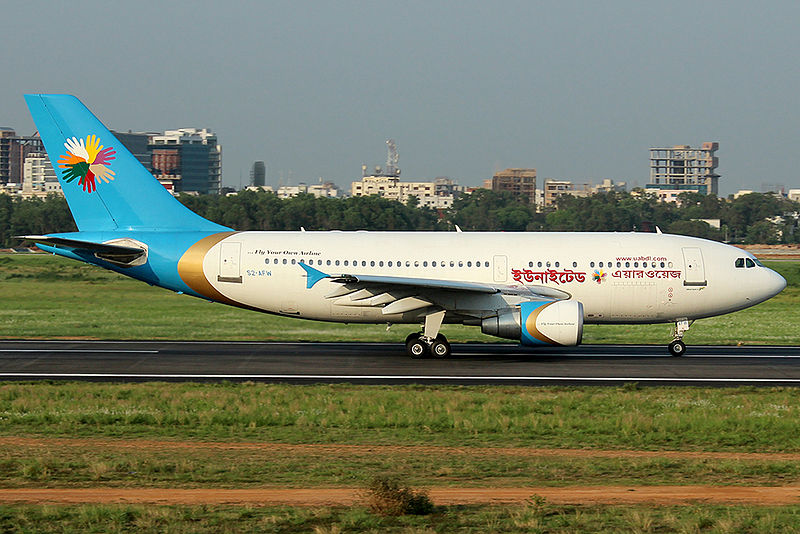
United Airways adds two new aircraft to its fleet

Courtesy Wikipedia. Image credit: Raihanspotter
Rapidly growing Bangladeshi private carrier United Airways has added two additional aircraft to its fleet. The aircraft are an ATR 72-200 registered as S2-AFU and a McDonnell Douglas MD-83 registered as S2-AEJ. The ATR 72-200 originated with LOT Polish Airlines, and then was transferred to LOT's regional subsidiary Eurolot before being sold to United Airways. Meanwhile, the MD-83 was delivered to US carrier Trans World Airlines (TWA) in 1995, became part of American Airlines' fleet after American acquired TWA in 2001, and then was sold to United Airways earlier this year after being parked in 2012.

The aircraft become the 10th and 11th airplanes in United Airways' fleet, composed of 2x Airbus A310-300s, 3x ATR 72-200s, 5x MD-83s, and 1x Bombardier Dash 8 Q100. The carrier also has 4x BAE Jetstream 31s on order to grow domestic operations, and a further A310-300 on order for longer haul flights.

Chairman and Managing Director of United Airways Capt. Tasbirul Ahmed Choudhury had this to say about the acquisitions:
These new addition of ATR-72 and MD-83 aircraft has increased the fleet strength of United Airways to Eleven. We definitely want to increase our fleet as this is the right time to procure desired aircraft to expand more domestic, regional and international destinations. The ATR-72 aircraft is having 64 economy class seats and the MD-83 aircraft 167 economy class seats.
United Airways serves 15 destinations (7 international) across Asia and the Middle East. It has its primary hub at Dhaka's Shajahlal International Airport.  
Read more »

Kingfisher lawsuit against IAE shows Vijay Mallya's desperation

by Vinay Bhaskara and Devesh Agarwal

Earlier this month, defunct Indian carrier Kingfisher Airlines, which has been grounded since 20th October, 2012 when the Indian regulator, the Directorate General of Civil Aviation (DGCA) suspended its flying license, filed its annual report for fiscal year 2012-2013.

Instead of focusing on finding a way to pay off the nearly Rs. 7,000 Crore debt the airline owes to a consortium of lenders led by the State Bank of India, Kingfisher used the annual report as a mouthpiece to announce a lawsuit filed in the City Civil Court at Bangalore against engine manufacturer International Aero Engines (IAE) for $235 million (damages of $210.4 million plus $24.6 million in punitive damages), claiming that the IAE V-2500 A5 engines used to power Kingfisher’s once 32-strong fleet of Airbus A320 family aircraft were “inherently defective, both in design and manufacture.” The Kingfisher annual report says.
United Breweries (Holdings) Limited has filed a suit in the City Civil Court at Bangalore against International Aero Engines AG, its shareholders / joint venture partners and your Company being O.S. No. 6406 of 2012, alleging that the IAE V-2500 A5 engines supplied to your Company were inherently defective, both in design and manufacture, and has claimed damages of USD 210,400,000 plus Rs. 1,621,000,000 (aggregating to approximately $24.557 million as per the current exchange rate of approx Rs. 66  per US Dollar) and has reserved liability to claim further damages. No relief is sought against your Company in the said suit.
This lawsuit smacks of desperation on the part of Kingfisher and its management, as the carrier continues to flounder.

Considering that it did not operate for most of the year, if Kingfisher still managed to find enough cash to pay CEO Sanjay Aggarwal US $591,000 in an annual salary, clearly demonstrates a carefully managed business strategy will allow the airline to slowly pay off debt without resorting to doomed strategies such as this lawsuit.

Kingfisher restart would be a strategic mistake

Kingfisher also continues to pursue the flawed idea that the carrier should “restart” operations with up to 20 aircraft, or that the carrier will make back the money by selling itself to an investor. This is a mistake. Re-launching operations in today’s Indian airline industry would be a tragic mistake. For starters, the Indian macroeconomic picture is very poor; the Indian Rupee has continued to decline and growth projections for the fiscal year have slipped beneath 5%. This has driven demand for Kingfisher’s premium style product lower than when Kingfisher shut down, and that too up against a somewhat re-vitalized Air India, a re-capitalized Jet Airways, a market leading IndiGo, and a soon to arrive behemoth AirAsia India. 

Moreover, India’s other airlines have committed to firm orders of at least 93 current generation narrow body aircraft, as well as 272 next-generation re-engined products (which doesn’t even include an expected re-engined order from low cost carrier (LCC) SpiceJet. This doesn’t even include the fleet of well-capitalized startup AirAsia India, who we project to grow to a fleet of between 10 and 12 Airbus A320s, and regional startup Air Costa, who is supposedly on the verge of launching operations within the next two months. And all of these orders and startups have locked Indian carriers into domestic capacity growth, even with the persistent demand weakness. LCCs have been flooding major Metro markets with capacity (see IndiGo driving out Jet Airways with a massive capacity dump in the Bhubaneswar market as just one prime example).

Even at the peak of the Indian market, Kingfisher as an airline was not profitable and the one part of their network which was profitable, the regional ATR network in the South, has been co-opted by LCC SpiceJet using a fleet of Bombardier Dash 8 Q400 turboprops. SpiceJet already has 15 Q400s in its fleet, and is working to secure financing to grow the fleet by another 15 frames. For example, one of Kingfisher’s most profitable routes pre-shutdown was the trunk route between Bangalore and the industrial Karnataka city of Hubli, but Hubli is now a SpiceJet monopoly with service to five destinations using the Q400s. And Air Costa is due to start operations, muddying up the waters with even more capacity.

One cannot blame Kingfisher’s investors for the idea that if only Kingfisher were to be re-started and/or sold, they will make back their money over time. This sort of playbook is present all over the global airline industry, most notably with US LCC Virgin America whose investors have continued to swallow persistent losses over the past six years in hopes of making their money back via an initial public offering. This would be a mistake in the Indian market, where the existing carriers are already struggling. SpiceJet, Jet Airways, and Air India have all hiked their fares by more than 25% in recent days to offset the rise in the Rupee, with GoAir and IndiGo expected to follow suit soon. Kingfisher re-launching into this environment would just be a recipe for racking up thousands of crores more, in further accumulated losses.

It is better to leave Kingfisher's aircraft rotting on tarmacs across the country where they could at least serve as a reminder to Dr. Mallya, how he, and his incompetent mis-managers, drove a great airline concept in to tatters.
Read more »

PHOTOS and Analysis: A new Indian start-up; Zexus Air?

by Vinay Bhaskara

A report in Ch-Aviation is stating that proposed domestic start-up Zexus Air, to be based at Delhi, is planning to acquire four Embraer E175LR regional jet aircraft (with manufacturer serial numbers [MSNs] 17000277, 17000287, 17000291, and 17000309), as per its application with India's Directorate General of Civil Aviation (DGCA) for an air operator certificate (AOC). The aircraft were previously with Brazilian regional operator TRIP Linhas Aereas, a subsidiary of Azul Brazilian Airlines, the Brazilian low cost carrier (LCC) founded by JetBlue's founder, David Neelman

Not much is known about the startup Zexus Air, except that it would operate on domestic routes, likely with a LCC business model. The carrier has not launched a website, and a quick scan of the airline's Facebook page reveals the following picture of a US Airways E-Jet with Zexus Air titles added via Photoshop or some equivalent. The unprofessional photo below does not re-assure anyone about the viability of Zexus Air's business plan, nor their level of capitalization at this present stage.

Image Credit: Zexus Air

Using Embraer E175 regional jets is a recipe for disaster in the Indian airline industry, thanks to discounts in airport costs for aircraft below a certain weight. These discounts, which apply to turboprops of the same size as the E175, are designed to promote service to Tier II and Tier III Indian cities. But as a side effect of the discounts, regional jet operations in India are simply economically un-viable. For example, regional operator Paramount Airways, who utilized a fleet of Embraer E-Jets, was decimated earlier this decade by competition from Kingfisher and Jet Airways ATR turboprops in the South.

Moreover, the Indian operating environment is anything but conducive to a new start-up airline. Demand is weakening thanks to a poor macro-economic climate, and the existing airlines are already locked into capacity growth thanks to massive aircraft orders. Moreover, seasoned LCC veteran Air Asia is soon to launch an Indian franchise, and even Air Costa, with a similar business model based around regional jets, is set to launch operations within a couple of months. Zexus Air, it would appear, is doomed from the start. 
Read more »

Analysis: Jet Airways to withdraw from Bhubaneswar

by Vinay Bhaskara

According to several reports, Mumbai-based full service carrier Jet Airways is planning on pulling out from Bhubaneswar from the Winter 2013/14 season. Inventory has been zeroed out from 27th October onwards and flights to and from Bhubaneswar are no longer bookable on jetairways.com. Additionally, sources are saying that Jet Airways has not requested slots at Bhubaneswar for this winter, though we will have to wait for the release of route information onto the Global Distribution System (GDS) to confirm this news.

During August, Jet Airways has operated three flights per day to Bhubaneswar, daily Chennai-Bangalore-Bhubaneswar and return, daily Mumbai-Bhubaneswar and return, and daily Kolkata-Bhubaneswar and return. Mumbai-Bhubaneswar and Kolkata-Bhubaneswar are served with JetKonnect Boeing 737-800 equipment, while Bangalore-Bhubaneswar is served with full service 737-800 equipment. The current service level actually marks a reduction from planned levels at the start of the summer, as an additional two flights per day to Kolkata were initially filed with the Directorate General of Civil Aviation (DGCA) utilizing ATR 72-500 turboprop equipment.

If true, the cancellation of Bhubaneswar is a poor step on the part of Jet Airways. One of the few strengths remaining for the financially struggling Jet Airways is its powerful domestic network, with 49 domestic destinations. Bhubaneswar is the 18th busiest airport in India, and one of the most important destinations in Eastern India. However, Jet Airways has been facing challenges thanks to the steady growth of low cost carrier (LCC) IndiGo in the Bhubaneswar market. IndiGo is the largest carrier in the Bhubaneswar market, with nine flights per day this summer to five nonstop destinations; Delhi, Hyderabad, Kolkata, Mumbai, and Vizag.

Even with the increased LCC competition, it does not make sense that Jet did not at least keep around Mumbai-Bhubaneswar for feed purposes. With the new Mumbai integrated terminal arriving by the end of next year, Jet Airways has the opportunity to build a strong regional hub at Mumbai connecting passengers domestic to international and vice-versa. Since Mumbai-Bhubaneswar is served with JetKonnect equipment, with lower operating costs, it is likely losing the least money of Jet's Bhubaneswar services, and thus it would have made sense for Jet to keep Bhubaneswar around.

But the cancellation is just the latest a growing pattern of poor network decisions made by Jet Airways over the past few years. It is certainly possible for airlines to cut services on their way to profitability; but that usually applies to redundant or heavily money-losing capacity that does not serve a strategic purpose (Delhi-Milan being one rare example at Jet Airways); not a key short haul destination. 
Read more »

ATR approved for unpaved runway operations in Russia’s Siberia and Far East

Turboprop manufacturer ATR has won approval from the Russian Interstate Aviation Committee (IAC) to operate from four unpaved runways in remote areas of Russia: Mys Kamenny, Lensk, Bodaibo and Igrim. Find out more details in the press release below:

26th August 2013

ATR obtained the company’s receipt of fleet-wide approval for new generation ATR aircraft to operate from 3 more unpaved runways in the remote parts of Russia. Russian Interstate Aviation Committee (IAC) delivered the approval in late June this year. This certification brings to 4 a total number of runways already approved for use and operations: Mys Kamenny, Lensk, Bodaibo and Igrim, the latest being certified last year. 

The certification allows ATR aircraft to operate from gravel, dirt and grass strips. This significant upgrade to ATR's outstanding performance package was accomplished runway per runway, each of which had undergone extensive and thorough operational expertise and testing performed by ATR engineering team. More unpaved air strips are being assessed to gain approval for ATR operations.

Today, with this additional performance advantage, ATR aircraft are the only in-production foreign turboprops above 50 seats having received the certification for unpaved runway operations from IAC. “The ability to land and depart from unpaved runways adds increased operating flexibility to an already outstanding and robust ATR aircraft requiring minimal airframe modifications,” said Carmine Orsi, ATR Senior Vice President Technical.

With its expanded performance and the ability to operate from unpaved surfaces, ATR proves its commitment and enthusiasm to further invest in Russia’s high potential market. ATR turboprops aim to improve communications with Russia’s most remote regions where harsh environmental conditions and country’s vast territory make road transportation impracticable.

Read more »

ATR financial and operational results 2012

In fiscal 2012 ATR, the French-Italian regional turbo-prop airframer recorded its highest turnover $1.44 billion, and also delivered a record 64 aircraft and increase of 18% over last year. Below is their data along with details of deliveries.

Read more »

Video: ATR72-600 series new 'Armonia' cabin designed by Giugiaro

by Devesh Agarwal

A video walk through of the 'Armonia' cabin on the ATR72-600 series designed with famous designer Giugiaro. As per ATR "the name Armonia is linked to beauty, harmony, balance and calm, themes apparent in the new design."

Read more »

First new ATR 72-600 delivered to InterSky

by Devesh Agarwal

Austrian carrier InterSky has taken delivery of their first ATR 72-600 aircraft ordered in 2012. This is also the first ATR aircraft that will fly in the livery of an Austrian airline. The second ATR 72-600 ordered by InterSky is scheduled for delivery in March this year.

The new aircraft was welcomed this morning at Friedrichshafen Airport, the company's main operating base, strategically situated in the southernmost part of Germany. Although head-quartered in Bregenz, Austria, InterSky benefits from the proximity of the Friedrichshafen Airport to both Swiss and Austrian borders allowing the airline to conveniently serve many commuters and business travellers from the Alpine regions.
with the aircraft entering service on routes to key regional destinations in Germany, Austria and Switzerland.

The ATR72-600 are equipped with a new full-glass cockpit and feature a high comfort layout seating 70 passengers with larger overhead bins.

With the introduction of these two new ATR 72-600s, InterSky should almost double the seat capacity of its fleet, which currently consists of three 50-seat turboprop aircraft.

About the ATR 72-600:
  • Passenger capacity: 68-74 seats
  • Engines: Pratt & Whitney 127M
  • Maximum power at take-off: 2,750 horse power per engine
  • Maximum weight at take-off: 23,000 Kg
  • Maximum load: 7,500 Kg
  • Maximum range with full passenger load: 900 nautical miles (1,665 Km)

Founded in 1981, ATR is an equal partnership between two major European aeronautics players, Alenia Aermacchi (a Finmeccanica Group company) and EADS.

Visit the Flying Engineer for a great technical comparison between the Q400 and the ATR72.
Read more »

SpiceJet to launch Bangalore-Mysore; Q400 order complete

From 14th January 2013, low cost carrier (LCC) SpiceJet will launch thrice weekly Bangalore - Mysore services using Bombardier Dash 8 Q400 turboprops. The schedule of the flights will be as follows:

SG3305 BLR - MYQ ~ 1220 – 1310 ~ Q400 135
SG3306 MYQ- BLR ~ 1330  – 1420 ~ Q400 135

The new route marks the beginning of the next round of Q400 expansion for SpiceJet, as the carrier recently took delivery of the final three Q400s in its initial order of fifteen. The three most recent Q400s for SpiceJet were inducted as: VT-SUP, VT-SUJ, VT-SUK. While SpiceJet does have options for another fifteen Q400s, it is having trouble finding financing for those deliveries at the moment. However, the next year will give SpiceJet ample time to evaluate the Q400 operation as it reaches maturity, and since none of the other major Indian carriers has any turboprop fleet growth (Jet Airways' order for ATR 72-600s is primarily for replacement purposes) in the next year, SpiceJet can afford to slow down its regional expansion. 
Read more »

Infographic: Jet Airways fleet and aircraft orders matrix

By Devesh Agarwal

Thanks to one of our loyal readers, below is the type-wise aircraft fleet and order matrix for Jet Airways and JetKonnect.

Read more »

Analysis: Etihad equity stake in Jet Airways likely to benefit both carriers

Over the past few weeks, it has become increasingly likely that Abu Dhabi based Eithad Airways will be purchasing a 24% stake in India’s largest full service carrier, Jet Airways, perhaps as soon as the end of this week. The deal for a stake in Naresh Goyal’s airline, is reportedly worth somewhere between Rs. 1600 to 2200 Crore, which would value Jet Airways as a whole at somewhere between Rs. 6,666 Crore and Rs. 9,166 Crore ($1.22-1.69 billion). This deal makes Jet Airways the first carrier to benefit significantly from the Indian Government’s decision earlier this year to allow Foreign Direct Investment (FDI) by foreign airlines into the Indian airline sector. On the flip side, it puts increased pressure onto the rest of India’s airlines, especially low cost carrier (LCC) SpiceJet and now defunct full service carrier Kingfisher Airlines, as they now lose one potential investor. The former lacks capital for profitable expansion of its fleet of Bombardier Q400 turboprops whereas the latter is desperately seeking an infusion of capital before it is grounded permanently.

Immediately, it is important to note that Jet Airways will benefit greatly from this capital infusion, allowing it to make critical investments in simplifying and improving its fleet, product, and brand. As they continue to adjust and restructure their international operations, including the swap of several smaller A330-200s for their larger cousin the A330-300s, the reconfiguration of some of its Boeing 777-300ERs to a more dense configuration, and the termination of several poor-performing international routes. When combined with the swap of 5 ATR 72-500s for new ATR 72-600s, Jet Airways does have a large requirement for capital in the near term, especially as the returns from sale-leaseback continue to diminish (Jet has already sold off many of its assets). And it is Bangalore Aviation’s opinion that the moves that Jet Airways has made will be beneficial in the long term; so the Etihad deal is a vehicle for important long run changes.

But the far more interesting question is what effect will the deal have on Jet Airways’ operations so as to make the deal beneficial for Etihad? The immediate benefit is the expansion of bilateral capacity – allowing Etihad to feed more Indian travelers into their “superhub” in Abu Dhabi. Under the current system of bilateral capacity, Etihad’s rivals Emirates and Qatar Airways are granted more capacity and frequencies into India thanks to the O&D targeting system. Meanwhile, Etihad has all but maxed out its bilateral capacity to and from India, which puts it at a competitive disadvantage relative to Emirates and Qatar Airways in one of the world’s fastest growing demand centers. On the flip side, the Indian airlines have not yet maxed out their available seats and flights to Abu Dhabi, so Jet Airways could jump in and apply for several frequencies between Indian cities and Abu Dhabi using some of its spare narrowbody capacity (aircraft utilization at Jet has been falling for more than a year). This sort of setup is not without precedent – Etihad has already invested in and tied up with several carriers around the world, most notably AirBerlin, Virgin Australia, and Garuda Indonesia.

Each of these carriers either launched new services or increased services to Abu Dhabi following the deal(s) – AirBerlin and Virgin Australia created new flights to Abu Dhabi, and Garuda shifted their Jakarta-Dubai-Amsterdam triangular routing to fly via Abu Dhabi instead. But critically, in each of these cases, the carriers in question did not suddenly halt all other international operations. Garuda continued to expand in its niche in East Asia, AirBerlin actually expanded its long haul operations with new service to New York, and Virgin Australia continued to challenge the Qantas hegemony in the South Pacific.

Similarly, Jet Airways will not just all of a sudden become a regional feeder for Etihad a-la ExpressJet or SkyWest in the US. Moving the westbound international scissors hub from Brussels to Abu Dhabi makes little sense, given that Jet Airways’ longest range aircraft, the Boeing 777-300ER, cannot do runs from Abu Dhabi to the West Coast of the US (at least at its current weight though the flights are theoretically possible), a commonly speculated expansion point. As with each of the other Etihad partners, Jet should be allowed to focus on its strengths, which include the milk runs to the US, the Heathrow flights, and regional flights to the Gulf and East Asia, as well as potential flights to Star Alliance partner hubs. In fact, the value of an Etihad partnership will likely facilitate an expansion in regional international routes for Jet. These are just some of the implications of an Etihad equity stake in Jet. As the deal gets finalized and more details emerge over the coming months, important, and positive changes will be coming to the new Jet Airways.
Read more »

Jet Airways to induct new generation ATR 72-600 turbo-prop aircraft

Mumbai-based Jet Airways will the first Indian carrier to induct the new ATR 72-600 series turbo-prop aircraft into their fleet, with five aircraft, starting this month and completing in March 2013.

The Franco-Italian ATR (Avions de Transport Régional) 72-600 is an upgrade from the existing ATR72-500 aircraft in the airline's fleet, and will be used for connectivity to smaller Tier II and III cities like Bhuj, Porbandar, and Udaipur, from Mumbai. It will seat 68 passengers, (up from 62 in the ATR72-500), in an all economy layout.

Compared to the ATR 72-500, which uses 50 per cent analog and 50 per cent digital instruments, the ATR 72-600 has an enhanced full-glass cockpit equipped with the latest navigation aid tools.

The new aircraft also features electronic check lists which eliminates paper in cockpit, replacing the current paper-based documents and maps. Pilots will have at their fingertips moving maps, graphical weather forecasts, terrain mapping and a variety of aviation data and function avionics display units are similar to those features in the Airbus 380 aircraft.

The new PW127M engines provide better performances in "hot and/or high" environments typical of most Indian airports, and the aircraft has also a boost function for short runways.

From a passenger viewpoint, the new ATR 72-600 is equipped with a new cabin, named Armonia and designed by the famous Italian designer Giorgetto Giugiaro, who was named car designer of the century in 1999. It has LED lightening, larger and thinner seats for more legroom and larger overhead bins.

Jet Airways has a total of 107 commanders and 114 first officers for the ATR fleet out of which 55 pilots, at present, are undergoing training on this new aircraft.
Read more »

The Kingfisher Airline's Airbus storage at Mumbai airport, ATR72 graveyard at Bangalore airport

In the Google Maps photograph below, you can see the storage yard, some may say, graveyard, of the Airbus fleet of Kingfisher Airlines at Mumbai airport.


View Larger Map

This parking area is at the 14 end of runway 32-14 next to the Kalina hangars of Air India.

From the top you can see an Airbus A330-200 parked in an East-West alignment next to the private jet. In the lower part of the image, from left to right, a representative of each of the Airbus jets in the Kingfisher fleet. 2 x A321's, 1 x A320, 1 x A319.

From a ground view the planes look somewhat like this.
Mean while, Bangalore airport is host to the ATR graveyard of the airline. This photo taken by me on October 24, shows the ATR 72-500 aircraft parked. The aircraft on the left of the picture have their engines stripped. The ones on the right are more recent additions, two of them without any logos on their tails, which typically means the airline does not own/lease them any more.


In related news, The Economic Times reports the Mumbai airport operator, MIAL, may ask Kingfisher to vacate the terminal, due to non-payment of dues.
Read more »

Employee Relations, Payment Defaults Hinder Kingfisher's re-structuring

The damning evidence against Kingfisher continues to mount, as a new report from the UK High Court claims that the embattled airline owes $21.6 million (Rs. 109.06 Crore) to the Bank of Scotland for overdue lease payments on 10 ATR 72-500 aircraft. The action was brought by Bank of Scotland on behalf of a consortium of lenders against Kingfisher parent UB Holdings, who had guaranteed Kingfisher's obligations. The judgment, brought by Justice Eder, paves the way for potential action in India or elsewhere, and enables Bank of Scotland to pursue United Breweries Holdings' assets to recover the outstanding sum.

Bank of Scotland is owed money because it helped fund KF Turbo Leasing, a special purpose vehicle incorporated in the Cayman Islands that purchased the ATR aircraft to lease to Kingfisher. Each ATR aircraft was then leased by KF Turbo Leasing to Kingfisher for a period of 10 years, dating from an agreement signed on 29 March, 2007.

The troubles with the Bank of Scotland represent only the latest credit issue for Kingfisher, who has been grappling with lessors off and on since the carrier first entered a state of crisis back in November. Since that point, Kingfisher has shrunk its operations at a rapid pace, operating around 175 flights per day (versus 340 at the same time last year). However, the decline in revenues has further eroded Kingfisher's cash flow, making it difficult for the carrier to pay for contracts entered into when its operations were more than two times their current size. Adding to this is the fact that Kingfisher is almost Rs. 7,000 Crore in debt (US $1.26 billion), and interest payments are now an astronomical 25.9% of nominal revenues. At this point, Kingfisher has defaulted on most of its interest and supplier obligations, and is essentially operating on a cash-and-carry system for critical charges such as landing fees and fuel. Thus it was not surprising that Kingfisher had its bank accounts seized by the income tax department; though the question of whether Kingfisher should even be taxed at all given its gargantuan losses and refusal to pay employees is a valid one?

India's aviation regulator DGCA (Directorate General of Civil Aviation) too has continued to repeat its concerns over potential safety violations in the face of Kingfisher's financial difficulties. Late last week, the DGCA threatened to de-register another Kingfisher plane as the carriers maintenance technicians went on strike from Thursday onwards. As of now, the strike has not yet caused major operational disruptions, but as time goes on, the situation will continue to worsen. The DGCA has already de-registered 3 Kingfisher A320s (VT-KFA, VT-KFD and VT-KFE), according to a report in The Live Mint.

More seriously, Civil Aviation Minister Ajit Singh threatened Sunday that a suspension of Kingfisher's operating license might be in order as the ministry continues to worry that non-payment of dues and employee salaries will compromise safety. "Closing an airline will impact passengers, employees," said Singh, "So cancellation of license won't happen. Suspension, however, gives a chance to restart operations once the issues have been sorted out,"

Employees indeed may be the most immediate threat facing Kingfisher. As we mentioned above, Kingfisher's technicians have been on strike at Delhi Airport since Wednesday. MRO service technicians perform routine and scheduled maintenance on aircraft engines, air conditioning systems, brakes, cockpit instruments, valves and other components. They also replace worn-out or defective parts, rebuild engines maintain service records, and perform aircraft inspections. While this maintenance work can be performed by technicians at other airports for the time being, Kingfisher's large Delhi operational base will eventually necessitate a resolution.

Kingfisher's pilots also feel threatened according to a recent report from the Times of India. According to the paper, Kingfisher had a confrontational meeting with its pilots Thursday, as the exodus of pilots to India's other airlines continues. Kingfisher hasn't been on-time with salary payments to pilots since early 2011, and with India's other airlines hungry for qualified pilots, many of Kingfisher's pilots have fled for greener pastures. Remaining pilots in Mumbai have reportedly begun calling in sick in droves in a form of industrial action that does not qualify as a formal strike, while up to 20% of Bangalore based employees have simply quit. If such industrial actions were to spread amongst the rest of Kingfisher's 510 odd pilots, management has claimed that Kingfisher may have to temporarily shut down as Australian carrier Qantas did back in October in response to strike threats from unhappy employees.

Kingfisher's current method of salary deferral while continuing operations (which has also shown up at Jet Airways and Air India in recent times) would not be valid in the US, where contracts (which employee salaries fall under) are absolute until a company shuts down or enters bankruptcy reorganization. But in India, the situation is not so cut and dry, and Vijay Mallya recently sent out a letter (presented at the bottom of this post) to his employees, urging them to maintain their faith in the company and accept proposed changes. However to many, Mallya's words ring hollow in the face of his huge personal wealth and possessions. All those photo shoots with statuesque models and the time spent at Formula One races and IPL matches do not mesh with Mallya's message of sacrifice by the employees, and we fear that his efforts may thus prove unsuccessful. When labor resents management, the results range from severe financial issues to full-on bankruptcy (see Qantas and American Airlines).

One of the ironic things about this entire sequence of events at Kingfisher is that the ATR aircraft adding to Kingfisher's woes are in all likelihood grounded. Kingfisher's cancellations have brought the airline closer in size to Go Air than to Jet Airways, and customer confidence and perception has continued to erode. Foreign travelers have for the most part sworn away from booking Kingfisher for their Indian flights, and we fear that the problem may no longer be easily solvable. Recognizing this issue, Kingfisher recently sent out the following letter to its travel agent partners in the United Kingdom seeking to re-assure them.
Dear Trade Partner,

On behalf of all of us at Kingfisher Airlines, I deeply regret the inconvenience many of your customers, who were booked on Kingfisher between 17th and 26th February, faced due to the unforeseen schedule disruption in our domestic network. Please do accept my sincere apologies to you and your staff for the anxiety and extra effort caused by these sudden cancellations. I totally appreciate the crucial and valuable role you and your team play between us and the guest. In order for us to be successful and bounce back on our feet, we need your support more than ever. Please be assured we are reaching out to all our valued guests who were affected during this period and personally apologizing to them. Kingfisher Airlines is on its way to normalcy. We are currently operating approximately 200 daily flights to 46 domestic and 7 international destinations. In the coming week, we will be adding more flights and our teams will keep you updated on the same. I reiterate that operating our schedule at its utmost consistent level is mine and my team’s endeavor. I request you to continue doing your valued business with Kingfisher Airlines. Your support and belief in us is something I am counting on.

Best Regards,
Sanjay Aggarwal
Chief Executive Officer
Ultimately, these issues have all arisen because Kingfisher's business fundamentals are poor; they are not a profitable carrier, or even a solid one by any stretch of the fiscal imagination. Kingfisher may be able to work its way out of this current rut, especially if either British Airways parent IAG or Etihad Airlines invests in the carrier under India's new foreign direct investment (FDI) regime. But in order to do so, it must first restore customer confidence, get its fiscal house in order, and win back the loyalty of its employees.

Vijay Mallya's Letter to Kingfisher Employees
Dear Colleagues,

I want to take this opportunity to update you on our current situation amidst all the media frenzy that is taking place. The Indian media and the "paid" media that even the Prime Minister referred to are unscrupulous and they will do whatever it takes, part fact or fiction, part true or untrue to achieve their sensationalist objectives.

I have organised funding so that we can pay your seriously overdue salaries which is a source of great personal sorrow for me. We are currently handicapped as our bank accounts are frozen by the tax authorities. I have been working tirelessly to urgently resolve this issue through negotiation and I hope that these efforts will be successful early next week. We fully intend to pay our tax dues as much as we commit to paying your salaries.

Government policies can make or break any Industry. So far it has been downhill for Civil Aviation except for one Airline that defies the odds and claims to be profitable however unlikely that may be.

Finally, there seems to be light at the end of a long dark tunnel. Government has issued a notification allowing direct import of Aviation fuel which promises to save us about 15 percent of our current fuel costs.

I am hoping that the next positive move would be the formal notification permitting Foreign Airlines to invest upto 49 percent of the equity in Indian carriers. This has already been widely announced by the Minister of Civil Aviation and according to reports, has been decided upon at a Empowered Group of Ministers meeting. Recently, last week, the promoters of our airline, The UB Group and its associates acting in concert, converted its loans for an additional 5 percent equity in Kingfisher Airlines. This is the maximum permitted under law in any one financial year but clearly demonstrates the faith that I have in all of you and in our Company.

I have been overwhelmed and emotionally moved by all the widespread expressions of support and appreciation for our Company despite the turbulence we are flying through. Despite media reports, we have many many supporters, well wishers and loyal guests. And all these words of appreciation are dedicated to you. Whilst many may have left our family and many may be in the process of leaving, our family may have become smaller for now. But our family will grow with those who have the pride in their hearts of having stood by our Company through ups and downs, sometimes with great personal sacrifice. That is the true test of loyalty dedication and commitment which I am going to reward.

Please stay committed to our common cause and for good reason to smile happily when this turbulence is over. We were the biggest and best. We may not be the biggest now but we remain simply the best for our guests and our valued King Club members.

I hope to have some good news for you shortly; thannk you for your patience and understanding.

Warm Regards
Vijay Mallya
Member of Parliament
Chairman and Managing Director
KINGFISHER AIRLINES LIMITED

Read more »

Full DGCA investigation report of Kingfisher Airlines VT-KAC crash at Mumbai

In follow-up to our story yesterday about the "serious incident" [read crash] of the Kingfisher Airlines ATR-72-500 VT-KAC at Mumbai on November 10, 2009, and thanks to well wishers, Bangalore Aviation has obtained a copy of the final investigation report by the Directorate General of Civil Aviation. It can be read here.


The synopsis in the front of the report, and the findings on the last two pages of the report give a quick overview. Simon Hradecky of The Aviation Herald has done an excellent analysis of the report and we strongly recommend reading it.

The Mint newspaper continues with the feeling in Indian aviation circles that rules were circumvented to classify this accident as a "serious incident" to keep an accident free record in 2009 for Indian civil aviation. In its report, the paper claims
This finding is a deviation from DGCA rules, according to an official of the regulator and Mohan Ranganathan, a Chennai-based safety expert and member of the government-established Civil Aviation Safety Advisory Council.

The assessment will keep 2009 as an accident-free year for India’s civil aviation sector, said a DGCA official, requesting anonymity.
Read more »

DGCA withdraws report on Kingfisher plane crash-cover-up or shoddy investigation?

Post the Air India Express crash at Mangalore, there have been calls across the country for greater transparency within the administration, policy, regulatory, and investigative units of India's civil aviation system.

With the exception of the famous incident involving President Pratibha Patil's helicopters in a near-miss with an Air India aircraft at Mumbai, with a view to increasing transparency, for the first time, India's regulator and investigator the Directorate General of Civil Aviation put up investigation reports on its website which did not involve the loss of life. One was regarding the crash of a Kingfisher Airlines ATR-72-500 aircraft VT-KAC at Mumbai on November 10, 2009, the other was concerning the sudden loss of altitude of an Air India Express Boeing 737-800 aircraft VT-AXJ en-route from Dubai, UAE to Pune, India on May 26 this year.

Yet, before most media in India could react, the DGCA pulled the Kingfisher report of its website. Luckily, the Indian Express reported most of the pertinent parts of the report. As per the Indian Express the DGCA has faulted the crew of the airline and ATC officials.
In its report, the DGCA says that the crew was not qualified to fly into the Mumbai airport during the shortened runway operations as the commander had not been a ‘training captain’. The crew did not take a decision to ‘go around’, despite an unstabilised approach at the time of landing. It adds that there was a breakdown in the ‘crew resource management’ as the commander —a 47-year-old veteran — did not conduct the correct briefing at Mumbai and Bhavnagar and the 34-year-old co-pilot, who was making her first landing on the shortened runway at Mumbai, did not offer the correct feedback to ‘go around’ at a crucial juncture. It has called on the airline to impart corrective training to the crew. DGCA has also pulled up the ATC for not warning the Kingfisher commander that a previous Air India flight had aquaplaned. Aquaplaning is a phenomenon when there is a thin film of water between the aircraft tyres and the runway, which reduces friction. The report says that the ATC officer had admitted to the DGCA team that he had not understood the word ‘aquaplane’, and not passed on the information to the Kingfisher commander.
The very next day, the Times of India reported about the withdrawal of the Kingfisher report, suggesting the report was withdrawn due to excessive technical faults and incorrect information. The paper also suggests that the Kingfisher "incident" was not classified, by thye DGCA, in contravention of ICAO rules an "accident", despite a significant damage to the aircraft hull. The Times of India report goes on to suggest that this was done to benefit Kingfisher Airlines which would have had to pay higher insurance premiums if it had suffered an "accident".

The Air India Express VT-AXJ report can be read here in PDF format. The report concludes the dive and loss of altitude occurred due to the incorrect handling of the flight control column by the co-pilot in automated mode and his lack of knowledge on how to correct the situation.
Read more »

Image: Attention Jet Airways co-pilot - please keep your eyes on the runway not the spotters

Today on the day of Janmashthami celebrating the birthday of Lord Krishna, the post is very tongue in cheek, much in the spirit of lord Krishna, who was known for his mischief, practical jokes and innuendos, and being written from the home city of Jet Airways, Mumbai.

The zeal of celebration in Mumbai is uniquely demonstrated by teams of youths who go around the city forming human pyramids and towers up to nine floors high to break the pots of buttermilk (dahi-handi). This year the prize money on many of the pots around the city exceeds Rs. 1.1 million.

Coming back to the tongue in cheek.....sorry Jet Airways......

During a recent a spotting trip at Bangalore on August 10th, I took this photo of a Jet Airways ATR-72-500 VT-JCP which had just landed on runway 27.
Jet Airways ATR 72 500 VT-JCPWhile processing the photo, I was rather surprised, almost shocked, to observe the first officer (sitting in the right seat) was busy staring at me instead of looking down the runway the plane was landing on.
All driving schools instruct their students not to take their eyes off the road. "That's how accidents happen" they pontificate. Does this instruction apply to pilots as well?
Read more »

BREAKING NEWS: Jet Airways ATR72 nose wheel collapses at Ahmedabad, airport shut down

Jet Airways ATR72-500A Jet Airways turbo-prop ATR72-500 (ATR72-212A) registration VT-JCA performing flight 9W2510 from Indore to Ahmedabad airport with 57 passengers and four crew on-board had a nose wheel collapse soon after landing at Ahmedabad airport around 21:20 (15:50Z). The airplane is blocking the single runway of the airport.

All passengers and crew are safe and were de-planed via stairs and taken to the terminal where the airline staff is catering to their needs.

All flight operations at Ahmedabad airport are shut down for the last 2h45min. Passengers of other airlines who were scheduled to depart have also been dis-embarked from their respective aircraft.

A crane is awaited to lift and move the aircraft off the runway.

VT-JCA has construction number 572 and was delivered to Jet Airways in October 1999.

Update 1
It is learnt that the nose gear strut had cracked and the two nose wheels had collapsed. The airline is still awaiting the return of their team from Ahmedabad to Mumbai before they can release further details.
Read more »

Farnborough 2010 - bounty of orders for the Boeing-Airbus duopoly

As the world economy slowly rebounds, the 2010 edition of the Farnborough air show is turning out to be an order feast for the duopoly of Boeing and Airbus S.A.S, along with orders for newcomers Sukhoi and regional jet manufacturer Embraer.

The show began with Boeing Commercial Airplanes President and CEO Jim Albaugh saying
"The market is clearly coming back and I feel very confident about how we are positioned to regain -- and retain -- leadership in this business,"
Aircraft operators and lessors are placing orders keeping in view long delivery times typical of the airframe industry, and expecting a return to the good times.

It appears that many of the orders have been already decided but shown on the respective manufacturers' order lists as "unidentified customer" and have been converted in to announcements in the media spotlight of the show.

Uresh Sheth has an impressive compilation of the orders announced till day 2 of the show.
Airbus:
Aeroflot - 11 x A330-300
Air Lease Corp - 31 x A320, 20 x A321
GECAS - 60 x A320
Hong Kong Airlines - converted 15 XA330 to 15 x A350 (MoU) ordered 10 x A330 (MoU)
LAN - 50 x A320 (MoU)
RBS Aviation - 53 x A320 (previously booked as unidentified customer)
Total - 91 x A320, 20 x A321, 11 x A330

ATR:
Air Lease Corp - 10 x ATR-72-600
Azul - 20 x ATR-72-600
Golden Airlines - 2 x ATR-72-500
Lao Airlines - 2 x ATR-72-500
Total - 30 x ATR-72-600, 4 x ATR-72-500

Boeing:
Air Lease Corp - 54 x 737 + 6 x 737 (options)
Avolon Air Lease - 12 x 737 (ordered in 2009)
Emirates - 12 x 777-300ER (30 total, 18 were previously ordered this year as an unidentified customer)
GECAS - 40 x 737-800
Norwegian Air Shuttle - 15 x 737-800 (exercise of purchase rights)
RBS Aviation - 43 x 737-800 (previously booked as an unidentified customer)
Royal Jordanian Airlines - 3 x 787-8 (previously ordered as an unidentified customer)
Total - 109 x 737, 12 x 777-300ER

Bombardier:
Qatar Airways - 2 x G5000 Business Jets, 1 x Challenger 605
Total - 2 x G5000, 1 x Challenger 605

Embraer
Air Lease Corp - 15 x E190
Azul - 5 x E195
Flybe - 35 x E175
Trip Airlines - 2 x E190
Total - 35 x E175, 17 x E190, 5 x E195

Sukhoi:
Kartika Airlines - 30 x SSJ-100 Super Jets
Orient Thai Airlines - 12 x SSJ-100 Super Jets
Total - 42 x SSJ-100
Day 3 tally

Thai_Airways_Airbus_A330-300_HS-TEN_Airbus_Photo
Today's additional tally till the time of this report is:

Airbus:
Thai Airways - 7 x A330-300s (MOU, delivery from end 2011)
Garuda Indonesia - 6 x A330-200s (Rolls Royce Trent 700 engines, 2 class cabin config, delivery from 4th Qtr 2012)
Germania - 5 x A319-100 (MOU converted to order, CFM engines, single class 150 seats, delivery from 2011
Alafco, Kuwait (lessor) - 12 x A350-900s (converted from existing 12 x A350-8 order)

Boeing:
Okay Airways, China - 10 x 737-800s (previously ordered as an unidentified customer)
Qatar Airways - 2 x 777-200LRs (previously booked as an unidentified customer)
Air Austral, Reunion islands, 2 x 777-200LRs (previously booked as an unidentified customer)
Air Austral chairman and CEO gives an interesting reason for choosing the 777LR
"The 777-200LR is the only wide-body airplane that can fly non-stop to Paris with a full payload from our short runway on the island of Mayotte,"
American Airlines, 35 x 737-800s (additional options added to existing 84x737 order)

Sukhoi
Pearl Aircraft Corp., Bermuda (lessor) - 30 x SSJ-100 Super Jets + 15 options (first North American customer for the Sukhoi SuperJet) (Thanks to Flightblogger Jon Ostrower for the info)

For sure more is to come.
Read more »