Showing posts with label LOT Polish Airlines. Show all posts

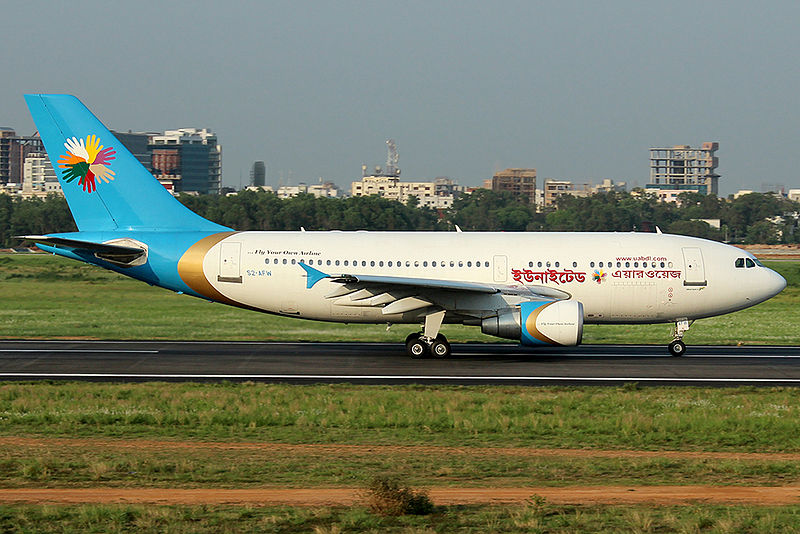
United Airways adds two new aircraft to its fleet

Courtesy Wikipedia. Image credit: Raihanspotter
Rapidly growing Bangladeshi private carrier United Airways has added two additional aircraft to its fleet. The aircraft are an ATR 72-200 registered as S2-AFU and a McDonnell Douglas MD-83 registered as S2-AEJ. The ATR 72-200 originated with LOT Polish Airlines, and then was transferred to LOT's regional subsidiary Eurolot before being sold to United Airways. Meanwhile, the MD-83 was delivered to US carrier Trans World Airlines (TWA) in 1995, became part of American Airlines' fleet after American acquired TWA in 2001, and then was sold to United Airways earlier this year after being parked in 2012.

The aircraft become the 10th and 11th airplanes in United Airways' fleet, composed of 2x Airbus A310-300s, 3x ATR 72-200s, 5x MD-83s, and 1x Bombardier Dash 8 Q100. The carrier also has 4x BAE Jetstream 31s on order to grow domestic operations, and a further A310-300 on order for longer haul flights.

Chairman and Managing Director of United Airways Capt. Tasbirul Ahmed Choudhury had this to say about the acquisitions:
These new addition of ATR-72 and MD-83 aircraft has increased the fleet strength of United Airways to Eleven. We definitely want to increase our fleet as this is the right time to procure desired aircraft to expand more domestic, regional and international destinations. The ATR-72 aircraft is having 64 economy class seats and the MD-83 aircraft 167 economy class seats.
United Airways serves 15 destinations (7 international) across Asia and the Middle East. It has its primary hub at Dhaka's Shajahlal International Airport.  
Read more »

Update 1: Air India grounds its Boeing 787 Dreamliner fleet, after FAA emergency directive

by Devesh Agarwal
The fleet of six Boeing 787-8 Dreamliners of state-owned national carrier Air India has been grounded by the country's aviation regulator the DGCA, which took this decision following the issue of an Emergency Airworthiness Directive (EAD) by the US Federal Aviation Administration (FAA) the regulator in the country of manufacture, and also the certifying body of the aircraft. The EAD concerns risks of fire in the aircraft's Lithium-ion batteries.

(Read the FAA Press Release here).

(You can read the FAA Emergency AD at the end of this article, or download it here).

Air India operates three international routes (Dubai, Frankfurt and Paris Roissy), and three domestic services (Bangalore, Chennai, and Kolkata), all from its base in New Delhi. One aircraft is used as a stand-by.

An Air India spokesperson informed Bangalore Aviation the airline is making "alternate arrangements" including changing of aircraft type on some routes, and "arrangements" for affected passengers, but refused to elaborate. The airline has also not issued any statement on the 787.

The FAA EAD comes after multiple incidents which afflicted Boeing's newest generation aircraft in the last few weeks. A United Airlines Boeing 787-8 was diverted near New Orleans on December 4, 2012. On December 8, a Qatar Airways 787 reported a generator failure. On January 7, a Japan Airlines 787 suffered an APU battery fire at Boston. On January 11, another ANA Dreamliner suffered a cracked wind-shield while on a domestic flight. Air India's debut flights were marred by air-conditioning pack failures. The other three operators Chile's LAN, Ethiopian Airlines, and LOT Polish Airlines have not reported any incidents with the 787.

In addition to United Airlines, and Air India, the two Japanese carriers, All Nippon Airways (ANA) and Japan Airlines (JAL), the first two operators of the 787, who operate almost 50% of the global 787 fleet (24 out of 50), grounded their fleets yesterday. LAN confirmed it is suspending 787 flights on advice of Chile's aviation regulator. The airline issued a statement
“In compliance with the recommendation of the Federal Aviation Administration of the United States (FAA) and in coordination with the Chilean Aeronautical Authority (DGAC), LAN announces that we will temporarily suspend the operation of our three Boeing 787 aircraft.

“Flights that were scheduled to be operated by the 787 will be temporarily replaced with other aircraft in our fleet to mitigate any potential impact that this situation could cause our passengers and cargo clients. The safety of our operation and our passengers is our top priority and we lament any inconvenience that this may cause.”
LOT have cancelled their launch event for their Warsaw Chicago service. The decisions of Qatar and Ethiopian are awaited, though it is expected they will follow suit.

Boeing reimposed faith in the safety of its aircraft. Chairman, President and CEO Jim McNerney issued the following statement following the FAA's EAD.
"The safety of passengers and crew members who fly aboard Boeing airplanes is our highest priority.

"Boeing is committed to supporting the FAA and finding answers as quickly as possible. The company is working around the clock with its customers and the various regulatory and investigative authorities. We will make available the entire resources of The Boeing Company to assist.

"We are confident the 787 is safe and we stand behind its overall integrity. We will be taking every necessary step in the coming days to assure our customers and the traveling public of the 787's safety and to return the airplanes to service.

"Boeing deeply regrets the impact that recent events have had on the operating schedules of our customers and the inconvenience to them and their passengers."

A DC-10-40 modified to perform as a tanker.
The Federal Aviation Administration does not enjoy the same reputation of independence as the NTSB, due to its contradicting roles of a regulator and a promoter of aviation. One has to go back 34 years to 1979, to find the last time the FAA issued an EAD on an aircraft. That was the McDonnell Douglas DC-10, following the horrific crash at Chicago of an American Airlines DC-10. In an ironic twist of history, the travelling public lost faith in the DC-10, and McDonnell Douglas never recovered from this disaster. It eventually went bankrupt, and was acquired by Boeing.

In no way do we imply the 787 is an unsafe aircraft, and we are confident the efforts of Boeing and its vendors will find a solution; but, speed is of the essence. Through its EAD the FAA and by extension other regulators will require operators (airlines) to prove that the batteries on their 787s are safe.

Unlike earlier generation aircraft, the 787 relies on greater electrical power to perform aircraft functions traditionally performed by hydraulic means. As a result it has a greater usage of batteries. While Lithium-ion batteries similar to the type used in the 787 are fairly common in the aerospace industry, the groundings will put tremendous pressure on both Boeing, and the battery manufacturer GS Yuasa of Japan, to examine their entire value chain, from design, to manufacturing, to quality control, determine reasons for the failures and find solutions, quickly.

Boeing has not indicated it will stop or suspend production of the 787. In fact the 100th 787 just entered the production line recently. However, while Boeing can assemble 787s it cannot fly them and therefore cannot conduct any test flights. The flight lines at both the Everett and Charleston plants will start filling up soon.

While the seriousness of the battery problems are not fully known, and therefore a time-frame for implementing a solution is elusive right now, Boeing has to keep history in mind. The DC-10 grounding in 1979 lasted over a month. In today's day and age neither Boeing nor Yuasa can afford this, especially after over three years of delay plaguing this fine aircraft.

Share your thoughts via a comment.

Update 1: 787 Interim Replacement Plan

Through January 22nd, Air India has implemented the following replacement plan for segments previously scheduled to be operated by the Boeing 787 Dreamliner:

Delhi - Chennai/Bangalore will be operated with the Airbus A330-200. Since the A330s are already based in Chennai to fly Chennai-Singapore, the aircraft which operates the night flight to Chennai will be rotated through Delhi for domestic flights during the day.

Delhi - Kolkata/Dubai will be operated by Boeing 747-400s which are currently used as spare aircraft for maintenance substitutions and charters.

Delhi - Paris Charles de Gaulle will be operated by a spare Boeing 777-200LR.

Delhi - Frankfurt will be operated by a spare Boeing 777-300ER.


US Federal Aviation Administration Emergency AD # 2103-02-51 787 Battery

Read more »

FAA grounds the Boeing 787 Dreamliner

by Vinay Bhaskara
Earlier today, the US Federal Aviation Administration (FAA) grounded all flights of the Boeing 787 Dreamliner in the United States due to the recent issues with the Lithium-Ion batteries on-board several different 787s, which are attributed as the cause for the recent fire of the engine of a Japan Airlines 787 in Boston as well as several other incidents around the globe. Japan Airlines and ANA have already each grounded their fleet of 787s, and while the FAA’s action only affects United Airlines’ fleet of six Dreamliners, aviation regulators around the world typically follow the lead of the FAA in safety actions.

Here is the full press release from the FAA:
“As a result of an in-flight, Boeing 787 battery incident earlier today in Japan, the FAA will issue an emergency airworthiness directive (AD) to address a potential battery fire risk in the 787 and require operators to temporarily cease operations. Before further flight, operators of U.S.-registered, Boeing 787 aircraft must demonstrate to the Federal Aviation Administration (FAA) that the batteries are safe.

“The FAA will work with the manufacturer and carriers to develop a corrective action plan to allow the U.S. 787 fleet to resume operations as quickly and safely as possible.The in-flight Japanese battery incident followed an earlier 787 battery incident that occurred on the ground in Boston on January 7, 2013. The AD is prompted by this second incident involving a lithium ion battery.

“The battery failures resulted in release of flammable electrolytes, heat damage, and smoke on two Model 787 airplanes. The root cause of these failures is currently under investigation. These conditions, if not corrected, could result in damage to critical systems and structures, and the potential for fire in the electrical compartment.Last Friday, the FAA announced a comprehensive review of the 787’s critical systems with the possibility of further action pending new data and information.

“In addition to the continuing review of the aircraft’s design, manufacture and assembly, the agency also will validate that 787 batteries and the battery system on the aircraft are in compliance with the special condition the agency issued as part of the aircraft’s certification.

“United Airlines is currently the only U.S. airline operating the 787, with six airplanes in service. When the FAA issues an airworthiness directive, it also alerts the international aviation community to the action so other civil aviation authorities can take parallel action to cover the fleets operating in their own countries.”
Read more »

Turkish Airlines in discussions to acquire LOT Polish, what about India?

Over the weekend, it broke that Middle Eastern behemoth Turkish Airlines was in negotiations to acquire a controlling stake in Poland's national carrier, LOT Polish Airlines.

Hamdi Topcu, Turkish chairman, said: "We are starting negotiations to buy LOT. It should be a win-win situation for both sides."

LOT operates a fleet of 56 aircraft to 92 destinations around the globe, losing $17.2 million in 2010. They have had their recent struggles, and the Polish government is now looking to offload its 68% stake. LOT's largest hub is in Warsaw, and they have positioned themselves as a low-end transit hub with moderate success.

Meanwhile, Turkish Airlines' name has come up as a suitor for numerous troubled European carriers in the past year and a half or so, most notably Barcelona based Spanair.

Turkish has been actively seeking a reliever for their central hub in Istanbul, which is congested and rapidly approaching its max carrying capacity with no apparent expansion possible. However, Warsaw is not a great airport to relieve Istanbul with, so there's probably something else behind this deal.


According to Topucu, Turkish's continued growth and profitability [$189.3 million in 2010] had led to "13 or 14 airlines" approaching it for investment.

"We have worked on [acquisitions] for more than a year and have chosen LOT."

With India's government moving towards allowing 49% foreign direct investment in India's airlines, would Turkish Airlines be interested in purchasing a large stake in an Indian carrier?

There are certainly opportunities to be had in one of the world's fastest growing markets and the steady hand of Turkish Airlines would be beneficial to India's struggling airline management.

The question then arises, which airline would THY look to invest in and why? Share your thoughts via a comment.
Read more »

Video: LOT Polish Airlines Boeing 767-300 power slides on Warsaw airport runway.

From the Aviation Herald
A LOT Polish Airlines Boeing 767-300, registration SP-LPC performing flight LO-16 from Newark,NJ (USA) to Warsaw (Poland) with 220 passengers and 10 crew, was on approach to Warsaw's runway 33 when the crew aborted the approach at 3000 feet reporting an unsafe gear indication for all three gear struts at about 13:10L (12:10Z) and entered a holding to troubleshoot the problem for about 80 minutes. Visual verification by fighter aircraft showed none of the gear struts was down, attempts to lower the gear alternatively failed. The aircraft subsequently performed a text book gear up landing on runway 33 at 14:40L (13:40Z), the aircraft was evacuated after stand still. No injuries occurred.
Hats off to the captain on a text book belly-landing and a hat tip to the You Tube users for the videos.


Read more »