Showing posts with label Bengaluru International Airport. Show all posts

Upgraded terminal at Bangalore airport inaugurated, airport renamed, exclusive pictures

by Devesh Agarwal

Bangalore's Bengaluru International Airport (BIA) was renamed to Kempegowda International Airport, Bengaluru (KIAB) at a glittering ceremony on Saturday by Karnataka state chief minister Siddaramaiah and Union civil aviation minister Ajit Singh, along with a battery of ministers, legislators, the Mayor of Bangalore, politicians, bureaucrats, the chairmen of the airport operating company Bengaluru International Airport Limited (BIAL), amongst others.

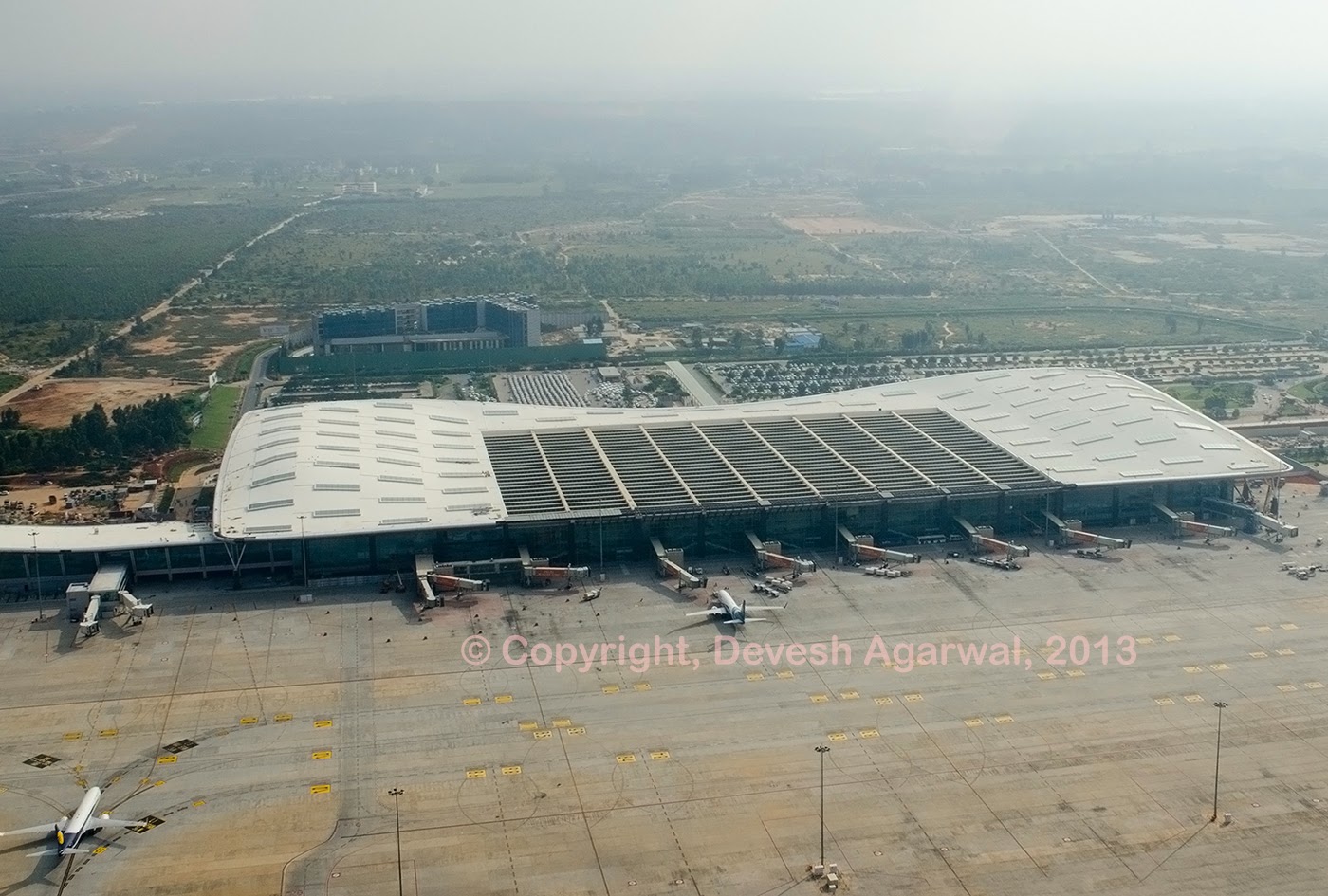
Upgraded terminal 1A at Kempegowda International Airport. The original portion is visible in the middle.
Along with the renaming, the upgraded passenger terminal, 1A, was inaugurated. The new terminal will be progressively introduced for passenger use starting from January 2014.

T1A, will almost double the floor space of the terminal, and is expected to cater to 20 million passengers. Mr. G.V. Krishna Reddy, the chairman of GVK Power and Infrastructure Ltd., the majority shareholder of BIAL, also indicated that the airport will now commence on planning for a new mega terminal 2, and a second runway that should see the airport build a capacity of up to 40 million passengers.

Upgraded terminal capabilities

The graphic below compares T1 with T1A. Comparisons aside, the new areas have a distinctly superior air. Almost like a five star hotel lobby.

The domestic portion on the west side of the terminal (right side of the picture) will commence operations first. The east side of the existing terminal which serves international traffic at present will remain for international traffic use which the area behind the existing immigration, customs and security will be built for international use.

Luxurious bathrooms await passengers in terminal 1A.

At a future date, not yet disclosed, but expected near March 2014, the new customs, immigration, and baggage reclaim hall will be completed, at which time the east portion of the existing terminal will be converted to domestic use, and the international operations will move to the new east hall (left side of the picture, under the new roof-canopy) and the extended pier will also be used.

In an environment first, the terminal building is LEED Gold certified for green energy use. 

Floor plans of Terminal 1A, Kempegowda international airport, Bangalore

Level 0, terminal 1A, Kempegowda international airport, Bangalore. Bus gates domestic, international baggage claim

Level 1, terminal 1A, domestic international contact stands, departures. Level 2 domestic close-up day hotel, lounges
Level 2, terminal 1A. Domestic lounges, international arrivals, immigration, extreme right Code F departures and lounge.

Lounges, day hotel, and food options

Now, there are reasons to get to the airport early. The domestic portion of the terminal will see a dramatic improvement in the lounges, with two of them opening up. Of significance to Citibank PremierMiles Mastercard holders, and other credit cards, one of the two lounges opening is by Plaza Premium. Overlooking the departure gates, the lounge is very much in the style of Cathay Pacific's The Wing lounge at Hong Kong airport.

Restaurants are upscale, and focussed towards local cuisine.

There is also a day hotel, located on the third level above domestic departures in the far west of the expanded terminal, offering bed-capsules for travellers wanting a quick rest and shower between flights or for passengers from slightly distant cities like Mysore, Tumkur, Salem, etc. The airport authorities are going to have to work out the modalities with the security agencies for international passengers to use the hotel, or early arrivals from close by cities like Mysore, Salem, etc.

Coming back to the lounge front, international premium passengers are doomed to suffer. The new wing while providing for new lounges, will expand lounge capacity by a small fraction over the existing Oberoi group operated lounge, was is forced to continue well past its contract period, supposed to end in October 2013. Oberoi did not get a contract to operate either of the two lounges, and naturally, their interest in operating the existing lounge is low. Despite the best efforts of BIAL staff, the Oberoi lounge provides a very sorry departing experience to the premium passengers.

Security check area shows a distinct five star look and feel of the new terminal.


Lounges are crucial to the passenger experience at hub airports. While the new international lounges are expected to be more luxurious than the existing, it remains to be seen whether these lounges will match up to the likes at Singapore Changi, Dubai, or even New Delhi IGI airports.

One of the two new lounges will be Plaza. Given its relatively small size, it is not clear whether credit card holders will be permitted entry. There is one lounge area being considered at level 2 of the east most gate (right side of floor plan photo) which is a Code F and can be used by an Airbus A380. Will Lufthansa use this area for creating a dedicated lounge? Let's see.

Photography at the terminal

Airplane photo buffs will be able to enjoy great views at the west end of the airport which should allow for a panoramic view of the apron. Head out near the new gate 1 any time before noon and click some photos. The best time of the year to take photos will be from September to April after which the sun will be north of the airport and many photos will be back-lit.

Photography from the terminal is permitted by the DGCA. You can read this article for more details and the relevant notifications which we suggest you keep a print out of.
Read more »

DragonAir takes advantage of expanded Bangalore airport terminal capacity to improve flight schedules

by Devesh Agarwal

The new expanded terminal at the Bengaluru International Airport (BIA) will be inaugurated this Saturday, December 14th. At the same time the airport will be re-named in honour of the founder of Bangalore, as Kempegowda International Airport, Bengaluru (KIAB).

Aerial view of the expanded terminal at Bangalore airport.
Aerial view of the expanded terminal at Bangalore airport. Photo copyright Devesh Agarwal. All rights reserved.
With the addition of four international gates on the east pier (in the picture above, only the first gate is visible on pier on the left of the photo), airlines have improved access during the prime desired time from 11pm to 1am.

Cathay Pacific's subsidiary DragonAir, which operates a daily A330 service between the city and Hong Kong is one of the first airlines that will take advantage of the expanded capacity of the new terminal.

Its existing poor time slot departs Bangalore at 02:40 and arrives in Hong Kong around 11:00 causing many passengers to miss the morning connections to many onward destinations.

From the Summer 2014 schedule DragonAir will pull forward its schedule. As per Rakesh Raicar, Sales and Marketing Manager - South Asia for the airline group,
“We have already revised our timings from Bengaluru and effective 30 March 2014, Dragonair will depart at 0130 from Bengaluru to Hong Kong. This decision to revise the timings was taken to offer our passengers an early arrival into Hong Kong and greater access to our extensive network. With a departure time of 0130, we will be able to offer better connections to the various cities we operate to, in China, Japan, Korea, North America and Australia.“
With this departure, arrival will be at 10:00. Better than the current 11:00, but still not ideal. In our opinion, DragonAir should try to advance their departure another hour, depart by 00:30 and arrive into Hong Kong by 09:00. To achieve this, the airline will have to advance their Hong Kong departure from the current very late 22:40 to around 20:30, which is still a very good time for both business and trade passengers.

Which other airlines, if any, do you feel should change their schedule at Bangalore? Share your thoughts via a comment.
Read more »

Trip report: Air France A330-200 business class Bangalore Paris Mumbai - new service attitude is producing results

by Devesh Agarwal

Until recently, like many others, I was under the opinion Air France was a stuffy airline, an uncaring crew, and one I was not likely to fly any time soon. Recently, I was a guest of Air France to attend the launch of their new "Best and Beyond" campaign in Paris, and had the opportunity to fly the airline in business class from Bangalore to Paris and back to Mumbai.

Air France A330-200 business class cabin.
Blue and white are soothing colours in the calm oasis of the Air France business class on board the A330-200

I also flew the airline, on my own account, in economy class between Paris CDG and Amsterdam Schiphol.

Over the coming weeks, I shall review various aspects of the airline, including trip reports, the Paris Charles De Gaulle hub, the Salon lounges, and also the Best and Beyond campaign.

Trip Report

Today, we commence with the trip report Bangalore to Paris Charles De Gaulle. AF191. Scheduled departure 01:50. Actual departure 02:30 (40 minute delay). Scheduled arrival 08:35. Actual arrival 08:50. Aircraft Airbus A330-200 registration F-GZCE.

Click on the photos below to see a high resolution light-box view.

New attitude

A critical component, of the new "Best and Beyond" initiative, meant to bring passengers back to Air France, is staff attitude. The change is visible starting right from the kerbside. I found a porter with a SkyPriority plaque waiting when you arrive.

The SkyPriority service is offered to all premium class passengers from Premium Economy upwards, and to all SkyTeam elite members from Silver level on upwards. Other than the erstwhile Kingfisher, I have not seen any other airline offer a kerbside porter service in Bangalore. Even overseas, I have seen it offered only to first class passengers.

Air France SkyPriority porter service at Bengaluru international airport Bangalore India kerbside
SkyPriority porter at Bangalore airport kerbside.

Check-in, lounge and boarding

Despite my many requests for him to help other passengers, the porter insisted, and whisked me in to the terminal, expediting the cumbersome passport check by the CISF. I was late, arriving at 1:05am for a scheduled 1:50am flight, but which was delayed to 2:30am. Check-in was smooth, quick and efficient. My boarding passes were issued, and my baggage checked, all the way to Amsterdam.

SkyPriority Check-in express lane Air France Bengaluru International Airport Bangalore, India
The SkyPriority lane at the check-in desks at Bengaluru International Airport.

Off I went, through immigration, on to the customs desk to declare all my camera equipment, and then through security, where I am required to take out each piece of camera equipment before scanning the bag, and where my cigarette lighter was seized, as it is not allowed. This is contradictory to my experiences at the security checks of 12 different airports in three continents I have been to in the last six months. But security checks at Indian airports are a whole different subject.

I barely had time to step inside the Oberoi run lounge at the Bengaluru International Airport, and I was thankful. The lounge is badly over-crowded, stuffy, hot, and poorly equipped to handle to the volume of premium passengers departing Bangalore. I am told that the new terminal expansion will solve this problem. Expect a separate article on this subject later.

Boarding was a smooth affair, and well managed.

Cabin product

You step in to a very calm and soothing cabin decked out in navy blue and white. Air France aircraft may have a reputation for being dirty looking on the outside, but the inside was spic and span. The smiles and welcome by the cabin crew, were genuine and warm.

Note: All the pictures below were shot, by me, in the natural light of the cabin. No flash was used

The business class has 40 seats in two sections, in a six abreast 2-2-2 layout. 61 inch pitch and 21.5 inch seat width. It features shell seats and unlike some of the other angled lay flat seats, has a good headrest which conforms to the rest of the seat when it reclines fully. The arm-rest goes down during the recline adding to the width. You will also find the lack of the bottom end of the leg-rest. Instead Air France provides a type of cubby-hole inside the seat-back which I found more comfortable than any of the lay-flat seats I have experienced till now. I am a notoriously poor sleeper on angle lay-flat seats, but I did manage about four hours in Air France, which is the longest. So the seats win my seal of approval.

Air France A330-200 business class seat. Sitting and reclining positions compared.
Business class seats in the upright and fully reclined position

Unlike other premium economy cabins which are more of an upgraded economy class, on the Air France Airbus A330-200, the premium economy cabin almost identical to the business class cabin, with the exception of the one additional seat to give a seven abreast 2-3-2 layout. There are 21 seats in three rows. 38 inch seat pitch, 19 inch seat width. I was later informed that Air France is the only airline that uses the similar shell seats in its premium economy class.

Air France A330-200 Premium Economy class cabin
The Premium Economy class with shell seating, exclusive to Air France

The economy class cabin is bright in the national colours of France, blue, red and white. The 147 seats are in the Airbus standard, eight abreast in a 2-4-2 configuration. 32 inch seat pitch, 18 inch seat width.

Air France A330-200 Economy class cabin
The national colours of France, blue, red and white, reflected in the economy class cabin

The trip, service, meals, in-flight entertainment

We departed at 2:30am, about 40 minutes past our scheduled departure. Trip time 10h15m. The flight route was from Bangalore, NNW, over Mumbai, turning WNW skirting the southern coast of Pakistan, turning NW entering Iran near Chabahar close to the Pakistan border, through Azerbaijan, over Tbilisi, Georgia, over Sevastopol in Southern Russia, Moldova, turn westerly, skirting northern Romania, Hungary, Slovakia, southern Czech Republic, Germany, in to France.

The flight was quite bumpy from take-off, so meal service was slightly delayed. The French are gastronomes and the meals reflect it. The fish I had was on of the better ones I have had anywhere, on board, or on ground. Deliciously prepared, cooked to creamy perfection, not rubbery at all.

Supper meal service Air France business class
Fish entree, supper, post take-off, Bangalore to Paris.

Air France business class Bangalore to Paris, supper and breakfast meal menu
Bangalore to Paris, supper and breakfast menu

The wine list was unusual and offered decent wines, but are not a match to the cellars of Singapore Airlines, Emirates, Qantas, or even Lufthansa. Considering wine and France are inseparable, this is an area the airline has to improve on.

Air France business class wine list September 2013
Air France business class wine list


The pre-arrival breakfast service was good. Nice breads, butter, preserves, and an espresso machine on-board for my double espressos kept me happy.

Breakfast pre-arrival meal service Air France business class
Breakfast service prior to arrival in Paris

Through the flight, the crew puts out a small buffet near the galley with fruits, cheeses, small sandwiches, nuts and chocolates for those wanting a small snack.

Through the flight the cabin crew service was good, attentive and responsive. While Air France still has a way to go before it catches up to the leaders Singapore Airlines and Cathay Pacific, the change in attitude is refreshing, and service levels are close to its main European competitor Lufthansa. This is a crucial advance for Air France in its efforts to attract back lost passengers.

If there was a let down, it was the in-flight entertainment (IFE), audio video on-demand (AVOD) system. While the content was good, it was fairly limited, and the screens are not too big. The user interface, and its navigation is, clunky and tests your patience. For a passenger flying Air France long haul about two or three flights a month, it is okay, but more than that, and you will start feeling the pinch of the lack of volume in terms of content.

Paris Arrivals lounge

All Air France-KLM long haul international flights to and from Paris CDG airport are from terminal 2E on concourses K, L, M. The concourse names are no coincidence. Air France had ground staff stationed who patiently explained each enquiring passenger how to get to their respective flights. Another sign of the changed attitude at Air France.

A hidden gem of information, at Paris, is the Arrivals Salon Lounge of Air France. Tucked away at the junction of terminals 2C and 2A, this petite lounge is easy to miss. I must apologise to you, our dear readers, but the memory card of the pictures of this lounge got corrupted, and I have none to share with you at the moment. If I can revive the pictures in any way, I will surely share them.

If you are arriving in to Paris, or have a longish connection (two or more hours) to a Schengen country, this lounge is a must visit. It has a great set of shower facilities, with one of the most complicated shower temples I have seen. Multiple jets blasting hot water just soothe those tired muscles. The lounge provides a complete toilet kit with L'Occitane en Provence personal care products, including a razor and toothbrush.

Once showered, there is a great breakfast. Despite a small area, I found the breakfast spread better than the large Salon departure lounges in concourse K when I departed back to Mumbai. There is the usual fantastic French breads, along with butter, preserves, and charcuterie. Eggs, fruits, yoghurt, crackers, cheese, varieties of drinks complete the feast.

Paris Amsterdam Paris domestic flights

Showered and fed, I headed to terminal 2F from where all the Air France flights to Schengen countries depart. Very honestly, this one hour flight both onward to Amsterdam and return, was extremely routine, pretty much any other short-distance domestic flight. However, even on this short duration, the change in Air France attitude was noticeable.

Air France A320 cabin. The business class has the centre seat blocked off and marked with a navy blue head rest cover.

The arrival concourse of Terminal 2F is extremely futuristic with its metal and glass construction. Makes on feel like they are in some Sci-Fi movie.

The futuristic looking Terminal 2F arrivals at Paris Charles De Gaulle airport

Paris Mumbai flight

An almost carbon copy of the Bangalore Paris flight, except for a more elaborate lunch starting with an L'amuse-bouche, appetiser, main course, cheese tray, and dessert. Great for a foodie like me.

Air France business class Paris to Mumbai lunch and light meal menu
Paris to Mumbai lunch menu

The aircraft coincidentally was the same one I had flown from Bangalore to Paris, just five days earlier, Airbus A330-200 registration F-GZCE. We departed on schedule, and thanks to some fantastic tailwinds, made it to Bombay one hour ahead of schedule.

Summary

I flew Air France after a gap of almost 25 years. The business class is much like other European carriers, but with a much more calm and soothing touch, compared to the energy of Lufthansa's new business class. The change in crew attitude was refreshing, and it appears to be yielding results. There was only one seat free in business class, and none free in premium economy on my outbound flight. Even on the return to Mumbai, the flight had just one seat empty.

I was informed later, that AF191/192 the Paris Bangalore route goes full almost all days of the week in both business and premium economy classes. If anything, Air France has spare seats only in economy class. Considering it was a Thursday night I flew to Paris, and a Wednesday morning I returned to Mumbai, this shows the positive results of a good overall hard and soft product.

Note: I was a guest of Air France on the India to Paris segments. The Paris Amsterdam v.v. segments were on my account.
Read more »

Bangalore International Airport introduces official airport app for BlackBerry smartphones

by Devesh Agarwal

The operator of the Bengaluru International Airport, Bengaluru International Airport Ltd., has announced the launch of its official ‘Airport Guide Application’ for BlackBerry® smartphones for all information relating to services at the airport. The free app is designed for both BlackBerry® 10 and BlackBerry® OS smartphones (running OS 5 or higher), and is available for downloads on the BlackBerry® World™ storefront.

The app offers comprehensive information on arrivals and departures of local and international flights, location of parking slots, rates, transport services and more.
Read more »

Singapore Airline's passengers suffer consequences of IndiGo accident

by Devesh Agarwal

Its Friday, the 13th, and many a frequent flyer will sympathise with the bad-luck of the passengers on Singapore Airlines flight SQ503 from Bangalore to Singapore earlier this morning.

The inbound flight SQ502 from Singapore scheduled to arrive at Bangalore around 10pm, was diverted to Chennai due to the runway closure at Bengaluru International Airport following the accident of IndiGo airline flight 6E-125 around 8pm last night.

The in-bound passengers waited and finally the runway at Bangalore was opened around 11pm. SQ502 finally arrived in Bangalore around 2am early this morning.

The return flight SQ503, left around 3am, about four hours behind schedule. The crew realised that they would exceed their Flight Duty Time Limit (FDTL). Hurried parleys were made with headquarters, and a decision was taken to divert to Bangkok. In the mean time, a stand-by crew was flown from Singapore to Bangkok to crew SQ503 back to Singapore.

The aircraft was on the ground in Bangkok for less than a hour, and SQ503 finally arrived in Singapore at 1pm, seven hours behind schedule.

Image courtesy Google maps.
All I can do is shake my head and sympathise with the passengers, but at the same time, give credit to the crew for thinking up of a solution.

If they had continued even to Kuala Lumpur, they would be in breach of the regulations.

Had they stayed back in Bangalore, the earliest a replacement crew could come would be on the morning SilkAir flight. This would mean the SQ503 flight would reach Singapore only around 5:30pm, and connections to the US west coast would be missed.

Already the existing delay meant that the morning connections to the United States, Asia, and Australia were missed. The Bangkok diversion allow the airline to try and make up some of the connections in the evening. However, considering this is the weekend, the airline staff in Singapore has their work cut out for them.

What are your thoughts? Share your frequent flyer gaffs via a comment.

Read more »

Bangalore airport shut down as IndiGo flight veers off runway

by Devesh Agarwal
IndiGo Airbus A320 VT-IGV at Bengaluru International Airport. Photo copyright Vedant Agarwal. Used with permission.
At approximately 20:10 (14:40Z), an IndiGo Airbus A320-232 registration VT-IGV performing flight 6E-125 from New Delhi to Bangalore, with 110 passengers and six crew (two pilots, four cabin crew), veered off the runway 27 while attempting to land at Bengaluru International Airport (BIA) during heavy rains and cross-winds.

The aircraft damaged five runway lights and suffered burst tyres, finally stopping near taxiway Foxtrot, and blocking the sole runway 09/27. There were no injuries.

All flight operations at the airport were suspended till repairs to the aircraft were carried out and it was towed to the apron. Flight operations resumed almost three hours later at 22:55 (17:25Z).

A number of flights both domestic and international were diverted to neighbouring airports like Chennai.

The airline released this statement
IndiGo flight 6E–125 from Delhi to Bengaluru, while landing on runway 27 at the Bengaluru airport at 20:10 pm, landed to the right of the center line, while experiencing heavy rains upon landing. The aircraft veered to the right and contacted 5 runway edge lights which led to deflation of the right main tyres. The aircraft was controlled and was taxied off the runway onto taxi track ‘’Foxtrot” and stopped.

All 110 passengers and six crew on board are safe with no injuries reported and have been de-planed safely from the aircraft to the terminal.

As per the operating procedure, the aircraft will be grounded for maintenance work. The matter has been reported to the DGCA and the safety department of IndiGo and DGCA will inquire further into the matter at the earliest.

At IndiGo, we are committed to passenger comfort, and safety is our highest priority. Hence, there can be absolutely no compromise on safety.
In April 2009, in a very similar incident, a Kingfisher Airlines Airbus A320-232 VT-KFT also veered off runway 27 in heavy rain and winds, and damaged runway lights. (Read that story here). At that time the runway was shut for less than 55 minutes. A shut down of three hours with the aircraft stopping on the taxiway suggests significantly more damage to the aircraft than IndiGo is claiming.
Read more »

Write to AERA about proposed airport charge hikes at Bangalore


The Bengaluru International Airport Ltd. (BIAL), which operates the Bangalore airport, is proposing hikes in User Development Fees (UDF) of up to 750%!!!

From the existing Rs. 231.40, BIAL has proposed to the Airport Economic Regulatory Authority (AERA), revised UDF of Rs. 1,729.43. Even international passengers will see an almost doubling of their UDF from the existing Rs. 952.30 to Rs. 1,700, and the operator would like a 6% year on year automatic increase.

The CEO of Teamlease, one of India's largest HR companies and a frequent flier, in a recent newspaper article complained
Bangalore airport doesn't have clients but hostages who are currently forced to pay ......
AERA has put out a consultation paper, and has already conducted a stakeholders consultation meeting on this issue. Minutes of the meeting can be read here. AERA has called for submissions on this topic.

While the government favours a single-till system, where all income is clubbed and then fees are decided, BIAL, like all other airports in India, wants a dual-till system, where only aeronautical revenue is considered, and all non-aero revenue is not. Quite naturally, there is a huge difference of almost 100% in the UDF based on the differing till systems.

For more detailed understanding of single-till and double-till system we recommend reading here, here, and here

Bangalore Aviation urges you to please read the consultation paper even though it is 300+ pages, and send your submissions to AERA before 19-September-2013.

Read more »

Mysore Bangalore airport direct 'FlyBus' service now operational

by Devesh Agarwal

On Wednesday, the Karnataka State Road Transport Corporation (KSRTC) inaugurated its luxury 'FlyBus' service which will connect the city of Mysore direct to the Bengaluru / Kempe Gowda International Airport in Bangalore.

The service will be operated by a 40 seat luxury Volvo B9R twin-rear-axle bus, complete with a pantry, chemical toilets, 2+2 semi-sleeper seating with 70 channels of in-seat video.

The bus will be equipped with GPS tracking systems which will provide up to date bus arrival information. The bus will also have a facility to display real-time flight arrival and departure information.

The bus will operate two services 12 hours apart in each direction. The bus departs Bangalore airport at 09:45 and 21:45 arrives in Mysore at 13:45 and 01:30 respectively. On the return, the bus shall depart Mysore at 02:00 and 14:00 to arrive at Bangalore airport at 05:45 and 18:00 respectively.

The fare for the service including snacks on board is Rs. 995. The FlyBus help line at the airport is +91 99722-13726. The main call centre is at +91 (80) 4455-4422. You can book FlyBus tickets online at the KSRTC website.

Visit here for a slide-show on the features of the FlyBus.
Read more »

Visa on arrival service now operational at Bangalore

by Devesh Agarwal

The Visa on Arrival service is now operational at the Bengaluru International Airport. Visitors from 11 countries, Japan, Singapore, New Zealand, Philippines, Indonesia, Luxembourg, Finland, Laos, Vietnam, Myanmar and Cambodia are eligible for this service.

The visa will be issued at the immigration desk and will be valid for a maximum period of 30 days. The airport authorities BIAL, will provide separate desks, special seating arrangements and appropriate signage. In the future, the facility will have an enclosure for photographing foreign nationals and currency exchange counters.

Visa on Arrival shall be granted to foreign nationals who are visiting India on recreation, sightseeing, short duration medical treatment or casual business visit. The tourist must hold a valid passport with minimum six months validity. Documents required to be presented at the counter are:
  • passport
  • two passport size photographs
  • photocopy of passport
  • hotel booking confirmation (if possible)
  • return ticket.

A fee of US $60/- or an equivalent amount in Indian rupees per passenger (including children) will be charged for the grant of Visa-on-Arrival. Travellers will be able to obtain single-entry tourism visas, which will be valid for 30 days, which can be extended, in special cases, to 60 days.

More information can be obtained from the Bureau of Immigration website.
Read more »

Bengaluru International Airport renamed as Kempe Gowda International Airport

The renaming of Bangalore's Bengaluru International Airport (BIA) to Kempegowda International Airport received approval from the Union Cabinet yesterday.

The lower house of the state legislature, the Karnataka Legislative Assembly, passed a unanimous resolution on December 10, last year and the upper house, the Karnataka Legislative Council, also passed a similar resolution two days later to rename the airport.

Hiriya Kempe Gowda commonly known as Kempe Gowda I or Bengalooru Kempe Gowda was a ruler under the Vijayanagara Empire, who is considered to be the founder of the metropolis of Bangalore, the capital of the Indian state of Karnataka. Kempe Gowda was a well educated and successful ruler. Noted for his progressive thinking, he ushered the foundations of a modern city with successful planning and building the current city building many temples and water reservoirs in Bangalore.

Bengaluru International Airport (BIA) is the sole airport serving the Bangalore region. It was commissioned and became operational on May 24, 2008. It is owned and operated by Bengaluru International Airport Pvt. Limited (BIAL) a conglomerate majority (74%) held by GVK Group, Siemens Projects, and Zurich Airport, along with two government bodies, the Karnataka State Industrial and Infrastructure Development Corporation KSIIDC, representing the state of Karnataka, and the Airports Authority of India, representing the Government of India, each owning 13%.
Read more »

Emergency services at Indian airports capable of handling Asiana San Francisco type crash

by Devesh Agarwal

The recent crash of Asiana Airlines flight OZ-214 at San Francisco International airport showcased the quick and heroic efforts of both the airport's emergency fire and rescue services and the cabin crew. Praise has flowed to both of these sets of people for their actions which resulted in minimal loss of life and injuries.

Prompted by this crash, Bangalore Aviation reader Anil Arvindam, wrote in the other day
"How prepared are our airports in India? Are our fire-fighters trained to respond like this San Francisco did?"
The short answer is a resounding YES. The details though are worth exploring.

ARFF / RFFS / CFR

DIAL_ARFF_Fire_FighterThere are many acronyms given to this specialised fire-fighting service. In the United Kingdom it is RFFS (Rescue and Fire Fighting Services), in India and the United States it is ARFF (Aircraft Rescue and Fire Fighting), in some parts of the US and in the Philippines it is Crash Fire Rescue (CFR). In this article we'll follow the Indian standard of ARFF. ARFF is a very specialised category of fire-fighting that involves the response, hazard mitigation, evacuation and rescue of passengers and crew of an aircraft involved in an emergency at, or near, an airport.

Rescue and fire-fighting services at airports in member countries are governed by standards of the International Civil Aviation Organisation (ICAO), pronounced "Eye Kay Oh". For example, ICAO Document 9137-AN/898, Airport Services Manual, Part 1 guives unform guidance in an effort to provide standardised levels of emergency services, across the world. The respective national civil aviation regulators like the Directorate General of Civil Aviation (DGCA) in India, or the US Federal Aviation Administration (FAA), in turn publish and enforce the rules and requirements.

ARFF normally will respond to all aircraft emergencies within an airport's boundaries and will also respond to emergencies outside the airport boundaries, typically in a six degree cone from the end of each runway, out to about eight kilometres and there is an defined understanding with the city emergency services on the respective roles and responsibilities to an 'off-airport' incident.

ARFF will also respond to non-aircraft emergencies within airport boundaries, but ARFF will not respond to non-aircraft emergencies outside the airport as this will leave the airport without adequate protection.

All the major airports in India are compliant with ICAO and DGCA norms for emergency services and are audited regularly. By rules if an airport has inadequate or no ARFF cover, it has to close its runways to passenger paying aircraft unless in an emergency, and even then, use of the airport is at the discretion of the commander of the aircraft.

The trend to modern ARFFs was initiated by the private airports of Bangalore, Hyderabad, New Delhi and Mumbai. Soon after, even the Airports Authority of India (AAI) run airports like Kolkata, Chennai, Ahmedabad, Amritsar, etc., migrated from their vintage Tata-Leyland trucks to modern ARFF stations and equipment.

Airport Category and ARFF capacity

The size of the ARFF facility at an is determined by the airport's category rating. The number of fire-stations at the airport are determined by the response time requirement which is detailed in the next section.

The category of the airport is based on the size of the largest aircraft that lands at the airport and is also tied in to the number of runways. The table below shows how category is determined, and then for each category what is the requirement of fire tenders, water, chemicals, foams, etc.

The British system is from Category 1 to 10. This system is also followed in India. The US FAA mandates a category system from A to E, and is also tied in to the number of daily departures of the largest size aircraft. FAR Part 139, Sec. 139.315, and FAR Part 139, Sec. 139.317 provide full details.

How an airport's fire-fighting capabilities and capacities are determined.

Bangalore's airport is single runway and is rated 'Cat-9' since it regularly handles flights up to a 747-400 i.e. Code E size. However, since 2012, the airport also regularly handles one daily flight of a Lufthansa Boeing 747-8i which is Code F size, the same as the A380, and this requires the airport to temporarily increase capability to the highest category, 'Cat-10', rating for the duration of that one flight. As airport spokesperson Anjana explains
ARFF scales up to Cat 10 for the period of operations of 747-8 by augmenting additional manpower out of the shifts during this period)

Response Times / Airfield Crash Fire Tenders

Fire is a major risk during any aircraft emergency. With wide-body aircraft now carrying over 300 passengers regularly, the potential of an emergency turning in to a mass casualty has increased in recent years. Keeping the fire risk in mind, safety regulations require an aircraft should have enough exits to be able to evacuate all passengers within 90 seconds.

Similarly, the arrival of the ARFF team(s) at the scene is of paramount importance. In air traffic control (ATC) towers around the world, there are emergency push-buttons within close reach of controllers which set off alarms blaring. The response time norms require ARFF teams to arrive at the scene within two minutes, for 'on runway' incidents, and within three minutes for 'off-runway' incidents anywhere within the airport perimeter.

This response time requirement has resulted in the development of specialised Airfield Crash Fire Tenders (ACFTs) which can only be described as "super trucks". Weighing well over 25~30 tons, twice more than a regular road truck, these tenders can accelerate to 100 kmph in under 30 seconds, thanks to special engines developing between 700 BHP to 1,000+ BHP, about the same power as a Formula 1 car. Taking a leaf from the racing cars, these trucks make extensive use of high strength, low weight, composite and fibre-glass parts.

Rosenbauer Panthers of Bangalore International Airport ARFF. The floor spray extinguishes ground fires ahead of the tender.

ACFTs are fitted with specialised suspensions that allow them to corner at high speeds like a sports car, go up slopes of over 60 degrees, or travel on a tilted embankment sloped up to 30 degrees. These trucks incorporate latest technology and automation. Forward looking infra-red (FLIR) allowing the fire-fighters to see in complete darkness, whether at night or in the black smoke of a fire, multiple spray nozzles, with individual remote controls, enabling fire-fighters to fight fires from inside the tender cabin, and much much more.

In India, due to the number of runways and its sheer size, Delhi's IGI airport has four fire stations. Bangalore airport has one station equipped with four Rosenbauer Panthers.


There are many vendors of ACFTs in the world. Rosenbauer of Austria, Iveco of Italy, and Oshkosh of the United States are major players. In India the Rs. 5 Crore Rosenbauer Panther 6x6 (6 wheels driving, 6 wheels total) is the preferred ACFT. At San Francisco Airport the ACFT of choice is the Oshkosh Striker 4500 8x8 which is a bigger and more expensive tender. Scroll down to see a video of the Striker in action at Dallas-Fort Worth International airport.

Oshkosh Striker 4500 of San Francisco International Airport ARFF.

In addition to the ACFTs, ARFFs and airports have other rescue equipment like high-lift turn-table ladders, ambulances, mobile intensive care units, power and hydraulic rescue tools, and special suits enabling fire-fighters to enter in to fires. Bangalore airport even has inflatable motor-boats just in case the emergency occurs on one the many lakes around the airport.

The airports have triage centres within the airport premises for trauma victims. Bangalore airport has special tie-ups with area hospitals like M.S. Ramaiah and emergency ambulance services to handle large scale trauma events.

Fire-fighters and Training

Human beings are a critical component of the airport's ARFF capabilities. At Bangalore Airport, with one ARFF station the team consists of 134 personnel working 24x7 in four watch shifts. Due to multiple runways, the ARFF at Delhi IGI airport has four stations and a significantly bigger team.

Continuous on-going training is a critical part of the ARFF operations. ICAO Annex 14, § 9.2.34 directs that: All rescue and fire fighting personnel shall be properly trained to perform their duties in an efficient manner and shall participate in live fire drills commensurate with the types of aircraft and type of rescue and fire fighting equipment in use at the aerodrome, including pressure-fed fuel fires.

In India, the Airports Authority of India (AAI) operates two ICAO approved training centres in New Delhi and Kolkata which trains ARFF personnel from across the country.

The fire fighters have to know by memory every aspect of the airport, and also the details for every aircraft that operates at the airport. Come an emergency, there is no time to be looking up books and charts. ARFF charts for Airbus aircraft can be downloaded here, and for Boeing aircraft here.

You can read a detailed paper on the various ARFF training methods across the world and their differences here.


In conclusion, we at Bangalore Aviation invite you to travel safely and with confidence. Air travel is the safest means of travel, and the heroes of the ARFF are on duty looking out for you.

If you would like to say thanks to them, post a comment. The PR teams at both BIAL and DIAL read Bangalore Aviation regularly and we are confident they will be happy to carry your compliments to their respective ARFF teams.
Read more »

AirAsia, Tatas and Amit Bhatia seek approval to start airline in India. Is SpiceJet the target?

by Devesh Agarwal

Malaysian low cost carrier AirAsia Berhad (Ltd.) through its investment arm, AirAsia Investment Ltd. (AAIL) has submitted an application to the Indian Foreign Investment Promotion Board (FIPB) seeking approval for AAIL to invest 49% into a proposed Indian joint venture together with Tata Sons Limited and Mr. Arun Bhatia of Telestra Tradeplace Pvt. Ltd. The expected holding in the JV is AirAsia 49%, Tatas 30%, and Arun Bhatia 21%.

Photo: Devesh Agarwal
This move comes amidst the backdrop of the September 2012 decision by the Government of India to open up the aviation sector to Foreign Direct Investment from foreign carriers.

AirAsia is one of the most successful low cost carriers in the world, and has created regional AirAsia airlines in Thailand, Indonesia, Philippines, and Japan in similar joint ventures like the one proposed for India.

The Tatas are a $100 billion conglomerate highly respected for their business values, and who used to own, then operate Air India prior to the government taking it over in the 1970s. The Tatas used to own close to 6% in Indian LCC SpiceJet Ltd., owned by the political heavyweight Marans who are related to DMK supremo Karunanidhi of Tamil Nadu. However, the Tatas claim their investment in SpiceJet is purely financial on with the two rounds of equity dilution at the airline, their stake is now down to less than 0.5%.

Mr. Arun Bhatia's son Amit Bhatia, is the son-in-law of one the richest men in the world, Mr. L.N. Mittal and serves serves on the Board of Directors at Queens Park Rangers Football Club in the United Kingdom alongside Tony Fernandes, the founder of AirAsia.

Subject to FIPB approval, the proposed joint venture company will make an application to Indian aviation regulators for the Air Operators Permit. The parties have signed a Memorandum of Agreement that details high-level terms with regards to the proposed partnership.

The airline, if formed, will be based out of Chennai, which will allow domestic connectivity to AirAsia's international operations.

This foray will mark a return of the Tatas to the airline and airport sector after almost 25 years. In the 1980s and 1990s, the Tatas had proposed a collaboration with Singapore Airlines to operate a domestic carrier and also to take over Air India. The Tatas had also collaborated with Changi Airport to develop the greenfield airport at Bangalore, which is now BIA. All efforts were thwarted by political opposition.

Our analysis

We are not sure how well this proposal will be received. India's civil aviation minister is on record with the Business Standard newspaper
“We are not giving licences for greenfield airlines. As of now, FDI (foreign direct investment) in aviation can come only through existing airlines."
Based on this premise, for the past few months, Jet Airways has been negotiating with Abu Dhabi based Etihad to sell a 24% stake in Jet for about $300 million. The Chairman of Etihad Sheikh Hamed bin Zayed al-Nahyan has already delayed the deal citing concerns on policy flip-flops. An approval to AirAsia will prove the Sheikh's point, and almost certainly scuttle the FDI initiative, announced by the government last year, which is essentially meant for rescuing India's debt-laden airlines and the banks who have already lent massive amounts to them.

We expect there will be strong, if not, insurmountable opposition especially with regards to existing Indian carriers like Jet Airways, SpiceJet and IndiGo, each of whom should not be discounted for their strong political connections.

So knowing all of this, why has this JV application been submitted? What do the Tatas, Bhatias, and Tony Fernandes know, that is not apparent?

Photo: Devesh Agarwal
If one was to go in to a conspiracy theory mode, the common point is SpiceJet.

From one side, the Tatas own a stake in the the airline. From the other side, Anthony Francis "Tony" Fernandes is in the very top Malaysian business tycoons circle, along with Mr. Ananda Krishnan, the Chairman of Maxis and Astro, both of which have been linked to the Maran brothers Dayanidhi and Kalanithi respectively, and Kalanithi Maran is the owner of SpiceJet, which has a need of funds for expansion.

Quoting from our Indian Aviation Review from earlier this year
Q400 operation is certainly a strong performer in SpiceJet’s tepid overall finances. The full order of 15 Q400s is now complete, and while SpiceJet has options to purchase 15 more from Bombardier, unfortunately it cannot find financing for the next 15 deliveries, which it desperately needs to expand the regional operation
May be Mr. Maran is wanting to exit the airline business?

What are your thoughts? Share a comment. Share this article on Facebook and Twitter. Start a discussion.

Read more »

The Kingfisher Airline's Airbus storage at Mumbai airport, ATR72 graveyard at Bangalore airport

In the Google Maps photograph below, you can see the storage yard, some may say, graveyard, of the Airbus fleet of Kingfisher Airlines at Mumbai airport.


View Larger Map

This parking area is at the 14 end of runway 32-14 next to the Kalina hangars of Air India.

From the top you can see an Airbus A330-200 parked in an East-West alignment next to the private jet. In the lower part of the image, from left to right, a representative of each of the Airbus jets in the Kingfisher fleet. 2 x A321's, 1 x A320, 1 x A319.

From a ground view the planes look somewhat like this.
Mean while, Bangalore airport is host to the ATR graveyard of the airline. This photo taken by me on October 24, shows the ATR 72-500 aircraft parked. The aircraft on the left of the picture have their engines stripped. The ones on the right are more recent additions, two of them without any logos on their tails, which typically means the airline does not own/lease them any more.


In related news, The Economic Times reports the Mumbai airport operator, MIAL, may ask Kingfisher to vacate the terminal, due to non-payment of dues.
Read more »

Trip report: Air India Boeing 787 Dreamliner Bangalore to New Delhi

I looked forward to my first Dreamliner flight with considerable excitement, and with some trepidation, since I gave up flying Air India in 1997. Made the booking via the Expedia website. An okay experience, but given a choice, I would make the booking directly on Air India website.

Air India AI505.
October 24, 2012 (Dussera Day)
From: Bangalore (BLR) Depart: 10:10
To: New Delhi (DEL) Arrive: 12:25
Aircraft: Boeing 787-8 Dreamliner (788) VT-ANI. Class: Economy. Seat: 17A

Check-in

I had web checked-in a day earlier, so I arrived at the airport around 09:00 in a relaxed state. This soon turned to absolute panic, when I discovered I left my wallet at home, along with all my money, credit cards, debit cards, ID's etc. Luckily I borrowed my son's debit card and withdrew some money, and my airport photographer ID badge lying in my camera bag bailed me out.

Check-in was smooth. Efficient, well dressed, well groomed, and courteous staff behind the counter. Hello Sir. Good morning. Thanks for flying Air India. Huh?!?!?! Is this Air India? When did this begin? Nice!!!

I also discovered that Air India allows you to check in 25kg against the 20kg norm on most domestic carriers. Check-in wait time: 1 minute. Check-in time: 30 seconds. and I was on my way to security.

Bengaluru Airport Restaurants

Browsed through the restaurants, but the menu choices were limited, and the Indian fast food restaurant keep telling patrons "Sorry, this is not available, that too is not available". When 2/3rds of your menu is not available, it is time for the airport authorities to look in to this matter. And other readers of Bangalore Aviation have complained to me in private about the lack of food choices in Bangalore. Bought a bottle of water.

Boarding

Strolled around the crowded departure lounge and arrived at the gate around 09:30. Here one can see the over-employment prevailing at Air India. About 12 staff mulling around the counter. Soon enough the aircraft pulled up to the gate.

At boarding we experienced the old Air India mismanagement. A haphazard, single line for boarding a full flight of over 225 passengers. People just cutting in to the line, while the 12 staff, including some managerial level, just stood there watch the show, either completely uninterested, or walking around like mindless automons not knowing what to do.

Despite announcing boarding by row numbers, the staff kept allowing passengers to board regardless. Being Dussera, the flight had its share of young mothers with equally young toddlers and infants, adding to the overall confusion. Rely on me to lead a group of passengers who goaded the ground staff in to some action and forcing them to impose discipline.

We experienced a 25 minutes delay, only due to the shoddy boarding. Thanks gate guys, you ruined the otherwise good airport experience.

On-board

We were welcomed with a smile. I got a seat over the wing. The electronic dimming windows have now become the latest play-toy for the cabin crew. The windows are kept dimmed, casting a dark pall on the interior.

The crew briefly brightens up the windows at take-off and at landing to comply with safety regulations, otherwise, the windows remain at 50% through the flight.

The cabin crew later informed me, this was being done after passengers on the Delhi Dubai flights were repeatedly punching the window share controls to the point of pushing the buttons in to the panels and breaking them.

The aircraft is quiet. I took this video at take-off and keep in mind, I was sitting right next to the monster GEnx engine.


In-flight service

Air India cabin service is traditionally inconsistent. We were lucky, this flight had the cream of the crop and we were well treated, even by international standards.

Do not ask me about the sky-aunties on the return flight. Their attitude would stun a team of oxen in their tracks.

About 30 minutes after take-off we were served some snacks. The food was above par compared to other domestic airlines, moist, tasty, and well heated.

After the meal service, I chatted with the crew and heard their horror stories on the boorish behaviour of passengers who fly Air India, mostly on the middle-east sectors.

Also heard about the constant grounding of the Dreamliners due to various technical faults. (My return flight which was also to be on a 788 was changed to an A330-200 VT-IWB due to a 788 grounding).

In-flight entertainment (IFE)


The in-flight entertainment is an AVOD (Audio Video On Demand) touch screen system by Thales. It has its bugs, but, by and large, performed well. Content is decent. One of the map views on the system is unusual.


Narrow uncomfortable seats

Air India has a very comfortable economy class seating in its Boeing 777 fleet, but for its Dreamliners, the airline has opted for a tight, nine abreast, 3-3-3 seating. The seats are narrow and uncomfortable. Even my daughter who weighs only 50 kgs, complained of the seats. It is okay for small to mid-sized (up to 75kg) adults.

I was able to survive only because the middle seat next to me was occupied by a precocious five year old, and I was able to steal about two inches from her seat by raising the arm-rest.

The narrow arm-rests also pushes the window seat in to the side panel and broad shouldered persons like me get pushed away from the side wall and have to sit tilted. You would be well advised to stay away from the window seats, or better still, away from the Dreamliner all together.


Unfortunately, most airlines, including Qatar Airways have opted for this bone-crunching, high density, 3-3-3 seating. How passengers are going to survive long trips in this aircraft is beyond me. In this respect the Dreamliner is positively a Nightmareliner.

We arrived in Delhi 25 minutes late, and taxied around Terminal 3. There were over 50 ground crew waiting to receive the aircraft (yes we know Air India is an employment paradise). Yet it took the crew over 10 minutes after chocks on and engine off to open a door. We all had to exit via the rear since the aircraft was docked at an international gate.

Hurriedly took a few shots of the cabin in the bright sunshine and exited. Boarded a bus, driven by a potential candidate for the upcoming Formula 1 New Delhi Grand Prix weekend. Never knew a bus could be turned at 5Gs.

Baggage came pretty fast.

Read more »

Air India's Boeing 787 Dreamliner suffers minor bird hit while landing at Bangalore

Like a new car getting its first scratch, Air India's first Dreamliner suffered a minor bird hit while landing at Bangalore earlier this morning.

Air India Boeing 787-8 VT-ANH performing flight AI803 from New Delhi, with 127 passengers, suffered a bird hit while landing on runway 27 around 09:00 (03:30Z) at Bengaluru International Airport, Bangalore. The bird, struck the fuselage, and was not ingested in to the engine. The crew performed a normal landing and taxied to the gate and passengers disembarked normally.

The aircraft was thoroughly inspected and no damage was found. The aircraft performed its return flight AI505 to New Delhi with a delay of 30 minutes.
Read more »

Pictures: Air India 787 Dreamliner gets water cannon salute on first arrival at Bangalore

On the auspicious day of Ganesh Chaturthi, Air India commenced commercial service of its Boeing 787 Dreamliner. VT-ANH, performing flight AI403 from Delhi was given the traditional welcome, on its first arrival at Bengaluru International Airport, a water cannon salute by the airport's fire-fighters (ARFF).
Air India 787 Dreamliner VT-ANH gets water cannon saute by ARFF on its first flight at Bangalore Airport.

The Dreamliner, carrying 173 passengers, touched down around 21:06, delayed by almost two hours late due to a failure of the air-conditioning system just as it was departing Delhi airport.


The aircraft was welcomed by senior officials of Air India, and a delegation from Bengaluru International Airport Limited (BIAL), led by Hari Marar, President, Airport Operations. Airside, virtually everyone connected to the aircraft, including engineers from engine manufacturer General Electric were present.

On arrival, the aircraft was given the traditional 'puja' accorded to new vehicles including the flight crew breaking a coconut to ward off evil spirits.


All these ceremonies took a toll on the turn-around time. The Dreamliner departed on its return flight to Delhi around 22:45, nearly three hours late, with 126 passengers on board, along with India's External Affairs Minister S. M. Krishna.

Read more »

Photo: Lufthansa Boeing 747-8i D-ABYA gets water cannon salute at Bangalore

In the very early hours of September 13th, Lufthansa landed its first Boeing 747-8i at Bengaluru International Airport. The B748 service on flight LH754 from Frankfurt to Bangalore commenced one day earlier than announced since Lufthansa was able to complete its fleet induction of the newest 748 D-ABYD, one day earlier. Keeping with tradition, the fire-fighters and rescue teams of the ARFF gave D-ABYA the water cannon salute, signifying the first flight by this aircraft type.

A piece of trivia for us AvGeeks. D-ABYA, the first Boeing 747-8i has performed the first flights to all the three existing Lufthansa 748 destinations -- Washington Dulles, New Delhi, and now Bangalore.

Below is a picture, courtesy Lufthansa.
Lufthansa Boeing 747-8i LH754 Frankfurt to Bangalore Water Cannon Salute D-ABYA
The Boeing 748 features Luthansa's new business class which was recently reviewed by Bangalore Aviation.

Read more »

Photos: Bengaluru International Airport - Terminal 1 expansion in progress

Late last week, I traveled through Bengaluru International Airport (BIA) on my way to Mumbai traveling on Air India. While the trip report for that flight will be posted at a later date, I managed to snap a few pictures of the construction currently going on at the airport. Back in 2010, Bangalore International Airport Limited announced a Rs. 1000 Crore ($222 million then, around $180  million now) expansion that would more than double the airport's floor space. Find attached below several of these pictures.


Read more »