Showing posts with label Tokyo. Show all posts

AirAsia X to commence flights to Nagoya

By BA Staff

AirAsia X Berhad, the long haul affiliate of the AirAsia Group, announced the launch of its third destination in Japan; Nagoya.

AirAsia X will commence its first flight into Chubu Centrair International Airport from Kuala Lumpur beginning 17 March, 2014.

AirAsia X will commence four weekly flights into Nagoya, Japan. The airline currently operates daily flights to Tokyo (Haneda) and four weekly flights to Osaka (Kansai) from Kuala Lumpur.

Azran Osman-Rani, CEO of AirAsia X said:
"We are excited to announce our latest route to Nagoya, marking our 3rd destination into Japan. This marks another milestone for AirAsia X and reiterates our expansion commitment in the key markets we operate in with the Asia Pacific Region. With the addition of Nagoya, guests will have more travel options to explore Japan, and we believe Nagoya being a scenic and historical destination will be a popular tourist destination. We have carried over half a million passengers to and from Japan. Japan contributed over 14% of our total revenue in the first half of 2013. Nagoya is strategically located just 50 minutes from Osaka and 1 hour 40 minutes from Tokyo via train. Guests may soon fly direct to Nagoya, and take a train to the metropolitan and capital city of Japan; Tokyo or visit the commercial centre of Japan, Osaka in the Kansai region and return from any of the ports we serve in Japan. Nagoya has much to offer, be it for families or even the back packers, the choices of attractions are endless.”
 He concluded:
“Japanese guest also will be able to fly to a host of destinations from Kuala Lumpur using AirAsia’s Fly-Thru service, which allows guests to easily connect between two different flights via the Kuala Lumpur Low Cost Carrier Terminal without having to worry about checking in twice.”
Fly-Thru routes available from Nagoya are: Adelaide, Gold Coast, Melbourne, Perth, and Sydney in Australia; Kochi in India; Bali, Bandung, Jakarta, Medan and Surabaya in Indonesia; Kota Kinabalu, Kuching, Langkawi andPenang in Malaysia; Singapore; Taipei in Taiwan; Bangkok and Phuket in Thailand; and Ho Chi Minh in Vietnam.
Read more »

Japan Airlines to launch Sky Suite on Tokyo Narita Vancouver route

by BA Staff

Japan Airlines will launch its upgraded cabin JAL Sky Suite II business class product on its revamped 767-300ER service between Tokyo (Narita) and Vancouver, from December 9, 2013.

The airline will also offer its Sky Wider improved economy class product on the same flight.

The Sky Suite II is a 24 seat business in a 1-2-1 configuration to offer direct aisle access to every passenger. The seat opens in to a full flat bed with a length of 200 cm and width of 52 cm. The TV screen is 15.4 inches, and each seat is equipped with a USB port and a universal AC power outlet.

The new Sky Wider economy class seats were initially tested in the airline's Boeing 777-300ERs. On the 767-300ERs 175 seats will be in a 2-3-2 abreast configuration. The new slim line seat offers increased pitch of 5 cm (2 inches) to 84 cm., a 10.6 inch touch sensitive TV screen, and each seat is equipped with a USB port and a universal AC power outlet.

The airline has also specially designated its 767s fitted with the Sky Suite product as SS6 in the time table.

After Vancouver, Kuala Lumpur will be the next destination, from January 2014, service by the revamped aircraft type. The airline also plans to expand this new service onto other long distance routes in South-east Asia and to Honolulu, Hawaii, USA.
Read more »

Analysis: Air India sells Boeing 777-200LRs to Etihad. Aircraft ill-suited for its operations.

by Devesh Agarwal

Air India Boeing 777-200LR.
Two days ago, when gulf major, Etihad Airways, announced its intention to fly between Abu Dhabi and Los Angeles, we at Bangalore Aviation were the first to indicate that Etihad's announcement was a pre-cursor to its purchase of Boeing 777-200LRs from Air India.

Yesterday, it was confirmed that Air India will indeed sell five of its eight Boeing 777-200LRs to the gulf carrier.

As per an Etihad statement
the aircraft will be delivered to Etihad Airways from the beginning of 2014 and each will be re-fitted in a three class cabin configuration consistent with similar aircraft in the Etihad Airways fleet. It is expected the first aircraft will enter service in April 2014.
Etihad currently does not have any 777-200LRs in its fleet. On its 777-300ERs, Eithad follows the lead of its fellow UAE carrier Emirates and has a bone crunching ten abreast 17 inch wide economy class seating. For the LR, Etihad has announced a configuration of eight first class suites, 40 business class flat beds, and 189 economy class seats. This is similar to Air India's current configuration of 8/35/195 which features a more comfortable nine abreast 18.5 inch wide economy class seating. Emirates which has the narrow ten abreast seating even in its LRs has 42 business class and 216 economy class seats. So it appears that Etihad will continue with the nine abreast seating.

Etihad is expected to pay an estimated sum of $500 million. For aircraft that are about six years old, while this is a reasonable price, for Air India it is a distress sale. We should thank a former civil aviation minister, for whose failed flights of fancy, we tax-payers, are ultimately paying for.Despite the haircut, this is a beneficial development for Air India as it will help the carrier reduce about $60 million a year in expenses, but this is a drop in the veritable ocean of losses for the mismanaged carrier whose debt now tops a whopping $6.7 billion, well ahead of the entire health department's budget of the nation for this year.

Etihad Airways Boeing 777-300ER
For reasons best known only to it, Air India will still retain three 777-200LR aircraft. One is hard pressed to understand why, since Air India had these five LRs on the tender list for a long long time.

Most likely, to operate Newark, which is essentially the only long haul flight in Air India's system that is profitable. Air India also operates LRs to Tokyo, Osaka, Seoul, and Hong Kong, which is akin to taking our money and setting it on fire.

The 777-200LR is a niche aircraft, called WorldLiner because of its ultra long haul (ULH) mission profile. It can fly close to 20 hours non-stop. However, to fly so long, the LR needs to carry a lot of fuel which takes up the weight of fare carrying passengers. The Air India LRs have the same engines, GE90-115B, as bigger brother, the 777-300ER, and hence similar fuel burn characteristics, yet the LR is about one-thirds smaller than its bigger brother. Additionally, the LR sacrifices weight and cargo space for the additional fuel tanks required to carry that additional fuel. The LR carries only around 235 passengers which is only 58% i.e. almost half, of the 400 carried in the ER. All these factors force an airline to earn more per passenger-kilometre flown.

To achieve this income, the plane has to be virtually filled to capacity with high fare paying passengers. Part of the higher fare comes from the "front of the bus" i.e. premium class passengers. Unfortunately with years of sloth, indifferent service, and unreliable schedules, Air India has completely lost the trust of the corporate flyer who pay for these premium seats.

For the shorter missions like Delhi Hong Kong Japan or Korea, the additional fuel tanks, become dead-weight, further burdening the carrier, which requires the airline to fill to at least 95% of the seats just to break-even. An impossibility for an inefficient state carrier like Air India. So one should ask why is the carrier burning money operating these routes? and what are the solutions?

As to why the carrier operating these routes with a clearly mismatched aircraft. From within Air India the answer is likely to be, "We need to operate this route and we do not have any other wide body medium capacity aircraft". So why not lease an A330 or a Boeing 777-200 which will provide better economics? Here the ugly head of corruption rears itself. The carrier's record is poor to say the least.

Another solution could be with Jet Airways, India's other wide body carrier. Jet has its fleet of A330s parked and under-utilised. Some are due to be leased to Etihad. Air India can outsource these routes to Jet on a wet lease? May be Jet, with its Etihad partnership, is not too keen at this moment, but more likely, Jet knows that such a proposal will not be able to overcome the farce of sympathy that will be created by the politicians?

Then of course is the much hyped Boeing 787 Dreamliner. However, as Boeing boss Dinesh Keskar told us "the 787 is not the airplane to go to Dubai and back", the 787 delivers fuel savings only when flying medium to long distances. Not short regional routes like New Delhi Dubai or New Delhi Hong Kong or onwards from Hong Kong to Korea or Japan.

What are your thoughts on the 200LR situation? Share them with a comment.
Read more »

JAL to Introduce Original Aroma at Its Lounges in Japan

By BA Staff

Japan Airlines is set to introduce its “original aroma” at its international and domestic lounges in Japan starting from September 20, 2013. JAL has two original aroma oils that are aimed towards creating a more comfortable and graceful atmosphere with a peace of mind to their customers when they are waiting for boarding at their lounges in Japan.

Effective date:

1. From September 20, 2013 ~

Photo Courtesy Japan Airlines
Tokyo (Haneda) 

International lounge: JAL First Class Lounge/SAKURA Lounge

Domestic lounge: Diamond Premier Lounge/SAKURA Lounge

Tokyo (Narita)

International lounge: JAL First Class Lounge/SAKURA Lounge

Domestic lounge: SAKURA Lounge

Sapporo (New Chitose)

Domestic lounge: SAKURA Lounge

2. From October 2013 ~

JAL will progressively expand this service to its main airport lounges in Japan.
Read more »

Air India reduces Delhi - Tokyo


by BA Staff

Image Credit: Devesh Agarwal
As per the Airline Route blog, Indian national carrier Air India is reducing Delhi-Tokyo Narita this winter from five flights per week to four utilizing Boeing 777-200LR equipment. The new schedules for the flight are as follow:

AI 306 departs Delhi at 21:10 on Tuesdays, Fridays, Saturdays, and Sundays ~ arrives to Tokyo Narita at 08:00 the next morning.

AI 307 departs Tokyo at 11:30 on Mondays, Wednesdays, Saturdays, and Sundays ~ arrives back in Delhi at 16:50 the same day - in time for connections to the evening bank of domestic departures.

Air India had been looking at sending its efficient fleet of Boeing 787-8 Dreamliners to Tokyo, but complications have arisen due to problems with the Japanese government. However, there has been progress towards getting Air India's Dreamliners approved to fly into Japan, and as Air India is set to take delivery of at least two more Dreamliners by the end of 2013, this plan could shift. 
Read more »

Japan Airlines to introduce new menus and services on Japan Honolulu flights

by Devesh Agarwal

BEDD for Resort salmon with ginger-fried pork
Japan Airlines (JAL) will offer new restaurant inspired in-flight meal services on its new service from Japan to Honolulu, Hawaii, USA which starts this autumn.

In business class JAL will introduce "BEDD for Resort", a special menu crafted by Star chef Chikara Yamada.

The Japanese menu is seasonal autumn salmon with ginger-fried pork and the western menu is steak of Japanese beef fillet with special sauce périgueux.

JAL will provide menu of "Ore-no Kinaishoku for Resort" on Honolulu routes in collaboration with Ore-no French and Ore-no Italian which are popular restaurants in Japan.

Japanese beef fillet with special sauce périgueux by Chef Chikara Yamada

In economy class, the airline is working with Kazuhide Nose, Chef of Ore-no French and Toshihiro Yamaura, Chef of Ore-no Italian for a new in-flight meal service, "Ore-no Kinaishoku for Resort". The main dish is Ore-no Beef Stroganoff, designed by Chef Nose with side dishes and dessert are Ore-no Zensai, Ore-no Salad with truffle oil dressing as well as Ore-no Sweets - Tiramisu, by Chef Yamaura, will be served between September and November 2013.

Economy class meal. Ore-no Kinaishoku for Resort beef Stroganoff

Between December and February 2013, the airline will switch, offering an Italian main dish designed by Chef Yamaura, and French side dishes and dessert designed by Chef Nose

The new menus will be served in both classes on flight to Honolulu from Tokyo (Narita), Nagoya (Chubu) and Osaka (Kansai), starting from September 1, 2013.

Kua 'Aina Hawaiian Hamburger Sandwich
On the Tokyo Haneda to Honolulu, Hawaii service JAL is offering a new breakfast menu in collaboration with KUA ‘AINA, a famous restaurant chain in Hawaii and Japan, which as been serving its famous burgers and succulent char-grilled sandwiches since 1975.

The airline is also re-timing its meal service, from after take-off to before landing for the flight departing from Tokyo (Haneda) at 23:40 from October 1, 2013, to ensure passengers have adequate time for rest.

For ladies, from October 1 onwards, the airline is providing a "womens' only" area comprising of four seats in the rear of the economy class which will be set up for make-up and nursing babies.

Read more »

Japan 'bans' Air India's Dreamliners

Japanese government irritated by Air India's inefficiency

by Devesh Agarwal

About three weeks ago I wrote debunking the myth being created by the Air India management and their political bosses about the fuel efficient Boeing 787 Dreamliner aircraft being the saviour of the beleaguered national carrier. Read the Op-Ed piece here.

In June no less than the Indian civil aviation minister, Ajit Singh, announced that Air India would soon operate the Dreamliner to Japan. Very logical. The Japanese are the largest operators of the 787 Dreamliner in the world with both their major airlines, All Nippon Airways and Japan Airlines being the launch and second customer of this aircraft. Japan Airlines was the first airline to bring the Dreamliner to India on regular commercial service.

And yet, Air India is unable to fly its Dreamliners to either of its Japanese destinations of Tokyo or Osaka.

Why? you ask. Simple. The wonderfully efficient Air India has failed to provide the Japanese civil aviation authorities with information they required about the modifications carried out on its Dreamliners post the battery fiasco that grounded all Dreamliners globally. Failing to receive a response to their numerous reminders, the Japanese are refusing to give Air India permission to operate the Dreamliner till they receive the information.

Sources inside the airline have told media, so irritated are the Japanese with Air India's sloth and unresponsive attitude, they have stopped interacting with the airline and are instead routing their communications through India's civil aviation regulator, the DGCA, another bastion of speedy operations.

Quite obviously the airline has no comment.

But your comments are always welcome.

Read more »

Japan Airlines revises its flights and fleet plans for financial year 2013~14

Japan Airlines Group (JAL) today announced revisions made to its flight frequency and fleet plans for the remaining of fiscal year 2013(ending March 31, 2014).

In regards to the airline's domestic network, flight frequencies on select routes will be adjusted to better meet demand as well as the changes in customer travel patterns including seasonal travel patterns in order to further maximize revenue. JAL will also strive to further improve customer convenience by expanding its domestic network.

In regards to the airline's international network, new Boeing 787-8 aircraft will be deployed onto flights between Tokyo (Narita) and Sydney as well as between Tokyo (Narita) and Bangkok to improve cost efficiency as well as to provide customers with updated products and services. In addition, the fully revamped Boeing 777-300ERs (JAL SKY SUITE 777) including the JAL SKY SUITE (named "Best Business Class Airline Seat" at SKYTRAX's 2013 World Airline Awards) will be introduced between Tokyo (Narita) and Los Angeles from November 2013 as well as between Tokyo (Narita) and Chicago from January 2014.

JAL will introduce completely revamped Boeing 767-300ERs (JAL SKY SUITE 767) between Tokyo (Narita) and Vancouver from December 2013 as well as between Tokyo (Narita) and Kuala Lumpur from January 2014.

*The following schedules are subject to government approval.

Domestic Network
Flight Frequency Changes

Route

Details

Date Effective

Haneda = Osaka (Itami)

Increase from 15 to 16 daily round-trip
flights

Oct. 27, 2013 ~ Mar. 29, 2014

Haneda = Sapporo

Increase from 16 to 17 daily round-trip
flights

Oct. 27, 2013 ~ Mar. 29, 2014

Haneda = Izumo

Increase from 5 to 6 daily round-trip flights

Oct. 27, 2013 ~ Mar. 29, 2014

Fukuoka = Matsuyama

Increase from 7 to 8 daily round-trip flights

Jan. 7, 2014 ~

Okinawa (Naha) = Ishigaki

Increase from 9 to 10 daily round-trip flights

Sep. 1, 2013 ~ Jan. 6, 2014
Feb. 3, 2014 ~ Mar. 29, 2014

Okinawa (Naha) = Okayama

Increase from 1 to 2 daily round-trip flights

Oct. 1, 2013 ~ Mar. 29, 2014(*)

Osaka (Itami) = Fukuoka

Decrease from 5 to 4 daily round-trip flights

Oct. 27, 2013 ~

Sapporo = Hanamaki

Decrease from 4 to 3 daily round-trip flights

Oct. 27, 2013 ~ Mar. 29, 2014

Kagoshima = Matsuyama

Decrease from 2 to 1 daily round-trip flights

Jan. 7, 2014 ~
(*) Flight frequency will be back to 1 daily round-trip flight during the following period:
Oct. 15,20,21,27,28,30; Nov. 8~10,26,28; Dec. 1,3,5,7,8,10 ~12; Jan. 17~25,27~31; Feb. 1,2,4


International Network
Boeing 787-8 will be introduced onto the following routes
Boeing 787-8 configured with the JAL SHELL FLAT NEO in Business Class will be introduced between Tokyo (Narita) and Sydney as well as between Tokyo (Narita) and Bangkok.

Route

Aircraft Type

Date Effective

Remarks

Narita = Sydney

787-8

Dec. 1, 2013 ~

JL771/JL772(JL772 from Dec. 2, 2013)

Narita = Bangkok

Dec. 2, 2013 ~

JL707/JL718, 4 among 7 weekly round-trip
flights
(JL718 from Dec.3, 2013)
*The type of aircraft might be changed due to the delivery schedule of Boeing 787-8.


Other aircraft type changes
JAL also aims to further improve the quality of its products and services offered on other routes, on all 3 daily round-trip flights operated between Tokyo (Haneda/Narita) and Bangkok, an improved JAL Business Class will be offered including the JAL SHELL FLAT SEAT installed on Boeing 777-200ERs, and JAL SHELL FLAT NEO installed on Boeing 787-8s.

Route

Aircraft Type/Date Effective

In-flight Service

Remarks

Haneda = Bangkok

From 767-300ER to 777-200ER
/Dec. 1, 2013 ~

Business Class:
JAL SHELL FLAT SEAT

JL33/JL34*1

Narita = Bangkok*2

From 767-300ER to777-200ER,787-8*3
/Dec. 1, 2013~

Business Class:
JAL SHELL FLAT SEAT(777-200ER)
JAL SHELL FLAT NEO(787-8)


From Narita to Bangkok:
JL717/Daily/777-200ER
JL707/Mo,Tu,Th,Sa/787-8
JL707/We,Fr,Su/777-200ER


From Bangkok to Narita:
JL718/Mo,Th,Sa/777-200ER
JL718/Tu,We,Fr,Su/787-8
JL708/Daily/777-200ER
*1 Premium Economy service will be provided on JL33/JL34 from Dec. 1, 2013.
*2 Among 14 weekly round-trip flights, 10 round-trip flights will be operated with Boeing 777-200ER, 4 round-trip flights will be operated with Boeing 787-8. Premium Economy service will be provided on flights with Boeing 777-200ER.
*3 The type of aircraft might be changed due to the delivery schedule of Boeing 787-8.

Flight frequency changes
Flight frequency will temporarily decrease in response to the passenger demand

Route

Details

Date Effective

Remarks

Narita = Beijing  

Decrease from 14 to 7 weekly round-trip
flights

Nov. 25 ~ Dec. 8, 2013  

JL863/JL864 decreased

Improving the quality of products and services on Europe, North America and Southern Asia routes
JAL is now gradually introducing fully revamped cabin which are both spacious and functional on its Boeing 777-300ERs (JAL SKY SUITE 777) on Europe and North America routes. Additionally, the airline will introduce fully revamped Boeing 767-300ERs (JAL SKY SUITE 767) on middle and long-haul routes.  
                       
1.       Expansion of
JAL SKY SUITE 777
                         
JAL SKY SUITE 777 is now available daily between Tokyo (Narita) and New York, London as well as Paris. Moreover, the new configuration will be introduced on routes between Tokyo (Narita) and Los Angeles as well as between Tokyo (Narita) and Chicago.

Route

Aircraft Type

In-flight Service

Date Effective

Remarks

Narita = Los Angeles


777-300ER

JAL SKY SUITE 777 (*1)
First Class: NEW JAL SUITE
Business Class: JAL SKY SUITE
Premium Economy: JAL SKY PREMIUM
Economy: JAL SKY WIDER

Nov. 2013 ~


(*2)

Narita = Chicago

Jan. 2014 ~
(*1) For more details on JAL SKY SUITE 777, please visit http://www.jal.co.jp/en/newsky/ss7/
(*2) The actual operating date will be introduced on JAL homepage when it has been decided. 


2.       Introduction of JAL SKY SUITE 767                       
JAL SKY WIDER, which is now being installed onto all Boeing 777-300ERs will also be installed on Boeing 767-300ERs. Highlights of the JAL Economy Class seat include increased pitch and a slim style seatback design resulting in approximately 10 cm (Max.) more legroom than the present seat pitch. In JAL Business Class, a new 180-degree fully reclining JAL SKY SUITE II seat will be installed, which was designed specifically for this aircraft type. In addition, each seat in the 1-2-1 configuration provides unobstructed aisle access for an undisturbed flight allowing maximum personal enjoyment and a soothing rest.

Route

Aircraft Type

In-flight Service

Date Effective

Remarks

Narita = Vancouver


767-300ER

JAL SKY SUITE 767 (*1)
Business Class: JAL SKY SUITE II
Economy: JAL SKY WIDER

Dec. 2013 ~


(*2)

Narita = Kuala Lumpur

Jan. 2014 ~
(*1)  For more details on JAL SKY SUITE 767, please visit http://www.jal.co.jp/en/newsky/ss6/
(*2)  The actual operating date will be introduced on JAL homepage when it has been decided.

Read more »

Hawaiian adds service to Beijing; when will India come on their radar?


by Vinay Bhaskara

Honolulu, Hawaii based full service carrier Hawaiian Airlines has announced new service to Beijing, China, with thrice weekly flights commencing in April 2014 utilizing 294 seat Airbus A330-200 aircraft configured as (18P/276Y).  The new service will be made possible because the existing 3 weekly flights to Manila in the Philippines will be cancelled from July 31st, 2013.


The new flights mark a continuation of the feverish Asian expansion begun by Hawaiian back in 2010, and fuelled by steady stream of A330 deliveries to sustain growth. Since June 2010, Hawaiian has added or announced new flights toSeoul Incheon, Osaka-Kansai, Fukuoka, Tokyo-Haneda, Sapporo, Brisbane, Auckland, Sendai, and Taipei. The flights are in large part a reflection of the changing nature of Hawaii’s tourism market; the traditional American and Japanese tourists are there in droves, but a rising number of affluent East Asians, especially Chinese, are making Hawaii a luxury destination of choice. And they are likely not done with growth to Asia, as Hawaiian has 11 more A330s scheduled for delivery.

As with China, Singapore, and the other East Asian nations, Indian tourism to China has grown by leaps and bounds over the past decade. However, inbound arrivals to Hawaii are still nowhere near enough to support a nonstop flight. However, at current growth rates, within 5-6 years, demand should be strong enough to support direct one-stop flights between India and Hawaii. In fact to some degree, the market has actually been held back by a lack of convenient one-stop options between India and Hawaii. Currently, the only option is to connect onto United in Newark, which entails a journey of more than 28 hours. Especially once Hawaiian begins to take delivery of its Airbus A350 aircraft, with their lower operating costs, a one-stop tag to India from one of Hawaiian’s Asian destinations could be viable.

Read more »

Japan Airlines and Jetstar Japan start codeshare and mileage tie-up

by Devesh Agarwal

Japan Airlines (JAL) will start code-share and mileage program partnership with Jetstar Japan (airline flight code: GK) - a joint-investment with the Qantas Group, Mitsubishi Corporation and Century Tokyo Leasing Corporation.

JAL, which started code-sharing with Jetstar (the Australian LCC) in 2007, on routes between Japan and Australia, will now be codesharing with Jetstar Japan on all its domestic flights for customers connecting to and from JAL's international services at Tokyo (Narita) and Osaka (Kansai) and Nagoya (Chube). JAL will not be selling segments on flights operated by Jetstar Japan that are without connections to JAL's international services.

Customers will be able to create a single itinerary with international and domestic flights with the "JL" code, operated respectively by JAL and Jetstar Japan. This provides a network with a wider choice of flights and timings, as well as faster transfers for customers.

Reservations, sales and JAL mileage redemption of flights operated by Jetstar Japan will begin from February 27, 2013, for flights commencing from March 6, 2013.

JAL Mileage Bank (JMB) members can utilise their accrued mileage to redeem tickets on Jetstar Japan flights. Jetstar Japan will be the 17th airline that JAL has similar arrangements. Other airlines with which JAL has mileage tie-ups are all the oneworld alliance members and their subsidiaries, Air Berlin, American Airlines, British Airways, Cathay Pacific, Dragonair, Finnair, Iberia, LAN, Malaysia Airlines, Qantas Airways, Royal Jordanian, S7, and Air France, Emirates, China Eastern, Hokkaido Air Commuter, Bangkok Airways beyond the alliance.

For more details on eligible Jetstar Japan routes and required mileage for redemption, visit the dedicated page on JAL's website.
Read more »

Japan Airlines wants to start Tokyo Bangalore service, but not in the near future.

Japan Airlines (JAL) wants to start a Bangalore Tokyo service, but does not have any plans to do so in the near future, Masaru Onishi, Chairman of the airline, told Bangalore Aviation on the sidelines of the Oneworld event to mark the entry of Malaysia Airlines in to the alliance.

Onishi went on to say, with the growing investment of Japanese companies in India, particularly in the Delhi and Bangalore geographies, India is definitely on the radar screen of the airline, but the lack of high enough demand for India Japan O and D (origin and destination) traffic is making it difficult for airline to firm-up its plans for expanding services to India.

The airline operates a daily flight between New Delhi and Tokyo. The other major Japanese carrier, All Nippon Airways, also operates a daily services between Tokyo and New Delhi and Mumbai.

Onishi went on to detail JAL's strategy. The airline is facing shrinking domestic markets. Short haul international flights to Korea and China are stable but are moving to the Low Cost Carrier segment like AirAsia Japan, and to Chinese airlines. Medium and long haul routes are where JAL wants to focus and India factors in to these plans.

We we asked about JAL tapping in to the large India to US West Coast market, Onishi explained that JAL already had very high passenger load factors on its trans-Pacific flights, that too from high yield markets like Japan, which makes the airline uncompetitive in low yield markets like India.

Despite this the Chairman is positive on the growth of Japan Airlines' services to India.

Read more »

Analysis: Qantas restructures Asian operations, looking at Indian service from 2016 onwards

by Vinay Bhaskara

Qantas A380 - Image courtesy QANTAS
Earlier today, Australian national carrier Qantas announced a restructuring of its Asian network. After launching an in-depth partnership with Middle Eastern carrier Emirates and switching its Kangaroo Route services to operate via Dubai instead of Asia, Qantas announced a renewed focus on strengthening its Asian operation. The key features of the news are as follow:
  • Increased capacity and better frequency/timings for services to Singapore and Hong Kong
  • Improvements to the cabin, in-flight experience, and lounges – dedicated capacity increase of 10% to Hong Kong and 40% to Singapore
  • Earlier arrival times into Hong Kong, Bangkok, and Singapore to increase onward connectivity
  • New code share service on Melbourne-Kuala Lampur, Melbourne/Brisbane-Singapore, and Sydney-Bangkok through Emirates 5th Freedom services
  • Brisbane-Hong Kong increased to daily service from 4 weekly
  • Melbourne/Sydney – Hong Kong re-timed for earlier arrival, Sydney – Hong Kong loses 4 weekly frequencies, Brisbane-Hong Kong increased from 4 weekly to daily, and re-timed, Perth – Hong Kong cancelled
  • Perth  - Singapore reduced to daily from double daily and re-timed, Brisbane-Singapore re-timed, Sydney-Singapore gets daily service as does Melbourne-Singapore, Adelaide-Singapore is cancelled
  • Sydney – Bangkok re-timed for earlier arrival. 
  • A new Qantas lounge in Singapore (scheduled to open 31st March), and a new First Class lounge in Hong Kong– Combined investment in these lounges was $9 million
  • An expanded Asian code share network through OneWorld partners Japan Airlines, Cathay Pacific, and Malaysia Airlines
  • Investigating increased destinations in Asia including Beijing, Seoul, Mumbai, Delhi, and Tokyo-Haneda using 787-9 aircraft from 2016 onwards. 
  • Potential refresh of the international Airbus A330 fleet with lie-flat seats in business class


The shit to focus on Asia for Qantas is a necessary change, especially as demand for both business and leisure travel has grown by leaps and bounds between rapidly developing East Asian nations and Australia. The better timings for onward connectivity also will buoy Qantas’ operations as they will allow for better integration with OneWorld partners. It should even be possible for Qantas passengers to connect through Asia onto British Airways for the Kangaroo route, though the timings are far from optimal.

But the decision to wait until 2016 for further Asian expansion is too far down the line; Beijing, Seoul, and Haneda are all viable destinations today. By 2016, Asian carriers will have had the opportunity to expand services on these routes even further, removing Qantas’ potential for expansion. Bangalore Aviation instead suggests that Qantas utilize its existing fleet of Airbus A330s to increase service to Asia, or at the very least use its fleet of 787-8s once the issues surrounding the 787s batteries are resolved.

In terms of serving Delhi and Mumbai, it would be wise to allow the market to develop and mature. None of the Indian carriers beyond the basket case national carrier Air India have any plans to serve Australia within the next 3-4 years, and Qantas can easily dominate Air India on the route. The Boeing 787-9 is the perfect aircraft for the route with enough range to make the route year round and strong unit costs to improve profitability. In terms of routes, the only city pair with enough volume to sustain nonstop service is Melbourne-Delhi, and even there the demand is primarily of the visiting family and relatives (VFR) variety, which is typically low yielding. So the profitability of Qantas services to India, even after 2016, is questionable at best.

Read more »

Japan Airlines faces much smaller impact of Boeing 787 grounding

by Devesh Agarwal

The impact of the month old grounding of their Boeing 787 Dreamliners on Japan Airlines (JAL) appears to much smaller when compared to fellow Japanese carrier All Nippon Airways (ANA). "We operated only six Dreamliners out of a fleet of 200 aircraft, so the total impact of the Dreamliner grounding on us is very small" JAL CEO Masaru Onishi told Bangalore Aviation on the sidelines of the Oneworld event to mark the entry of Malaysia Airlines in to the alliance, on January 31.

Onishi-san explained that JAL operated six Dreamliners to Boston, San Diego, Singapore and Moscow, keeping one aircraft spare, a much smaller number when compared to the 24 Dreamliners in the fleet of fellow Japanese carrier ANA.

Keeping in mind his airline's focus on passenger convenience, he went on to say, that JAL had minimised disruptions by deploying Boeing 777s on the higher demand routes serviced by the 787, and 767s on the lower demand routes. JAL had also transferred some of its passengers on to fellow oneworld member American Airlines. While JAL did not transfer any passenger on to ANA, they did receive transferred passengers of ANA.

One route that was affected was Tokyo Narita - San Diego, which was specifically planned for 787 operations only. For JAL to operate the flight using 777s, the airline had to take specific certifications which take about three weeks. The airline has already commenced the certification process, but the San Diego flight is suspended till JAL completes the formalities and obtains the certification. [Editor's note: This morning Japan Airlines announced that it was indefinitely delaying the launch of its Narita Helsinki route, scheduled to commence on February 25.]

On operating costs, Onishi san conceded that airline was taking a hit. "With [Boeing] 777s we achieve about 60% passenger load factor compared to 80%+ in the 787s."

Onishi-san also appeared to be resigned to the fact, that the battery problem, which has resulted in the grounding of the global 787 fleet, is not going to be resolved any time soon. "We have had discussions with Boeing and they are doing their best to fix it [the problem], and we hope they do it within two months, but I cannot say for sure".

When asked what will be Japan Airlines' stand on compensation or their order book especially if the fix took longer than the anticipated two months, Onishi san refused to speculate, saying "Let us not focus on such issues right now. More important is the fix."

Onishi-san also indicated that JAL is committed to its 787 orders.
Read more »

Japan Airlines to serve Miyazaki beef on international First Class

Japan Airlines (JAL) will be introducing the award-winning Miyazaki beef in its in-flight meals for First Class on international routes from Tokyo (Narita) to Europe and North America between January 9 and March 31, 2013, to commemorate the launch of JAL Sky Suite 777 - the airline's latest cabin product on its 777-300ERs.

Produced in Miyazaki Prefecture situated in the southern islands of Kyushu, Japan, Miyazaki beef is rated over level A-4 by the Japan Meat Grading Association for its outstanding quality of meat. It won the top-most accolades in five of nine categories in a nationwide wagyu (Japanese beef) quality contest that is held every five years, for two consecutive contests (2007 and 2012), and is recognized as the most superior beef in Japan and a well-known prime label overseas.

For the period between January 9 and February 28, 2013, JAL will serve the high grade beef in First Class as a main western meal selection. Customers can enjoy the luxuriously juicy and tender Miyazaki beef fillet "alla Rossini", matched with fragrantly seared foie gras and apple - a menu specially crafted by Seiji Yamamoto, Michelin 3-star chef and owner of distinguished Japanese restaurant Ryugin.

There will be a change of menu from March 1, 2013 and the airline will continue to utilize Miyazaki beef in the new line-up until March 31, 2013.
Read more »

Air India has a one week low air fares sale to international destinations

Following in the footsteps of most international airlines, offering special fares ex-India, national carrier Air India, today announced, it is offering low fares for the lean season which commences from the middle of January.

The scheme is valid for immediate out-bound travel to the Far East and Near East, and from 21 January 2013 onwards for the USA, UK, Europe and UAE sectors.

The sale is open for one week from December 10 through 16, 2012.

Some of the fares under the scheme are:
  • USA - New York JFK, Newark, and Chicago : Rs 51,999
  • UK - London Heathrow : Rs 40,999
  • Europe - Frankfurt and Paris CDG : Rs 35,999
  • UAE - Dubai, Abu Dhabi, and Sharjah : Rs 15,999
  • Far East Seoul Incheon, Osaka Kansai and Tokyo Narita : 34,999
  • Near East Hong Kong, Shanghai Pudong and Singapore : 17,999
Read more »

Exclusive interview: G.M. Toh, General Manager India, Singapore Airlines

Singapore Airlines (SQ) is one of the most respected airlines in the world. Bangalore Aviation was honoured to have an exclusive one-on-one with Mr. G.M. Toh, the airline's head in India.

Q. Please give us an overview of the trends you’ve seen in the Indian market over the past 6 months? What do you see in the next 6 months? 12 months? 24 months?
The air travel as a whole is dependent on the world economy. While a lot of air travel is essential, there is a high component of discretionary travel as well, and when there is a slow down, both corporations and individuals cut back on air travel. So yes, there has been an impact on Singapore Airlines.

In India, travel was good till end last year. The Indian domestic market was recording double digit growth. The growth slowed down by the start of the fiscal to single digits, and in the last few months we are seeing a contraction. It is a shocking slowdown, especially considering the Indian economy is growing at 5%~5.5% and normally air travel growth is 2x the economic growth. Clearly there are some other factors at play. This is purely my personal view, it is possible that the current economic growth is being driven by rural India where air travel is not significant. The increases in air fares could also be a factor, but I feel there is a softening of demand.

On Singapore Airlines itself, we are a listed company so we are not allowed to disclose information that is not already published and available to public. At a macro level, if you see the last published resulted for the fiscal year ended March 2012, our performance has been impacted considerably, especially in the last fiscal quarter i.e. January to March 2012. In the quarter one of fiscal 2013 i.e. April to June, 2012, the results were better than expected, but the overall results are not as good. While we are still reporting profits, margins are slim and not at previous levels.

Our growth has moderated. Long haul flights are very challenging for us, given the high fuel prices. We have had to cut back on longer haul flights like Houston, but growth this year is focussed on Asia. We have added services to China, Indonesia, a little bit to Australia, and to India.

At Mumbai, we are growing from 14 services a week from Mumbai to 21 from November, a 50% growth. At Hyderabad we are increasing Silkair services from a daily, to nine a week. We have announced new SilkAir services to Vishakhapatanam (Vizag). In total we will grow from about 79~80 fights a week in July 2011, to 93, a growth of 14 flights, which is good considering these depressed times. 50% of this growth has been in Mumbai were we have traffic rights. As you know our traffic rights to the top five cities of India are very constrained, so we add where we can.

Q. A lot of growth is on SilkAir (MI) rather than Singapore Airlines. Is this growth, a brand driven exercise, or an aircraft driven one, considering Singapore Airlines has only wide body aircraft, while SilkAir has only narrow body (A320 family) aircraft?

It is a little complicated. By and large it is aircraft driven. A lot of the newer destinations like Vizag and Coimbatore, cannot handle larger aircraft. There are also factors like traffic rights. We are unable to expand to the larger Indian cities due to constrained traffic rights. The newer destinations are smaller cities and we operate narrow bodies due to traffic capacities and economic reasons.

Q. How do the forward bookings for Indian travel look given the economic slowdown here and continuing economic woes in the rest of the world?

There is no doubt there is a softening of demand across domestic and international travel, but due to our added services and destination we are overall okay compared to last year, but I am sorry I cannot give specifics.

Q. How is competition from the MEB3 (Middle East Big 3 Three - Emirates, Qatar, Etihad) affecting Singapore Airlines, especially on the India to US routes?

We do not compete too much with MEB3. Their main markets from India are the middle east, Africa, Europe and to a lesser extent the United States. To the US east coast, frankly, they [MEB3] compete with the European carriers. To the west coast, which is a far smaller market than the east coast, from the south and east of India we compete well. From the west and north, the routing does not favour us as much. We operate two flights a day each to San Francisco and Los Angeles. Most of our traffic from India is to the east i.e. Asia and Australia / New Zealand, and there the MEB3 routing does not afford them to compete with us.

Q. Singapore Airlines currently operates its 777-300ER with the 1-2-1 ultra-premium business class product on the red-eye flights from Delhi and Mumbai, but does not on its remaining Indian sectors, especially Bangalore. Please give us insight as to why this is?

There are two factors. The 777-300ER is space intensive cabin, specifically meant for long distance flights. Our business class is an ultra-wide 1-2-1, 4 abreast configuration compared to the 2-2-2, 6 abreast of our competitors. Even our economy we have a nine abreast economy cabin, while some of the big middle east carriers are flying ten across. [Editor's note: Emirates and Etihad, and now Jet Airways have this 10 abreast ultra-narrow configuration].

So our 777-300ER has only 276 seats compared to 330~340 seats of our competitor. We have put in fewer seats recognising that long haul flights require more comfort for our passengers. Mumbai and New Delhi are like Shanghai and Beijing in China. One is the commercial capital, one is the national capital, and in recognition of the commercial importance of these markets, we limit operations of the 777-300ERs to these cities, both in India and China.

The second factor. You will observe world-wide airlines are cutting back on the traditional three class aircraft of First, Business and Economy. First class is a very limited product and very few routes can remuneratively sustain First class, on a regular basis. You will observe we offer a First class only to Mumbai and Delhi in India, Shanghai and Beijing in China, Sydney and Melbourne in Australia, Auckland in New Zealand, and Tokyo in Japan.

In response to your question, why not Bangalore. Bangalore has good corporate demand and good business class traffic, but it does not have a sustainable First class demand. Across the world for markets similar to Bangalore, most carriers, including Singapore Airlines operate a two class aircraft. So we do not operate our 777-300ER which has a First class cabin due to market matching.

Q. How does the financial performance look on the secondary Indian routes by Silkair to airports like Coimbatore, Kochi, and Trivandrum ?

It is no secret that Singapore Airlines and Silkair are aggressively cutting back non-performing routes. We left Amritsar in 2009 for example. Coming to these secondary routes, we started Trivandrum (Thiruvananthapuram) in 1991, Kochi in 2001, Coimbatore in 2007, and the fact that we are still operating these routes, suggest they are doing okay. Two factors work for us. First is the immigration to Singapore and Malaysia from southern states of India, especially Tamil Nadu and Kerala, which leads to a natural demand for the family driven traffic, and the needs of travelers from these cities to connect to the world which we provide from our Singapore hub. [Editor's note: Singapore Airlines is a handful of carriers belonging to the "six continents club" i.e. offering flights to all six populated continents of the world].

Q. How are the LCCs like AirAsia, IndiGo and Tiger Airways competing with you in India? We have seen a lot of churn with AirAsia withdrawing from many stations?

Devesh, you are very knowledgeable about the industry, and you know Singapore is the epicentre of low cost carriers in Asia. These are purely my own thinking. There are two reasons why low cost carriers have done so well at Singapore.

First, we have a very liberal, business friendly attitude and policies in Singapore. JetStar Asia is very big in Singapore, and even though it is 51% owned by a Singapore business house, it is effectively run by Qantas who owns 49%. So, from about 2003, when LCCs started operating in Singapore, their traffic share has gone from single digits to over 26% today on a base of about 45 million passengers annually.

Secondly, Singapore is a strong yielding market. Our strong economy and strong currency, it allows LCCs to price lower than full service carriers, but yet make their operations viable.

India is a challenging market for anyone, but especially for low cost carriers. Indian LCCs who dominate the domestic market, now enjoy operational efficiencies which makes it very hard for foreign low cost carriers to compete against them. Another aspect to consider is that India is a low yielding market compared to many destinations in the Gulf or ASEAN region. So foreign LCCs choose to deploy capacities to higher yielding markets, especially in these tough times.

Q. How much scope for expansion does Singapore Airlines see for more Indian service, whether that be capacity/frequency increases, or new routes?

Traffic rights still remain the constraining factor. If we get additional rights, I leave it to your educated guess to where we would like to expand. [Editor's note: It would be New Delhi, Bangalore, Chennai]. Last year, in Chennai, we were forced to reduce our SilkAir services in favour of Tiger Airways. So we are facing a further dilution of traffic rights.

Q. Given that Tiger Airways is making a resurgence in India, as a knowledgeable industry professional, what are your thoughts about Scoot in India?

If you see Scoot is expanding in to those countries where we have open skies or very liberal third and fourth freedom rights. Australia, China, Thailand, Taiwan and Japan. I think Scoot is focussed on economic returns and since they have modified their 777-200's to 400+ seats, they are only looking at high volume routes. There are some cities in India which are high volume enough to sustain Scoot, but traffic rights are the constraint.

Q. Is there a scenario wherein Singapore Airlines would operate the A380 to India, and is it already allowed to?

We have ordered 19 A380's all of which have been delivered. They are deployed on long distance, high volume, high yielding routes. London Heathrow is THE airport the A380 was built for. As present we have no plans for bringing the A380 in India. If you observe, we operate the A380 to Hong Kong which is 3.5 hours, but then we operate seven flights a day one of which is the A380. I am not sure any destination in India will justify it, at least for now. For the future, I look forward to India growing and generating these levels of traffic.

Q. What has been the effect of the wing rib cracks on the A380?

When this matter showed up, there was some initial juggling of the schedules and I think the initial issues have been settled, but I am not an expert on this matter.

Q. Can you share any insight into the business/leisure breakdown of Singapore Airlines proper’s Indian operation (i.e how much of the traffic is business traffic and how much is leisure) ?

We do have a good mix of both, but I cannot share more information than that.

Q. Can you share what percentage of Singapore Airlines’ Indian traffic is origin and destination (O and D) and what percentage is connecting onwards through Singapore (6th freedom)?

Devesh you are already well informed. But for those who want greater detail, I recommend your readers see the CAG report. If you see the top ten airlines, most of them are in the 70%~80% range [connecting vs. O and D]. Lufthansa was around 87%. Clearly these airlines are carrying Indian passengers to the world not to their countries. Singapore Airlines was one of the lowest with a very healthy mix of about 50% passengers flying to Singapore and 50% going beyond. Which is not surprising considering the historical ethnic links and the over 300,000 Indian permanent residents in Singapore, and 900,000 visitors from India in Singapore. Unfortunately we get clubbed with the other airlines and our traffic rights are constrained.

Q. What does SQ/MI look forward to, from the Indian government, in terms of aviation policy? What in your opinion should be some initiatives the Indian government must take in the civil aviation sector? Comments on Indian airports, charges, facilities? What does SQ/MI look to from airports in the future? In current stations? In future stations?

To be fair to the airport operators, they moved from the old airports terminals to these spanking new facilities. This costs a lot of money, and we recognise someone has to pay for it. Our issue is how the payment burden is structured. To have such a huge increase, implemented all in one go, and in some cases, almost retrospectively, is not the way business should be done. As an example, at Delhi, just the passenger fee increases represents a double-digit percentage increase in total fare outgo by the passenger. Even the increases on landing and parking charges for us is over seven digits and we operate only two flights a day. It is not fair.

As a comparison, Singapore Changi airport, after many many years, is increasing the passenger fee by S$6. This is effective April 1, 2013, and this increase was announced two months ago, giving the airlines a lead time of over six months, and is valid only on tickets sold after November 1, 2012. Indian airports need to do fare increases in an orderly, planned and gradual manner, giving all the stake-holders time to adjust and to enable passengers to make their ticket purchases with their eyes wide open on the total costs. The suddenness and quantum of the increase is having its impact on marginal airlines.

I have been in India now for 22 months and I have seen 17 airports. I must admit, I am very impressed by some of the new airport terminals coming up. For example Chandigarh, Amritsar, or Vizag. We recognise there is a cost to be paid for these new terminals, what industry needs is for the power that is, to recognise that we all want better facilities, but we all need to find better ways of managing costs and distributing them in a fair and equitable manner.

One fundamental issue that has come up from the Delhi airport saga, is that, while PPP [Public Private Partnership] is good, but if you have AAI taking such a large chunk of the revenue collected, as its share, makes the job very challenging for the operator, and is a key reason why charges have gone up by some much.

Thank you Mr. Toh. Its been a pleasure.
Read more »

AirAsia Japan to commence flights between Tokyo and Seoul

Low cost carrier AirAsia Japan, is commencing a flight on the busy Tokyo Narita Seoul Incheon route from October 28. The flight will be operated on an Airbus A320 aircraft in an all economy configuration with a capacity of 180 seats.

Flight JW893 departs Tokyo Narita 14:15 arrives Seoul Incheon 17:00
Flight JW892 departs Seoul Incheon 17:45 arrives Tokyo Narita 20:00

Both countries have a common time zone of GMT +9 hours.

Special promotional fares are being offered starting today till October 17, 2012 for the travel period from October 28, 2012 to March 30, 2013.

The new route announcement was made simultaneously by AirAsia Group CEO Tony Fernandes in Seoul and AirAsia Japan CEO Kazuyuki Iwakata in Tokyo.

Interested readers can follow AirAsia in Korea via Facebook or via Twitter.
Read more »

Nippon Cargo Airlines takes delivery of first Boeing 747-8 freighter

Tokyo Narita based Nippon Cargo Airlines (NCA), became the first Japanese operator of the 747-8 Freighter.

The airline currently operates eight 747-400 Freighters with two 747-400 Freighters on lease with other airlines.

The environmentally focused Nippon Cargo Airlines will also operate the delivery flight of this aircraft using biofuel. The new airplane will become the first 747-8 to use a blend of environmentally progressive biofuels (jet kerosene and used cooking oil) to fly across the Pacific Ocean.

Nippon Cargo Airlines, one of the launch customers for the 747-8 Freighter in 2005 and also part of a team that helped develop the aircraft, plans to begin revenue service with its new 747-8 Freighter by mid-August on Asia and North American routes.
Read more »

ANA to launch services to Delhi - deepening ties between India and Japan

Japan’s largest airline, All Nippon Airways (ANA), has announced that it will be launching flights between Tokyo Narita and New Delhi later this fall as part of a broader plan to increase its international capacity by 22% by the beginning of fiscal year 2014. The expansion will be enabled by a growth in ANA’s long haul fleet, as it will take delivery of 22 new jets, including 14 more of the fuel efficient Boeing 787 Dreamliner while retiring 17 older aircraft including up to 7 Boeing 747-400Ds, which are used primarily on short haul routes.

 According to an ANA spokesperson, “ANA is planning to launch the Delhi service this year, but it has not been announced which aircraft will be used.” However, one can hope that the Dreamliner, which ANA’s chief rival Japan Airlines will be using to serve Delhi on all 7 weekly flights from November 30th onwards. Currently, Japan Airlines operates the Dreamliner on 4 of 5 weekly services (Boeing 777-200ER operates the final one). The service will be increased to daily on October 28th (with the two additional flights also operated by Boeing 777-200ER) before going all-787 in November.

According to ANA, customer response to the Dreamliner has been nothing short of extraordinary
“The results of the survey, the first to be carried out since the 787 entered service with ANA in October last year, show that passengers are attracted by the unique features of the Dreamliner, which include higher cabin humidity and lower cabin altitude, more headroom and larger windows and overhead luggage bins than conventional aircraft….Some 98 per cent of passengers said they would like to fly again on the Dreamliner with ANA or another airline or go out of their way to do so.”
ANA has 55 Boeing 787s on order; 40 of the smaller 787-8 and 15 of the larger 787-9, which is planned for entry into service (EIS) in 2014.

According to ANA, the Dreamliner is also saving them money in the fuel department, offering 21% savings over ANA’s 767-300ERs. Furthermore, ANA’s first 787s were considerably overweight and lacking in engine fuel efficiency (requiring major weight reductions on the part of Boeing and performance improvement packages [pip] from the engine makers), meaning that if the early 787s are already performing this well, then the first 787s that meet spec (our sources tell us that this will happen around LN 90) are sure to perform even better. And the superb fuel efficiency could be very beneficial for India’s beleaguered national carrier Air India, who will be taking delivery of the first of 27 Dreamliners on order in the coming months.

ANA’s Dreamliners are configured in 3 separate configurations; domestic, regional, and long haul. The seat pitches and configurations for the aircraft can be found below.

Domestic : 264 (12J / 252Y): Business class seat pitch – 59 inches, Economy class seat pitch – 31~32 inches
Regional : 222 (42J / 180Y): Business – 59 inches, Economy – 31~32 inches
Long Haul : 158 (46J / 112Y): Business – 44 inches (staggered), Economy – 34 inches

Meanwhile, ANA operates daily flights between Narita and Mumbai already, twice weekly with the Boeing 737-700ER in all-business class configuration and the rest of the flights with normal mainline Boeing 737s.

According to ANA’s spokesperson the rationale behind adding Delhi service is, "ANA continues to expand the network and opportunities in Asia where the economic growth is strong, and Delhi fits the profile perfectly."

Overview of India – Japan market

As India’s economy continues to diversify and expand in fast growing sectors like technology and IT, Bangalore Aviation feels that India-Japan passenger traffic figures are set to explode. The following is an overview of the India-Japan market as it will stand in November, assuming that Air India’s re-start of international operations goes as planned.

Furthermore, we feel that there is significant potential for Indian carriers to launch more service to Japan, especially for India’s largest private carrier Jet Airways. With the airline reportedly in talks for up to 9 Airbus A330-300 aircraft, perhaps 1-2 of its A330-200s can be shifted to begin service to Narita from Mumbai? And airlines from both countries should also consider launching services from Bangalore and Chennai, both large local markets with no nonstop service. As Tokyo-Narita airport offers up more slots, there is a significant potential for India-Japan air links to grow and prosper.

Special Thanks to ANA PR team for their always prompt responses, and for confirming Delhi route plan even though no formal route announcement has been made through their PR page. 
Read more »

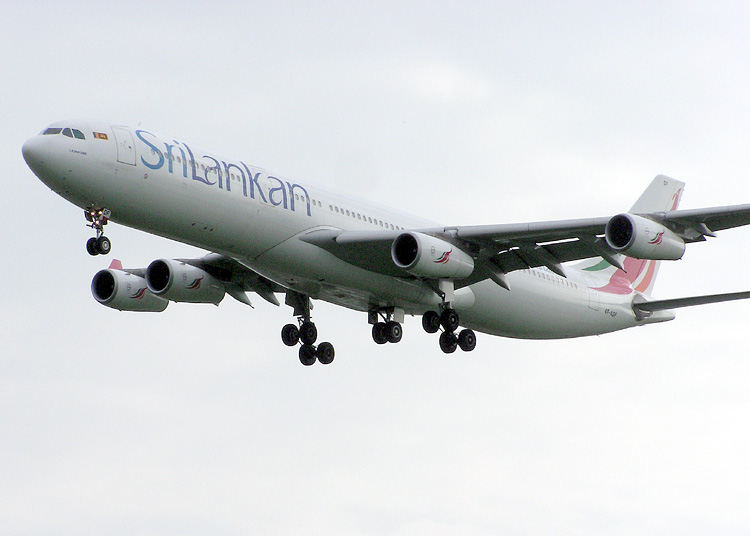
Analysis: SriLankan Airlines set to join oneworld in 2013

Will SriLankan Airline's entry into oneworld force a change in the carrier's network strategy?

Image courtesy Wikimedia
Early Monday, SriLankan Airlines, the flag carrier of India’s southernmost neighbor, is set to be announced as the newest member of the oneworld, the global alliance of airlines. The carrier, which serves 60 destinations on a fleet of 21 aircraft, will add Kochi, Tiruchirapalli and Thiruvananthapuram to oneworld’s network of 850 destinations in 150 countries.

Sri Lankan’s entry into oneworld is being sponsored by Cathay Pacific, which serves SriLankan’s hub in Colombo 7 times per week from its own hub in Hong Kong via Singapore and Bangkok onboard Boeing 777-300 aircraft. SriLankan Airlines also has a code-share agreement with oneworld member-elect Malaysian Airlines and plans to implement code-shares with oneworld members Royal Jordanian and S7 Airlines. The carrier will enter the alliance in 2013.

"With the world airline industry increasingly focused on alliances, SriLankan has carried out in-depth analysis of the options open to the airline as we enter this latest phase of our development. Oneworld is very clearly the best option for us. Joining the alliance will help put SriLankan more firmly on the global aviation map and vastly improve our connections with the rest of the world," says airline chairman Nishantha Wickremasinghe.

For SriLankan, there is clear value added with entry into oneworld. The carrier already serves 3 Oneworld hubs; Tokyo, Moscow, and London and is rumored to be starting up service to 2 more; Sydney and Melbourne. Now, it will have access to the global alliance’s network and its marketing arm, which can help it win more passengers away from competitors, and add incremental sales revenue. Its frequent flyer base, limited as that may be, will also get expanded redemption opportunities around the globe.

From oneworld’s side, the value proposition is a little less clear. To a certain degree, simply adding an airline to the network, especially one in a region that can be considered a “hole” for that alliance, is always a good thing. And to the extent that South Asia is a hole for oneworld, that is true of SriLankan’s entry. But adding such a small airline doesn’t really do much for oneworld’s coverage of South Asia (really India). And Sri Lankan’s long haul network strategy, which consists of less than daily flights (in a lot of cases less than 3 per week) to a broad base of destinations scheduled for O&D purposes, isn’t exactly conducive to an alliance seeking to provide seamless global connectivity.

That’s not to say that Sri Lankan won’t have immediate benefits for oneworld. Oneworld frequent flyers will now have many more redemption options, especially to Colombo and Male (where Sri Lankan operate a whopping 38 flights per week). But I do think that entrance into oneworld will necessitate some changes in SriLankan’s network. For a long time now, oneworld has had substandard coverage of India. While its European connections are competitive, both SkyTeam, and especially Star Alliance have taken advantage of hubs located in regions with strong ethnic ties (Saudi Arabia and Singapore/Bangkok respectively) to strengthen their reach within India’s second and third tier cities.

The entrance of Kingfisher Airlines into the alliance was supposed to have solved this problem, but since Kingfisher’s entry was suspended indefinitely back in February, oneworld once again has problems here. SriLankan currently serves 7 Indian destinations; Bangalore, Chennai, Delhi, Mumbai, Kochi, Tiruchirapalli and Thiruvananthapuram. To add more value into oneWorld, look for SriLankan to also add (in some cases restore) flights to regional Indian destinations like Hyderabad, Coimbatore, Mangalore, Vijaywada, Kozhikode, and Pune. Doing so would substantially increase SriLankan and oneworld’s penetration into the Indian market.

However, to take full advantage of this would also necessitate a restructuring (moderate) of SriLankan’s longer haul operations. Currently, the carrier serves Tokyo 4 times per week, and London 7 times per week after cancelling 4 weekly service via Male, as well as twice weekly services to Moscow via Dubai on an Airbus A320. Reportedly, SriLankan is looking to add 9 further long-haul aircraft to the fleet by 2015; a mix of Airbus A330-300 and Boeing 777s. What this would allow is for SriLankan to enhance its long haul operation to better fit in with oneworld. London could be buffed up back to 12 flights per week (its level this summer), Tokyo could be made daily, and Moscow could be de-coupled from Dubai. The airline also has leeway in adding new sub-daily services to oneworld hubs like Berlin, Dusseldorf, Madrid, and the like. Thus in time, SriLankan Airlines’ network will likely shift to become a stronger asset for the oneworld alliance.
Read more »