Showing posts with label financial. Show all posts

Alaska Air group approves quarterly cash dividend of 20 cents per share

By BA Staff

The board of directors of Alaska Air Group has approved a quarterly cash dividend of 20 cents per share to all shareholders of record as of Nov. 19. The dividend will be paid on Dec. 4.

Air Group paid a quarterly dividend of 20 cents per share in August, the first time since 1992 that the company had paid a dividend. The dividends are financed from operating cash flow and existing cash on hand.
Read more »

Emirates group first half fiscal 2014 net profits up 4%. Airline net profit up 2% to $475 million

by Devesh Agarwal

Emirates A380. Photo copyright Devesh Agarwal.
The Emirates Group, the aviation holding company of the Al Maktoum family which rules Dubai, and the parent of Emirates airline, announced its first half (April to September) results of the fiscal year 2014 (ending March 31, 2014) today.

Group

The Emirates Group revenues reached AED 42.3 billion (US$ 11.5 billion) for the first six months of its current fiscal year ending September 30, 2013, up 13% from AED 37.5 billion (US$ 10.2 billion) at 30 September 2012.

Net profit for the Group rose to AED 2.2 billion (US$ 600 million) an increase of 4% over the last year’s results.

The Group’s cash position on 30 September 2013 came down to AED 18.2 billion (US$ 4.9 billion), from AED 27.0 billion (US$ 7.3 billion) six months earlier. This is after a AED 1.8 billion bond repayment which matured in July 2013, a AED 367 million first instalment payment on a USD one billion Sukuk (Islamic equivalent of bonds), and a AED 7 billion injection back into the business to fund new aircraft, engines, spares and other projects across the Group.

His Highness Sheikh Ahmed bin Saeed Al Maktoum, Chairman and Chief Executive, Emirates Airline and Group said
“The global business environment continues to be challenging. We have stayed agile even as we grow, and this ability to adapt and act quickly has been key to our success. Our investments in the infrastructure of both Emirates and dnata continue to pay off,”
Group employee numbers increased 11.7% to over 75,800 from six months earlier.

Emirates airline

Capacity measured in Available Seat Kilometres (ASK), grew 16.9% on the addition of ten aircraft – six A380s, three 777s and one 777 freighter in the reported six month. 15 more new aircraft scheduled to be delivered to the airline before March 31, 2014, the end of the current fiscal year FY2014.

Passenger traffic carried measured in Revenue Passenger Kilometres (RPK) was up 16.1% with a load factor averaging 79.2% down from last year’s 79.7%. In number, Emirates carried 21.5 million passengers in the six months, since 1 April 2013, up 15% from the same period last year.

Cargo volumes increased 5.2% but the airline has not released the actual performance nomrally measured in FTK (Freight Ton Kilometre) or capacity in ATK (Available Ton Kilometre) .

Emirates airline's revenue, including other operating income, for the six months was AED 39.8 billion (US$ 10.8 billion) up 12% from last year's first half revenue of AED 35.4 billion (US$ 9.6 billion) to return a 2% increase in net profit of AED 1.7 billion (US$ 475 million).

Fuel prices constituted 39% of the airline's expenditures. The Union and state governments of India would be well advised to observe the disadvantage they put Indian carriers to, thanks to their greedy excessive taxation regime which makes fuel between 45%~50% of expenditure.

Emirates launched new routes to Haneda and Stockholm, bringing the total count of new routes launched in the past 12 months to seven including Adelaide, Lyon, Phuket, Warsaw and Algiers. The airline now flies to 137 destinations in 77 countries, up from 126 cities last year in 74 countries. Additional new routes to be added in the remaining part of the fiscal year include Kabul, Kiev, Taipei and Boston.

The airline also celebrated the five year operating anniversary, of its A380 super-jumbo. Emirates' A380s have carried 18 million passengers since its first flight on August 1, 2008 from Dubai to New York.

dnata airport services and infrastructure

dnata (formerly Dubai National Air Transport Association) now operates in 38 countries with revenues including other operating income of AED 3.7 billion (US$ 1 billion), 18% higher compared to AED 3.2 billion (US$ 864 million) last year. Overall profit for dnata rose strongly by 13% to AED 458 million (US$ 125 million).

dnata’s airport operations was the largest contributor to revenues with AED 1.4 billion (US$ 375 million), a 16% increase from last year's first half revenues of AED 1.2 billion (US$ 324 million). The number of aircraft handled by dnata rose 9%, to 141,845

dnata’s in-flight catering operation, which operates the world's largest flight kitchen, in Dubai, United Arab Emirates, recorded strong growth thanks to its acquisition of Servair in Italy in June 2013. Revenues were up 39% to AED 891 million (US$ 243 million). 22.4 million meals were uplifted for the first half of the fiscal year, up a massive 81% from last year.

Revenue from dnata’s Travel Services operation contributed AED 303 million (US$ 83 million), up 16% from the same period last year.

dnata’s cargo handling division grew revenues 4% to AED 546 million (US$ 149 million) on account of increased tonnage mainly for dnata’s UK operation and in Switzerland which rose in total by 2% to 809,236 tonnes.
Read more »

SpiceJet posts record Rs. 559 crore loss in Q2 FY2014. Needs urgent capital infusion.

by Devesh Agarwal

Gurgaon based low fare carrier SpiceJet Ltd., continued the record of disastrous performance in the Indian airline industry when it announced a record Rs. 559 crore loss for the second quarter, ended September 30, of the fiscal year 2013~2014.

This compared to the Rs. 163.5 crore loss from the same quarter last fiscal, and a Rs. 50.5 crore profit from the first quarter of this fiscal.

On October 23, India's largest private carrier Jet Airways reported a monstrous loss of almost Rs. 1,000 crore.

The airline blamed the poor performance on the precipitous drop in the exchange of the Indian Rupee vs the US Dollar which occurred in the quarter and contributed Rs. 42 crore to losses. In a statement released late this evening, it said
“The civil aviation sector in India continues to struggle under the burden of several adversities mainly the Indian rupee that saw unprecedented weakness during the quarter,”
Poor demand due to a slowing economy saw a drop in income to Rs. 1,257.22 crore from Rs. 1,701.543 crore in the first quarter, though marginally better from Rs. 1,185.244 crore from the same quarter last fiscal. A 9% growth in number of passengers out-stripped the 17% increase in capacity measured in available seat kilometres (ASK), resulting in a 7% in average passenger yields from Rs. 4,001 to Rs. 3,711. Desperate sales at cut-throat fares have also taken their toll.

A lack of capacity discipline by virtually every Indian carrier, especially domestic leader IndiGo, and Jet Airways, continues to exasperate the soft demand situation, and we see the same indiscriminate financial indiscipline as we did in 2008.

Expenses shot up to Rs. 1,791.623 crore against Rs. 1,641.933 in the first quarter, and Rs. 1,357.305 crore from the same quarter last fiscal. Aircraft maintenance costs shot up almost 64% from Rs. 199 crore to Rs. 325 crore largely driven by Rs. 78 crores in engine maintenance expenses due to a bunching up of shop visits.

Fuel costs fell from 45% of total expenses to 39.7% but thanks to the plunge in income, increased from 43.8% to 57% of income.

Continuing losses have put the airline in a precarious financial position. It is estimated the airline requires a minimum Rs. 1,500 crore capital infusion. While the airline has announced the appointment of Sanjiv Kapoor, the former chief executive of GMG Airlines of Bangladesh, as its Chief Operating Officer, it still lacks a Chief Executive, since the departure of Neil Mills, nearly three months ago.

The silver lining for SpiceJet is that parts of the third quarter and the fourth quarter sees high air travel due to the festival season and returning Indian travel.


The supply-demand imbalance is heading for a precipice with expected the commencement of new airlines AirAsia India, and Tata-SIA.

Share your thoughts via a comment.

Read more »

Alaska Air group reports record third quarter fiscal 2013 results

By BA Staff

Alaska Air Group, Inc., reported third quarter 2013 GAAP net income of $289 million, or $4.08 per diluted share, compared to $163 million, or $2.27 per diluted share in the third quarter of 2012. Excluding the impact of mark-to-market fuel hedge adjustments of $20 million ($12 million after tax, or $0.17 per diluted share), and a one-time special revenue item of $192 million ($120 million after tax, or $1.70 per diluted share) that primarily resulted from the application of new accounting rules associated with the modified affinity card agreement, the company reported record adjusted net income of $157 million, or $2.21 per diluted share, compared to adjusted net income of $150 million, or $2.09 per diluted share, in 2012.

Alaska Air Group CEO Brad Tilden said:
"These results represent our best quarter ever and mark Alaska's 18th consecutive quarterly profit. This is noteworthy given significant additional competition in some of our core markets. The balance and strength of our network combined with the ability of our people to respond quickly to changing business conditions are enabling us to succeed in this highly competitive industry."

The following table reconciles the company's reported GAAP net income and earnings per diluted share (EPS) during the third quarters of 2013 and 2012 to adjusted amounts:

Three Months Ended September 30,
(in millions, except per share amounts)DollarsDiluted EPSDollarsDiluted EPS
Reported GAAP net income$289 $4.08 $163 $2.27
Mark-to-market fuel-hedge adjustments, net of tax-12-0.17-13-0.18
Special revenue item, net of tax-120-1.7--------
Non-GAAP adjusted income and per-share amounts$157 $2.21 $150 $2.09
Read more »

Boeing reports robust third quarter fiscal 2013 results. Raises full year earnings guidance

by Devesh Agarwal

Chicago based, US aerospace and defence giant The Boeing Company reported earnings of $1,160 million, a massive 12% jump in its third-quarter profit compared to $1,030 million from the same period a year ago. The company has also raised its 2013 financial performance outlook, based on an increase in commercial aircraft deliveries.

Key highlights of the quarter
  • Core Earnings Per Share (non-GAAP)* rose 16% to $1.80 on strong operating performance; GAAP EPS of $1.51
  • Revenue increased 11% to $22.1 billion reflecting higher commercial deliveries
  • Backlog grew to a record $415 billion, including $27 billion of net orders during the quarter
  • Operating cash flow before pension contributions increased to $4.3 billion
  • 2013 Core EPS guidance increased to between $6.50 and $6.65 (previously forecast of $6.20 to $6.40); GAAP EPS to between $5.40 and $5.5
Boeing Chairman, President and CEO Jim McNerney said
"Consistently strong operating performance is driving higher earnings, revenue and cash flow as we deliver on our record backlog and return increased value to shareholders,"  "During the quarter, Commercial Airplanes completed the first flight of the 787-9 and delivered 170 airplanes, while Defense, Space & Security maintained solid performance and captured $7 billion in new orders. Despite the uncertainty of the U.S. defense market, overall our customer-focused business strategies and disciplined execution on our programs are producing the results we expect, and our strong year-to-date performance and positive outlook allow us to increase our 2013 guidance for earnings and operating cash flow."

Boeing Commercial Airplanes was the star performer with third-quarter profits of $1,620 million, up 40%, on revenue of $14 billion, and operating margin improving to 11.6%. During the quarter, the 787-9 completed first flight. The company intends to increase the 787 production rate from 10 to 12 per month in 2016, and to 14 per month before the end of the decade. The division booked 200 net orders during the quarter with a backlog of nearly 4,800 airplanes valued at $345 billion.

Boeing Defense, Space & Security's third-quarter revenue was $8 billion ($8,000 million), while operating margin was 8.4%. Profits fell by 19%, mainly due to a profit fall of 48% in Boeing Military Aircraft (BMA) whose third-quarter revenue was $3.5 billion, primarily reflecting lower delivery volume. Operating margin at BMA decreased to 6.2%, impacted by mix and one-time charges on the F-15 and C-17 programs. During the quarter, BMA was awarded a low-rate initial production award for 13 P-8A Poseidon aircraft.

Network & Space Systems (N&SS) third-quarter revenue was $2.2 billion, reflecting higher sales of Delta inventory and revenue in the Space Launch System program, and operating margin was 8.7%. During the quarter, N&SS was awarded a contract by Mexico's Satmex for an additional 702 small satellite.

Global Services & Support (GS&S) third-quarter revenue was $2.3 billion, due to higher volume in maintenance, modifications and upgrades. Operating margin was 11.4%. During the quarter, GS&S achieved first flight on the QF-16 unmanned aircraft and was also awarded a contract by the U.S. Air Force for 56 additional replacement wings for the A-10 aircraft.

Backlog at Defense, Space & Security was $70 billion, of which 38% represents orders with international customers.
Read more »

Delta Air Lines reports strong September traffic results

by BA Staff

American full service carrier Delta Air Lines reported its traffic results for September 2013. Unit passenger revenues continued the summer's strong performance, increasing 5.5% year over year. Highlights include:
  • 5.5% increase in passenger revenue per available seat mile (PRASM)
  • Projected September quarter per gallon fuel price: $2.98 - $3.03
  • September mainline completion factor 99.9%
  • September on time performance: 90.2%
The table below provides a summary of the full traffic results

RegionSep-13Sep-12Change
RPMs (billion)
*TrafficDomestic9.088.991.0%
Mainline7.367.221.8%
Regional1.731.77-2.2%
International6.996.82.8%
Latin America1.070.9413.8%
Atlantic3.83.722.2%
Pacific2.112.13-1.0%
Total System16.0715.791.8%
ASMs (billion)
*CapacityDomestic11.2411.170.7%
Mainline8.968.880.9%
Regional2.282.28-
International8.067.813.1%
Latin America1.321.1415.5%
Atlantic4.24.141.4%
Pacific2.542.530.2%
Total System19.318.981.7%
Load FactorDomestic80.8%80.5%0.3
Mainline82.1%81.3%0.8
Regional75.8%77.5%-1.7
International86.8%87.0%-0.2
Latin America81.4%82.7%-1.3
Atlantic90.6%89.9%0.7
Pacific83.2%84.3%-1.1
Total System83.3%83.2%-0.1
Passengers BoardedTotal System13.25 million13.12 million0.9%
Cargo Ton MilesTotal System201.57 million202.71 million-0.6%
Read more »

Analysis: SpiceJet to launch Delhi-Macau

by Vinay Bhaskara


A report in the Macau Business Daily states that Gurgaon based low cost carrier (LCC) SpiceJet is planning on launching nonstop flights between Delhi and Macau. SpiceJet has already won approval from the Indian government to launch Delhi-Macau, likely using Boeing 737 equipment. But it has not yet filed for approval from the Macau government. A Macau airport statesman had this to say about a potential SpiceJet application:
We have been aware of communications [about the route] between the Macau International Airport Company Ltd and the airline. SpiceJet had previously contacted us to obtain some initial information on the application procedures, which is a common practice for any interested airlines.
No airline currently serves Macau nonstop from India. The current bilateral air service agreement (ASA) between India and Macau allows each side's airline to operate up 600 seats per week with 2 return flights per week. However, both governments have agreed in principle to negotiate an expansion of the ASA later this year.

Macau, China's largest gambling center in the vein of Las Vegas in the United States, is an important and growing leisure destination for the increasingly affluent Indian upper middle class, and India's wealthy. However, demand for Macau is more concentrated in Bangalore and Mumbai than in Delhi, which may bode poorly for SpiceJet's chances on the route. The Macau international market is currently dominated by flag carrier Air Macau, a subsidiary of China's national carrier Air China, who serves 22 destinations on a fleet of 15 aircraft.

If the reports are true, it would mark just the latest step in SpiceJet's international growth track. The carrier now serves five international destinations from Delhi (Dubai, Guangzhou, Kabul, Kathmandu, and Riyadh) with 32 flights per week. Overall, SpiceJet serves nine international destinations (the aforementioned five plus Colombo, Muscat, Sharjah, and Male) with 87 flights per week. And along with the regional operation using Bombardier Dash 8 Q400 turboprops, the international growth has been an important contributor to SpiceJet's swing to profitability.
Read more »

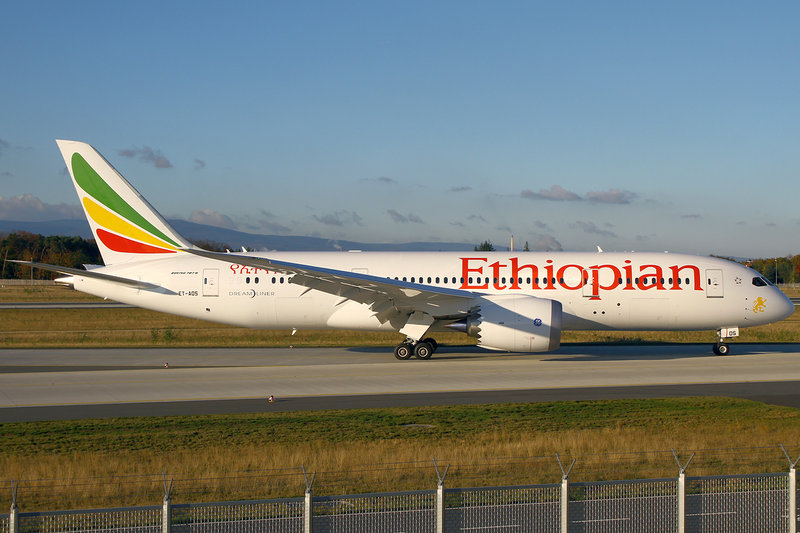
Ethiopian Airlines reports record profits, stands behind Dreamliner despite fire

Image Credit: Konstantin von Wedelstaedt
by Vinay Bhaskara

African carrier Ethiopian Airlines has announced a record net profit of 2.03 billion birr (US $107.6 million) for the period from July 2012 - June 2013, up 178% from 734 million birr (US $39.2 million)year-over-year (YOY). Operating profitability also rose a healthy 170% YOY to 2.7 billion birr (US $143.1 billion), from 1 billion birr (US $53.0 million). While the carrier has not yet formally released its financial results, CEO Tewolde Gebremariam presented these figures as coming from Ethiopian's un-audited results for the period. The formal announcement of results should come soon.

Interestingly, Gebremariam attributed Ethiopian's profitability in part to the troubled Boeing 787-8 Dreamliners, citing the fuel savings driven by the aircraft's increased fuel efficiency. His comments come just a month and a half after an Ethiopian Dreamliner memorably caught fire at London's Heathrow Airport in early July (an incident later attributed to a Honeywell Emergency Locator Transmitter), and a three month long grounding of the aircraft due to battery issues earlier this year. Gebremariam admitted that the Dreamliners had caused some issues for Ethiopian this past financial year:
Definitely the incidents and grounding have some impact. We were very fortunate that coincidentally the grounding of the planes were in what we call slack season. It's a slow demand season. So were able to minimize the level of the impact.
However, he also said that the carrier has seen a demand boost from the Dreamliners:
Whenever we introduce the aircraft in any route, the load factor immediately increases, which means our customers love the plane, they are enjoying its features
Ethiopian says that it will take delivery of its remaining 8 Dreamliners on order (5 direct orders and 3 leases), bringing the carrier's active fleet of 787-8 Dreamliners to 12 (13 frames on the books but one is currently indisposed at Heathrow Airport). Ethiopian currently operates a fleet of 54 passenger aircraft (with 31 more on order - 14 Airbus A350-900s, 8 Boeing 787-8 Dreamliners, 4 Boeing 777-300ERs, and 5 Boeing 737-800s) serving 80 passenger destinations around the globe. Based in Addis Ababa, Ethiopian is a member of the Star Alliance partnership of global airlines, and is one of the world's fastest growing airlines.
Read more »

Analysis: Qantas more than doubles full year profit as rival Virgin Australia loses money

by Vinay Bhaskara
Image Credit: Paul Spijkers


Australian airline group Qantas Group has reported an underlying pre-tax profit of AUD 192 million (US $171.5 million) for the year ended 30th June 2013, more than doubling from AUD 95 million for the year ending 30th June 2012.

Broken up by segment, profit for Qantas mainline domestic fell 21% year-over-year (YOY) to AUD 365 million thanks to a fare war with Australia's second largest airline, Virgin Australia. Profits also fell 20% YOY at Qantas freight on Asian demand weakness to AUD 36 million, while Jetstar Group saw a deep 32% YOY decline in profit to AUD 132 million thanks to the start up costs of Jetstar Japan and Jetstar Hong Kong. Profits at the loyalty (frequent flyer) division remained strong, rising 13% YOY to AUD 260 million, but the biggest improvement came from the reduction in losses at Qantas' international division, with losses halving to AUD 246 million from AUD 484 million YOY.

Group operating revenues rose 1% to AUD 15.9 billion while operating costs remained essentially flat thanks to a 2% reduction in fuel costs. This contributed to a 5% reduction year over year in unit costs excluding fuel (cost per available seat kilometer - CASK ex. fuel), which was partly offset by a 2% decline in yields.

For the year, capacity as measured by available seat kilometers (ASKs) was essentially flat YOY, while passenger traffic in revenue passenger kilometers (RPKs) was down around 1%. However, passengers carried actually grew 3% YOY to 48.3 million as the Group re-balanced capacity towards shorter haul routes.

For Qantas, the strong improvement in its international results was a partial validation of the turnaround plan announced last year with an eye towards returning the international division to profitability by fiscal year 2015. The biggest part of that turnaround plan, a tie-up with Emirates, has also been partially validated, as it contributed to the results via a doubling of bookings onto code share services to Europe (versus the previous partnership with British Airways). And the partnership's contribution should continue to improve into FY14 as much of the partnership has not been fully implemented and FY13 had to deal with the start-up costs of launching operations in Dubai.

Moreover, the cost-base on international operations improved 5% thanks to reduction of loss-making routes, aircraft retirements, and the reconfiguration of 9 Boeing 747s and 12 A380s improving fleet economics. Qantas International has certainly paid the price for poor strategic vision in the sense of not taking advantage of the rise of Asia over the past decade. But the decision to join hands with Emirates and cut loss-making routes from the international network was the right decision. Bigger is not always better. By reducing some of the lower yielding destinations like Frankfurt and Buenos Aires, Qantas has cut its way towards profitability.

And the turnaround domestically has allowed Qantas to re-focus efforts on the group's primary profit center; Domestic. As Qantas struggled to re-make its international operations over the past few years, Australia's second largest carrier, Virgin Australia evolved from a low cost nuisance into a true full service rival. Having reconfigured its short haul fleet of Boeing 737s and Embraer E190s with a business class cabin, Virgin Australia even took a major shot across Qantas' bow by introducing Airbus A330-200 aircraft with lie-flat business class seats on lucrative transcontinental routes from Perth in 2011.

New Qantas A330-200 business class - Image Credit: Qantas
But Qantas now has the funds and shareholder confidence to fight back. Earlier this month, they announced a new updated product on its own fleet of 10 transcontinental A330s with lie-flat suites aimed at clawing back market share from Virgin Australia. Qantas also announced a new premium product for five Boeing 717-200s, to be flown by subsidiart QantasLink in competition with Virgin Australia Embraer E190s out of Australia's capital Canberra.

Even as Qantas is revving up for a fight, Virgin Australia continues to struggle. With a jumbled strategy of acquisitions aimed at modeling Virgin Australia Holdings after Qantas Group (including the transformation of regional provider Skywest into Virgin Australia Regional and the purchase of a 60% stake in ultra low cost carrier [ULCC] Tigerair Australia) weighing on results, Virgin Australia reported a post-tax loss of AUD 98.1 million for FY13. The competitive tide in the Australian market, for the moment, appears to have shifted back in Qantas' favor.


Read more »

Cathay Pacific July 2013 traffic results

Hong Kong based full service carrier Cathay Pacific Airways posted its consolidated (including regional arm Dragonair) traffic results for July 2013, showing an increase in passenger traffic offset by a decrease in cargo tonnage. Find the details below.

20th August 2013

Cathay Pacific Airways today released combined Cathay Pacific and Dragonair traffic figures for July 2013 that show a year-on-year rise in the number of passengers carried. Cargo and mail tonnage fell compared to the same month in 2012.

Cathay Pacific and Dragonair carried a total of 2,679,193 passengers in July – an increase of 6.9% compared to the same month last year. The passenger load factor was up 3.9 percentage points to 85.0%, while capacity, measured in available seat kilometres (ASKs), rose by 0.1%. For the year to date, the number of passengers carried has increased by 2.1% while capacity has fallen by 4.1%.

The two airlines carried 122,920 tonnes of cargo and mail last month, a drop of 1.9% compared to July 2012. The cargo and mail load factor fell by 4.4 percentage points to 60.3%. Capacity, measured in available cargo/mail tonne kilometres, rose by 6.6% while cargo and mail revenue tonne kilometres were down by 0.7%. For the year to date, tonnage has fallen by 1.8% compared to a 0.6% capacity decline.

Cathay Pacific General Manager Revenue Management James Tong said: “We enjoyed a strong start to the summer peak period, with good loads on major long-haul routes and also to the key holiday destinations within the region. However, the comparison with last year is distorted by the effect of Severe Typhoon Vicente, which had a major impact on our operations in July 2012. The Economy cabins were particularly busy last month; demand in the premium cabins was generally weaker, but in line with our expectations for the summer peak.”

Cathay Pacific General Manager Cargo Sales & Marketing Mark Sutch said: “Demand was soft out of many of the major airfreight markets last month and once again we saw tonnage and load factor dropping compared to 2012, when business was already weak. The bright spots in our network were the transpacific lanes and demand on intra-Asia routes, particular out of Hanoi and Dhaka. Europe and Japan remain two of the weaker markets at the moment."


CATHAY PACIFIC / DRAGONAIR COMBINED TRAFFIC
JUL
2013
% Change
VS JUL 12
Cumulative
JUL 2013
%
Change
YTD


RPK (000)


 - Mainland China
775,166
9.5%
4,763,356
4.1%
 - North East Asia
1,206,578
12.9%
7,539,802
7.2%
 - South East Asia
1,279,559
6.0%
8,437,035
3.9%
- India, Middle East, Pakistan & Sri Lanka
666,415
-0.4%
4,711,537
-5.8%
 - South West Pacific & South Africa
1,182,343
6.4%
8,073,930
-2.1%
 - North America
2,378,062
-4.2%
15,551,810
-11.3%
 - Europe
1,886,418
11.6%
10,840,134
0.6%
RPK Total (000)
9,374,541
4.9%
59,917,604
-2.2%
Passengers carried
2,679,193
6.9%
17,176,225
2.1%
Cargo and mail revenue tonne km (000)
715,127
-0.7%
4,839,502
-4.1%
Cargo and mail carried (000kg)
122,920
-1.9%
863,472
-1.8%
Number of flights
6,175
6.2%
41,197
5.2%

CATHAY PACIFIC / DRAGONAIR COMBINED CAPACITY
JUL
2013
% Change
VS JUL 12
Cumulative
JUL 2013
%
Change
YTD


ASK (000)


 - Mainland China
995,472
6.8%
6,654,262
6.0%
 - North East Asia
1,511,165
3.2%
9,825,641
0.9%
 - South East Asia
1,561,896
0.8%
10,562,289
3.9%
- India, Middle East, Pakistan & Sri Lanka
872,564
-0.3%
6,228,611
-3.9%
 - South West Pacific & South Africa
1,440,550
-1.3%
10,223,144
-6.6%
 - North America
2,635,993
-6.5%
17,394,262
-13.2%
 - Europe
2,008,263
4.9%
12,324,486
-3.2%
ASK Total (000)
11,025,903
0.1%
73,212,695
-4.1%
Passenger load factor
85.0%
3.9pt
81.8%
1.5pt
Available cargo/mail tonne km (000)
1,185,840
6.6%
7,792,496
-0.6%
Cargo and mail load factor
60.3%
-4.4pt
62.1%
-2.2pt
ATK (000)
2,234,229
3.4%
14,754,455
-2.3%

Read more »

Malaysia Airlines posts operating profit in Q2 2013

by Vinay Bhaskara

Newly minted oneworld alliance member Malaysia Airlines saw progress in Q2 2013 in its corporate turnaround plan as the carrier swung to a RM (Malaysian Ringgit) 8 million (US $2.4 million) operating profit from an operating loss of RM 102 million (US $31.0 million) during the same period a year prior.

The performance was buoyed by 14% revenue growth on a 19% increase in capacity. Traffic grew 29% pushing seat load factors to a 10 year high of 80%. Q2 marked the fourth consecutive quarter of positive cash-flow from operations and Group cash balance improved to RM 5.4 billion (US $1.64 billion).

Net losses for Q2 were reduced 50% to RM 176 million ($53.5 million) as the carrier increased productivity and controlled costs; especially fuel expense, which fell 7.5% year-over-year. For the first half of 2013, operating loss was RM 157 million (US $47.7 million) and net loss was RM 455 million (US $138.3 million - down from RM 409 million [US $124.4 million] and RM 521 million [US $158.3 million] respectively).

Said Malaysia Airlines Group CEO Ahmad Jauhari Yahya:
With the encouraging performance at the revenue generation level, we can now focus on implementing more structural improvements, including enhancing our administration and support services. We will continue to improve operational effectiveness such as continued improvement in our On Time Performance, turn times on our aircraft, better engineering service turnaround, reducing service disruptions, precise material and inventory management, and much more which will further contribute to the bottom-line in the future.
Quarters three and four are traditionally the strongest for Malaysia Airlines, and the carrier has made its first Q2 operating profit in several years. The carrier still hopes to reach net profitability by the end of 2014 and claims that it is on track to meet that metric. Having taken delivery of 6 A380s, 7 A330s, and 8 Boeing 737-800s over the past 12 months, passengers carried grew to 4.2 million passengers.

Premium cabin demand received a boost on the introduction of the 494-seat Airbus A380, with premium cabin (First and Business) demand up 36% year-over-year on a 17% increase in capacity. The A380 has already been deployed to London, Paris, and Hong Kong from Malaysia Airlines' hub at Kuala Lampur.

Malaysia Airlines is one the largest overseas carriers in India, and is slated to launch services to Kochi in September
Read more »

Jet Airways Q1 FY2013~14 performance analysis - part 2 - JetLite, aircraft utilization, and ancillary revenues

by Vinay Bhaskara

JetLite continues to be a (modest) bright spot in Jet Airways’ broader operations. The low cost wing of Jet Airways, which was recently merged with the JetKonnect brand to streamline low cost operations, reported a net post-tax profit of Rs. 6.9 Crore, down from Rs. 11.7 Crore a year prior.

An increased proportion of JetKonnect’s fleet was contained within the mainline operation, and standalone JetLite’s fleet declined to 13 frames from 19 last year. Thanks to this reduction in fleet size, revenues declined 17.2% on a 17% decline in available seat kilometers (ASKs) and revenue per available seat kilometer (RASK) declined 0.3% with cost per available seat kilometer (CASK) increasing 1.4% year over year (YOY). CASK and RASK are used to adjust revenue and cost figures for segment length. Operating margin for JetLite stood at 5.1%, up from 3.8% the year prior.

The low cost wing of Jet Airways continues to outperform the full service wing domestically. And given the economic slowdown, weakening salary growth, and heavy inflation, customers, even business travelers are likely to pinch pennies and be more frugal in consuming air travel. At least on domestic sectors, the Indian purchasing behavior pattern has skewed more heavily towards low cost carriers. It probably makes sense for Jet to focus on expanding its low cost operations as a proportion of overall operations. For example, JetLite (and by extension JetKonnect) have unit costs that are roughly 23.5% lower than those of mainline Jet Airways; a significant advantage in challenging the low cost carriers (LCCs) who have only grown in stature as Jet has shrunk in parallel.

Turning to a structural analysis of Jet’s business, one of the key factors dragging down financial performance for Jet is now its large net debt, as we mentioned in Part 1, which stands at Rs. 12,100 Crore ($2.1 billion). Commensurately, financial charges increased to Rs. 234.13 Crore for Q1. But Jet’s problems do not necessarily end there; the network may be an even bigger challenge. On the conference call, Jet mentioned that in the domestic market, it has no immediate plans to cut capacity from its Q1 levels, on which it operated 32,500 quarterly departures utilizing 42 737s split between the 737-700/800/900 variants (12 for JetLite) and 14 ATR 72 (one for JetLite). The remaining 19 737s, 14 A330s (10 A330-200s, 4 A330-300s), and seven 777-300ERs are used to operate the 9,350 quarterly departures internationally. 

On international sectors, we asked why Jet had chosen not to operate the A330-200 on shorter haul sectors as several of the aircraft are underutilized, and their Vice President of Commercial Strategy and Investor Relations K.G Vishwanath responded by stating:
From a financial standpoint, we have always seen that the 737 or a single aisle aircraft is the most suitable airplane for any flying distance between zero to five hours. And you have been in this business for four, five years and you know very surely that the margin you are able to make on the 737 is significantly higher as compared to the A330. The A330 airplane is basically an overkill for a short-haul given that fuel costs are very expensive and the fact that the flying distance is very short, you end up running more fuel and it does not give you the right kind of revenue per RPKM to be able to make a decent margin.
In our view, under-utilization of the A330 fleet is not justified by the (slightly) higher operating margins that can be driven on the 737. When you include the financing costs (leases and/or debt costs) of the A330 fleet, the airline is likely losing more money on the underutilization of the A330s, than it is gaining from the higher margins on the 737s. Moreover, the idea that the A330 is very expensive on shorter haul routes is correct to a degree, but not overall. The A330 has lower unit costs (CASK) than the 737s, which Jet needs volume to profit on. An expensive, unused asset is more costly in the short term than imperfect alignment of asset with mission.

Mr. Vishwanath also tackled ancillary revenues during the call:
So currently our ancillary revenues appears in the other income line you will see in the P&L. We’re currently at roughly 4 to 5% of our top line revenues. We would like to take this number up to 10% of top line in the next two to three years.
This is a very positive strategy on the part of Jet. Looking at the global airline industry, the West in particular, sustainable profitability for full service carriers has occurred over the past 4-5 years primarily because of ancillary revenues; especially checked baggage fees and change fees. Growing ancillary revenue is a good way for Jet to tackle the profitability issues that have cropped up in the domestic market.

Read Part 1 of this analysis here

Stay tuned for Part 3 of this analysis, in which we tackle Jet Airways’ fleet plans and a way to reduce their debt load.
Read more »

Jet Airways Q1 FY2013~14 performance analysis - part 1 - Financials

by Vinay Bhaskara and Devesh Agarwal

Earlier this week, Mumbai based Jet Airways announced a net post-tax loss of Rs. 355.4 Crore (US $ 59.8 million) for the first quarter of Fiscal Year 2014, reversing from a Rs. 24.7 Crore net profit during the same period a year prior.

Total revenues declined a whopping 12.3% to Rs. 4, 064.4 Crore on a 15.0% decline in revenue passengers to 4.13 million, and an 11.3% capacity decline measured by available seat kilometres (ASKs) to 9.13 million ASKs. Seat factors cratered to 78.4% from 82.7% year-over-year (YOY).

Jet Airways recorded a large operating loss of Rs. 111.2 Crore in Q1 versus an operating profit of Rs. 223.5 Crore the year, translating to an operating margin of -2.8% versus +4.9% in Q1 of Fiscal Year 2013.

The nominal average fare paid by Jet Airways customers rose 2.3% to Rs. 8,278, but fell 4.2% on an inflation adjusted basis. Revenue per available seat kilometer (RASK) fell 0.8% year over year to 3.60 Rupees from 3.63 Rupees a year prior while cost per available seat kilometer (CASK) increased 8.7% to 3.92 Rupees. CASK and RASK are used to adjust revenue and cost figures for segment length.

Looking segment by segment, Jet Airways’ full service domestic operations once again performed abysmally, with a net pre-tax loss of Rs. 263.0 Crore versus a profit of Rs. 16.8 Crore the year prior. Operating margin domestically was an astoundingly poor -7.9% versus +6.8% a year prior – a swing of 14.7 percentage points! Domestic revenues fell 13.1% year over year to Rs. 1763.5 Crore, and while domestic RASK actually increased by 0.9% (down 3.3% on an inflation-adjusted basis), it was more than offset by a 17.6% increase in CASK.

Domestic operations continued to suffer from the poor Indian macroeconomic environment, as growth for Fiscal Year 2014 is projected to fall to 5.5% by the Reserve Bank of India. India’s growth prospects seem doveish for the next few years and airline will see growth plateauing over the next few months.

Importantly, fuel is not a major contributor to Jet Airways’ woes, as moderating fuel prices around the globe in Q1 meant that fuel cost per ASK fell 7.5% year over year. Despite the slowing economy, domestic capacity amongst Indian carriers was up 0.1% in Q1 and passenger demand rose 1%.

Low Cost Carriers (LCCs) SpiceJet, GoAir, and IndiGo have continued their rapid expansion despite slowing Indian growth, which has put increased fare pressure on Jet Airways at the lower end. At the same time, the expected fare bump amongst high yield business travellers and first class passengers after the demise of full service rival Kingfisher Airlines largely has not materialized thanks to aggressive pricing on the part of beleaguered national carrier Air India. Despite spotty operational reliability, LCC SpiceJet has continued to profit (Rs. 55 Crore in Q1 of FY14) and its maturing Q400 operation is taking away business from Jet Airways’ regional ATR operations, especially in the South.

International financial performance also weakened year over year, falling to a Rs. 92.4 Crore pre-tax loss from a Rs. 16.5 Crore pre-tax profit the year prior. Revenues fell 11.7% to Rs. 2300.9 Crore as Jet Airways continues to restructure its international operations in advance of the implementation of the newly designed Jetihad partnership with Etihad Airways. Revenue per available seat mile fell 2.1% (7.8% on an inflation adjusted basis), while cost per available seat kilometer grew 2.3%. The operating margin on international operations fell to 0.8%, from 5.6% in Q1 of Fiscal Year 2013.

Despite all the hubbub and media drama surrounding Jet Airways’ international operations, they are actually the better performer within the company on an operating and net basis. International operations came under some pressure thanks to the continued de-valuation of the Indian Rupee since many costs on international operations are accrued in US dollars. That pressure, which contributed nearly a third of Jet Airways’ losses in Q1 at Rs. 134.3 Crores, looks like it should subside to some degree as the Indian government is taking steps to increase in-flow of US dollars.

Bulk of Jet Airways' A330-200 fleet idle at New Delhi
The airline withdrew from many international routes like Mumbai Johannesburg, Chennai Brussels, Brussels New York JFK, and New Delhi Milan. The contraction in operations led to a severe under-utilisation of Jet Airways’ wide body fleet, especially the Airbus A330-200s, (as captured by Devesh Agarwal at New Delhi IGI airport), which led to a Rs. 128.2 Crore adverse impact on finances.

During the analysts earnings call, Jet Airways management indicated that the airline had already leased two A330s to investor Etihad Airways PJSC of Abu Dhabi, and is "close to signing" a deal with another west Asian carrier for five A330s. So the cost impact will reduce in the quarters moving forward.
 
During the call, the airline announced “load factors for the North American routes were at 79.1%, the UK routes were at 84.1%, Asian routes were at 82.1%, Gulf routes were at 83.4%, SAARC routes were at 75.1%.” However, thanks to its contraction on long haul routes, Jet has been unable to capitalize on recovering Western economies in the United States and in the European Union. Still, the outlook moving forward for the international operations. from a purely financial perspective (ignoring strategic considerations), the feeder operation with Eithad, which appears likely to be Jet Airways’ plan as the carrier undertakes a 10 year network planning study, is likely to return Jet to profitability on its international operations at least.
But the domestic operations remain challenging. In our opinion, from a financial perspective, Jet must solve its lagging domestic revenue and market share before the company as a whole can return to profitability. Structurally, the debt load facing Jet Airways, including US $300-400 million in high-cost shorter term debt, is the major challenge. Finance charges stood at Rs. 234.1 Crore in Q1, and with Jet Airways recently committing to order 50 737 MAX, as per a report in the Live Mint, the capital expenditures plan over the next 10 years only looks set to exacerbate that.

Stay tuned for Parts 2 and 3 of our analysis coming later this week, covering JetLite results, analysis of fleet and network plans, and a plan to tackle the debt load.

Read more »

BREAKING: US Airways Shareholders Approve Merger With American Airlines

by Vinay Bhaskara

Earlier today, at its annual general meeting for shareholders, the shareholders of Tempe, Arizona based US Airways voted to approve the merger between US Airways and Fort Worth, Texas based American Airlines. The merger, which would create the world's largest carrier by passengers carried, was announced on February 14, 2013.

Under the terms of the merger agreement, US Airways shareholders would get 28% of the combined shares in the company. The all-stock transaction would yield a company with annual revenues of nearly $38.7 billion, and headquartered in Dallas Fort Worth. The new board would include 5 AMR creditor representatives, 3 current AMR directors, and
4 US Airways representatives. US Airways shareholders did not question any component of the merger agreement proposal before voting.

According to US Airways CEO Doug Parker, the merger is still on track to close by the end of the 3rd quarter. Clearance for the merger is still required from the Department of Justice and the AMR bankrupcy court. Parker said at the meeting that if forced too, the new American will give up precious landing slots at Washington's Reagan National Airport, where the merged carrier will hold a dominant market share. However, Parker warned that the first markets to lose service as a result of divestment would be small cities. Parker said that the new American preferred to keep its entire slot holdings intact post merger;
There is no such standard in antitrust law that says airlines can't have that size of departures from any given airport.
Parker also tried to downplay any antitrust concerns surrounding the deal.
It [the new American] creates an important strong competitor to United, Delta and Southwest .... We will create a premier global airline.
Recent testimony from the US Government Accountability Office (GAO) before Congress warned that Philadelphia International Airport, currently US Airways' second largest hub and trans-Atlantic gateway, could lose service post merger to nearby New York JFK. However, Parker, in responding to a question from a Philadelhpia based frequent flyer and shareholder appeared to allay these concerns.
"Our hub [in Philadelphia] does well for US Airways... it will do even better as a part of American"
The new American will operate a mainline fleet of more than 940 aircraft, operating more than 6,700 flights per day to 336 destinations around the globe.

Read more »

Analysis: Etihad post strong results; government fears over Jetihad overblown

by Vinay Bhaskara

Abu Dhabi based full service carrier Etihad Airways announced yesterday that it had achieved record revenue growth for the second quarter and first half of 2013. For Q2 2013, passenger revenues grew a robust 8% to $921 million, while passenger revenues for the first half of 2013 hit $1.8 billion, up 13% from $1.6 billion in 2012.

Revenue generated by its code share and equity alliance partners leapt 25% to $184 million in Q2 and was responsible for 20% of Etihad’s revenue for the first half. Passenger traffic as measured in revenue passenger miles (RPMs) and capacity as measured by available seat miles (ASMs) each grew 13% year over year in Q2; the figures were 15% and 12% respectively for the first half of 2013. Etihad added 11 new aircraft to the fleet over the preceding 12 month period (bringing its fleet up to 78 frames), and added new services to Amsterdam, Belgrade, Sao Paulo, and Washington DC (added at the end of March) in Q2.

Clearly, Etihad has achieved a strong pattern of growth in the shadow of its behemoth rivals of the MEB3 +1 (Middle East Big 3 plus One) carriers; Dubai based Emirates Airlines, Doha based Qatar Airways, and Istanbul based Turkish Airlines. A key component of this growth is driven by Etihad’s equity investments.

In addition to Etihad’s proposed 24% investment into Jet Airways creating the so-called Jetihad partnership, Etihad holds a 29% share of airberlin, 40% of Air Seychelles, 10% of Virgin Australia, and 3% of Aer Lingus. Etihad recently secured Australian regulatory approval to increase its equity stake in Virgin Australia from 10% to 19%.  It also announced that it had signed an Initial Memorandum of Understanding (MoU) with the Serbian government to discuss potentially investing in Serbian national carrier JatAirways.

As per the Etihad press release, CEO James Hogan:
…said a significant achievement in Q2 was the improved contribution of the Etihad Airways equity alliance partners, in particular Germany’s airberlin, which has become the largest code share contributor. This reflects increased connectivity between the integrated networks of the two airlines.
And the Etihad results illustrate the case that can be made for the Jetihad partnership. In recent weeks, the Jetihad deal has hit a series of setbacks due to government reticence over allowing control over Jet Airways’ strategy to fall into foreign hands. A report from CNN IBN stated that
Jet's plan to relocate operations and core functions to Abu Dhabi has raised eyebrows as the proposed plan is not consistent with Indian norms, sources said. The co-operative board of the company will have control with 19 foreign nationals nominated by Etihad, sources added, and the government fears losing operation control of the domestic airline Jet.
Civil Aviation Minister Ajit Singh is reportedly sending a note to the Prime Minister’s Office asking Jet and Etihad to rework their deal to allay government concerns that the recent seat sharing agreement in the re-worked Abu Dhabi – India bilateral air service agreement (ASA).

Clearly the Jetihad partnership will benefit Etihad extensively, giving it a solid grip on westbound international traffic from India. And the seat sharing deal indeed does favor Jetihad over other full service carriers serving Abu Dhabi. But the ASA with Dubai is similarly tilted in favor of Emirates Airlines, and Jetihad will only serve to create a strong competitor to Emirates, who has increasingly monopolized westbound international traffic from India.

As to the question of whether Indian norms are being flouted by the addition of foreign nationals… maybe. But is that all together a bad thing? Operating under Indian norms, Jet Airways had fallen into a rut of sustained financial losses and network stagnation. In contrast, Etihad has created robust partnerships with its equity partners and helped re-vitalize them; Aer Lingus is reporting excellent financial results despite recession in Europe and residual demand weakness in its home country of Ireland.

Foreign blood may very well be just what Jet Airways needs to return it to profitability and stability domestically – the expertise of Etihad in running a profitable airline will be invaluable for Jet given the latter’s inconsistent result. And from a practical perspective, Etihad will likely do little to change Jet’s domestic strategy given its lack of expertise in the market. There is even room for some organic international expansion under the umbrella of Etihad; for example Aer Lingus recently announced an intercontinental expansion from its hub in Dublin to San Francisco and Toronto for 2014. Similar opportunities may present themselves for Jet Airways heading eastbound from the new integrated terminal at Mumbai.

I would like to remind readers, this is my view. Your comments, as usual, are requested and welcome.

Read more »