Showing posts with label Airport. Show all posts

AirAsia shifts operations to New International Terminal Chennai (NITC)

By BA Staff

AirAsia is shifting its operations in Chennai, from Anna International Terminal, Chennai Airport to the New International Terminal, Chennai (NITC) effective from 21 October 2013.

From the effective date onwards, flight departure from Chennai will be based and operated at the NITC. Arrivals will be at the old terminal.

AirAsia guests with flights from the NITC are advised to arrive early at the terminal—at least three hours prior to departure—in order to familiarize themselves with the new layout and processes.

The airline’s ground personnel will be at hand to help guests navigate through the new airport.

The state-of-the-art integrated terminal was built at an investment of over Rs. 2,000 crore and could handle 4 million passengers annually. It has a well equipped five-level structure (basement, arrival, mezzanine, departure, VIP levels) with an area spanning 6,51,300 sq. ft and 52 check-in counters.
Read more »

PHOTOS: Star Alliance opens new lounge at Los Angeles International Airport

by BA Staff

The new joint Star Alliance lounge at the Tom Bradley International Terminal (TBIT) at Los Angeles International Airport opened its doors on 25th September. The new lounge, designed by global architectural firm Gensler, has more than 18,000 square feet of floor space, and an open air terrace offering panoramic views of the airport's northern runway looking towards the Hollywood Hills. In addition to the terrace, the lounge also offers a bar area, a library space, a den, a study, a media room, and eight shower rooms.

The lounge has space for around 400 passengers, including an exclusive area for passengers traveling in First Class. Access is provided for passengers traveling in Business or First Class, or for passengers with Star Alliance Gold frequent flyer status. The following are pictures of the new lounge:

Image Credit: Star Alliance

Image Credit: Star Alliance

Read more »

Delta improves food and beverage options at JFK airport terminal 2

by BA Staff

Delta Air Lines is building on its successful investments at New York's John F. Kennedy airport terminal 4 and terminals C and D at New York's LaGuardia Airport, and is launching a new chef-driven food and beverage program at JFK Terminal 2.

In May, Delta opened the new terminal 4 expansion as the first phase of a $1.4 billion redevelopment at JFK airport. T4 features nine new and seven renovated gates, a redesigned lobby that includes a dedicated Sky Priority check in area, a 24,000-square-foot Delta Sky Club with the first-ever outdoor Sky Deck and restaurants from top names including Danny Meyer and Marcus Samuelsson.

The upgrade of terminal 2 will include seven food and beverage concepts, fresh markets, coffee shops, concierge services and the integration of Apple iPads in the new restaurants to make it easy and convenient for travellers to order food and drinks, shop, monitor their flight information and stay connected. Some of the biggest names from New York culinary world will be developing concepts for Terminal 2, including Andrew Carmellini of Lafayette and the Dutch, Ceasare Casella of Salumeria Rosi, Laurent Tourondel of Brasserie Ruhlmann and Arlington Club, and Robby Cook of Morimoto. The new venues are:
  • Due Amici: This restaurant features traditional Italian cuisine in the distinctive atmosphere of chic Italy. The menu highlights rustic Italian flavors and features locally grown products. A standout will be the salumi and cheese platters, a specialty of concept Chef Ceasare Casella.
  • BRKLYN Beer Garden: Beer gardens have historically been a gathering place for communities and celebration, and they are the inspiration for this outpost. With a characteristic Brooklyn edge, this bar features a selection of more than 20 beers on tap. Chef Laurent Tourondel will offer his expertise to see that the menu is as cutting-edge as the selection of brews.
  • Shiso: Featuring contemporary Japanese cuisine by Chef Robby Cook, Shiso brings a modern menu that celebrates fresh ingredients and traditional technique. The menu includes a creative assortment of sushi and rolls, as well as fun Japanese small plates.
  • Croque Madame; This playful sandwich shop offers traditional French sandwiches, tartines (open faced sandwiches), mouthwatering crepes, and a selection of made-to-order salads. Chef Andrew Carmellini¹s menu at Croque madame highlights fresh ingredients and classic flavors. This eatery features a full breakfast and fresh breads and pastries from some of New York¹s best bakeries including Pain D'Avignon. The vibrant design adds a whimsical element to the terminal with its exuberant, feminine patterns. It is a celebration of excess ­ much like French design and cuisine.
  • Cibo Express® Gourmet Markets. Featuring a wide assortment of freshly prepared products and bottled beverages, including more than 1,000 different products. The markets feature not only 57 varieties of sandwiches, wraps, sides and salads rotated through the offerings, but also an expansive assortment of nuts, fruits, dried fruits, sweets, chocolates, cookies, health bars, granolas, veggies, cheese, crackers, side salads and pastas, spreads and dips, chips, pretzels and pastries.
  • Tagliare: Classic New York-style pizza by the slice or the pie, baked fresh all day using local ingredients.
  • WorldBean: Fresh roasted coffee and espresso drinks. Fair-trade beans are sourced seasonally from small farmers throughout the world. Roasted in small batches to ensure freshness, the coffee selection will rotate depending on which coffee crops are in season. Balthazar pastries will be served at World Bean.

Temporary versions of the concepts have begun rolling out. The the full program is expectted to be implemented by the summer of 2014.
Read more »

Ten things you should not do at airports

by Devesh Agarwal

Some helpful advice from a frequent traveller, which should, hopefully, make your air travel journey more pleasant for the staff, you, and your fellow travellers.
Mumbai CSI airport. Domestic departure terminal 1B. Photo copyright Devesh Agarwal. Used with permission.

1. Be over smart

In the post 9/11, 26/11, 7/7 world, airports and the people working there are paranoid about security. Keep your jokes and smart comments bottled up. When the counter agent asks about your baggage being packed by someone else, just say yes; unless you like having your bag, and you, strip-searched.

2. Try and push your way through

We all like our personal space, and we hate fellow passengers who crowd us or try to jump to the head of the queue. Keep cool, and keep the respect of your fellow travellers. My personal pet peeve are the fellow passengers who keep hitting me with their baggage trolley in their eagerness to move ahead. Keep your patience. You are not going to get to your destination any sooner by shoving around.If anything, you might end up with a tongue lashing.

3. Get drunk

There is a reason why many languages use a synonym of "oil" for alcohol. It greases your tongue and your intelligence. An unclear head and a loose tongue get you blabbing things you shouldn't. You don't want to run afoul of the cabin crew who can de-board you, or worse get you arrested. Also, the air in the aircraft cabin is very dry and only intensifies your dehydration during the flight, and the hang-over once you land.

4. Lose your temper

Air travel today is a frustrating experience, which gives you many opportunities to lose your cool. Whatever the provocation, keep your cool. Giving the check-in agent a hard time because your flight is delayed is definitely not going to help you, but just might land-up hurting you. You want all the allies you can get.

5. Flirt with the counter-staff or cabin crew

Being polite is one thing, being lecherous quite another. Just because the counter-staff or the air-hostesses (as most Indians call them) smile at you, does not give you a green light to drool all over her. Its her duty to smile and be polite, and she wants to get through her shift. Its almost certain she has a family, and if not a husband, a boyfriend.

6. Crowd the boarding gate

"XYZ airline announces the departure of its flight abc to D......" and there is a line a mile long crowding the boarding gate. Forget the fact that the airline would like to board its premium passengers first, or would like for a more orderly boarding, by rows. I just have to be the first on-board and hog that precious overhead bin.

7. Play music or video games loudly on your mobile device

Remember the rule about keep your cool. Don't add to your fellow travellers mental misery by blasting your phone or tablet or your voice. Use headphones while playing music or video games, and for heavens sake, use your indoor voice when talking on your phone.

8. Sleep

This may not apply much at Indian airports, but I have seen enough situations where a passenger thinks, just a quick 40 winks nap, only to wake up and find out they have missed their flight due to over-sleeping.

9. Under-prepare for your flight with your infant

The number one gripe most passengers have are wailing infants and unruly children. Remember to carry enough games, toys, books, puzzles, etc., to keep your children entertained and in control. Carry a change of clothes. Infants do not know how to deal with the changes in air-pressure as the aircraft ascends and descends. They cry when their ears get blocked during the descent of the aircraft. The chewing motion relieves the air pressure, so carry a small piece of candy or "mishri" or a pacifier that will ease the situation for your toddler, your fellow passengers and you.

Image by Siddarth Bhandary. Used with permission.
10. Crowd the baggage claim with your trolley

Leave the trolley behind if possible. With increasing airplane sizes and more passengers on each flight, there is less space for you and your trolley along the baggage belt. Stop jamming your baggage trolley in between everyone waiting for their bags. You end up hurting people and getting dirty looks. One of the nicest things I remember from Terminal 1 at Singapore Changi airport was a yellow line marking a three feet trolley exclusion zone, all around the baggage claim belt. Try to follow this rule and make life comfortable for everyone.


Read more »

Infographic: India's ten busiest airports: June 2013 vs. June 2012

by Vinay Bhaskara

June was a mostly positive month for traffic at India's ten busiest airports. As the table below shows, traffic grew at eight airports, while declining at just two. Total traffic at India's ten busiest airports grew around 2% year-over-year to roughly 10.7 million passengers, positive news after some declines in passenger traffic earlier this year. There were no changes in the top ten, either in constitution or in order, though Bangalore moved closer to surpassing Chennai as India's third busiest airport as traffic grew 2.4% against a drop of 1.2% at Chennai. Just outside the top ten, fast growing Srinagar surpassed Goa to become India's 11th busiest airport in June, and will likely surpass Trivandrum by the end of the year (Srinagar trailed Trivandrum by 11,000 passengers in June).

AirportJune 2013June 2012YOY Growth
Delhi (DEL)313313530727802.0%
Mumbai (BOM)257360024942023.2%
Chennai (MAA)10772671090302-1.2%
Bengaluru (BLR)10221589983022.4%
Kolkata (CCU)854846890240-4.0%
Hyderabad (HYD)7116777029401.2%
Kochi (COK)42825138256611.9%
Ahmedabad (AMD)3565583482732.4%
Pune(PNQ)2974212764967.6%
Trivandrum (TRV)2439682320245.1%
TOTAL10698881104881252.0%

The following chart shows traffic India's top ten airports in June 2013 vs. June 2012 (click for a larger view)


Read more »

United Airlines applies for San Francisco - Chengdu

by BA staff
A United 787 Dreamliner - Image Credit: United Airlines

Chicago-based full service carrier United Airlines announced today that it has applied with the US Department of Transportation (DOT) for the authority to serve San Francisco - Chengdu, China nonstop from 9th June, 2014.

The proposed flights to Chengdu, China's fourth largest city and home to China's fifth busiest airport by passenger traffic, would be served three times per week using Boeing 787-8 Dreamliner equipment. Subject to government approval, the proposed schedule for the flights is as follows. On Mondays, Wednesdays, and Saturdays, flights will depart San Francisco at 1:35 pm, arriving in Chengdu the following day at 6:50 pm the following day. The return flights from Chengdu will depart at 10:00 am on Mondays, Wednesdays, and Fridays, arriving back in San Francisco at 8:50 am the same day, in time for connections throughout the United States.

Chengdu becomes the eighth trans-Pacific destination served by United at San Francisco - already the single largest US carrier trans-Pacific gateway. Chengdu and San Francisco have strong business links owing to Chengdu's status as China's electronics manufacturing hub, and San Francisco's status as the world's largest technology business hub through nearby Silicon Valley. Chengdu also offers United the potential for connections throughout Central, Southern, and Western China via Star Alliance partner Air China, for whom Chengdu is the second largest hub. 
Read more »

Qatar Airways bringing its 787 Dreamliner to Bangalore and New Delhi

AirlineRoute is reporting
As per 10AUG13 GDS timetable/inventory display, QATAR Airways plans to operate Boeing 787 aircraft on flights to Bangalore and Delhi, during the month of September 2013. Planned operation as follow.

Doha – Bangalore 01SEP13 – 29SEP13 1 daily (BLR departure 02SEP13 – 30SEP13)
QR226 DOH 2020 – 0310+1 BLR 788 Daily
QR227 BLR 0440 – 0625 DOH 788 Daily

Doha – Delhi 01SEP13 – 29SEP13 QR232/233 1 daily (DEL departure 02SEP13 – 30SEP13)
QR232 DOH 2100 – 0325+1 DEL 788 Daily
QR233 DEL 0450 – 0630 DOH 788 Daily
Pity we plane spotters will not be able to photograph this bird at night.
Read more »

BREAKING: Asiana Airlines 777 crash lands at San Francisco International Airport

[Last updated on 04:30 UTC]
by Vinay Bhaskara and Devesh Agarwal

Asiana 777-200ER Image Credit: Wikimedia
Earlier today, Asiana Airlines Flight 214 with service from Seoul Incheon Airport to San Francisco crash landed on arrival at San Francisco.

The flight was carrying 291 passengers and 16 crew members. Latest reports put the death toll at two.

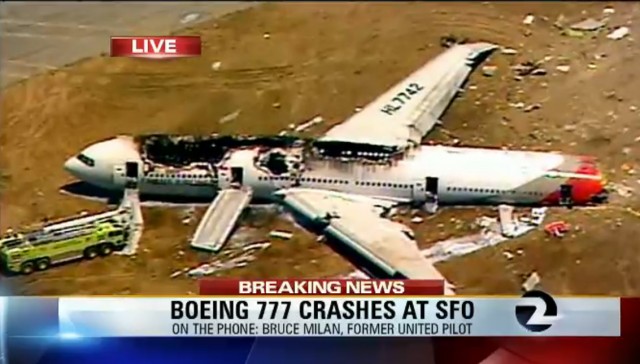
Initial reports are that the aircraft had just touched down around 11:20 am local time, when the empennage was sheared off rear of the aft pressure bulkhead of the 777, and the tail, gear, and engine of the plane separated. The plane turned around nearly 180 degrees and came to a stop to the right of the runway facing eastwards. Photos show debris before runway 28L; implying that the aircraft hit the ground before making it over the runway. Passengers were evacuated before the aircraft caught fire. The National Transportation Safety Board [NTSB] has been dispatched to the scene to investigate.

Image of the crash from news outlet KTVU
The aircraft is a Boeing 777-200ER with registration HL7742. The aircraft, with line number MSN-29171 is powered by 2 Pratt&Whitney 4090 engines and is configured with either 296 or 300 seats on board and was delivered on March 7th, 2006. Asiana Airlines operates 9 Boeing 777-200ER aircraft in 6 different configurations.

291 passengers (19 business, 272 economy) and 16 crew members were on board, reports are that all  of the 307 passengers are accounted for. According to the San Francisco fire department, 2 people have been reported dead, with 230 injuries of some sort. However, in situations such as this crash, the numbers in terms of passengers According to Asiana Airlines, the passengers on board “were comprised of 77 Korean citizens, 141 Chinese citizens, 61 US citizens, 1 Japanese citizen.”

Asiana's official press release related to the incident can be found here. San Francisco International Airport has been updating the media constantly with intermittent press conferences as it can release information.

The incident is the first fatal incident involving passengers and a Boeing 777. The last (and only other) major crash of a Boeing 777 aircraft occurred on January 17, 2008, when British Airways Flight 38 crashed on arrival at London Heathrow after flying in from Beijing. However, on September 5th, 2001, a ground fire broke out on a British Airways 777-236 at Denver, and one re-fueling operative was killed.

Asiana flight 214 is the first airline crash on US soil since Colgan Airlines flight 3407 on February 12, 2009, which killed 49 passengers on a Bombardier Dash 8 aircraft. The last mainline crash in the United States occurred on November 12, 2001, when American Airlines Flight 587, an Airbus A300 crashed at New York's JFK International Airport, killing 265 (260 passengers, 5 on the ground)

The following picture from passenger David Eun shows passengers disembarking the aircraft, and the fuselage appears to be intact, though burning.

The following videos were taken by a passenger at San Francisco Airport


Videos credit to @360kid

The ATC feed can be heard here on the LiveATC site archive. Asiana 214 is given a landing clearance to runway 28L around 21m20s into the recording. The crash occurs around 22m02s. Shouting can be heard in the background of the tower controller's transmission at the time of the crash.

Image via Ben Sandilands showing emergency response
The airline put out a statement around 2130 UTC
The following information has been confirmed.

Asiana Airlines flight OZ214 (Aircraft Registration HL7742) departed Incheon International Airport on July 6, 2013 at 16:35 (Korea time) bound for San Francisco. Only July 6, 2013 at 11:28 (Local time) an accident occurred as OZ214 was making a landing on San Francisco International Airport's runway 28.

There were a total of 291 passengers (19 business class, 272 travel class) and 16 cabin crew aboard. The majority of the passengers were comprised of 77 Korean citizens, 141 Chinese citizens, 61 US citizens, 1 Japanese citizen, etc. for a total of 291 people.

Asiana Airlines is currently investigating the specific cause of the incident as well as any injuries that may have been sustained to passengers as a result. Asiana Airlines will continue to cooperate fully with the investigation of all associated government agencies and to facilitate this cooperation has established an emergency response center at its headquarters.

At this point no additional information has been confirmed. New developments will be announced as more information becomes available.

*For further information regarding OZ213/214, please contact 02-2669-4015 (for overseas calls : 82-2-2669-4015).
Read more »

Airport lounge report: Iberia Dali business class lounge at Madrid Barajas Terminal 4

Guest post by Vishal Mehra
@vishal1mehra

During my trip from Barcelona to Lisbon via Madrid (read trip report here), I had intentionally chosen a long layover at Barajas airport as I wanted to both see the famous wavy ceilings which created quite a ripple (yes, the pun is intentional) when the airport opened in 2006, and I also wanted to explore the Iberia lounge at its home base.

As I got done with my little terminal tour and purchasing the customary refrigerator magnet from the duty free store, I proceeded to Iberia’s business class Dali lounge in Terminal 4.

Considering Madrid is the home base for Iberia, my expectations of the lounges in Madrid being superior and larger that those in Barcelona were fulfilled. The lounge was huge, as well as very impressive to say the least.


Divided into 2 areas, it had large areas of comfortable seating which was soothing for the eyes to see and invited me to sink my tired muscles into and relax. The central area shown above had a spacecraft design to it, with little chairs, and fountains inside it along with a wide selection of reading material, though again it was dominated by Spanish selections.


After relaxing for few minutes, I grabbed myself a beer and started exploring the lounge. There were reasonable options for food, including salads, pasta, sandwiches, wraps and sushi rolls. I would have ideally liked to see more hot food options as well but as this lounge serves the Schengen area flights with usually small layovers, it appears Iberia decided to serve more "to-go" options. There is a large choice area of alcoholic, non-alcoholic drinks and a café.


Besides your typical coffee machine, the lounge served various pastries, croissants, cornflakes, milk and tea options. The lounge also had a fancier coffee machine, though I must admit I did not try it all.

Something rather unique in this lounge was this dedicated wine bar which serves a wide variety of wines. This bar, I was informed, also hosts regular tasting sessions, but to my loss, there was no such session during my transit. I was still able to lay my hands on couple of reds.


The Dali lounge also features a dedicated quiet area in the back that had little beds for passengers opting to take a quick nap between their flights. Given the long days and hectic schedules of business passengers, who comprise the largest share of premium passengers, it would behove other airlines to incorporate a similar feature in their lounge offerings.


The business area had the obligatory few computers, internet access, a printer and a fax machine. Iberia though has to remove one very irritating feature. The wireless internet was accessible only through 30 minute cards which, though the front desk gave with a smile, is disruptive to a business passenger. By the time I went for my third card, the staff on duty graciously offered to give me an extra one to save me the trouble of coming back. I had to decline her offer as my flight to Lisbon was due to depart soon.


Though the TV lounge was largely unoccupied, barring one keen viewer. Again considering this lounge mostly serves intra-European flights, the lounge shows the extent to which Iberia has gone to make this lounge a pleasant experience for the many needs and interests of the passengers it would carry.


Overall, It was a very enjoyable experience at the lounge, and clearly one of the best that Iberia has to offer to its passengers. Iberia may be in deep financial mess it appears they have not spared any expense in making this lounge a comfortable experience for the premium traveller.

I must admit thoroughly relishing myself during these six odd total hours with Iberia minus few niggles. These six hours compromised of two lounge visits, in Madrid and Barcelona each (read Barcelona lounge report here), as well as two flights on Iberia’s A320, from Barcelona to Madrid and then from Madrid to Lisbon. All of this cost me 9000 avios and Rs. 5771. It's a price I would pay happily for so many firsts every single time.

- Vishal Mehra is a digital marketer at a global agency, smitten by travelling and commercial aviation. He tweets a lot and off late has taken to blogging as well. Visit his blog.

All images in this article are the copyright of Vishal Mehra and used with his permission. Unauthorised use and/or reproduction is prohibited.
Read more »

Dubai airport's dedicated Emirates A380 Concouse A now fully operational

The special concourse dedicated for Emirates' Airbus A380 superjumbos at Dubai airports is now fully functional.

Concourse A at Terminal 3, Dubai International Airport, is the world’s first purpose-built facility for A380 the aircraft at Dubai International. It features 20 A380 capable contact gates, and 29,000 square metres of Emirates' First and Business class lounges. The concourse has 11 floors and a total built-up area of 528,000 square metres, and is connected to Concourse B and Terminal 3 via an underground train.

In the first month of limited operations, with four gates, the concourse has handled 461,972 pieces of luggage, served over 2,450 flights with 589,234 passengers.

Concourse A will boost the airport's annual passenger capacity by 15 million to 75 million. The Dubai Airports company has a $7.8 billion 'Strategic Plan 2020' which will further increase passenger capacity by another 15 million by 2018.
Read more »

GMR Maldives CEO refutes claims of Maldives government on handover of Male airport

The CEO of GMR Male International Airport Pvt. Ltd. (GMIAL), Andrew Harrison has put out a statement refuting claims of the Maldavian government of a smooth and orderly take over of Male airport operations by the government.
I categorically refute the version of events being portrayed to the media in relation to the meeting this morning with GoM officials and outline the true meeting content as follows:

1.
I received a telephone call from a Colonel of Maldives National Defence Force (MNDF) at 1103 to advise me that the Acting Transport Minister who is also the Defence Minister is meeting with MACL at the airport and would like to call upon me personally. The meeting took place at 1145 in our Boardroom at Male' airport. The meeting was attended by the Acting Transport Minister, the Chairman of Maldives Civil Aviation Authority, our Lawyer in Maldives and 3 members of MNDF.

2.
The meeting was cordial and the Acting Transport Minister outlined the following:
  • MACL would be operating the airport from Saturday morning in line with the Government of Maldives communication to GMR-MAHB.
  • The Minister would like a smooth transition as the airport operations should not be affected and suffer in any way. Passengers should not be inconvenienced and therefore all activities including Duty Free would be allowed to continue as is.
  • According to their legal advisors he injunction issued by Singapore High Court does not prevent them from taking over the airport and the injunction cannot be applied to a sovereign state.
  • They propose offering 100% employment in MACL to all staff currently working for GMIAL and an announcement to that effect would be made tomorrow by the MACL Board. The offer includes both local and foreign staff at their existing terms and conditions including salary.
Our position, which I communicated to them, remains crystal clear. The Singapore High Court has issued an injunction which clearly prevents MACL or the Government of Maldives or any of its agents from taking any action that interferes with GMIAL operating the airport. The injunction clearly prevents them from taking the action outlined in their notice issued to us stating that the airport would be taken over at the end of the 7 day period. We remain resolute in our position and there is no question of an offer being made and certainly no question of any alleged offer being accepted as we will simply not agree to our rights nor the injunction being undermined in any way.

Our Lawyer further clarified that the injunction was to be honoured as their representatives and Attorney General were party to those proceedings and were present during the proceedings in the Singapore High Court. Further to this we have issued a communication to their lawyers to confirm that their client (MACL/GoM) will not ignore the injunction and outlining the consequences as well as the disturbing media reports that they will ignore the injunction and take over the airport as planned.

The Acting Transport Minister explained that he was not a legal person and he would therefore arrange for his legal team to meet our Lawyer tomorrow to go discuss the legal matters and in the meantime he stated that we should maintain dialogue. We will always maintain dialogue but our legal position is very clear and we will not compromise on our legal position which is clearly supported by the injunction.

Any version of the meeting being described any differently to my response is categorically untrue and we maintain that we have been granted the right to continue operating the airport in line with the injunction. There is and has never been any change in our position.

Regards,

Andrew Harrison
Chief Executive Officer
GMR Male' International Airport Pvt. Ltd.
Read more »

OPINION: Aviation at a Crossroads

The past couple of years have not been kind to the global aviation industry. Whether it’s the European union implementing a misguided carbon taxation scheme, the Indian government crushing its nascent airline industry under the weight of oppressive regulations and heavy fuel taxation, increased “NIMBY” (not-in-my-backyard : a term used to describe local residents who oppose aviation development near their residences)” activity in the west holding back growth in the airline sector, or a global airline industry plagued by rising fixed costs and softened demand in the face of the Global financial crisis, there is little doubt that the headwinds faced by the global airline industry are amongst the worst in its history.

Yet despite the apparent irrelevance of the airline industry to our daily lives, its potential decline has profound implications for my entire generation. To start with, it is important to define the essential role that aviation plays in local communities and in the economy as a whole. According to the Federal Aviation Administration (FAA), in 2011 civil aviation alone contributed to and supported more than $1.3 trillion in economic activity as well as 10 million jobs. These estimates ignore the thousands of jobs and billions of dollars in economic activity created and supported by military aviation; both directly in the air force, as well as in the thousands of companies involved in the supply chains of building and maintaining military aircraft for use both at home and with our allies abroad. In several communities, airlines, airports, and aircraft manufacturers are an important source of jobs- especially because positions in the former two sectors can’t realistically be outsourced.

On a more visceral level, the airline industry has contributed heavily to global and US economic growth. The most important aspect is that it makes sharing ideas, knowledge, and skills much easier. In the past, if you wanted to collaborate on a project with a group of engineers from Tokyo, it would take them days, even weeks to cross the Pacific by boat. But thanks to the miracle of modern aviation, you can now have them by your side in less than 24 hours, and at a reasonable fare to boot. This enhanced dissemination of knowledge and know-how has helped drive economic growth around the world, increasing the standard of life for everyone. On a more basic level, air cargo allows precious, time-sensitive, and/or valuable goods to be shipped around the world almost instantly – carving out new markets for exotic fruits and goods, as well as American exports. In today’s America, when unemployment amongst my peers is close to 15%, we can ill afford to lose the jobs provided by directly by aviation, let alone the many more indirectly made possible by air travel and air freight.

On a societal level, we all benefit when different cultures and viewpoints are brought together at common locations to discuss, integrate, and assimilate. Some of the best things about life in America (“Gangnam Style,” basketball, even apple pie) are foreign inventions brought here by immigrants. It is absolutely critical that we continue to make the world more interconnected, so that we can maximize the quality of life of all of the world’s citizens. It is no accident that as the aviation world has developed over the last few years; the degree of global integration has grown exponentially alongside. And in an increasingly uncertain environment which has led many economists to question whether the economy will even grow at all moving forward (or if we have settled into a “Great Stagnation”), cutting off a source and facilitator of economic activity makes little sense.

On a personal level, it kills me to see an industry that I love so much slowly be slowly squeezed to death (though there are bright spots like the United Arab Emirates and Singapore) by incompetent governance and an oblivious populace.

 And the threats to global aviation are numerous and diverse in nature. Part of the trouble is the incessant obsession with carbon dioxide emissions, and the general effect of environmentalism. According to the International Energy Agency (IEA), global aviation accounts for just under 3% of global greenhouse gas emissions (GHG). Yet the European Union proposed an invasive and expensive carbon tax, guaranteed to reduce airline activity and harm not only its own aviation industry, but those around the world. Environmentalists, because of their insistence on protecting each and every animal regardless of the cost, have effectively prevented the expansion of John F. Kennedy International Airport in New York, because the only viable option is to expand onto protected wetlands on Jamaica Bay. This lack of suitable airport expansion in the NYC area has in turn held back aviation development, as the number of flights at each New York City airport has been capped.

But because the runway capacity in the area is insufficient, there is now a huge backup of flights (planes lining up to land on runways) and an extraordinary amount of delays in the NYC airspace. The greatest irony of the situation is that now, tons upon tons of extra carbon dioxide emissions are being spewed into the air because the flights are forced to wait in line with their engines on at the airport or in the air. Many climate scientists would argue that this actually has a greater environmental cost than the loss of a few square miles worth of wetlands which could alleviate, if not solve outright, the problem. But the threats to aviation extend beyond inconsistent and incoherent environmental opposition. In recent years, the political power of so called NIMBYs has expanded. Around the world, especially in the great European cities like Frankfurt (where local residents passed a poorly thought out curfew for flights that decimated Frankfurt’s air cargo industry – likely creating more jobs for the superhubs in the Middle East) and London (where a combination of environmental, governmental, and local opposition to building a third runway at already slot restricted London Heathrow Airport threatens the place of London as a hub in the future aviation hegemony), but also in places like Philadelphia (where local residents are desperately trying to expand the constricted Philadelphia International Airport’s capacity). Admittedly, these residents are affected by airports in the region, but I have problems with using this as an argument to halt development.

The first is that in most, if not all cases, the local residents moved to the region after the airport was built there – they should have been aware of the risk that airports can expand and grow in importance. But more importantly, the needs of the few (local residents around airports opposing development typically number less than 1% of the population of the metro area that it serves) should not outweigh the needs of many. In times of crisis, like our economy today, it makes little sense to sacrifice new jobs and economic activity that would benefit the general region for such limited benefit.
Read more »

50 flights diverted due to Dubai airport closure

Air Traffic at the middle-east's busiest hub experience major snarls due to the fog and loss of power to a critical runway backup system.

The closures were caused this morning when reduced runway visibility. About 06:45 there was a loss of power to a critical runway backup system required to maintain runway lights during foggy conditions. While actual power was not disrupted, it is essential, for reasons of safety that the backup system remains functional.

This prompted Dubai International airport administrators to suspend flight operations. About 50 flights were diverted to a number of area airports in the Persian Gulf region including Dubai World Central, Al Ain, Doha in Qatar, Abu Dhabi, Dammam in Saudi Arabia, Muscat in Oman, and Bahrain, among others.

Runway operations were restored by 08:30. The airport operator is working with airlines, air traffic and ground services staff to restore operations, clear the backlog and limit customer inconvenience.

Further flight delays are anticipated as a result of the disruption, and so passengers are advised to check with their airline or airline websites for further information on flight arrival and departure time.

Image courtesy Dubai International airports
Read more »

Mangalore, Lucknow, Varanasi, Trichy, Mangalore and Coimbatore declared International airports

Photo copyright Samrat Mondal. Used under CC licence.
The Union Cabinet today approved the declaration of Chaudhary Charan Singh Airport, Lucknow, Lal Bahadur Shastri Airport, Varanasi and airports at Tiruchirapalli, Mangalore and Coimbatore as international airports.

The Indian ministry of civil aviation says, all these airports are capable of handling medium capacity long range type of aircrafts and are also equipped with facilities for night operations. These airports have been recently upgraded to international standards.

The release goes on to provide details of the airports, and while are happy for the information, and congratulate these airports and the ministry, we cannot but help notice the glaring contradictions.

Chaudhary Charan Singh Airport, Lucknow: The airport runway is suitable for operation of AB-300 type of aircraft in all weather conditions. The existing apron is suitable for parking 14 aircraft (2 B747, 1 B-767-400, 11 AB-321 type of aircraft), in Power in/Push back configuration. Presently, Indian Airlines, Jetlite, GoAir, IndiGo and SpiceJet airlines are operating domestic flights. [If the runway can only handle an Airbus A300, the smallest of Code D aircraft, why have stands for larger aircraft like a 747? Also, Indian Airlines was merged in to Air India. Is the ministry trying to send a signal to the world at large?]

Lal Bahadur Shastri Airport, Varanasi: The airport has a runway suitable for operation of AB-320 type of aircraft in all weather conditions. The existing apron is suitable for parking 5 B767 and 4 AB-321 type of aircrafts. Presently, Air India, Jet Airways, Jetlite, SpiceJet and Kingfisher airlines are operating domestic services through this airport. Air India, Thai Airways and Cosmic Air are operating International flights through this airport.
[Again, if the runway can only handle Code C aircraft (Airbus A320/Boeing 737 size), why have parking for a Code D aircraft like the Boeing 767?]

Tiruchirapalli: The airport is suitable for operation of AB-320 / B-737-800 type of aircraft in all weather conditions. Night operations are permitted. Domestic and international flights are operating and the destinations covered are: Abu Dhabi, Chennai, Colombo, Dubai, Kuala Lampur, Mumbai and Singapore. Airlines operators - Air India Express, Air Asia, Kingfisher, Mihin Lanka, Sri Lankan and Tiger Airways. The airport is equipped with navigational aids and visual aids.

Mangalore Bajpe Airport: It is suitable for AB-310 and B737-400 type of aircraft operations in all weather conditions. Night operations are permitted and domestic and international flights are operating and the destinations covered are: Dubai, Doha, Muscat, Kuwait, Calicut, Bangalore, Hyderabad, Chennai and Mumbai. Airlines operating are :- Air India, Kingfisher, SpiceJet, Jet Airways and Air India Express. The runway is provided with instrument landing system (ILS).
[Air India Express has only Boeing 737-800 aircraft in its fleet. Why specify an older generation Boeing 737?]

Coimbatore: Coimbatore is presently handling limited international operations. The Airport is suitable for all weather operation of B-767-400 type of aircraft. Night landing operations are permitted at the airport. Destinations covered are: Bangalore, Chennai, Calicut, Delhi, Hyderabad, Mumbai, Sharjah and Singapore. Airline operators are : Air India, Air Arabia, IndiGo, Jet Airways, Jetlite, Kingfisher, Silk Air and Spice Jet. The airport is equipped with navigational and visual aids including CAT-l Instrument Landing System (ILS).

Read more »

Review: Lufthansa's new Business Class onboard its Boeing 747-8i and Airbus A330-300 Mumbai Munich


Following an excellent trip in India, I started off on my return flight to the US. I got to Mumbai Airport around 22:20 (10:20pm) for my flight to Munich at 01:07.

Mumbai airport - A series of bottlenecks

Right now Mumbai Airport is in a bit of a transition phase as they construct the new integrated terminal so I suppose this is forgivable, but the ground-side experience at Mumbai’s Terminal 2 is just plain awful right now. Call it a lack of CISF personnel or a lack of planning, but all passengers are funnelled in to just two doors, and at peak times for international departures, 9pm onwards, the lines can extend up to 30 minutes long, and it’s a humongous bottleneck that the team at Mumbai airport must look in to on top priority.

Once you get into the terminal, it gets a little bit better but not much. In my case, Lufthansa’s local station manager came over and showed me to the first class check in line. Checking in was a breeze, and I headed over to the second bottleneck at Mumbai Airport, the immigration line. Now I’ll hope against hope that this issue will be fixed once the new integrated terminal comes up, but based on experiences of passengers at T3 in New Delhi, there are just not enough immigration counters or personnel to serve the peak demand both inbound and outbound. Wait times for the premium classes are 20~30 minutes and economy class from 45~60 minutes. I understand why most travellers from India are loathe to connect from domestic to international at hubs, especially Mumbai.

From this bottleneck, you are immediately funnelled into the next bottleneck -- the security check. Another 30 minutes, again thanks to a lack of adequate personnel. A lack of adequate English language knowledge and both the CISF end and many foreign non-English speaking passengers adds to the delays. These are issues the Ministry of Civil Aviation must address if they intend to succeed at hubs and improve tourism. The CISF too needs to explain why is it cannot provide adequate personnel and rendering such a poor service when it receives at least Rs. 130 per departing passenger.

I immediately headed to the Lufthansa Business Lounge opposite Gate 6, which was excellent (review to come soon).

Lufthansa LH765 Mumbai - Munich 

Around 1215, I left for the gate so that I would be able to board the plane early and get some unencumbered shots of Lufthansa’s new business class seat. Unfortunately, the boarding was on a remote gate and in-explicably there was no separate boarding for premium class/frequent flyer passengers versus economy class passengers.

Flight #1 LH765 BOM-MUC 0107-0555 Seat: 8K(business, aisle)- new business class product Aircraft: Airbus A330-300 (2-2-2 business configuration), 90% full.

I got onto the plane and managed to snap a few good shots of the business class seat before settling in. Immediately once we got into the air, the Lufthansa flight attendants immediately came around with hot towels, which were very useful given my state after running around Mumbai Airport.

Following this, they came around with a drink service along with some nuts, which while delicious, weren’t served warm as they are in some other business classes. Still, a meal followed in which I had an excellent Asian vegetarian palate, though the highlight was definitely the apple raisin pie for dessert, as well as the excellent bread basket. A hot dessert might have been in order, though this is just nitpicking.

Following this meal, I decided to check out the selection available in Lufthansa’s AVOD (Audio Video On Demand) in-flight entertainment system (IFE).
The content offering is sparse (especially in comparison to Singapore Airlines, Cathay Pacific, and even United). After some deliberation, I decided on the pilot for 2 Broke Girls on CBS (rapidly becoming one of my more favoured shows – for those that don’t know, I’m a TV savant – I regularly follow some 20-25 shows year round), followed by Battleship, an incredibly contrived big budget action film with gaping plot holes. Still, the impressive visuals from Battleship were pretty awesome on Lufthansa’s massive AVOD screen in the new business class.

I decided to test out the full extent of Lufthansa’s new lie-flat product. And I have to say that the seat passed with flying colours. Lufthansa has this fantastic seat control system which allows you to adjust every single aspect of your seat, including the firmness, and it was pretty awesome for someone like me, who is a bit of a quirky sleeper. I slept like a baby and it was pretty much the best business class seat I’ve ever been in (out of 15 airlines) from a sleep perspective. I managed to squeeze in around 5 hours of sleep before waking up to an excellent breakfast service that finished around 30 minutes before our touchdown on-time in Munich.

Conclusion - Great seat, fantastic bed, excellent cabin crew

As a whole I would judge the new Lufthansa business class product as excellent. This is not to say that there are no flaws. The AVOD IFE content offering is a bit sparse, though this would be mitigated once Flynet (inflight WiFi) is available. Of course the use of your own devices over WiFi becomes less relevant if they run out of battery 3 hours in, so I think it’s critical for Lufthansa to add proper in-seat power outlets and really take Flynet to its full potential, perhaps using the hybrid outlets that accept both US and European plugs.

Edit: A Lufthansa spokesperson informed me that Lufthansa does in fact offer vegetarian meals, so it must have been a communication error on my part that precluded me from getting a standard vegetarian meal.

However, these short-comings are more than overcome by the incredible seat and something that I’ve grown to consider a huge Lufthansa asset; their cabin crew. On my last five to six Lufthansa long-haul flights, I’ve had great flight attendants in both economy and business class. I later found out from Devesh, that Lufthansa has been training its cabin crew with its partner, Singapore Airlines, which is famous for its "Singapore Girl" cabin crew.

I observed the Lufthansa cabin crew always extremely professional and courteous, but they have this critical extra touch of care and attention. Throughout this trip, from Newark to Frankfurt to Bangalore and from Mumbai to Munich, what struck me was the care and attention the LH cabin crew devote to helping out elderly passengers with mundane inflight stuff; like getting up to go to the bathroom, and dealing with wheelchairs and baggage post-flight; something we younger passengers take for granted.

Kudos to Lufthansa’s flight attendants for their excellent service; like their counter-parts in Singapore Airlines, the cabin crew adds those critical extra touches to the overall experience, that makes the difference between good and great.

So overall, I’d rate this a solid 8.5/10, falling behind because of the limited in-flight entertainment content and the limited amenity kit (though the kit bag itself was awesome), and limited food options, but these short-comings may not matter as much to the corporate traveller to whom, rest and service is critical, and there the new business class seat would get a rating of 12 out of 10 if it were possible, and the cabin crew a solid 9.5/10.

It is, by far, the best business class product offered ex-Bangalore today.

All we can say in closing, competitors ........ look out.

Editor's note: Lufthansa commences its Bangalore Frankfurt Boeing 747-8i service later tonight. This is the same Business class found on this new aircraft. Vinay's economy seat was paid for. Thanks to Lufthansa for upgrading him to the Business class on the Mumbai Munich sector operated by an Airbus A330-300. Lufthansa is upgrading its A333 fleet to the same new business class as the B748i progressively.

Read more »

Comptroller and Auditor General of India report on PPP at Delhi Airport

In a report titled "Implementation of Public Private Partnership, Indira Gandhi International Airport, Delhi" the Comptroller and Auditor General of India (CAG) has found faults in almost every step of implementation of the Public Private Partnership (PPP) model in the brownfield privatisation of New Delhi's Indira Gandhi International Airport (IGIA).

While acknowledging the PPP was the correct method to follow and praising the airport operating company Delhi International Airport Ltd., (DIAL) owned by a consortium headed by GMR Group,
It is acknowledged in this report that there have been significant improvements in services at the airport for the travelling public. The new terminal T3 was completed within time for the Commonwealth Games. The airport has been adjudged as the second best in the world in the category of 25-40 million passengers per annum by Airports Council International.
the report is probably the most damning indictment of former civil aviation minister Praful Patel and the ministry he led during the period of the airport privatisation.
Many observations in the present report would indicate that whenever DIAL raised an issue regarding revenue to accrue to it or expenditure to be debited to Government in contravention of the provisions of OMDA, the Ministry and AAI interpreted the provisions always in favour of the operators and against the interest of the Government.
The report accuses the Ministry of Civil Aviation, headed by Mr. Patel, of violating laws, and providing post contractual benefits to DIAL, to the detriment of the government as well as the travelling public.
Ministry of Civil Aviation and later AERA allowed DIAL to collect Development Fees amounting to Rs. 3415.35 crore. The order of Ministry in February 2009 allowing that was in contravention of the OMDA, AAI Act and the AERA Act.
Contrary to the provisions of OMDA, DIAL was allowed to use the amount collected as Development Fees to meet the project costs. In fact, only 19 per cent of the project cost came from equity, approximately 42 per cent came from debt. The remaining project costs were met from security deposits and Development Fees.
The report also highlights where DIAL was given benefits significantly over and above Government departments
It was noted that the concept of upfront fee was used to lease out an additional land of 190.19 acres for a paltry one time payment of Rs. 6.19 crore. Other Government offices like Director General of Civil Aviation and Bureau of Aviation Security were given a much harsher treatment when 7.60 acres of land was leased out to them at a license fee of Rs. 2.41 crore per annum.
The report highlights how by omitting the phrase “mutual agreement and negotiation of terms” which was present in the note approved by the Union Cabinet, but removed in the concession agreement OMDA, DIAL has unilateral rights to extend the concession period for an additional 30 years at the original already grossly under-rated terms of the OMDA.
The decision to adopt the joint venture route was taken based on the Cabinet Note of September 2003. While seeking approval for restructuring of the Delhi and Mumbai Airports, this Cabinet Note specifically envisaged an initial concession period of 30 years which could be extended by another 30 years subject to "mutual agreement and negotiation of terms". However, in the draft OMDA which formed part of the bid documents, the important condition "subject to mutual agreement and negotiation of terms" was omitted. The OMDA, which was signed in April 2006, did not contain any provision of mutual agreement and fresh negotiations before extension of the concession period. This is not only a violation of the commitment in the Cabinet Note but is also a unilateral and unfair advantage given to DIAL which is detrimental to Government interest as it does not provide the Government any scope for review of any of the conditions.
The report also highlights the liberal manner of how the OMDA is written to favour DIAL.
The possibility of any JVC event default in the small window of 5 years between 20th and 25th year is remote. Such a sweeping provision, without any scope of review at any time during the currency of the concession period, has effectively granted DIAL the sole right to operate the airport for a period of sixty years with the terms and conditions frozen in the OMDA.
Editor's note: The relaxation of requirements or confining performance to an extremely narrow window is a common thread found in virtually every India PPP airport concession agreement, all of which were signed during the tenure of Mr. Patel as civil aviation minister.

The report alleges the virtual give-away of land to DIAL, accusing the Ministry of giving DIAL land worth more than Rs. 24,000 Crore for a sum of Rs. 31 lakhs, and an annual payment of Rs. 100 only.
The projected earning capacity of this land in terms of license fee over the concession period of 58 years was indicated by DIAL itself as Rs. 681.63 crore per acre in a letter to the Joint Secretary, MOCA. Thus for the entire area of 239.95 acres, the potential earning from the land, according to the calculations worked out by DIAL itself, amounts to Rs. 1,63,557 crore. Audit would like to draw attention to the fact that this area is part of the entire area of land that has been handed over to DIAL at the lease rent of Rs. 100 per annum.

It has been ascertained from AERA [Airport Economic Regulatory Authority] that the current valuation of the land made by M/S Merrill Lynch in the report of 26th August, 2011 has been worked out at the rate of Rs. 100 crore per acre. Thus even in terms of this conservative estimate, the total current value of the land available to DIAL for commercial exploitation, would amount to approximately Rs. 24,000 crore.

Audit is constrained to observe that against the aforementioned calculations, MoCA [Ministry of Civil Aviation] allowed DIAL to use 239.95 acres of land for commercial exploitation at a consideration for one time payment of Rs. 31 lakh (5 percent of Rs. 6.19 crore) and an annual payment of Rs. One hundred only.
Both DIAL and the Ministry of Civil Aviation have refuted the observations of the CAG. In a release DIAL said
The Comptroller and Auditor General (CAG) has tabled a report on the Implementation of Public-Private Partnership at Indira Gandhi International Airport before the august Houses of the Parliament.

This report pertains to an audit conducted by the CAG on the performance of the AAI with particular reference to the privatization process of Indira Gandhi International Airport (IGIA). Therefore, the appropriate and competent authority for redressal of all queries on this issue is the Airport Authority of India (AAI) or the Ministry of Civil Aviation (MOCA).

Even though many of these issues have already been discussed between the ministry and auditors and were responded to in detail, they have not been reflected in the final report. Even the former Secretary Civil Aviation had expressed this view in a separate letter to the Audit Authority.

Hence, we feel sad that a showcase airport created with dedicated efforts and a well-thought-out policy of the national government has come in for adverse remarks. We have also noted with concern that the reputation of this company has been questioned regularly in the media based on incomplete and inaccurate facts. Hence, purely in order to put the records straight, we would like to state the following without prejudice to our rights:

1. Delhi International Airport Private Limited (DIAL) has NOT received any undue benefits from the government before, during or after the bidding process. The entire process of the privatization and selection of Joint Venture was based on a transparent, international, competitive bidding which was guided and presided over by competent bodies and has been upheld as such by the Hon’ble Supreme Court in 2006.

2. It is alleged that with the airport modernization project DIAL was effectively handed over land valued at Rs. 1,63,557 Crore for only Rs. 100 per year.

a. The purpose of leasing the airport land by AAI to DIAL was neither sale of land nor earning of a rental income from it.

b. The basis of providing the concession to operate the airport was the revenue share quoted by the bidders to AAI.

c. The entire commercial land available with DIAL neither has any immediate commercial value nor can be put to use and therefore cannot be monetized immediately. Thus, just using value of one acre and extrapolating the same for the entire land parcel is at best an arithmetic exercise and not practical.

d. In fact, using the same method of calculation, AAI will receive Rs. 3 to 4 Lakh Crore from DIAL as revenue share over the 54 years.

3. The allegation that Airport Development Fee (ADF) was an afterthought and done only to benefit DIAL is absolutely untrue:

a. ADF is allowed as per section 22 A of AAI Act 1994 as amended in 2003 – long before the bidding process – and hence was known to all bidders

b. AAI Act is the primary governing legislation for the concession as provided in the transaction documents

c. The levy of ADF was upheld by the Hon’ble Supreme Court vide its order dated 26th April 2011

4. The concession period of 30 years with 30 years extension being an unfair advantage to DIAL is also not true:

a. Such long concession periods are quite normal in infrastructure projects where the investment is large and gestation period is long

b. Moreover, as this was a bid condition known to all bidders, they had already considered this condition while quoting the bids

The Indira Gandhi International Airport (IGIA), Delhi is a shining example of the success of PPP model of infrastructure development in India. IGIA is currently rated as the second best airport in the world in the 25-40 million passengers per year category. The current Airport Service Quality (ASQ) rating of IGIA stand at 4.73/5.00 which far exceeds that stipulated in the concession agreement - at 3.75/5.00. It is currently the largest airport in India - catering to 36 million passengers per annum (mppa), handling 600,000 tonnes of cargo and managing over 300,000 aircraft movements every year. According to NCAER, IGIA contributes 0.45 per cent to the national GDP and 13.53 per cent to state GDP of Delhi. It has also created 15,78,000 jobs which is 25.9 per cent of Delhi’s total employment and 0.34 per cent of national total employment.
The Ministry said
Ministry of Civil Aviation has gone through the report of the CAG on Indira Gandhi International Airport, Delhi as tabled in Parliament today and strongly refutes the loss figures and other allegations as made in the report.

The calculation of presumptive gain from the commercial use of land at the Delhi Airport is totally erroneous and misleading as it simply adds the nominal value of the projected revenue, without taking the net present value. In fact the net present value of the figure quoted by CAG is Rs 13795 crores only. CAG has further failed to appreciate that 46% of this amount would be payable to AAI as revenue share.

It is also pointed out that the levy of Development Fee is under Section 22 (A) of AAI Act, 1994 and was in the knowledge of all the bidders prior to the bidding process. Hence, contrary to what the CAG has said, the levy of Development Fee by DIAL was not a post contractual benefit provided to DIAL at the cost of passengers. Further, the levy of the Development Fee has been upheld by the Supreme Court, which has already examined and rejected all the issues now being raised by CAG in its report.

On the issue of lease of Airport land, it is clarified that the land has not been given to DIAL on rental basis. Rs100 is just a token amount for the purpose of the Conveyance Deed. The determining factor for grant of concession to the bidder was the Gross Revenue share quoted by the bidders. As a result, Airports Authority of India (AAI) now receives 45.99% share of Gross Revenues of DIAL and 26% of all Dividends. Benefit to AAI is likely to be more than Rs 3 lakh crores in this process during the entire Concession period. AAI has already got its revenue share of Rs.2936 crores in the last 6 years and likely to get Rs. 1770 crores in the year 2012-13 and Rs. 2287 crores in the year 2013-14. The AAI share of revenue from DIAL is further going to constantly rise every year in the balance concession period.

It may also be noted that the right to use 5% of Airport land for commercial purpose was also defined in the bid and known to all bidders.

The decision to restructure and modernize Delhi and Mumbai Airports was a policy decision of the highest body i.e., the Cabinet following the broad policy formulations of Policy on Airport Infrastructure, 1997. The modalities of modernization/ restructuring were as per the Cabinet decision and were frozen in the Transaction Documents finalized and approved by the Empowered Group of Ministers (EGoM), based on which the bidding process was completed. The issues now being highlighted in the CAG report, viz. Concession Period, Right of First Refusal (ROFR), Upfront Fee, Commercial exploitation of land, and Lease rental of land were part of these documents and were symmetrically known to all bidders before bidding and during the bidding process. These documents were later converted into different agreements, like Operation Management and Development Agreement (OMDA), State Support Agreement (SSA), Shareholders Agreement (SHA), Lease Deed Agreement, CNS-ATM Agreement, and State Government Support Agreement (SGSA), and there has been no change in these documents ever since.

All decisions including the entire bidding process and the approval of the OMDA was monitored by EGoM and subsequently approved by the Union Cabinet. The bidding process has also been upheld by the Supreme Court.

All Aeronautical and Airport assets created by DIAL will be transferred back to AAI as per agreement at the end of the concession period.

It is further stated that the views of Ministry of Civil Aviation and AAI have not been incorporated in the final report of the CAG and there are aspects mentioned in the final report which were neither included in the draft audit report nor were discussed with the Ministry of Civil Aviation at any point in time.

It is pertinent to mention that CAG in its report has itself acknowledged the significant improvement in the services for travelling public, new terminal T-III being completed within the time frame for Common Wealth Games and Delhi Airport being adjudged the second best in the world in the category of 25 to 40 million passengers per annum by the Airports Council International.

India has few world class Airports achieved in a very short span of time. Reports like these would damage the process of PPP and stunt infrastructure development in the country.

The brief parawise comments to the CAG report on IGI Airport are attached as Annexure and are also available on the website of Ministry of Civil Aviation.

Click here to see Annexure
You can download the entire CAG report on DIAL here. Do read it, and share your thoughts.
Read more »

New terminal at Lucknow airport found defective

A note from the Press Information Bureau of India about Lucknow airport, which is incidentally named after the father of present civil aviation minister Ajit Singh. The airport is owned and operated by the Airports Authority of India.
Taking a serious note of the complaints of irregularities in the construction of the New Terminal Building of the Chaudhary Charan Singh Airport, Lucknow, Union Minister of Civil Aviation, Shri Ajit Singh has decided to refer the matter to the Chief Technical Examiner’s Wing of the Central Vigilance Commission (CVC) for conducting a detailed enquiry into construction of the building. The decision of Shri Ajit Singh is based on a preliminary enquiry report submitted by a committee which was headed by Shri Samir Sahai, Chief Vigilance Officer, Pawan Hans Helicopters Limited. This committee was constituted by the Minister himself following various complaints received from Members of Parliament and news items published in this regard in newspapers. The report submitted by the enquiry officer has prima facie substantiated various defects in the construction quality, design and maintenance of Lucknow Airport Terminal.

The committee members visited the Airport in Lucknow and found the quality of work of the New Terminal Building below standard. The major defects included leakages from the roof above the check-in counter, in the ceilings near the departure lounge corridor and from some of the thermal expansion joints. The rain water harvesting method was also found prone to leakage as proper drainage system was not in place. The Committee also found that the flooring in the Arrival and Departure Terminal was not proper with granite stone cracking at some places. The electrical fittings were also not properly fixed up at many places. The overall maintenance of the building was found in poor condition, despite the fact that it was inaugurated only about two months back.

As the Committee was of the view that the architectural design as well as construction shortcomings and defects and quality of work need to be verified in detail, it was decided to refer the matter to the CVC. The building was constructed by M/s IPL, Brahmaputra Infrastructure Ltd. (JV) at a cost of about Rs. 90 crore out of which Rs. 85 crore has already been paid to the contractor. This is also noteworthy that the award of the construction was finalized in October 2007 and stipulated date of completion was April 2009. However, the completion was delayed and completed in May 2012. Inauguration of the airport was done on 19th May 2012. The Civil Aviation Minister has taken a serious note of the fact that the airport was inaugurated without ensuring the complete and quality construction. The Minister has clarified to the authorities that stern action will be taken against those found guilty.
The contractor has already received almost all his money. The delay of three years itself would have invoked certain cost escalation clauses in favour of the contractor. What are your views on these developments? Will the true facts ever see the light of day? Will ALL those guilty and culpable face justice?
Read more »

Bangalore airport update: terminal expansion photos. To complete by end 2013. Code F approvals received.

The on-going upgrade of Terminal 1 continues its progress. The airport operating company BIAL told Bangalore Aviation that the expansion would be completed in phases.

First to be ready will be the new VVIP terminal building, followed by each of the left and right wings and finally the small strip in the front of the terminal where the current escalators are.

Here are some pictures showing the work in progress. I must say, they do look a lot like the initial artist's impressions and video which can be seen here.
The right wing, on the site of the old VVIP terminal, is going to be marginally longer than the left.

Code F aircraft capability

German carrier Lufthansa, has announced, Bangalore will be a destination for its new Boeing 747-8i aircraft, which happens to be Code F due to a massive wing span. On enquiry a BIAL spokesperson informed Bangalore Aviation
For your update on Code F aircraft operation from Bengaluru International Airport please note Bangalore International Airport Limited has done safety risk assessment for Code F aircraft and has received approval to permit regular operations of this type of aircraft at this airport from the Director General Civil Aviation. Additionally Code F compliant stand is being created as part of T1 expansion and it will have the capability to accommodate A380 type of aircraft.
This is good news indeed, as Lufthansa's third 747-8i D-ABYD had its first flight earlier today. As a bit of trivia, there is a mis-match between the registration sequence and aircraft number sequence, as the registration D-ABYB is "number plated" i.e. retired and locked. This was the registration of a Lufthansa Boeing 747-100 operating flight LH540 which crashed at Nairobi, Kenya back in 1974.

Read more »

Bangalore International Airport revamps cab operations, introduces unified brand "The Airport Taxi"

A revamp of taxi operations at the Bengaluru International Airport has taken place, with the airport operating company BIAL launching an all new fleet of taxis under a new unified service brand called “The Airport Taxi”.

Bangalore becomes the first airport in India to develop and offer a taxi service with a unique identity.

The all white taxi fleet will be at 2,000 cars comprising of brands such as Toyota Etios, Maruti Swift Dzire, and Mahindra Verito (formerly Renault Logan). 1,400 taxis were introduced today and the balance 600 will be added through calendar 2012. The taxi service will be operated by two existing operators, Meru and KSTDC, and one new operator, Mega cabs. The bookings can be done at 080-4422-4422 or 080-4747-4747 or 080-4900-7777.

Leaving airport operations is the cab company Easy Cab. Bangalore Aviation understands that the taxi contracts came up for renewal and Easy Cab's offer was not as attractive as the others and hence was replaced.

What is surprising is the inclusion of Meru. The cab company has a poor reputation amongst frequent travellers due to the numerous strikes and incidents in the past, which led to disruptions of service at the airport.

Bangalore Aviation once again strongly advises travellers to and from the airport to discourage the touts and use only the official "The Airport Taxi" service or the Vayu Vajra Volvo airport bus service.

Editor's note: Bangalore Aviation regrets the error in the original story which indicated Meru had left the airport operations. The release from BIAL did not contain cab company details and there was a mis-understanding, by us, on which cab companies continued. Our sincere apologies.
Read more »

A PPP proposal to rescue Air India while retaining government ownership

Yesterday the government announced a massive Rs. 30,000 Crore ($5 billion) bailout of national carrier Air India.

The government has justified this this bailout to ostensibly protect the jobs of the over-bloated workforce of 30,000 employees at the airline.

Simple maths effectively translates the infusion to Rs. 10 million per employee, a figure the average Indian cannot even hope to earn in their lifetime.
All four aircraft types operated by Air India.
A good way to understand why the government is doing what it is with Air India, is to read this article by TN Ninan titled "Do-gooder economics and the LokPal", which shows how the powers that are, distort the market to create un-level playing fields for the personal enrichment of a feeding train all the way from the very top of the political food-chain to the lowest.

The bailout of Air India is not for its employees. They are just the pawns on whose shoulders the justification gun is fired from. The real beneficiaries are elsewhere.

Corruption, not necessarily financial, rears its ugly head in all aspects of the airline's operations.

Management is beholden to the political class for their jobs, so the leadership merely accepts the status-quo with minor window dressing to protect their chairs and by extension, their careers, for their tenure at the airline. Any effort by the management to change the working is met with political interference or labour resistance, the latter, being supported by the politicians who want to protect their vote-banks. The middle and junior management and the rest of the work force mimic this attitude raising lethargy and tolerance to inefficiency to unacceptable levels.

The only way to remove this governmental operation and political interference is to remove government from the operations of the ailing carrier, which means privatisation, and herein lies the billion dollar hurdle. There is no way any government, let alone the current, weakened, UPA-2 government, can politically sell even the notion of the privatisation of Air India.

To get around this, we propose to the Government of India, that they should consider leasing out Air India to a private player under the PPP (Public Private Partnership) model, as it has done for airports at New Delhi and Mumbai.

Under a competitive and open bidding, the airline can be leased out for a period of 15 or 20 years to a bidder leading a consortium which includes an airline of any origin, subject to a maximum of 49% share, in return for a share of revenue, or a share of profits.

The government should reserve an option of the employees of Air India coming together and bidding for the company which would bring the trade unionists at bay.

The government will have a 26% shareholding in the new company, along with representation on the Board of Directors. The government will not have any role to play in the daily operations of the company. In return the government should spell out in its tender document a time-table of financial goals the lessee must achieve, with the needed penalty clauses put in place.

What are your thoughts on this proposal? Share a comment.
Read more »