Showing posts with label Cargo. Show all posts

Boeing delivers first 747-8 with performance-improved engines

By BA Staff


Boeing image
Boeing delivered the first 747-8 with performance-improved GEnx-2B engines as part of the airplane's Performance Improvement Package (PIP.)

A Cathay Pacific Airways Cargo 747-8F Freighter was the first aircraft delivered with the new PIP engines.

The engine is the first of the package's three improvements to enter service. The two other components, Flight Management Computer (FMC) software upgrades and reactivation of the horizontal tank fuel system on the passenger version, the 747-8 Intercontinental, are expected to enter service later this month and in early 2014, respectively.

The PIP engine improves the airplane's efficiency by 1.8 percent. All three PIP components can be retrofitted on the 747-8. The tail fuel reactivation is applicable only for the 747-8 Intercontinental and the FMC upgrades can also be made to existing 747-400s.
Read more »

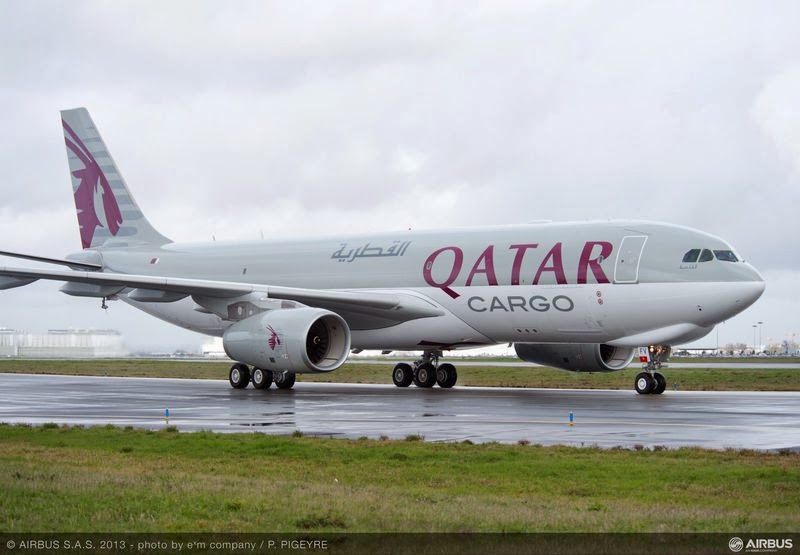
Qatar Airways Cargo order five new Airbus A330-200F freighters

By BA Staff

Qatar Airways A330-200F. Image courtesy Airbus S.A.S.
Qatar Airways has placed a firm order for five new Airbus A330-200 Freighter aircraft in an agreement signed at the Dubai Airshow 2013.

These new aircraft will complement the airline's rapidly growing network, which includes more than 40 routes that have dedicated freighter services.

Included in the order are eight additional A330-200F options – which would make the deal potentially worth over $2.8bn at list prices for a total of 13 aircraft.

Qatar Airways Cargo already operates three A330-200Fs since earlier this year.

Akbar Al Baker, Qatar Airways CEO said:
“The A330 Family has demonstrated outstanding operational reliability and performance for both our passenger and cargo transport operations. It is with this in mind that we chose to expand our freighter fleets with more A330-200Fs. We aim to be the best in everything we do, the air cargo market is no different, which is why we ordered the most modern and economic cargo aircraft available in its category.”
Airbus President and CEO, Fabrice Brégier said:
“Qatar Airways is one of our key partners in the region, and its selection of the A330-200F illuminates its ambitious plans as the airline expands and invests in new freighter aircraft. The A330-200F, with up to 70 metric tonnes of payload, is the only viable alternative to large freighters in today’s fast changing market, making it an ideal choice for a constantly evolving carrier.”
Qatar Airways received its first Airbus aircraft in 1997. Today Airbus aircraft form an ever more essential cornerstone of Qatar Airways’ global operations with more than 200 aircraft directly ordered across all modern Airbus product families, from the single-aisle A320 all the way up to the flagship A380.

Aimed at replacing ageing mid-sized freighters, the A330-200F offers an alternative to larger freighters within fleets. It builds on the successful A330 twin-jet platform and can carry 70 tonnes of payload, with a range capability of up to 4,000nm.
Read more »

dnata selects Amadeus' flight management solution

By BA Staff

Amadeus, announced that dnata, part of the Emirates group of Dubai and one of the world’s largest combined air services providers, will implement Amadeus' Altéa Departure Control’s Flight Management solution in their centralised load control offices (CLC) in Dubai.

The airport ground handler, is now present in 75 airports in 38 countries. The deal spans all Emirates and flydubai domestic and international flights and over 100 other dnata customer airlines using the system.

Under the agreement, Amadeus will provide dnata, which offers ground handling, cargo, travel and flight catering services, with a fully automated solution for managing the weight and balance of all flights it handles from its CLC in Dubai.

This solution is a new generation load control platform designed to enable ground handlers to ensure efficient flight departures and optimise the weight and balance process of all handled flights. It improves the productivity of load controllers, and enables greater precision in the forecast and analysis of passenger and cargo load. The system automatically defines optimal load distribution, thereby optimising fuel requirements for airlines and increasing uplift capacity of aircraft.

Jon Conway, Divisional Senior Vice President, Airport Operations, dnata, said:
“Amadeus’ in-depth experience, vast reach and high level of development will help us gain greater efficiencies through the full automation of our weight and balance system. Furthermore, Altéa Departure Control’s Flight Management enables us to provide our airline customers with significant fuel savings. The system’s community and SaaS elements also allow for greater collaboration with our customers. Altea DCS FM is already showing high performance in a centralised load control (CLC) environment, increasing productivity.”
John Jarrell, Head of Airport IT, Amadeus, commented:
“We are extremely pleased to continue our airport journey having signed the world’s fourth largest ground handler. Amadeus is proud to be part of dnata’s successful growth strategy today and into the future. We are certain this will only be the beginning of a fruitful relationship as we work closer together with this important customer to offer further enhancements in ground handling. This agreement enables us to strengthen our foothold globally, alongside our 50 ground handlers currently using our solutions today.” 
Francois Weissert, SVP & Chief Technology Advisor Middle East and Asia, Amadeus, stated:
“We are very happy to add an important ground handler like dnata to our growing list of customers in the Middle-East region, where we already have agreements in Egypt, Qatar, Bahrain and Kuwait. Amadeus believes in the potential of this region, which has established itself as a global air travel hub over the last few years. Since the creation of our regional head office in Dubai, we continue to invest in this strategic area, growing hand in hand with our customers and the regional travel industry.”
Read more »

Dubai International’s passenger traffic up 13.1 per cent in September

By BA Staff

Courtesy of Wikipedia
Passenger traffic at Dubai International, the world’s second busiest airport for international passengers, rose 13.1 per cent in September, according to the latest traffic statistics issued yesterday by operator Dubai Airports.

Passenger traffic in September totaled 5,407,326, an increase of 13.1 per cent compared to 4,780,394 during the corresponding month in 2012. Year to date traffic is up 16 per cent to 49,379,165 compared to 42,565,340 recorded during the first nine months of 2012. Aircraft movements totaled 30,746 during September, an increase of 10.2 per cent from the 27,909 recorded during the same period last year. Passengers per aircraft movement in September came in at 193.

All regions recorded positive growth in September with the exception of South America (-6.9 per cent).  Among the strongest markets in terms of percentage* passenger growth were Eastern Europe (+65.1 per cent), driven by flydubai expansion to multiple destinations in the region and Emirates’ new service to Warsaw. Passenger traffic to and from Australasia rose 38.6 per cent as a result of Emirates' expansion and Qantas’ new operation connecting Australia and London through Dubai. On a country level, Australia (+41.7 per cent), France (+23.7 per cent), Saudi Arabia (+22.4 per cent), Thailand (+21.8 per cent) and the UK (+21.7 per cent) saw the largest increases.

In terms of overall passenger numbers, Western Europe traffic took over as the top market thanks to robust growth (+14.8 per cent) during the month. AGCC came in second thanks to 15 per cent year-on-year passenger traffic growth. The Indian subcontinent, which took third spot, continued to show positive growth (+9.8 per cent) due to the expansion of several Indian carriers including Indigo, Spice Jet and Air India Express.

Air freight volumes rose 1.8 per cent in September with volumes of 196,823 tonnes compared to 193,261 recorded during the same period last year. Year-to-date cargo traffic totalled 1,785,539 tonnes, up 6.6 per cent from the 1,674,997 tonnes shipped during the same period last year.

Paul Griffiths, CEO of Dubai Airports said:
“Passenger and cargo traffic growth continue unabated and Dubai International is on track to eclipse our projections for 65.4 million passengers and 2.7 million tonnes of cargo. With the opening of our new passenger terminal at Al Maktoum International at Dubai World Central, and the ongoing expansion at Dubai International, Dubai’s aviation infrastructure continues to make it an attractive destination for tourism, trade and commerce.”
Read more »

Air France - KLM provides update on Transform 2015 progress

by BA Staff

European airline group Air France - KLM has provided an update on its Transform 2015 plan, which aims to transform the airline and restore profitability by 2015 by slashing unit costs excluding fuel by 10% and shedding €2 billion worth of debt. The following details were provided by Air France - KLM in a release:

  • Tranform 2015 measures drove an improvement of €100 million in first half operating results
  • Air France has judged that it has 2,800 "excess staff" who will be progressively eliminated over the course of 2013-14 via voluntary departure plans
  • Wage moderation will continue in 2014
  • Point to point operations at Paris Orly will be handed over to low cost carrier (LCC) wing Transavia France
    • Five new aircraft will be based at Orly by Transavia France from 2014 onwards, and Air France's full service point-to-point network will be adjusted downwards accordingly
    • Seasonal adjustment of schedules and capacity will be used more heavily
  • More outsourcing will occur at French stations and customer service processes will be reorganized
  • Air France will retire all of its dedicated Boeing 747 freighters by 2015, leaving two Boeing 777Fs as the only dedicated cargo aircraft in its fleet
  • Cargo operations at Paris Orly will be outsourced
  • Growth in the route network will be focused on long haul only
    • Fleet wise, the seven 747-400s will leave the fleet by 2015, to be replaced by four Boeing 777-300ERs and 3 Airbus A380-800s, though the final two A380s have been deferred to 2016 or beyond. The first 787s will arrive at KLM in 2017, followed by Air France's first A350s in 2018
  • A new "Future hub" plan is being set up at Paris Charles de Gaulle, which will see the carrier invest in new technology and facilities so as to give passengers flying through Charles de Gaulle into a smoother connecting experience
Read more »

Cathay Pacific July 2013 traffic results

Hong Kong based full service carrier Cathay Pacific Airways posted its consolidated (including regional arm Dragonair) traffic results for July 2013, showing an increase in passenger traffic offset by a decrease in cargo tonnage. Find the details below.

20th August 2013

Cathay Pacific Airways today released combined Cathay Pacific and Dragonair traffic figures for July 2013 that show a year-on-year rise in the number of passengers carried. Cargo and mail tonnage fell compared to the same month in 2012.

Cathay Pacific and Dragonair carried a total of 2,679,193 passengers in July – an increase of 6.9% compared to the same month last year. The passenger load factor was up 3.9 percentage points to 85.0%, while capacity, measured in available seat kilometres (ASKs), rose by 0.1%. For the year to date, the number of passengers carried has increased by 2.1% while capacity has fallen by 4.1%.

The two airlines carried 122,920 tonnes of cargo and mail last month, a drop of 1.9% compared to July 2012. The cargo and mail load factor fell by 4.4 percentage points to 60.3%. Capacity, measured in available cargo/mail tonne kilometres, rose by 6.6% while cargo and mail revenue tonne kilometres were down by 0.7%. For the year to date, tonnage has fallen by 1.8% compared to a 0.6% capacity decline.

Cathay Pacific General Manager Revenue Management James Tong said: “We enjoyed a strong start to the summer peak period, with good loads on major long-haul routes and also to the key holiday destinations within the region. However, the comparison with last year is distorted by the effect of Severe Typhoon Vicente, which had a major impact on our operations in July 2012. The Economy cabins were particularly busy last month; demand in the premium cabins was generally weaker, but in line with our expectations for the summer peak.”

Cathay Pacific General Manager Cargo Sales & Marketing Mark Sutch said: “Demand was soft out of many of the major airfreight markets last month and once again we saw tonnage and load factor dropping compared to 2012, when business was already weak. The bright spots in our network were the transpacific lanes and demand on intra-Asia routes, particular out of Hanoi and Dhaka. Europe and Japan remain two of the weaker markets at the moment."


CATHAY PACIFIC / DRAGONAIR COMBINED TRAFFIC
JUL
2013
% Change
VS JUL 12
Cumulative
JUL 2013
%
Change
YTD


RPK (000)


 - Mainland China
775,166
9.5%
4,763,356
4.1%
 - North East Asia
1,206,578
12.9%
7,539,802
7.2%
 - South East Asia
1,279,559
6.0%
8,437,035
3.9%
- India, Middle East, Pakistan & Sri Lanka
666,415
-0.4%
4,711,537
-5.8%
 - South West Pacific & South Africa
1,182,343
6.4%
8,073,930
-2.1%
 - North America
2,378,062
-4.2%
15,551,810
-11.3%
 - Europe
1,886,418
11.6%
10,840,134
0.6%
RPK Total (000)
9,374,541
4.9%
59,917,604
-2.2%
Passengers carried
2,679,193
6.9%
17,176,225
2.1%
Cargo and mail revenue tonne km (000)
715,127
-0.7%
4,839,502
-4.1%
Cargo and mail carried (000kg)
122,920
-1.9%
863,472
-1.8%
Number of flights
6,175
6.2%
41,197
5.2%

CATHAY PACIFIC / DRAGONAIR COMBINED CAPACITY
JUL
2013
% Change
VS JUL 12
Cumulative
JUL 2013
%
Change
YTD


ASK (000)


 - Mainland China
995,472
6.8%
6,654,262
6.0%
 - North East Asia
1,511,165
3.2%
9,825,641
0.9%
 - South East Asia
1,561,896
0.8%
10,562,289
3.9%
- India, Middle East, Pakistan & Sri Lanka
872,564
-0.3%
6,228,611
-3.9%
 - South West Pacific & South Africa
1,440,550
-1.3%
10,223,144
-6.6%
 - North America
2,635,993
-6.5%
17,394,262
-13.2%
 - Europe
2,008,263
4.9%
12,324,486
-3.2%
ASK Total (000)
11,025,903
0.1%
73,212,695
-4.1%
Passenger load factor
85.0%
3.9pt
81.8%
1.5pt
Available cargo/mail tonne km (000)
1,185,840
6.6%
7,792,496
-0.6%
Cargo and mail load factor
60.3%
-4.4pt
62.1%
-2.2pt
ATK (000)
2,234,229
3.4%
14,754,455
-2.3%

Read more »

Air Cargo Germany suspends operations

by Devesh Agarwal

German air freight operator Air Cargo Germany announced a "temporary" but indefinite suspension of all of its operations as of Thursday, April 18.
Air Cargo Germany Boeing 747-400 freighter D-ACGD at Mumbai India. Click on image for a larger view.
ACG Boeing 747-400 freighter at Mumbai. Photo copyright Devesh Agarwal

The carrier, with an IATA code of 6U and based out of Frankfurt Hahn airport, has a fleet of four Boeing 747-400 freighters that are operated from both Hahn and Frankfurt Main airports to destinations across Africa, Latin America and Asia, including Mumbai in India.

A statement by CEO Michael Schaecher posted on carrier's website, says
It is with regret that I have to inform you that we will have a temporary interruption of our services, effective today April 18th, 2013. The suddenness of this interruption is beyond our control and was neither expected nor foreseen in any way.

Our Shareholders are supporting in any way possible and you can be assured that we work around the clock to find sustainable solutions to recommence our services to you. Despite the surprise of this measure, we remain very confident that the operations can be resumed in the next few days.
One of ACG's large shareholders is Volga-Dnepr Airlines, the Russian freighter operator which specialises in over-sized cargo requiring the use of the famous Antonov An-124 mega freighter aircraft.
Read more »

Air cargo business grows cautiously in January: IATA

by Devesh Agarwal

The International Air Transport Association (IATA), which represents about 240 airlines comprising 84% of global air traffic, released its global air freight demand statistics for January 2013 which show signs of stabilisation of air freight industry on the back of encouraging growth towards the end of 2012.

Compared to the previous year, demand for air freight grew 5.0%, but this number is deceptive due to the exceptionally low base, caused by the timing of the Chinese New Year, which occurred in early February this year, causing the factories across east Asia to push out material in January, ahead of their closure. Compared to the December Freight Tonne Kilometers (FTK), air freight volumes in January were 0.9% lower. Year-on-year, capacity expanded by 2.1% and the global load factor stood at 41.9%.

Tony Tyler, IATA’s Director General and CEO said
“The air freight business is showing some encouraging signs. But it’s too early to be overly optimistic. While the decline has stopped, overall volumes are still below the levels of 2010 and 2011. Load factors are low. And the global economy is fragile. Our forecast remains for modest demand growth of 1.4%. But with weak load factors, yields are going to continue to be under severe downward pressure,”

Regional Highlights

  • Asia-Pacific carriers, which represent some 39.2% of global air cargo, saw year-on-year demand growth of 7.1% while capacity was down 0.4%. Adjusting for the effect of Chinese New Year, it is estimated that the region’s carriers saw demand growth of about 3.0%. The region’s airlines have captured about 60% of the growth in FTK volumes seen in January compared to October. This has been led by the acceleration in the Chinese economy and with export-dependent economies like South Korea and Chinese Taipei experiencing stronger global demand.
  • North American airlines saw a modest 0.6% growth compared to January 2012, while capacity was trimmed by 1.0%. US consumers are looking more positive about their economic prospects, and North American airlines have contributed 15% of the global FTK increase observed in January compared to October.
  • European airlines reported demand growth of 1.2% year-on-year, which was half the 2.4% growth in capacity. Persistent economic weakness in the Eurozone, which is a major market for air freighted consumer goods, is dampening global world trade growth, and will limit the growth in air freight volumes in 2013.
  • Middle Eastern airlines continued to be the most rapidly growing to be the fastest-growing, reporting a demand increase of 16.3% over January 2012. This was ahead of a 12.4% capacity expansion. The region’s airlines continue to benefit from route and capacity expansion into rapidly growing economies in West Africa and Asia.
  • Latin American airlines were the only regional grouping to report a fall in demand, with a 1.6% decline on the previous year. That was against a 10.2% increase in capacity. Latin American airlines have been adding air freight capacity to seize the opportunities of solid trade growth in many regional economies. This potential is also attracting airlines from other parts of the world which has led to very stiff competition.
  • African airlines reported a demand increase of 3.7% while capacity expanded by 13.9%. The region’s carriers benefitted from strong economic growth, particularly in West Africa.

A small known fact of the air cargo business is that by volume, less than 1% of total global freight is shipped by air; but by value it is almost 33%!!

Let us see how the leaders of the world's air cargo business meet the challenges of sustainable business growth for 2013, when they meet in one weeks time at Doha, Qatar for the World Cargo Symposium.

The detailed monthly analysis can be downloaded here, or viewed below.

Read more »

Photo: Unusual Antonov An-74TK-100 STOL cargo freighter at Mumbai airport

As I was returning to Bangalore on Saturday, I spotted this very unusual aircraft at the ramp across the passenger terminal at Mumbai CSI airport, an Antonov An-74-TK-100.

UR-CKC belongs to Cavok Air, a Ukranian cargo operator. The striking feature of this aircraft is the overwing engines which are used to perform short take-off and landings by using the Coandă effect.

As per Wikipedia
.... An-74 was initially the upgrade of the An-72 test aircraft to be used in the Arctic and on Antarctica and had the designation An-72A "Arctic". The aircraft's main purpose was to deliver cargo, equipment and personnel over short and medium range routes in climatic conditions ranging from −60°C to +45°C anywhere in the world, including the North Pole, and at high altitudes. It can operate from low grade airstrips made with concrete, pebble, ice and snow aerodromes.
The aircraft pictured here is the An-74TK-100 which allows conversion flexibility in seating up to 52 passengers or cargo or a mix of both. It also has an additional navigator station. This particular airframe was built in 1992.

Apparently this aircraft suffered an emergency when landing at Mumbai. A statement from the airport details the situation.
At about 12:43 hrs MIAL airside team detected a landing Russian charter cargo aircraft (AN 74) had caught fire as a lot of smoke was seen from undercarriage. The airside safety team immediately coordinated with ATC, entered runway and detected both starboard tyre burst due which the thick smoke and fire was seen. MIAL Apron control immediately requested ATC to advise the pilot to switch off engines, fire assistance was called and all emergency systems were activated. The aircraft was stuck on Taxiway N7 due which RWY 27 was blocked for 3 hours. Runway 32 was immediately activated for all incoming and outgoing flights. Aircraft was towed to stand 40 at 15:43 hrs after both the tyres were replaced. No airport operations were affected due to this incident.
Observe, even the emergency cannot resist taking pictures of themselves next to this unusual aircraft.

Read more »

Night photos from Delhi Indira Gandhi international airport - the Cathay Pacific Boeing 747-400 Freighter twins

Bangalore Aviation photographer Vedant took this photograph of a pair of Boeing 747 freighters of Hong Kong based, Cathay Pacific Cargo at New Delhi's Indira Gandhi international airport. Click on the image for a high resolution view.

One of the 747s is an original 747 Freighter, while the other is a 747-400 BCF (Boeing Converted Freighter). Can you identify which one is which? Left is which one and right is which one. Answer via a comment.

Also do take the time to leave a comment on JetPhotos as encouragement.

Read more »

Guest Post: The unique air cargo industry

The air cargo industry is quite obviously different from the passenger airline industry. Beyond both offering services that mostly focus on transportation via air the two industries share little else. Let's get into it.

For passenger airlines, the exchange of services (and in some cases, goods) is pretty much entirely contained within the airport or the aircraft. Passenger airlines offer an airport to airport service where travel and accommodation beyond these gateways is ultimately up to the passenger.

The cargo industry offers a very different service. When I worked for a major international cargo service (full disclosure: DHL is the company I previously worked for so my goal is to approach this from an academic and unbiased narrative), we offered what we called "door-to-door" service. That is, a company employee would pick up a package from a customer's home or warehouse and the package(s) would be delivered to the home or final destination of wherever the customer required. Customers were not required to drive to the airport and check their cargo in with the airline and then have another person at the closest airport that the airline served to the package's final destination waiting to pick it up.

Cargo carriers also deal with the logistics of offering a "door-to-door" service. That means massive fleets of everything from vans and trucks to aircraft, bicycles, motorcycles, cargo ships, trains, and I've even seen branded segways. It is easily surmised from this point that there is a lot more overhead and operational costs to be able to maintain these kinds of service. To be able to control these extra costs there are some operational differences that vary from the passenger transport business.

First is the aircraft. Cargo aircraft operate entirely different schedules and have an entirely different set of costs than passenger aircraft. The biggest advantage is the regulations that mandate the amount of maintenance required on the aircraft on a regular basis. Now don't think that these cargo aircraft are deathtraps - they just aren't. They are immaculate aircraft. They just don't require some of the more in-depth inspections that passenger aircraft are required to go through. This provides a benefit to the cargo airlines in the form of reduced operating costs.

This also allows many cargo carriers the ability to operate much older aircraft. This is another huge economic benefit. Buying a used MD-11 with tens of thousands of hours on the airframe is worlds cheaper than a brand new 747-400F(reighter). This directly puts the cargo carriers at another economic advantage. With lower costs for the acquisition of these assets cargo carriers can afford, in many cases, to purchase these aircraft outright instead of leasing them. This is just like purchasing a car and paying in full with cash - it just means no monthly payments, no interest payments, no outstanding liabilities in the ledger, and in a pinch assets that they can potentially liquidate to free up some cash. All of these aspects of the industry are utilized, particularly by the American based cargo carriers.

Cargo carriers almost exclusively operate at night. This provides a multitude of benefits as well. First of all these night operations are essential for their time-sensitive deliveries. The deadline to ship a package is usually in the late afternoon so that people can still drop off packages one their way home from work and still be delivered to the other side of the country before noon the next day. This means mostly having night time operations to move the cargo.

Some cargo airlines deviate from this route though. One way this is done is by contracting out the air portion of cargo movement. Mostly that is done by paying a passenger airline or other carrier to carry cargo for them. You may be surprised to learn that some of the largest cargo carriers (measured by total tonnes carried) are passenger airlines. Delta and Southwest are constantly in the top 10 largest cargo carriers in the world, and it makes sense. Delta operates over 4,000 flights a day and there is cargo on just about every flight where UPS operations only about 1,000. Granted those 1,000 UPS flight are pure cargo and the 4,000 Delta are mostly passengers, they are still comparable.

Another way this is done is by purchasing space on a contract cargo carrier. FedEx does this with one company called Mountain Air Cargo. All of Mountain's aircraft are painted in FedEx logos and fly routes specified by FedEx but have their own non-FedEx call-signs and flight numbers. This is a great way for FedEx to be able to server smaller markets without having to purchase, maintain, and staff the smaller aircraft. This also allows for some cities to receive important and sensitive air cargo that can not be delivered by the large MD-11's or 747's. It is obvious that in some cases passenger and cargo operations are one in the same. The two may travel in different cabins of service but still are essential to quick and on-time delivery.

In some aspects cargo and passenger air carriers are very alike. When it comes to pure cargo carriers though, the air cargo industry leverages important economic benefits to create a very resilient and sustainable industry.

--
Jesse Ziglar works as an analyst for a major carrier in the southern United States. More of his writing can be found at his blog Air Transparency. He can also be found on Twitter: @airtransparency
Read more »

Pics and Video: Cathay Pacific cargo takes delivery of its first Boeing 747-8F freighter

Hong Kong based Cathay Pacific Airways has taken delivery of its first Boeing 747-8F freighter from its order for ten aircraft. The carrier becomes the first operator of this new generation aircraft in the Asia-Pacific region, the largest for air cargo in the world.

With the delivery of B-LJE Cathay joins launch operation CargoLux, which took delivery of its first Boeing 747-8F on October 12.

The 747-8F Freighters are expected to progressively replace the 747-400 Boeing Converted Freighter (BCF) in the Cathay Pacific Cargo fleet. Cathay Pacific currently operates six 747-400 Freighters, six 747-400ER Freighters and eight 747-400BCFs.

Cathay expects significant fuel burn improvements in the new aircraft, along with lower operating costs and emissions. Cathay already uses innovative techniques to reduce weight of their aircraft. This includes 747 freighters with no paint on them.

However, the 747-8F has a full coat of paint. One can only speculate why Cathay chose to abandon its "no paint" effort.

A video of the delivery flight from Paine Field to Hong Kong on October 31, 2011 is below.

Read more »

Videos: Boeing Freighters at Bangalore - AeroLogic 777F, Singapore Airlines Cargo 744F

Due to its lack of a port coupled with high value addition industry, Bangalore ships, as a percentage of industrial output, more cargo by air, than any other major Indian city.

Some weekend spotting videos of freighters at Bengaluru International Airport for your Monday enjoyment. The Boeing 777F of DHL and Lufthansa Cargo joint-venture Aerologic which features the huge and beautiful GE90-115B engines, and the Boeing 747-400F of Singapore Airlines Cargo, still the queen of the skies. This is an original 747 freighter, identified by the short upper deck. The Boeing Converted Freighters (BCF) will have the traditional stretched upper deck of the passenger aircraft. Observe the dust the outboard engines kick-up when throttled up.


Do keep in mind each of these planes can carry about 100 metric tonnes of payload cargo. Sorry for the shakes. I am still learning the art of videography using my Nikon D7000.
Read more »

Metallica music equipment arrives in Bangalore ahead of concert aboard TMA A300 freighter

The concert gear of music group Metallica arrived in Bangalore on Saturday afternoon, ahead of their concert scheduled for today October 30th.

An Airbus A300F4-622R Trans Mediterranean Airways Cargo freighter OD-TMA brought the equipment in to Bengaluru International Airport around 1pm on Saturday. Some members of India's official plane spotting group -- Aviation Photographers India Foundation were at the airport, and we share this picture with you.

Trans Mediterranean Airways Cargo Airbus A300F4-622R freighter OD-TMA.
Photo copyright Vedant Agarwal. All rights reserved.
The group is expected to reach Bangalore around 3pm today, aboard a private Gulfstream business jet.
Read more »

Cathay Pacific and Singapore Airlines Announce Additional Orders for the Boeing 777

Earlier this week, Cathay Pacific Airways and Singapore Airlines both announced new orders for Boeing 777s. For Singapore Airlines, the order for eight Boeing 777-300ERs comes in addition to the 15 Airbus A330s that were ordered from Airbus (leased via Airbus as well) in late June.

Singapore Airlines Boeing 777-300ER at Mumbai. Photo copyright Vedant Agarwal.

Deliveries of the new aircraft are scheduled to commence during 2013~2014 and will join the existing fleet of 19 aircraft. All eight aircraft are in a 3 class cabin configuration and like all 777-300ER's are powered by General Electric's GE90-115B engines.  The new order brings Singapore Airlines's total order book for passenger aircraft to 70 (15 A330-300s, 7 A380s, 20 A350-900s, 20 Boeing 787-9s, and 8 777-300ERs).

Cathay Pacific meanwhile, has ordered four more Boeing 777-300ERs, as well as eight Boeing 777F freighters. The aircraft are scheduled to be delivered between 2013 and 2016, and both variants will also be powered by the GE-90 engines. Cathay Pacific currently operates 22 Boeing 777-300ERs, and will operate a total 64 upon completion of this order -- 38 previous orders, 4 new orders, and 22 already delivered. The Boeing 777-300ERs are slated to replace the carrier's current fleet of Boeing 747-400s and Airbus A340-300s. Cathay Pacific's total order book for passenger aircraft has now risen to 93 which includes 42 777-300ER, 32 Airbus A350-900s, and 19 Airbus A330-300s.

Cathay Pacific Boeing 777-300ER in a oneworld livery. Boeing image.

Cathay Pacific also shed some light on its future planned cargo operations. The eight 777Fs are in addition to a previous order for ten Boeing 747-8F freighters whose delivery is expected to commence this year.

Currently, the carrier operates 21 Boeing 747-400 freighters of various variants including the 747-400BCF (Boeing Converted Freighter). Two of these aircraft will be sold to the airline's new cargo carrier joint venture with Air China, and one or two more will be sold or leased to Air Hong Kong, another all-cargo subsidiary.

Thus the long term fleet plan calls for around 35 freighter aircraft (17 Boeing 747-400 freighters, 10 747-8 freighters, and 8 777-200 freighters). Cathay is hopeful that Boeing with deliver the first two Boeing 747-8Fs in September, and is targeting a total of five joining the fleet in 2011.

Cathay Pacific has confirmed that the 747-8F freighters
"will be used almost exclusively on routes between Hong Kong and North America."
while the 777-200Fs will provide a fuel efficient alternative to the heavier 747-400Fs. According to the carrier
For a typical 3,000 nautical mile trip, the 777-200F will burn 15% and 24% less fuel per payload tonne than the 747-400F and 747-400BCF respectively.
These aircraft are expected to be deployed on dense intra-Asia and on European routes.

Cathay Pacific is the world's largest airline by international cargo carried, and is investing about $700 million in a new cargo terminal at Hong Kong International Airport, which is expected to be functional in 2013.

Like Cathay, Singapore Airlines too, is currently in the midst of an extensive fleet renewal program. The airline has shed most of their iconic Boeing 747-400 Megatops, many of which have been sold to Cathay Pacific for conversion in to the 747-400BCFs. The last five remaining Megatops which are deployed exclusively on the Singapore-Frankfurt-New York JFK route performing flights SQ25 and SQ26, are due to be retired by March of 2012.

The airline is also expected to transfer a few of its older Boeing 777-200s to its recently announced long-haul low cost subsidiary, and these will be replaced by the A330-300s (which will be delivered between 2013 and 2015).

Singapore Airlines' motive in the new order is twofold. Firstly, it allows them to maintain their mainline fleet while simultaneously developing the new LCC. While mainline growth may be restricted with a new LCC in town, the mainline hub is likely to be maintained at or near its current level; thus the need for new aircraft.

Additionally, Singapore Airlines may be using these orders as a hedge against further delays in the 787 and A350 programs. Late last month, Boeing indicated to Air New Zealand (who was furious about it) that the 787-9's EIS would slip by another 6 months or so. Additionally, Airbus said at the Paris Air Show that the A350-800/1000 would both be delayed by at least two years. And while they have not as of yet planned any delays for the A350-900 (EIS is still planned for 2013), such delays are always possible; which is why it is nice for Singapore Airlines to have a few 777-300ERs on hand.

The rationale for Cathay Pacific is a little bit different. While they too can use the 777-300ERs as a hedge against A350 delays (they haven't yet ordered the Boeing 787); they also have a more pressing need- to replace their fleet of 4 engined Boeing 747s and A340s. Cathay Pacific currently operates 21 747-400s and 11 A340-300s. And despite the recent respite in oil prices, the overall trend seems to be up, up, and up. Thus Cathay Pacific sees value in adding the far more fuel efficient 777-300ERs to help mitigate that rise in fuel prices.

For Boeing, the new order bring net orders for the 777 to 99 on the year. For a carrier that is currently stumbling due to Airbus A320neo success and 787 delays, this must be a welcome piece of good news.

Authors note.
This is my first post on Bangalore Aviation. I welcome your questions, comments, feedback, or discussion via the comments system below. You can also reach me on Twitter at @TheABVinay, and via email at vinay [at] bangaloreaviation [dot] com.

- Vinay Bhaskara
Read more »

Bangalore grows 23% to surpass Chennai and become third largest airport in India

On the back of strong economic growth in the region, Bangalore has grown its passenger traffic 23% to 11.24 million for calendar 2010 surpassing Chennai to become the third largest airport in the country. For the last five years, Bangalore had been leading Chennai as the third largest in domestic passenger and freight traffic, but this year in May the Bengaluru International Airport has helped the city reach the number three slot in overall passenger traffic.

Read 2009 performance here

The passenger traffic in the last quarter was 3.06 million and just six days ago, on December 17, the airport handled 38,134 passengers, the highest ever reported since airport opened in May 2008.

Flight movements grew 8.2% to reach 110,437 averaging 312 movements per day and airlines fly to 30 domestic and 19 international destinations from Bangalore. Air Asia, Air China, Silk Air, Qatar Airways, and FedEx commenced operations to Bangalore during 2010.

The Best Managed Airport in India
The entry of the GVK group has energised airport operations which were facing a resource crunch. The airport won the title 'Best Managed Airport in India' in the CNBC AWAAZ Travel Awards 2010.

The airport operations group led by President Marcel Hungerbuehler and Director Hari Marar have been pushing for continuous improvements in efficiency. The airport maintained flight punctuality of over 85%, within 15 minutes of the scheduled time of departure. Baggage delivery has averaged six minutes from arrival time of aircraft on stand, for the first bag. Check-in wait times too are short at two and a half and four minutes for domestic and international flights respectively. (Read related story on the airport operations control centre.)

However, the management of the airport is going to have to work extra hard with government agencies to reduce the lines and wait times at immigration and to some extent security.

Air Cargo
With the resurgence of manufacturing activity in the hinterland, the airport's two cargo operators Menzies-Bobba Aviation and Air India-Singapore Airport Terminal Services (AI-SATS) saw an impressive 33% growth over last year to 210,000 metric tonnes. FedEx Express commenced direct flights to Bangalore and one can look forward DHL following suit, considering it has a major operations hub at the airport along with partner Blue Dart.

Due to the nature of its high-technology, pharma, food, floriculture, aviation and precision engineering industries, Bangalore has always led India in percentage of GSDP shipped by air. The local Customs commissionerate has traditionally been highly efficient compared with the rest of the country and many an industry from as far away as Chennai has considered importing cargo via Bangalore due to it faster clearing times.

The future
Based on economic projections and the accepted rule of thumb that air traffic grows at twice the GDP growth rate, one can safely estimate a growth of 15% year-on-year for the next two years.

Bangalore Aviation readers may recall the over-crowding in the departure halls soon after the airport opened in 2008 when traffic was at 10.3 million. The economic slowdown of 2008 and 2009 provided a breather to then promoters of the airport, but they chose not to invest in terminal expansion when they had the time.

Luckily for Bangalore, the airport operating company Bengaluru International Airport Limited, was acquired by the GVK group. The re-jiged management led by Managing Director Mr. Sanjay Reddy has fast-tracked the expansion of the existing terminal which is expected to be completed by 2012 and will increase the capacity by about 35%. See photos and video of the proposed expansion.

Indian carriers miss the international bus
The economic slowdown of 2008 and 2009 saw a 20.5% year-on-year contraction in domestic passenger traffic, while international traffic grew at 6.68%.

Despite this strength in international passenger traffic, while Indian carriers are increasing their domestic operations to capitalise on the growth, the three Indian carriers with significant international operations, Jet Airways, Kingfisher and Air India, have largely chosen to ignore Bangalore for their international operations, handing over the international passenger market to foreign carriers. Emirates still remains the largest carrier to Bangalore with 20 wide body operations per week, followed by Lufthansa, British Airways, Singapore Airlines, Thai Airways, Air France and DragonAir.

Abu Dhabi based Eithad will commence a daily Airbus A320 service to Bangalore joining Qatar Airways to complete the gulf carrier troika.

The airport authorities are hopeful of snagging Thai Air Asia, Thai Tiger, DHL cargo, TNT cargo, China Southern and ANA, though I doubt Thai Tiger, TNT cargo and All Nippon commencing operations any time soon.
Read more »

Photos: Lufthansa Cargo MD-11F freighter in full ground operation

Today's picture shows Lufthansa Cargo's Boeing MD-11F freighter registration D-ALCC in full ground operations at Bangalore. D-ALCC was delivered to Lufthansa Cargo in 1998.

Lufthansa freighter MD-11F Boeing D-ALCC air cargo import export handling highlifter loader Bangalore Bengaluru International Airport India customsClick on the image for a high resolution view.
The aircraft features a forward port side cargo door of 140 in x 102 in or 3.56 m x 2.59 m (see the edge of the door open on the top of the aircraft). The main deck volume is 15,530 cubic feet (447 m3) and the aircraft can carry a maximum payload of 200,151 lb or close to 91 metric tonnes (about eight truckloads full).

Due to the lack of a seaport and also the high tech nature of its industry and large food and flower exports, Bangalore leads India in air-freight usage as a percentage of GSDP. Lufthansa Cargo is a major player Bangalore's air freight market, thanks to being one of the first to commence regularly scheduled cargo operations in the city, on September 26, 1989. This long term commitment is paying handsome dividends today. The cargo division operates five MD-11F flights a week and the passenger side operates a daily Boeing 747-400 which gives the airline plenty of cargo hold space.

In the photo you can see the frenetic pace at which cargo is unloaded and re-loaded to ensure the aircraft is turned around in under 90 minutes. The photo shows classic cargo operations. Large size pallets are loaded on the main deck from the left main cargo door. Smaller pallets are loaded in to the belly from the right belly door. In the background stands a bag loader at the ready to load last minute urgent cargo which is not palletised. Also observe, unlike passenger operations, where the human boarding is from the left of the plane, in cargo operations it is from the right to prevent any fouling with the main cargo door which is also on the left.

The largest operator of the MD-11F is US delivery company FedEx Express with 58 followed by Lufthansa Cargo with 18. Sadly Lufthansa Cargo lost one aircraft, D-ALCQ recently in Saudi Arabia.

A special thanks to the folks at Lufthansa who allowed me to take this photograph.
Read more »

Lufthansa Cargo increases MD-11F flights ex Bangalore and Chennai to Frankfurt

This week onwards, Lufthansa Cargo has increased its freighter service to Frankfurt ex Bangalore and Chennai to four MD-11F flights a week by adding an additional freighter into its existing network in India.

Lufthansa Cargo McDonnell Douglas Boeing MD-11F freighter Bangalore Bengaluru International airport
Reflecting the growth of the Indian economy, Carsten Hernig, Regional Manager India and Middle East of Lufthansa Cargo said
“India is still one the most dynamic markets with high growth potential,” “With this latest addition we can offer our customers a wide spread of main deck capacity offer from the Indian subcontinent.”
Lufthansa Cargo currently serves the India with connections to Bangalore, Chennai, Hyderabad, Mumbai, Kolkata and New Delhi. Additional capacity is offered on passenger flights of Lufthansa.
Read more »

Kingfisher Airlines launches same day delivery air cargo service, Kingfisher Xpress

Kingfisher Airlines will launch Kingfisher Xpress, a new Door-to-Door cargo delivery service from tomorrow. Kingfisher Xpress Same Day service will be India’s first and only same day delivery by air service, with a money-back guarantee.

This service will offer a pick up facility in the six metropolitan cities of India -- Bangalore, Chennai, New Delhi, Hyderabad, Kolkata and Mumbai with a guaranteed same day delivery in up to 18 cities of India -- Bagdogra, Bangalore, Chennai, Coimbatore, Delhi, Kochi, Goa, Guwahati, Hyderabad, Indore, Kolkata, Mumbai, Raipur, Ranchi, Lucknow, Nagpur, Pune and Srinagar.

Commenting on the launch of yet another market-first from Kingfisher Airlines, Mr. Prakash Mirpuri, Vice President-Corporate Communications said,
“Kingfisher Xpress has been conceived with a view to serving the unmet needs of users who are looking for a solution which ensures that their shipment reaches the recipient’s doorstep on the very same day. Our confidence in this service reflects in our money back guarantee. Kingfisher Xpress will also offer a next-day delivery service across 20 cities in India”.
Kingfisher Xpress will also offer other shipping options such as:
  • Door to Airport: Pick-up of shipments from the shipper’s door step and delivery at the destination airport, to the authorized representative of the shipper
  • Airport to Door: Delivering the shipment at the nearest airport of the shipper’s choice and requesting for a door delivery at the destination across Kingfisher Xpress network.
  • Counter to Counter: Shipper can deliver their shipments to the nearest Kingfisher Xpress centre in the origin city and arrange for their recipeint representative to pick-up the shipment from the Kingfisher Xpress centre in the destination city.
Kingfisher Xpress’ has a dedicated 24x7 helpline 1800 209 1222. For more details about Kingfisher Xpress, please visit their website.
Read more »