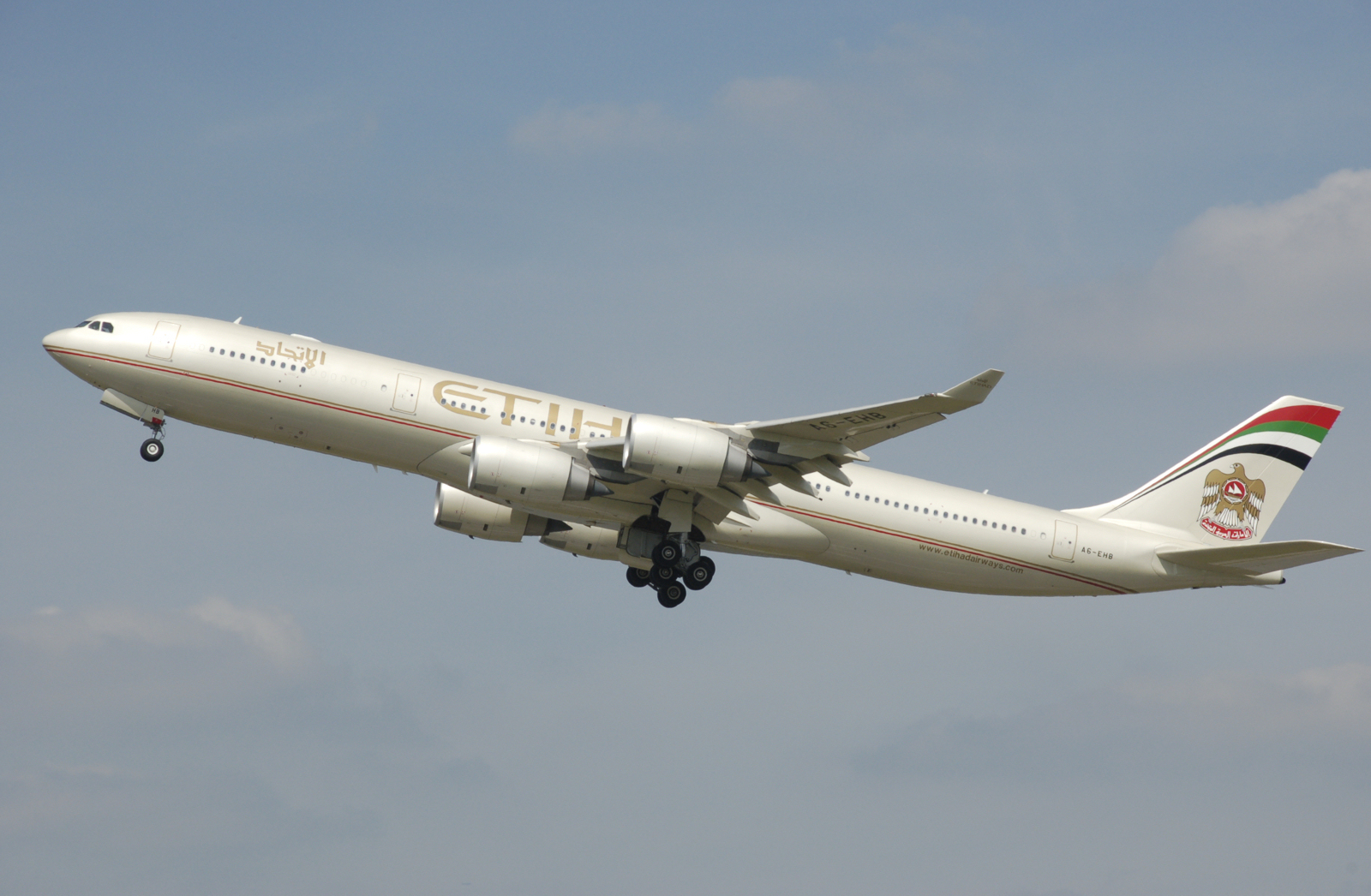
Showing posts with label stake. Show all posts

Jetihad is born. Jet Airways completes 24% stake sale to Etihad Airways

Abu Dhabi-based Etihad Airways and Mumbai-based Jet Airways today announced that they have closed the transaction of a 24% equity stake by Etihad Airways in Jet Airways.

Jet Airways' Boeing 777-300ER


In a release they said
"All requisite Indian regulatory approvals had been obtained by November 12th, 2013. Jet Airways has, on November 20th, 2013, issued and allotted 27,263,372 equity shares of a face value of Rs. 10 each at a price of Rs. 754.7361607 per equity share on a preferential basis to Etihad Airways.

Consequent to the above allotment, the paid up share capital of Jet Airways stands increased to 11,35,97,383 equity shares of Rs. 10 each. Following this issue and allotment of the said equity shares on a preferential basis to Etihad Airways, Etihad Airways holds 24 per cent of the post issue paid up share capital of Jet Airways (on a fully diluted basis)."
Mr. James Hogan, CEO, and Mr. James Rigney, CFO of Etihad Airways have been appointed as additional directors on the board of directors of Jet Airways as from November 20th, 2013.

Mr. Goyal and Mr. Hogan confirmed that the collaboration between the airlines would commence immediately with a view to delivering network and service benefits to customers as soon as possible.
Read more »

A detailed behind the scene insight on the making of the Jet Etihad deal

by Devesh Agarwal

The aviation enthusiast community may not have too much respect for The Economic Times newspaper when it comes to technical accuracy when reporting aviation related stories, but hats off to a great article that goes in to the depths on how the deal for a 24% stake by Etihad Airways in Jet Airways was negotiated and struck.

The article goes behind the scenes, giving insight in to the motivations, events, players, and tactics involved in the negotiations. A definitely must read.

One crucial observation, Jet Airways first met Etihad in June 2012, a full three months before the government announced the new liberalised policy of allowing foreign airlines to invest in Indian carriers. Quite clearly, Mr. Naresh Goyal's connections served him well.

Read the article here.
Read more »

Ethiad Airways increases stake in Virgin Australia to 19.9 percent

By BA Staff

Etihad Airways, the national airline of the United Arab Emirates, confirmed its equity stake in Virgin Australia Holdings had reached 19.9%.

This follows a series of on-market purchases of Virgin Australia shares over recent weeks. The Abu Dhabi-based airline now holds more than 515 million shares in the airline.

At 19.9%, Etihad Airways has reached the threshold approved by Australia’s Foreign Investment Review Board in June 2013.

James Hogan, President and Chief Executive Officer of Etihad Airways, said: 
“We are delighted to have reached this milestone. It reflects our strong support for the business strategy and management team of Virgin Australia and our enduring commitment to the Australian market. It also reflects the close working relationship between our two airlines and we look forward to strengthening its commercial foundations. The strategic partnership continues to deliver significant revenue streams and other benefits to each airline. Increasing our equity in Virgin Australia will further enrich the commercial benefits which the partnership delivers for both airlines as well as increasing the benefits to Australian travellers and visitors to Australia.”"
Etihad Airways and Virgin Australia signed a ten year strategic partnership agreement in August 2010 that includes code-sharing on flights, joint sales and marketing activities, and reciprocal earn-and-burn on their respective frequent flyer programs.

Those benefits include seamless connectivity to more than 40 codeshare destinations in Australia, New Zealand, Indonesia and Thailand and loyalty program privileges such as priority baggage handling, priority boarding and airport lounge access for top tier program members.

Combined, Etihad Airways (25) and Virgin Australia (3) operate 28 flights a week between Abu Dhabi and Australia and passengers have access to a combined global network of more than 280 destinations.

Etihad Airways began flying to Australia in March 2007, when it launched services to Sydney. Flights to Melbourne and Brisbane followed in 2009. The airline has carried more than 2.5 million passengers between Abu Dhabi and these three Australian gateways in the past six years. The airline plans to operate services to Perth in Western Australia in the future.

Etihad Airways also holds equity investments in airberlin, Air Seychelles, Virgin Australia and Aer Lingus, will acquire 49% of Air Serbia from January 2014, and, subject to regulatory approval, will acquire 24% of India’s Jet Airways. It also has codeshare partnerships with 47 airlines worldwide.
Read more »

Sudheer Raghavan leaving Jet Airways?

by Devesh Agarwal

The rumour mill has that Jet Airway's Chief Commercial Officer Sudheer Raghavan will be leaving the airline soon and is expected to be succeeded by Mr. Wayne Pearce, currently the CEO of Oman Air.

Pearce reportedly enjoys a good rapport with Etihad CEO James Hogan. Etihad which is in the process of completing a 24% stake purchase in Jet Airways for $379 million, has been strengthening its hold within Jet Airways management, steadily taking over key management positions in planning, strategy, and operations.

If Raghavan quits, he will be the third high level exit from Jet following the Etihad investment in April. In June, CEO Nikos Kardassis resigned. Recently, Mr. K. G. Vishwanath, Vice President – Commercial Strategy and Investor Relations resigned. It is understood that he was considered close to Jet Airway's Chairman Naresh Goyal, in an function where Etihad wants its own people.
Read more »

Analysis: Jetihad partnership a big winner for the two airlines

by Devesh Agarwal

Jet's A330 fleet is expected to be deployed to Abu Dhabi
The 24% stake sale by Jet Airways to Abu Dhabi owned and based Etihad Airways is a bonanza for both the airlines.

For Jet Airways it gets a significant amount of cash it desperately needs to reduce part of its massive two billion dollar debt, since it is issuing fresh shares. Apart from this cash Jet gets from the stake sale, Etihad will also inject a further $220 million in to Jet.

The gulf carrier has already paid $70 million to purchase Jet Airways’ three pairs of Heathrow slots through a sale and lease back agreement, which Jet Airways will continue to operate flights to London utilising these slots, for now.

Etihad will also invest $150 million to gain a majority equity investment in Jet Airways’ frequent flyer program Jet Privilege, expected to be completed within the next six months. This is a major coup for the gulf carrier as it gets controlling access to the top frequent fliers in the country. Since Etihad is essentially owned by the rulers of Abu Dhabi just like all other major institutions, Jet Airways will also get access to low interest loans, estimated a 3% per annum, which it will use to retire high cost debt.

What does Etihad get in return? Much as the leadership at Jet or their many government supporters may deny, Etihad will get control of Jet Airways' international operations. As of now, the planned shareholding will be Naresh Goyal 51%, the public 25%, and Etihad 24%. Any future issue of shares or dilution of share-holding by Naresh Goyal will be offered on a basis "right of first refusal" to Etihad. To remain a publicly listed company, a 25% public shareholding is required.

I have been advocating a new name for Jet Airways on its 20th anniversary. Jetihad Airways.

Our analysis of Jetihad

The speed at which the bi-lateral air services agreement (ASA) with the United Arab Emirates, excluding Dubai, was re-negotiated shows the sheer political muscle of the promoters of Jet Airways. In the blink of the eye, without Etihad even asking for it, the capacity between India and Abu Dhabi has been almost quadrupled. Anyone who believes this is not a direct quid pro-quo is naively denuding themselves.

The main beneficiary of this capacity increase will be Jet Airways from India and Etihad from Abu Dhabi. Jet Airways, very recently, sought additional rights of 41,600 seats a week from 23 Indian cities to Abu Dhabi for the next three years. That’s more than the 26,600 seats a week available for all Indian and Abu Dhabi-based airlines put together to fly between the two countries. The capacity from Abu Dhabi is of course, reserved for Etihad.

Based on the seat capacity requests Jet will more than double its share from 31% to 76%, as will Etihad in reverse.

Market share of Indian carriers to Abu Dhabi

The ASA also allows for gauge-change and code-sharing and this will allow Jet to leverage its domestic network and ferry passengers from India to Abu Dhabi on a combination of narrow bodies from smaller cities and wide-bodies from larger cities, which will then be fed on to Etihad's network of 87 passenger and cargo destinations in 55 countries served by its 66 aircraft operating 1,300 flight per week. This will allow Etihad to leap-frog ahead of fellow UAE carrier and competitor Emirates airline, in one fell swoop. Emirates already deploys more than 12% of its capacity to India, and is asking for a doubling of its 50,000+ existing weekly seat capacity.

India's west bound international traffic is growing at 10% per year and is expected to reach 40 million from the current 28 million soon. Assuming Jet will try and target about 10% market share, but since Etihad will carry passengers the longer distance from Abu Dhabi to destinations in Europe, North America, Africa, and South America, expect that airline to earn bulk of the Indian passengers' money, not Jet.

The partnership with Etihad will also allow Jet to lease many of its wide-bodies to the carrier who needs aircraft capacity right now, as well as utilise the large Boeing 777 fleet, much of which has spent its life being leased to other carriers. With the rulers of Abu Dhbai owning Etihad, Jet can use its A330 fleet to ferry passengers from India to Abu Dhabi and onwards using fifth and seventh freedom rights.

With Etihad covering the west, will Jet be allowed to focus east to Japan and Korea? What about down under to Australia? One cannot say for certain at this moment in time.

On the alliance front, Jet can now kiss goodbye to the Star Alliance which is vehemently opposed to Gulf carriers, and this is now further compounded with the growing size and clout of existing member Turkish airlines. Turkey wants to construct the world's largest airport.

Apart from traffic and operations, the main question still remains, who will head the board of directors and who all will run it operationally? We can expect the nominal executive leadership to remain with Jet, but all effective operational control will pass to Etihad despite rules in India requiring management to be Indian. These are all very easily "handleable". The middle management of Jet faces significant uncertainty on their future career prospect.

Jet Airways - the powerful Gemini

The Jetihad deal and the events surrounding it are a revealing insight to the enormity of the political clout commanded by Jet Airways and its promoter Mr. Naresh Goyal, a former travel agent. Goyal's influence is widely regarded as the catalyst for forming aviation and financial policy, many times contrary to the national interests of India, but well suited to the needs of private airlines like Jet Airways. This included a policy preventing foreign airlines to invest in Indian carriers, which was done to block the Tatas and Singapore Airlines starting a domestic Indian airline.

He is also believed to be responsible for passage of rules requiring Indian carriers to operate a minimum five years and have a fleet of 20 aircraft, before they could fly internationally. Again to benefit a very nascent Jet Airways at that time, but one which allowed foreign carriers, not required to follow these rules, to come in to India and establish market share, while Indian carriers could only look on.

Till about February last year, Jet Airways and its subsidiary JetLite (the former Air Sahara) were the largest airline in India, both domestic and international. Then upstart and irreverent low cost carrier, IndiGo, usurped the crown of largest domestic carrier. There were some months when, even the hopelessly inefficient Air India, topped Jet Airways in the market share standing. Losses mounted, debt ballooned.

Also, influenced by the imploding Kingfisher Airlines and its promoter and Member of Parliament, Dr. Vijay Mallya, the Indian government started talking about liberalising the airline sector by permitting foreign airlines to invest up to 49% stake in Indian carriers.

When he saw the writing on the wall, in a very smart move, Goyal switched tact, leveraged his middle-east connections, and commenced negotiations with Etihad, which, after many a false start, has culminated in the deal at hand.

Given the history of Jet Airways and its promoters over the last 20+ years, one has to take a huge pinch of salt to digest Goyal's statement
“I would like to thank the Government of India, especially the Ministries of Civil Aviation, Commerce and Industry, and Finance, for having the foresight to introduce the historic reform of allowing foreign direct investment into civil aviation in India. Infusion of FDI in the domestic sector will result in the improvement of the economics of aviation, grow traffic at our airports and create job opportunities."

India - UAE (Abu Dhabi) Bi-lateral air services capacity

Normally negotiations of bilateral air services agreements take years, and are normally commenced only after existing capacity is exhausted.

In 2011, the Comptroller and Auditor General of India, indicted the government and aviation ministry officials for their liberal policy of doling out bilateral seat capacity like candy. The CAG even suggested a roll-back of the capacities. Yet, barely 18 months after that report, political clout is amply demonstrated by the haste with which the Indian government enhanced its ASA with Abu Dhabi.

This despite the vehement objections of the operators of Delhi, Mumbai, Bangalore, and Hyderabad airports, and virtually all airlines, who fear their expensive investments will be now rendered uncompetitive, as another hub is created in Abu Dhabi, with Jet Airways ferrying passengers from even the smallest cities to the Emirate.

Even a strong letter, against expanding capacity, by former minister Dinesh Trivedi seems to have had no effect.
Read more »

Jetihad is born. Etihad buys 24% stake in Jet Airways for $379 million. To inject additional $220 million.

Etihad Airways to inject additional $220 million in to Jet Airways

by Devesh Agarwal

We are reproducing the official release. Our analysis of this transaction will follow next week.

Jet Airways and Etihad Airways at a glance

Highlights

  • Strategic investment under FDI policy of the Government of India will deliver wide-ranging revenue growth and cost synergy opportunities for both airlines
  • Alliance will bring significant passenger benefits with expanded code-sharing, creating a combined network of 140 destinations
  • Alliance will bring significant benefits to the Indian economy, both in terms of growth, job creation, trade and tourism
  • Jet Airways passengers from 23 cities in India to gain direct access to an expanded global network
  • Jet Airways to enhance its services from its primary hubs of Delhi and Mumbai, and introduce new flights from Hyderabad and Bangalore
  • The strategic alliance between the two airlines will bring additional traffic, frequencies and revenues to metro airports, as well as other airports of Airports Authority of India
  • New India-Abu Dhabi routes and Jet Airways to establish a Gulf gateway for flights to the US, Europe, Africa and the Middle East
  • The strategic investment enables Etihad Airways to tap into India’s fast-growing 42 million strong travel market
  • Frequent flyer program members of both airlines will benefit from fully integration with reciprocal earn and spend
  • Alliance will result in both consumer benefits and/or all round efficiencies
  • This strategic investment with a US$600 million commitment from Etihad Airways will help further strengthening of Jet Airways financial position.
Etihad Airways P.J.S.C. of the United Arab Emirates and Jet Airways of India today announced that the UAE national carrier has agreed to subscribe for 27,263,372 new shares in Jet Airways at a price of Rs. 754.74 per share. The value of this equity investment is US$379 million and will result in Etihad Airways holding 24 per cent of the enlarged share capital of Jet Airways.

Etihad Airways' wider overall commitment to Jet Airways includes the injection of US$220 million to create and strengthen a wide-ranging partnership between the two carriers.

As part of this Etihad Airways paid US$70 million to purchase Jet Airways’ three pairs of Heathrow slots through the sale and lease back agreement announced on 27 February 2013. Jet Airways continues to operate flights to London utilising these slots

An amount of US$150 million will be invested by Etihad Airways by way of a majority equity investment in Jet Airways’ frequent flyer program "Jet Privilege", subject to appropriate regulatory and corporate approvals and final commercial agreements which are expected to be completed within the next six months.

Under the strategic partnership, which will be subject to full regulatory and shareholder approval, the airlines will gradually expand existing operations and introduce new routes between India and Abu Dhabi, providing an ever wider choice to the travelling public. They will combine their network of 140 destinations, with Jet Airways establishing a Gulf gateway in Abu Dhabi and expanding its reach through Etihad Airways’ growing global network.

Passengers from 23 cities in India will benefit from direct connections to international destinations. New flights from Jet Airways’ home hubs and metro airports will further strengthen its current operations from these airports. Jet Airways’ vision continues to be to develop Delhi and Mumbai airports as its primary home hubs and connecting them to Asian, European and other regions.

Details of the investment were unveiled by Etihad Airways President and Chief Executive Officer, James Hogan, and the Chairman of Jet Airways, Naresh Goyal.

Mr Hogan said
“We are pleased to have reached this significant stage in India with Jet Airways and are certain the partnership will bring significant benefits and opportunities for global growth to both airlines.

“It is expected to bring immediate revenue growth and cost synergy opportunities, with our initial estimates of a contribution of several hundred million dollars for both airlines over the next five years.

“The Indian market is fundamental to our business model of organic growth partnerships and equity investments. This deal will allow us to compete more effectively in one of the largest and fastest-growing markets in the world.”

“We look forward to collaborating with Jet Airways and constructively working together with them and their stakeholders to build a sustainable, competitive and profitable airline.”
Mr Goyal said
“I would like to thank the Government of India, especially the Ministries of Civil Aviation, Commerce and Industry, and Finance, for having the foresight to introduce the historic reform of allowing foreign direct investment into civil aviation in India. Infusion of FDI in the domestic sector will result in the improvement of the economics of aviation, grow traffic at our airports and create job opportunities.

“I am extremely happy to be in a partnership with an airline that shares our customer-centric operational philosophy and ethos. I have no doubt that this partnership with Etihad Airways is a win-win situation for all our stakeholders, especially our guests, who will now have access to a much expanded global network.

“This transaction further strengthens the balance sheet of Jet Airways and, more importantly, underpins future revenue streams, which will accelerate our return to sustainable profitability and liquidity.”
A key component of the wide-ranging partnership is expanded codesharing on flights with passengers benefiting from reciprocal ‘earn-and-burn’ rights on the airlines’ frequent flyer programs.

The proposed codeshare expansion will significantly enable Etihad Airways to tap into India’s rapidly growing travel market, providing additional passenger traffic to Etihad Airways’ Middle Eastern, North American and European destinations, and give Jet Airways passengers from various cities access to an expanded network.

Current estimates predict the size of the Indian market to grow to 42 million travellers over the next five years at a rate of 10 per cent per year, while the Indian middle class, which provides the majority of air travel demand, is forecast to grow by 200 million, over the next eight years.

Etihad Airways currently flies to nine Indian destinations including Delhi, Chennai, Mumbai, Kozhikode, Thiruvananthapuram, Hyderabad, Bangalore, Ahmedabad and Kochi, with a total of 59 flights per week.

The partnership will also help drive a significant increase in traffic growth through Abu Dhabi International Airport, as well as Jet Airways’ hubs of Mumbai and Delhi international airports.
Key benefits for both airlines will flow from synergies and cost savings in areas including fleet acquisition, maintenance, product development and training.

The airlines will explore joint purchasing opportunities for fuel, spare parts, equipment and catering supplies, as well as external services such as insurance and technology support.

Other areas of co-operation will include joint training of pilots, cabin crew and engineers, as well as maintenance of common aircraft types and the consolidation of guest loyalty programs.

A joint project management office will be set up to ensure delivery of all synergy benefits to both parties.

Substantial ownership and effective control will remain with Indian nationals, with Mr Goyal as the non-executive Chairman holding 51 per cent of the company.

Etihad Airways’ investment in Jet Airways follows the minority equity stakes taken by the airline in airberlin, Air Seychelles, Virgin Australia, and Aer Lingus over the last 12 months.

Etihad is being advised by HSBC, DLA Piper, Amarchand Mangaldas, Suresh A. Shroff and Co and PricewaterhouseCoopers on this transaction.

Jet Airways is being advised by Mr Harish Salve, Gagrats, ELP, Ernst and Young, DSP Merrill Lynch Limited and Credit Suisse.
Read more »