Showing posts with label MD80. Show all posts

United Airways adds two new aircraft to its fleet

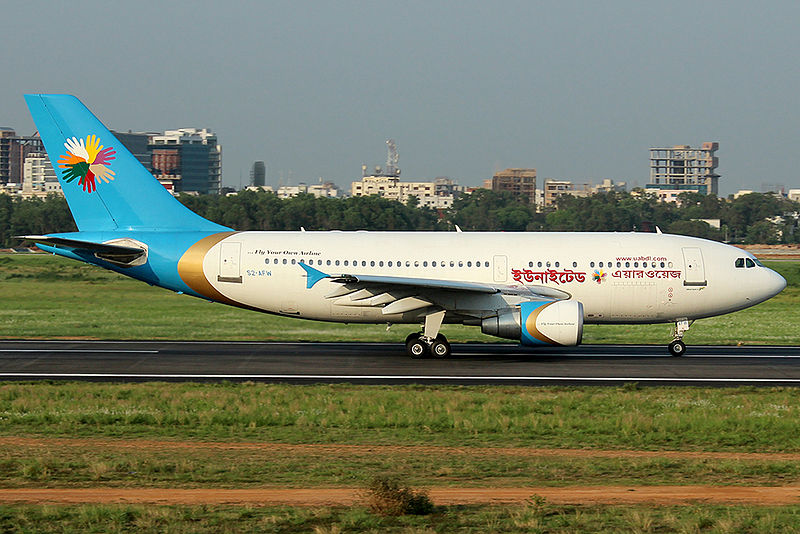
Courtesy Wikipedia. Image credit: Raihanspotter
Rapidly growing Bangladeshi private carrier United Airways has added two additional aircraft to its fleet. The aircraft are an ATR 72-200 registered as S2-AFU and a McDonnell Douglas MD-83 registered as S2-AEJ. The ATR 72-200 originated with LOT Polish Airlines, and then was transferred to LOT's regional subsidiary Eurolot before being sold to United Airways. Meanwhile, the MD-83 was delivered to US carrier Trans World Airlines (TWA) in 1995, became part of American Airlines' fleet after American acquired TWA in 2001, and then was sold to United Airways earlier this year after being parked in 2012.

The aircraft become the 10th and 11th airplanes in United Airways' fleet, composed of 2x Airbus A310-300s, 3x ATR 72-200s, 5x MD-83s, and 1x Bombardier Dash 8 Q100. The carrier also has 4x BAE Jetstream 31s on order to grow domestic operations, and a further A310-300 on order for longer haul flights.

Chairman and Managing Director of United Airways Capt. Tasbirul Ahmed Choudhury had this to say about the acquisitions:
These new addition of ATR-72 and MD-83 aircraft has increased the fleet strength of United Airways to Eleven. We definitely want to increase our fleet as this is the right time to procure desired aircraft to expand more domestic, regional and international destinations. The ATR-72 aircraft is having 64 economy class seats and the MD-83 aircraft 167 economy class seats.
United Airways serves 15 destinations (7 international) across Asia and the Middle East. It has its primary hub at Dhaka's Shajahlal International Airport.  
Read more »

Dutch Antilles Express suspends operations

by Vinay Bhaskara


A Dutch Antilles Express ATR 42-300 on the ground at its largest hub - Hato International Airport in Curacao
According to several news reports (see here and here), Caribbean low cost carrier Dutch Antilles Express, the second largest airline in the Dutch country of Curacao has suspended operations.

Formed in 2005 via the merger of Bonaire Express and Curacao Express, Dutch Antilles Express had been bleeding cash for several months before the shut down. Earlier this month, the carrier approached the Curacao Parliament for a cash loan of 5 million guilders; a request denied on 16th August. The Curacao government had previously stepped in to save the airline from closure in 2011. With its operations bleeding money, the airline was forced to shut down operations for the time being.

At the time of suspension, Dutch Antilles Express served 10 destinations across 9 countries (including Orlando and Miami in the United States) on a fleet of five aircraft (1x ATR 42-300, 3x Fokker F100, and 1x McDonnell Douglas MD-83). It had previously been forced to suspend services to Caracas, Maracaibo, and Valencia in Venezuela in May of this year over safety concerns.

Service in Curacao will continue to be provided by several airlines, including low cost carrier (LCC) Insel Air, which operates a hub at Hato International Airport, the primary airport of Curacao. Insel Air serves 16 destinations across 10 countries(15 from Curacao - including Miami, Orlando, San Juan, and Charlotte) on a fleet of 13 aircraft (with 7 more Fokker 70s on order - current fleet includes 3x Embraer 110s [two temporarily grounded], 3x Fokker F100s, 4x McDonnell Douglas MD-82s, and 2x McDonnell Douglas MD-83s). 
Read more »

25th anniversary of the first Airbus A320 delivery

by Devesh Agarwal

25 years ago today, Airbus entered the hither-to US dominated market of narrow body airliners when it delivered its first A320 to Air France. The A320 shook up the market segment with the highest demand. As of today Boeing and Airbus estimate the single aisle narrow body segment to purchase about 20,000 airframes in the next 20 years.

The A320 which seats 180 passengers in a single class high density configuration, was the first member of the A320 family. Launched in March 1984, it first flew on 22 February 1987, and without a doubt, has significantly altered the face of "Code C" market segment, which sees the highest demand of aircraft. As of today Boeing and Airbus estimate the single aisle narrow body segment to purchase about 20,000 airframes in the next 20 years.
The A320 family. A318, A319, A320, A321. The number of over-wing doors is the secret to identifying the variants.

The A320 family was soon expanded to include the extended length A321 seating 220 passengers in a single class high density configuration, first delivered in 1994, the shorter A319 seating 156, first delivered in 1996, and the really short A318, seating 132, first delivered in 2003.

All economy class Kingfisher Airbus A321 VT-KFW.
The A320 family pioneered the use of digital fly-by-wire flight control systems, as well as side-stick controls, in commercial aircraft, and extensive use of automation and flight envelope protection, causing Boeing supporters to deride the aircraft as flying a video arcade.

Final assembly of the A320 family takes place in Toulouse, France, and Hamburg, Germany, and in Tianjin, China. Airbus has announced the construction of a final assembly line (FAL) in Mobile, Alabama, USA, the home turf of arch-rival Boeing.

Winglets and Sharklets

The first series of A320s, the A320-100 did not feature any winglets. Only 21 aircraft were produced for Air Inter and British Caledonian Airways, both bought by Air France and British Airways respectively.

An Airbus A320-100 (F-GGEA) of Air Inter without winglets. Image courtesy Wikimedia

The all familiar wing-tip fence was added from the -200 series onwards. Indian Airlines an early adopter of the A320 had Airbus develop special four-wheel main gear bogies for use on rough under-prepared airstrips which the large dual wheel bogies could not handle. Unfortunately these non-standard four wheel bogies have become a curse for the airline, which now cannot find a buyer for these aircraft.

Airbus A320-200 VT-EPC of Indian Airlines (now Air India) featuring winglets and four wheel main gear bogie.

Now the A320 optionally ships with new blended winglets called "Sharklets". Both of India's low cost carriers GoAir and IndiGo operate Sharklet equipped A320s.

Airbus A320-200 of GoAir VT-GOL featuring the new "Sharklets".
Airbus A320-200 of GoAir VT-GOL featuring the new "Sharklets". Image courtesy Airbus.

Competition

The Airbus A319, A320, A321 today compete with the Boeing 737-700, 737-800, and 737-900ER respectively. The venerable Boeing 737, even today, is the best selling aircraft in the world, Boeing having just delivered its 7,500th 737 aircraft recently; but this lead is slender and the A320 is closing the gap. The McDonnell Douglas MD80, MD83, MD88, and MD90 which morphed in to the Boeing 717 are no more in contention. Newcomers like the Bombardier C series and COMAC C919 are expected to offer competition, especially in the smaller sizes.

Delivery history Airbus A320 vs. Boeing 737

As of December 2012, Airbus has delivered 5,402 A320 series aircraft since their first delivery on March 26, 1988, with another 3,629 on firm order. In comparison, Boeing has shipped 5,919 737s in the same period and has a further 3,074 on firm order.
Annual deliveries of Airbus A320 (in green) vs Boeing 737 (in red). Image courtesy Wikipedia.

The future

On 1 December 2010, Airbus officially launched the next generation of the A320 family with the A320neo or "New Engine Option". The neo offers a choice of larger diameter engines which offer significant fuel savings, which can top 15%, when combined with airframe improvements and the standard fit of Sharklets. Airbus enjoys an advantage in larger diameter fan engines, since its A320s are taller and there is more space under the wing, unlike Boeing which needs to so 

Cut and make your own A320neo paper model airplane

Operators are offered an engine choice of the CFM International LEAP-X or the Pratt and Whitney Pure Power PW1000G Geared Turbo-Fan (GTF). With well over 1,400 aircraft on order from 22 airlines, the A320neo family is the fastest ever selling commercial aircraft.


Boeing subsequently responded with its re-engined option of the 737 called 737 MAX which has scored impressive wins but lags behind the neo on backlogs of the newest generation orders 40%-60%.

Read our analysis of the A320neo vs. the 737 MAX

The re-engined aircraft will carry the two behemoth airframers for the next ten years. The narrow body single aisle aircraft segment is the hottest in the industry and both Airbus and Boeing are going to face competition from the Bombardier C Series, Sukhoi SuperJet, COMAC C919, Embraer E195, and UAC/Irkut MS21. Expect a new aircraft from both manufacturers about 12 years to 15 years from now. A paper by the US Congressional Research Service (CRS) documents well, the challenges the duopoly of Airbus and Boeing face in the coming years. You can download the PDF here.

For now, just a simple congratulations to the team at Airbus for developing an option.
Read more »

Delta Air Lines expands Economy Comfort Service

Earlier today, Delta Air Lines announced that it would be expanding its popular economy comfrot service to all domestic aircraft. 550 mainline aircraft, as well as 250 2-class regional jets will be configured with the new seating. Earlier this year, Delta implemented an international Economy Comfort section on 170 aircraft.

The new economy comfort sections will be installed in the first 3-5 rows of Delta's 767, 757, A320, A319, 737, MD-88, MD-90, and DC-9 aircraft, as well as in Delta's two class regional jets such as the E170, E175, CRJ-700, and CRJ-900. The new seats will offer the following amenities:

  • 34+ inches of pitch: Current Delta economy class seats have between 29 and 31 inches of seat; so the new cabin will have 3-5 inches worth of extra legroom
  • Priority Boarding: Customers traveling in Economy Comfort will board early, directly after first class passengers and Delta's elite frequent flyers.
Initially, customers who have purchased economy class seats can upgrade to Economy Comfort for a fee of $19-$99 after purchase. In 2012, the carrier plans to gradually introduce their international Economy Comfort directly into their booking engine, though it is not yet clear whether they will choose to do so for domestic flights as well.

Passengers who purchased a full-price economy class ticket will get access to Economy Comfort for free, and the following SkyTeam frequent flyer groups get some benefits as well.

  • Diamond/Platinum/Gold: Complimentary access at time of booking
  • Silver Medallion: 50% discount at the time of purchase or free access at check-in

When traveling domestically within the US, the lack of domestic seat pitch is perhaps the worst part of the experience. While I do not have extraordinarily long legs (being about 5'8"), I regularly struggle with the legroom on domestic passenger aircraft. Thus even if one does not care for the extra amenities of first class, paying for an upgrade to Economy Comfort can be well worth the price.

For Delta, who becomes the second US airline to implement a premium economy section after United Airlines, the addition of an economy comfort cabin will add incremental ancillary revenue, but more importantly will help the carrier retain its frequent flyers. Junior level frequent flyers often complain that their status lacks real perks; upgrades to first class are often limited to frequent flyers of the highest tier. But the ability to upgrade cheaply (or for free) to a premium economy cabin adds value to membership in lower frequent flyer tiers; helping Delta retain high value customers.
Read more »

The typical takeoff and climb angles of all Boeing planes

In the recent issue of Boeing's AERO magazine there is an article titled Exceeding tire speed during takeoff in which there is this nice graphic that demonstrates the recommended take-off rotation and climb angles for all Boeing aircraft.

I was surprised that despite it's length, the Boeing 747-400 Jumbo Jet has a rotation angle of 10 degrees. Compare that to 7 to 9 degrees for the 737s and 777s. The king of the angle is the MD-11 with a take-off rotation of up to 10 degrees and a climb angle of a whopping 25 degrees. Then I remembered who made the F15 Eagles.

Typical takeoff and climb angles for all Boeing aircraft 717, 737, 747, 757, 767, 777, MD11, MD80, MD90Image courtesy Boeing AERO magazine Q2 2009.
Read more »