Showing posts with label Brussels. Show all posts

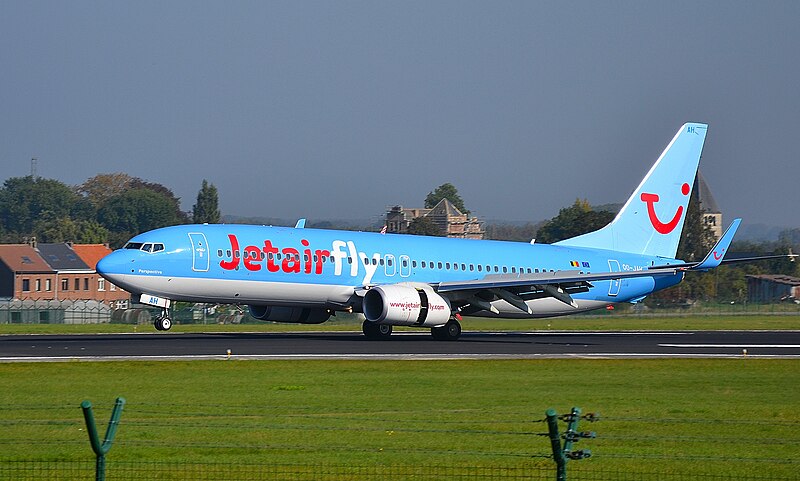
Jetairfly to Launch Miami-Brussels

by BA Staff

Image Credit: Mopje18
Belgian charter operator Jetairfly has announced the launch of twice weekly flights between its home base at Brussels and Miami, commencing 4th April, 2014 using Boeing 767-300ER aircraft. Miami becomes the airline's 107th destination around the globe, its 9th in the Americas, but its first in the United States.

Jetairfly is a subsidiary of parent company TUI Travel, a UK based charter airline group which includes Jetairfly, Corsair International, Thomson Airways, TUIFly, TUIFly Nordic, and Arkefly. Currently, Jetairfly operates a fleet of 22 passenger aircraft (4x Boeing 737-700, 14x Boeing 737-800, 2x Embraer E190, and 2x Boeing 767-300ER). Jetairfly also has 1 Boeing 787-8 Dreamliner on order and an undisclosed amount of 737 MAX as part of the larger TUI Travel order.

Jetairfly's long haul 767s are configured to seat 257 passengers with 2 classes of service (though no difference in seat). Economy Class offers full economy service with catering, while Comfort Class offers more legroom, amenity kits, iPad IFE, premium meals, free champagne and alcohol, newspapers, and at Brussels airport access to the VIP-lounge, separate check-in and security fast lane.
Read more »

Report: Jet Airways scissors hub moving to Amsterdam


Earlier this week in a press conference at Amsterdam’s Schiphol Airport, Etihad CEO broke the news that Indian full service carrier Jet Airways will be transferring its European scissors hub from Brussels to Amsterdam. Thanks to the recently created Jetihad partnership (Etihad owns 24% of Jet Airways), Etihad exerts significant control over Jet’s international strategy.

Jet Airways currently operates daily flights from Mumbai and Delhi to Brussels, which then continue onwards to Newark and Toronto. Etihad recently signed a cooperation agreement with KLM that covers several destinations under a joint venture agreement. While Etihad (and by extension Jetihad) have no plans to join SkyTeam, they are apparently interested in working more closely with Air France-KLM and Delta. Etihad already places its code on 12 KLM destinations out of Amsterdam and on 15th May launched daily services between Abu Dhabi and Amsterdam using Airbus A330-200 equipment.

No timeline has been set for the transfer and it remains to be seen whether the shift of Jet’s North American services to Amsterdam is an intermediate step, or the final plan for these flights. Most industry observers had predicted that Jet Airways’ long haul fleet would be re-deployed for use on westbound international services through Abu Dhabi; indeed part of the value proposition for the Jetihad deal was the ability to utilize Jet Airways’ wide-body fleet to augment Etihad’s hub in Abu Dhabi via a scissors hub.

Still, Amsterdam makes sense as an intermediate transfer point. Mumbai does have more O&D demand to Brussels, but KLM’s Amsterdam hub is much stronger than the comparable operation for Brussels Airlines in Brussels. So Jet Airways will get some additional feed in Amsterdam. And if they were to launch a joint venture for US-Europe-India with Air France-KLM and Delta, it could be potentially lucrative.

Read more »

Jet Airways to upgrades Delhi-Brussels-Toronto to Airbus A330-300

Mumbai based, Jet Airways, has upgraded its Delhi Toronto via Brussels route to be operated by their brand new Airbus A330-300 (A333). The route was previously operated by A330-200's.

The A330-300 will increase seating capacity from 18 in business class and 236 in economy to to 34 in Business and 259 in Economy. The economy class passengers will get some additional leg-room, while the Première class features the new 280 degrees lie-flat air cushioned ‘Contour Vantage 2’ seats.

The Airbus 330-300 incorporates a lighter, brighter and more spacious cabin results from updated features that include smoother contours, new interior styling, state-of-the-art LED lighting and newly-designed air conditioning units adding to the comfort of the guests. Onboard mood lighting and advanced safety features like an inbuilt air-bag within the seat belt in both the Première and the Economy add to guest security and safety.

Read more »

Jet Airways international fleet and network operations analysis

by Vinay Bhaskara

A recent report from Flightglobal quoted Boeing Asia head Dinesh Keskar as saying that India’s largest full service carrier, Jet Airways, could potentially convert existing order into the larger Boeing 787-9 variant. Jet Airways currently has 10 Boeing 787-8s on order for delivery from 2014 onwards, but Mr. Keskar said, “"If they do that [convert orders to the 787-9], there will be a delay. The -9s, however, have better economics for them, so now they are looking at their portfolio."

Interestingly, the move would parallel Jet Airways’ recent fleet planning decision to shift away from the smaller A330-200 to its larger cousin the A330-300. Part of the impetus behind the decision was certainly the competition from Jet’s largest Gulf and Asian rivals. Most of these carriers operate not only the A330-300, but also the Boeing 777-300ER, both of which blow the A330-200 out of the water in terms of unit costs on regional routes. Especially as Jet consolidates around the core long haul routes in New York, Toronto, and London, all of which face severe competition from a myriad of airlines around the world. In response to this heightened state of competition, Jet made the correct choice in opting for a larger variant.

The same principle applies to the 787-8 versus the 787-9. While the smaller 787-8 (seating around 220 passengers) was the first 787 variant to come out, most industry analysts (including Bangalore Aviation) feel that the 787-9 will have much better operating economics, as the airframe is actually more optimized for aerodynamic driven fuel efficiency and has lower seat-kilometer costs thanks to its larger seating capacity. Furthermore, Boeing’s current projections for the ranges of the two aircraft show the 787-9 to have a range of 8,000 – 8,500 nautical miles (9,210 – 9,780 miles), which would allow Jet to operate most, if not all, US-India route pairs nonstop, including routes as long as Mumbai and Bangalore to the US west coast. Bangalore-San Francisco nonstop would be a gold mine to whichever carrier launched it first, and given that Air India only has 787-8s and that United will only receive 14 787-9s (many of which will likely be used to retire aging Boeing 777-200 non-ERs), Jet could conceivably be the first airline to launch onto this important route.

* The range figures for the 787-9 are quoted from sources within the industry

Currently, as per the Jet Airways fleet matrix, beyond the 787s, Jet has 3 A330-300s on order (the A330-300s start service on 23rd December) with 1 already having joined the fleet, 10 operational A330-200s with 5 outstanding orders, and 5 operational Boeing 777-300ERs with 5 aircrafts leased out to Thai Airways International. With the understanding that any *new* (beyond the initial 10) 787 orders would not be delivered till around 2018 at the earliest, the following is my suggestion for Jet Airways’ widebody fleet plan moving forward.

Immediately switch the 787-8 order to 787-9s and trade delivery slots with other airlines wherever possible to ensure delivery of these aircraft between 2015 and 2018. Order 15 further 787-8s for delivery 2018 onwards as well as 15 more 787-9s for delivery in the same timeframe. Of the current A330-200 orders, convert all 5 to A330-300s and cancel one order to create a fleet of 8 A330-300s, with the last 6 being the recently upgraded A330-300 with higher gross weight and range. Keep the current 5 777-300ERs as is, and reconfigure the 5 777-300ERs currently at Thai Airways into a 2-class configuration when they are returned (aim for 349 seats in a 2 class configuration – similar to Air Canada).

*These plans imply that Jet Airways will use Mumbai as an international connecting hub moving forward, made possible in part by the new integrated terminal.

Following this shift, the A330-200 would be used on European flights (excluding Heathrow) from Mumbai (Brussels-Chicago, as well as Paris, Frankfurt, and Munich – the latter two assume Jet’s entry into Star Alliance), Delhi (Brussels – Toronto), Bangalore, and Chennai (both to Munich), as well as on Delhi-Hong Kong-Manila, Mumbai – Seoul, and potentially Bangalore-Narita. Longer term, the 787-8s would replace the A330-200s one to one, converting the Delhi-Toronto and Mumbai-Chicago legs to nonstop flights.

The A330-300s would be used primarily on regional and VFR heavy routes. Mumbai-Brussels-Newark would continue in the very near term. Additionally, Mumbai/Delhi – Beijing, Mumbai – Tokyo-Narita, Mumbai – Jakarta, and Mumbai -Shanghai could be launched with the A330-300s, as well as Mumbai-Nairobi, Mumbai-Cairo, and both Mumbai-Dubai flights. Longer term, 787-9s would be used to replace the A330-300s on a one-to-one basis after all of the 777-300ERs have been replaced.

The 5 777-300ERs currently in the fleet would be deployed onto the two daily flights between Mumbai and London-Heathrow, as well as the daily Delhi - London-Heathrow. Mumbai – Hong Kong would remain as an 777-300ER service, with potential extension to Taipei since the aircraft is required to spend almost 8 hours in Hong Kong anyway for commercially viable timings. And Mumbai-Singapore could be converted to 777-300ER for the night flight, leaving one aircraft for spare.

The remaining 5 777-300ERs would be reconfigured into 349 seat configuration without first class, thus allowing the aircraft to fly India-US nonstop. Two aircraft would be deployed onto the Mumbai-Newark sector nonstop (in partnership with United through a potential JV after joining Star Alliance), while two more aircraft would ply Mumbai – Boston nonstop 3 weekly, and Mumbai- New York JFK 4 times per week. The final aircraft would be used to run thrice weekly flights Mumbai-Sydney-Auckland.

All of these 777-300ERs would be replaced with the first batch of 787-9s. The first 5 aircraft would be configured in 3 class configuration as a subfleet, while the remaining 20 787-9s would be configured in 2 class configuration for 1 to 1 replacements and growth.

All of this would leave Jet Airways with a standardized widebody fleet of 40 Boeing 787s, 28 for replacement, and 12 for growth. The standardized fleet would help save money on maintenance and training (the so-called “commonality” effect) and if necessary, Jet could even order the larger 787-10 to replace some A330-300s and 777-300ERs if demand conditions warrant such an action.

All of the above is an idealized scenario based on several assumptions, but it represents the kind of strategic thinking one should expect from Jet. However, it is also possible that Jet Airways simply wants to delay the acquisition of aircraft due to a funds constraint, in which case the delayed timeline of the 787-9 would offer Jet more time.  
Read more »

Jet Airways takes delivery of first new Airbus A330-300

Jet Airways, today took delivery of the first of four new Airbus A330-300 series aircraft into its fleet, at the airframer's headquarters in Toulouse, France. Aircraft registration VT-JWR. The airline is expected to take delivery of an additional A330-300 (VT-JWS) later this month.

The first A330-300 aircraft will be be deployed from December 22 as 9W 228/227 on the Mumbai Brussels sector.

Comparison graphic A330-200 vs. A330-300 dimensions size lateral view. Photo copyright Airbus S.A.S.
The airline already has 11 of the smaller variant A330-200 aircraft, shorter than the A330-300 by 17.7ft, in its fleet. Each of the new A330-300's will replace an existing A330-200 aircraft, which will be returned to lessors.

Compared to the A330-200s, the new A330-300s have an additional 73 seats 4 Première business class and 69 Economy seats. Jet pilots will enjoy the benefit of a common flight deck between the two variants. The aircraft are configured with 34 seats in Première, and 259 seats in economy.

Jet continues with Welsh seat manufacturer Contour, though it has dropped the 'Herringbone' configuration whose design a court ruled in favour of Virgin Atlantic. The new seating is the ‘Contour Vantage 2’ seat control featuring air cushioned seats in a configuration very similar to the new Lufthansa business class (see photos and video here). The seat converts to a horizontal flat bed and offers pumped air lumbar support, with a massage feature.


The in-flight entertainment (IFE) system is via a 12.1” monitor. An eXport socket located immediately below the video screen is for guests to plug-in their personal Apple devices such as iPods, iPads and iPhones allowing them to view their personal video content on the video screen and/or listen to music, while allowing for the device to be charged. The seats also feature a PC power socket and USB socket both of which can charge various electrical items.
Read more »

Analysis: Etihad equity stake in Jet Airways likely to benefit both carriers

Over the past few weeks, it has become increasingly likely that Abu Dhabi based Eithad Airways will be purchasing a 24% stake in India’s largest full service carrier, Jet Airways, perhaps as soon as the end of this week. The deal for a stake in Naresh Goyal’s airline, is reportedly worth somewhere between Rs. 1600 to 2200 Crore, which would value Jet Airways as a whole at somewhere between Rs. 6,666 Crore and Rs. 9,166 Crore ($1.22-1.69 billion). This deal makes Jet Airways the first carrier to benefit significantly from the Indian Government’s decision earlier this year to allow Foreign Direct Investment (FDI) by foreign airlines into the Indian airline sector. On the flip side, it puts increased pressure onto the rest of India’s airlines, especially low cost carrier (LCC) SpiceJet and now defunct full service carrier Kingfisher Airlines, as they now lose one potential investor. The former lacks capital for profitable expansion of its fleet of Bombardier Q400 turboprops whereas the latter is desperately seeking an infusion of capital before it is grounded permanently.

Immediately, it is important to note that Jet Airways will benefit greatly from this capital infusion, allowing it to make critical investments in simplifying and improving its fleet, product, and brand. As they continue to adjust and restructure their international operations, including the swap of several smaller A330-200s for their larger cousin the A330-300s, the reconfiguration of some of its Boeing 777-300ERs to a more dense configuration, and the termination of several poor-performing international routes. When combined with the swap of 5 ATR 72-500s for new ATR 72-600s, Jet Airways does have a large requirement for capital in the near term, especially as the returns from sale-leaseback continue to diminish (Jet has already sold off many of its assets). And it is Bangalore Aviation’s opinion that the moves that Jet Airways has made will be beneficial in the long term; so the Etihad deal is a vehicle for important long run changes.

But the far more interesting question is what effect will the deal have on Jet Airways’ operations so as to make the deal beneficial for Etihad? The immediate benefit is the expansion of bilateral capacity – allowing Etihad to feed more Indian travelers into their “superhub” in Abu Dhabi. Under the current system of bilateral capacity, Etihad’s rivals Emirates and Qatar Airways are granted more capacity and frequencies into India thanks to the O&D targeting system. Meanwhile, Etihad has all but maxed out its bilateral capacity to and from India, which puts it at a competitive disadvantage relative to Emirates and Qatar Airways in one of the world’s fastest growing demand centers. On the flip side, the Indian airlines have not yet maxed out their available seats and flights to Abu Dhabi, so Jet Airways could jump in and apply for several frequencies between Indian cities and Abu Dhabi using some of its spare narrowbody capacity (aircraft utilization at Jet has been falling for more than a year). This sort of setup is not without precedent – Etihad has already invested in and tied up with several carriers around the world, most notably AirBerlin, Virgin Australia, and Garuda Indonesia.

Each of these carriers either launched new services or increased services to Abu Dhabi following the deal(s) – AirBerlin and Virgin Australia created new flights to Abu Dhabi, and Garuda shifted their Jakarta-Dubai-Amsterdam triangular routing to fly via Abu Dhabi instead. But critically, in each of these cases, the carriers in question did not suddenly halt all other international operations. Garuda continued to expand in its niche in East Asia, AirBerlin actually expanded its long haul operations with new service to New York, and Virgin Australia continued to challenge the Qantas hegemony in the South Pacific.

Similarly, Jet Airways will not just all of a sudden become a regional feeder for Etihad a-la ExpressJet or SkyWest in the US. Moving the westbound international scissors hub from Brussels to Abu Dhabi makes little sense, given that Jet Airways’ longest range aircraft, the Boeing 777-300ER, cannot do runs from Abu Dhabi to the West Coast of the US (at least at its current weight though the flights are theoretically possible), a commonly speculated expansion point. As with each of the other Etihad partners, Jet should be allowed to focus on its strengths, which include the milk runs to the US, the Heathrow flights, and regional flights to the Gulf and East Asia, as well as potential flights to Star Alliance partner hubs. In fact, the value of an Etihad partnership will likely facilitate an expansion in regional international routes for Jet. These are just some of the implications of an Etihad equity stake in Jet. As the deal gets finalized and more details emerge over the coming months, important, and positive changes will be coming to the new Jet Airways.
Read more »

Analysis - Jet Airways decision to axe Chennai-Brussels and add Bangalore-Munich is viable

It has been almost a month since India’s largest airline Jet Airways announced that it was cancelling its flights between Chennai (India’s third largest city) and its once robust scissors hub in Brussels, and I still am having trouble fully understanding the impetus behind the decision, though I do believe that there is a scenario where the move(s) made by Jet do make sense. The cancellation left Jet Airways with just 4 daily flights in Brussels; Mumbai and Delhi on the Indian side – Newark and Toronto on the North American side.

Separately, Jet Airways appears to be launching a daily Bangalore – Munich terminator as Jet Airways flights 152/153, though the route has not yet been officially announced by Jet Airways and the winter 2012-2013 flight schedules have not been finalized.

The elimination of Chennai-Brussels flies in the face of the strategy we outlined earlier this year for Jet Airways’ North American operations, which called for an expansion of the scissors hub. From a practical perspective, it reduces the value of Jet Airways to Star Alliance (by eliminating a hub-hub route), while also reducing the attractiveness of Jet Airways to the rapidly burgeoning merchant and manufacturing travel base in Chennai by eliminating the direct flights.

Adding Bangalore-Munich makes more sense, especially if the expanded partnership between Jet Airways and Lufthansa comes to fruition. Even with a Lufthansa partnership, 9W 153 is not timed optimally to connect into Lufthansa’s North American bank in mid-afternoon; the 8:35 am arrival would require a 6-7 hour connection for most US destinations. The United, US Airways, and Air Canada flights are timed a little bit closer to the Jet Airways arrival but the business case seems to be primarily built on European connections.

As of right now, Jet appears to have no immediate plans to terminate the Mumbai-Newark and Delhi-Toronto services through Brussels. What this implies is that Jet Airways plans to continue with both a European operation to Munich, and a North American operation through Brussels. This sort of split operation is typically a bad idea, because instead of a strong European operation in one place, you can end up with a weaker operation in each of two places. That being said, there is a scenario under which the switch would make sense.

Since Jet Airways currently under-utilizes its fleet of Airbus A330-200 aircraft, two A330s could be dedicated to Munich flights from Bangalore and Chennai. The purpose of these flights would be to feed into Lufthansa’s Munich hub and secure the two major Indian cities currently outside of Lufthansa’s destination portfolio in Munich. The flights would be timed to depart India in the early morning (between 6 and 8 am), and arrive in Munich around noon. 

The critical piece is securing membership in the Trans-Atlantic joint venture (JV) partnership between Lufthansa, United, Swiss, Austrian Airlines, and Air Canada. The JV offers its members anti-trust immunity (ATI) for all trans-Atlantic flights. In practice, this means that the airlines can act like one business across the Atlantic; sharing the costs and profits of their respective trans-Atlantic network proportionally to their size, jointly marketing and selling trans-Atlantic tickets, and most importantly being allowed to coordinate and discuss strategy. It doesn’t matter to United if a passenger flies Lufthansa’s Frankfurt-Newark leg or United’s; because United will still get a share of the profits.

Without membership in this JV, the Munich flights by Jet will have to be treated as Indian competition for Lufthansa’s lucrative business here (especially in Bangalore). Once under the umbrella of ATI, these flights can instead be treated as strengthening additions to the Star Alliance hub in Munich – giving Jet a shot at financial viability. I am still not fond of Jet’s decision to abandon Chennai-Brussels and add Bangalore-Munich, but I can understand the strategy behind it.
Read more »

Jet Airways withdraws Chennai Brussels flight

India's Jet Airways has suspended its Chennai Brussels daily flight with effect from November 15, 2012. This flight used to be operated by an Airbus A330-200.

Confirming Bangalore Aviation's query a Jet Airways spokesperson said
In view of the current global economic scenario, including the ongoing Eurozone Crisis, Jet Airways has announced a redeployment of assets on its existing route network. As part of the airline's ongoing network rationalisation, Jet Airways will temporarily suspend its existing operations on the Chennai-Brussels sector, effective Nov 15, 2012.

Jet Airways will ensure that all guests booked on the Chennai-Brussels flight will be offered alternative flights to Brussels/New York (Newark)/Toronto, either on Jet Airways or that of its partner airlines along with through check-in facilities.
This is the second suspension of Jet Airways from its scissors hub at Brussels. Earlier this year Jet Airways withdrew its Brussels New York JFK service ahead of commencement on this route of its partner, some would say now competitor, Brussels Airlines.

Picture courtesy gcmap.com

This withdrawal now leaves Jet Airways with only four flights at Brussels. Mumbai and Delhi to/from India; Toronto and Newark to/from North America. Jet will offer its Chennai passengers a connection to Brussels and North America via its Mumbai and Delhi gateways.

The spokesperson went on the confirm our views
Jet Airways' operations from Mumbai and Delhi to Brussels and onwards to New York (Newark) and Toronto will continue to operate as scheduled.
The Mumbai Brussels flight is currently operated with a Boeing 777-300ER and Airbus A330-200 mix, while the Delhi Brussels is serviced with an A330-200. We expect Jet will upgrade one or both of these services to the A330-300 it expects to induct very soon, to cater to the additional Chennai demand.

Editors Note: We have reproduced the Jet Airways comment as is. We clarify Newark is not in New York.
Read more »

Jet Airways to get its first Airbus A330-300 next week

Jet Airways Airbus A330-300 VT-JWR
Photo copyright Eurospot
India's doyen of aviation journalism, Neelam Matthews, reports that, Jet Airways will receive its first Airbus A330-300 next week, which will be registered as VT-JWR.

The airline already operates ten of the smaller A330-200 in its fleet, and has leased out two. The A330-200 and A330-300 are almost identical in all but length. The two other key differences are that the centre tank is activated for increased fuel capacity and an extended fin and rudder on the A330-200. Jet will leverage the common flight deck for quick deployment using its existing flight crews.

Comparison graphic A330-200 vs. A330-300 dimensions size lateral view. Photo copyright Airbus S.A.S.
The new aircraft is expected to have 34 seats in business class and 258 in economy. Compare this to the two configurations of the A330-200. 30 Business 190 Economy and 18 Business 236 Economy.

Mumbai-Brussels and Mumbai-Hong Kong are the two routes, Jet operates, that are capable of sustaining this, the larger of the A330 brothers.

The A330-300 is expected to bridge the gap between the smaller A330-200s and the significantly heavier Boeing 777-300ERs (B77Ws) in the airline's fleet, and bring a significant level of flexibility to cater to peak demands.

Jet's Boeing 777-300ERs currently configured in a 8 First, 30 Business, and 274 Economy. These aircraft, which have been a success for most of the world's airlines, are turning out to be a problem for Jet Airways.

They are configured with First Class Suites. (See images of the premium cabins). While the suites have won Jet international accolades, at almost two tons per suite, it has turned out to be a pyrrhic victory for the airline. Jet's 777s are so heavy that unlike Air India, the other Indian 777 operator, Jet cannot operate its aircraft non-stop to the United States.

Jet is reconfiguring its economy class from a comfortable nine abreast, to a bone crunching ten abreast layout, increasing its economy class seats from 274 to 314. This will add more weight to their  already overweight 777s, and while it will increase the number of passengers, it will reduce comfort, and play right in to the hands of Emirates, which Jet cannot match, either in terms of pricing, or network.

With a limited destination network, Jet is unable to fill its First Class, except on the Mumbai-London and Delhi-London sector which relies on the wealthy Indians, resident in these three cities.

Consequently, out of a fleet of ten 777s, Jet used to operate only three, leasing out the balance to Turkish Airlines and Thai Airways, both of which have successfully leveraged these aircraft, till their own 777-300ERs arrived. Now they are returning these aircraft to Jet, which is running out of income and out of options. At present, five are leased to Thai Airways and Jet operates five, only because the airline has not been able to lease them out, not because of need.

Hopefully the A330-300s will give Jet some options, but the airline has to forgo ego, and exercise ingenuity, to extract maximum benefit. Do you think Jet will be able to do that?

As usual, your thoughts and comments are solicited.
Read more »

Analysis: Indian carriers get new international flying rights

Late yesterday, India's ministry of civil aviation (MoCA) announced the latest allocation of traffic rights to Indian carriers.

Traffic rights granted effective Summer 12

Spicejet – 7 services/week for Delhi-Kabul, Delhi-Guangzhou, Madurai-Colombo, Hyderabad-Bangkok, Trivandrum-Male, Cochin-Male, Delhi-Dubai, Mumbai-Dubai, Delhi-Hong Kong, Delhi-Riyadh.

Jet Airways – 4 services/week on Guwahati-Dhaka, 7 services/week each on Mumbai-Chittagong, Kochi-Kuwait, Mumbai-Kuwait, Trivandrum-Dubai, Chennai-Colombo-Male, Mumbai-Singapore, Delhi-Singapore, Mumbai-Dar es Salaam, Kolkata-Bangkok.

IndiGo – 7 services/week each on Kolkata-Kathmandu, Chennai-Singapore, Hyderabad-Singapore, Delhi-Bangkok, Chennai-Dubai, Delhi-Dubai, Hyderabad-Dubai, Cochin-Dubai, Mumbai-Jeddah.

 Traffic rights granted effective Winter 12

Jet Airways – 7 services/week on Bangalore – Brussels – Chicago /SanFrancisco/ Washington D.C., Mumbai-Paris, Delhi-Munich, Chennai-Munich, Bangalore-Munich, Mumbai-Frankfurt, Mumbai-Munich.

In Bangalore Aviation's opinion, the majority of SpiceJet's granted routes appear feasible (though they did not get rights to Delhi-Dhaka-Yangon).

Jet Airways' summer services are a bit more tenuous, we see Guwhati-Dhaka as very unlikely, same for Mumbai-Chitagong. Chennai-Colombo-Male is now more crowded thanks to Maldivian, Mumbai-Dar Es Salaam is a rather small market with admittedly growing business connections, and a second daily Delhi-Singapore is unlikely given the elevated competition on this route.

Jet's winter services granted vary. We've been very vocal in our support for Jet adding Bangalore-Brussels-San Francisco (they'd instantly become the fastest option, perhaps they can JV with Lufthansa on the route). Similarly, Brussels-Chicago makes sense after American Airlines cut the route; it can be placed into the vacated Brussels-JFK slot. Mumbai-Paris makes sense as an addition to Jet's strong Mumbai operation, as do Mumbai-Frankfurt/Munich if those two routes can be timed to connect in Lufthansa's long haul banks. Chennai-Munich could also work under a JV with Lufthansa scenario; bringing the third Indian destination into the fold. Bangalore-Munich and Delhi-Munich likely wouldn't work given the expanded capacity from Lufthansa's 747-8is to Frankfurt (they wouldn't want Jet to cannibalize some of the traffic).

Most of IndiGo's given rights have already been announced, and the remainder are very safe and conservative.
Read more »

Analysis: Jet Airways re-configures its Boeing 777-300ER economy class seats to lower costs

When India’s largest full service carrier Jet Airways announced that it was reconfiguring its fleet of five Boeing 777-300ER aircraft, it was a part validation of Bangalore Aviation’s suggestion made in March of this year.

Jet Airways will be switching its Boeing 777-300ERs from a 9-abreast 3-3-3 seating configuration in economy class to a 10 abreast 3-4-3 seating configuration. The move will lower the width of Jet Airway’s 777-300ER economy seats from the current comfortable 18.5” to a narrow 17”. The move will increase the economy class seat capacity 13% from 274 to 310. Business class remains at 30 seats and the extra-heavy First class suites at 8.

The aircraft will be entering service first onto Jet Airways’ multiple routes to London Heathrow. The newly reconfigured aircraft will be placed onto Jet Airways Flight 122 Delhi – London Heathrow on 16th October, onto Jet Airways Flight 118 Mumbai- London Heathrow (afternoon) from 1st November, and onto Jet Airways flight 120 Mumbai – London Heathrow (overnight) from 15th November. Mumbai-Hong Kong resumes with the 777-300ER this winter, but no confirmation as to whether it will stay that way with the new Airbus A330-300s coming on board. A similar question surrounds the current thrice weekly Mumbai-Brussels-Newark 777-300ER service, for which no announcement has been made in terms of adding the reconfigured 777-300ERs to the route.

While a certain degree of passenger comfort will be sacrificed because of the move, ultimately it was necessary for Jet Airways in its fight to compete with the large UAE carriers Emirates and Etihad, both of whom configure their 777-300ERs with 10-abreast economy class seating.

This denser configuration leads to lower seat-mile costs for these two airlines, which in turn leads to lower fares (if your costs are lower on a per seat basis, then you will offer lower fares to try and fill up your plane and maximize profits).

Ultimately, what this move will do is reduce Jet Airways’ per seat costs by more than 12%, which will allow it to more effectively compete with Emirates and Etihad. Emirates essentially operates the A380 on its Mumbai-Dubai-London routes (the vast majority of flight time is on the A380 on the Dubai-London leg.

With either 499 or 517 seats, Emirates’ A380s have more than 30% lower seat mile costs than Jet’s 777-300ERs. Thus from a simple competition perspective, Emirates can offer much lower fares profitably on the same route than Jet can. In a price sensitive market like India, it is often more profitable to offer lower fares than to have excellent service.

We do feel that it was a mistake for Jet to only go part way, and not strip these 777-300ERs of their 8 first class seats, which are reportedly so heavy that they don’t allow Jet to do Delhi-US nonstops, which the 777-300ER’s less powerful cousin the 777-200ER easily makes for United Airlines.

However, given that First Class loads are reportedly very good to Heathrow, perhaps Jet Airways can opt for a split fleet of 777-300ERs, 4 with first class to cover the Heathrow route and 6 others reconfigured into a two class configuration keeping the 3-3-3 economy class configuration but adding 5-6 more rows to provide the same boost in seating capacity and reduction in seat mile costs.

There is no question that this move will degrade Jet Airways’ strong passenger experience to some degree; a narrower seat is just plainly more uncomfortable. We are of the opinion that this move will affect Jet’s ability to continue to charge a premium for its economy class product and will move some of the Jet loyalists away from the airline. Jet Airways should consider offering about 18~27 (2 or 3 rows) seats in the 9 abreast seating as a premium economy class, to cater to the higher class leisure traffic that it attracts today.

Right now, our thinking is that the lower costs will outweigh any fare and comfort degradation, but it remains to be seen what will occur.
Read more »

Jet Airways should strengthen its Brussels hub, not shift to Munich

Editor's note: This is Part 1 in a series of analyses answering the question: “What should Jet Airways do with its international operations?” Parts 2 and 3 will cover the idea of a Mumbai hub and the fate of Jet’s 777-300ER fleet.
Photo courtesy Jet Airways
Late last week, a report emerged from the Economic Times of India that India's largest private airline, Jet Airways, was considering a shift of its scissors-hub operation for flights to North America from Brussels to Munich. While questions have arisen about the factuality of the report, the combination of such rumours and the fact that Jet Airways recently applied for 35 weekly frequencies between India and Germany lends credence to the idea that Jet might actually consider such a move.

While Munich would appear to have a larger origin and destination (OD) market with North America and India, Brussels has the edge to North America. Munich, lying close to the automotive heartland of Germany, and virtually all German automotive majors having a presence in India, has the traffic to and from India, it is also a full-fledged hub for Star Alliance member and global behemoth Lufthansa, who operates more than 250 flights per day in Munich. Supposedly, the shift in scissors operation would be in conjunction with Jet Airways' entry into the Star Alliance global partnership of airlines.

However, it is doubtful that Jet Airways will be allowed entry into Star Alliance unimpeded. In August 2011, Air India’s long touted entrance into Star Alliance was delayed indefinitely, due to a variety of operational, financial, and service issues. However, reports that have emerged since that time give indication that one of the sticking points on Air India’s entry was that the Star Alliance insisted on the condition that Jet Airways be allowed to join the alliance simultaneously (listen to podcast here). Whether or not these reports are true, India’s government has taken a provocative stance, and is unlikely to allow the induction of Jet Airways without significant concessions from the alliance.

Regardless, there is a scenario under which a scissors hub in Munich just might be viable. The most important step for Jet Airways would be to secure antitrust immunity (ATI) and/or a joint venture with Lufthansa. This would allow the two airlines to coordinate on schedules, pricing, and service, as well as (most importantly) sharing costs and profits. Once this profit sharing plan is in place, it incentivises Lufthansa to slot Jet Airways’ flights into its current hub.

With that in mind, the potential exists for Jet Airways to integrate its scissors hub operations into the current Lufthansa hub structure at Munich. The current departure timings to North America from Munich are as follows (including Lufthansa’s partner airlines):

Newark: 0920 (United), Charlotte: 1125 (Lufthansa), Washington DC Dulles: 1140 (United), New York JFK: 1145 (Lufthansa), Toronto: 1150 (Air Canada), Philadelphia: 1215 (US Air), Chicago: 1235 (United), Newark: 1530 (Lufthansa), Chicago: 1535 (Lufthansa), Montreal: 1540 (Lufthansa), Los Angeles: 1545 (Lufthansa), Boston: 1555 (Lufthansa), Washington DC Dulles: 1555 (Lufthansa), San Francisco: 1605 (Lufthansa)

Current India operations are timed to arrive in the morning (from Mumbai) and around noon (from Delhi)

Currently, Jet Airways operates three sectors in each direction of Brussels; three to and from India - Mumbai, Delhi and Chennai and three to and from North America - Newark, New York JFK, and Toronto.

Under this hypothetical scenario, there is one potential path for Jet to follow. Their long haul flights should be integrated into Lufthansa’s afternoon departure bank and timed between 3:45 and 4:15 pm. Under this scenario, there would be overlap between Jet’s EWR service and Lufthansa’s, so the carrier would instead pair Mumbai service with Miami on a daily A330-200 service Mumbai-Munich-Miami. The Mumbai-Miami leg has more than 40,000 OD passengers per annum, the Munich-Miami leg has close to 50,000 OD passengers per annum, and the Mumbai-Munich leg has around 25,000 OD passengers per annum, for a sum OD of close to 115,000 passengers per annum. A daily A330-200 represents roughly 160,000 seats per annum, so when combined with new connections enabled by Lufthansa’s hub, the flight could be adequately filled.

Delhi-New York JFK and Chennai-Toronto services could be continued by simply substituting a Munich stop for the Brussels one once again retaining the usage of an A330-200. Finally, a Bangalore-Munich-Houston routing with A330-200 could be used to connect two Star Alliance hubs and feed Bangalore into the scissors hub. This routing would be more heavily dependent on connecting traffic from Lufthansa, and on connections with Latin America in Houston. All of these flights would be timed to arrive between 12 and 1 (with late morning departures from the Indian airports allowing for connections from other Indian cities).

Return flights for the 8 segments would work similarly, with early afternoon departures from the US (2pm~4 pm). Return flights would arrive in Europe in the early morning (6am~7 am), as do most trans-Atlantic flights, and then a departure bank back to India would leave around 9am~10 am.

This series of flights would maximise loads and utilisation of Jet’s flights thanks to the improved connections, especially on the long haul connections to the US which will improve the overall flight potential.

However, despite this potential viability, we feel instead that Jet Airways should maintain its scissors hub operation in Brussels, for a couple of important reasons.

The first is that OD between India and Brussels is more plentiful than to Munich, (roughly 140,000 annual passengers versus around 85,000 annual passengers) though Munich traffic is higher yielding. But even more importantly, OD traffic between Brussels and the US is more plentiful than from Munich (700,000 annual OD versus 600,000 – both estimated figures), and higher yielding. High-yield OD is critical to the profitability of long haul flights.

Secondly, Jet Airways has already built up significant loyalty in the Brussels-North America market, which is equally critical for the viability of these flights. Moving to Munich will mean that they would have to once again start from scratch in building customer loyalty, which is likely to be retained by Lufthansa anyway.

If Jet Airways can get a joint venture with Lufthansa in spite of the Air India-Star Alliance fiasco, then they can just as easily get a JV with Brussels based Brussels Airlines (with whom they already have a code-share agreement), who did not have as direct of a role in Air India’s deferral as Lufthansa, who sponsored the Indian national carrier’s entry into the alliance.

Once this JV is in hand, Jet Airways could proceed as follows. Brussels Airlines is already starting a daily Brussels-New York JFK flight to connect into their own African network, so with a JV, Jet could drop the Brussels-JFK segment of their flight from Delhi, and instead replace it with Chicago O’Hare (while Brussels-New York is a larger market, it also has much more competition). This route would continue to be served with an Airbus A330-200, while Mumbai-Brussels-Newark and Chennai-Brussels-Toronto will continue with their current equipment. Additionally, Bangalore-Brussels-San Francisco would be added daily using A330-200s.

While Bangalore-Brussels OD demand is very small, at just over 7,000 passengers per annum, there is a huge and well documented high-yielding OD demand between Bangalore and San Francisco (73,000 passengers per year) thanks to IT industry links, while Brussels-San Francisco is also a large market (57,000 passengers per year). This cumulative passenger base of 130,000 passengers should be more than enough (along with connections from both Jet Airways and Brussels Airlines short haul networks) to fill daily A330-200 flights on the 258 seat variant, or even 777-300ER of current configuration (it would provide for optimal utilisation of the 777-300ER fleet as one of few routes with huge high yielding OD traffic base).

Longer term, a second daily flight Mumbai-Brussels-Miami (50,000 passengers per annum Mumbai-Miami – 53,000 passengers per annum Brussels Miami) with low density A330-200, as well as a four times per week flight Delhi-Brussels-Vancouver (120,000 passengers per annum Delhi-Vancouver, 15-40 thousand passengers annually between Brussels and Western Canada) using a high density A330-300 (more on this in another part). Finally, a three times per week Chennai-Brussels-Los Angeles could be run with the same high density A330-300 to tap into the large OD market Chennai-Los Angeles (more than 15,000 passengers per annum) as well as Brussels-Los Angeles (69,000 OD passengers per year).

The aforementioned changes will allow Jet Airways to continue to grow critical mass at Brussels, and win an ever increasing share

So to summarise, here is our proposed structure of Jet Airways’ scissors hub in Brussels.

Near-term (within 1 year of writing):

Delhi-Brussels-Chicago O’hare: daily: A332
Mumbai-Brussels-Newark: daily: B77W
Chennai-Brussels-Toronto: daily: A332
Bangalore-Brussels-San Francisco: daily: A332 or B77W

Long-term (within 3-5 years of writing)

Delhi-Brussels-Vancouver: 4/week: A332
Chennai-Brussels-Los Angeles: 3/week: A332
Mumbai-Brussels-Miami: daily: A332

Map generated courtesy GCMap
Read more »

Turbocharging Jet Airway's international operations

By Rishul Saraf and Vinay Bhaskara

Jet’s international operation, which began in 2004 with a Chennai – Colombo flight, today has over a hundred flights daily, which generate nearly 60% of the airline’s total revenues. Jet’s system wide load factors stay around a healthy 80% mark, but their revenues are unable to match up with this, hence denying them of consistent profitability. Jet lost about $74 million on their international operations between March and December 2011.

In their international network, Jet’s two biggest biggest international operational regions are the Gulf where they deploy 32% of their available seat capacity and the SAARC (Indian sub-continent) countries which sees about 27% of their total international seats offered.

Jet’s strongest points are destinations which attract business centric traffic, Hong Kong, Singapore, London, coupled with high operational reliability, a good in-flight-product, and a strong frequent flyer program (FFP).

Although stable in-terms of passenger loads, there are plenty of problems facing Jet on the international front.

Integration
Firstly, Jet needs to effectively integrate their domestic-international operations. Certain routes, like Delhi-Milan and Mumbai-Johannesburg, depend heavily on passengers from beyond their immediate origins and destinations, and therefore well timed and integrated domestic connections. A lack of this much need connectivity, at both ends, is in our opinion the bigger reason for the underperformance of these flights, and not the cut-throat competition from the Gulf Carriers, as we are pre-disposed to believe.

North America and Brussels
Another big issue is Jet's North American operation. Despite impressive loads, and commanding a sizeable chunk of traffic at the European scissor hub, Brussels, Jet's revenues are getting eaten up by the high cost of operating this hub.  In comparison, Air India’s non-stop operations from Delhi to various markets in the US like New York and Chicago, have led to a lot of high yielding passengers shift from Jet to Air India because of more conveniently timed arrivals into the US and Canada, and shorter overall flights.

The problem in a scissors hub is that an airline cannot make significant changes in one of the flights and expect the hub-wide operations to remain stable, which is what limits Jet as far as Brussels is concerned.

However, Jet Airways could hypothetically re-time their entire Brussels hub operation to roughly match the timings of Air India’s nonstops, with the only limit being the operational flexibility of their overextended A330-200 fleet. The Brussels hub would also be strengthened by more destinations on the US and Indian ends. For example, Chicago-Brussels was recently cut by American Airlines, and Jet could effectively step in to replace this service and offer an India-Chicago service.

Jet Airways should also seek to improve ties with Brussels based Brussels Airlines, who operates flights within the EU and to Africa. Further integration between the two carriers would turn Brussels into a viable connecting option on the US-EU, US-Africa, US-Middle East, India-Africa, and India-EU sectors. If Jet and Brussels Airlines were to apply for Anti-Trust Immunity (ATI) in the Brussels hub, the two airlines could coordinate schedules and prices, share profits, and generally shore up their tottering finances.

Alliances
One way to improve system wide yields and effectively compete on mature markets such as the US is to join a major alliance, Jet may or may not be in talks with all three alliances, but going forward they have to decide which one to choose, as the advantages of being in a major alliance, by far, outweigh the advantages of having interlines/code-shares with airlines of all three alliances.

Boeing 777-300ER
One thing that needs to be addressed by Jet on a high priority is their Boeing 777-300ER (77W) utilisation.

At present they have five in their fleet and five are leased out to Thai International Airways, which are due to return late next year. Last year Jet had seven of this great aircraft from its fleet leased out to Turkish THY Airlines, and Thai.

It is a very incorrect perception of a lot of people who believe that B77W’s are very big planes for the Indian market. They’re perfectly capable aircraft for the Indian market.

The problem is the way Jet has configured their aircradt couple with Jet's operational and network strategy.

Jet is probably one of the only airlines in the world offering First Class Suites in the Boeing 777 aircraft, and has won global awards for the cabin product. Even their business class is a herringbone configuration with full flat seats. (See pictures here). These cabin products though very luxurious, occupy a lot of space and add on a lot of weight, leading to very high operational costs. Couple this with a competitive market ex-Mumbai especially by the Gulf carriers, married to the lack of Jet participating in any alliance, the carrier loses out as they’re not in a position to price their tickets proportional to the luxury reducing them to razor thin margins.

Jet should strongly consider eliminating their First Class, and downsizing their Business Class and as a worst case increase seats in Economy by changing from the current nine abreast 3-3-3, to the high density 10 abreast 3-4-3 configuration.

Overall there are various positive markers in Jet’s international operations, and results will improve again once the oil prices cool down and the rupee denomination stabilizes, but Jet will have to take certain measures so as to reduce their susceptibility to the ever fluctuating oil prices. Fuel hedging contracts at the moment may not be practical, but if the price of fuel drops below $70 per barrel (West Texas Intermediate) as some analysts have predicted, then Jet would do well to stabilize its fuel expenditure that makes up more than 45% of operating costs.

With the de-facto termination of Kingfisher’s international operations later this month, Jet will have an opportunity to shore up its international operations and return them to net profitability. Promotions targeting former Kingfisher frequent flyers may be in order, as would sales and other attempts to increase the carrier’s share of this lucrative segment. Jet has been afforded an opportunity to grow a profitable business segment, now it just needs to take advantage.

Rishul Saraf is an aviation enthusiast for the last three years when not engaged as an Engineering student. He has a keen interest in Jet Airways.
Read more »

Brussels Airlines to join Star Alliance

The Star alliance press office announced that at their annual Board Meeting, the CEOs of the Star Alliance member airlines have voted to accept the application of Brussels Airlines to become a future member of the alliance.

Brussels Airlines is the Belgian airline offering the widest choice of flights to and from the “capital” of Europe. With a fleet of 45 aircraft the airline operates some 300 daily flights to 55 European airports and 15 African destinations.

Glenn Tilton, Chairman, President and CEO of United, in his role as chairman of the meeting said, “Brussels Airlines further strengthens the Star Alliance by offering greater connectivity throughout Europe and Africa to better serve the international travel needs of all our customers.”

Bernard Gustin, Managing Director of Brussels Airlines, said “We are very happy with this invitation from Star Alliance and we look forward to becoming a member carrier. Together we will be able to bring all the advantages of Star Alliance to our customers, both at the heart of Europe where we have our state-of-the-art hub, and to Africa, our second home where we have more than 80 years of experience.”

For the upcoming integration in Star Alliance, Brussels Airlines will be assisted by its sponsor Lufthansa. Wolfgang Mayrhuber, Chairman of the Executive Board and CEO of Deutsche Lufthansa AG, said, “Brussels Airlines is known for its reliability and brings into the alliance a trusted product. The leading Belgian carrier will significantly increase the presence of Star Alliance at Brussels Airport and will offer the easiest access to a couple of African destinations new to the network.”

Through its membership in Star Alliance, Brussels Airlines will be able to offer its passengers a variety of benefits. On the network side for instance, the airline will be able to offer its passengers seamless travel across the Star Alliance network which will expand to cover 1,074 destinations in 174 countries*.

Frequent Flyers in the Brussels Airlines Privilege programme will be able to collect and redeem miles on all other Star Alliance member carriers.

In order to provide all the alliance benefits, the specialised teams at Brussels Airlines, Star Alliance and its member carriers will now be working on the integration process, which once completed, will make Brussels Airlines a part of the Star Alliance network, currently consisting of 21 members.

Brussels Airlines is also a close partner with Indian carrier, Mumbai based, Jet Airways. At the same time, Lufthansa has announced its intention to help the state owned national carrier Air India, also based out of Mumbai, to become a member of the Star Alliance.
Read more »

Why did Jet Airways suddenly withdraw Bangalore Brussels flight ?

I was shocked by Jet Airways' sudden withdrawal of its recently launched Bangalore Brussels flight. Read related article.

It is a well known in the industry, that any international flight route, takes up to three years to stabilise. On the four flights a week, Jet is averaging about 150 passengers on the two weekend flights, and 60~70 passengers on the two weekday flights. Very respectable figures, especially considering, Jet commenced the flights only three weeks ago, and, is competing against global goliaths like British Airways, Air France, Lufthansa, and Emirates.

Yet, Jet Airways announced withdrawal of the Bangalore Brussels route within 3 weeks of commencement!!!!

Surely, Bangalore cannot be the reason, and we need to look elsewhere for indicators.

Historically, Bangalore, has never been on the strategic radar screen of Jet Airways for international flights, which owes its corporate loyalty to Mumbai and New Delhi. Even during the super high growth period of 2005-2008, Jet Airways chose to build its international routes from Hyderabad and Chennai, instead of Bangalore, a market begging for flights. Even today, while the poor international route performance of these stations is tolerated in the name of "corporate prestige and brand building", Bangalore appears to receive step-child treatment from the Jet corporate office.

Jet Airways is facing terrible cost reduction pressures. They do not have the deep pockets, required to establish and sustain an international route. The first station to get the axe is Bangalore.

In a bid to earn income from its excess fleet capacity, Jet Airways is leasing 6 of its 10 Boeing 777-300ERs to Turkish Airlines. The existing fleet of Airbus 330-200 will be used in replacement. There are not enough A330s to go around, so the A330 on BLR-BRU route is needed elsewhere.

Jet Airways flights from Mumbai to Newark via Brussels are facing low loads on the Brussels Newark sector. So downgrading the B777-300ER with a less fuel consuming A330-200 will lessen the losses. Again, Bangalore is the looser.

The recent alliance between Jet and Kingfisher could also be a reason. The Bangalore London Heathrow flight of Kingfisher is performing miserably; On average the flight is reported to carry only about 20~30 passengers daily. Jet could be withdrawing to leave the market to Kingfisher. However, this is a move that will not help Kingfisher. The Kingfisher flight timing slots along with their lack of alliances with any other airlines, do not allow for any onward connections; and there is just not enough traffic, between London and Bangalore. Also, as per a first hand report by my brother, an lifetime Executive Platinum on OneWorld, who flew Kingfisher recently, at my recommendation, the onboard service leaves much to be desired.

A better solution will be for Jet to lease the spare A330s of its partner, Kingfisher, lying parked at HAL airport, and continue to operate the Bangalore Brussels flight. It will help Jet establish its international operations from Bangalore, and give some revenue to Kingfisher also.

Having started the flight, I exhort Jet -- stick with Bangalore, and Bangaloreans will reward you in times to come. Credibility is a crucial corporate asset, very tough to obtain, and once lost, next to impossible to regain.
Read more »