Showing posts with label emergency. Show all posts

Singapore Airlines A380 diverts to New Delhi on medical emergency

by Devesh Agarwal

Just as there are talks of permitting A380 operations in India, a Singapore Airlines Airbus A380-800 registration 9V-SKT operating flight SQ321 from London Heathrow, United Kingdom to Singapore Changi airport, with 388 passengers onboard (number of crew unknown at this time) was forced to divert to New Delhi's Indira Gandhi International Airport (IGIA), India, due to a medical emergency.
Singapore Airlines A380-800. Image copyright Devesh Agarwal. Used with permission. May not be copied or re-distributed.

The flight landed at 12:29 local (06:59Z). The ill passenger was taken to the airport hospital for check-up and treatment. The flight departed for Singapore at 14:30 (09:00Z).
Read more »

Airbus corporate foundation coordinates relief aid to the Philippines

By BA Staff

An Airbus A340-300 test flight aircraft left Lyon, France at 7:45 Nov. 15, for Cebu, Philippines with 28 logistics and emergency rescue specialists on board plus nearly 30 tonnes of water purification equipment and energy biscuits, destined for the victims of the Haiyan typhoon in the Philippines. This relief mission has been jointly organised with Action Contre la Faim (ACF). The aircraft is scheduled to arrive on Saturday morning at 7 a.m. locally.

In addition a delivery-flight of an all new A321 to Philippine Airlines is being used to send a medical team of 10 doctors and nurses as well as 11 tonnes of medical equipment and food to Tacloban via Manila, Philippines. This help has been facilitated together with the Foundation partners Philippine Airlines, Humedica e.V. and Kühne & Nagel. The flight will leave the Airbus site in Hamburg, Germany, this Friday evening and is expected to arrive at Manila Capital airport on Sunday 8:30 p.m. local time. The medical personnel and goods will then be transported by an onward flight to Tacloban.

Fabrice Brégier, Airbus President and CEO and Chairman of the Airbus Foundation said:
"The Philippines have been struck by a true human disaster and it is natural, that we look at all possibilities about how we can contribute in facilitating relief in this tragic situation quickly and efficiently. It fills me with gratitude and pride to see our teams being engaged so strongly with our Foundation Partners to work towards this common objective, and I wish to thank everybody involved."
Jean-Baptiste Lamarche, Logistics Director ACF, stated:
"This partnership is very valuable to ACF. As one of our privileged logistics partners, Airbus helps us to intervene rapidly and efficiently during emergency situations, like after the natural disasters in Haiti in 2010, and recently in the Philippines. This logistical support allows us fulfill our mission, which consists in saving lives and helping the most vulnerable."                                                                                                                           
Wolfgang Gross, Managing Director of Humedica e.V. said:
"We are very grateful for this opportunity to quickly bring further aid to Tacloban. By now we have twelve medical specialists in Tacloban who are working non-stop and urgently need further support and medical goods.”

The Airbus Corporate Foundation has completed 34 relief or goodwill flights to destinations around the globe to date and has built up a global network of airlines and relief organisations to support international humanitarian causes.

Read more »

Emergency services at Indian airports capable of handling Asiana San Francisco type crash

by Devesh Agarwal

The recent crash of Asiana Airlines flight OZ-214 at San Francisco International airport showcased the quick and heroic efforts of both the airport's emergency fire and rescue services and the cabin crew. Praise has flowed to both of these sets of people for their actions which resulted in minimal loss of life and injuries.

Prompted by this crash, Bangalore Aviation reader Anil Arvindam, wrote in the other day
"How prepared are our airports in India? Are our fire-fighters trained to respond like this San Francisco did?"
The short answer is a resounding YES. The details though are worth exploring.

ARFF / RFFS / CFR

DIAL_ARFF_Fire_FighterThere are many acronyms given to this specialised fire-fighting service. In the United Kingdom it is RFFS (Rescue and Fire Fighting Services), in India and the United States it is ARFF (Aircraft Rescue and Fire Fighting), in some parts of the US and in the Philippines it is Crash Fire Rescue (CFR). In this article we'll follow the Indian standard of ARFF. ARFF is a very specialised category of fire-fighting that involves the response, hazard mitigation, evacuation and rescue of passengers and crew of an aircraft involved in an emergency at, or near, an airport.

Rescue and fire-fighting services at airports in member countries are governed by standards of the International Civil Aviation Organisation (ICAO), pronounced "Eye Kay Oh". For example, ICAO Document 9137-AN/898, Airport Services Manual, Part 1 guives unform guidance in an effort to provide standardised levels of emergency services, across the world. The respective national civil aviation regulators like the Directorate General of Civil Aviation (DGCA) in India, or the US Federal Aviation Administration (FAA), in turn publish and enforce the rules and requirements.

ARFF normally will respond to all aircraft emergencies within an airport's boundaries and will also respond to emergencies outside the airport boundaries, typically in a six degree cone from the end of each runway, out to about eight kilometres and there is an defined understanding with the city emergency services on the respective roles and responsibilities to an 'off-airport' incident.

ARFF will also respond to non-aircraft emergencies within airport boundaries, but ARFF will not respond to non-aircraft emergencies outside the airport as this will leave the airport without adequate protection.

All the major airports in India are compliant with ICAO and DGCA norms for emergency services and are audited regularly. By rules if an airport has inadequate or no ARFF cover, it has to close its runways to passenger paying aircraft unless in an emergency, and even then, use of the airport is at the discretion of the commander of the aircraft.

The trend to modern ARFFs was initiated by the private airports of Bangalore, Hyderabad, New Delhi and Mumbai. Soon after, even the Airports Authority of India (AAI) run airports like Kolkata, Chennai, Ahmedabad, Amritsar, etc., migrated from their vintage Tata-Leyland trucks to modern ARFF stations and equipment.

Airport Category and ARFF capacity

The size of the ARFF facility at an is determined by the airport's category rating. The number of fire-stations at the airport are determined by the response time requirement which is detailed in the next section.

The category of the airport is based on the size of the largest aircraft that lands at the airport and is also tied in to the number of runways. The table below shows how category is determined, and then for each category what is the requirement of fire tenders, water, chemicals, foams, etc.

The British system is from Category 1 to 10. This system is also followed in India. The US FAA mandates a category system from A to E, and is also tied in to the number of daily departures of the largest size aircraft. FAR Part 139, Sec. 139.315, and FAR Part 139, Sec. 139.317 provide full details.

How an airport's fire-fighting capabilities and capacities are determined.

Bangalore's airport is single runway and is rated 'Cat-9' since it regularly handles flights up to a 747-400 i.e. Code E size. However, since 2012, the airport also regularly handles one daily flight of a Lufthansa Boeing 747-8i which is Code F size, the same as the A380, and this requires the airport to temporarily increase capability to the highest category, 'Cat-10', rating for the duration of that one flight. As airport spokesperson Anjana explains
ARFF scales up to Cat 10 for the period of operations of 747-8 by augmenting additional manpower out of the shifts during this period)

Response Times / Airfield Crash Fire Tenders

Fire is a major risk during any aircraft emergency. With wide-body aircraft now carrying over 300 passengers regularly, the potential of an emergency turning in to a mass casualty has increased in recent years. Keeping the fire risk in mind, safety regulations require an aircraft should have enough exits to be able to evacuate all passengers within 90 seconds.

Similarly, the arrival of the ARFF team(s) at the scene is of paramount importance. In air traffic control (ATC) towers around the world, there are emergency push-buttons within close reach of controllers which set off alarms blaring. The response time norms require ARFF teams to arrive at the scene within two minutes, for 'on runway' incidents, and within three minutes for 'off-runway' incidents anywhere within the airport perimeter.

This response time requirement has resulted in the development of specialised Airfield Crash Fire Tenders (ACFTs) which can only be described as "super trucks". Weighing well over 25~30 tons, twice more than a regular road truck, these tenders can accelerate to 100 kmph in under 30 seconds, thanks to special engines developing between 700 BHP to 1,000+ BHP, about the same power as a Formula 1 car. Taking a leaf from the racing cars, these trucks make extensive use of high strength, low weight, composite and fibre-glass parts.

Rosenbauer Panthers of Bangalore International Airport ARFF. The floor spray extinguishes ground fires ahead of the tender.

ACFTs are fitted with specialised suspensions that allow them to corner at high speeds like a sports car, go up slopes of over 60 degrees, or travel on a tilted embankment sloped up to 30 degrees. These trucks incorporate latest technology and automation. Forward looking infra-red (FLIR) allowing the fire-fighters to see in complete darkness, whether at night or in the black smoke of a fire, multiple spray nozzles, with individual remote controls, enabling fire-fighters to fight fires from inside the tender cabin, and much much more.

In India, due to the number of runways and its sheer size, Delhi's IGI airport has four fire stations. Bangalore airport has one station equipped with four Rosenbauer Panthers.


There are many vendors of ACFTs in the world. Rosenbauer of Austria, Iveco of Italy, and Oshkosh of the United States are major players. In India the Rs. 5 Crore Rosenbauer Panther 6x6 (6 wheels driving, 6 wheels total) is the preferred ACFT. At San Francisco Airport the ACFT of choice is the Oshkosh Striker 4500 8x8 which is a bigger and more expensive tender. Scroll down to see a video of the Striker in action at Dallas-Fort Worth International airport.

Oshkosh Striker 4500 of San Francisco International Airport ARFF.

In addition to the ACFTs, ARFFs and airports have other rescue equipment like high-lift turn-table ladders, ambulances, mobile intensive care units, power and hydraulic rescue tools, and special suits enabling fire-fighters to enter in to fires. Bangalore airport even has inflatable motor-boats just in case the emergency occurs on one the many lakes around the airport.

The airports have triage centres within the airport premises for trauma victims. Bangalore airport has special tie-ups with area hospitals like M.S. Ramaiah and emergency ambulance services to handle large scale trauma events.

Fire-fighters and Training

Human beings are a critical component of the airport's ARFF capabilities. At Bangalore Airport, with one ARFF station the team consists of 134 personnel working 24x7 in four watch shifts. Due to multiple runways, the ARFF at Delhi IGI airport has four stations and a significantly bigger team.

Continuous on-going training is a critical part of the ARFF operations. ICAO Annex 14, § 9.2.34 directs that: All rescue and fire fighting personnel shall be properly trained to perform their duties in an efficient manner and shall participate in live fire drills commensurate with the types of aircraft and type of rescue and fire fighting equipment in use at the aerodrome, including pressure-fed fuel fires.

In India, the Airports Authority of India (AAI) operates two ICAO approved training centres in New Delhi and Kolkata which trains ARFF personnel from across the country.

The fire fighters have to know by memory every aspect of the airport, and also the details for every aircraft that operates at the airport. Come an emergency, there is no time to be looking up books and charts. ARFF charts for Airbus aircraft can be downloaded here, and for Boeing aircraft here.

You can read a detailed paper on the various ARFF training methods across the world and their differences here.


In conclusion, we at Bangalore Aviation invite you to travel safely and with confidence. Air travel is the safest means of travel, and the heroes of the ARFF are on duty looking out for you.

If you would like to say thanks to them, post a comment. The PR teams at both BIAL and DIAL read Bangalore Aviation regularly and we are confident they will be happy to carry your compliments to their respective ARFF teams.
Read more »

Opinion: After Ethiopian Airlines incident at Heathrow Airport; 787 remains safe

by Vinay Bhaskara

Last Friday, a pair of incidents occurred with the Boeing 787 Dreamliner. Smoke was observed billowing from an Ethiopian Airlines Boeing 787 parked on the ground at London Heathrow International Airport with no passengers on board, while a Thomson Airways Dreamliner operating between Manchester and Sanford, Florida (SFB) was forced to return to Manchester due to a routine maintenance problem.

Turning first to the Ethiopian 787, the facts are as follow:

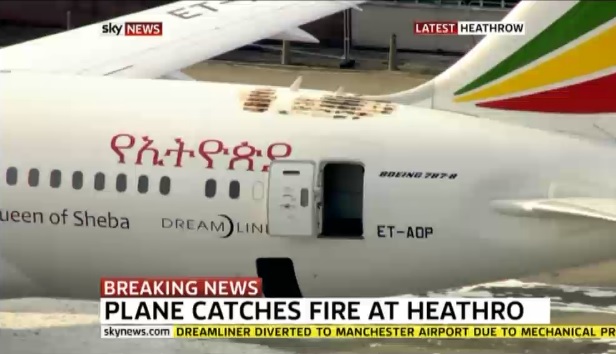
Around 16:30 B.S.T, the Ethiopian 787, registration ET-AOP, was observed with smoke billowing throughout the aircraft. Fire response crews at Heathrow rushed to the aircraft and doused it with fire retardant foam from at least 3 vehicles

787 damage at Heathrow Airport - via Sky News
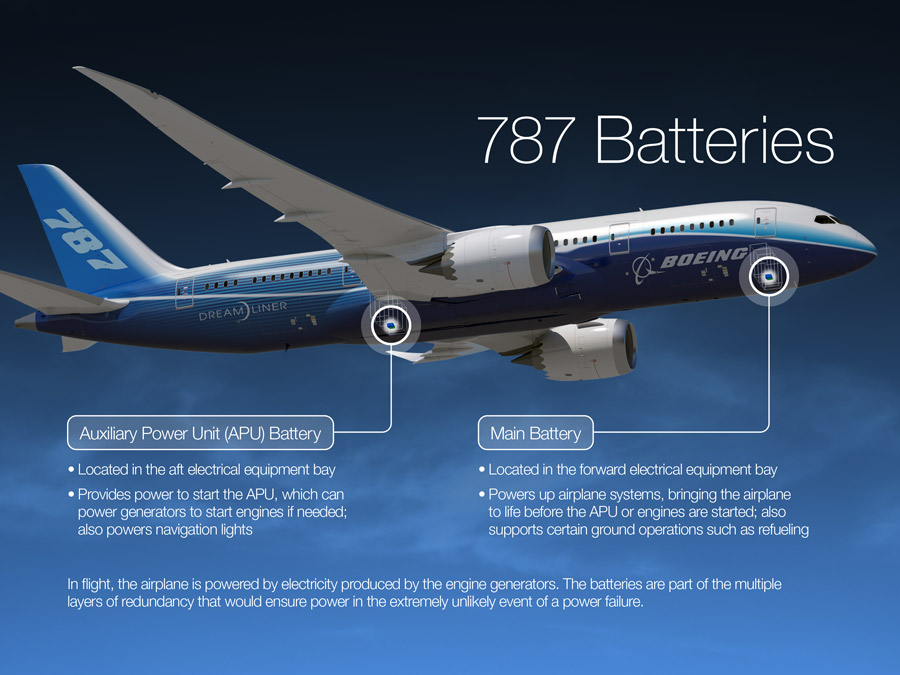
There was significant smoke/fire damage to the carbon fiber reinforced polymer (CFRP) skin of the Ethiopian 787, in the crown of the fuselage just forward of door 4 (the aft door). The damage was in a different location than that caused by the issues with the 787’s lithium-ion batteries that caused the Dreamliner to be grounded worldwide for more than 3 months. In fact, the British Air Accidents Investigation Branch (AAIB) has ruled out a direct causal relationship between the 787’s batteries and/or auxiliary power unit (APU) and the fire damage. The graphic below from Boeing shows that the damage from the 787 batteries occurred in a different location entirely.

Graphic showing location of 787 batteries - Image Credit: Boeing
The 787 was on Fixed Electrical Ground Power (FEGP) at the time of the incident. A report in the Financial Times quoted an Ethiopian Airlines source as stating that a problem had been observed in the aircraft’s air-conditioning system, and that “sparks were observed,” but this report has not been corroborated anywhere else. The 787’s aft ceiling contains Remote Data Concentrators (RDCs) and Remote Power Distribution Units (RPDUs) with significant amounts of wire, and there is a galley station (but no crew rest) beneath the section of the roof where damage occurred.

The National Transportation Safety Board (NTSB), European Air and Space Agency (EASA), AAIB, Boeing, and Ethiopian are all investigating the incident. The damage represents a massive aircraft on ground (AOG) challenge, and a good testing case for composites repair, which presents its own set of challenges (find more information on composite repair here). The cause of the damage is unknown at this point.

These are the facts we know; full stop.

All of the speculation about design problems with the 787 and maintenance issues is exactly that, speculation.

For their part, Boeing, Ethiopian Airlines, and (importantly) the assorted aviation safety agencies are all treating this as a one-off event. Ethiopian Airlines issued a statement saying that the incident was “unrelated to flight safety.”  Ethiopian is scheduled to take delivery of its 5th 787 this week, and plans to do so as scheduled and keep its entire remaining fleet of Dreamliners operational.

To their credit, the DGCA is taking a similar approach with national carrier Air India’s fleet of 787s. "We are keeping a close watch in the investigations (at Heathrow). We will take a view (on Air India's fleet) only after we receive reports of the inquiry and know the causes behind these incidents," DCGA chief Arun Mishra told the Press Trust of India (PTI). To date, Air India has taken delivery of 7 Dreamliners out of a total order of 27.

Air India should keep its Dreamliner fleet operational
This is the correct tactic. While many in the media, especially (albeit understandably) among the British press, have used this as an opportunity to question the 787’s safety, the fact is that this incident is unrelated to any prior ones on the 787. Aviation is not a perfect process; things can go wrong. And even the best of aircraft have one off issues from time to time (see the recent 777 crash or the Air France A330 crash in 2009). When the safety authorities whose job it is to separate isolated incidents from chronic safety problems are treating the 787 as a safe, airworthy aircraft; you should too.

Every aircraft, especially one with such a large degree of new and advanced technology, will suffer its fair share of teething issues. Remember the A380s wing rib cracks? Or the myriad issues that the 747, 777, 767, A340, and A300 all faced on their respective entries into service (EIS). Give Boeing and other involved parties some time to work out the kinks; because when they do, the 787 is set to revolutionize air travel.

Read more »

Update 1: Air India grounds its Boeing 787 Dreamliner fleet, after FAA emergency directive

by Devesh Agarwal
The fleet of six Boeing 787-8 Dreamliners of state-owned national carrier Air India has been grounded by the country's aviation regulator the DGCA, which took this decision following the issue of an Emergency Airworthiness Directive (EAD) by the US Federal Aviation Administration (FAA) the regulator in the country of manufacture, and also the certifying body of the aircraft. The EAD concerns risks of fire in the aircraft's Lithium-ion batteries.

(Read the FAA Press Release here).

(You can read the FAA Emergency AD at the end of this article, or download it here).

Air India operates three international routes (Dubai, Frankfurt and Paris Roissy), and three domestic services (Bangalore, Chennai, and Kolkata), all from its base in New Delhi. One aircraft is used as a stand-by.

An Air India spokesperson informed Bangalore Aviation the airline is making "alternate arrangements" including changing of aircraft type on some routes, and "arrangements" for affected passengers, but refused to elaborate. The airline has also not issued any statement on the 787.

The FAA EAD comes after multiple incidents which afflicted Boeing's newest generation aircraft in the last few weeks. A United Airlines Boeing 787-8 was diverted near New Orleans on December 4, 2012. On December 8, a Qatar Airways 787 reported a generator failure. On January 7, a Japan Airlines 787 suffered an APU battery fire at Boston. On January 11, another ANA Dreamliner suffered a cracked wind-shield while on a domestic flight. Air India's debut flights were marred by air-conditioning pack failures. The other three operators Chile's LAN, Ethiopian Airlines, and LOT Polish Airlines have not reported any incidents with the 787.

In addition to United Airlines, and Air India, the two Japanese carriers, All Nippon Airways (ANA) and Japan Airlines (JAL), the first two operators of the 787, who operate almost 50% of the global 787 fleet (24 out of 50), grounded their fleets yesterday. LAN confirmed it is suspending 787 flights on advice of Chile's aviation regulator. The airline issued a statement
“In compliance with the recommendation of the Federal Aviation Administration of the United States (FAA) and in coordination with the Chilean Aeronautical Authority (DGAC), LAN announces that we will temporarily suspend the operation of our three Boeing 787 aircraft.

“Flights that were scheduled to be operated by the 787 will be temporarily replaced with other aircraft in our fleet to mitigate any potential impact that this situation could cause our passengers and cargo clients. The safety of our operation and our passengers is our top priority and we lament any inconvenience that this may cause.”
LOT have cancelled their launch event for their Warsaw Chicago service. The decisions of Qatar and Ethiopian are awaited, though it is expected they will follow suit.

Boeing reimposed faith in the safety of its aircraft. Chairman, President and CEO Jim McNerney issued the following statement following the FAA's EAD.
"The safety of passengers and crew members who fly aboard Boeing airplanes is our highest priority.

"Boeing is committed to supporting the FAA and finding answers as quickly as possible. The company is working around the clock with its customers and the various regulatory and investigative authorities. We will make available the entire resources of The Boeing Company to assist.

"We are confident the 787 is safe and we stand behind its overall integrity. We will be taking every necessary step in the coming days to assure our customers and the traveling public of the 787's safety and to return the airplanes to service.

"Boeing deeply regrets the impact that recent events have had on the operating schedules of our customers and the inconvenience to them and their passengers."

A DC-10-40 modified to perform as a tanker.
The Federal Aviation Administration does not enjoy the same reputation of independence as the NTSB, due to its contradicting roles of a regulator and a promoter of aviation. One has to go back 34 years to 1979, to find the last time the FAA issued an EAD on an aircraft. That was the McDonnell Douglas DC-10, following the horrific crash at Chicago of an American Airlines DC-10. In an ironic twist of history, the travelling public lost faith in the DC-10, and McDonnell Douglas never recovered from this disaster. It eventually went bankrupt, and was acquired by Boeing.

In no way do we imply the 787 is an unsafe aircraft, and we are confident the efforts of Boeing and its vendors will find a solution; but, speed is of the essence. Through its EAD the FAA and by extension other regulators will require operators (airlines) to prove that the batteries on their 787s are safe.

Unlike earlier generation aircraft, the 787 relies on greater electrical power to perform aircraft functions traditionally performed by hydraulic means. As a result it has a greater usage of batteries. While Lithium-ion batteries similar to the type used in the 787 are fairly common in the aerospace industry, the groundings will put tremendous pressure on both Boeing, and the battery manufacturer GS Yuasa of Japan, to examine their entire value chain, from design, to manufacturing, to quality control, determine reasons for the failures and find solutions, quickly.

Boeing has not indicated it will stop or suspend production of the 787. In fact the 100th 787 just entered the production line recently. However, while Boeing can assemble 787s it cannot fly them and therefore cannot conduct any test flights. The flight lines at both the Everett and Charleston plants will start filling up soon.

While the seriousness of the battery problems are not fully known, and therefore a time-frame for implementing a solution is elusive right now, Boeing has to keep history in mind. The DC-10 grounding in 1979 lasted over a month. In today's day and age neither Boeing nor Yuasa can afford this, especially after over three years of delay plaguing this fine aircraft.

Share your thoughts via a comment.

Update 1: 787 Interim Replacement Plan

Through January 22nd, Air India has implemented the following replacement plan for segments previously scheduled to be operated by the Boeing 787 Dreamliner:

Delhi - Chennai/Bangalore will be operated with the Airbus A330-200. Since the A330s are already based in Chennai to fly Chennai-Singapore, the aircraft which operates the night flight to Chennai will be rotated through Delhi for domestic flights during the day.

Delhi - Kolkata/Dubai will be operated by Boeing 747-400s which are currently used as spare aircraft for maintenance substitutions and charters.

Delhi - Paris Charles de Gaulle will be operated by a spare Boeing 777-200LR.

Delhi - Frankfurt will be operated by a spare Boeing 777-300ER.


US Federal Aviation Administration Emergency AD # 2103-02-51 787 Battery

Read more »

US FAA and EASA issue Emergency Airworthiness Directive on Airbus A320 family aircraft

DATE: December 17, 2012
AD #: 2012-26-51

Emergency airworthiness directive (AD) 2012-26-51 is sent to owners and operators of
Airbus Model A318, A319, A320, and A321 series airplanes.

Background
The European Aviation Safety Agency (EASA), which is the Technical Agent for the Member States of the European Community, has issued EASA Emergency Airworthiness Directive 2012-0264-E, dated December 17, 2012 (referred to after this as the Mandatory Continuing Airworthiness Information or “the MCAI”), to correct an unsafe condition for the specified products.

EASA has advised that an Airbus Model A330 airplane equipped with Angle of Attack (AoA) sensors installed with conic plates recently experienced blockage of all sensors during climb, leading to autopilot disconnection and activation of the alpha protection (Alpha Prot) when Mach number was increased. Based on the results of subsequent analysis, it is suspected that these conic plates may have contributed to the event. Investigations are ongoing to determine what caused the blockage of these AoA sensors.

Blockage of two or three AoA sensors at the same angle may cause the Alpha Prot of the
normal law to activate. Under normal flight conditions (in normal law), if the Alpha Prot activates and Mach number increases, the flight control laws order a pitch down of the airplane that the flight crew might not be able to counteract with a side stick deflection, even in the full backward position.

This condition, if not corrected, could result in reduced control of the airplane. EASA also issued Emergency AD 2012-0258-E, dated December 4, 2012, for Airbus Model A330 and A340 airplanes to require an amendment of the AFM to ensure that flight crews apply the applicable emergency procedure.

AoA sensor conic plates of similar design are also installed on Model A320 series airplanes. Installation of these AoA sensor conic plates was required for Model A318, A319, A320, and A321 series airplanes by EASA AD 2012-0236, dated November 9, 2012 (corrected November 12, 2012).

Subsequently, EASA issued AD 2012-0236R1, dated December 17, 2012, to remove the requirement to install AoA sensor conic plates.

Read the full Emergency AD here.

Read more »

Qantas jumbo makes emergency landing

Qantas jumbo makes emergency landing after mid-air drama

Image from BBC News

MANILA (AFP) — A Qantas Boeing 747 flying to Melbourne made an emergency landing in Manila on Friday after a dramatic mid-air rupture that left a "gaping hole" in its fuselage, officials and passengers said.

Stunned passengers reported how the jumbo, which originated in London and made a stop in Hong Kong, plunged 20,000 feet (6,000) metres in an "absolutely terrifying" ordeal.

A Qantas spokeswoman said the plane, carrying 346 passengers and 19 crew, diverted to Manila where it was now undergoing inspection on the ground.

"There was a terrific boom, and bits of wood and debris just flew forward into first (class) and the oxygen masks dropped down," June Kane, a passenger from Melbourne, told the Australian Broadcasting Corporation.

"We were told that one of th
e rear doors, a hole had blown into it, but I've since looked at the plane and there's a gigantic gaping hole in the plane. "It was absolutely terrifying, but I have to say everyone was very calm," she added, speaking from the Philippine capital.

Qantas chief executive officer Geoff Dixon said initial inspections showed the aircraft had sustained a hole in its fuselage, and it was currently being inspected by engineers.
He said the flight crew performed emergency procedures after oxygen masks were deployed and there were no reports of any injuries. Dixon said the Australian Transportation Safety Bureau and Civil Aviation Safety Authority had been notified.

Manila airport operations officer Ding Lima said the aircraft lost cabin pressure shortly after leaving Hong Kong bound for Melbourne. "The captain of the aircraft immediately called the (Manila) control tower for an immediate landing," Lima told local radio. "There is a big hole in the belly of the aircraft near the right wing about three metres in diameter," he added.

Flight QF30, which took off from Hong Kong at 9:00am (0100 GMT), had been due to arrive in Melbourne at 1145 GMT, according to the Qantas website.
Lorena Dimaya, a Qantas assistant supervisor in Manila, said the aircraft had landed safely just after 11:00am local time and the incident had not been "life threatening." She said the plane had taken off from Hong Kong when it "encountered some technical problems and requested to be diverted to Manila, where it made an emergency landing."

Passenger June Kane said the problem seemed to centre on the baggage compartment of the plane.
"I'm looking at the plane now and on the left-hand side, just forward of the wing, there's a gaping hole from the wing to the underbody," she said. "It's about two metres by four metres and there's baggage hanging out so you assume that there's a few bags that may have gone missing.

Passengers praised the crew for landing the plane safely.
"We heard a very large bang, the oxygen masks came out. But the crew was very calm and everything was fine," said Phil Rescall, a 40-year-old man from England travelling to Australia for work. "I think we were all very lucky."

"The crew were terrific, they did a great job," another passenger, Brendan McClements, said. "Everyone gave them a round of applause as we landed."

Source : AFP
Read more »