Showing posts with label DGCA. Show all posts

Upgraded terminal at Bangalore airport inaugurated, airport renamed, exclusive pictures

by Devesh Agarwal

Bangalore's Bengaluru International Airport (BIA) was renamed to Kempegowda International Airport, Bengaluru (KIAB) at a glittering ceremony on Saturday by Karnataka state chief minister Siddaramaiah and Union civil aviation minister Ajit Singh, along with a battery of ministers, legislators, the Mayor of Bangalore, politicians, bureaucrats, the chairmen of the airport operating company Bengaluru International Airport Limited (BIAL), amongst others.

Upgraded terminal 1A at Kempegowda International Airport. The original portion is visible in the middle.
Along with the renaming, the upgraded passenger terminal, 1A, was inaugurated. The new terminal will be progressively introduced for passenger use starting from January 2014.

T1A, will almost double the floor space of the terminal, and is expected to cater to 20 million passengers. Mr. G.V. Krishna Reddy, the chairman of GVK Power and Infrastructure Ltd., the majority shareholder of BIAL, also indicated that the airport will now commence on planning for a new mega terminal 2, and a second runway that should see the airport build a capacity of up to 40 million passengers.

Upgraded terminal capabilities

The graphic below compares T1 with T1A. Comparisons aside, the new areas have a distinctly superior air. Almost like a five star hotel lobby.

The domestic portion on the west side of the terminal (right side of the picture) will commence operations first. The east side of the existing terminal which serves international traffic at present will remain for international traffic use which the area behind the existing immigration, customs and security will be built for international use.

Luxurious bathrooms await passengers in terminal 1A.

At a future date, not yet disclosed, but expected near March 2014, the new customs, immigration, and baggage reclaim hall will be completed, at which time the east portion of the existing terminal will be converted to domestic use, and the international operations will move to the new east hall (left side of the picture, under the new roof-canopy) and the extended pier will also be used.

In an environment first, the terminal building is LEED Gold certified for green energy use. 

Floor plans of Terminal 1A, Kempegowda international airport, Bangalore

Level 0, terminal 1A, Kempegowda international airport, Bangalore. Bus gates domestic, international baggage claim

Level 1, terminal 1A, domestic international contact stands, departures. Level 2 domestic close-up day hotel, lounges
Level 2, terminal 1A. Domestic lounges, international arrivals, immigration, extreme right Code F departures and lounge.

Lounges, day hotel, and food options

Now, there are reasons to get to the airport early. The domestic portion of the terminal will see a dramatic improvement in the lounges, with two of them opening up. Of significance to Citibank PremierMiles Mastercard holders, and other credit cards, one of the two lounges opening is by Plaza Premium. Overlooking the departure gates, the lounge is very much in the style of Cathay Pacific's The Wing lounge at Hong Kong airport.

Restaurants are upscale, and focussed towards local cuisine.

There is also a day hotel, located on the third level above domestic departures in the far west of the expanded terminal, offering bed-capsules for travellers wanting a quick rest and shower between flights or for passengers from slightly distant cities like Mysore, Tumkur, Salem, etc. The airport authorities are going to have to work out the modalities with the security agencies for international passengers to use the hotel, or early arrivals from close by cities like Mysore, Salem, etc.

Coming back to the lounge front, international premium passengers are doomed to suffer. The new wing while providing for new lounges, will expand lounge capacity by a small fraction over the existing Oberoi group operated lounge, was is forced to continue well past its contract period, supposed to end in October 2013. Oberoi did not get a contract to operate either of the two lounges, and naturally, their interest in operating the existing lounge is low. Despite the best efforts of BIAL staff, the Oberoi lounge provides a very sorry departing experience to the premium passengers.

Security check area shows a distinct five star look and feel of the new terminal.


Lounges are crucial to the passenger experience at hub airports. While the new international lounges are expected to be more luxurious than the existing, it remains to be seen whether these lounges will match up to the likes at Singapore Changi, Dubai, or even New Delhi IGI airports.

One of the two new lounges will be Plaza. Given its relatively small size, it is not clear whether credit card holders will be permitted entry. There is one lounge area being considered at level 2 of the east most gate (right side of floor plan photo) which is a Code F and can be used by an Airbus A380. Will Lufthansa use this area for creating a dedicated lounge? Let's see.

Photography at the terminal

Airplane photo buffs will be able to enjoy great views at the west end of the airport which should allow for a panoramic view of the apron. Head out near the new gate 1 any time before noon and click some photos. The best time of the year to take photos will be from September to April after which the sun will be north of the airport and many photos will be back-lit.

Photography from the terminal is permitted by the DGCA. You can read this article for more details and the relevant notifications which we suggest you keep a print out of.
Read more »

USDOT fines US Airways $1.2m for failure to provide wheelchair assistance

By BA Staff

The U.S. Department of Transportation (DOT) fined US Airways $1.2 million for failing to provide adequate wheelchair assistance to passengers in Philadelphia and Charlotte, N.C. The fine is one of the largest ever assessed by DOT in a disability case.

U.S. Transportation Secretary Anthony Foxx said:
“All air travelers deserve to be treated equally and with respect, and this includes persons in wheelchairs and other passengers with disabilities. We will continue to make sure that airlines comply with our rules and treat their passengers fairly.”
Under DOT’s rules implementing the Air Carrier Access Act, airlines are required to provide free, prompt wheelchair assistance upon request to passengers with disabilities. This includes helping passengers to move between gates and make connections to other flights. 

In one of its periodic reviews of airline compliance with DOT rules, the Department’s Aviation Enforcement Office found that US Airways committed a significant number of violations of the requirements for wheelchair assistance during 2011 and 2012 at Philadelphia International Airport and Charlotte Douglas International Airport. 

As part of its review, the Enforcement Office examined approximately 300 complaints filed by passengers with the airline and DOT relating to incidents at Philadelphia and Charlotte, which covered only a sample of complaints filed over two years against US Airways for the two airports. The airline’s use of a combination of electric carts and wheelchairs to carry passengers between gates required frequent transfers and led to long delays. Some passengers missed connections because of the delays or were left unattended for long periods of time.

Of the $1.2 million fine, US Airways may use up to $500,000 for improvements in its service, to passengers with disabilities, that are beyond what DOT rules require. These include hiring managers to ensure the quality of the airline’s disability services in Philadelphia and Charlotte, creating a telephone line to assist these passengers, purchasing tablets and other equipment to monitor assistance requests, providing compensation to passengers with disability-related complaints, and programming the airline’s computers so that boarding passes identify passengers who request special services.

Now if only the DGCA comes up with similar fines for Indian carriers. Share your thoughts via a comment.
 
Read more »

Tata-SIA joint venture receives FIPB approval

by Devesh Agarwal

Photo © Devesh Agarwal
The joint venture of Singapore Airlines (SIA) and Tata Sons, Tata SIA Airlines Ltd., to set up a full service airline, has won approval from India's Foreign Investment Promotion Board (FIPB).

The company has an initial capital outlay of $100 million with Tatas holding 51% and Singapore Airlines holding 49%.

Tata-SIA will now have to approach a variety of agencies, many under the ministry of civil aviation, to obtain the slew of regulatory and security approvals, before it can commence operations.
Read more »

Bangalore airport shut down as IndiGo flight veers off runway

by Devesh Agarwal
IndiGo Airbus A320 VT-IGV at Bengaluru International Airport. Photo copyright Vedant Agarwal. Used with permission.
At approximately 20:10 (14:40Z), an IndiGo Airbus A320-232 registration VT-IGV performing flight 6E-125 from New Delhi to Bangalore, with 110 passengers and six crew (two pilots, four cabin crew), veered off the runway 27 while attempting to land at Bengaluru International Airport (BIA) during heavy rains and cross-winds.

The aircraft damaged five runway lights and suffered burst tyres, finally stopping near taxiway Foxtrot, and blocking the sole runway 09/27. There were no injuries.

All flight operations at the airport were suspended till repairs to the aircraft were carried out and it was towed to the apron. Flight operations resumed almost three hours later at 22:55 (17:25Z).

A number of flights both domestic and international were diverted to neighbouring airports like Chennai.

The airline released this statement
IndiGo flight 6E–125 from Delhi to Bengaluru, while landing on runway 27 at the Bengaluru airport at 20:10 pm, landed to the right of the center line, while experiencing heavy rains upon landing. The aircraft veered to the right and contacted 5 runway edge lights which led to deflation of the right main tyres. The aircraft was controlled and was taxied off the runway onto taxi track ‘’Foxtrot” and stopped.

All 110 passengers and six crew on board are safe with no injuries reported and have been de-planed safely from the aircraft to the terminal.

As per the operating procedure, the aircraft will be grounded for maintenance work. The matter has been reported to the DGCA and the safety department of IndiGo and DGCA will inquire further into the matter at the earliest.

At IndiGo, we are committed to passenger comfort, and safety is our highest priority. Hence, there can be absolutely no compromise on safety.
In April 2009, in a very similar incident, a Kingfisher Airlines Airbus A320-232 VT-KFT also veered off runway 27 in heavy rain and winds, and damaged runway lights. (Read that story here). At that time the runway was shut for less than 55 minutes. A shut down of three hours with the aircraft stopping on the taxiway suggests significantly more damage to the aircraft than IndiGo is claiming.
Read more »

India succesfully addresses ICAO's safety concerns

by BA Staff

The Press Information Bureau, Government of India reports, The International Civil Aviation Organization (ICAO) validation team submitted its report and recommendations to ICAO headquarters for the review by the ICAO SSC Validation Committee. ICAO has conveyed that corrective action taken by India have successfully addressed and resolved two Significant Safety Concerns (SSC) relating to airworthiness and operations. Consequent to this decision, the Safety Concerns have been resolved and India no longer figures amongst the States with SSC on the ICAO website.

International Civil Aviation Organization (ICAO), during the ICAO Coordinated Validation Mission of India in December 2012, had identified two Significant Safety Concerns (SSC) relating to airworthiness and operations. The concern on airworthiness related to approval of major modifications and repairs carried out on foreign manufactured aircraft and registered in India while the concern on operations related to the procedure for grant of Air Operator Permit to non-scheduled operators and flight documentation system of scheduled airlines.

DGCA prepared a Corrective Action Plan (CAP) in January, 2013 to address the concerns and submitted the same to ICAO for their acceptance. On acceptance by ICAO, DGCA initiated action to implement the CAP to address both the Safety Concerns. Regular updates were provided to ICAO on the progress made on CAP implementation.

In June 2013, on completing substantial work, DGCA requested ICAO to send a Validation Team to assess the implementation of the CAP for resolving the SSC. A three member ICAO Team visited India from 19th to 23rd August, 2013 for the validation of the CAP implementation. During the visit, the team examined all documentary evidences at DGCA Headquarters and Regional Offices at Delhi and Mumbai. As part of the Validation process, the team also visited organizations to ascertain the safety oversight capability of DGCA with respect to implementation of CAP.
Read more »

Analysis: Jet Airways to withdraw from Bhubaneswar

by Vinay Bhaskara

According to several reports, Mumbai-based full service carrier Jet Airways is planning on pulling out from Bhubaneswar from the Winter 2013/14 season. Inventory has been zeroed out from 27th October onwards and flights to and from Bhubaneswar are no longer bookable on jetairways.com. Additionally, sources are saying that Jet Airways has not requested slots at Bhubaneswar for this winter, though we will have to wait for the release of route information onto the Global Distribution System (GDS) to confirm this news.

During August, Jet Airways has operated three flights per day to Bhubaneswar, daily Chennai-Bangalore-Bhubaneswar and return, daily Mumbai-Bhubaneswar and return, and daily Kolkata-Bhubaneswar and return. Mumbai-Bhubaneswar and Kolkata-Bhubaneswar are served with JetKonnect Boeing 737-800 equipment, while Bangalore-Bhubaneswar is served with full service 737-800 equipment. The current service level actually marks a reduction from planned levels at the start of the summer, as an additional two flights per day to Kolkata were initially filed with the Directorate General of Civil Aviation (DGCA) utilizing ATR 72-500 turboprop equipment.

If true, the cancellation of Bhubaneswar is a poor step on the part of Jet Airways. One of the few strengths remaining for the financially struggling Jet Airways is its powerful domestic network, with 49 domestic destinations. Bhubaneswar is the 18th busiest airport in India, and one of the most important destinations in Eastern India. However, Jet Airways has been facing challenges thanks to the steady growth of low cost carrier (LCC) IndiGo in the Bhubaneswar market. IndiGo is the largest carrier in the Bhubaneswar market, with nine flights per day this summer to five nonstop destinations; Delhi, Hyderabad, Kolkata, Mumbai, and Vizag.

Even with the increased LCC competition, it does not make sense that Jet did not at least keep around Mumbai-Bhubaneswar for feed purposes. With the new Mumbai integrated terminal arriving by the end of next year, Jet Airways has the opportunity to build a strong regional hub at Mumbai connecting passengers domestic to international and vice-versa. Since Mumbai-Bhubaneswar is served with JetKonnect equipment, with lower operating costs, it is likely losing the least money of Jet's Bhubaneswar services, and thus it would have made sense for Jet to keep Bhubaneswar around.

But the cancellation is just the latest a growing pattern of poor network decisions made by Jet Airways over the past few years. It is certainly possible for airlines to cut services on their way to profitability; but that usually applies to redundant or heavily money-losing capacity that does not serve a strategic purpose (Delhi-Milan being one rare example at Jet Airways); not a key short haul destination. 
Read more »

Emergency services at Indian airports capable of handling Asiana San Francisco type crash

by Devesh Agarwal

The recent crash of Asiana Airlines flight OZ-214 at San Francisco International airport showcased the quick and heroic efforts of both the airport's emergency fire and rescue services and the cabin crew. Praise has flowed to both of these sets of people for their actions which resulted in minimal loss of life and injuries.

Prompted by this crash, Bangalore Aviation reader Anil Arvindam, wrote in the other day
"How prepared are our airports in India? Are our fire-fighters trained to respond like this San Francisco did?"
The short answer is a resounding YES. The details though are worth exploring.

ARFF / RFFS / CFR

DIAL_ARFF_Fire_FighterThere are many acronyms given to this specialised fire-fighting service. In the United Kingdom it is RFFS (Rescue and Fire Fighting Services), in India and the United States it is ARFF (Aircraft Rescue and Fire Fighting), in some parts of the US and in the Philippines it is Crash Fire Rescue (CFR). In this article we'll follow the Indian standard of ARFF. ARFF is a very specialised category of fire-fighting that involves the response, hazard mitigation, evacuation and rescue of passengers and crew of an aircraft involved in an emergency at, or near, an airport.

Rescue and fire-fighting services at airports in member countries are governed by standards of the International Civil Aviation Organisation (ICAO), pronounced "Eye Kay Oh". For example, ICAO Document 9137-AN/898, Airport Services Manual, Part 1 guives unform guidance in an effort to provide standardised levels of emergency services, across the world. The respective national civil aviation regulators like the Directorate General of Civil Aviation (DGCA) in India, or the US Federal Aviation Administration (FAA), in turn publish and enforce the rules and requirements.

ARFF normally will respond to all aircraft emergencies within an airport's boundaries and will also respond to emergencies outside the airport boundaries, typically in a six degree cone from the end of each runway, out to about eight kilometres and there is an defined understanding with the city emergency services on the respective roles and responsibilities to an 'off-airport' incident.

ARFF will also respond to non-aircraft emergencies within airport boundaries, but ARFF will not respond to non-aircraft emergencies outside the airport as this will leave the airport without adequate protection.

All the major airports in India are compliant with ICAO and DGCA norms for emergency services and are audited regularly. By rules if an airport has inadequate or no ARFF cover, it has to close its runways to passenger paying aircraft unless in an emergency, and even then, use of the airport is at the discretion of the commander of the aircraft.

The trend to modern ARFFs was initiated by the private airports of Bangalore, Hyderabad, New Delhi and Mumbai. Soon after, even the Airports Authority of India (AAI) run airports like Kolkata, Chennai, Ahmedabad, Amritsar, etc., migrated from their vintage Tata-Leyland trucks to modern ARFF stations and equipment.

Airport Category and ARFF capacity

The size of the ARFF facility at an is determined by the airport's category rating. The number of fire-stations at the airport are determined by the response time requirement which is detailed in the next section.

The category of the airport is based on the size of the largest aircraft that lands at the airport and is also tied in to the number of runways. The table below shows how category is determined, and then for each category what is the requirement of fire tenders, water, chemicals, foams, etc.

The British system is from Category 1 to 10. This system is also followed in India. The US FAA mandates a category system from A to E, and is also tied in to the number of daily departures of the largest size aircraft. FAR Part 139, Sec. 139.315, and FAR Part 139, Sec. 139.317 provide full details.

How an airport's fire-fighting capabilities and capacities are determined.

Bangalore's airport is single runway and is rated 'Cat-9' since it regularly handles flights up to a 747-400 i.e. Code E size. However, since 2012, the airport also regularly handles one daily flight of a Lufthansa Boeing 747-8i which is Code F size, the same as the A380, and this requires the airport to temporarily increase capability to the highest category, 'Cat-10', rating for the duration of that one flight. As airport spokesperson Anjana explains
ARFF scales up to Cat 10 for the period of operations of 747-8 by augmenting additional manpower out of the shifts during this period)

Response Times / Airfield Crash Fire Tenders

Fire is a major risk during any aircraft emergency. With wide-body aircraft now carrying over 300 passengers regularly, the potential of an emergency turning in to a mass casualty has increased in recent years. Keeping the fire risk in mind, safety regulations require an aircraft should have enough exits to be able to evacuate all passengers within 90 seconds.

Similarly, the arrival of the ARFF team(s) at the scene is of paramount importance. In air traffic control (ATC) towers around the world, there are emergency push-buttons within close reach of controllers which set off alarms blaring. The response time norms require ARFF teams to arrive at the scene within two minutes, for 'on runway' incidents, and within three minutes for 'off-runway' incidents anywhere within the airport perimeter.

This response time requirement has resulted in the development of specialised Airfield Crash Fire Tenders (ACFTs) which can only be described as "super trucks". Weighing well over 25~30 tons, twice more than a regular road truck, these tenders can accelerate to 100 kmph in under 30 seconds, thanks to special engines developing between 700 BHP to 1,000+ BHP, about the same power as a Formula 1 car. Taking a leaf from the racing cars, these trucks make extensive use of high strength, low weight, composite and fibre-glass parts.

Rosenbauer Panthers of Bangalore International Airport ARFF. The floor spray extinguishes ground fires ahead of the tender.

ACFTs are fitted with specialised suspensions that allow them to corner at high speeds like a sports car, go up slopes of over 60 degrees, or travel on a tilted embankment sloped up to 30 degrees. These trucks incorporate latest technology and automation. Forward looking infra-red (FLIR) allowing the fire-fighters to see in complete darkness, whether at night or in the black smoke of a fire, multiple spray nozzles, with individual remote controls, enabling fire-fighters to fight fires from inside the tender cabin, and much much more.

In India, due to the number of runways and its sheer size, Delhi's IGI airport has four fire stations. Bangalore airport has one station equipped with four Rosenbauer Panthers.


There are many vendors of ACFTs in the world. Rosenbauer of Austria, Iveco of Italy, and Oshkosh of the United States are major players. In India the Rs. 5 Crore Rosenbauer Panther 6x6 (6 wheels driving, 6 wheels total) is the preferred ACFT. At San Francisco Airport the ACFT of choice is the Oshkosh Striker 4500 8x8 which is a bigger and more expensive tender. Scroll down to see a video of the Striker in action at Dallas-Fort Worth International airport.

Oshkosh Striker 4500 of San Francisco International Airport ARFF.

In addition to the ACFTs, ARFFs and airports have other rescue equipment like high-lift turn-table ladders, ambulances, mobile intensive care units, power and hydraulic rescue tools, and special suits enabling fire-fighters to enter in to fires. Bangalore airport even has inflatable motor-boats just in case the emergency occurs on one the many lakes around the airport.

The airports have triage centres within the airport premises for trauma victims. Bangalore airport has special tie-ups with area hospitals like M.S. Ramaiah and emergency ambulance services to handle large scale trauma events.

Fire-fighters and Training

Human beings are a critical component of the airport's ARFF capabilities. At Bangalore Airport, with one ARFF station the team consists of 134 personnel working 24x7 in four watch shifts. Due to multiple runways, the ARFF at Delhi IGI airport has four stations and a significantly bigger team.

Continuous on-going training is a critical part of the ARFF operations. ICAO Annex 14, § 9.2.34 directs that: All rescue and fire fighting personnel shall be properly trained to perform their duties in an efficient manner and shall participate in live fire drills commensurate with the types of aircraft and type of rescue and fire fighting equipment in use at the aerodrome, including pressure-fed fuel fires.

In India, the Airports Authority of India (AAI) operates two ICAO approved training centres in New Delhi and Kolkata which trains ARFF personnel from across the country.

The fire fighters have to know by memory every aspect of the airport, and also the details for every aircraft that operates at the airport. Come an emergency, there is no time to be looking up books and charts. ARFF charts for Airbus aircraft can be downloaded here, and for Boeing aircraft here.

You can read a detailed paper on the various ARFF training methods across the world and their differences here.


In conclusion, we at Bangalore Aviation invite you to travel safely and with confidence. Air travel is the safest means of travel, and the heroes of the ARFF are on duty looking out for you.

If you would like to say thanks to them, post a comment. The PR teams at both BIAL and DIAL read Bangalore Aviation regularly and we are confident they will be happy to carry your compliments to their respective ARFF teams.
Read more »

Opinion: After Ethiopian Airlines incident at Heathrow Airport; 787 remains safe

by Vinay Bhaskara

Last Friday, a pair of incidents occurred with the Boeing 787 Dreamliner. Smoke was observed billowing from an Ethiopian Airlines Boeing 787 parked on the ground at London Heathrow International Airport with no passengers on board, while a Thomson Airways Dreamliner operating between Manchester and Sanford, Florida (SFB) was forced to return to Manchester due to a routine maintenance problem.

Turning first to the Ethiopian 787, the facts are as follow:

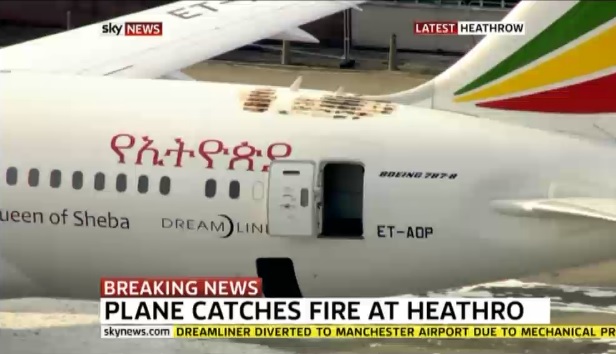
Around 16:30 B.S.T, the Ethiopian 787, registration ET-AOP, was observed with smoke billowing throughout the aircraft. Fire response crews at Heathrow rushed to the aircraft and doused it with fire retardant foam from at least 3 vehicles

787 damage at Heathrow Airport - via Sky News
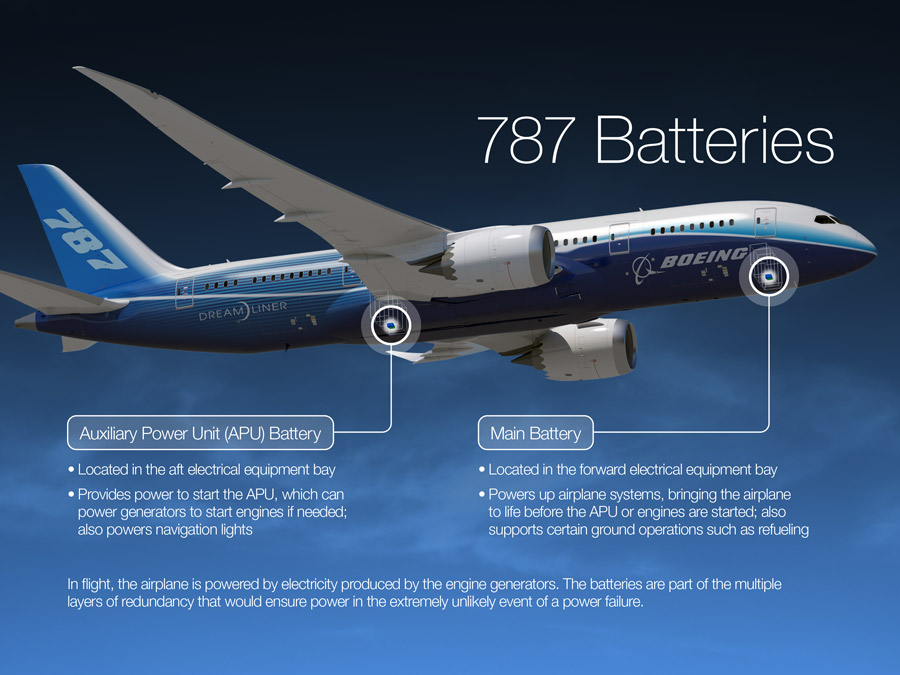
There was significant smoke/fire damage to the carbon fiber reinforced polymer (CFRP) skin of the Ethiopian 787, in the crown of the fuselage just forward of door 4 (the aft door). The damage was in a different location than that caused by the issues with the 787’s lithium-ion batteries that caused the Dreamliner to be grounded worldwide for more than 3 months. In fact, the British Air Accidents Investigation Branch (AAIB) has ruled out a direct causal relationship between the 787’s batteries and/or auxiliary power unit (APU) and the fire damage. The graphic below from Boeing shows that the damage from the 787 batteries occurred in a different location entirely.

Graphic showing location of 787 batteries - Image Credit: Boeing
The 787 was on Fixed Electrical Ground Power (FEGP) at the time of the incident. A report in the Financial Times quoted an Ethiopian Airlines source as stating that a problem had been observed in the aircraft’s air-conditioning system, and that “sparks were observed,” but this report has not been corroborated anywhere else. The 787’s aft ceiling contains Remote Data Concentrators (RDCs) and Remote Power Distribution Units (RPDUs) with significant amounts of wire, and there is a galley station (but no crew rest) beneath the section of the roof where damage occurred.

The National Transportation Safety Board (NTSB), European Air and Space Agency (EASA), AAIB, Boeing, and Ethiopian are all investigating the incident. The damage represents a massive aircraft on ground (AOG) challenge, and a good testing case for composites repair, which presents its own set of challenges (find more information on composite repair here). The cause of the damage is unknown at this point.

These are the facts we know; full stop.

All of the speculation about design problems with the 787 and maintenance issues is exactly that, speculation.

For their part, Boeing, Ethiopian Airlines, and (importantly) the assorted aviation safety agencies are all treating this as a one-off event. Ethiopian Airlines issued a statement saying that the incident was “unrelated to flight safety.”  Ethiopian is scheduled to take delivery of its 5th 787 this week, and plans to do so as scheduled and keep its entire remaining fleet of Dreamliners operational.

To their credit, the DGCA is taking a similar approach with national carrier Air India’s fleet of 787s. "We are keeping a close watch in the investigations (at Heathrow). We will take a view (on Air India's fleet) only after we receive reports of the inquiry and know the causes behind these incidents," DCGA chief Arun Mishra told the Press Trust of India (PTI). To date, Air India has taken delivery of 7 Dreamliners out of a total order of 27.

Air India should keep its Dreamliner fleet operational
This is the correct tactic. While many in the media, especially (albeit understandably) among the British press, have used this as an opportunity to question the 787’s safety, the fact is that this incident is unrelated to any prior ones on the 787. Aviation is not a perfect process; things can go wrong. And even the best of aircraft have one off issues from time to time (see the recent 777 crash or the Air France A330 crash in 2009). When the safety authorities whose job it is to separate isolated incidents from chronic safety problems are treating the 787 as a safe, airworthy aircraft; you should too.

Every aircraft, especially one with such a large degree of new and advanced technology, will suffer its fair share of teething issues. Remember the A380s wing rib cracks? Or the myriad issues that the 747, 777, 767, A340, and A300 all faced on their respective entries into service (EIS). Give Boeing and other involved parties some time to work out the kinks; because when they do, the 787 is set to revolutionize air travel.

Read more »

Boeing to begin modifying 787s for return to service

Boeing image
Today's approval of battery system improvements for the 787 Dreamliner by the U.S. Federal Aviation Administration (FAA) clears the way for Boeing and its customers to install the approved modifications and will lead to a return to service and resumption of new production deliveries.

The FAA's action will permit the return to service of 787s in the United States upon installation of the improvements. For 787s based and modified outside the United States, local regulatory authorities provide the final approval on return to service, but it is expected the local bodies will follow the FAA's lead.

Approval of the improved 787 battery system was granted by the FAA after the agency conducted an extensive review of certification tests. The tests were designed to validate that individual components of the battery, as well as its integration with the charging system and a new enclosure, all performed as expected during normal operation and under failure conditions. Testing was conducted under the supervision of the FAA over a month-long period beginning in early March.

Boeing, in collaboration with its supplier partners and in support of the investigations of the National Transportation Safety Board and the Japan Transport Safety Board, conducted extensive engineering analysis and testing to develop a thorough understanding of the factors that could have caused the 787's batteries to fail and overheat in two incidents last January. The team spent more than 100,000 hours developing test plans, building test rigs, conducting tests and analyzing the results to ensure the proposed solutions met all requirements.

Boeing also engaged a team of more than a dozen battery experts from across multiple industries, government, academia and consumer safety to review and validate the company's assumptions, findings, proposed solution and test plan.

The improved battery system includes design changes to both prevent and isolate a fault should it occur. In addition, improved production, operating and testing processes have been implemented. The new steel enclosure system is designed to keep any level of battery overheating from affecting the airplane or even being noticed by passengers.

Boeing has deployed teams to locations around the world to begin installing improved battery systems on 787s. Kits with the parts needed for the new battery systems are staged for shipment and new batteries also will be shipped immediately. Teams have been assigned to customer locations to install the new systems. Airplanes will be modified in approximately the order they were delivered.

Boeing will also begin installing the changes on new airplanes at the company's two 787 final-assembly plants, with deliveries expected to resume in the weeks ahead. Despite the disruption in deliveries that began in January, Boeing expects to complete all planned 2013 deliveries by the end of the year. Boeing further expects that the 787 battery issue will have no significant impact to its 2013 financial guidance.
Read more »

Guest Post: India scraps Aircraft Acquisition Committee

by Ashwin Jadhav
The aircraft acquisition process for airlines in India
The Indian government has scrapped its aircraft acquisition committee (AAC), meaning domestic airlines will find it easier to import aircraft. After allowing 49% FDI (foreign direct investment) by foreign airlines, in the Indian airline sector, the government last week moved a step closer to liberalizing the civil aviation space by abolishing the AAC, a nodal agency which until now cleared requests by airlines and private individuals seeking to import aircraft.

The AAC individually scrutinized each request to import an aircraft into the country, often delaying the process. Axing the scheme, which was only introduced a year ago, will help to "liberalize the market," India's Civil Aviation Minister, Ajit Singh has said.

Domestic airlines will still have to report to the Directorate general of Civil Aviation (DGCA) to register an aircraft before it enters the country, however, the softened rules should support the country's ambition to grow its air travel industry.

Streamlining the process

For most airlines, the aircraft acquisition process begins with an initial valuation agreement with the manufacturer. Following this process, the airline conducts a need assessment, cost analysis and market research aligned with their short-term and long-term strategies.

These processes can be completed in any order, depending on constraints, and are finalized by identification of the candidate aircraft. Usually 2-5 aircraft are short-listed and further narrowed down based on factors like purchase price and aircraft performance (fuel consumption, range, payload, ceiling, weight/balance, capacity, etc.).

Once the aircraft to be purchased is confirmed, a proposal has to be submitted to the aircraft acquisition committee (AAC). The committee was formed in October 2012 “to consider, examine and make recommendations on all proposals for permitting import or acquisition of aircraft for various purposes”, but had increasingly become more involved in commercial and operational decisions.

An objection or delay in the AAC verdict meant that the entire process had to be initiated from inception. This would include rewording agreements, reassessing the market performance and reconsidering the number of aircraft to be purchased. In the recent past, airlines had started objecting to the delays in the meetings of AAC to clear their aircraft orders, saying this adversely affected their commercial decisions to acquire and fly new planes and, hence, profitability.


Approval by the committee would originate negotiations with the manufacturer, which would subsequently be followed by a purchase agreement, legal verification and final delivery of the aircraft. As airlines in India do not purchase their aircraft directly, a leasing agency would be involved, taking over the contract at this stage. The airline would sign a dry or wet leaseback agreement with the leasing company. Once the sale was final, the aircraft would become operational into the airline fleet.

A step forward

The abolishing of the ACC will result in streamlining of the entire aircraft acquisition process in India, a step that could potentially improve the financial health of airlines in India. After Thursday's move, airlines will only need the initial no-objection certificate from DGCA and an in-principle approval to import planes. "The in-principle nod is needed for meeting RBI norms that mandate some sort of government clearance before allowing a commercial entity to make payments to a foreign company," Ajit Singh added.

The impending Jet-Etihad deal and the soon-to-be-launched Air Asia India will now see more planes coming to Indian skies without any trouble from the ministry. Between December 2011 and March 2013, nine airlines that operate in India sought permission to import 97 planes and all were granted permission.
At present India has only one commercial aircraft for every 3.2 million population, compared with Philippines that has one for 9 lakh people, China for every 1.14 million and Brazil, one for every 6 lakh citizens.

Ashwin Jadhav is an aerospace engineer by profession and works in the Flight Operations and Air Traffic Management domain.

Editor's note: As usual comments are welcome. I am sure Ashwin will welcome your feedback.
Read more »

AirAsia JV approved. Aviation ministry officials seek policy clarification

by Devesh Agarwal
India's Foreign Investment Promotion Board (FIPB) today gace an in-principle approval to the Joint Venture (JV) company proposal of AirAsia, the Tatas and the Bhatias. The stated goal of this JV company is to form and operate an airline most likely AirAsia India, based out of Chennai.

As per a report, the JV will initially invest about Rs. 80 crore (approx $14.5 million), well above the minimum Rs. 50 crore requirement to start an airline. The JV will now have to approach the aviation regulator The Directorate General of Civil Aviation (DGCA) for obtaining a permit to start and operate an airline.

On the same day there is a report of senior aviation ministry officials clarifications from the Department of Industrial Policy and Promotion (DIPP) on whether the JV proposal complies with the Government's guidelines on FDI in Indian carriers by foreign carriers.

Bangalore Aviation readers will recall, just about two weeks ago, I had raised this very point in my article.
When the cabinet approved the policy on September 14, 2012, the press statement said
"......there has been a need to consider financing options available for private airlines in the country, for their operations and service upgradation, and to enable them to compete with other global carriers. Denial of access to foreign capital could result in the collapse of many of our domestic airlines, creating a systemic risk for financial institutions, and a vital gap in the country’s infrastructure"
The doubt stems from the lack of clarity in the guidelines on whether the revised FDI policy also allows investments in to fresh start-up airlines, in additional to the stated policy of existing airlines.

If allowed to invest in start-ups, it will enable foreign carriers to bypass infusing funds into existing Indian carriers, thus defeating a stated goal of the policy.

Then it will be the Indian tax-payer finally bearing the debt burden of these Indian carriers, who are largely financed by tax-payer paid "public sector" banks.

It will be interesting to see further developments, though I feel the proposal will go through. The Tatas are an extremely methodical, competent and powerful company. Behind the scenes, they will have worked tirelessly to ensure no embarrassment due to a public rejection.

Share your thoughts via a comment.
Read more »

Update 1: Air India grounds its Boeing 787 Dreamliner fleet, after FAA emergency directive

by Devesh Agarwal
The fleet of six Boeing 787-8 Dreamliners of state-owned national carrier Air India has been grounded by the country's aviation regulator the DGCA, which took this decision following the issue of an Emergency Airworthiness Directive (EAD) by the US Federal Aviation Administration (FAA) the regulator in the country of manufacture, and also the certifying body of the aircraft. The EAD concerns risks of fire in the aircraft's Lithium-ion batteries.

(Read the FAA Press Release here).

(You can read the FAA Emergency AD at the end of this article, or download it here).

Air India operates three international routes (Dubai, Frankfurt and Paris Roissy), and three domestic services (Bangalore, Chennai, and Kolkata), all from its base in New Delhi. One aircraft is used as a stand-by.

An Air India spokesperson informed Bangalore Aviation the airline is making "alternate arrangements" including changing of aircraft type on some routes, and "arrangements" for affected passengers, but refused to elaborate. The airline has also not issued any statement on the 787.

The FAA EAD comes after multiple incidents which afflicted Boeing's newest generation aircraft in the last few weeks. A United Airlines Boeing 787-8 was diverted near New Orleans on December 4, 2012. On December 8, a Qatar Airways 787 reported a generator failure. On January 7, a Japan Airlines 787 suffered an APU battery fire at Boston. On January 11, another ANA Dreamliner suffered a cracked wind-shield while on a domestic flight. Air India's debut flights were marred by air-conditioning pack failures. The other three operators Chile's LAN, Ethiopian Airlines, and LOT Polish Airlines have not reported any incidents with the 787.

In addition to United Airlines, and Air India, the two Japanese carriers, All Nippon Airways (ANA) and Japan Airlines (JAL), the first two operators of the 787, who operate almost 50% of the global 787 fleet (24 out of 50), grounded their fleets yesterday. LAN confirmed it is suspending 787 flights on advice of Chile's aviation regulator. The airline issued a statement
“In compliance with the recommendation of the Federal Aviation Administration of the United States (FAA) and in coordination with the Chilean Aeronautical Authority (DGAC), LAN announces that we will temporarily suspend the operation of our three Boeing 787 aircraft.

“Flights that were scheduled to be operated by the 787 will be temporarily replaced with other aircraft in our fleet to mitigate any potential impact that this situation could cause our passengers and cargo clients. The safety of our operation and our passengers is our top priority and we lament any inconvenience that this may cause.”
LOT have cancelled their launch event for their Warsaw Chicago service. The decisions of Qatar and Ethiopian are awaited, though it is expected they will follow suit.

Boeing reimposed faith in the safety of its aircraft. Chairman, President and CEO Jim McNerney issued the following statement following the FAA's EAD.
"The safety of passengers and crew members who fly aboard Boeing airplanes is our highest priority.

"Boeing is committed to supporting the FAA and finding answers as quickly as possible. The company is working around the clock with its customers and the various regulatory and investigative authorities. We will make available the entire resources of The Boeing Company to assist.

"We are confident the 787 is safe and we stand behind its overall integrity. We will be taking every necessary step in the coming days to assure our customers and the traveling public of the 787's safety and to return the airplanes to service.

"Boeing deeply regrets the impact that recent events have had on the operating schedules of our customers and the inconvenience to them and their passengers."

A DC-10-40 modified to perform as a tanker.
The Federal Aviation Administration does not enjoy the same reputation of independence as the NTSB, due to its contradicting roles of a regulator and a promoter of aviation. One has to go back 34 years to 1979, to find the last time the FAA issued an EAD on an aircraft. That was the McDonnell Douglas DC-10, following the horrific crash at Chicago of an American Airlines DC-10. In an ironic twist of history, the travelling public lost faith in the DC-10, and McDonnell Douglas never recovered from this disaster. It eventually went bankrupt, and was acquired by Boeing.

In no way do we imply the 787 is an unsafe aircraft, and we are confident the efforts of Boeing and its vendors will find a solution; but, speed is of the essence. Through its EAD the FAA and by extension other regulators will require operators (airlines) to prove that the batteries on their 787s are safe.

Unlike earlier generation aircraft, the 787 relies on greater electrical power to perform aircraft functions traditionally performed by hydraulic means. As a result it has a greater usage of batteries. While Lithium-ion batteries similar to the type used in the 787 are fairly common in the aerospace industry, the groundings will put tremendous pressure on both Boeing, and the battery manufacturer GS Yuasa of Japan, to examine their entire value chain, from design, to manufacturing, to quality control, determine reasons for the failures and find solutions, quickly.

Boeing has not indicated it will stop or suspend production of the 787. In fact the 100th 787 just entered the production line recently. However, while Boeing can assemble 787s it cannot fly them and therefore cannot conduct any test flights. The flight lines at both the Everett and Charleston plants will start filling up soon.

While the seriousness of the battery problems are not fully known, and therefore a time-frame for implementing a solution is elusive right now, Boeing has to keep history in mind. The DC-10 grounding in 1979 lasted over a month. In today's day and age neither Boeing nor Yuasa can afford this, especially after over three years of delay plaguing this fine aircraft.

Share your thoughts via a comment.

Update 1: 787 Interim Replacement Plan

Through January 22nd, Air India has implemented the following replacement plan for segments previously scheduled to be operated by the Boeing 787 Dreamliner:

Delhi - Chennai/Bangalore will be operated with the Airbus A330-200. Since the A330s are already based in Chennai to fly Chennai-Singapore, the aircraft which operates the night flight to Chennai will be rotated through Delhi for domestic flights during the day.

Delhi - Kolkata/Dubai will be operated by Boeing 747-400s which are currently used as spare aircraft for maintenance substitutions and charters.

Delhi - Paris Charles de Gaulle will be operated by a spare Boeing 777-200LR.

Delhi - Frankfurt will be operated by a spare Boeing 777-300ER.


US Federal Aviation Administration Emergency AD # 2103-02-51 787 Battery

Read more »

Air India stands by its Boeing 787 Dreamliners as Japan grounds almost 50% of the global fleet

by Devesh Agarwal

National carrier Air India has stood by the six Boeing 787 Dreamliners in its fleet, even as safety concerns grounded the 787 fleet at the first two operators of the aircraft, both from Japan, All Nippon Airways (ANA) and Japan Airlines (JAL). Between the two of them, ANA and JAL operate almost 50% of the global 787 fleet, 24 of the 50 delivered till date. 

Early yesterday, an ANA Boeing 787-8 performing a domestic flight NH 692 from Ube to Tokyo Haneda was forced to make an emergency diversion to Takamatsu when there were indications of battery problems and a burning smell developed on board.

This incident is only the latest in a series of problems to affect the new generation airliner. Many of the problems that plague the Dreamliner seem to be electrical in nature and are affecting airline operators across the world. A United Airlines Boeing 787-8 was diverted near New Orleans on December 4, 2012. On December 8, a Qatar Airways 787 reported a generator failure. On January 7, a Japan Airlines 787 suffered an APU battery fire at Boston. On January 11, another ANA Dreamliner suffered a cracked wind-shield while on a domestic flight.

Air India's debut flight to Bangalore was marred by snags in the air conditioning system.

Japan Airlines the first operator of the 787 with GEnx engines, the same as Air India issued a statement
"In view of the incident encountered by another airline involving the 787-8 aircraft today, Japan Airlines has decided to cancel the operations of its 787-8 aircraft scheduled for flights today and tomorrow, January 17, 2013, to ensure complete safety." "Operations of JAL’s 787-8 aircraft from January 18, 2013 will be decided after further assessment of the situation with the investigations."
The United States National Transportation Safety Board (NTSB) has already launched an investigation in to the Boston incident, and now the Japan Transport Safety Board (JTSB) has launched an investigation in to flight NH692.

The spate of incidents surrounding Boeing's newest aircraft has prompted the US Federal Aviation Administration (FAA) to conduct a review in to the design, manufacturing, and quality control and assurance processes at Boeing.

A spokesperson for Air India re-affirmed the airline's faith in the aircraft and confirmed the airline was in touch with the airframer, Boeing, and in close contact with India's aviation regulator the Directorate General of Civil Aviation (DGCA). The airline will follow the guidelines prescribed by the regulator.

The DGCA has decided to take a wait and watch approach to the situation. It awaits reports and findings from the United States agencies, NTSB and FAA.

In news reports, Mr. Mihir Mishra, the DGCA, points out that globally no regulator has grounded the aircraft. The decision to ground 787s, has been taken by individual airlines.

While we respect the views of Mr. Mishra, and also have faith in Boeing and its products, we do point out, airlines are in the business of making a profit, and no airline will take the decision to ground their latest state of the art aircraft lightly.

It costs them tremendously. Whether it is loss of income by cancelled flights, costs incurred to accommodate the thousands of passengers whose travel is disrupted, costs incurred to inspect their fleet, and the incalculable losses should their passengers start doubting their Dreamliners and shun the aircraft.

Share your thoughts via a comment.

A special hat tip to Simon Hradecky at Aviation Herald for the incident reports.
Read more »

DGCA made a bad financial decision in shutting down Kingfisher Airlines


Earlier this month, now shutdown Kingfisher Airlines, once India’s largest private domestic carrier, reported a huge net pre-tax loss of Rs. 1115.5 Crore for the second quarter of Fiscal Year 2012-13. The performance was by far and away the poorest quarterly financial performance out of any Indian airline in the last few years, though that is to be expected given their shutdown at the end of the quarter.

Revenue performance was abysmal, falling 87.1% on a year over year basis (keeping in mind that FY 11-12’s Q2 was the last quarter of full Kingfisher operations – the first really big capacity cuts hit in November of that year). Fuel expenses were better year over year on a per ASM basis (mirroring the performance of the general industry), and operating margins as a whole did not decline as much as one would have expected (from -98% to -127.5%), though they were obviously atrocious. The main culprit was, as usual, interest, finance, and restructuring charges which contributed the remaining 850 odd Crores worth of net loss. But at this point, the drivers behind Kingfisher’s poor financial performance are well known.

What is more interesting to consider is the question of whether the DGCA made the correct move in shutting down Kingfisher pending a recovery plan. Keep in mind that the Indian government, through its network of state owned banks, is the primary holder of Kingfisher’s more than US $1.4 billion worth of debt. Thus it is in the government’s best interest for Kingfisher to minimize its losses, thereby limiting the further accumulation of debt as well as making Kingfisher slightly more attractive (though still a money pit) for foreign investors. While the DGCA is not operating in response to the same incentives as the general government of India (GOI) and State Bank of India, the two can certainly act in concert to minimize the impact on the public. First, let us simply throw away the ridiculous assertion that financial troubles would drive safety concerns at Kingfisher; this sort of event rarely occurs outside of the hellholes of the Third World, and the incentives for Kingfisher to skimp on safety are simply not in place. Notice that even as it cut the rest of its expenses by hook or crook, the level of maintenance expenses per available seat kilometer remained constant for Kingfisher over the past year. Any airline knows that the minute it compromises safety is the minute it loses viability as an airline in the eyes of the public. But even absent this factor, it would still make sense for the DGCA to shut down Kingfisher if the airline loses more money operating than shut down.

Since the financial and “restructuring” costs will remain regardless of whether Kingfisher carries passengers or not, we can focus our analysis entirely on the operating results on the balance sheet. Based on the data presented in the quarterly results, we can conclude that shutting down has cost Kingfisher around Rs. 220 Crore worth of revenue for Q3 (typically among the strongest Indian quarters). On the flip side, Rs. 160 Crore worth of fuel expenses are no longer accrued, as are a certain percentage (around 35% based on the auditor’s notes to Kingfisher’s financial statement) of the “other operating expenses.” Remaining expenses, including aircraft lease rentals, maintenance, depreciation and amortization, and longer term ground leases will still be accrued. So the total savings that Kingfisher gets from not operating is around Rs. 215 Crore, whereas they are forgoing Rs. 220 Crore worth of potential revenue, not to mention the benefits of operating in increasing the attractiveness to foreign investors. Thus the math suggests that the DGCA made a bad financial decision in shutting down Kingfisher.
Read more »

Night photos from Delhi Indira Gandhi international airport - the Airbus collection

Continuing our photo essay (see part two) on the night photography at Indira Gandhi International Airport (IGIA), thanks to the support of the kind friends at Delhi International Airport (P) Ltd. (DIAL) and the DGCA, today is the Airbus collection.

Unlike Bangalore where the mid-sized Airbus (since the A380 is not permitted) is the dominant aircraft type, Delhi with its higher traffic volumes, commands the larger aircraft of Boeing, the 777 and 747.

Yet, one does get to see the Airbus of mostly Indian and European airlines.

IndiGo Airbus A320-232 VT-IES. Used for international flights at night and domestic during the day.

Jet Airways Airbus A330-200 VT-JWM.


Aeroflot Airbus A330-200 VP-BLY


SWISS Airbus A330-300 (the longer brother of the -200) HB-JHI


KLM Royal Dutch Airlines Airbus A330-200 PH-AOK


We request you to please encourage these photographers via a comment on the photo site.

Photos are used with permission of the photographers who retain full copyright. Pictures may not be used without their specific permission.

Hope you enjoyed this photo-essay series.
Read more »

Night photos from Delhi Indira Gandhi international airport - the Boeing 777 collection

Continuing our photo essay (see part one) on the night photography at Indira Gandhi International Airport (IGIA), thanks to the support of the kind friends at Delhi International Airport (P) Ltd. (DIAL) and the DGCA, today is the Boeing 777 collection.

The 777 is largest twin-engine airliner in the world, along with being one of the most popular, and the most profitable for its manufacturer, Boeing.
The newer 777-300ER, 777-200LR (both of which form bulk of Air India's long distance fleet), and Freighter variants feature the largest engines in aviation history, the General Electric GE90-115B or -110B1 engines. The GE90-115B, has a fan diameter of 3.25 metres or 10ft 8in. This photo offers a size comparison between the GE90 and the earlier engines used to power the venerable Boeing 747.

The GE90 has a distinct "moaning" sound when it starts. It is music to us plane spotters. Play the video to hear it. Anywhere in the world, if you are within earshot of an airport, or on-board a 777-300ER or 777-200LR flight, keep an ear out for the sound.

Air India Boeing 777-200LR (also called 77L in airline parlance) VT-ALE (equipped with the GE90-110B)


Emirates airline Boeing 777-300ER (77W) A6-ECK (equipped with GE90-115B)


Singapore Airlines Boeing 777-300 (773) 9V-SYF (not an ER. Equipped with Rolls Royce Trent 800 RB212 engine)


Thai Airways Boeing 777-300 HS-TKB (equipped with Rolls Royce Trent 800)


We request you to please encourage these photographers via a comment on the photo site.

Photos are used with permission of the photographers who retain full copyright. Pictures may not be used without their specific permission.
Read more »

Night photos from Delhi Indira Gandhi international airport - the Boeing collection

Thanks to the support of the kind friends at Delhi International Airport (P) Ltd. (DIAL) who operate the Indira Gandhi International Airport (IGIA), and the DGCA, some members of the Aviation Photographers India, went airside for some photography. Click here to see photographs from the entire group.

Below are some night photographs from the event taken by the Bangalore Aviation team of Devesh and Vedant. Photographing airliners at night is very challenging, very tiring, but at the end of it, most exhilarating. It is when the big boys from across the world come, the airport is relatively quiet so we can get up close to the planes, and the creativity we can exercise with the light. For example the star bursts are not generated using any filters. They are created by stopping down the aperture and increasing the time the shutter is open.

We hope you enjoy. Do take the time to leave a comment, either here, or on the photograph page itself. Considering we are hobbyists, praise always helps.

Today is the Boeing collection from the 757 to the new 747-8i. Click on the images to see the original photos in high resolution. We are excluding the 777s which will be posted in a separate collection tomorrow.

Lufthansa Boeing 747-8i D-ABYA


China Southern Airlines Boeing 757-200 B-2823


China Southern Airlines Boeing 757-200 B-2812 (another night, another plane). Compare the star bursts between the two photos. This one is created used a prime 50mm f/1.8 Nikon lens, and at around Rs. 8,000 it is a steal, compared to the 24~70mm f/2.8, used for the shot above, which costs six figures.


Kenya Airways Boeing 767-300ER 5Y-KYX


Read more »

Opinion: Kingfisher Airlines' license suspension actually helps Vijay Mallya

On Saturday India's civil aviation minister Ajit Singh, announced that aviation regulator, the DGCA had suspended the operating permit of Kingfisher Airlines, after the carrier failed to respond to their show-cause notice.

With mountains of unpaid debts, the airline has been on life-support for some time now. Unpaid employees have been striking since October 1, resulting in a suspension of all flight operations by the Dr. Vijay Mallya promoted airline.

While many proclaimed their eulogies, the PR folks at the airline, called the suspension temporary
"We would like to clarify that this is not a cancellation but a temporary suspension which is valid only till such time that we submit a concrete and reliable revival plan to the satisfaction of DGCA."
The alcoholic beverages (alcobev) business in India is at the intersection of public relations, sexually aspirational marketing, board-room machinations, manoeuvring around the hundreds of contradicting laws, gratification and slush funds of administrators and politicians.

Call me a conspiracy theorist, but I refuse to accept that a man who made his billions in this tricky business, will just fold up his airline, risking his personal assets and those of the UB Group, which have been given as surety on the loans to the airline.

Going out on a limb, I suspect, this suspension may be one last, desperate move by team Mallya, to scare the stakeholders, employees, banks, vendors, and government, into saving the airline.

The striking employees who have been unpaid for seven months have been taking a hard line. With the management offering only one month salary, reconciliation meetings till now have proved futile. Ahead of their meeting with the management on Monday, the suspension suddenly gave the employees a preview of cold, hard reality. If the airline goes under, not only will they not get their unpaid salaries, but they will have to look for new jobs in a shrinking Indian aviation market.

The banks which are refusing to lend any more funds, demanding the Mallya bring in about $500 million (Rs. 2,500 Crore) to re-capitalise the airline, were given a preview of Kingfisher going under. Banks have collateral for only about 10% of their loan exposure. A lengthy, expensive, legal recovery process is not a desirable situation for them. Recovery proceedings may also bring to the surface undesirable information and questions, about potential political influence in these government owned banks granting loans to the airline.

The vendors, especially the airports, the fuel companies, and lessors, who will have to commence lengthy and expensive litigation to recover their dues if Kingfisher goes under. The mess will get further complicated due to cross litigation between the various vendors. For example the lessors who own the aircraft will have to pay the dues of airports before they can take away their aircraft.

The Government, by ordering the suspension or cancellation of Kingfisher's permit, has given Mallya the perfect escape route. He can now dump the entire problem in to the government's lap, saying "What can I do? I did my utmost to save the airline, but the government cancelled the permit. Now they must deal with the consequences."

The spin doctors are UB Group are masters in PR. We recently experienced how well they diverted the media's attention away from the Rs. 60 Cr. humanitarian loan extended by banks. Get a Kingfisher stewardess out in protest saying she is out on the streets, and all the TV news channels will cover it from head to toe. In no time, public opinion will be turned, that the government must be humane and take care of those poor unpaid employees who are now out on the streets.

Last, but not the least, is us passengers and tax payers. Thanks to capacity reductions, fares are already up 20% in the last few months, and over 50% compared to last year. With the Dussera festival this week, kicking off the peak travel season till mid January, and Kingfisher out of the picture, fares will rise to astronomical levels. There will be a public outcry and the government will be forced to defend the situation with the Kingfisher spin doctors saying "See, we tried to save the airline. The government closed us down. These fare increases are due to that."

The situation is being unfolded exactly how the King of Good Times wants it.

What are your thoughts on the suspension of Kingfisher's permit? On my conspirator theory? Your thoughts and comments are always welcome.

Read more »

Vijay Mallya shifts ownership of his Airbus A319 private jet VT-VJM away from Kingfisher Airlines

In what could be a move to protect his personal toys, UB Group has transferred the operational ownership of the ultra-luxurious Airbus A319-133ACJ (Airbus Corporate Jet) used by Kingfisher Airlines Chairman Vijay Mallya out of Kingfisher Airlines.

In its previous avatar, VT-VJM used to sport a tail with the Kingfisher Airlines logo and used to operate with the radio call sign "Kingfisher 11 (one-one)".

Now the plane wears a plain white tail with the same UB Group logo near the front door, but with a conspicuous absence of any reference to Kingfisher, the beer, or the packaged drinking water, or the airline. Sources inform that the plane has also stopped using the radio call sign "Kingfisher 11", and now just uses its registration number like any other private plane does.

Vijay Mallya Private Airbus A319-133X CJ at Liege Airport for Belgium F1 Grand Prix. Copyright by Jean-Marie Hanon - NO USE WITHOUT PERMISSION!
VT-VJM at Liege Airport when Dr. Mallya attended the Belgian Formula 1 Grand Prix. Photo copyright Jean-Marie Hanon. Used with permission of the copyright holder. All rights reserved. Do not reproduce.

Both Boeing and Airbus offer a business jet version of the popular 737 and A318, A319 airframes. Typically, the commercial A319 carries about 140 passengers, but the corporate jets have a much more luxurious interior, reducing the passenger capacity.

The price of the aircraft is reported as $61,093,550 — its standard equipment costing $33,321,040 and customised equipment $27,772,510, when purchased in November 2006. As per DGCA records the owner leasing company is C J Leasing (Cayman) Ltd., located in the tax haven of the Grand Cayman islands. This implies a sale and lease-back arrangement.

Dr. Mallya's plane has a capacity of only 22 passengers as per DGCA records. In addition to its hefty price tag, an ACJ319 typically costs upwards of Rs. 10 Crore  per year to operate. Given Dr. Mallya's many international trips to and from various Formula 1 venues across the globe, the operating costs of his private jet could be, even higher.

The picture below shows a representative business jet cabin layout, but each owner decides the level of customisation and luxury. A normal A319 will cost about $7 million above the base airframe to outfit for airline use, but Dr. Mallya's plane has cost a whopping additional $27 million. One can be reasonably sure the aircraft has a bedroom and may be even a shower, in addition to a business section.


Though the transfer of the aircraft out of Kingfisher Airlines reportedly took place sometime in May or June this year, DGCA records still reflect the old information of Kingfisher Airlines. The correct status of two Eurocopter EC-155-B1 helicopters (VT-SVM and VT-LVM) owned or operated by Kingfisher Airlines, too remains unknown.

VT-VJM was last spotted in the New York city area leaving for a trans-Atlantic flight on October 4th morning. Her current whereabouts are unknown but we can be rest-assured it will be at New Delhi on the weekend of 26~28 October during the Airtel Indian Grand Prix.

Share your thoughts on this transfer via a comment.
Read more »