Showing posts with label AF447. Show all posts

BEA's final report on the crash of Air France AF-447

Image courtesy BEA
France's Bureau of Investigations and Analysis’ (BEA) submitted its final report on the crash of Air France flight AF-447 flying from Rio de Janeiro to Paris, killing all 228 passengers and crew on-board.

The final report essentially re-states what has already been released till date.

The crash commenced with ice crystals blocking the pitot tubes, sending false information to the flight computers and causing the autopilot to shut down while the plane was at cruising altitude, and a reconfiguration of flight controls to alternate law.

A confluence of factors, including a barrage of alarms coupled with inadequate training of the flight crew, and false sensor readings, completely surprised the crew. As per the report "The crew likely never understood that it was faced with a ‘simple’ loss of all three sources of airspeed information.”

In a series of errors, the pilots relying on erroneous readings never recognised they were in a stall and kept nosing the Airbus A330 aircraft upward, rather than downward as was necessary. Chief investigator Alain Bouillard said "The crew was in a state of near-total loss of control". Ironically the flight captain, who was on a rest break, did not return to the cockpit until it was too late.

The BEA has passed the blame all around and its recommendations call for more training of pilots, an improved layout of cockpit instruments and warning systems to help crew better recognise and manage unusual flight situations, and thorough review of the flight director software..

Investigators recommended that the European Aviation Safety Agency (EASA) require the aircraft manufacturer Airbus S.A.S. to review the flight director’s design and to possibly modify the software so that it either disengages permanently in the event of a stall or displays “appropriate orders” when a stall warning is set off.

Read more details at the BEA's page for AF-447.
Read the final report here.
Read the final report summary here.

Read more »

Air India Mangalore accident highlights need for an independent accidents investigator

Ever since the unfortunate crash of Air India Express' Boeing 737-800 VT-AXV at Mangalore Bajpe, I have been inundated by requests across the world to comment and even speculate about the crash and possible causes.

Over the last few days we see all kinds of high energy stories in the media, be it speculating on reasons for the crash, or making a mountain out of a molehill. In a headlong rush for TRPs TV channels made a huge issue about the “miraculous escape” due to the runway incursion by IndiGo airlines at Mumbai.

By their measure, I have "miraculously escaped" at least eight times during my last 20 years of flying. May be I am on my ninth and last life, but I wouldn’t bet on it.

As a responsible aviation analyst, I have always advocated shunning speculation on reasons for air accidents. It does great dis-service to the families of the victims, the memories of the lost, and to efforts of those who remain.

Accidents are almost never a case of one single reason or major failure, but rather a chain of several minor reasons or failures. Only a proper investigation will lead to the true cause. The two black boxes have been recovered. Preliminary analysis of the Cockpit Voice Recorder and Digital Flight Data Recorder are only two weeks away. Let us wait for the full truth.

While we are waiting, let us bow our heads in memory of those who perished one year ago on the night of May 31, 2009, in the crash of Air France AF-447. A crash where the two black boxes have still not yet been recovered, and cause still undetermined, despite the hundreds of millions of dollars and countless hours already spent, and efforts that are still underway.

I am confident in Indian aviation and firmly believe it is the safest means of transport. This is the first fatal crash of Air India since the 1985 Kanishka bombing.

However, there seems to be this paranoia about secrecy at various Ministries responsible for transportation be it Civil Aviation, Railways, or Shipping. If we recall major transportation accidents over the last one year. Very little information has been publicly disclosed as to the reasons for the accidents and virtually no information is available on the much more important corrective action required and taken. Just as we have forgotten AF-447 these other accidents no longer feature in our memory.

It is time India has an independent investigating body like the US National Transportation Safety Board (NTSB) or the UK Air Accidents Investigations Board (AAIB) or the Canadian Transportation Accident Investigation and Safety Board (TSB) or the Australian Transport Safety Bureau (ATSB). These agencies are completely independent of the regulators like the US Federal Aviation Administration or UK Civil Aviation Authority, policy makers and service providers. These boards investigate accidents and publicly disclose causal information along with suggested corrective action.

In India I do not know who the regulator and inspector is for rail and shipping, but at least for the air we have the Directorate General of Civil Aviation, however air accident investigations are also under the DGCA.

The DGCA is a fine organisation, and I can personally attest to the upstanding nature and integrity of Dr. Zaidi. However, a separation between investigation and regulation is a must. If the investigation reveals, requires and justifies it; an investigator has to be able to criticise a regulator (DGCA) or even a policy maker (Ministry) and require changes.

Something the current system just does not provide for or do.
Read more »

EASA proposes Airworthiness Directive on Airbus A330/A340 Thales pitot probes

The European Aviation Safety Agency (EASA) has released a Proposal for an Airworthiness Directive (PAD) requiring all Airbus A330 and A340 aircraft currently equipped with Thales pitot probes should be equipped with Goodrich pitot probes on position 1 (Captain) and 3 (Standby) instead, while pitot probe 2 (first officer) should be upgraded to the enhanced Thales pitot probe type BA or to the Goodrich pitot probe.

The PAD reasons
Occurrences have been reported on A330/340 family aeroplanes of airspeed indication discrepancies while flying at high altitudes in inclement weather conditions. Investigation results indicate that A330/A340 aeroplanes equipped with Thales Avionics pitot probes appear to have a greater susceptibility to adverse environmental conditions than aeroplanes equipped with Goodrich pitot probes.

A new Thales Pitot probe Part Number (P/N) C16195BA has been designed which improves A320 aeroplane airspeed indication behaviour in heavy rain conditions. This same pitot probe standard has been made available as optional installation on A330/A340 aeroplanes, and although this has shown an improvement over the previous P/N C16195AA standard, it has not yet demonstrated the same level of robustness to withstand high-altitude ice crystals as the Goodrich P/N 0851HL probe. At this time, no other pitot probes are approved for installation on the A330/A340 family of aeroplanes.

Airspeed discrepancies may lead in particular to disconnection of the autopilot and/or auto-thrust functions, and reversion to Flight Control Alternate law, which would cause an increase of pilot workload. Depending on the prevailing aeroplane altitude and weather, this condition, if not corrected, could result in reduced control of the aeroplane.

For the reasons described above, this AD is a precautionary measure and requires the removal from service of all Thales Avionics P/N C16195AA pitot probes, the replacement of Thales Avionics P/N C16195BA pitot probes at positions 1 (Captain) and 3 (Stand by) with Goodrich P/N 0851HL probes and the installation at position 2 (First Officer) of a Thales Avionics pitot probe P/N C16195BA. This AD is considered to be an interim measure and further AD action cannot be excluded.
The upgrade is to be accomplished within 4 months after the Airworthiness Directive (AD) becomes effective. EASA is open for consultation on this proposal until September 7 2009.

Readers will observe the Aero-Instruments 0851HL-AI Pitot Probe , recently approved by the US Federal Aviation Administration for use on all Airbus A320/A330/A340 families of aircraft, is not mentioned in the EASA PAD.

Hat tip to Simon Hradecky at AVHerald for the story.
Read more »

Aero-Instruments Pitot Probe approved by FAA for use on Airbus aircraft

The U.S. Federal Aviation Administration (FAA) has approved the Aero-Instruments 0851HL-AI Pitot Probe as a replacement part on Airbus Airbus A318, A319, A320, A321, A330 and A340 series airplanes airplanes flown worldwide.

Each Airbus commercial aircraft has three Pitot Probes, which are the primary air speed sensing components on aircraft and are designed with integrated electrical heaters to prevent icing.

The Pitot Probes made by another vendor, Thales of France, have been under suspicion in the crash of Air France AF-447. In addition to the standard AA type probes of Thales, even the new modified BA type probes are under suspicion after a recent incident involving an Air France A320 aircraft registration F-GFKJ where all airspeed information as well other air data related indications were lost in the cockpit, and the autopilot and autothrust systems dropped off-line.

In granting Parts Manufacturer Approval (PMA) for the Aero-Instruments 0851HL-AI Pitot Probe, the FAA concluded that the part meets or exceeds the agreed upon certification plan, which was based on the requirements of TSO C-16A, including the icing requirements outlined in SAE AS393, AS8006, and BS2G.135.

Aero-Instruments will be the third manufacturer of these Pitot Probes. The other being Goodrich of the US.
Read more »

Air France #AF447: BEA initial report; real-time transmission of flight data

A lot has been interpreted over France's Bureau d’Enquêtes et d’Analyses (BEA) initial findings in to the crash of Air France AF-447 from Rio to Paris.

I do not want to add to the interpretation. Two good starting points for Bangalore Aviation readers.
  1. The official initial report of the BEA which can be downloaded in PDF format here.
  2. Simon Hradeck's analysis at Aviation Herald, which in my humble opinion is one of most comprehensive.
A lot has been made of the 25 ACARS messages that were received from the Airbus A330 airplane F-GZCP, since it is the only indication available of what MAY have happened. The official report goes in-depth in to most of these messages, what were the indications in the cockpit, and what is the meaning.

The on-going search for the two "black boxes" -- the Digital Flight Data Recorder (DFDR) and Cockpit Voice Recorder (CVR)will be suspended on July 10th.

The demand for answers, the lack of locating the black boxes and the improvements in satellite and wireless communications technology have prompted calls for exploration of real time downloading of flight data and cockpit voice recordings to ground stations.

Airbus has launched a study for reinforcing flight data recovery, including, but not limited to, extended data transmission for commercial airliners, so that in the event of accidents, critical flight information can still be recovered and released to the investigating authorities.

Tom Enders, President and CEO of Airbus commented:
"Gathering information from accidents is vitally important to further improve the safety of flying. Various technical means for reinforcing flight data recovery and data transmission to ground centres are principally available. We will now study different options for viable commercial solutions, including those where our experience with real-time data transmission from our own test aircraft could support the further development of such solutions."
The study will be conducted by Patrick Gavin, Head of Airbus Engineering, and Charles Champion, Head of Customer Services, and will need to address technological issues as well as data protection and privacy concerns. Airbus will include industrial partners, research institutions, and international airworthiness and investigation authorities in this study.

Historically, the few air tragedies that have occurred, have led to large leaps in safety. While the study launched by Airbus may result in such a leap, we should caution ourselves against expecting too much. Existing air-to-ground links do not offer the bandwidth that would be needed for full real-time transmission of all the data stored in the DFDR and CVR. We also have to keep in mind the cost aspects of implementing such a system considering the fact that air travel is still the safest mode of transport and that in the very few cases of accidents, almost all times the DFDR and CVR are recovered.

It is ultimately a balance between the costs of implementing an upgrade versus the liability costs of an accident, and as much as I am hating writing this, history has repeatedly shown us that the bean counters always run the show; be it airlines or aerospace manufacturers.
Read more »

Remains of Air France #AF447 captain identified

In a simple statement Air France said the remains of the Captain of Air France AF-447 which crashed on a flight from Rio De Janeiro to Paris Charles De Gaulle on June 1, has been identified.
Among the victims found in the sea search, two members of the Air France crew have been identified: the flight captain and a steward.

Chief Executive Officer, Pierre-Henri Gourgeon, extended his condolences to their families on behalf of all Air France.

Português

Entre as vítimas encontradas do voo AF 447, foram identificados dois membros da tripulação do voo: o comandante e um comissário de bordo.

Pierre-Henri Gourgeon, diretor-geral da Air France-KLM, expressou, em nome da companhia, suas condolências às famílias.

About 50 bodies have been recovered till date.

IAG and AVHerald have good updates on the progress of investigations so far.
Read more »

Air France #AF447: The search so far - some great sources of information - IAG and ATI

The search and recovery operations go on for Air France AF-447, as does my search for information. Some information I recommend as well worth reading and listening.

My good friend Addison Schonland at IAG has created and continues to create a nice series of articles and podcasts on AF447.
This article on CNN written by Kieran Daly, Editor of Air Transport Intelligence is also a "must read".

For those Bangalore Aviation readers of a more technical mind-set - we have been hearing a lot about the possible freezing of the pitot probes (also called pitot speed sensors) on the Airbus A330, and the replacement being offered by Thales. Thales a French company, was the vendor for the pitot probes most likely model C16195BA on the Air France aircraft.

Goodrich is also a vendor of pitot tubes on Airbus aircraft and a competitor to Thales. The product documentation of their new model 0851HL pitot probe which is a replacement for the older model 0851GR pitot probe, is also very conveniently positioned as a replacement for it's "competitor" - read Thales. The document makes some very interesting reading on the icing problem that afflicts the older pitot probes and what changes have been made to address the problem.

I must caution that I am no way implying, nor should we in any way assume, that Thales products are inferior to those of Goodrich.

All said and done we still have to wait for facts and Kieran's words best summarises my feelings "But the fact remains that this is today speculation".
Read more »

Air France #AF447: Time to quell speculation as rudder is recovered

Air France AF447 A330-203 Brazil Navy recovers rudder assembely F-GZCPBrazil's navy recovered a large part of F-GZCP's vertical stabiliser better known as the rudder, yesterday.

The New York Times reports, the part, bearing the trademark stripes and logo of Air France, bore no evident burn marks and had retained its triangular shape, save for a missing chunk where it appeared to have been torn from the body of the plane.

Vertical stabiliser rudder of an Air France A330Speculation is already commencing on whether this crash resembles the crash of American Airlines flight AA587 in the New York City borough of Queens on November 12, 2001, which involved the tearing off of the rudder of an Airbus A300-605R aircraft registration N14053.

I re-iterate that we should end this speculation and push for the recovery of the flight data recorder and cockpit voice recorder. Only the recovery of these "black boxes" will give us some semblance of truth.

The tail section is one of the strongest parts of an aircraft and hence flight recorders are generally kept here. One can only hope that this discovery helps narrow the search in the deep ocean’s waters of the South Atlantic, but we must temper our hopes; if the vertical stabiliser ripped off the aircraft at altitude and in the middle of a storm, it would behave like a wing and could have landed far away from the main body of wreckage.

Also, in response to the ongoing speculation on the inconsistent speed and sensors issues regarding AF-447, Air France issued a statement late on Saturday.
Paris, 06 June 2009 - 23:09 local time

Press release N° 12

Update on anemometric sensors
Following the many questions which have appeared in the media on the issue of the Pitot probes in its fleet (the Pitot probe is an instrument which measures the air speed of the aircraft), Air France wishes to make the following clarifications:

1) Malfunctions in the Pitot probes on the A 320 led the manufacturer to issue a recommendation in September 2007 to change the probes. This recommendation also applies to long-haul aircraft using the same probes and on which a very few incidents of a similar nature had occurred.

It should be noted that a recommendation from the manufacturer gives the operator total freedom to apply the corresponding guidelines fully, partially or not at all. Should flight safety be concerned, the manufacturer, together with the authorities, issues a mandatory service bulletin followed by an airworthiness directive (AD).

The recommendation to change the probes was implemented by Air France on its A320 fleet where this type of incident involving water ingress had been observed. It was not implemented on the A340/330s as no such incidents had been noted.

2) Starting in May 2008 Air France experienced incidents involving a loss of airspeed data in flight, in cruise phase on A340s and A330s. These incidents were analysed with Airbus as resulting from pitot probe icing for a few minutes, after which the phenomenon disappeared. Discussions subsequently took place with the manufacturer. Air France asked for a solution which would reduce or eliminate the occurrence of these incidents. In response to these requests, the manufacturer indicated that the probe model recommended for the A320 was not designed to prevent such incidents which took place at cruise levels, and reiterated the operational procedures well-known to the crews.

In the first quarter of 2009 laboratory tests suggested, however, that the new probe could represent a valuable improvement to reduce the incidence of high altitude airspeed discrepancy resulting from pitot probe icing, and an in service evaluation in real flight conditions was proposed by Airbus. Without waiting for the in service evaluation, Air France decided to replace all its probes and the programme was launched on 27 April 2009.

Without making any assumptions as to a possible link with the causes of the accident, Air France speeded up this programme and reminded its pilots of the current instructions issued by the manufacturer to cope with the loss of airspeed data.
The three full service Indian carriers have a fleet of 19 Airbus A330s between them. Air India has two, Jet Airways twelve and Kingfisher Airlines five. Driven by this speculation, the air safety wing of India's Directorate General of Civil Aviation (DGCA) has written to airframe manufacturer Airbus SAS seeking additional information in an effort to find out if any further checks or remedial measures need to be taken.

Most airlines globally are waiting for specific directives from Airbus, which can be expected only some level of a proper investigation. This then begs the question, why is the DGCA wasting it's precious resources chasing speculation? As a regulatory body, it should instead squash speculation by focussing on airlines in India and ensuring they have implemented all the advisories, recommendations and directives received the various manufacturers of airplanes not just the Airbus A330.

We should stay away from speculation and as Sargent Friday would say on Dragnet "All we want are the facts, ma'am."

While mainstream media is indulging in speculation, I invite you to read this great article by Andrea James in the Seattle Post which accurately summarises the facts. Thank you for the facts ma'am.

I invite your views on the media's coverage of the crash of Air France AF447, and the debate on facts vs. speculation. Post a comment.

Read all AF447 related articles.
Read more »

Air France #AF447: Two bodies, luggage and debris recovered

Fox News is reporting that two bodies of passengers on-board the doomed Air France flight AF-447 from Rio to Paris have been recovered.
The first bodies of passengers of the doomed Air France flight that plummeted into the sea have been found, Brazil's air force said Saturday.

The Brazilian military said search crews scanning the Atlantic Ocean located two male bodies of passengers aboard Flight 447 — which crashed midway through a trip from Rio de Janeiro to Paris before dawn Monday morning.

Air force spokesman Col. Jorge Amaral said searchers also recovered a leather briefcase with an Air France ticket for the flight inside of it.

"It was confirmed with Air France that the ticket number corresponds to a passenger on the flight," he told The Associated Press.
The bodies may help put a more accurate location to the crash location of the Airbus A330-203 F-GZCP.

Related Stories:
Read more »

Air France #AF447: Theories abound as recovered debris is not from the jet

Air France AF447 F-GZCP flight pathAs Brazilian authorities indicate the recently recovered debris is not from Air France AF-447, all forms of theories are popping up.

One theory that faulty sensors that may have given erroneous speed indications has prompted the airplane manufacturer Airbus SAS to issue warnings to operators of all A330 aircraft.

More preposterous theories abound that Air France AF447 collided with another aircraft, possibly a drug runner. At 35,000 fleet? Drug runners fly their aircraft low to avoid radar, not way up for all radars to see.

There is one theory that a meteor collided with the doomed jet. I would have dismissed it, but it is from the highly respected Discover magazine. The logic they use is possible; I am no way saying it is probable, but the article is worth reading at least from a mathematical perspective.

The one fact we know for a certainty is that the answers are buried along with the two black boxes on-board F-GZCP; the flight data recorder and the cockpit voice recorder, but finding them in the deep waters off the coast of Brazil will be a herculean task.
Read more »

Air France #AF447: Finding answers will be difficult

The search for the debris is widening. As per Brazil's Defence Minister Nelson Jobim the debris discovered so far is spread over 230 kilometres (140 miles) located about 640 kilometres (400 miles) north-east of the Fernando de Noronha islands. This wide debris field suggests a mid-air break-up.

A deep water submersible considered key to finding the Digital Flight Data Recorder and Cockpit Voice Recorder (black boxes) is delayed till next week. The black boxes will emit a locator signal for 30 days and time will run out fast thanks to the ocean floor which drops as low as 22,950 feet (7,000 meters), underwater mountains and canyons, all coupled with a vast area to search will make locating these recorders a massive undertaking.

Keeping this in mind investigators are already relying heavily on the automated messages received from the A330-203 F-GZCP performing Air France flight AF447 in the hopes of reconstructing at least some parts of events.

While hopes of finding survivors are all but extinguished, more speculations abound. Speculation only harms while facts help.

What we know for a fact is the A330 flew into very severe cumulonimbus (CB) clouds. Weather data shows wind up-drafts in excess of 160 kilometres per hours (100 mph) in the clouds. In my earlier article I have referenced two more articles that detail both the aviation and the weather perspective.

The sequence of events best reported by the Associated Press.
The plane's last automated messages detail a series of failures that end with its systems shutting down, suggesting the plane broke apart in the sky, according to an aviation industry official with knowledge of the investigation, who spoke on condition of anonymity because he was not authorized to discuss the crash.

The pilot sent a manual signal at 11 p.m. local time Sunday saying he was flying through an area of black, electrically charged cumulonimbus clouds that come with violent winds and lightning.

Ten minutes later, a cascade of problems began: Automatic messages indicate the autopilot had disengaged, a key computer system switched to alternative power, and controls needed to keep the plane stable had been damaged. An alarm sounded indicating the deterioration of flight systems.

Three minutes after that, more automatic messages reported the failure of systems to monitor air speed, altitude and direction. Control of the main flight computer and wing spoilers failed as well.

The last automatic message, at 11:14 p.m., signaled loss of cabin pressure and complete electrical failure — catastrophic events in a plane that was likely already plunging toward the ocean.


Captain Dave, an Airbus pilot, and author of Flight Level 390 has written his views which are well worth a read.

For sure, the last few minutes were not pleasant for both the passengers and the crew who would have fought valiantly till the last moment to perform their prime duty -- bring all on board back to earth safely.

Blue skies and tail winds!!!!
Read more »

A poem for the victims of Air France AF447

An extract from the poem Footsteps in the Sand by Brazilian poet Ademar de Barros which was read at the end of the inter-religious prayer ceremony for the 228 who perished on-board Air France AF447 June 1, 2009.
One night, I dreamed a dream, I was walking along the beach with my Lord. Across the dark sky flashed scenes from my life. For each scene, I noticed two sets of footprints in the sand, one belonging to me and one to my Lord. When the last scene of my life shot before me, I looked back at the footprints in the sand. There was only one set of footprints. I realized that this was at the lowest and saddest times of my life. This always bothered me and I questioned the Lord about my dilemma. "Lord, You told me when I decided to follow You, You would walk and talk with me all the way. But I’m aware that during the most troublesome times of my life there is only one set of footprints. I just don’t understand why, when I need You most, You leave me”.

He whispered “My precious child, I love you and will never leave you, never, ever, during your trials and testings. When you saw only one set of footprints, it was then that I carried you.”
Read more »

A birthday, loss of Air France 447, loss of a sister -- what a day

The Chinese have a saying
May you live in interesting times
Yesterday, June 1, 2009 was certainly interesting to say the least.

The day began mixed. My son celebrated his birthday, while my sister was battling for her life in hospital. By 3:30pm (10:00Z) reports started filtering in about Air France's flight AF447 from Rio de Janeiro to Paris being overdue. By the evening the AF447 story snowballed, and then . . . . my sister passed away.

What a day -- celebration, hope, despair and sorrow.

I had planned to bring you a five part interview with Bengaluru International Airport Limited CEO Marcel Hungerbuehler on the BIA airport past present and future, starting yesterday but events have overtaken me. I request your understanding and permission to commence it later in the week.

Coming back to Air France AF447, various reports are suggesting that there was a flurry of ACARS messages of a string of system failures which started to stream in from 02:10Z. These messages seem to indicate disengagement of the autopilot, problems with the ADIRU (Air Data Inertial Reference Unit), ISIS (Integrated Standby Instrument System), and an advisory message on "cabin vertical speed", read this as turbulence making the plane rise up or fall too fast.

The ADIRU and cabin vertical speed messages raise the spectre of previous problems the Airbus A330 has had with ADIRUs and in-flight upsets. There have been two incidents in the past, both involving Qantas A330s, one at Learmonth and another near Perth, based on which both the European EASA and FAA have issued Emergency Airworthiness Directives (EADs). Australia's CASA has also issued EADs regarding the ISIS units on the A330s back in 2004.

For certain, AF447 has flown in to some extremely severe weather. What impact it had on the various systems is to be determined.

I came across two articles that provide a good detailed overview on what might have happened to Air France AF447. One from Simon Hradecky which provides a good aviation perspective. The other is from Tim Vasquez which is a fantastic meteorological analysis.

Both articles are a "must read".

In the mean time, there are reports of small pieces of debris that have been found 650 km (400 miles) north of the islands of Fernando de Noronha off Brazil’s northern coast. The debris, comprising metal objects and aircraft seats, is near where the last contact was made with AF447, but without a serial number it will be impossible to say for a fact.

Hopefully, weather information gathered by Lufthansa jets in the area under the World Meteorological Organization's Aircraft Meteorological Data Relay Programme (AMDAR) may provide clues.

In the meantime, my prayers for the 228 souls who perished in addition to my sister.

Some of the links on this site have been enhanced with Apture.

Follow me on Twitter.

Search hashtag #AF447 on Twitter.
Read more »

Air France Airbus A330 flight AF447 Rio de Janeiro to Paris missing; 228 feared lost - Update 3

Follow Bangalore Aviation on Twitter.

An Air France Airbus A330-200, registration F-GZCP performing flight AF447 which departed May 31, 2009, from Rio de Janeiro Galeão - Antônio Carlos Jobim International Airport, Brazil (IATA: GIG ICAO: SBGL) to Paris Charles de Gaulle, France (IATA: CDG ICAO: LFPG) with 216 passengers and 12 crew, is missing and overdue at Paris for more than two hours. The airplane had departed Brazil's radar coverage normally.

Sources are indicating the system data has been purged and this is an indication that the worst is feared to have happened.

A crisis and intervention centre has been set up at Paris Charles de Gaulle Airport.

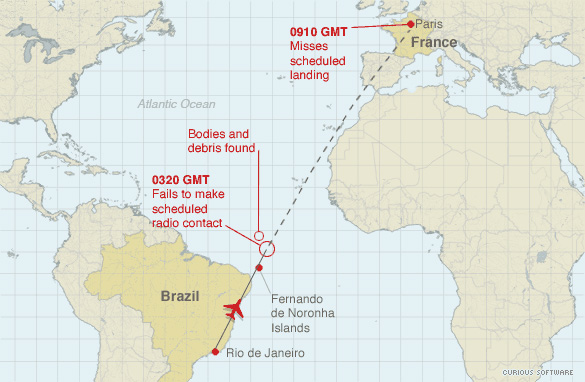
Brazil has launched a search and rescue operation off their coast along the last known radar positions near the Island of Fernando de Noronha where the airplane had failed to establish required radio communication.


Source: AVHerald. Image courtesy Google Earth.

F-GZCP is just over four years old. An Airbus A330-203 MSN660 she had her first flight on February 25, 2005 and was delivered to Air France on April 18.

The flight path from Rio to Paris is very isolated and almost the entire flight is done over the Atlantic ocean. Should the worst happen, there is very little chance of finding the aircraft and along with it the reasons. One can only hope and pray that the plane shows up with all on-board safe.


Update 1 (12:30Z)

Brazil has launched a search and rescue operation off their coast along the last known radar positions near the Island of Fernando de Noronha after which the airplane had failed to establish required radio communication.

There have been no reports of an unscheduled landing anywhere on Atlantic Islands or airports surrounding the Atlantic. French Authorities report, that the airplane would have run out of fuel by now.

According to Forca Aerea Brasileira (FAB) the last radio contact with the crew was about 3 hours into the flight at around 01:33Z. The crew reported flying through "severe turbulence".

Air France reported, that they had received an automatic message (ACARS) from the airplane reporting an electrical short circuit and the failure of multiple systems at 02:14Z. Air Traffic Control as well as Military Stations along the Atlantic coast of South America, Africa, Portugal, Spain and France have been alerted and attempted to contact the airplane without success. Attempts to locate the airplane using civil and military radars from both west and east coasts (including France) of the Atlantic also proved unsuccessful. The airplane had accumulated 18,870 flights hours. The captain had 11,700 flight hours, one of the first officers had 6,600, the other 3,000 flight hours.

Air France has set up hotlines for family members at 0800 800 812 within France and +33 1 57 02 10 55 from abroad.

Brasilian government sources report, that the airplane also disappeared from military radars which are primary radars that do not depend on transponder signals.

NASA satellite imagery shows extremely large cells of very intense storms in the vicinity.


Update 2 (15:30Z)

Air France has released a statement
Air France expresses its deepest sympathy to the relatives and friends of the passengers and crew who were on board AF flight 447 on 31 May 2009, which disappeared somewhere between Rio de Janeiro and Paris-Charles de Gaulle.

Air France is doing its utmost to provide support to relatives and friends: counselling with physicians and psychologists as well as specially trained Air France volunteers has been set up at the airports of Paris-Charles de Gaulle 2 and Rio de Janeiro.

Air France has also established a special toll-free number for the attention of relatives and friends of passengers who may have been on board. They can use this number to obtain information on whether or not a member of their family or friends were on board.

Phone number reserved for relatives and friends

0800 800 812 in France, 0800 881 20 20 in Brazil, and + 33 1 57 02 10 55 for calls from all other countries.
Journalists are specifically requested NOT to call these numbers.

Additional details released by Air France :
  • The Airbus A330-200, registration F-GZCP, left Rio on 31 May at 7:03pm local time (12:03am in Paris).
  • The aircraft hit a zone of stormy weather with strong turbulence at 02:00Z (04:00 in Paris). An automatic message was received from the aircraft at 02:14Z (04:14 in Paris) indicating a failure in the electric circuit a long way from the coast.
  • The Brazilian, African, Spanish and French air traffic control centres all tried to make contact with flight AF 447 but to no avail. The French military air traffic control centre tried to detect the aircraft but did not succeed.
  • 216 passengers were on board: 126 men, 82 women, seven children and one infant.
  • There were 12 flight crew members: Three pilots and nine flight attendants.
  • The flight captain had a record of 11,000 flight hours and had already flown 1,700 hours on Airbus A330/A340s.
  • Of the two first officers, one had flown 3,000 flight hours (800 of which on the Airbus A330/A340) and the other 6,600 (2,600 on the Airbus A330/A340).
  • The aircraft was powered by General Electric CF6-80E engines.
  • The aircraft had totalled 18,870 flight hours and went into service on 18 April 2005.
  • Its last maintenance check in the hangar took place on 16 April 2009.

Update 3 (19:30Z)


Airbus SAS the manufacturer of F-GZCP has released a statement.

This crash marks the first crash of an Airbus A330 series aircraft in commercial service. Four hulls were destroyed/written off in non-commercial operations. It also marks the first fatal accident for Air France since the crash of Concorde AF4590 on July 25, 2000.

As per Flightglobal the sequence of events are :

At 22:33 Brasilia local time, the aircraft F-GZCP made final radio contact with the eastern Brazilian Cindacta-3 Atlantic area control centre at Recife, one of four en route centres that oversee Brazilian airspace.

The aircraft contacted Cindacta-3 at the INTOL waypoint, some 350nm (565km) from Natal, a city on the Brazilian coast. It indicated that it would enter Dakar airspace, Senegal, at the TASIL waypoint - about 663nm (1,228km) from Natal just under 50min later, at 23:20 Brasilia time.

AF447 left Cindacta-3 radar surveillance from the island of Fernando de Noronha, at 22:48. At this time it was cruising at 35,000ft at 453kt, says the defence ministry, with indications that the flight was "normal".

The aircraft did not contact air traffic control around the time of the expected transit of TASIL.

The ministry says that Air France has informed Cindacta-3 that, about 54nm (100km) from TASIL the flight transmitted a technical message concerning loss of pressurisation and an electrical failure.

AVHerald reports the airplane would have been approximately 360nm northnortheast of the Island of Fernando de Noronha and right in the largest red zone on the infrared weather satellite image by NASA at 02:14Z. As per weather services clouds and severe turbulence reached up to 55000 feet in that area which implies extremely severity.

Air France has released a list of nationalities on-board the ill fated flight. Expectedly the majority are Brazilians and French.
Air France is now able to confirm the nationalities of the passengers who were on board flight AF 447 on 31 May 2009, which disappeared between Rio de Janeiro and Paris-Charles de Gaulle. This list is based on the information provided by the Brazilian Authorities.
  • 2 American
  • 1 Argentinian
  • 1 Austrian
  • 1 Belgian
  • 58 Brazilian
  • 5 British
  • 1 Canadian
  • 9 Chinese
  • 1 Croatian
  • 1 Danish
  • 1 Dutch
  • 1 Estonian
  • 1 Filipino
  • 61 French
  • 1 Gambian
  • 26 German
  • 4 Hungarian
  • 3 Irish
  • 1 Icelandic
  • 9 Italian
  • 5 Lebanese
  • 2 Moroccan
  • 3 Norwegians
  • 2 Polish
  • 1 Romanian
  • 1 Russian
  • 3 Slovakian
  • 1 South African
  • 1 Swedish
  • 6 Swiss
  • 1 Turkish
Read more »