Showing posts with label SpiceJet. Show all posts

SpiceJet and TigerAir collaborate via interline agreement

by Devesh Agarwal

Two budget carriers, India's SpiceJet and Singapore's Tiger Airways, have signed a three-year interline agreement to carry passengers on each other's networks through Hyderabad Rajiv Gandhi airport (RGIA).


From January 6, 2014, SpiceJet customers from 14 Indian cities Ahmedabad, Bangalore, Bhopal, Chennai, Kolkata, Coimbatore, Delhi, Goa, Indore, Mangalore, Madurai, Pune, Tirupati, and Visakhapatnam, can connect to TigerAir's Singapore flights from Hyderabad. From January 12, 2014, TigerAir passengers can connect to destinations on SpiceJet's domestic network.

RGIA, operated by GMR Hyderabad International Airport Ltd. (GHIAL) will be the first Indian airport to facilitate the connecting flights between SpiceJet and Tigerair. The airport will provide a free porter service to facilitate the collection and transfer of checked-in baggage for passengers travelling on connecting flights between the two airlines.

SpiceJet is the first Indian budget carrier to establish such an arrangement with a foreign airline. SpiceJet is offering an introductory promotional fare, starting from Rs 4,699 one way and return starting from Rs 9,998 both all inclusive.

The agreement was concluded by SpiceJet's new Chief Operating Officer, Sanjiv Kapoor, with TigerAir Group Chief Commercial Officer of Alexander Knigge, in the presence of SGK Kishore, CEO, GHIAL
Read more »

Video - Making of SpiceJet's SpiceRoute magazine, Christmas issue

For your weekend viewing pleasure

Read more »

SpiceJet posts record Rs. 559 crore loss in Q2 FY2014. Needs urgent capital infusion.

by Devesh Agarwal

Gurgaon based low fare carrier SpiceJet Ltd., continued the record of disastrous performance in the Indian airline industry when it announced a record Rs. 559 crore loss for the second quarter, ended September 30, of the fiscal year 2013~2014.

This compared to the Rs. 163.5 crore loss from the same quarter last fiscal, and a Rs. 50.5 crore profit from the first quarter of this fiscal.

On October 23, India's largest private carrier Jet Airways reported a monstrous loss of almost Rs. 1,000 crore.

The airline blamed the poor performance on the precipitous drop in the exchange of the Indian Rupee vs the US Dollar which occurred in the quarter and contributed Rs. 42 crore to losses. In a statement released late this evening, it said
“The civil aviation sector in India continues to struggle under the burden of several adversities mainly the Indian rupee that saw unprecedented weakness during the quarter,”
Poor demand due to a slowing economy saw a drop in income to Rs. 1,257.22 crore from Rs. 1,701.543 crore in the first quarter, though marginally better from Rs. 1,185.244 crore from the same quarter last fiscal. A 9% growth in number of passengers out-stripped the 17% increase in capacity measured in available seat kilometres (ASK), resulting in a 7% in average passenger yields from Rs. 4,001 to Rs. 3,711. Desperate sales at cut-throat fares have also taken their toll.

A lack of capacity discipline by virtually every Indian carrier, especially domestic leader IndiGo, and Jet Airways, continues to exasperate the soft demand situation, and we see the same indiscriminate financial indiscipline as we did in 2008.

Expenses shot up to Rs. 1,791.623 crore against Rs. 1,641.933 in the first quarter, and Rs. 1,357.305 crore from the same quarter last fiscal. Aircraft maintenance costs shot up almost 64% from Rs. 199 crore to Rs. 325 crore largely driven by Rs. 78 crores in engine maintenance expenses due to a bunching up of shop visits.

Fuel costs fell from 45% of total expenses to 39.7% but thanks to the plunge in income, increased from 43.8% to 57% of income.

Continuing losses have put the airline in a precarious financial position. It is estimated the airline requires a minimum Rs. 1,500 crore capital infusion. While the airline has announced the appointment of Sanjiv Kapoor, the former chief executive of GMG Airlines of Bangladesh, as its Chief Operating Officer, it still lacks a Chief Executive, since the departure of Neil Mills, nearly three months ago.

The silver lining for SpiceJet is that parts of the third quarter and the fourth quarter sees high air travel due to the festival season and returning Indian travel.


The supply-demand imbalance is heading for a precipice with expected the commencement of new airlines AirAsia India, and Tata-SIA.

Share your thoughts via a comment.

Read more »

Dubai International’s passenger traffic up 13.1 per cent in September

By BA Staff

Courtesy of Wikipedia
Passenger traffic at Dubai International, the world’s second busiest airport for international passengers, rose 13.1 per cent in September, according to the latest traffic statistics issued yesterday by operator Dubai Airports.

Passenger traffic in September totaled 5,407,326, an increase of 13.1 per cent compared to 4,780,394 during the corresponding month in 2012. Year to date traffic is up 16 per cent to 49,379,165 compared to 42,565,340 recorded during the first nine months of 2012. Aircraft movements totaled 30,746 during September, an increase of 10.2 per cent from the 27,909 recorded during the same period last year. Passengers per aircraft movement in September came in at 193.

All regions recorded positive growth in September with the exception of South America (-6.9 per cent).  Among the strongest markets in terms of percentage* passenger growth were Eastern Europe (+65.1 per cent), driven by flydubai expansion to multiple destinations in the region and Emirates’ new service to Warsaw. Passenger traffic to and from Australasia rose 38.6 per cent as a result of Emirates' expansion and Qantas’ new operation connecting Australia and London through Dubai. On a country level, Australia (+41.7 per cent), France (+23.7 per cent), Saudi Arabia (+22.4 per cent), Thailand (+21.8 per cent) and the UK (+21.7 per cent) saw the largest increases.

In terms of overall passenger numbers, Western Europe traffic took over as the top market thanks to robust growth (+14.8 per cent) during the month. AGCC came in second thanks to 15 per cent year-on-year passenger traffic growth. The Indian subcontinent, which took third spot, continued to show positive growth (+9.8 per cent) due to the expansion of several Indian carriers including Indigo, Spice Jet and Air India Express.

Air freight volumes rose 1.8 per cent in September with volumes of 196,823 tonnes compared to 193,261 recorded during the same period last year. Year-to-date cargo traffic totalled 1,785,539 tonnes, up 6.6 per cent from the 1,674,997 tonnes shipped during the same period last year.

Paul Griffiths, CEO of Dubai Airports said:
“Passenger and cargo traffic growth continue unabated and Dubai International is on track to eclipse our projections for 65.4 million passengers and 2.7 million tonnes of cargo. With the opening of our new passenger terminal at Al Maktoum International at Dubai World Central, and the ongoing expansion at Dubai International, Dubai’s aviation infrastructure continues to make it an attractive destination for tourism, trade and commerce.”
Read more »

SpiceJet announces Madurai-Dubai service

By BA Staff

SpiceJet will begin a daily direct flight between Madurai and Dubai from November 22nd, 2013 utilising an all economy class 189 seat Boeing 737-800. Booking of tickets on this route is now open.

Flight SG023 will depart Madurai 23:35 and arrive Dubai 02:20 the next morning. The return flight SG024 will depart Dubai at 03:50 and arrive Madurai 09:45.


The airline is offering an introductory fare of  Rs 6999/- one way (inclusive of all taxes) and a return fare of 13999/- (inclusive of all taxes) on the route.

Madurai is fifth Indian destination to get connected with Dubai on SpiceJet network. The airline already operates daily direct services to Dubai from Delhi, Mumbai, Kochi and Ahmedabad.
Read more »

SpiceJet to launch Bangalore - Bangkok flights

by Devesh Agarwal

Delhi based low fare carrier SpiceJet will commence international flights from Bangalore on October 28. The first destination is Bangkok with four flights per week.

The carrier will be the only Indian carrier to service this route.

As per the SpiceJet website on which tickets which are available for purchase, the schedule is on Mondays, Wednesdays, Fridays, and Sundays,

SG091 departs Bangalore 03:35 arrives Bangkok Suvarnabhumi 09:05
SG092 departs Bangkok Suvarnabhumi 20:10 arrives Bangalore 22:35

The airline will use a Boeing 737-800 to service the flights.
Read more »

Analysis: SpiceJet to launch Delhi-Macau

by Vinay Bhaskara


A report in the Macau Business Daily states that Gurgaon based low cost carrier (LCC) SpiceJet is planning on launching nonstop flights between Delhi and Macau. SpiceJet has already won approval from the Indian government to launch Delhi-Macau, likely using Boeing 737 equipment. But it has not yet filed for approval from the Macau government. A Macau airport statesman had this to say about a potential SpiceJet application:
We have been aware of communications [about the route] between the Macau International Airport Company Ltd and the airline. SpiceJet had previously contacted us to obtain some initial information on the application procedures, which is a common practice for any interested airlines.
No airline currently serves Macau nonstop from India. The current bilateral air service agreement (ASA) between India and Macau allows each side's airline to operate up 600 seats per week with 2 return flights per week. However, both governments have agreed in principle to negotiate an expansion of the ASA later this year.

Macau, China's largest gambling center in the vein of Las Vegas in the United States, is an important and growing leisure destination for the increasingly affluent Indian upper middle class, and India's wealthy. However, demand for Macau is more concentrated in Bangalore and Mumbai than in Delhi, which may bode poorly for SpiceJet's chances on the route. The Macau international market is currently dominated by flag carrier Air Macau, a subsidiary of China's national carrier Air China, who serves 22 destinations on a fleet of 15 aircraft.

If the reports are true, it would mark just the latest step in SpiceJet's international growth track. The carrier now serves five international destinations from Delhi (Dubai, Guangzhou, Kabul, Kathmandu, and Riyadh) with 32 flights per week. Overall, SpiceJet serves nine international destinations (the aforementioned five plus Colombo, Muscat, Sharjah, and Male) with 87 flights per week. And along with the regional operation using Bombardier Dash 8 Q400 turboprops, the international growth has been an important contributor to SpiceJet's swing to profitability.
Read more »

New Boeing 737-800s of SpiceJet and Jet Airways delivered

by Devesh Agarwal

US airplane manufacturer Boeing has delivered to two Indian airlines, SpiceJet and Jet Airways, their newest 737-800NG aircraft.

Last Thursday, VT-SZH of SpiceJet, L/N 4573 C/N 41261 B737-86N departed Boeing Field International airport for India via Gander, Newfoundland, Canada. The aircraft has already landed in New Delhi and completing its customs and aviation paperwork formalities to enter service shortly. This aircraft is leased to SpiceJet by GECAS.

Last Friday VT-JFL of Jet Airways, L/N 4579 C/N 39061 B737-8AL, departed Boeing Field International for India via Toronto, Canada. The aircraft is en-route, currently in Shannon, Ireland. Track the flight here. This aircraft is leased to Jet Airways from Bank of China Aviation (BOC Aviation).

Boeing Customer Codes


A small trivia for your enjoyment.

The full aircraft model shows the original customer as per the records of Boeing. The last two digits are the two digit Boeing customer code and the first four digits are the model and variant.

Hence a Boeing 737-800 will be shown at B737-8xx. A Boeing 737-900ER would be shown as B737-9xxER. This will never change in the history of the aircraft.

6N is customer code for GECAS and AL is for BOC Aviation. SpiceJet's Boeing customer code is GJ and Jet Airway's is 5R. If these aircraft were bought by either airline, irrespective of a subsequent sale and lease-back agreement, the aircraft models would have been B737-8GJ and B737-85R respectively.

Air India's customer code is 37, Air India Express is HG, and the Indian Air Force is HI. Sorry, but the code for the Indian Navy is not known at present. Will try and find out.

Above photos are representative of the aircraft and airline and are copyrighted. They may not be used without permission.
Read more »

SpiceJet to commence Pune Sharjah flights

by Vinay Bhaskara

New Delhi-based low fare carrier SpiceJet, is launching direct flights between Pune and Sharjah from September 21, 2013. The airline will deploy its Boeing 737-800 which seats 189 passengers in a single class configuration.

SG051 departs Pune 22:30 on Mondays, Wednesday, Thursday, Saturdays and arrives Sharjah 00:25+1
SG052 departs Sharjah 01:25 on Tuesdays, Thursdays, Fridays, Sundays and arrives Pune 06:00

SpiceJet is offering an introductory fare of Rs 6,499/- one way all inclusive on this route. For full information and terms and conditions visit www.spicejet.com.

Pune is the third Indian destination to connect with Sharjah on SpiceJet network. SpiceJet already serves Sharjah with three flights per week from Lucknow and three flights per week from Varanasi. The airline also operates four daily flights to Dubai from Delhi, Mumbai, Ahmedabad and Kochi.

International operations have become an increasingly large component in SpiceJet's operations as the carrier deals with heavy competition in the domestic sphere from low cost rivals like IndiGo, GoAir, and Jet Airways subsidiary JetKonnect.

The carrier now serves eight international destinations, Sharjah, Riyadh, Guangzhou, Kabul, Kathmandu, Dubai, Male, and Colombo, with a ninth, Muscat coming on-line a week from now when the airline will commence Ahmedabad Muscat flights. Read about that service here.

The growth in international operations helped contribute to a Rs.55 Crore profit for SpiceJet in the first quarter of fiscal year 2014.
Read more »

SpiceJet to commence Ahmedabad to Muscat service

Low cost carrier, SpiceJet, will commence a thrice a week service on the Muscat-Ahmedabad route from August 29, 2013. The airline will deploy its 189 seat Boeing 737-800 New Generation aircraft. Muscat, the capital of Oman, will be the ninth international destination to be served by SpiceJet.

The airline is offering an introductory fare of just Rs 5,999/- one way (inclusive of all taxes) on this route.


SG 061 departs Ahmedabad 21:30 arrives Muscat 23:00 on Mondays, Thursdays and Fridays
SG 062 departs Muscat 00:30 arrives Ahmedabad 04:20 on Tuesdays, Fridays, and Saturdays.
Read more »

Spicejet CEO Neil Mills resigns for personal reasons

India's only publicly listed low fare carrier, SpiceJet Ltd., faced turbulence in the stock market after newspapers reported the resignation of its Chief Executive Officer Neil Mills.

The stock price of the Kalanithi Maran controlled airline fell as low as Rs. 26.50, its lowest price since June 27.

Mills joined the airline in October 2010 from flyDubai. While there is much speculation on the reasons behind Mills' departure, sources inside the airline, who prefer to remain anonymous, said, the resignation was amicable and was for family reasons. A search for a new CEO is on.

Bangalore Aviation wishes Neil Mills continued success and happiness.

Read more »

Opinion: Air India pilots should not resort to scare tactics

by Devesh Agarwal
The Indian Commercial Pilots Association (ICPA) of the erstwhile Indian Airlines, who fly the narrow body A320 family fleet of national carrier Air India is resorting to scare tactics accusing the airline "of arbitrarily changing the flight operating procedures for narrow-body A320 aircraft, affecting flight safety."

The issue revolves around the carrier's decision to reduce the acceleration altitude to 800 feet AGL (above ground level).

Bangalore Aviation readers will recall our report last month on German carrier Lufthansa reducing its take-off acceleration altitude, as a method to save fuel and reduce harmful emissions.

Immediately after take off, an aircraft usually ascends at a constant speed with the flaps extended until it reaches a certain altitude. In an effort to preserve engines, and since most modern aircraft generally do not require the maximum thrust available, a reduced level of take-off thrust is used. When the aircraft reaches a certain initial target altitude, the engines thrust is reduced, flaps retracted, and then the aircraft is switched to climb thrust. Soon after that the aircraft starts speeding up. The altitude at which the speed increase begins is called the acceleration altitude. This is also when the aircraft commences entering a "clean configuration" which is flaps up, etc. - a configuration it will fly in.

In India, IndiGo was one of the first airlines to work on reducing the acceleration altitude. Initially it was driven by safety as a counter measure to avoid bird strikes, so common around Indian airports. The Airbus A320 typically maintains an angle of 15 degrees when it takes-off, till it reaches the clean configuration. This high nose-up attitude prevents forward visibility and thus prevents the pilots from taking any corrective action in case of bird activity. An additional benefit was fuel savings. The airline worked closely with aircraft manufacturer Airbus, and today the airline commences flap retraction at 500 feet AGL and enters a clean configuration before 1,000 feet. The two Boeing 737 operators in India, Jet Airways and SpiceJet too maintain an acceleration altitude of 800 feet AGL.

The flap with the pilots appears to be, that a Regional Director issued the norms instead of a senior person like a Director Flight Operations, or a Director Training and it is altogether possible the egos of these pilots are bruised. On the flip side, I acknowledge that proper procedure and protocol should be followed, but my issue is the public scare tactics the pilots are resorting to. It hurts the image of an airline, and it hurts the image of the pilots themselves, who are already perceived as a pampered and selfish lot. Today's companies are teams and employee loyalty is a critical component to their very survival.

Air India is making a change that is already being practised by its fellow airlines, and one that will save it money.

I, for one, would expect to see the pilots of the ICPA support such proven cost saving initiatives.

Do feel free to post your comment in agreement or disagreement. I would like to hear from other pilots, especially A320 pilots. Just request to keep the comment clean and civil. We do have the young generation reading this site.
Read more »

Vested interests shaping government policy helped AirAsia partner Tatas too

by Devesh Agarwal
Image courtesy Wikipedia
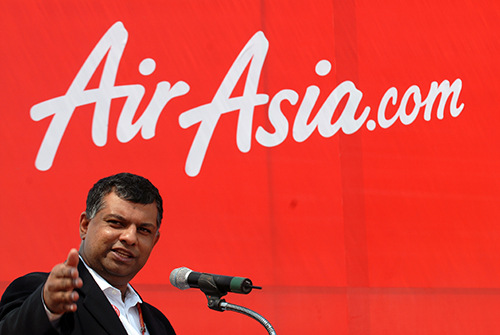
Aviation insiders have known for many years what AirAsia boss Tony Fernandes dared publicly state the day before yesterday, after his meeting with civil aviation minister Ajit Singh. Vested interests have shaped, nay, distorted Indian civil aviation policy.

One of the more shameful rules of Indian civil aviation is the policy of allowing Indian carriers to operate international flights only after they have been in operation for five years, and have a fleet of at least 20 aircraft.

The worst aspect of this rule is that it applies only to Indian carriers. So while even newly formed airlines from our neighbours like Mihin Lanka, flyDubai, etc., could fly to India, a perfectly capable IndiGo or SpiceJet were forced to watch their competitors establish themselves, while they themselves had to sit idly by. Even today GoAir is unable to operate international flights since its fleet is smaller than the mandated 20 aircraft, forcing the airline to lobby and seek an exemption from the rule.

Image © Devesh Agarwal. All rights reserved.
The blind ambition to operate international flights before it completed the five year requirement, was one of the driving reasons for Vijay Mallya promoted Kingfisher Airline's disastrous acquisition of the loss-laden Air Deccan, which is now acknowledged as a major reason for the ultimate demise of the liquor baron's airline.

We completely agree with Fernandes that this bizarre rule has held back Indian airlines while other airlines in the region have formed and grown to become large stable businesses, thus causing a loss to the nation.

Fernandes appeared to confirm insider information when he used the name "Naresh", most likely referring to Naresh Goyal, the politically super-connected boss of Jet Airways, who was the "vested interest" behind this bizarre policy decision.

Fernandes though, should remember history and use caution when blaming "vested interests" for distorting government policy. Back in 2006, his partners in AirAsia India, the Tatas, actively lobbied the finance departing to apply a different yard-stick from the then national auto policy, and made their fledgling Indica car qualify as a "small car" and obtain lower excise duty benefits which it was otherwise not be entitled to, while its competitors would.

A 2006 report explains
While the Auto Policy defines a small car as being up to 3.8-metre long and the 6-digit excise notification in the official tariff book places a cap of 1,000 cc on the engine capacity for a car to qualify as 'small', the Budget made cars up to 4 metre in length and having an engine capacity of 1,200 cc (petrol) and 1500 cc (diesel) eligible for the lower, 16% excise slab.

This means, had the finance minister stuck to the existing definition, petrol models such as Hyundai Santro and Maruti WagonR would not have become eligible for lower excise. Under this definition, the upcoming diesel variants of Swift and Getz will also become eligible for lower excise since the engine capacity cap for diesel versions has been placed at 1,500 cc. But, just a few weeks after the budget was passed, two major automobile companies have begun lobbying for extending these concessions further.

Officials confirmed that two companies, including the Ratan Tata-led Tata Motors, have sought further relaxation.
Fernandes' outburst is understandably,  also vested. After all, he is responsible to the shareholders of his business for delivering results. One way for his new venture AirAsia India to quickly grow, would be to operate internationally.

Today AirAsia cannot carry passengers all the way from south east Asia to the middle-east on its narrow body A320s, since the distance it too great. At the same time. some of the routes would not have enough traffic to fill the wide-body A330s of AirAsia X. But if AirAsia India flies overseas, it can be fed by its sisters AirAsia, and Thai AirAsia who would bring passengers to the Indian hubs and transfer them on their Indian sister along with Indian passengers for the onward journey to the middle-east.

Is this a case of the pot calling the kettle black? Or is Tony Fernandes genuinely interested in universal change to fair play rules? Share your thoughts via a comment.
Read more »

Three-way analysis: How does Emirates respond to Jetihad?


By Oussama Salah, Vinay Bhaskara, and Devesh Agarwal


Emirates Boeing 777-200 at Bengaluru International Airport. Photo copyright Devesh Agarwal. Used with permisssion. Do not reproduce.
Photo copyright Devesh Agarwal
The Indian government often makes curious decisions in setting aviation policy. For example, it encouraged Air India to lower prices to gain market share, causing mayhem in the market place and increasing Air India’s losses. It also recently  allowed Air Asia to expand in India by approving a JV with the Tata and Bhatia group, creating an LCC that will put pressure on indigenous carriers like SpiceJet and IndiGo. The latest example is the quadrupling in the number of seats between India and Abu Dhabi due to the recently concluded UAE-India bilateral air services agreement which will mostly benefit the newly formed Jetihad partnership.

A recent Bangalore Aviation analysis of International Traffic Share in and out of India, showed Jet Airways share at 16.01%, Emirates at 13.04% and Etihad at 1.95%. In one fell swoop, Etihad has not only caught up with Emirates, but has effectively almost doubled its total seat capacity because its strategic partner Jet Airways will have access to almost the same number of seats from the Indian side of the bi-lateral agreement. This is visible with the newest route being launched by Jet Airways - Kochi-Abu Dhabi-Kuwait.

The Indian market is important to the Gulf carriers as it is an important source of demand to MENA (Middle East and North Africa) , Europe, and North America. In particular, the North American market is being developed by these carriers at a rapid pace, and new routes such as Qatar Airways’ upcoming services to Philadelphia are heavily dependent on feed from the Indian subcontinent. The latest India/UAE bilateral almost doubles the weekly seat allocation for Jetihad to Abu Dhabi.

Dubai has unofficially asked for a doubling of the weekly seat allocation to Dubai and the rights to serve additional Indian metros but officially requested an increase from 54,200 to 72,400 seats per week.

The problem is that Dubai and Emirates airline in particular are in the cross-hairs of the Comptroller and Auditor General (CAG) of India which has criticised the civil aviation ministry for granting excessive rights to the airline during the tenure of Praful Patel as minister. Emirates is facing the "Devil's Alternative". The spotlight is shining bright on it, however, with India accounting for 11% of Emirates huge global capacity, the airline cannot just let Etihad-Jet Airways (Jetihad) just gobble seat capacity.

Elections are looming next year, some very skilful and smart "lobbying" will have to be done.

Another tactic will be similar to Jetihad. Emirates can opt for to invest in one of the remaining India carriers, IndiGo, SpiceJet, or GoAir, in hopes of gaining additional capacity. It is doubtful the promoters of IndiGo who have access to large sums of cash will accept acquisition, GoAir has indicated its willingness, but is too small within India and does not have any international operations yet. SpiceJet is the wild card. Are the Marans ready to dilute or even exit the airline business with their Maxis and Astro business relations under investigation? Emirates is hesitant to invest in foreign airlines after its poor experience with Sri Lankan Airlines, but will the airline have to bite the bullet to keep its India dominance alive?

Another option is for Emirates to code share with one of the large domestic players like Indigo or SpiceJet in order to increase its Indian feed and encourage them to operate additional flights to Dubai. Emirates currently code share on Jet Airways flights from Mumbai and Delhi to Dubai. Flydubai flies only to three destinations Hyderabad, Ahmedabad and Lucknow and would like to increase its Indian presence (which is less than 2% of its capacity). It is capable of serving smaller secondary airports thanks to its fleet of narrowbody 737-800s, and could provide additional feed for Emirates’ super-hub in Dubai. While flyDubai and Emirates are technically separate entities, both are owned and operated by the government of Dubai and increased integration of the route networks is possible.

But code sharing is a short term solution. Ultimately, the real fix has to be driven through the India-UAE bilateral. Emirates needs the increased capacity for itself and flydubai. Emirates can leverage Dubai’s position as a global business hub and destination for Indians to ask for increased services. Indians are the top expatriate investors in Dubai property (9 Billion AED) and the UAE is the second largest trading partner of India with billions of dollars in reciprocal investments. With almost two (2) million NRIs (non resident Indians) living in the UAE, many affluent, the UAE has a solid basis to ask for increased seat capacity in the next round of bilateral talks. However, it would need to find a powerful Indian advocate to help in its cause. Jetihad was able to secure such a large growth in bilateral capacity to Abu Dhabi in large part thanks to the political influence of Jet Airways head Naresh Goyal. It remains to be seen whether Emirates can find a similarly connected individual to help advance its interests, and by extension those of flydubai and even Air Arabia.

Regardless, with the current state of flux in Indian Aviation, Emirates will not stand still in response to Jetihad, expect something to happen, and soon.

Oussama Salah, who blogs at “Oussama’s Take”, is an aviation geek and aviation professional with 35 years of experience in the Mena/GCC airline industry. He is a regular contributor to Bangalore Aviation with his insightful and knowledgeable comments.

Read more »

INFOGRAPHIC: Airline-wise share of international passenger traffic, to and from India, 2011 to 2012

Based on a report in The Economic Times we have prepared this infographic showing the airlines' market share of international passenger traffic to and from India during fiscal 2011~2012.

airlines' market share of international passenger traffic to and from India during fiscal 2011~2012
The chart throws up some surprises. SriLankan Airlines and Oman Air feature on this list, but Singapore Airlines does not. Hard to accept? and where is AirAsia? Share your thoughts via a comment.

Read more »

Analysis: Strong first quarter for Etihad bodes well for Jetihad deal


by Vinay Bhaskara

Abu Dhabi based full service carrier Etihad Airways reported record results for the first quarter of 2013.
Revenues grew a whopping 18.7% year over year to $900 million, up from $758 million in Q1 of 2012. In its 10th year of operations, Etihad also saw cargo revenues grow 17% to $193 million. Passenger figures also reached a new high of 2.8 million, growing 13% year over year from 2.3 million. Average seat factors grew 4 percentage points over 2012 to 80.5% despite a 12.5% increase in capacity. See the table at the bottom of the story for a full overview of key metrics for Etihad’s first quarter.

Said Eithad President and Chief Executive Officer James Hogan, “Our Q1 2013 results have again outstripped global trends, with our strongest ever first quarter results for passenger revenue… This performance demonstrates that Etihad Airways’ strategy of organic growth, wide-ranging partnerships, and strategic equity investments is delivering for us and our partners.”

More importantly for a future “Jetihad” partnership and equity investment, Etihad’s existing equity stakes are beginning to pay handsome dividends, with revenues growing 34% from $136 million to $182 million, and accounting for 20% of Etihad’s overall revenues.

The success of Etihad’s existing equity investments in airberlin, Air Seychelles, Virgin Australia, and Aer Lingus, who all reported profits in the first quarter of 2013 bodes well for a potential equity investment in Jet Airways because it shows that such an investment is viable.

However, the current macroeconomic pressures in India do give some pause. Demand growth continues to slow, with domestic demand falling 9% year over year in February. This, to some degree reduces the value of Jet Airways, and Naresh Goyal and other Jet Airways decision-makers will need to realize this and adjust their expectations accordingly.  Some of the valuation figures of Jet Airways at over a billion US dollars are unrealistic and out of line with the current strength of the industry and the Indian investment environment as a whole. That being said, the Indian Diaspora and international demand remain relatively robust, and thus Jet does offer significant value to Etihad as an Indian partner.

Jet Airways could sorely use the additional capital in order to solidify its restructuring efforts at a time of flux in the industry. Air India continues to flounder (and indeed a recapitalized Jet could win away some of Air India’s passengers), and Kingfisher is dead. SpiceJet appears to have found a pair of winner in its regional network of international destinations and fleet of Q400 turboprops serving Tier II/III destinations - while GoAir continues to fly under the radar as a presumably profitable airline. IndiGo meanwhile, is still humming along, though it has begun to rethink its growth strategy and must continue to do so. AirAsia’s new venture threatens to usurp the delicate balance of power that has emerged in the domestic industry, though much is yet to be determined.

We will learn a lot from the first quarter results of SpiceJet and Jet Airways. The domestic results in particular will indicate if the shrinking of demand has been made up for with increased fares on aggregate (a sign of a healthier industry). Regardless, a Jetihad deal is slowly getting closer and closer to fruition.

Etihad Key Metrics: First Quarter 2013

Key indicators
Q1 2013
Q1 2012
Variance
Passenger revenue
US$ 900 million
US$ 758.1 million
+19 per cent
Cargo revenue
US$ 193.1 million
US$ 165.4 million
+ 17 per cent
Total revenue
US$ 1,136.5 million
US$ 989 million
+ 15 per cent
Passengers
2,767,789
2,340,356
+ 18 per cent
Revenue passenger kilometres (RPKs)
12.9 billion
10.9 billion
+ 17 per cent
Available seat kilometres (ASKs)
15.9 billion
14.3 billion
+ 12 per cent
Seat factor
80.5 per cent
76.5 per cent
+ 4 points
Aircraft
73
66
+ 7


Read more »

AirAsia, Tatas and Amit Bhatia seek approval to start airline in India. Is SpiceJet the target?

by Devesh Agarwal

Malaysian low cost carrier AirAsia Berhad (Ltd.) through its investment arm, AirAsia Investment Ltd. (AAIL) has submitted an application to the Indian Foreign Investment Promotion Board (FIPB) seeking approval for AAIL to invest 49% into a proposed Indian joint venture together with Tata Sons Limited and Mr. Arun Bhatia of Telestra Tradeplace Pvt. Ltd. The expected holding in the JV is AirAsia 49%, Tatas 30%, and Arun Bhatia 21%.

Photo: Devesh Agarwal
This move comes amidst the backdrop of the September 2012 decision by the Government of India to open up the aviation sector to Foreign Direct Investment from foreign carriers.

AirAsia is one of the most successful low cost carriers in the world, and has created regional AirAsia airlines in Thailand, Indonesia, Philippines, and Japan in similar joint ventures like the one proposed for India.

The Tatas are a $100 billion conglomerate highly respected for their business values, and who used to own, then operate Air India prior to the government taking it over in the 1970s. The Tatas used to own close to 6% in Indian LCC SpiceJet Ltd., owned by the political heavyweight Marans who are related to DMK supremo Karunanidhi of Tamil Nadu. However, the Tatas claim their investment in SpiceJet is purely financial on with the two rounds of equity dilution at the airline, their stake is now down to less than 0.5%.

Mr. Arun Bhatia's son Amit Bhatia, is the son-in-law of one the richest men in the world, Mr. L.N. Mittal and serves serves on the Board of Directors at Queens Park Rangers Football Club in the United Kingdom alongside Tony Fernandes, the founder of AirAsia.

Subject to FIPB approval, the proposed joint venture company will make an application to Indian aviation regulators for the Air Operators Permit. The parties have signed a Memorandum of Agreement that details high-level terms with regards to the proposed partnership.

The airline, if formed, will be based out of Chennai, which will allow domestic connectivity to AirAsia's international operations.

This foray will mark a return of the Tatas to the airline and airport sector after almost 25 years. In the 1980s and 1990s, the Tatas had proposed a collaboration with Singapore Airlines to operate a domestic carrier and also to take over Air India. The Tatas had also collaborated with Changi Airport to develop the greenfield airport at Bangalore, which is now BIA. All efforts were thwarted by political opposition.

Our analysis

We are not sure how well this proposal will be received. India's civil aviation minister is on record with the Business Standard newspaper
“We are not giving licences for greenfield airlines. As of now, FDI (foreign direct investment) in aviation can come only through existing airlines."
Based on this premise, for the past few months, Jet Airways has been negotiating with Abu Dhabi based Etihad to sell a 24% stake in Jet for about $300 million. The Chairman of Etihad Sheikh Hamed bin Zayed al-Nahyan has already delayed the deal citing concerns on policy flip-flops. An approval to AirAsia will prove the Sheikh's point, and almost certainly scuttle the FDI initiative, announced by the government last year, which is essentially meant for rescuing India's debt-laden airlines and the banks who have already lent massive amounts to them.

We expect there will be strong, if not, insurmountable opposition especially with regards to existing Indian carriers like Jet Airways, SpiceJet and IndiGo, each of whom should not be discounted for their strong political connections.

So knowing all of this, why has this JV application been submitted? What do the Tatas, Bhatias, and Tony Fernandes know, that is not apparent?

Photo: Devesh Agarwal
If one was to go in to a conspiracy theory mode, the common point is SpiceJet.

From one side, the Tatas own a stake in the the airline. From the other side, Anthony Francis "Tony" Fernandes is in the very top Malaysian business tycoons circle, along with Mr. Ananda Krishnan, the Chairman of Maxis and Astro, both of which have been linked to the Maran brothers Dayanidhi and Kalanithi respectively, and Kalanithi Maran is the owner of SpiceJet, which has a need of funds for expansion.

Quoting from our Indian Aviation Review from earlier this year
Q400 operation is certainly a strong performer in SpiceJet’s tepid overall finances. The full order of 15 Q400s is now complete, and while SpiceJet has options to purchase 15 more from Bombardier, unfortunately it cannot find financing for the next 15 deliveries, which it desperately needs to expand the regional operation
May be Mr. Maran is wanting to exit the airline business?

What are your thoughts? Share a comment. Share this article on Facebook and Twitter. Start a discussion.

Read more »

Jet Airways site says they halved ticket pices in a sale, but we cannot find the savings

by Devesh Agarwal

Experience India’s biggest air ticket sale with 20 lakh seats on over 450 daily flights across 57 cities within India. Lofares on Jet Airways and JetKonnect flights starting INR 2,250.
is what Jet Airways' website screams at you as one of the largest Indian carriers launches a mega sale valid till February 24, in which it appears to have cut its fares in half.

Jet's sale appears to be another salvo in a fare war which is seeing the price discipline of Indian airlines over the last one year slowly disappear. This fiscal discipline which brought the airlines back in to profitability, has also seen passenger load factor percentages dip from the high 80's in to the 60's.

Earlier this year, low cost carrier SpiceJet, had offered one million seats at an all inclusive fare of Rs. 2,013 for any domestic flight between February 1 an April 30. Jet Airways is topping this offer with two million seats, for travel through the calendar year 2013.

However, like the SpiceJet sale, one has to take the Jet sale with a pinch of salt. A quick check of fares by Bangalore Aviation for fares in the first week of March on the airline's website for a round-trip Bangalore Delhi returned fares of Rs. 14,500 compared to Rs. 8,700~9,500 on fare search website Ixigo flown on SpiceJet or IndiGo. The comparison was done for similarly timed flights, and using the lowest fare in the time slot (morning, mid-day, late afternoon, evening) including the low fare JetKonnect.

Terms and conditions of the offer (as per the Jet Airways website at time of publication):
  • Offer valid for booking in Economy between February 19, 2013 and February 24, 2013 (both days inclusive)
  • Offer valid only for bookings on www.jetairways.com and www.jetkonnect.com
  • Travel must commence on or before December 31, 2013. The travel validity for this offer may differ based on your journey but not later than December 31, 2013.
  • Offer not valid on International flights
  • Fares indicated are as on date
  • This offer cannot be combined with any other offers / discounts / promotions / JPMiles redemption Award tickets from Jet Airways or JetKonnect
For more details visit the airline's websites. Be warned though, both sites are sluggish with many fliers taking advantage of this offer.
Read more »

Spicejet reports profit in Q3 FY2013 - Financial and operational analysis

By Vinay Bhaskara and Devesh Agarwal
In a result that represents a positive sign for the prospects of the Indian airline industry moving forward, Gurgaon based low cost carrier (LCC) SpiceJet reported a Rs. 102 Crore (US $19 million) net profit for the third quarter of fiscal year 2012-13 (FY 12-13), a sharp improvement from the results in both the second quarter of FY 12-13 (Rs. 169.8 Crore net loss) and in the same period a year ago (Rs. 39.3 Crore net loss).

SpiceJet financials at the end of the article.


The move represents a sharp turn towards profitability for SpiceJet, and when combined with a previous profit in Q1 of FY 12-13, brings their year to date (YTD) net result to essentially break even (loss of Rs. 53.5 Lakh on revenues of Rs. 4282.5 Crore). Factors contributing to SpiceJet’s resurgence include the strong performance of the regional Q400 operation, as well as that of new international routes, manageable fuel prices, and a better revenue and capacity environment within the domestic Indian airline industry.

Looking at some of the specific metrics provided by SpiceJet, the airline recorded a 7% growth in passengers carried, 18% growth in capacity as measured by available seat kilometers (ASKs), and a 25% growth in number of departures or frequencies.

At first glance, it would seem that this performance completely contradicts our standard mantra of "capacity discipline and restraint at all costs", but a detailed look at at the composition of these growth figures shows out the strategy.

On the heavily saturated mainline domestic flights (basically flights in-between Metros/Tier I cities operated with the 737 fleet), passenger traffic actually fell by 2% and ASK growth was measured in the single digits.

At the same time, international passenger traffic grew by 80% and regional passenger traffic, serviced by the Q400 turbo-prop operation to Tier II and Tier III cities, saw a massive 82% growth in passenger traffic.

These latter two categories are the market sectors with limited competition, enabling SpiceJet to achieve better profitability. The buoyancy in passenger yields helped SpiceJet record a superb 29% increase from Rs. 3,421 to Rs. 4,412, the best quarterly revenue performance from SpiceJet in the last 18 months.

To clarify our views on capacity discipline are that growth for growth’s sake should not be pursued; simply throwing capacity onto the high competition routes between Metros so that aggregate passenger figures grow is a meaningless strategy that some of the Indian carriers (and airlines in general) fall into from time to time. Profitable growth opportunities in under-served or un-served markets should be pursued. Indian airlines should never abandon profitable growth opportunities; rather they should be smart and prudent about where, when, and how they grow. Just as growth for growth’s sake is pointless, so is capacity discipline for capacity discipline’s sake.

Getting back on topic, an important factor in a successful quarter for SpiceJet was, cost discipline. On a per ASK (Available Seat-Kilometre) basis, normalising for increased size of operations, cost growth was a very manageable 4.4%, and much of the increase can be attributed to the initiation costs and added complexity of new international routes. One of the other factors that contributed to the relatively modest rise in costs is the growing maturity of the Q400 operation. Much of calendar year 2012 was spent integrating the Q400s into the fleet and this temporarily increases an airline’s costs as new and existing personnel must be hired and retrained for the new aircraft type, new infrastructure put in place, and generally operational complexity increases in the short term; but these are all temporary costs, as the Q400 operation matures, SpiceJet will see a steady reduction in costs of the Q400 operations, as well as demand side market maturation i.e. increased fares and market penetration.

This effect has already begun to take hold, ergo the rise in yields, and the maturation driven cost-reduction will benefit SpiceJet over the next few quarters.

Equally important is the flattening of fuel costs, which had been the most significant driver in SpiceJet’s poor financial performance for the past two years. Once again, fuel costs rose a manageable 4.5% on a per-ASK basis year over year, which given SpiceJet’s extraordinary revenue performance was more than adequate performance. Part of the moderation can of course be traced to the stabilization of oil prices around US $90 per barrel (West Texas Intermediate measure), another part also stems from SpiceJet’s increased international and Q400 operations. Fuel purchases for all international flights do not suffer the usual exorbitant average 24% sales tax, that varies by state. Similarly, to promote regional connectivity, the Government of India mandates a uniform 4% sales tax instead of the average 24% for sub-80 seat aircraft, which covers the 78 seat Q400 operations. For example, in Delhi fuel prices for international flights are roughly 23% lower than domestic ones. In Kolkata it is 30% lower, in Mumbai 26%, and 29% lower in Chennai. Given that fuel represents over 50% of costs for most Indian airlines, these discounts are a serious boon for SpiceJet.

As SpiceJet increased its international flying and regional Q400 operations, as a proportion of total capacity, the relative fuel burden decreased thanks to the lower level of taxation. This saving in fuel costs will continue to improve as international and Q400 operations continue to increase as a proportion
As a whole, SpiceJet put in a very strong third quarter of FY 12-13. It will be interesting to see if this was a one-off occurrence, or if SpiceJet can sustain profitability moving forward. But in the present, SpiceJet CEO Neil Mills put it best
SpiceJet financial statement Q3 FY 2013

Download here.

Read more »

IndiGo concentrates Dubai presence with second Mumbai and first Thiruvananthapuram service

by Devesh Agarwal
Gurgaon based IndiGo will commence a daily service between Kerala's capital Thiruvananthapuram (Trivandrum) and Dubai from March 1, 2013.

6E 038 will depart Thiruvananthapuram 18:20 arrive Dubai 21:15
6E 037 will depart Dubai 11:25 arrive Thiruvananthapuram 17:15

On the same day the carrier will commence its second daily flight between Mumbai and Dubai.

6E 063 will depart Mumbai 08:35 arrive Dubai 10:25
6E 064 will depart Dubai 11:25 arrive Mumbai 15:55

The launch of these two flights will coincide with the launch of IndiGo's flights between Chennai and Singapore.

6E 053 will depart Chennai 22:00 arrive Singapore 04:50+1 (the next morning)
6E 054 will depart Singapore 05:50 arrive Chennai 07:15

These three launches come after the airline will completely withdraw from Singapore by terminating its current New Delhi Singapore and Mumbai Singapore flights, and scale back by withdrawal of its Mumbai Bangkok service.

With the launch of the two Dubai services, IndiGo will operate a total of 56 weekly flights between India and Dubai.

With the increased focus on Dubai, by Indian airlines like Jet Airways which operates 42 flights, SpiceJet, which operates 49, not counting the flights by the traditional operators like Air India with 60 flights, Air India Express with 63, and the 189 wide-body weekly services operated by behemoth Emirates, one has to serious consider the serious glut of capacity to this tiny Emirate.

Share your thoughts via a comment.

Read more »