Showing posts with label FAA. Show all posts

Emergency services at Indian airports capable of handling Asiana San Francisco type crash

by Devesh Agarwal

The recent crash of Asiana Airlines flight OZ-214 at San Francisco International airport showcased the quick and heroic efforts of both the airport's emergency fire and rescue services and the cabin crew. Praise has flowed to both of these sets of people for their actions which resulted in minimal loss of life and injuries.

Prompted by this crash, Bangalore Aviation reader Anil Arvindam, wrote in the other day
"How prepared are our airports in India? Are our fire-fighters trained to respond like this San Francisco did?"
The short answer is a resounding YES. The details though are worth exploring.

ARFF / RFFS / CFR

DIAL_ARFF_Fire_FighterThere are many acronyms given to this specialised fire-fighting service. In the United Kingdom it is RFFS (Rescue and Fire Fighting Services), in India and the United States it is ARFF (Aircraft Rescue and Fire Fighting), in some parts of the US and in the Philippines it is Crash Fire Rescue (CFR). In this article we'll follow the Indian standard of ARFF. ARFF is a very specialised category of fire-fighting that involves the response, hazard mitigation, evacuation and rescue of passengers and crew of an aircraft involved in an emergency at, or near, an airport.

Rescue and fire-fighting services at airports in member countries are governed by standards of the International Civil Aviation Organisation (ICAO), pronounced "Eye Kay Oh". For example, ICAO Document 9137-AN/898, Airport Services Manual, Part 1 guives unform guidance in an effort to provide standardised levels of emergency services, across the world. The respective national civil aviation regulators like the Directorate General of Civil Aviation (DGCA) in India, or the US Federal Aviation Administration (FAA), in turn publish and enforce the rules and requirements.

ARFF normally will respond to all aircraft emergencies within an airport's boundaries and will also respond to emergencies outside the airport boundaries, typically in a six degree cone from the end of each runway, out to about eight kilometres and there is an defined understanding with the city emergency services on the respective roles and responsibilities to an 'off-airport' incident.

ARFF will also respond to non-aircraft emergencies within airport boundaries, but ARFF will not respond to non-aircraft emergencies outside the airport as this will leave the airport without adequate protection.

All the major airports in India are compliant with ICAO and DGCA norms for emergency services and are audited regularly. By rules if an airport has inadequate or no ARFF cover, it has to close its runways to passenger paying aircraft unless in an emergency, and even then, use of the airport is at the discretion of the commander of the aircraft.

The trend to modern ARFFs was initiated by the private airports of Bangalore, Hyderabad, New Delhi and Mumbai. Soon after, even the Airports Authority of India (AAI) run airports like Kolkata, Chennai, Ahmedabad, Amritsar, etc., migrated from their vintage Tata-Leyland trucks to modern ARFF stations and equipment.

Airport Category and ARFF capacity

The size of the ARFF facility at an is determined by the airport's category rating. The number of fire-stations at the airport are determined by the response time requirement which is detailed in the next section.

The category of the airport is based on the size of the largest aircraft that lands at the airport and is also tied in to the number of runways. The table below shows how category is determined, and then for each category what is the requirement of fire tenders, water, chemicals, foams, etc.

The British system is from Category 1 to 10. This system is also followed in India. The US FAA mandates a category system from A to E, and is also tied in to the number of daily departures of the largest size aircraft. FAR Part 139, Sec. 139.315, and FAR Part 139, Sec. 139.317 provide full details.

How an airport's fire-fighting capabilities and capacities are determined.

Bangalore's airport is single runway and is rated 'Cat-9' since it regularly handles flights up to a 747-400 i.e. Code E size. However, since 2012, the airport also regularly handles one daily flight of a Lufthansa Boeing 747-8i which is Code F size, the same as the A380, and this requires the airport to temporarily increase capability to the highest category, 'Cat-10', rating for the duration of that one flight. As airport spokesperson Anjana explains
ARFF scales up to Cat 10 for the period of operations of 747-8 by augmenting additional manpower out of the shifts during this period)

Response Times / Airfield Crash Fire Tenders

Fire is a major risk during any aircraft emergency. With wide-body aircraft now carrying over 300 passengers regularly, the potential of an emergency turning in to a mass casualty has increased in recent years. Keeping the fire risk in mind, safety regulations require an aircraft should have enough exits to be able to evacuate all passengers within 90 seconds.

Similarly, the arrival of the ARFF team(s) at the scene is of paramount importance. In air traffic control (ATC) towers around the world, there are emergency push-buttons within close reach of controllers which set off alarms blaring. The response time norms require ARFF teams to arrive at the scene within two minutes, for 'on runway' incidents, and within three minutes for 'off-runway' incidents anywhere within the airport perimeter.

This response time requirement has resulted in the development of specialised Airfield Crash Fire Tenders (ACFTs) which can only be described as "super trucks". Weighing well over 25~30 tons, twice more than a regular road truck, these tenders can accelerate to 100 kmph in under 30 seconds, thanks to special engines developing between 700 BHP to 1,000+ BHP, about the same power as a Formula 1 car. Taking a leaf from the racing cars, these trucks make extensive use of high strength, low weight, composite and fibre-glass parts.

Rosenbauer Panthers of Bangalore International Airport ARFF. The floor spray extinguishes ground fires ahead of the tender.

ACFTs are fitted with specialised suspensions that allow them to corner at high speeds like a sports car, go up slopes of over 60 degrees, or travel on a tilted embankment sloped up to 30 degrees. These trucks incorporate latest technology and automation. Forward looking infra-red (FLIR) allowing the fire-fighters to see in complete darkness, whether at night or in the black smoke of a fire, multiple spray nozzles, with individual remote controls, enabling fire-fighters to fight fires from inside the tender cabin, and much much more.

In India, due to the number of runways and its sheer size, Delhi's IGI airport has four fire stations. Bangalore airport has one station equipped with four Rosenbauer Panthers.


There are many vendors of ACFTs in the world. Rosenbauer of Austria, Iveco of Italy, and Oshkosh of the United States are major players. In India the Rs. 5 Crore Rosenbauer Panther 6x6 (6 wheels driving, 6 wheels total) is the preferred ACFT. At San Francisco Airport the ACFT of choice is the Oshkosh Striker 4500 8x8 which is a bigger and more expensive tender. Scroll down to see a video of the Striker in action at Dallas-Fort Worth International airport.

Oshkosh Striker 4500 of San Francisco International Airport ARFF.

In addition to the ACFTs, ARFFs and airports have other rescue equipment like high-lift turn-table ladders, ambulances, mobile intensive care units, power and hydraulic rescue tools, and special suits enabling fire-fighters to enter in to fires. Bangalore airport even has inflatable motor-boats just in case the emergency occurs on one the many lakes around the airport.

The airports have triage centres within the airport premises for trauma victims. Bangalore airport has special tie-ups with area hospitals like M.S. Ramaiah and emergency ambulance services to handle large scale trauma events.

Fire-fighters and Training

Human beings are a critical component of the airport's ARFF capabilities. At Bangalore Airport, with one ARFF station the team consists of 134 personnel working 24x7 in four watch shifts. Due to multiple runways, the ARFF at Delhi IGI airport has four stations and a significantly bigger team.

Continuous on-going training is a critical part of the ARFF operations. ICAO Annex 14, § 9.2.34 directs that: All rescue and fire fighting personnel shall be properly trained to perform their duties in an efficient manner and shall participate in live fire drills commensurate with the types of aircraft and type of rescue and fire fighting equipment in use at the aerodrome, including pressure-fed fuel fires.

In India, the Airports Authority of India (AAI) operates two ICAO approved training centres in New Delhi and Kolkata which trains ARFF personnel from across the country.

The fire fighters have to know by memory every aspect of the airport, and also the details for every aircraft that operates at the airport. Come an emergency, there is no time to be looking up books and charts. ARFF charts for Airbus aircraft can be downloaded here, and for Boeing aircraft here.

You can read a detailed paper on the various ARFF training methods across the world and their differences here.


In conclusion, we at Bangalore Aviation invite you to travel safely and with confidence. Air travel is the safest means of travel, and the heroes of the ARFF are on duty looking out for you.

If you would like to say thanks to them, post a comment. The PR teams at both BIAL and DIAL read Bangalore Aviation regularly and we are confident they will be happy to carry your compliments to their respective ARFF teams.
Read more »

Opinion: After Ethiopian Airlines incident at Heathrow Airport; 787 remains safe

by Vinay Bhaskara

Last Friday, a pair of incidents occurred with the Boeing 787 Dreamliner. Smoke was observed billowing from an Ethiopian Airlines Boeing 787 parked on the ground at London Heathrow International Airport with no passengers on board, while a Thomson Airways Dreamliner operating between Manchester and Sanford, Florida (SFB) was forced to return to Manchester due to a routine maintenance problem.

Turning first to the Ethiopian 787, the facts are as follow:

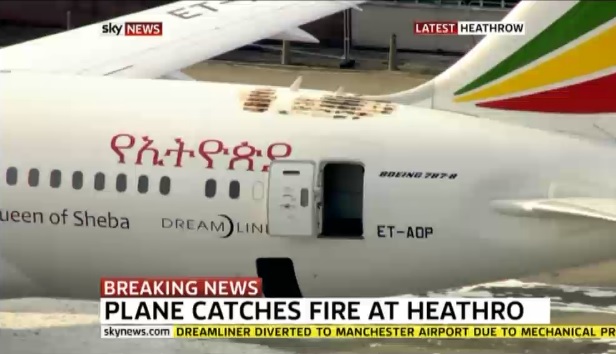
Around 16:30 B.S.T, the Ethiopian 787, registration ET-AOP, was observed with smoke billowing throughout the aircraft. Fire response crews at Heathrow rushed to the aircraft and doused it with fire retardant foam from at least 3 vehicles

787 damage at Heathrow Airport - via Sky News
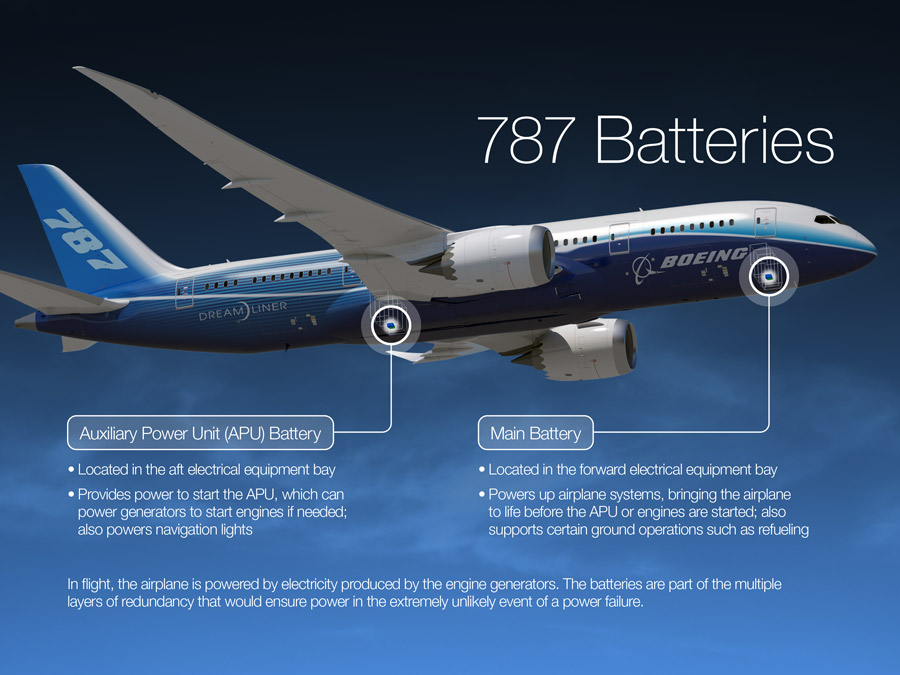
There was significant smoke/fire damage to the carbon fiber reinforced polymer (CFRP) skin of the Ethiopian 787, in the crown of the fuselage just forward of door 4 (the aft door). The damage was in a different location than that caused by the issues with the 787’s lithium-ion batteries that caused the Dreamliner to be grounded worldwide for more than 3 months. In fact, the British Air Accidents Investigation Branch (AAIB) has ruled out a direct causal relationship between the 787’s batteries and/or auxiliary power unit (APU) and the fire damage. The graphic below from Boeing shows that the damage from the 787 batteries occurred in a different location entirely.

Graphic showing location of 787 batteries - Image Credit: Boeing
The 787 was on Fixed Electrical Ground Power (FEGP) at the time of the incident. A report in the Financial Times quoted an Ethiopian Airlines source as stating that a problem had been observed in the aircraft’s air-conditioning system, and that “sparks were observed,” but this report has not been corroborated anywhere else. The 787’s aft ceiling contains Remote Data Concentrators (RDCs) and Remote Power Distribution Units (RPDUs) with significant amounts of wire, and there is a galley station (but no crew rest) beneath the section of the roof where damage occurred.

The National Transportation Safety Board (NTSB), European Air and Space Agency (EASA), AAIB, Boeing, and Ethiopian are all investigating the incident. The damage represents a massive aircraft on ground (AOG) challenge, and a good testing case for composites repair, which presents its own set of challenges (find more information on composite repair here). The cause of the damage is unknown at this point.

These are the facts we know; full stop.

All of the speculation about design problems with the 787 and maintenance issues is exactly that, speculation.

For their part, Boeing, Ethiopian Airlines, and (importantly) the assorted aviation safety agencies are all treating this as a one-off event. Ethiopian Airlines issued a statement saying that the incident was “unrelated to flight safety.”  Ethiopian is scheduled to take delivery of its 5th 787 this week, and plans to do so as scheduled and keep its entire remaining fleet of Dreamliners operational.

To their credit, the DGCA is taking a similar approach with national carrier Air India’s fleet of 787s. "We are keeping a close watch in the investigations (at Heathrow). We will take a view (on Air India's fleet) only after we receive reports of the inquiry and know the causes behind these incidents," DCGA chief Arun Mishra told the Press Trust of India (PTI). To date, Air India has taken delivery of 7 Dreamliners out of a total order of 27.

Air India should keep its Dreamliner fleet operational
This is the correct tactic. While many in the media, especially (albeit understandably) among the British press, have used this as an opportunity to question the 787’s safety, the fact is that this incident is unrelated to any prior ones on the 787. Aviation is not a perfect process; things can go wrong. And even the best of aircraft have one off issues from time to time (see the recent 777 crash or the Air France A330 crash in 2009). When the safety authorities whose job it is to separate isolated incidents from chronic safety problems are treating the 787 as a safe, airworthy aircraft; you should too.

Every aircraft, especially one with such a large degree of new and advanced technology, will suffer its fair share of teething issues. Remember the A380s wing rib cracks? Or the myriad issues that the 747, 777, 767, A340, and A300 all faced on their respective entries into service (EIS). Give Boeing and other involved parties some time to work out the kinks; because when they do, the 787 is set to revolutionize air travel.

Read more »

FAA significantly enhances pilot qualification standards

by Devesh Agarwal

The Federal Aviation Administration (FAA) announced today that it is increasing the qualification requirements for first officers who fly for U.S. passenger and cargo airlines.

The rule requires first officers – also known as co-pilots – to hold an Airline Transport Pilot (ATP) certificate, requiring 1,500 hours total time as a pilot. Previously, first officers were required to have only a commercial pilot certificate, which requires 250 hours of flight time.

The rule also requires first officers to have an aircraft type rating, which involves additional training and testing specific to the airplanes they fly.

The new regulations stem in part from the tragic crash of Colgan Air 3407 in February 2009 near Buffalo, New York, and address a Congressional mandate in the Airline Safety and Federal Aviation Administration Extension Act of 2010 to ensure that both pilots and co-pilots receive the ATP certification. Today’s rule is one of several rulemakings required by the Act, including the new flight duty and rest requirements for pilots that were finalized in December 2011, and new training requirements expected this fall for air carrier training programs to ensure pilots know how to react properly in difficult operating environments.

FAA Administrator Michael Huerta said
"The rule gives first officers a stronger foundation of aeronautical knowledge and experience before they fly for an air carrier,” “With this rule and our efforts to address pilot fatigue – both initiatives championed by the families of Colgan flight 3407 – we're making a safe system even safer."
Other highlights of the rule include:
  • A requirement for a pilot to have a minimum of 1,000 flight hours as a co-pilot in air carrier operations prior to serving as a captain for a U.S. airline.
  • Enhanced training requirements for an ATP certificate, including 50 hours of multi-engine flight experience and completion of a new FAA-approved training program.
  • An allowance for pilots with fewer than 1,500 hours of flight time or who have not reached the minimum age of 23 to obtain a “restricted privileges” ATP certificate. A restricted privileges ATP certificate allows a pilot to serve as a co-pilot until he or she obtains the necessary 1,500 hours. The options are:
    • Military pilots with 750 hours total time as a pilot;
    • Graduates holding a Bachelor’s degree with an aviation major with 1,000 hours total time as a pilot;
    • Graduates holding an Associate’s degree with an aviation major with 1,250 hours;

    • Pilots who are at least 21 years old with 1,500 flight hours.

The rule is consistent with the Airline Safety and Federal Aviation Administration Extension Act of 2010. The rule addresses recommendations from an Aviation Rulemaking Committee, the National Transportation Safety Board, and the FAA’s Call to Action to improve airline safety.

The rule can be viewed at: http://www.faa.gov/regulations_policies/rulemaking/recently_published/media/2120-AJ67.pdf 

Read more »

BREAKING: Asiana Airlines 777 crash lands at San Francisco International Airport

[Last updated on 04:30 UTC]
by Vinay Bhaskara and Devesh Agarwal

Asiana 777-200ER Image Credit: Wikimedia
Earlier today, Asiana Airlines Flight 214 with service from Seoul Incheon Airport to San Francisco crash landed on arrival at San Francisco.

The flight was carrying 291 passengers and 16 crew members. Latest reports put the death toll at two.

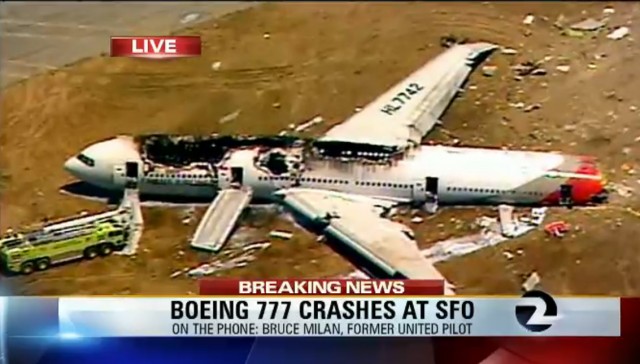
Initial reports are that the aircraft had just touched down around 11:20 am local time, when the empennage was sheared off rear of the aft pressure bulkhead of the 777, and the tail, gear, and engine of the plane separated. The plane turned around nearly 180 degrees and came to a stop to the right of the runway facing eastwards. Photos show debris before runway 28L; implying that the aircraft hit the ground before making it over the runway. Passengers were evacuated before the aircraft caught fire. The National Transportation Safety Board [NTSB] has been dispatched to the scene to investigate.

Image of the crash from news outlet KTVU
The aircraft is a Boeing 777-200ER with registration HL7742. The aircraft, with line number MSN-29171 is powered by 2 Pratt&Whitney 4090 engines and is configured with either 296 or 300 seats on board and was delivered on March 7th, 2006. Asiana Airlines operates 9 Boeing 777-200ER aircraft in 6 different configurations.

291 passengers (19 business, 272 economy) and 16 crew members were on board, reports are that all  of the 307 passengers are accounted for. According to the San Francisco fire department, 2 people have been reported dead, with 230 injuries of some sort. However, in situations such as this crash, the numbers in terms of passengers According to Asiana Airlines, the passengers on board “were comprised of 77 Korean citizens, 141 Chinese citizens, 61 US citizens, 1 Japanese citizen.”

Asiana's official press release related to the incident can be found here. San Francisco International Airport has been updating the media constantly with intermittent press conferences as it can release information.

The incident is the first fatal incident involving passengers and a Boeing 777. The last (and only other) major crash of a Boeing 777 aircraft occurred on January 17, 2008, when British Airways Flight 38 crashed on arrival at London Heathrow after flying in from Beijing. However, on September 5th, 2001, a ground fire broke out on a British Airways 777-236 at Denver, and one re-fueling operative was killed.

Asiana flight 214 is the first airline crash on US soil since Colgan Airlines flight 3407 on February 12, 2009, which killed 49 passengers on a Bombardier Dash 8 aircraft. The last mainline crash in the United States occurred on November 12, 2001, when American Airlines Flight 587, an Airbus A300 crashed at New York's JFK International Airport, killing 265 (260 passengers, 5 on the ground)

The following picture from passenger David Eun shows passengers disembarking the aircraft, and the fuselage appears to be intact, though burning.

The following videos were taken by a passenger at San Francisco Airport


Videos credit to @360kid

The ATC feed can be heard here on the LiveATC site archive. Asiana 214 is given a landing clearance to runway 28L around 21m20s into the recording. The crash occurs around 22m02s. Shouting can be heard in the background of the tower controller's transmission at the time of the crash.

Image via Ben Sandilands showing emergency response
The airline put out a statement around 2130 UTC
The following information has been confirmed.

Asiana Airlines flight OZ214 (Aircraft Registration HL7742) departed Incheon International Airport on July 6, 2013 at 16:35 (Korea time) bound for San Francisco. Only July 6, 2013 at 11:28 (Local time) an accident occurred as OZ214 was making a landing on San Francisco International Airport's runway 28.

There were a total of 291 passengers (19 business class, 272 travel class) and 16 cabin crew aboard. The majority of the passengers were comprised of 77 Korean citizens, 141 Chinese citizens, 61 US citizens, 1 Japanese citizen, etc. for a total of 291 people.

Asiana Airlines is currently investigating the specific cause of the incident as well as any injuries that may have been sustained to passengers as a result. Asiana Airlines will continue to cooperate fully with the investigation of all associated government agencies and to facilitate this cooperation has established an emergency response center at its headquarters.

At this point no additional information has been confirmed. New developments will be announced as more information becomes available.

*For further information regarding OZ213/214, please contact 02-2669-4015 (for overseas calls : 82-2-2669-4015).
Read more »

Air India may not get compensation from Boeing for 787 grounding


by Vinay Bhaskara

After Air India joined most global operators of the Boeing 787 Dreamliner in grounding the aircraft following a Federal Aviation Administration (FAA) emergency directive due to issues with the 787’s Lithium-Ion batteries, the beleaguered Indian national carrier is reportedly seeking compensation from Boeing for the losses caused by the grounding. India’s civil aviation minister Ajit Singh said that Air India will seek “some kind of compensation” for the grounding, but that the issue will be taken up with Boeing later; after Air India ascertains the exact cause behind the battery issues and gets the Dreamliner fleet back into service.

Singh re-iterated that Air India plans to take full delivery of its entire order for 27 Dreamliners, and that they will be receiving an interim report from the FAA over the next couple of days that will shed more light on the likely duration of the grounding. Air India has already substituted other wide-body aircraft onto the 787’s operational routes.

Unlike Air India’s attempts for outrageous levels of compensation from Boeing for the delay in Dreamliner deliveries, this request for compensation is relatively reasonable given the nature of this issue.

However, whether or not Air India ultimately receives compensation depends on how the 787 purchase contract between Air India and Boeing was structured.

For example, during the furore over the Airbus A380’s wing cracks earlier this year, Emirates sought compensation to cover the cost of repairing the cracks from Airbus. However, because this provision was not covered in Emirates’ A380 purchase contract with Airbus, they were refused compensation.

Regardless of the merit of Air India’s complaint, they will likely be unsuccessful in securing compensation for the same reason, unless their contract specifically covers such contingencies.

Read more »

FAA enplanements forecast for US critically linked to Next Gen Project

Editor's Note: This is a guest post via Ashwin Jadhav

The FAA’s Next Gen project, which involves revamping of the nation’s air traffic system to accommodate the forecasted traffic growth, maintain high standards of safety and increase operational efficiency, uses the above mentioned forecasts as a baseline. The changes in the forecasts determine the urgency of the implementation phases for Next Gen, funding required and further proposals.

The FAA announced a few days back the 2012 forecast for the next two decades. The forecast indicates that U.S. airlines will carry 1 billion passengers by 2024 at an average traffic growth rate of 3.8% per year. Moreover, it will take at least four more years for the airlines to reach the 2007 traffic levels. The numbers indicate a significant demand drop in terms of Next Gen implementation.


Don’t get me wrong, certain aspects of the air traffic management system need modifications, but the demand for the complete overhaul of the system is losing its ground. The Next Gen project, however, is still not being modified based on the needs of the National Airspace System. For example, if more emphasis was placed on Continuous Descent Approaches and other Performance Based Navigation improvements rather than premature airport modernizations, airlines would save millions of gallons of fuel. Subsequently, the reduced CO2 emissions would have significant environmental benefits, which would align well with the current Global Aviation Targets. After the four-year reauthorization bill passed by Congress last month, the FAA still seeks to expedite the Next Gen implementation.

This exposes the two major concerns in Next Gen which were previously highlighted. Firstly, the project is being continued without any long-term funding and secondly, the gained funding is not being utilized to address the more problematic areas in the National Airspace System. The changing FAA forecast is not having any impact on the Next Gen Implementation Plan , which appears questionable considering the near-term stagnation in passengers and traffic.
Read more »

The transition into Air Traffic Management continues with the AORRA

Editor's Note: This is a guest post from Ashwin Jadav

Global aviation is steadily progressing through the modernization of technological infrastructure into the new era of seamless air transportation. A major component of this transformation is a complete overhaul of the air traffic control (ATC) system within developed nations, ultimately resulting in the transition to air traffic management (ATM).

In modern-day flight operations, flight planners and dispatchers file a route or flight plan (FPL) using existing navigational infrastructure. The flight then flies the assigned trajectory which includes airways, waypoints, VORs and other nav-aids (as mentioned in the FPL). In the event of traffic congestion, adverse weather or any emergency, air traffic control (ATC) may choose to modify the aircraft’s route, thereby altering the FPL. Conversely, using a bottom-up approach, flight dispatchers could select their trajectory initially based on these factors and then fly the trajectory once approved by ATC. The concept of Random Routing, although not a brand new one, has evolved into a much broader concept called Air Traffic Management (ATM). A Random Route by definition is a trajectory that is picked prior to a particular flight based on traffic patterns, upper winds, weather forecasts, etc. for that particular flight. The benefits of this approach, however, are maximized on long-haul flights.

The Atlantic Oceanic Random Routing RNAV Area (AORRA) is one of the largest expanses of airspace that permits flights to fly without restricted ground navigational aids within its boundaries. It is located between the American and the African continents mainly in the Southern hemisphere. Although a revolutionary means for seamless navigation, the AORRA has not been able to fully utilize the potential of long range aircraft and provide maximum benefits. There were just a few entry and exit points (nav aids / waypoints) on the AORRA boundary via which an aircraft can enter or exit the airspace. In order to completely randomize the trajectory within the AORRA, an increased number of entry/exit “gates” were needed.

*Note: Area Navigation (RNAV) can be defined as a method of navigation that permits aircraft operation on any desired course within the coverage of station-referenced navigation signals or within the limits of a self contained system capability, or a combination of these.

Being two of the airlines that use the airspace most frequently, Delta Airlines and Emirates joined hands with the International Civil Aviation Organization (ICAO), the International Air Transportation Association (IATA) and the Civil Air Navigation Services Organization (CANSO) to initiate a pilot project. Delta’s focus was mainly on the Atlanta – Johannesburg long-haul route while Emirates concentrated on their Dubai – Sao Paulo route. The working group has successfully placed several waypoints on the AORRA boundary for flexible entry and exit. Further, resultant issues such as the intersection of the North American-African and Eurpoean-South American flight corridors were addressed. Since, giving flights additional flexibility would result in multiple possibilities of flight paths on these corridors intersecting, flight level rules were established. Due to the under-developed airspace structure of the African continent, the transition waypoints into/from the AORRA airspace were limited. The implementation of new airways connecting the domestic structure with the AORRA airspace was successfully completed in mid-2011. Finally, the working group presented a paper proposing the additional expansion of the AORRA boundary. The successful implementation of the proposal would bring the AORRA boundary closer to the African continent allowing aircraft to use existing ground infrastructure to aid navigation. The working paper presented at the South Atlantic Group meeting (SAT/16) can be found here.

Not surprisingly, other major air traffic management projects such as the U.S. Next Gen and European SESAR use trajectory optimization and flight flexibility as their foundation. Adding additional flexibility to such airspaces and implementing Random Routing could result in massive time and fuel (thereby CO2) savings for long-haul flights within ‘low density and permitted’ airspaces.
Read more »

Analysis: Air India's $1 billion compensation claim on Boeing for 787 delays is baseless

Earlier this week, reports surfaced that India’s national carrier Air India was asking for roughly $1 billion in compensation from US original equipment manufacturer (OEM) Boeing for the roughly 3 year delay of the Boeing 787-8.

With Air India’s initial delivery having been pushed back almost 2.75 years by the natural program delays and further delay of the delivery of Air India’s 787s into early 2012 because of a failure to complete the final certification requirements of the General Electric GEnx-1B engines with the United States Federal Aviation Administration (FAA), Boeing is certainly culpable for these delays. Air India will be the first airline to receive GE-powered 787s, with multiple 787-8s featuring Rolls-Royce’s competing Trent 1000 already plying commercial flights around the globe.

However, when Air India first signed a contract for the 787-8, compensation was capped at 0.5% of the order’s list value, which at that time roughly $3.24 billion due to under-pricing of the 787 by Boeing (it was priced at $120 million then, now at $193.5 million). This would translate to a cap on compensation of $162 million. Of course Boeing naturally had to soften this stance given the image problems created by the 787 delays, even offering about $500 million in compensation.

However, the fact remains that $1 billion in compensation is far, FAR too much for Boeing to have to pay. Air India’s economic losses on the 787 delays are far from $1 billion, as the following analysis should indicate, and as such, we feel that Air India is completely out of line in asking for this much money to pump into their black hole of an operation.

Please consider a few things before reading this analysis. Firstly, these are “back-of-the-envelope” calculations, so to speak; they do not represent Air India’s internal analyses but rather the best “apples-to-apples” estimates we could come up with. Secondly, these are highly optimistic projections, utilizing best case scenarios. Thirdly, the origin of the operating cost data is from my report “Hot Air- The Mid Sized Widebody Race in Early This Decade,” a copy of which can be purchased at Air Insight’s online store for US$ 49 (INR 2,500). I cannot share more details of this data as it would violate certain NDAs and represent conflict of interest between my various ventures.

With all of that being said, here are the major assumptions present in this analysis. The 787-8 is projected to meet all range targets and is thus able to make Chicago/Toronto-Delhi nonstop in both directions with a full passenger load. Air India was to receive 20 787s over the first 3 years of the program; this is an estimate based off the timeline for the delivery of their first seven 787-8s (VT-ANA through ANH) outlined in early December. We are choosing to ignore the fact that Air India was in fact moving to defer their own 787 deliveries by two years in 2009 before being “bailed” out by Boeing’s delay, which would invalidate both this analysis and Air India’s claims. Because the 787 deliveries are staggered, we are projecting that the average of 20 787-8s will only occur in Air India’s fleet only over the last two years of that period and thus we are amortizing the net loss over 2 years.

Based on extensive research of Air India fares over the next 6 months, we have estimated the following typical yield mixes for Air India’s 3 cabins; $234 per flight hour for first class, $136 per flight hour for business class, $67 per flight hour for economy class. In each case, we are assuming 75% loads for first class, 80% loads for business class, and 85% loads for first class to calculate lost revenue potential (rounding to the nearest passenger for each case). We feel comfortable in making these assumptions because Air India has a relatively price inelastic customer base: they charge roughly the same fare for each class on both the 777-200LR and 777-300ER on the same route (where there are aircraft swaps) despite the 777-300ER having 43.7% more seats.

There are two models through which we can measure the impact of the 787 delays on Air India’s finances over the past two years. The first is the replacement model, under which the 20 787s would directly replace the 777-300ERs and the 777-200LRs. These two fleets combined for Air India have an average daily utilization of about 11 hours per day in summer 2012, and as such are similar to Air India’s projected 11.78 hours per day total utilization of the 787-8s denoted in the RFP for sale-leaseback from December. Under this model, the cost to AI comes from the lost savings of the 787-8 vs. the 777s net of the lost revenue potential, plus the (very small) marginal benefit of having the passenger friendly and reliable 787-8 in their fleet.

Utilizing this model, we first turn to the 777-300ERs, which have average daily utilization of roughly 9 hours per day, multiplied by 12 aircraft in the fleet for 108 hours per day. Under our estimates, the 777-300ER is on average (for Air India’s routes) $7600 less efficient than the 787-8 per flight hour. Under Air India’s configuration however, the aircraft has 4 more first class seats, 17 more business class seats, and 65 more economy class seats. Under our projected loads, that represents an advantage of 3 first class, 14 business class, and 55 economy class seats. This translates to $6291 of lost revenue potential, which creates a net loss of $1309 per flight hour. Spreading that over 108 flight hours per day over 2 years translates to a net loss of $103.2 million.

Moving to the 777-200LR; this aircraft has 8 more first class seats, 17 more business class seats, and 43 fewer economy class seats. It also costs $5000 more to operate per hour than the 787-8. Under our load factor assumptions, this represents 6 more first class seats, 14 more business class seats, and 34 fewer economy class seats. Thus, the lost revenue potential is just $963 per flight hour, yielding a net loss of $4037 per hour. Spreading that over the 14 hours of daily utilization for 8 aircraft or 112 hours of daily utilization, the net loss over 2 years is $330.1 million.

Summing the costs of these two brings us to $433.3 million, or close to the sum initially offered by Boeing. Given the cascade of bad news that has overcome Air India over the past 3 years, it’s not impossible to tack on another $70 million or so to account for the rising costs of negative customer perception and interest fees on accumulated losses, bringing us essentially to a nice round figure of $500 million.

The second model that we can use is a model of lost revenue/opportunity. Under this model, Air India (as it has for the most part indicated it plans to do) would use the 787-8s primarily for expansion. Thus the cost to Air India of the delay is simply the lost profitability of the 787 (revenue per flight hour minus cost per flight hour), plus the marginal loss of flow traffic (connections) and potential frequent flyers (who might have jumped over to Air India with the new routes).

This model poses a set of unique challenges, however, the first being that it’s hard to find the requisite 236 hours of daily utilization or so that would be required to meet Air India’s projections. That being said, we’ll assume that they do in fact operate these flights and this utilization.

In terms of yields, there will be some drop off due to the added capacity. In terms of the true addition of capacity, Air India’s utilization figures from the RFP indicate that 20 787s would add about 4.4 million annual seats to Air India’s network. From a perspective of Air India’s network, that represents about a 26% increase in seat capacity (measured in available seat miles). Using a consensus of estimates of the price elasticity of demand for air travel and Air India’s unique demand streams, we’ll allow Air India the benefit of the doubt for this exercise, and build in just a 15% drop in yield for Air India (smaller in magnitude than the increase in capacity). Under our model, this would mean that business class yields were $116 per flight hour, and economy class yields were $57. Under this model, the sudden rise in capacity also would decrease load factors by just 5 percentage points in each class; to 75% in business class and 80% in economy class. Under these conditions, the 787-8 would have 14 business class seats filled, and 190 economy class seats filled.

With average cycle length of 5 hours and average annual utilization of 4300 hours, the 787-8’s operational profitability under the conditions denoted above would thus be roughly $119 million over the two years. This operational profitability is a best case scenario (and hard to envision given Air India’s current status of not even covering costs of fuel on some long haul flights), and does not include the financial costs (lease rates and/or depreciation) of operating the aircraft.
Building in $100 million for the effects of increased flow traffic through Delhi and Mumbai, as well as another $50 million for the effect of increased frequent flyer retention (both very generous estimates), plus $100 million for all other effects, including increased negative customer perception and accumulated losses (and the resultant interest charges). Even adding up these highly optimistic charges, we still reach a sum of $469 million, less than the sum Boeing has offered.

So it should be abundantly clear that Air India has very little basis to claim $1 billion in compensation. It would appear rather, that a carrier who is seeking a $6 billion bailout from the Indian government to fund loss-making operations from the next decade is simply looking to soak Boeing for more cash (funding a whopping 1 year more of Air India operations) so as to slightly delay the timing of their next bailout, which we can be sure will at least double in size. Air India is building off of the baseline of other, profitable, carriers who have valid claims for compensation from Boeing, but should not be allowed to do so.

As Devesh pointed out last week, Air India’s proposed bailout of 30,000 crore could feed all of India’s hungry (231 million people, or close to 20 times Air India’s annual passenger base) for more than one year. The best solution for Air India is to simply accept the more than generous $500 million offered by Boeing and allow the OEM to focus its cash on improving the 787-8 further, perhaps cutting Air India’s future losses and distributing the savings to the hungry.
Read more »