Showing posts with label Ethiopian Airlines. Show all posts

Ethiopian Airlines authorised as service facility for Q400 turboprops

By BA Staff

Bombardier Aerospace celebrated its growing support network in Africa by agreeing with Ethiopian Airlines of Addis Ababa, as yet another Authorised Service Facility (ASF) for commercial aircraft on the continent.

The airline can now perform line and heavy maintenance on Q400 and Q400 NextGen turboprop aircraft under the Bombardier ASF banner.

Ethiopian Airlines operates a fleet of modern aircraft, and performs complete aircraft, as well as engine and component overhaul and repair services from facilities at Bole International Airport in Addis Ababa. The facility employs an all-Ethiopian workforce of over 750 licensed technicians and support staff.

Éric Martel, President, Customer Services and Specialized and Amphibious Aircraft, Bombardier Aerospace said:
“Ethiopian Airlines is one of Africa’s most respected airlines and a valued Bombardier customer. Their commitment to excellence both in operations and maintenance services will benefit our operator base in the region and beyond, as a part of our network. Through sustained investment and focus, we continue to expand our support services in Africa and are looking forward to this new chapter of our relationship with Ethiopian.”
Tewolde Gebremariam, Chief Executive Officer, Ethiopian Airlines said:

“Ethiopian Airlines’ NextGen turboprops are proving their high value by delivering excellent passenger experience, operational flexibility and economics – confirming that they are excellent aircraft for operations in Africa. As a newly appointed Authorized Service Facility for Q400 and Q400 NextGen aircraft, we welcome the opportunity to expand our relationship with Bombardier, and to provide maintenance services to other carriers as an increasing number of these modern turboprops take to the skies in our geographically diverse continent.” 
Read more »

Palma Holdings signs LOI for up to eight new Bombardier Q400 NextGen turboprops

By BA Staff

Bombardier Aerospace announced that Palma Holding Limited (Palma) has signed a letter of intent to acquire up to eight dual-class Q400 NextGen aircraft. The agreement would cover four firm-ordered aircraft and four options. Palma intends to lease four aircraft to Ethiopian Airlines.

Based on the list price, the potential contract value for Palma's transaction covering four Q400 NextGen aircraft and four options would be approximately $282 million US.

Moulay Omar Alaoui, President, Palma Holding Ltd said:
"We are very pleased to become the first Middle Eastern lessor for Bombardier's Q400 NextGen aircraft, and the first lessor worldwide for the aircraft's dual-class configuration. We are working to conclude lease structures with interested airlines including existing Q400 NextGen aircraft operator Ethiopian Airlines. We have already concluded commitments with Ethiopian Airlines that will provide the carrier with additional development opportunities."
Mike Arcamone, President, Bombardier Commercial Aircraft said:
"Our customers' success with their Q400 NextGen aircraft in the Middle East and Africa is testament to the aircraft's unique ability to serve the diverse and challenging environment in the region. In addition, the Q400 NextGen aircraft's comfortable, quiet cabin provides an excellent experience for passengers; and the dual-class option allows flexible integration into carrier's network operations by providing seamless business class service to passengers,"
Ethiopian Airlines currently operates a fleet that includes 13 Q400s.
Read more »

Boeing delivers Ethiopian Airlines' first 777-300ER

By BA Staff

Boeing has delivered a 777-300ER (Extended Range) jet to GE Capital Aviation Services (GECAS) for lease to Ethiopian Airlines. The 777-300ER is now the largest airplane in the Ethiopian flag-carrier's fleet and will provide it with increased capacity and improved operating economics on key routes from its base in the Ethiopian capital, Addis Ababa.

Mesfin Tassew, Chief Operation Officer of Ethiopian Airlines said:
"The introduction of the B777-300 ER into our fleet is a major milestone, as it will be our biggest aircraft with a 400 seat capacity. Ethiopian B777-300 ER will give our passengers the best possible travel experience with its spacious cabin interior, high ceiling, advanced in-flight entertainment system, increased stowage capability and additional cargo uplift flexibility. The aircraft will be deployed on our long haul non-stop routes to the US and China and will give us exceptional range capability and fuel efficiency."
Van Rex Gallard, vice president of Sales for Africa, Latin America and the Caribbean, Boeing Commercial Airplanes said:
"For more than half a century, Ethiopian has been at the forefront of providing its passengers with the most innovative products.  The 777-300ER continues this tradition and represents another significant milestone in the long history between both our companies. The 777-300ER will be a key player in the continued success of Ethiopian, offering more capacity, increased flexibility and exceptional comfort on its operations worldwide."
Read more »

Ethiopian Airlines reports record profits, stands behind Dreamliner despite fire

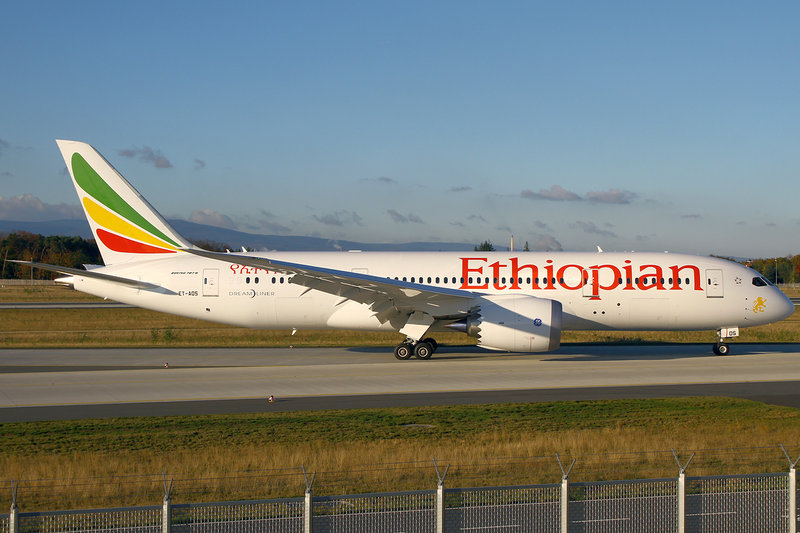
Image Credit: Konstantin von Wedelstaedt
by Vinay Bhaskara

African carrier Ethiopian Airlines has announced a record net profit of 2.03 billion birr (US $107.6 million) for the period from July 2012 - June 2013, up 178% from 734 million birr (US $39.2 million)year-over-year (YOY). Operating profitability also rose a healthy 170% YOY to 2.7 billion birr (US $143.1 billion), from 1 billion birr (US $53.0 million). While the carrier has not yet formally released its financial results, CEO Tewolde Gebremariam presented these figures as coming from Ethiopian's un-audited results for the period. The formal announcement of results should come soon.

Interestingly, Gebremariam attributed Ethiopian's profitability in part to the troubled Boeing 787-8 Dreamliners, citing the fuel savings driven by the aircraft's increased fuel efficiency. His comments come just a month and a half after an Ethiopian Dreamliner memorably caught fire at London's Heathrow Airport in early July (an incident later attributed to a Honeywell Emergency Locator Transmitter), and a three month long grounding of the aircraft due to battery issues earlier this year. Gebremariam admitted that the Dreamliners had caused some issues for Ethiopian this past financial year:
Definitely the incidents and grounding have some impact. We were very fortunate that coincidentally the grounding of the planes were in what we call slack season. It's a slow demand season. So were able to minimize the level of the impact.
However, he also said that the carrier has seen a demand boost from the Dreamliners:
Whenever we introduce the aircraft in any route, the load factor immediately increases, which means our customers love the plane, they are enjoying its features
Ethiopian says that it will take delivery of its remaining 8 Dreamliners on order (5 direct orders and 3 leases), bringing the carrier's active fleet of 787-8 Dreamliners to 12 (13 frames on the books but one is currently indisposed at Heathrow Airport). Ethiopian currently operates a fleet of 54 passenger aircraft (with 31 more on order - 14 Airbus A350-900s, 8 Boeing 787-8 Dreamliners, 4 Boeing 777-300ERs, and 5 Boeing 737-800s) serving 80 passenger destinations around the globe. Based in Addis Ababa, Ethiopian is a member of the Star Alliance partnership of global airlines, and is one of the world's fastest growing airlines.
Read more »

Post 787 fire, UK air accident investigator recommends review of all Lithium powered ELTs on all aircraft

by Devesh Agarwal

The United Kingdom's Air Accidents Investigation Branch (AAIB) has issued a special bulletin (read PDF here) on the fire that broke out on Ethiopian Airline's Boeing 787-8 Dreamliner ET-AOP, parked at London's Heathrow airport last Friday.

In the report, the AAIB said the fire occurred in the rear upper fuselage where the fixed Emergency Locator Transmitter (ELT) is located. The ELT model RESCU406AFN is made by US aviation major, Honeywell International.

The report says
Detailed examination of the ELT has shown some indications of disruption to the battery cells. It is not clear however, whether the combustion in the area of the ELT was initiated by a release of energy within the batteries or by an external mechanism such as an electrical short. In the case of an electrical short, the same batteries could provide the energy for an ignition and suffer damage in the subsequent fire.
There are no other aircraft system in this area of the plane which, with the aircraft unpowered, contained stored energy capable of causing such a fire,
However, the report also gives some benefit of doubt to Honeywell, saying
The ELT manufacturer has produced some 6,000 units of this design which are fitted to a wide range of aircraft and, to date, the incident on 12 July 2013 has been the only significant thermal event
The AAIB has made two safety recommendations in its report:
Safety Recommendation 2013-016
It is recommended that the Federal Aviation Administration initiate action for making inert the Honeywell International RESCU406AFN fixed Emergency Locator Transmitter system in Boeing 787 aircraft until appropriate airworthiness actions can be completed.

Safety Recommendation 2013-017
It is recommended that the Federal Aviation Administration, in association with other regulatory authorities, conduct a safety review of installations of Lithium-powered Emergency Locator Transmitter systems in other aircraft types and, where appropriate, initiate airworthiness action.
Aircraft manufacturer Boeing released a statement saying
As a party to the investigation, Boeing supports the two recommendations from the UK Air Accidents Investigation Branch (AAIB), which we think are reasonable precautionary measures to take as the investigation proceeds. We are working proactively to support the regulatory authorities in taking appropriate action in response to these recommendations, in coordination with our customers, suppliers, and other commercial airplane manufacturers.

We are confident the 787 is safe and we stand behind its overall integrity.
Read more »

Opinion: After Ethiopian Airlines incident at Heathrow Airport; 787 remains safe

by Vinay Bhaskara

Last Friday, a pair of incidents occurred with the Boeing 787 Dreamliner. Smoke was observed billowing from an Ethiopian Airlines Boeing 787 parked on the ground at London Heathrow International Airport with no passengers on board, while a Thomson Airways Dreamliner operating between Manchester and Sanford, Florida (SFB) was forced to return to Manchester due to a routine maintenance problem.

Turning first to the Ethiopian 787, the facts are as follow:

Around 16:30 B.S.T, the Ethiopian 787, registration ET-AOP, was observed with smoke billowing throughout the aircraft. Fire response crews at Heathrow rushed to the aircraft and doused it with fire retardant foam from at least 3 vehicles

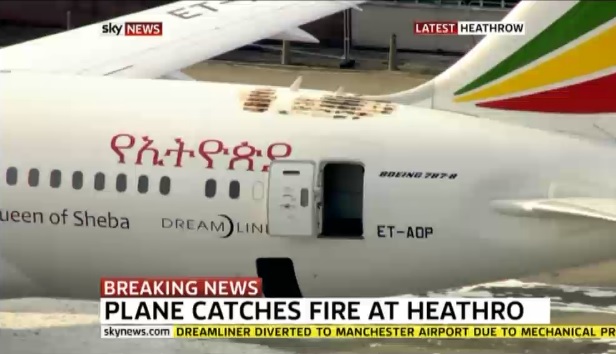
787 damage at Heathrow Airport - via Sky News
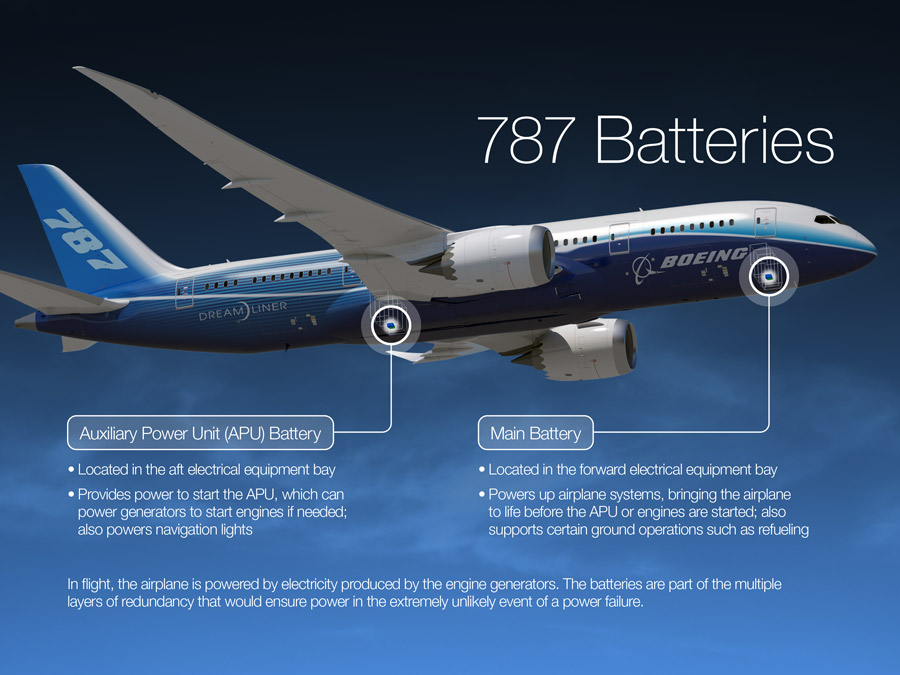
There was significant smoke/fire damage to the carbon fiber reinforced polymer (CFRP) skin of the Ethiopian 787, in the crown of the fuselage just forward of door 4 (the aft door). The damage was in a different location than that caused by the issues with the 787’s lithium-ion batteries that caused the Dreamliner to be grounded worldwide for more than 3 months. In fact, the British Air Accidents Investigation Branch (AAIB) has ruled out a direct causal relationship between the 787’s batteries and/or auxiliary power unit (APU) and the fire damage. The graphic below from Boeing shows that the damage from the 787 batteries occurred in a different location entirely.

Graphic showing location of 787 batteries - Image Credit: Boeing
The 787 was on Fixed Electrical Ground Power (FEGP) at the time of the incident. A report in the Financial Times quoted an Ethiopian Airlines source as stating that a problem had been observed in the aircraft’s air-conditioning system, and that “sparks were observed,” but this report has not been corroborated anywhere else. The 787’s aft ceiling contains Remote Data Concentrators (RDCs) and Remote Power Distribution Units (RPDUs) with significant amounts of wire, and there is a galley station (but no crew rest) beneath the section of the roof where damage occurred.

The National Transportation Safety Board (NTSB), European Air and Space Agency (EASA), AAIB, Boeing, and Ethiopian are all investigating the incident. The damage represents a massive aircraft on ground (AOG) challenge, and a good testing case for composites repair, which presents its own set of challenges (find more information on composite repair here). The cause of the damage is unknown at this point.

These are the facts we know; full stop.

All of the speculation about design problems with the 787 and maintenance issues is exactly that, speculation.

For their part, Boeing, Ethiopian Airlines, and (importantly) the assorted aviation safety agencies are all treating this as a one-off event. Ethiopian Airlines issued a statement saying that the incident was “unrelated to flight safety.”  Ethiopian is scheduled to take delivery of its 5th 787 this week, and plans to do so as scheduled and keep its entire remaining fleet of Dreamliners operational.

To their credit, the DGCA is taking a similar approach with national carrier Air India’s fleet of 787s. "We are keeping a close watch in the investigations (at Heathrow). We will take a view (on Air India's fleet) only after we receive reports of the inquiry and know the causes behind these incidents," DCGA chief Arun Mishra told the Press Trust of India (PTI). To date, Air India has taken delivery of 7 Dreamliners out of a total order of 27.

Air India should keep its Dreamliner fleet operational
This is the correct tactic. While many in the media, especially (albeit understandably) among the British press, have used this as an opportunity to question the 787’s safety, the fact is that this incident is unrelated to any prior ones on the 787. Aviation is not a perfect process; things can go wrong. And even the best of aircraft have one off issues from time to time (see the recent 777 crash or the Air France A330 crash in 2009). When the safety authorities whose job it is to separate isolated incidents from chronic safety problems are treating the 787 as a safe, airworthy aircraft; you should too.

Every aircraft, especially one with such a large degree of new and advanced technology, will suffer its fair share of teething issues. Remember the A380s wing rib cracks? Or the myriad issues that the 747, 777, 767, A340, and A300 all faced on their respective entries into service (EIS). Give Boeing and other involved parties some time to work out the kinks; because when they do, the 787 is set to revolutionize air travel.

Read more »

As 787 Dreamliners return, passengers face economy class discomfort

As its much vaunted state of the art jetliner, the 787 Dreamliner returns to the skies, US airframer Boeing faces a dilemma. On the one hand Boeing has incorporated many improvements in the composite fuselage aircraft, which was meant to improve passenger comfort.

These include
  • Windows that are about 30% bigger, allowing more natural light.
  • Windows also feature an electronic dimming system
  • Cabin pressure being maintained at a lower altitude of 6,000ft MSL rather than the traditional 8,000ft, thus reducing passenger fatigue.
  • High cabin humidity reducing passenger dehydration
  • The air-conditioning system is fed with air from scoops rather than engines, thus much cleaner
  • The computer controlled LED lighting system that simulates the rise and ebb of natural light through the day, thus helping passengers better adjust to time zones.
  • High ceilings, bigger over-head bins, and the cabin derived from the Boeing Sky Interior which gives passengers a bigger sense of space
  • External to the cabin, the aircraft has an anti-turbulence system that makes for a smoother flight and much quieter engines.

Yet, despite all these improvements, with the exception of the two Japanese airlines All Nippon and Japan Airlines, all the other 787 operators have opted for the ultra-tight nine abreast 3-3-3 configuration in economy class that leaves the seats around a bone crushing 17" width. Fine for a short 737 flight, but extremely uncomfortable for the longer eight to twelve hour flights envisaged in the Dreamliner.

Even British Airways which recently revealed its 787 cabin layout has chosen the narrow 3-3-3 configuration for its World Traveller (economy) class.

One has to wait and see what configuration will "premium" carriers like Singapore Airlines choose.

So unless you are a zero sized petite Bollywood, Hollywood model, you might be well advised to leave the Dreamliner in your dreams. On the flip side, since most airlines have chosen not to have a first class in their 787s, if you have the big bucks or frequent flier miles to afford the Business Class, then the Dreamliner will truly live up to its name in its pampering.

Talking about frequent flier miles, I have just returned from one trip covering the US and Europe and had a chance to experience the new business class aboard Lufthansa's 747-8i's and the BusinessFirst "Pods" aboard Air Canada's 777s and 767s. They were both good experiences and I request you to please await my trip reports.

Unfortunately, I am going back to the US. Will be in the air when this publishes. While I am a charter member of Masochists-R-Us, but, after a long long time, I am flying Singapore Airlines, in their 777 economy class, considered the best in the world. Stay tuned for that trip report too.
Read more »

Update 1: Air India grounds its Boeing 787 Dreamliner fleet, after FAA emergency directive

by Devesh Agarwal
The fleet of six Boeing 787-8 Dreamliners of state-owned national carrier Air India has been grounded by the country's aviation regulator the DGCA, which took this decision following the issue of an Emergency Airworthiness Directive (EAD) by the US Federal Aviation Administration (FAA) the regulator in the country of manufacture, and also the certifying body of the aircraft. The EAD concerns risks of fire in the aircraft's Lithium-ion batteries.

(Read the FAA Press Release here).

(You can read the FAA Emergency AD at the end of this article, or download it here).

Air India operates three international routes (Dubai, Frankfurt and Paris Roissy), and three domestic services (Bangalore, Chennai, and Kolkata), all from its base in New Delhi. One aircraft is used as a stand-by.

An Air India spokesperson informed Bangalore Aviation the airline is making "alternate arrangements" including changing of aircraft type on some routes, and "arrangements" for affected passengers, but refused to elaborate. The airline has also not issued any statement on the 787.

The FAA EAD comes after multiple incidents which afflicted Boeing's newest generation aircraft in the last few weeks. A United Airlines Boeing 787-8 was diverted near New Orleans on December 4, 2012. On December 8, a Qatar Airways 787 reported a generator failure. On January 7, a Japan Airlines 787 suffered an APU battery fire at Boston. On January 11, another ANA Dreamliner suffered a cracked wind-shield while on a domestic flight. Air India's debut flights were marred by air-conditioning pack failures. The other three operators Chile's LAN, Ethiopian Airlines, and LOT Polish Airlines have not reported any incidents with the 787.

In addition to United Airlines, and Air India, the two Japanese carriers, All Nippon Airways (ANA) and Japan Airlines (JAL), the first two operators of the 787, who operate almost 50% of the global 787 fleet (24 out of 50), grounded their fleets yesterday. LAN confirmed it is suspending 787 flights on advice of Chile's aviation regulator. The airline issued a statement
“In compliance with the recommendation of the Federal Aviation Administration of the United States (FAA) and in coordination with the Chilean Aeronautical Authority (DGAC), LAN announces that we will temporarily suspend the operation of our three Boeing 787 aircraft.

“Flights that were scheduled to be operated by the 787 will be temporarily replaced with other aircraft in our fleet to mitigate any potential impact that this situation could cause our passengers and cargo clients. The safety of our operation and our passengers is our top priority and we lament any inconvenience that this may cause.”
LOT have cancelled their launch event for their Warsaw Chicago service. The decisions of Qatar and Ethiopian are awaited, though it is expected they will follow suit.

Boeing reimposed faith in the safety of its aircraft. Chairman, President and CEO Jim McNerney issued the following statement following the FAA's EAD.
"The safety of passengers and crew members who fly aboard Boeing airplanes is our highest priority.

"Boeing is committed to supporting the FAA and finding answers as quickly as possible. The company is working around the clock with its customers and the various regulatory and investigative authorities. We will make available the entire resources of The Boeing Company to assist.

"We are confident the 787 is safe and we stand behind its overall integrity. We will be taking every necessary step in the coming days to assure our customers and the traveling public of the 787's safety and to return the airplanes to service.

"Boeing deeply regrets the impact that recent events have had on the operating schedules of our customers and the inconvenience to them and their passengers."

A DC-10-40 modified to perform as a tanker.
The Federal Aviation Administration does not enjoy the same reputation of independence as the NTSB, due to its contradicting roles of a regulator and a promoter of aviation. One has to go back 34 years to 1979, to find the last time the FAA issued an EAD on an aircraft. That was the McDonnell Douglas DC-10, following the horrific crash at Chicago of an American Airlines DC-10. In an ironic twist of history, the travelling public lost faith in the DC-10, and McDonnell Douglas never recovered from this disaster. It eventually went bankrupt, and was acquired by Boeing.

In no way do we imply the 787 is an unsafe aircraft, and we are confident the efforts of Boeing and its vendors will find a solution; but, speed is of the essence. Through its EAD the FAA and by extension other regulators will require operators (airlines) to prove that the batteries on their 787s are safe.

Unlike earlier generation aircraft, the 787 relies on greater electrical power to perform aircraft functions traditionally performed by hydraulic means. As a result it has a greater usage of batteries. While Lithium-ion batteries similar to the type used in the 787 are fairly common in the aerospace industry, the groundings will put tremendous pressure on both Boeing, and the battery manufacturer GS Yuasa of Japan, to examine their entire value chain, from design, to manufacturing, to quality control, determine reasons for the failures and find solutions, quickly.

Boeing has not indicated it will stop or suspend production of the 787. In fact the 100th 787 just entered the production line recently. However, while Boeing can assemble 787s it cannot fly them and therefore cannot conduct any test flights. The flight lines at both the Everett and Charleston plants will start filling up soon.

While the seriousness of the battery problems are not fully known, and therefore a time-frame for implementing a solution is elusive right now, Boeing has to keep history in mind. The DC-10 grounding in 1979 lasted over a month. In today's day and age neither Boeing nor Yuasa can afford this, especially after over three years of delay plaguing this fine aircraft.

Share your thoughts via a comment.

Update 1: 787 Interim Replacement Plan

Through January 22nd, Air India has implemented the following replacement plan for segments previously scheduled to be operated by the Boeing 787 Dreamliner:

Delhi - Chennai/Bangalore will be operated with the Airbus A330-200. Since the A330s are already based in Chennai to fly Chennai-Singapore, the aircraft which operates the night flight to Chennai will be rotated through Delhi for domestic flights during the day.

Delhi - Kolkata/Dubai will be operated by Boeing 747-400s which are currently used as spare aircraft for maintenance substitutions and charters.

Delhi - Paris Charles de Gaulle will be operated by a spare Boeing 777-200LR.

Delhi - Frankfurt will be operated by a spare Boeing 777-300ER.


US Federal Aviation Administration Emergency AD # 2103-02-51 787 Battery

Read more »

Routes Analysis - India Edition: Air India, IndiGo, Nepal Airlines, Ethiopian

Over the last week, foreign and Indian carriers alike have announced several interesting pieces of news around the Indian domestic and international networks.

IndiGo
India's largest low cost carrier (LCC), IndiGo, will be adding one additional daily flight on each of Mumbai-Delhi and Mumbai-Hyderabad. The LCC will now operate 12 daily flights (except on Sundays) between Mumbai and Delhi, as well as 5 daily flights Mumbai-Hyderabad. The new flights are scheduled as follow:

6E171 DEL-BOM -- 0525 – 0725 -- 320 -- Daily x7
6E188 BOM-DEL -- 0840 – 1045 -- 320 -- Daily x7

6E231 HYD-BOM -- 1920 – 2045 -- 320 -- Daily
6E234 BOM-HYD -- 2120 – 2235 -- 320 -- Daily

In spite of the heavy losses sustained by Indian carriers on most of these Metro routes, Indian carriers continue to saturate the market with heavy frequencies. Part of it is certainly the loss of Kingfisher, which has sent fares spiraling upwards and left what some would call a void in the market for the other Indian airlines to fill. Another part of it is surely that IndiGo wishes to firm up its Mumbai operation in an effort to increase its attractiveness to business travelers and frequent flyers (especially important as it attempts to grow its international operations).

Still I'm not sure that I like the moves. Higher fares, despite the adverse effects on consumers, are exactly what the Indian airline industry needs (I'll cover this in a later post). Looking around the world, the only airlines that have sustained high profit margins since the Global Financial Crisis are those that practice capacity discipline (especially the US based "legacy" carriers). For IndiGo, are marginal benefits of an additional inter-Metro flight truly worth losing the capacity discipline which has been so beneficial for the bottom line at Indian carriers in recent months?

Air India

From December 5th, Air India will be restarting service between Thiruvananthapuram and Riyadh twice weekly on Boeing 747-400 equipment. Previously, Air India operated on the route with onestop service through multiple intermediate points for several years, before it was slotted for cancellation in March 2013. The schedule for the route is as follows:

AI929 TRV-RUH -- 1440 – 1645 -- 744 -- 35
AI928 RUH-TRV -- 0600 – 1310 -- 744 -- 35

The service is paired with new 2 weekly 747-400 service on Mumbai-Riyadh, bringing service on that sector up to daily.

AI921 BOM-RUH -- 0250 – 0445 -- 744 -- 35
AI920 RUH-BOM -- 1800 – 0030+1 -- 744 -- 35

Both of these new flights represent a reversal of the recent trend in the India-Middle East market, which has been contraction at all costs. From a practical perspective, this also partially solves the problem of what to do with the 747-400s, though the most sane option (scrapping, retiring, or selling them) is still on the table.

Meanwhile, Air India just sent out the following email to its Flying Returns members:
The winter season is here, Air India has introduced its schedule for this season with a host of improvements for your convenience. The highlights of the schedule are:

1) New Daily Flights

•Chennai – Pune – Chennai
•Ahmedabad – London - Ahmedabad
•Delhi – Dhaka – Delhi (effective 3rd December)
•Delhi – London – Delhi (2nd daily flight eff. 25th Nov.)
•Hyderabad – Varanasi
•Goa – Srinagar
•Delhi – Mangalore
•Mumbai – Srinagar
•Raipur – Visakhapatnam

2) Non-Stop flights now available on eff. 11th Nov.

•Mumbai – Bhopal
•Mumbai – Jodhpur
•Delhi – Indore
•Delhi – Udaipur

3) Dreamliner B-787 flights on
•Delhi – Frankfurt – Delhi
•Delhi – Dubai – Delhi
Some notes on individual routes above:
  • Pune has experienced a bit of a Renaissance with a recent slot auction bringing a nice set of new daily flights to the Industrial hub in central India ... Good for them
  • Ahmedabad - London - Ahmedabad is via Delhi - this sort of routing wasn't very successful the first time Air India tried it - with any sort of rational head at Air India, this should go away pretty soon. 
  • Delhi-London 2nd daily flight makes little sense - the last time they dropped it, part of the rationale was that the competition on the sector was too fierce. That is still the case. You still have Jet and a revitalized British Airways/IAG to contend with - Air India should really just sell the slot.
  • I'm not sure that the 787 will fly either of those routes any time soon. Looking over in the US, the 787 inaguration has not gone smoothly with United Airlines, and I wonder if Air India has had some similar struggles. Initial dispatch reliability for the domestic 787 flights isn't so great. 
SpiceJet

SpiceJet continues to refine its burgeoning Q400 regional operations. First, they are adding Chennai-Bangalore-Belgaum services with schedules as follow:

SG3301 MAA-BLR-IXG -- 0615 - 0705 -- 0740 - 0830 -- Q400 -- Daily
SG3302 IXG-BLR -- 0850 - 0935 -- 0850 - 0935 -- Q400 -- Daily

SpiceJet continues to grow its Q400 operations. With the shutdown of Kingfisher, there exist several small and medium markets in India where there is potential for SpiceJet to undercut the monopolies of either Jet Airways or Air India (Alliance Air). Additionally, SpiceJet's Mangalore operations are undergoing a restructuring. The current 737 flight between Bangalore-Mangalore is being terminated, and instead the current Chennai-Mangalore Q400 flight is being re-routed as a one-stop through Bangalore. This is a smart utilization of the Q400 to help prop up fares on a route that is too short to profitably fill a 737. The new schedules are as follow:

SG3231 MAA-BLR-IXE -- 1240-1335 -- 1400 - 1445 -- Q400 -- Daily
SG3232 IXE-BLR-MAA -- 1025-1110 -- 1130 - 1220 -- Q400 -- Daily

Royal Nepal Airlines

Royal Nepal Airlines, the Kathmandu based flag carrier, has signalled that it wishes to resume service to Delhi, and add service to Patna and Gaya. Currently the carrier operates a mixed fleet of 757s and Twin Otters, but presumably either A320s or the newly ordered Xian MA-60s (from China, these aircraft are not yet certified to operate from India).

British Airways

OneWorld carrier British Airways plans to increase its service to Chennai up to 6 flights per week up from the current level of 5 flights per week according to sources- the highest level that the service has been at in the past few years. Considering some of the drawdown of Indian flights by British Airways in the past year, its nice to see them adding some service back to India.

Ethiopian Airlines

Ethiopian Airlines has moved forward plans to place the new Boeing 787 Dreamliner onto the daily Addis Ababa - Mumbai service. Initally, service was planned to begin on 25th November. Then, the plan was briefly cancelled, before it was moved up this week to a November 11th start up. The schedule for the flights is as follows:

ET610 ADD-BOM -- 2120 – 0450+1 -- 788 -- Daily
ET611 BOM-ADD -- 0540 – 0800 -- 788 -- Daily

Interestingly, Ethiopian's 787 integration has gone very smoothly  while United and Air India have struggled. India is a strong part of their growth plan and one can expect to see more green and white 787s plying Indian skies in the near future given the centrality of the 787 to their future fleet growth.
Read more »

NTSB issues urgent safety alerts for GEnx engines; Air India, JAL, Ethiopian, Qatar 787 Dreamliners affected

The National Transportation Safety Board, the independent safety investigator of the United States, has issued two urgent safety recommendations (A-12-52 and A-12-53) on General Electric GEnx engines, which power the latest generation of Boeing aircraft; the 787 Dreamliners and the Boeing 747-8 both freighters and Intercontinental passenger jets.

The GEnx-1B engines power the 787 Dreamliners operating with Air India, Japan Airlines (JAL), Ethiopian Airlines, and soon, Qatar Airways. The two other 787 operators All Nippon Airways (ANA) and LAN Chile, have their aircraft powered by the Rolls Royce Trent 1000 engines.

The GEnx-2B engines power the Boeing 747-8i of Lufthansa and the 747-8F freighters of many carriers.

The investigation of the GEnx engines began with the July 28th engine failure incident at Charleston, SC, USA, involving a Boeing 787 Dreamliner destined for Air India. Initial investigations suggested a fracture failure of the fan midshaft (FMS), first reported by Bangalore Aviation. While that investigation is still on-going, on August 31, the NTSB found similar indications on another GEnx-1B fitted on, a yet to fly, 787. The fan midshaft was removed from that engine for further inspection and examination. As a result of the investigative work to date, the NTSB has determined that the fan midshafts (FMS) on the GEnx engines fractured or cracked at the forward end of the shaft where the retaining nut is installed.

Exemplar image of GEnx Fan mid-shaft

The NTSB is also concerned about a loss of power on the GEnx-2B engine of a Boeing 747-8F cargo flight, operated by Air Bridge Cargo, at Shanghai, China, during take-off. The airplane had accelerated through 50 knots when the engine's low pressure rotor speed dropped. The pilot rejected the takeoff and returned to the ramp. Photographs of the low pressure turbine show damage similar to the GEnx-1B engine from the Charleston incident.

The urgent recommendations are: (1) (A-12-52) Issue an airworthiness directive to require, before further flight, the immediate ultrasonic inspection of the fan midshaft (FMS) in all GEnx-1B and -2B engines that have not undergone inspection, and (2) (A-12-53) Require repetitive inspections of the fan midshaft at a sufficiently short interval that would permit multiple inspections and detection of a crack before it could reach critical length and the fan midshaft fractures.

NTSB Chairman Deborah A.P. Hersman said
"The parties to our investigation -- the FAA, GE and Boeing -- have taken many important steps and additional efforts are in progress to ensure that the fleet is inspected properly," "We are issuing this recommendation today because of the potential for multiple engine failures on a single aircraft and the urgent need for the FAA to act immediately."
The engine manufacturer, GE, has developed a field ultrasonic inspection method to inspect the fan midshaft in the area where the fracture and crack occurred. This inspection can be done with the engine still installed on the airplane, thus saving operators a lot of money and downtime. To date, all in-service and spare GEnx-1B engines have been inspected. In addition, all GEnx-2B engines on passenger airplanes have been inspected. However, as per the the NTSB, approximately 43 GEnx-2B engines mounted on 747-8F cargo airplanes have not yet been inspected, and this is a concern on potential fan midshaft failures.

Read the full safety recommendations here.

The NTSB is still continuing its investigations, but these safety recommendations have the potential of snow-balling in to a major issue for national carrier Air India. After the Charleston incident, delivery of the first 787 for the carrier was delayed, with Indian aviation regulator, the DGCA, slow to grant safety clearance. At least two possibly three 787s were due to be delivered in rapid succession in the next few weeks. Will the carrier delay induction awaiting clarifications from the engine manufacturer?

Prudence demands they should. After all, engines can make up more than 30% the cost of the aircraft, and need to be beyond 100% reliable.

Share your thoughts via a comment.
Read more »

Ethiopian Airlines beats Air India to become first non-Japanese Boeing 787 Dreamliner operator

Ethiopian Airlines Boeing 787-8 ET-AOQ Delivery Flight Boeing image
National carrier Ethiopian Airlines beat out a dithering Air India to become the third overall, and first non-Japanese carrier to take delivery of the Boeing 787 Dreamliner.

After taking delivery, Ethiopian flew its first Dreamliner ET-AOQ, to Washington D.C. Dulles airport, where the aircraft was displayed to VIP guests and media. It then made its inaugural trip to Africa and its first revenue flight from Dulles International Airport to Bole Addis Ababa International Airport.

Ethiopian Airways has nine more 787 Dreamliners remaining on order. The airline was the first African airline to operate the 777-200LR, the first to order the Boeing 787 Dreamliner, and the first to order the 777 Freighter. Ethiopian Airlines currently operates an all-Boeing fleet of 737, 757, 767 and 777, and now 787 airplanes in passenger service and a 757, MD11 and 747 in cargo operations.
Read more »

NTSB traces Air India Boeing 787 GEnx engine failure to fan mid-shaft fracture

The United States National Transportation Safety Board (NTSB) released an interim report on the progress of its investigation in to the failure of a General Electric GEnx engine on-board a Boeing 787 Dreamliner destined for Air India on July 28th last. The have traced the failure to a fracture on the forward end of the Fan Mid-Shaft.

Bangalore Aviation has exclusive obtained this exemplar image showing approximate location of the failure.
Exemplar image of GEnx Fan mid-shaft

The National Transportation Safety Board continues its investigation of the July 28, 2012 contained engine failure that occurred on a Boeing 787 Dreamliner during a pre-delivery taxi test in Charleston, South Carolina. A contained engine failure is a specific engine design feature in which components might separate inside the engine but either remain within the engine’s cases or exit the engine through the tail pipe. This design feature generally does not pose immediate safety risks.

Last week, the NTSB sent an investigator to the scene to gather information on the incident and subsequently launched a full investigation into the cause of the failure, led by NTSB Investigator-in-Charge, Mr. David Helson.

On August 1, 2012, a team of experts from the NTSB, FAA, Boeing and GE Aviation specializing in engine systems and metallurgy traveled to a GE facility in Cincinnati, OH to disassemble and examine the failed GEnx engine. GE is the manufacturer of the GEnx engine. The parties to the investigation have been extremely cooperative in assisting NTSB personnel in its review and assessment.

As a result of the investigative work to date, the NTSB has determined that a fan mid-shaft on the failed GEnx engine fractured at the forward end of the shaft, rear of the threads where the retaining nut is installed. The fan mid-shaft is undergoing several detailed examinations including dimensional and metallurgical inspections.

GEnx engine cut-away drawing not part of NTSB release.
The GEnx engine is a newly designed aircraft engine. It is a “dual shaft” engine, meaning that one shaft connects the compressor spool at one end to the high pressure turbine spool at the other end. A longer “fan shaft” connects the fan and booster in the front of the engine to the low pressure turbine in the back.

The cockpit voice recorder and flight data recorder, which is a combined unit on the 787 Dreamliner, was transported to the agency's Recorders Laboratory in Washington, DC for processing and readout. Both recordings captured the event and analysis is ongoing.

Moving forward, investigators will continue the detailed examination of the engine and metallurgical analysis of its components. The investigators have also begun reviewing the engine manufacturing and assembly records.

This investigation is ongoing. The information released today is factual in nature and does not include any analysis. Additional factual information may be released as it is developed.
Engine experts in India say that the main component carrying shafts inside an engine are an important part of the engine, but it is too early to say whether this fracture was caused due to materials flaw, a fault in manufacturing, or a design flaw. Depending on the reason for failure, it has the potential to become serious. However, the NTSB has not issued any recommendations yet. Boeing is due to deliver a GEnx powered 787 to Ethiopian Airlines early next week.
Read more »

Ethiopian Airlines orders additional Boeing 777-200LR

Boeing announced that Ethiopian Airlines has ordered an additional Boeing 777-200LR aircraft, in addition to the airline's fleet of five 777-200LRs.

Tewolde Gebremariam, CEO of Ethiopian Airlines said
"The 777-200LR has been a fantastic airplane for Ethiopian Airlines," "The performance and range of the airplane allowed us to open direct routes from Washington D.C to Addis Ababa, Addis Ababa to Beijing, Toronto to Addis Ababa, as well as other long range routes . In line with our Vision 2025, we plan to provide more and more non-stop long haul flights to connect east, west, north and south, using the strategic location of our Addis Ababa hub. We need at least two airplanes on each route to operate daily service efficiently to long range routes. This additional airplane will let us take full advantage of the performance and economics of this great airplane."
No details on the delivery schedule of the aircraft were provided at this time. The carrier also has an outstanding order for six Boeing 777F freighters.
Read more »

MAP: All of the announced routes by airlines for the Boeing 787 Dreamliner

To date, the only carrier to enter the new super-efficient Boeing 787 Dreamliner into service is Japan-based All Nippon Airways (ANA). However, numerous airlines have announced their planned operations for the Boeing 787 as follow:

1. ANA (already in service)
2. Japan Airlines (already delivered; will enter service in March)
3. Air India (already delivered; entry into service [EIS] TBD)
4. Ethiopian Airlines (planned operations begin in June)
5. Jetstar
6. Qatar Airways
7. Hainan Airlines
8. United Airlines

This map summarizes all of the international 787 routes announced by these operators. See more 787 articles.


The launch operator of the Boeing 787 is All Nippon Airways (ANA), who operates the aircraft on a host of domestic services within Japan (centered on their Haneda hub), as well as on a select few global routes from their dual Tokyo hubs at Haneda and Narita (Beijing and Frankfurt from Haneda). ANA has 55 787s remaining on order, with 5 already delivered.


Africa's fourth largest airline Ethiopian Airlines will be using the Dreamliner on services within Africa/Middle East, as well as to the Far East and Guangzhou. Ethiopian has ordered 10 Dreamliners.


The world's largest airline, United Airlines, had previously announced Houston-Lagos on the 787, but due to delays, it has already commenced that route on Boeing 787 equipment. The only currently planned route for the 787 is Houston-Auckland. United has an even 50 Boeing 787s ordered.


Japan's second largest airline, Japan Airlines has announced a host of international routes from both Narita and Haneda; the route to San Diego is notable as San Diego's first ever nonstop Asian flight (Philippines Airlines has served it in the past with a one-stop flight). JAL has 45 787s on order, and will become either the first or second carrier to induct 787 operations to India(Delhi)depending on the new timeline for Air India's 787 integration.


India's beleaguered national carrier Air India is currently "planning" to induct its 787s first on the long rumored Delhi-Melbourne route. However, it is still uncertain whether the airline will take full delivery of its order for 27 787s. We have pictures of the planned Air India 787 interior here.


Middle East heavyweight Qatar Airways has 30 787s on order, but has only announced service on Doha-London Heathrow thus far.


China's fourth airline, Hainan Airlines has applied for long haul services to the US from Shanghai for their first batch of 787 routes (out of an eventual order of 10), a curious choice given that their primary hubs are located in Haikou and Beijing.


Finally, the low cost wing of Australia's Qantas, Jetstar, has announced a series of 787 routes from its Asian hub in Singapore. It is eventually planned that all Singapore widebody operations by Jetstar will become 787s, with the currently used A330-200s being transferred back to parent carrier Qantas. Qantas Group as a whole has ordered 55 Boeing 787s.


In addition to these announced routes, LAN, the third largest South American airline, will announce its initial planned 787 routes at the International Air and Space Fair, FIDAE, in Chile this month on March 27th. Meanwhile, fellow OneWorld member British Airways has said that it will use the Dreamliner on services to Asia without denoting specific destinations.
Read more »

Ethiopian Airlines Boeing 737-800 crashes near Beirut

An Ethiopian Airlines Boeing 737-800, performing flight ET-409 from Beirut, Lebanon to the Ethiopian capital Addis Ababa crashed in to the Mediterranean Sea about 2nm (3.55 km) off the coast of Naameh soon after take-off around 02:35 (00:35Z).


View ET-409 crash site in a larger map

The aircraft with 82 passengers and 8 crew, was reportedly struck by multiple bolts of lightning, lost height and impacted sea.

News reports indicate that seven survivors have been rescued, while search and recovery efforts are ongoing.

METARS indicate that thunderstorms were in the vicinity of the airport and officials have indicated to news channels that the aircraft took off in stormy weather.

OLBA 250000Z 31008KT 280V340 8000 VCTS FEW020CB SCT026 13/06 Q1014 NOSIG
[00:00 UTC; wind 310 degrees at 8 knots, variable from 280° to 340°; visibility 8km; thunderstorms in the vicinity; few clouds with cumulonimbus at 2,000 ft; scattered clouds at 2,600 ft; temperature 13 degrees C, dew point 6 degrees C, pressure 1014 hPa]

Unlike most African airlines, Ethiopian Airlines has a relatively good flight safety history. It lost one of its Boeing 767s in a 1996 hijacking attempt, when the hijacker forced the plane to run out of fuel and crash into the sea.

In September 1988, it lost a Boeing 737 soon after takeoff at Bahar Dar, Ethiopia, after the plane suffered multiple bird hits. One engine was lost immediately and the second lost power when the plane returned to the airport, where it made a crash landing.

The airline is gearing up in the wake of the crash. Ethiopian Airlines has formed an emergency command center. Information can be obtained by calling +251 11 517 8766 or +251 91 150 1248 or +251 91 125 5577 or +251 91 120 3412 or +251 11 662 0062.

An investigative team from Beirut has already arrived at the scene. A team comprising of 14 people from Ethiopian’s Safety & Emergency Response department, Medical Unit, Flight Operations, Maintenance & Engineering, the Ethiopian Civil Aviation and Ethiopian’s Chief Airline Security office have departed for Beirut.

The airline's CEO, Ato Girma Wake also reported that a team of Aircraft Accident Handling and Crisis Management experts will be traveling to Beirut from London. The team consisting of eight people from BLAKE Emergency services is proceeding from London to Beirut today to assist with the rescue mission and establish a family assistance center to help the families. BLAKE Emergency Services can be contacted at +27 11 6352000.
Read more »

Airbus commences Dubai Air Show with a slew of orders

Toulouse, France based Airbus S.A.S. has commenced the Dubai Air Show 2009 with a slew of orders.

Ethiopian Airlines has today ordered 12 Airbus A350 XWB aircraft, bringing total orders for the A350 XWB family to 505. The airline will operate the A350s from their hub in Addis Ababa on routes to Europe, the US and Asia.

Luxury charter company Comlux the largest Airbus Corporate Jetliner ACJ family customer, has ordered a third ACJ, taking its total orders for ACJs to ten aircraft - 4 A318s, 3 Airbus ACJs, 2 A320 Prestiges and one A330-200 Prestige.

Yemenia, the official carrier of the state of Yemen, based in Sanaa, signed a Memorandum of Understanding (MoU) for 10 Airbus A320 Family aircraft.

Yemenia’s A320s will be configured in a two-class configuration with seating for 12 passengers in Business Class and 138 in Economy. The aircraft will be deployed to enhance and expand services on regional, African, Indian and European routes.

Yemenia’s fleet includes two A330-200s and three A310s. During the 2007 Dubai airshow, Yemenia placed an order with Airbus for ten Airbus A350 XWB.

Indian carriers who made a tremendous splash back in 2005 but a reeling with industry leading losses are not expected to place any orders. There are rumours that regional player Paramount Airways may place an order for turbo-props with either Bombardier or ATR.

Images courtesy Airbus
Read more »