Showing posts with label security. Show all posts

Boeing partners with US Air Force to reduce supply chain costs

By BA Staff

Boeing and the U.S. Air Force Sustainment Center (AFSC) have entered into an overarching public-private partnership that will streamline supply chain contracting, saving money and speeding up execution by as much as 10 months.

The partnership – the first of its kind – allows the three Air Force logistics complexes that are under the AFSC to immediately execute implementation agreements with Boeing.

Scott Strode, vice president and general manager of Maintenance, Modifications & Upgrades for Boeing Defense, Space & Security said:
“Boeing is proud to lead the way for industry by developing a new, more efficient and affordable way to do business.”
In the past, each complex – Oklahoma City Air Logistics Complex, Ogden Air Logistics Complex and Warner Robins Air Logistics Complex – would enter into an individual partnering agreement with Boeing, a process that took 12 to 16 months to complete.

The enterprise partnering agreement now in place allows the complexes to move directly to executing the details of the agreement, allowing implementation eight to 10 months earlier.

Ken Shaw, vice president of Supply Chain Management for Boeing Defense, Space & Security said:
“The new partnering agreement will make our supply chain more agile so we can deliver maximum mission readiness to our customers.”
Read more »

Ryanair enhances consumer security on Ryanair.com

Earlier today, European ultra-low cost carrier (ULCC) Ryanair launched a new customer verification system on the Ryanair.com website. Find the details below. 

20th August 2013
Ryanair, Europe’s only ultra-low cost carrier (ULCC), today (20 Aug) launched a new consumer verification security system on the Ryanair.com website, which offers increased security when booking Ryanair’s lowest fares on Ryanair.com.

Delivered through CardinalCommerce’s Centinel® technology platform, the new system has been introduced across all Ryanair markets and provides consumers with enhanced fraud protection during the payment process, delivering increased security for all Ryanair passengers.

Ryanair’s Robin Kiely said:
“Ryanair is continually striving to improve the customer experience of our 81.5m passengers and we have introduced a new consumer verification system on our Ryanair.com website, which will further improve the security of Ryanair.com for our 81.5m passengers – and make booking our ultra-low cost flights even more secure.”

CardinalCommerce’s Alasdair Rambaud said:
“We’re delighted Ryanair recognises the ongoing value of deploying Verified by Visa and MasterCard® SecureCode®, and chose Cardinal because of our years of experience, understanding and knowledge as pioneers of consumer authentication. We look forward to working with Ryanair and providing their consumers with an even better booking experience.”
Read more »

Houston Intercontinental airport terminal B sealed after shooting incident

Houston's George Bush Intercontinental airport (IATA: IAH) is undergoing severe disruptions, as officials have effectively sealed up Terminal B after a fatal shooting earlier today.

The Houston Police report on its Facebook page says
The armed suspect in the airport incident has died from his injuries. He entered Terminal B and fired at least one shot in the air. A nearby Department of Homeland Security Officer heard the gunfire and immediately responded. The Homeland Security Officer and the suspect fired shots simultaneously. The suspect was struck and treated by responding paramedics who pronounced him dead in an ambulance. The Harris County Medical Examiner (Institute of Forensic Sciences) will determine the suspect’s cause of death.

No other travelers in the terminal were hurt. The airport remains safe and the area of the terminal was quickly contained. The investigation remains ongoing.
As a consequence, officials have sealed and closed Terminal B, which operates mostly United Airlines flights. Passengers are being screened and diverted to other terminals. There are severe delays and passengers should check with their airlines immediately. If you are picking up someone arriving, please check, as their flight, will most likely, be diverted to another terminal.

Check the important information page of the airport for latest information. You can also follow the IAH airport on Twitter.
Read more »

I Had My First Pat-Down Search and I'm Fine With It.


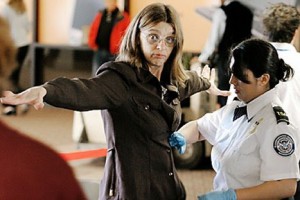
Over the past few years here in the US, there has been a severe backlash surrounding the usage of full body scanners and the resultant pat-down searches; for passengers who opt out of the body scan. Supporters of the body scans claim that they are necessary to weed out terrorists who might have dangerous materials such as plastic explosives that can't be detected by the traditional metal detectors strapped to their body. Opponents counter that both the body scans, and the pat-down searches are both violations of privacy and of civil liberties (citing the preclusion of search & seizure without due process in the US Constitution).

Lending credence to the latter viewpoint are the spate of incidents in which the TSA patted down "8-year old girls" and "old grandmothers in diapers," robbed passengers of thousands of dollars worth of equipment, and used the body scan images (which show the "private parts of passengers") inappropriately. So it was under this backdrop that I received my first pat-down search at Munich Airport while on my way back to the States from Switzerland earlier this year.

In the United States, passengers are typically given the option of either passing through the invasive body scanners mentioned above, or receiving a pat down search. However, in Munich, passengers connecting to US flights must pass through a special second security checkpoint at the entrance to the US section of Hall H on the top level of Lufthansa's Terminal 2. It was at this second security checkpoint that I received my very first pat-down search, ostensibly because Munich still lacks body scanners.

The security agent, in an admittedly stark contrast to the typical TSA agent, was courteous and professional, asking me the purpose of my visit (visiting family) and a few other questions such as citizenship and the like, before beginning to pat me down. He explained what he was doing at the beginning of the search, which put my (very slight) unease to rest, and then he actually patted me down. Beyond a little discomfort when he was searching my groin area, the actual search itself wasn't too bad; I had experienced worse before when entering a federal building.

After me came my younger brother, and the agent was once again very kind, explaining in even more detail what he was doing (my brother is 12 for comparison's sake). He went through almost the same routine for the actual search, but didn't touch my little brother's groin area, as he was a young(er) child.

And that was it; we collected our bags and went on our way. To be honest, I can't really see what was so bad. Of course the trademark European "customer service" and professionalism, as well as the civilized manner with which they treated my brother had something to do with my apathy. I'm sure if a surly TSA agent did a truly full body pat-down on my little brother, or even on my 76 year old grandmother, I'd be a good sight angrier.

I see the validity of the arguments about violations of privacy, but ultimately this is something that needs to be done for safety reasons. The TSA is really stuck between a rock and a hard place on this one; they are criticized for the invasive pat-downs and body scanners, but what happens if they withdraw these tools and some terrorist uses the opportunity to sneak plastic explosives onto a flight and blow a plane out of the sky? My guess is that the TSA would be criticized even more than they are right now.

My experience is particularly relevant because Australia appears to be adding full body scanners to its airport experience without the pat-down opt out. Would the pat-down search as I described it serve as a more humane alternative?

Readers, what are your thoughts on body-scanners and pat-down searches? Have you experienced the body scanners yet? Please do let us know via a comment.
Read more »

Yikes!!! Australian tester of Boeing 747 video system claims breaking in to the aircraft engine system

Boeing image. Boeing 747-8 Intercontinental.
At a time when every stakeholder, governments to airlines and airports on to tax-payers and everyone in-between is spending obscene amounts of money, loss of privacy, and other resources to make the skies safer, this story is downright scary.

The worst part of this story is that this vulnerability exists due to a lack of timely updating of operating system patches. May be the Australian Transport Safety Bureau (ATSB) should be black-listing this airline.

Dr. Craig S Wright GSE in Australia, on his blog claims he broke in to the engine control system of a Boeing 747 of a certain airline, while contracted to test their new video system.
A while back now, but many of the same systems are in place in the same way, I was contracted to test the systems on a Boeing 747. They had added a new video system that ran over IP. They segregated this from the control systems using layer 2 - VLANs. We managed to break the VLANs and access other systems and with source routing could access the Engine management systems.

The response, "the engine management system is out of scope."

For those who do not know, 747's are big flying Unix hosts. At the time, the engine management system on this particular airline was Solaris based. The patching was well behind and they used telnet as SSH broke the menus and the budget did not extend to fixing this. The engineers could actually access the engine management system of a 747 in route. If issues are noted, they can re-tune the engine in air.

The issue here is that all that separated the engine control systems and the open network was NAT based filters. There were (and as far as I know this is true today), no extrusion controls. They filter incoming traffic, but all outgoing traffic is allowed. For those who engage in Pen Testing and know what a shoveled shell is... I need not say more.
All I can say is YIKES!!!!! May be Unix gurus can elaborate a little more on this story.

A huge huge hat tip to Mary Kirby the Runway Girl for the heads-up on this story.
Read more »

How plane spotters are helping airport security in their battle against terror

Last week saw yet another dastardly attack against the citizens of India in general and Mumbai in particular. As per the Government of India, there was no prior intelligence warning of the Mumbai blasts.

Across the world, governments have realised the importance of involving and engaging the local community to ensure a flow of information, especially on strangers or unknown person entering that community. Almost any security agency including the police have a network of confidential informants.

Post the 1993 riots, the Mumbai Police had a policy of actively engaging "Mohalla Committees". Across North America in both the United States and Canada, voluntary "neighborhood watch" programs are an active deterent against crime. Surely there are similar programs across most countries.

Following the blasts, airports, like other sensitive installations across India, instantly went on high alert and security was beefed up. Just a couple of days before the blasts, we also saw a case where the Mumbai Police harassed a press photographer for taking a photograph of an airplane without first obtaining permission.

As an aviation enthusiast and plane spotter, it got me thinking ........

Instead of shunning and persecuting, would it not be better for the police and airport security forces across India to co-opt the voluntary services of aviation enthusiasts and plane spotters? Can this work for airports in India? How can this be achieved?

Enthusiasts and spotters are in many ways a local community to their airport. We understand, respect, and support, the need for airports to be safe and secure from malicious elements. Almost all of us have knowledge of airport operations, some of us, vast, and some of us, not so vast. In our quest to get good photographs or to see the planes or airports better we explore all around the airport, sometimes in areas not regularly patrolled by security.

Across the world, spotters have a universal credo. Observe, record, and report. As regular visitors to our local airport we are familiar with the daily routine and can quickly observe if something is out of the ordinary.

All these traits make enthusiasts and spotters valuable sets of additional eyes for a nation's security agencies entrusted with securing airports and their perimeters.

In many countries, airport authorities and security agencies have enrolled, enthusiasts and spotters in active volunteer groups who Observe, Record, and Report any suspicious activity to authorities while they participate in their favorite hobby of watching airplanes. The groups also keep a look out for activities like littering which attracts birds which are dangerous for airplanes, traffic blockages on access points to the airports, fires outside but in the vicinity of the airport, etc.

Volunteers are security screened and issued appropriate identification which helps security agencies distinguish them quickly.

In Canada, in cooperation with the Royal Canadian Mounted Police (RCMP), volunteers operate as Airport Watch Canada at the airports in the nation's capital Ottawa and the commercial capital Toronto.

In the United Kingdom volunteers of The Aviation Enthusiast Security Scheme (TAESS), of which I too am a member, operate in cooperation with the BAA Airport Security and the Metropolitan Police.

Similar efforts are underway in the United States at the local level.

In India, the authorities at Bengaluru International Airport took initiative and supported aviation enthusiasts who eventually formed the Aviation Photographers India Foundation.

Surely the Ministry of Home Affairs and the Bureau of Civil Aviation Security in cooperation with the Director General of Civil Aviation can take the success of these programs across the world and create a model for India which will only serve to strengthen security.

What are your thoughts? Is there anyone reading this post who can help take this idea up to the appropriate authorities?
Read more »

Enhanced security checks at Bangalore airport. Give yourself additional time.

There is a high security alert at Bengaluru International Airport till Friday. There are enhanced security checks across all stages of embarkation. This includes a very high level of pre-embarkation checks and secondary ladder point check. These checks have been mandated by various intelligence agencies who must have some credible risk perception.

Airines too are closing flights for check-in and commencing the boarding earlier to accomodate these additional security measures.

Please be a more considerate passenger. For the next two days, reach the airport 90 minutes before your flight to give youself some extra time. Carry the minimum amount of hand baggage and try and pack everything in to your checked-in baggage. Above all, please be patient and polite with the security staff. After all, they too are under stress and pressure.
Read more »

Priority boarding - lessons from AirAsia to IndiGo and SpiceJet and for airports from temples

AirAsia Airbus A320 9M-AHS Penang Bayan Lepas Airport MalaysiaAbout two months ago, I flew AirAsia, rather Thai AirAsia for the first time. I could help but compare their services with those of Indian low fare carriers IndiGo and SpiceJet.

There is a marked difference between AirAsia and the Indians. In some cases the Indians can learn, and some where AirAsia can learn.

In the air, the crew friendliness and overall no-nonsense, smooth, and, efficient operations, are common to all the three carriers. With ticket prices almost the same for similar distance flights, one can draw satisfaction that Indian low cost carriers are keeping up with AirAsia and doing in a very similar manner all the right things to keep bringing in and retaining the customers.

IndiGo airlines India Airbus A320-232 VT-INK Bengaluru International Airport print quality photo
But on the ground, especially at check-in, the Indians make a passenger feel far more welcome and valuable than AirAsia. It brings back the question -- in air travel what percentage is a transport business and how much is hospitality? Air Asia can learn from its Indian cousins -- you never get a second chance to make a first impression.

At both Bangkok Suvarnabhumi, and on the return at Hat Yai airport, the check-in staff insisted on weighing the hand-carry baggage to ensure it is below the weight limit of 7kgs. The actions of the check-in staff made me wonder what would be the case, if my cabin bag crossed the 7kg mark, since I had pre-paid for 15kg check-in baggage and my check-in bag weighed a mere 9kg.

SpiceJet latest Boeing 737-800 VT-SGG
One area which both the Indian carriers can learn from AirAsia, is the concept of priority boarding. All three carrier charge for for a seat in the front or exit rows. AirAsia and IndiGo charge about $7~$8 (THB250 or INR300), SpiceJet is a bit lower.

AirAsia incentivises the sale of these seats by offering priority boarding to passengers who purchase these seats, something, neither SpiceJet or IndiGo offer. In case of bus boarding when the aircraft in a remote bay, the priority boarding passengers are loaded in the first bus and sent ahead. The priority boarding adds only about three minutes to the entire boarding process but the impact on the customer is tremendous. Passengers who purchase these seats benefit from no boarding queues and empty overhead bins, and therefore look to repeat the experience in future trips. Those passengers who do not purchase these seats, look on those who do, with envy, and strongly consider buying these seats on their next trip. A double benefit for AirAsia seat selection sales.

Along with priority boarding, I started thinking what other "speed" benefits would passengers be willing to pay for? I wouldn't quite call it a divine inspiration, but what if airports in India would take an inspiration from the temples of India for their serpentine and often treacly slow security check queues.

Most major temples in India like Tirupathi Thirumala Lord Venkateswara, Vaishno Devi, and others offer a priority queue system for which hundreds of thousands of tickets are sold every year. The pilgrims who do not pay also get their darshan, it just takes a little while longer.

Could airports provision one or two "express security lanes" and sell tickets to these for Rs.250~Rs.500 a trip? I am sure it will be a hit with the frequent travellers. Many airports across the world already offer similar services.

In plutocratic airports where even government provides services only after payment of a fee (the Rs. 225 passenger service fee of which about Rs. 130 is paid to CISF for security), surely this is an idea whose time has come?  What is your opinion?

After all we experience preference due to cronyism, nepotism, gerontocracy, oligarchy, and aristocracy almost daily.
Read more »

Q.E.D. - Wrong security stamps on boarding passes

Last week I had discussed the need to review the requirement of Indian aviation security agencies of placing a stamp on boarding passes and hand luggage tags.

Many readers have commented about similar experiences and the frivolity of having such an archaic system which has become irrelevant in a modern world where threats are more insidious and require ever increasing levels of alertness from our security agencies.

To demonstrate how insignificant, security agencies treat the information on the stamp, a Bangalore Aviation reader sent in this picture.


Do you see the error?

The reader has travelled on April 8th, but the security stamp is dated April 18th -- six days in the future as of today. (Editors note: for privacy reasons the seat number, passenger name and airline sequence number have been erased)

The passenger travelled without a hitch, thank you. It appears that the CISF guard at the boarding gate was only concerned that a stamp was applied, and not with the accuracy of the stamp.

So what is preventing a terrorist from bypassing the security and attaching a hand-baggage tag which was stamped earlier?

Bengaluru International Airport has a very strong and fool-proof security system. If the security system is fool-proof and a person cannot bypass the security, then why need the stamp?

Quod Erat Demonstratum(QED).

It is time for the Bureau of Civil Aviation Security to encourage airports which invest in security by removing archaic rules to help them improve efficiency and become role models for those that have not.
Read more »

Right sizing and re-focussing airport security in India

Thanks to the increasing security threats, queues at security checks have become the bane of air travellers across the world. However, during my recent trip to Malaysia and Thailand, I found reasonably fast moving lines. In contrast, at peak hours across airports in India, we experience extremely long lines at security checks and a boarding process that moves slower than the thickest of molasses. On one particular early morning flight, it took me more time to cover the 200 meters from the ATC tower at Bangalore airport to the boarding gate than it took for me to cover the 55 kilometres to the airport.

The constant refrain we passengers hear from the CISF, the agency entrusted by India’s Bureau of Civil Aviation Security (BCAS) to enforce airport security, is of inadequate staff.

The main thing I observe is the excess deployment of CISF personnel at the X-ray, metal detector and frisking check point. Thanks to the rules mandated by BCAS this requires four CISF guards per lane, much higher than global standards. The insistence on a full body frisk adds to the check time, but is a good option in my humble opinion.

Not so good, is this archaic insistence on stamping everything from hand baggage tags to boarding passes. Hardly any other country in the world has this system.

In addition to burdening the CISF into deploying additional staff to check, then stamp, and then verify the stamp, the process appears to have given the CISF guards a form of tunnel vision. The entire security process now seems to be centred around "the stamp". A fifth guard is deployed at the boarding gate only to verify the stamps further delaying the boarding process.

While I was travelling out of Bangalore a few months ago, the CISF team at the X-ray point forgot to stamp one of tags of my hand baggage. I was made to trudge all the way back from the boarding gate just to get my bag stamped. The team at the X-ray point did not check my bag a second time, but just stamped my bag.

The very fact that only a stamp matters is, in and of itself, a very scary thought, implying that persons in the security process do not trust their predecessor in the chain. If the security chain is foolproof, then the very fact that a passenger is in the sterile security hold automatically implies he/she has been checked; in which case the stamp is immaterial. If the chain is not fool proof, then no amount of stamping will matter.

In a few months Indira Gandhi International Airport will inaugurate Terminal 3, one of the largest in the world with over 100 gates. What happens to flight timings if a passenger is made to walk all the way back from the furthest gate, which will be about half a kilometre to the security checkpoint just to get a stamp?

The CISF will insist that the event of security breakdown they can identify which guard checked the mischief monger. In the recent security flap when black powder was found on a Kingfisher aircraft, the security agencies first went back and reviewed camera footage, not bag tags, to ensure every passenger was checked.

It is time to right-size, re-focus, and use modern techniques. CISF staff currently deployed around "the stamp" should instead be used more productively to further enhance security by observing and profiling passengers. More than a bomb or knife, it is the predictable regularity of drunks getting aboard an aircraft and then creating havoc, that scares regular fliers.

This, the CISF claims, is the airlines' responsibility, not theirs. Should ensuring the safety of a flight by delivering a "sterile" passenger, be it a knife, gun, or bomb wielding terrorist or the equally out of control belligerent or drunk, not be the responsibility of the CISF?

Another pet peeve of mine is the fact that at almost all airports the gate is a double door. Yet the CISF guard will open only one door, block the other, and expect passengers to squeeze through the narrow gap. I just stop at the gate and tell them I am too wide. While this gets me a glare, it also opens the doors for me.
Read related article about the wrong stamp being applied to a boarding pass.
Read more »

How to: Avoiding thieves at airports and on-board flights

Steve Frischling, the author of Flying with Fish, has written two excellent and must read articles, for any traveller, on thieves at airports and on-board flights - yes even on board flights, thefts do occur.

He goes in to extensive details on how thieves operate and how best to avoid being a victim.

Article on airport thieves
Article on in-flight thieves

With the upcoming independence day weekend, many people are travelling, hopefully these tips will help you avoid being a victim.
Read more »