Showing posts with label Air Traffic Control. Show all posts

India's tallest Air Traffic Control tower, at Mumbai airport, inaugurated

By BA Staff

Mumbai's Chhatrapati Shivaji International Airport (CSIA), inaugurated India’s tallest ATC tower with a height of 83.8 metre and built within an area of 2,800 square metres.

The location and the height of the new ATC tower will enable the tower controllers to have unobstructed view of the entire operational area, which will help in optimizing air traffic separation and increase the traffic handling capacity at the airport.

The tower will be equipped with the latest technology including electronic flight strips which will soften the work load of the tower controllers, enhance safety and overall capacity of the airport.

The airport operating company Mumbai International Airport Limited (MIAL) is upgrading the air-side with new taxiways and rapid-exit taxiways to help reduce the time aircraft occupy the runway to further increase the ability of the airport to handle more flights per hour.

GVK CSIA awarded the iconic design and architecture project to Hong Kong based renowned architectural design firm HOK and international engineering design firm ARUP following a global architectural and engineering design competition. International lighting consultant Spiers and Majors were mandated for the innovatively designed lighting of the tower to bring out the sculptural qualities of the tower.
Read more »

BREAKING: Asiana Airlines 777 crash lands at San Francisco International Airport

[Last updated on 04:30 UTC]
by Vinay Bhaskara and Devesh Agarwal

Asiana 777-200ER Image Credit: Wikimedia
Earlier today, Asiana Airlines Flight 214 with service from Seoul Incheon Airport to San Francisco crash landed on arrival at San Francisco.

The flight was carrying 291 passengers and 16 crew members. Latest reports put the death toll at two.

Initial reports are that the aircraft had just touched down around 11:20 am local time, when the empennage was sheared off rear of the aft pressure bulkhead of the 777, and the tail, gear, and engine of the plane separated. The plane turned around nearly 180 degrees and came to a stop to the right of the runway facing eastwards. Photos show debris before runway 28L; implying that the aircraft hit the ground before making it over the runway. Passengers were evacuated before the aircraft caught fire. The National Transportation Safety Board [NTSB] has been dispatched to the scene to investigate.

Image of the crash from news outlet KTVU
The aircraft is a Boeing 777-200ER with registration HL7742. The aircraft, with line number MSN-29171 is powered by 2 Pratt&Whitney 4090 engines and is configured with either 296 or 300 seats on board and was delivered on March 7th, 2006. Asiana Airlines operates 9 Boeing 777-200ER aircraft in 6 different configurations.

291 passengers (19 business, 272 economy) and 16 crew members were on board, reports are that all  of the 307 passengers are accounted for. According to the San Francisco fire department, 2 people have been reported dead, with 230 injuries of some sort. However, in situations such as this crash, the numbers in terms of passengers According to Asiana Airlines, the passengers on board “were comprised of 77 Korean citizens, 141 Chinese citizens, 61 US citizens, 1 Japanese citizen.”

Asiana's official press release related to the incident can be found here. San Francisco International Airport has been updating the media constantly with intermittent press conferences as it can release information.

The incident is the first fatal incident involving passengers and a Boeing 777. The last (and only other) major crash of a Boeing 777 aircraft occurred on January 17, 2008, when British Airways Flight 38 crashed on arrival at London Heathrow after flying in from Beijing. However, on September 5th, 2001, a ground fire broke out on a British Airways 777-236 at Denver, and one re-fueling operative was killed.

Asiana flight 214 is the first airline crash on US soil since Colgan Airlines flight 3407 on February 12, 2009, which killed 49 passengers on a Bombardier Dash 8 aircraft. The last mainline crash in the United States occurred on November 12, 2001, when American Airlines Flight 587, an Airbus A300 crashed at New York's JFK International Airport, killing 265 (260 passengers, 5 on the ground)

The following picture from passenger David Eun shows passengers disembarking the aircraft, and the fuselage appears to be intact, though burning.

The following videos were taken by a passenger at San Francisco Airport


Videos credit to @360kid

The ATC feed can be heard here on the LiveATC site archive. Asiana 214 is given a landing clearance to runway 28L around 21m20s into the recording. The crash occurs around 22m02s. Shouting can be heard in the background of the tower controller's transmission at the time of the crash.

Image via Ben Sandilands showing emergency response
The airline put out a statement around 2130 UTC
The following information has been confirmed.

Asiana Airlines flight OZ214 (Aircraft Registration HL7742) departed Incheon International Airport on July 6, 2013 at 16:35 (Korea time) bound for San Francisco. Only July 6, 2013 at 11:28 (Local time) an accident occurred as OZ214 was making a landing on San Francisco International Airport's runway 28.

There were a total of 291 passengers (19 business class, 272 travel class) and 16 cabin crew aboard. The majority of the passengers were comprised of 77 Korean citizens, 141 Chinese citizens, 61 US citizens, 1 Japanese citizen, etc. for a total of 291 people.

Asiana Airlines is currently investigating the specific cause of the incident as well as any injuries that may have been sustained to passengers as a result. Asiana Airlines will continue to cooperate fully with the investigation of all associated government agencies and to facilitate this cooperation has established an emergency response center at its headquarters.

At this point no additional information has been confirmed. New developments will be announced as more information becomes available.

*For further information regarding OZ213/214, please contact 02-2669-4015 (for overseas calls : 82-2-2669-4015).
Read more »

Mumbai airport commences trials of automated ATC departure clearance system

The congested Air Traffic Control (ATC) system at Mumbai airport is under-going a major leap forward with trials of the SITA Departure Clearance System (DCL) through Data Link Communication (DLC).
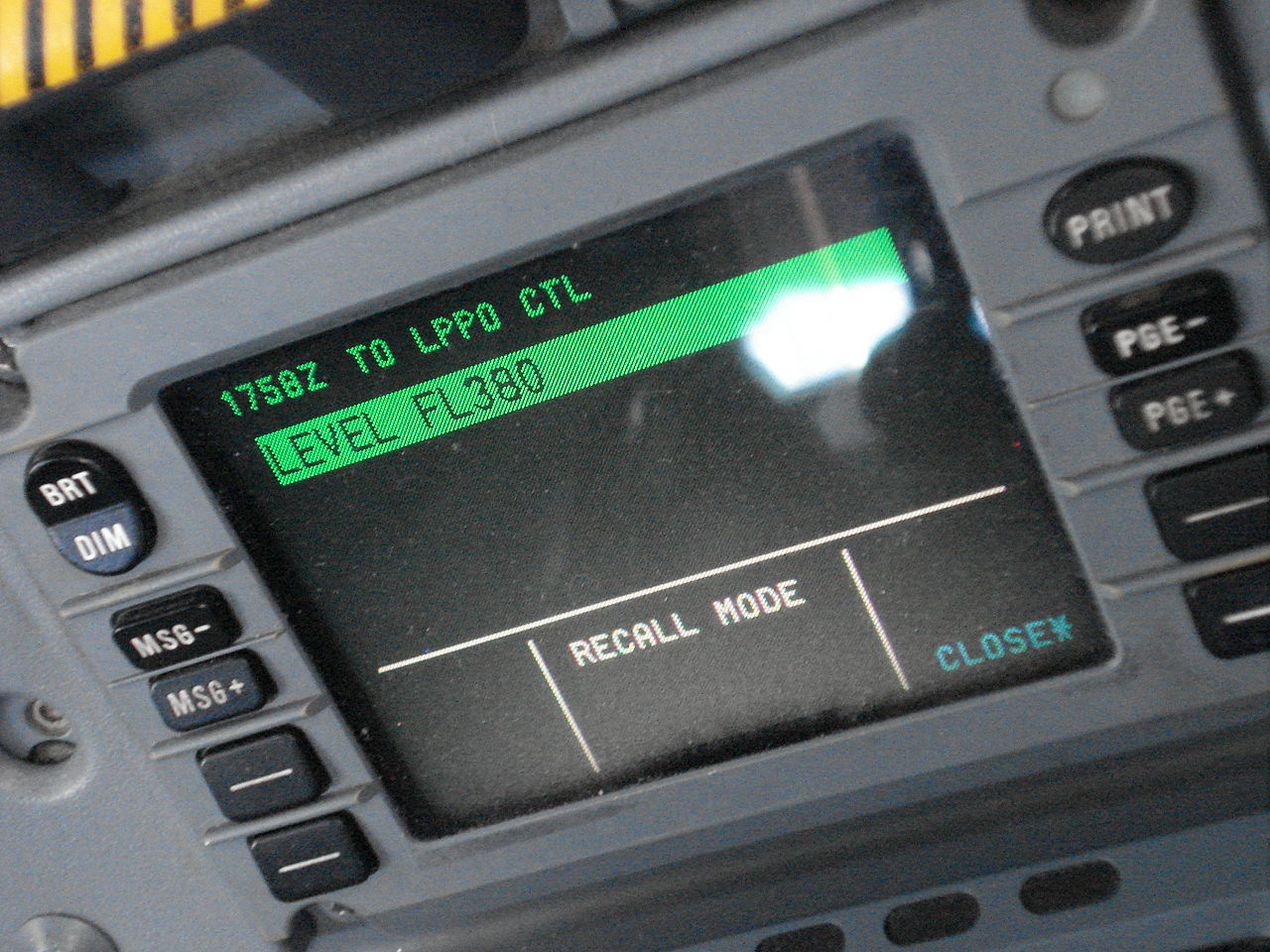
The Datalink Control and Display Unit (DCDU) the pilot interface for CPDLC messages. Image courtesy Wikipedia.
The Airports Authority of India (AAI) which manages civilian ATC operations across most of India, has begun has begun trial operations of Data Link Communication for pre-departure clearance. This new system is expected to significantly reduce workload of ATC controllers by automating the transmission of routine information like clearance delivery, Automatic Terminal Information Service (ATIS), meteorological (weather etc.) information (VOLMET) etc.  The system is supplied by SITA and its components at Mumbai are :
  1. PDC (Pre Departure Clearance delivery) through data link using ACARS (Aircraft Communications Addressing and Reporting System) capability.
  2. Centralised d-ATIS
  3. d-VOLMET
however, initially only the automated PDC system will be operated.
Read this SITA PDF document for more information on this technology.
Pre-departure clearance is an authorisation issued by ATC to a pilot regarding the runway to be used, route to be flown right from take-off to destination, including use of SIDs (Standard Instrument Departure), and cruising level that the aircraft is expected to maintain. The PDC system can be extended to include taxi information i.e. the route the aircraft is expected to take from its parking bay to the runway.

At present, pilots obtain their PDCs from the ATC through voice radio communication. The pilots then read back the entire clearance to confirm correct receipt of the PDC. (See and hear this clearance delivery at Long Beach airport in Los Angeles). This is a time consuming exercise leading to increased communication workload, along with having the potential of misunderstanding.

In the new system the pilot requests pre-departure clearance using the Flight Management Computer (FMC) in the cockpit. The request is transmitted via data-link to the air traffic controller (ATCO), who then selects the appropriate clearance sends the PDC back to the aircraft at the press of a button, again via an ACARS data link. At the aircraft, the PDC can be printed out.

Getting the information both on screen and print saves on both the radio chatter and time for both the controller and the pilot, and eliminates human errors enhancing safety and operational efficiency. For the passenger this translates to quick departures as pilots do not have to wait in a queue for obtaining clearance.

Image courtesy Wikipedia. 
In case you are wondering on the importance of clear communications between the pilot and controller, the worst accident in the history of aviation occurred on the ground, due to mis-understanding and mis-communication. 583 people died when a KLM 747 collided in to a Pan Am 747 at Los Rodeos Airport, Tenerife.

See a 84 minute video on this incident at the end of this article.

Kingfisher and IndiGo to benefit most
This system is dependent on the aircraft having the data link capability. Bangalore Aviation contacted the major domestic airlines to determine their fleet capability.

Air India confirmed that their wide body fleet i.e. Boeing 747-400 and Boeing 777-200LR and 777-300ER fleet is fully equipped up to a higher level of data link called CPDLC (Controller Pilot Data Link Communication) which is part of FANS. However their narrow body fleet Boeing 737-800 of Air India Express, and Airbus A319/A320/A321 of the erstwhile Indian Airlines is not equipped with any data link capability.

Kingfisher confirmed their Airbus A320/A319/A321 fleet is equipped to receive PDCs via ACARS. Their ATR-72 "are also capable of receiving PDC messages, when ACARS is activated."

Jet Airways, SpiceJet and IndiGo did not respond to our requests.


IndiGo advertises its use of ACARS, so it is safe to assume their aircraft will have the ability to benefit from this system. Airline sources indicated that SpiceJet aircraft are not equipped with data link, and technical airport sources indicated that narrow body aircraft at Jet Airways and Jet Airways Konnect may not have data link capability. It is not clear if Jet's wide-body aircraft are data link capable.

In addition to Mumbai, such Data Link Departure Clearance (DLC) systems are also being deployed at Delhi, Kolkata, Chennai, Bangalore and Hyderabad airports.

Sources at Bangalore Airport informed that the DLC system is already built-in to their Selex air traffic control equipment from the time of its delivery almost five years ago. It is awaiting activation pending some software updates from the manufacturer and a green light from the AAI operated ATC.

Read more »

The transition into Air Traffic Management continues with the AORRA

Editor's Note: This is a guest post from Ashwin Jadav

Global aviation is steadily progressing through the modernization of technological infrastructure into the new era of seamless air transportation. A major component of this transformation is a complete overhaul of the air traffic control (ATC) system within developed nations, ultimately resulting in the transition to air traffic management (ATM).

In modern-day flight operations, flight planners and dispatchers file a route or flight plan (FPL) using existing navigational infrastructure. The flight then flies the assigned trajectory which includes airways, waypoints, VORs and other nav-aids (as mentioned in the FPL). In the event of traffic congestion, adverse weather or any emergency, air traffic control (ATC) may choose to modify the aircraft’s route, thereby altering the FPL. Conversely, using a bottom-up approach, flight dispatchers could select their trajectory initially based on these factors and then fly the trajectory once approved by ATC. The concept of Random Routing, although not a brand new one, has evolved into a much broader concept called Air Traffic Management (ATM). A Random Route by definition is a trajectory that is picked prior to a particular flight based on traffic patterns, upper winds, weather forecasts, etc. for that particular flight. The benefits of this approach, however, are maximized on long-haul flights.

The Atlantic Oceanic Random Routing RNAV Area (AORRA) is one of the largest expanses of airspace that permits flights to fly without restricted ground navigational aids within its boundaries. It is located between the American and the African continents mainly in the Southern hemisphere. Although a revolutionary means for seamless navigation, the AORRA has not been able to fully utilize the potential of long range aircraft and provide maximum benefits. There were just a few entry and exit points (nav aids / waypoints) on the AORRA boundary via which an aircraft can enter or exit the airspace. In order to completely randomize the trajectory within the AORRA, an increased number of entry/exit “gates” were needed.

*Note: Area Navigation (RNAV) can be defined as a method of navigation that permits aircraft operation on any desired course within the coverage of station-referenced navigation signals or within the limits of a self contained system capability, or a combination of these.

Being two of the airlines that use the airspace most frequently, Delta Airlines and Emirates joined hands with the International Civil Aviation Organization (ICAO), the International Air Transportation Association (IATA) and the Civil Air Navigation Services Organization (CANSO) to initiate a pilot project. Delta’s focus was mainly on the Atlanta – Johannesburg long-haul route while Emirates concentrated on their Dubai – Sao Paulo route. The working group has successfully placed several waypoints on the AORRA boundary for flexible entry and exit. Further, resultant issues such as the intersection of the North American-African and Eurpoean-South American flight corridors were addressed. Since, giving flights additional flexibility would result in multiple possibilities of flight paths on these corridors intersecting, flight level rules were established. Due to the under-developed airspace structure of the African continent, the transition waypoints into/from the AORRA airspace were limited. The implementation of new airways connecting the domestic structure with the AORRA airspace was successfully completed in mid-2011. Finally, the working group presented a paper proposing the additional expansion of the AORRA boundary. The successful implementation of the proposal would bring the AORRA boundary closer to the African continent allowing aircraft to use existing ground infrastructure to aid navigation. The working paper presented at the South Atlantic Group meeting (SAT/16) can be found here.

Not surprisingly, other major air traffic management projects such as the U.S. Next Gen and European SESAR use trajectory optimization and flight flexibility as their foundation. Adding additional flexibility to such airspaces and implementing Random Routing could result in massive time and fuel (thereby CO2) savings for long-haul flights within ‘low density and permitted’ airspaces.
Read more »

Bangalore airport's hidden brain - the Airport Operation Control Centre

Sitting directly opposite the western-most arrivals gate, in plain sight and yet missed by most passengers is the hidden nerve centre of Bengaluru International Airport (BIA) - the Airport Operations Control Centre or AOCC in short.

The AOCC is the command, coordination and control centre for the whole airport which brings together the diverse processes relating to the three major operational areas -- passengers, baggage and cargo, and aircraft.

Mumbai's Chhatrapati Shivaji International Airport was the first AOCC in India followed by Hyderabad's Rajiv Gandhi International Airport. Despite not being the first in the country, the AOCC at BIA has leapfrogged all to become the first and only truly participative AOCC in the country, which in turn has helped the airport bag the prestigious CNBC-Awaaz award for the best managed airport in India.

Genesis of coordination
At any airport in the world there are three main processes i.e. passengers, baggage and/or cargo, and aircraft. Within each main process there are plenty of sub-processes and there are overlap between all the processes. Multiple agencies are involved. Airlines, ground handlers, cargo handlers, fuelling, air traffic control, terminal operations, maintenance, security (airline, terminal, airside, land-side, airport), parking, sovereign functions (customs, immigration, commercial taxes, etc.), VIP handling, etc. The list is very long. Even with the high levels of standardisation prevalent in aviation industry, these are at a macro level and each agency as an individual organisational unit, has their own methods of doing a given process.

For example, Air India carries a fire extinguisher with the push back tractor while an airplane is starting its engines. Since BIA is equipped with a fully functional ARFF (Air Rescue and Fire Fighting) station which calls for a maximum two minute response time anywhere in the airport, this is not necessary, but given the numerous small airports Air India operates at across India and the movement of staff, one can understand the standardisation of the process within Air India.

Each organisation at the airport has its own objective and goals, and sometimes this impacted the overall process or sub-process. There was no common focus and the ultimate loser was the customer -- the passenger or the air freight user.

Each country took are different approach to this free for all situation. Some acknowledged the problem and took coordination action, some did not acknowledge the problem at all. The United States acknowledged the problem and tried to fix it by regulation. In India, in true government style, the problems were acknowledged by the Airports Authority of India, but no action was taken.

Genesis of the AOCC
Thanks to relative small (geographically) countries, married to big national egos, air traffic control in western Europe was a mess. Most of Europe acknowledged the coordination problem and in 1963, Eurocontrol was created. Everyone involved in air traffic management was put in to a room and forced in to collaborative decision making (CDM), which required everyone to take decisions keeping the other's constraints in view, and also created a central flow management unit (CFMU)

Airport operators across Europe modified the collaborative decision making (CDM) philosophy used by Eurocontrol, for airports calling it airport CDM (ACDM), and began the start of the AOCC using a as we know it today. Bengaluru International Airport, with its airport management from Zurich airport, has implemented the European style of AOCC.

It is important to note, due a variety of reasons, mostly because there was no European Union at the time, there was no government regulation forcing the collaborative decision making or the AOCC, the whole process was voluntary participation.

In contrast, the United States with a large monolithic land mass and a massive aviation industry, which allowed for common regulation, has gone on to develop very advanced central flow management units at airports which function using collaborative decision making at extremely advanced levels, enabling some of the highest infrastructure utilisation levels in the world.

Be it the collaborative model of Europe, or the mandated model of the United States, the common thread across all AOCC's is information. All information is the same, and all stake-holders put their inputs and information in to a common repository and each stake-holder takes out their piece(s) of needed information resulting in better decision making, lower disruptions, and seamless operations. All of this is done on a real-time basis.

The BIA AOCC
As expected there was complete apathy in India to the concept of collaborative decision making. It was not limited to only the sovereign functions like security, customs, immigration, security and air traffic control, but also airlines, since most of them do their own ground handling.

The Airport Operations Control Centre at Bengaluru International Airport
The Unique Zurich airport management team commenced the Bengaluru International Airport Airport Operations Control Centre with two main objectives in mind.

A. Ground Objective
Synchronise all processes and sub-processes that happen on the ground to ensure a well structured slot allocation mechanism.

B. Air Objective
Establish an on-ground control centre for the air.
  1. Improve air space management which depends on accurate demand forecasting and ground resource availability information.
  2. Since current information sharing was weak, establish coordination between the AOCC and the Air Traffic Control (ATC) to improve and maximise efficiency on air operations and slot allocations.
Keeping to European traditions, the BIA AOCC is based on voluntary participation in the airport collaborative decision making (ACDM) process.

Contrary to popular expectation, the one airline that was gung-ho on ACDM and has participated in the AOCC from day one is, Air India. Air India already had a well established internal coordination cell, similar to the AOCC but at the airline level. This cell used to coordinate all the various internal department to ensure flight operations.

After Air India, Kingfisher joined the AOCC and after that Jet Airways and JetLite. IndiGo has joined the AOCC only about a month ago on a trial basis.

Foreign carriers are handled by the dedicated ground handling companies Air India-SATS (AI-SATS) or Globe Ground India (GGI), both of whom participate in the AOCC.

The AOCC today covers 80% of domestic flights and 100% of international flights at the airport.

Operations
The AOCC commences its macro level planning at a seasonal level. In the aviation world, October 28 marks the start of northern winter season, and March 28 the northern summer. For the season the AOCC stake-holders and air traffic control gather and discuss and prepare a high level operations plan which includes full operational details including slot allocations, etc.

Click on this picture for a high resolution view which shows the real-time planning and monitoring screens. 6MB file.

These high level seasonal plans are used as a master-plan to perform daily operations plans. The plan covers all operations from 05:00 local to 04:59 the next morning. Each morning, while we are snug in bed, at 03:00 (yes, 3am), the stake-holders gather and discuss the daily operations plan and if there is anything out of the ordinary. May be a new aircraft which requires a water cannon salute, or may be a VIP, who most Indians regard as a very intrusive person (sic), or a special aircraft movement like the behemoth Antonov An-124.

This daily operations plan is then monitored on a real time basis, minute by minute for GMPT (ground milestones performance timing):
  • Plane off-block at origin station (removed from chocks)
  • Estimated Time of Arrival (ETA)
  • Plane airborne at origin station
  • Plane entering BIA airspace (50 nm out)
  • Plane TMO (ten [nautical] miles out)
  • Plane touchdown at BIA runway
  • Plane on-block at BIA (chocks placed) also called Actual Time of Arrival (ATA)
Airport ground resources such as parking stands are allocated on a dynamic basis based the various GMPT inputs. The GMPT also allow airlines and ground handlers to allocate staff and ground handling equipment, sovereign functions like customs to allocate staff, and cargo terminals to plan loading and off-loading of cargo.

Once the aircraft is on-block another set of ground metrics are monitored to measure and ensure maximum efficiency of the airport. These include timings of:
  • Aircraft on block (chocks on, engines off)
  • Disembarkation start ~ disembarkation complete
  • Baggage off-load start ~ complete
  • First bag on baggage collection belt ~ last bag on belt
  • Cleaning start ~ complete
  • Fuelling start ~ complete
  • Catering start ~ complete
  • Baggage loading start ~ complete
  • Embarkation start ~ complete
  • Aircraft doors closed
  • Aircraft off-block
  • Aircraft airborne
The end result. Bengaluru International Airport has been adjudged as the "best managed airport" in the country. On time departures are above 94%, one of the highest in the country, while on time arrivals still lag at around 76%. "On time" is considered within 15 minutes the scheduled time of arrival or departure.

Airlines love Bangalore. Thanks to the AOCC, the synchronisation and resultant efficiency are so high that the airport helps airlines recover about 85% of their delayed flights. i.e. if a flight arrives 20 minutes behind schedule, the following flight of the aircraft leaves Bangalore only 5~10 minutes behind, helping the airline recover those precious 10~15 minutes.

Passengers love Bangalore since their baggage arrives on the belt typically within seven minutes of "on block" for domestic flights and they can leave the airport quickly.

The owners love the AOCC since it improves the bottom line while happy airlines operate more flights and help improve the top line.

The future
Indranil Gupta, who heads airside operations at BIA and the AOCC, is optimistic. His goal is to take the AOCC beyond the ACDM model in to Total Airport Management (TAM). Something akin to Total Quality Management practised by global leaders in manufacturing, the TAM model will fine tune the synchronisation of all airport operations and tie-in all air and ground processes along with all stake-holders in to a complete chain all the way to back-end systems like yield management, airspace management, etc.

The ultimate goal is to implement SWIM or system wide information management, which also happens to be a key component of the Next Generation Air Transport System the United States plans to implement between 2012 and 2025.

In case Bangalore Aviation readers would like to visit the AOCC, please leave a comment. We cannot promise for sure, but we will try and organise a trip if possible.
Read more »

An incident filled week at Bengaluru International Airport

The past week has been an incident filled "odd" one for Bengaluru International Airport (BIA).

On Monday (day 1 of the week), a Kingfisher Airlines Airbus A320 skidded off runway 27 in rain and high winds and damaged runway lights and its landing gear, forcing the airport to shut down the runway during the peak international flights period for an hour.

On Wednesday (day 3), an Emirates airline decided to repeat the Kingfisher incident. In a torrential tropical thunderstorm with high crosswinds the flight crew decided to land on runway 27. The extremely hard landing caused the airplane to bounce back up in to the air where a 30 knot gust of crosswind caught it and forced it to the left -- way left. While the captain was throttling up the engines for a go-around, the plane was headed straight for the ATC tower more than 500 meters to the south of the runway. People at the kerbside of the terminal were shocked to see and hear the plane thunder overhead banking severely right and narrowly missing the tower. After a successful go-around the pilot declared emergency fuel and make a priority landing.

Today morning, Friday (day 5), the radar system at the airport failed, forcing the controllers to resort to manual control. The peak hour naturally produced a huge traffic jam in the skies forcing quite a few flights to divert to Chennai. Its such a tragedy that a perfectly functioning airport, HAL, just a few miles south of BIA, is not used as an alternate airport by the airlines -- something I had proposed way back in June 2008.

Lets just hope day 7 goes off without any further incidents.

Incidentally, Kingfisher and its MRO crews must have worked overtime to repair VT-KFT since I caught a picture of it yesterday late at dusk coming in to land on runway 27.

Kingfisher_Airlines_A320_VT-KFT

For some more images check out my gallery at Planeppotters.net. In addition to some really classy images, it has one of the most comprehensive airline databases around.

In closing, Airbus A380 MSN017 the fifth for Emirates A6-EDE will be delivered today and will leave Hamburg today at 1900 for Dubai.
Read more »

JetLite flight forced to make three landing attempts due to faulty ILS at Delhi airport

A Jetlite Boeing 737-800, registration VT-SJH performing flight S2-320 from Kolkata to New Delhi with 140 persons on board, was forced to make three landing attempts due to weather and a fault Instrument Landing System at New Delhi's Indira Gandhi International Airport.

The flight was on approach to New Delhi's runway 29, when a thunderstorm went into its final approach and landing path. The crew aborted the landing and requested for a different runway.

Air Traffic Control (ATC) vectored the aircraft for an ILS approach to runway 11 (the opposite side of runway 29). However, when the crew attempted to intercept the ILS localizer on runway 11, the ILS was found to be malfunctioning.

Air Traffic Control then instructed the pilots to swing over to runway 10. However, while the airplane manoeuvred to align with runway 10, Air Traffic Control reported that the ILS on runway 11 was now working.

The airplane finally landed on runway 11 on the third approach 20 minutes after the first approach attempt.

JetLite refused to answer my queries if they have lodged any complaint or protest about the malfunctions with either the Airports Authority of India (AAI) whose controllers operate the ATC or with the airport operator Delhi International Airport Limited (DIAL). They issued me this statement
"Due to weather detected on the aircraft weather radar S2 320 requested a runway change from R/W 29 to R/W 11. While the aircraft was being vectored for an approach to R/W 11, non-availability of the ILS (Instrument Landing System) of R/W 11 necessitated the change of the approach to R/W10. However, during the approach to R/W 10 a downgrade of the R/W10 ILS and subsequent availability of R/W 11 ILS resulted in the approach and landing being made on R/W 11. The changes in the approaches did not result in any go-arounds."

METARS:
VIDP 291300Z 00000KT 3500 HZ SCT035 FEW040CB BKN090 23/19 Q1010 TEMPO TSRA
VIDP 291230Z 18005KT 3500 HZ SCT035 FEW040CB BKN100 23/19 Q1009 TEMPO TSRA
VIDP 291200Z 18006KT 3500 -DZ SCT035 FEW040CB BKN100 23/18 Q1009 TEMPO TSRA
VIDP 291100Z 18005KT 3500 HZ SCT035 FEW040CB BKN100 26/17 Q1009 NOSIG
VIDP 291030Z 20005KT 3500 HZ SCT035 FEW040CB BKN100 26/17 Q1009 NOSIG
VIDP 290930Z 31005KT 2800 TS SCT035 FEW040CB BKN100 27/17 Q1010 BECMG 3000
VIDP 290900Z 28003KT 2800 HZ SCT035 FEW040CB BKN100 28/17 Q1010 NOSIG
VIDP 290830Z 01005KT 2600 HZ FEW035 FEW040CB BKN100 28/17 Q1010 NOSIG
VIDP 290730Z 32005KT 2800 HZ FEW035 FEW040CB BKN100 27/18 Q1010 BECMG 3000
VIDP 290700Z 34005KT 2800 HZ FEW035 FEW040CB BKN100 27/18 Q1011 NOSIG


Thanks to Simon Hradecky at Aviation Herald for the tip.
Read more »

The heart of Aero India 2009

The Aero India 2009 continues to draw large crowds, and for today and tomorrow, a huge crush of footfalls is expected.

Aerial displays in the morning and afternoon sessions are as spectacular and breathtaking as in any major air show held worldwide. While the public focusses on the magnificent flying machines and their daredevil pilots, they remain blissfully unaware of the singular edifice that facilitates and coordinates all the flying activity – the Air Traffic Control (ATC) - the heart of the air show, at Air Force Station (AFS) Yelahanka (VOYK).

Activity at the ATC begin before dawn and continue well beyond dusk. As the premiere training station for all Indian Air Force (IAF) transport wing, AFS Yelahanka, is one of the busiest military airfields in the country. Not only does it handle over 60,000 movements annually, it also has to contend with two major airfields - Bengaluru International Airport (BIA), just 4 nm to the north, and the HAL airport 10nm south. A task well handled by Chief Operations Officer (COO), Wing Commander N.V.M. Unnithan and his team.

Assisting him and bristling with activity, a 24x7 manned 'Base Operations Room' controls all aspects of the flying and coordinating with various agencies including 'flying display director', routine movements, VIP protocol, ground handling agencies, BIA, and HAL remains fully operational at the ATC tower.

While an anxious F-16 pilot, USAF Lieutenant Mike Benson, coordinating the flight schedule of the C-130 Hercules, was happy after the arrangements were explained by the COO, Captain Uphoff and Lieutenant Michael Schumacher (just a coincidence) of the German Air Force's Fighter Wing-73, technical team members of the Eurofighter Typhoon dropped by to thank the officials at the ATC, a gesture symbolic of the universal spirit exemplified at the air show.

Preparations began six months in advance. Coordination meetings were crucial as Aero India 2009 was the first air show since the opening of new airport (BIA) last year. With a lateral separation between the airfields of just 4.3 nautical miles it was imperative to halt all civilian flights at BIA during the air displays. Most visiting aircraft of the IAF had to be housed at HAL due to the space constraints at Yelahanka. There is full cooperation between all the three airports and the flight displays are going perfect as expected.

The proximity of the flight paths at Yelahanka and BIA is demonstrated by this photograph of the F16IN SuperViper by my photography guru and guide, Praveen Sundaram a.k.a. Photoyogi. Do take the time to check his photo-stream.

Significant improvements in airfield infrastructure, resurfacing of the taxi-track, airfield links, refitting of the runway lighting, drainage of the 8,500 feet long runway were completed in just four months, ahead of the show, as per senior ATC officer, Wing Commander Sunil Ninan.

Seated on the console panels in a glass-encased environment, the cool demeanour of the five ATC officers manning the consoles betray little of the highly stressful role the controllers undergo. The banner displayed at the entrance says it all - 'You are about to witness the most stressful profession in the world'.

While many in Indian commercial aviation complain about the accents of expatriate pilots, at Aero India there are many pilots from different countries, speaking in different accents, and the ATC controllers are equally adept at picking up the nuances, ensuring unambiguous and crystal clear communication between the pilots and ATC.

Flight safety remains paramount; all flight paths including the aerial displays, and restrictions are designed with risk mitigation in mind. AFS Yelahanka has the township of Yelahanka to the south, and is bounded to the north and east by BIA and its resultant development.

In an effort to restrict the bird activity especially during the flying displays that are flown at low-levels, adequate aerial surveys were done in the period leading to the air show. Ten 'bird scare' teams mounted on specially procured silent electric bikes prowl the entire airfield with double-barrel guns in the airfield area. In addition, 'whistlers', a pyro-technique device emitting high frequency, high-pitch sound that irritate the birds are being effectively used.

Closure of the fish, poultry, and meat markets in the near vicinity on specified days and covering water bodies (lakes and ponds) with nets are some of the initiatives undertaken by the IAF personnel at the base.

Despite these steps, birds are present in plenty, and BBMP officials have to get serious about sanitation and open-air meat markets in the Yelahanka, Devanahalli and Ejipura area

The meteorological forecasts during the air show got a boost with the installation of a 'Numerical Weather Prediction Module' enabling 24-hours observation watch, and 18-hours forecast watch, informed Wing Commander VK Choudhary, senior Met Officer at the base.

We have to applaud the efforts of all the people involved. From the policeman at Hebbal flyover, ensuring traffic gets to AFS Yelahanka quickly, to the IAF personnel at the base, the exhibitors, the display teams, pilots, and support crews, the government, and the organisers. It is a herculean effort executed with seamless precision and complete cooperation. Last, and certainly not the least, I hats off to the tireless efforts of the entire team at the Confederation of Indian Industry (CII), led by Greeta Varughese and Sourav Narayan Biswas. They have all been working 20+ hour days for the last two weeks, to ensure the show is an unbridled success it is.

Stay tuned for a photo-essay........
Read more »

Technical glitch at Air Traffic Control hits Frankfurt airport

Frankfurt airport, one of the busiest in the world, was shut down for 50 minutes this morning, due to a technical glitch in its Air Traffic Control.

The airport, was shrouded in fog, and the data transmission from the German weather service and the ATC broke down between 0635 and 0725, as per a spokesman for air traffic control.

This forced a cancellation of all flights in and out.

Airport operator Fraport reports 38 departing flights and 37 arriving flights. 25 flights already in the air, mostly long distance flights en-route to Frankfurt, were diverted to Cologne and Stuttgart airports.

The stoppage, caused significant downstream disruptions which took almost half the day to clear up.
Read more »

Air travel control systems modernised at major airports

According to a PIB release, at a recent parliamentary session of the Rajya Sabha, Minister for Civil Aviation, Praful Patel informed that major work in modernisation of Air Traffic Control System (ATCs) has been undertaken at Delhi, Mumbai, Chennai, Kolkata, Hyderabad, Trivandrum, Mangalore, Bangalore, Nagpur, Ahmedabad, Varanasi and Guwahati.

The expenditure incurred by Airports Authority of India (AAI) on the modernisation of the Communication, Navigation and Surveillance and Air Traffic Management systems (CNS / ATM) during the last three years is as follows: (Rs. 5 Cr. = 1 Million)
  • for the year 2005-06, Rs 118.20 crores;
  • for the year 2006-07, Rs 66.15 crores;
  • for the year 2007-08, Rs 200.71 crores.
After the installation of modern navigational/landing aids, increase in the handling capacity of airspace and airport, enhanced safety, reduction in delays in flight, saving of fuel and thus minimisation of adverse affect on environment, have been observed. Other benefits accrued include uninterrupted operation of flights through airports during the periods of poor visibility, monitoring of aircraft movements in avoiding over-flying over the restricted and prohibited areas and more effective and efficient monitoring of runways during periods of poor visibility.

Patel informed that Monopulse Secondary Surveillance Radars (MSSRs) have been installed at Delhi, Mumbai, Chennai, Kolkata, Trivandrum, Guwahati, Nagpur, Mangalore, Ahmedabad, Bangalore, Hyderabad, Behrampur and Varanasi, by the AAI, at a cost of Rs 229 crore.

MSSR provides position, distance, call sign and altitude of the aircraft and data link between controller and pilot. It also provides seamless surveillance over territorial airspace by filling the radar coverage gaps for smooth and efficient air-traffic flow.

New Delhi, and Mumbai will be installing a GBAS navigation system similar to the one proposed at Newark Liberty airport, by 2010.
Read more »

A video and audio tribute to Air Traffic Controllers (ATCOs)

Air traffic control is one of, if not, the most stressful job in the world. Air traffic control officers (ATCOs) have to be constantly on the alert, even when pilots make a mistake. We as passengers never hear of their deeds, only of their mis-deeds. In a tribute to ATCOs around the world, I present a collection of videos and audios.

We begin with a happy ATCO at JFK airport in New York.


Humour is always a good stress buster, and mothers-in-law appear to be a globally common source of pain, as this conversation between a JFK ATCO and a Virgin Atlantic flight demonstrates.


About a year ago, there was extreme commotion in the Indian skies with ATCOs bitterly complaining about the expatriate pilots, and their lack of English language skills, the universally accepted language of the skies. This audio exchange between Air China 981 and JFK ATC demonstrates the language problem.


Sometimes it is the accent or idioms of the ATCO that pilots do not understand. Given the busy conditions at most airports, it leads to confusion, then irritation, and anger, as we hear in this conversation between Etihad 503 (UAE), Asiana 222 (Korea) and a JFK ATCO.


And then there are times, where pilots really screw up and need to be rescued, as this re-creation of a scary incident at Providence, Rhode Island.


And as a closing, I am sure you too will feel sorry for this JFK ATCO, who is having a really bad day in the office.


So please take some time, and send a thank you letter to the ATCOs at your local airport.
Read more »