Showing posts with label American Airlines. Show all posts

American Airlines to buy up to 70 CRJ900 NextGen regional jets

by Devesh Agarwal

CGI of CRJ900 NextGen in American Eagle livery.
Bombardier Aerospace of Canada and American Airlines Group Inc., of Fort Worth, Texas have signed a firm purchase agreement to acquire 30 CRJ900 NextGen aircraft along with options on an additional 40 aircraft.

Based on the list price for the CRJ900 NextGen aircraft, the firm order contract is valued at approximately US$1.42 billion and could increase to approximately US$3.38 billion if the 40 options are converted into firm orders.

American Airlines becomes the first customer to acquire the newest version of regional jet which has an improved fuel burn of four per cent with the “NextGen” package enhancements. Improvement to the aircraft’s engines and ongoing weight reduction initiatives, which include upgraded avionics, will offer a further reduction of up to 1.5 per cent.

Including the American Airlines order announced today, Bombardier has recorded firm orders for 1,812 CRJ Series aircraft, including 339 CRJ900 and CRJ900 NextGen aircraft. Worldwide, CRJ Series aircraft are in service with more than 60 airlines and more than 30 customers operate corporate variants of the aircraft.
Read more »

US August passenger airline employment down 2.2 percent

By BA Staff

U.S. scheduled passenger airlines employed 380,328 workers in August 2013, down 2.2% from a year earlier, as per the U.S. Department of Transportation’s Bureau of Transportation Statistics (BTS) reports. August was the 12th consecutive month that full-time equivalent (FTE) employment for U.S. scheduled passenger carriers was below that of the same month of the previous year.

Scheduled passenger airline categories include network, low-cost, regional and other airlines. 

The decline in FTEs may be due, in part, to two factors.  First, American Airlines, the industry’s third largest employer, filed for bankruptcy in November 2011 and reduced FTEs by 7.2% year-to-year. Second, network carriers have experienced increased fuel costs and have reduced contracts with the regional airlines that operate less fuel-efficient regional jets.  Regional airline employment is down 5.1 percent year-to-year.

The five network airlines that collectively employ two-thirds of the scheduled passenger airline FTEs reported 2.5% fewer FTEs in August 2013 than in August 2012, the 13th consecutive month with a decline from the same month of the previous year. Delta Air Lines reduced FTEs by 4.2%, and American Airlines 7.2%. United Airlines increased 0.2% FTEs, US Airways increased FTEs by 2.8% and Alaska Airlines by 3.1% from the same month a year earlier. Network airlines operate a significant portion of flights using at least one hub where connections are made for flights to down-line destinations or spoke cities.

Of the six low-cost carriers, half i.e. Spirit Airlines, Allegiant Airlines and JetBlue Airways - reported an increase in FTEs while the other half, Frontier Airlines, Southwest Airlines and Virgin America, reported a decline. Low-cost airlines operate under a low-cost business model, with infrastructure and aircraft operating costs below the overall industry average.
Read more »

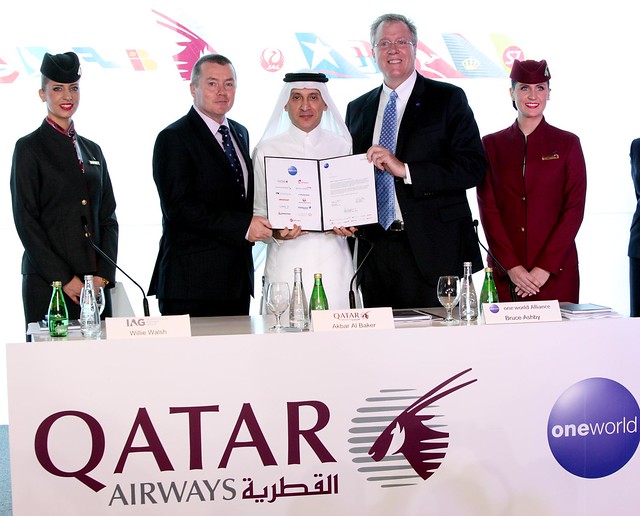
Qatar Airways joins oneworld alliance

by Devesh Agarwal

Flag carrier Qatar Airways becomes part of oneworld® alliance at midnight Doha time tonight, becoming the first carrier from the burgeoning Gulf region to join join any airline alliance. Qatar also joins fellow middle-east carrier Royal Jordanian which is a member of oneworld.

QR633 which departs from Bangladeshi capital, Dhaka for Doha at 03.15 local (00.15 Doha time) and QR1166 from Doha for Riyadh, leaving five minutes later at 00.20 Doha time, will the first flights of Qatar Airways as a oneworld member.

The airline completed its induction procedures within just one year, compared to the typical 18 to 24 months taken to join an alliance.

Qatar Airways, which serves more than 130 destinations in 70 countries will bring 20 of its destinations and five countries – Ethiopia, Iran, Rwanda, Serbia and Tanzania – to the oneworld map. The airline will bring more one-stop transit options for passengers flying between Asia and Europe or between Asia and Africa hitherto less available or unavailable within the oneworld network.

oneworld livery

image courtesy oneworld®
At a ceremony to mark its entry into oneworld, held at Hamad International Airport, which is to be Qatar Airway's new base in the future, the airline “unveiled” the first aircraft in its fleet to be decorated in a special oneworld livery, Boeing 777-300ER registration A7-BAA.

Its distinctive design features “oneworld” in blue letters some 6 ft (2 metre) high along a white fuselage and the airline’s standard tailfin. The airline will decorate three other aircraft in its fleet in this special livery – another 777 and two Airbus A320s.

Starting tonight, oneworld logos will be applied by the side passenger entrance doors on Qatar Airway’s entire fleet of 130 aircraft as part of a massive rebranding programme that will also see the alliance logo added virtually wherever the Qatar Airways name is displayed – at airport check-in desks and signage, on its website, tickets, boarding passes and all items of stationery.

Frequent flier programme

All cardholders in the airline's Privilege Club frequent flyer programme are being sent new membership cards, bearing the oneworld logo and “gemstone” tier indicator. Platinum cardholders will have Emerald status in the oneworld programme, Gold will be equivalent to oneworld Sapphire and Silver will be oneworld Ruby.

The airline is offering a ‘Double miles’ offer to frequent flyer members to celebrate its induction into the alliance. Privilege Club members will receive double Qmiles award miles when flying on Qatar Airways and its oneworld partners between 15 November and 31 January (except between 20 December and 5 January), and (till 24 January for Cathay Pacific). Likewise, oneworld member frequent fliers will receive double mileage when flying Qatar. Please visit the respective airlines' websites for specific information.

Premium passenger terminal only for revenue passengers

Doha Premium Passenger Terminal. Photo © Devesh Agarwal.
From midnight tonight, Privilege Club Platinum and Gold members will be able to access more than 550 airport lounges worldwide offered by oneworld member airlines when they fly with one of the alliance’s carriers.

Qatar Airways’ First and Business Class passengers will also be able to use oneworld partner airline lounges. As oneworld Emeralds, Privilege Club Platinum cardholders will be able to use First Class lounges, where available, and receive an additional baggage allowance and access fast tracks through departure security at select airports.

However, the reciprocation at Doha is not quite equitable. The airline in a release stated that oneworld elite tier passengers flying in economy class would be provided basic lounge facilities in the main terminal at Doha. The premium terminal will be reserved for revenue first and business class passengers only.
Facilities at Qatar Airways' Premium Passenger Terminal at its Doha hub will continue to be accessible only by customers holding First Class or Business Class tickets on Qatar Airways.

What does Qatar's induction mean for India

Qatar Airways as of now is the second largest international carrier to India, with 100+ weekly flights. Earlier this year, Malaysia Airlines joined oneworld, and SriLankan will join the alliance early next year, thus ring-fencing the sub-continent.

In one fell swoop, oneworld now will become the dominant alliance operating in India, and will be a credible alternative to the Star Alliance. Qatar offers competitive connections to most of Europe, and existing members British Airways and Finnair will definitely feel the pinch. Similarly, connections to Africa, and South America, will make joining the alliance interesting for the frequent flier. As of now, the two best frequent flier programmes within the oneworld alliance appears to be American Airline's AAdvantage, and British Airway's Executive Club.

Indian carriers are still dilly-dallying about joining an alliance. Kingfisher was to join oneworld, before its financial implosion. For some unknown reason Air India wants to join only Star, even if the alliance will not have it. With Etihad now in control of Jet, there is no way, it will join oneworld thanks to opposition by Qatar and Royal Jordanian. Turkish would like to keep Etihad out of Star, leaving SkyTeam, where Etihad already has a strategic alliance with Air France-KLM.

oneworld’s biggest membership expansion drive

The addition of Qatar Airways represents the latest landmark in oneworld’s biggest membership expansion yet. Other elements elsewhere in the world include:
  • The addition of Malaysia Airlines, strengthening oneworld’s position in South East Asia.
  • The induction on 1 October 2013 of LAN Colombia, the second largest airline in South America’s second biggest economy.
  • The transition to oneworld on 31 March 2014 by TAM, the leading airline in Latin America’s leading economy, Brazil, with its Paraguayan affiliate to be added soon afterwards. This will complete the consolidation in oneworld of all the passenger carriers in LATAM Airlines Group, the region’s leading airline company, building on oneworld’s position as the leading global airline alliance serving Latin America.
  • The introduction early next year of SriLankan Airlines, as the first airline from the Indian subcontinent to join any global alliance, which, with Qatar Airways, will make oneworld the leading alliance in the region.
  • The proposed switch by US Airways from Star to oneworld as part of its planned merger with American Airlines, subject to necessary approvals.
Read more »

Qatar Airways to fly to Miami from June 2014

by Devesh Agarwal

Image courtesy Qatar Airways
Flag carrier, Qatar Airways, has announced Miami to be its sixth destination in the United States with flights beginning June 10, 2014.

The airline will offer four non-stop flights a week from Doha using a Boeing 777-200LR aircraft in a two class configuration with 42 lie-flat seats in business class, and 217 seats in economy.

The proposed schedule dove-tails well with flights to the Indian sub-continent, which arrive in to Doha early morning, and depart at night.

Tuesday, Thursday, Saturday and Sunday
QR777 departs Doha 08:40 (8:40am) arrives Miami MIA 17:20 (5:20pm). Travel time: 15h40m.
QR778 departs Miami 21:15 (9:15pm) arrives Doha 18:20 (6:20pm) the next day. Travel time: 14h20m.

As it prepares to enter the oneworld alliance, this is a good move by Qatar Airways as Miami is the gateway to Latin America for oneworld original member American Airlines. Qatar already operates to American's hub in Chicago, and to Houston, New York (JFK), and Washington D.C. (Dulles), and will add Philadelphia in April 2014.
Read more »

American Airlines to commence Dallas-Fort Worth to Hong Kong and to Shanghai daily services

By BA Staff

American Airlines Boeing 777-300ER.
American Airlines will launch new international services from Dallas-Fort Worth (DFW) to Hong Kong (HKG) and to Shanghai Pudong (PVG) in the summer of 2014, the first flights between the cities.

American will operate its Boeing 777-300ER (B77W) aircraft on the Hong Kong route and a Boeing 777-200ER on the Shanghai route, both with a daily frequency.

The service will be American's first-ever service into Hong Kong, and will connect two of the busiest and largest hubs of two of the original oneworld® alliance members American and Cathay Pacific.

Robert Hsueh, Chair, Dallas/Fort Worth International Airport Board of Directors explained:
"American's new flights to Hong Kong and Shanghai will begin an exciting era for DFW and are among the most significant air service development announcements in DFW Airport's history. These direct routes connect DFW to major destinations in Asia and will play a key role in further strengthening ties between our region and Asia."
Tom Horton, Chairman and CEO of American Airlines, said:
"Today's news underscores our commitment to strengthen American's global network in the most important markets around the world. This is just another example of how we're taking a fresh look at everything we do to provide what our customers value most -- from new planes, products and services, to new destinations around the world. Simply put, we're building an even stronger foundation to succeed in our pending merger with US Airways."
The new American flights to Hong Kong and Shanghai extend the most prolific period of international air service expansion in DFW Airport history.  DFW has now added 17 new international destinations to its flight portfolio over the past three years, giving the airport a total of 204 destinations, including 56 international markets and 148 domestic airports.

Fort Worth Mayor Betsy Price mentioned:
 "We've been working hard on building our international relationships, and our work continues to pay off for North Texas. Today's news is great for the Metroplex and a landmark development for the state of Texas, whose residents will have direct access to Hong Kong and Shanghai for the first time in our history. The Asian market is ripe for Texas business and tourists alike."
Dallas Mayor Mike Rawlings said:
"DFW Airport, Mayor Price and I have been advocating for more direct access to the Asian market because it's critical for businesses here and across the state. These new routes will represent more than $360 million in annual economic impact for our region and launch Dallas and Fort Worth into a new dimension of international business and cultural engagement."
Image courtesy American Airlines
Read more »

Etihad Airways to commence Los Angeles flights using Air India 777-200LRs?

by Devesh Agarwal

Etihad Airways Boeing 777-300ER
Etihad Airways, the national airline of the United Arab Emirates (UAE), today announced the launch of direct non stop flights between its home base of Abu Dhabi (AUH) to Los Angeles, California, USA (LAX), from June 1, 2014, subject to regulatory approvals.

The announcement goes on to say,
Etihad will deploy a three class ultra-long haul (ULH) Boeing 777-200LR on the Los Angeles route. The aircraft will be configured to carry 237 guests, with 8 Diamond First Class suites, 40 Pearl Business Class flatbed seats, and 189 Coral Economy Class seats.
This is interesting since the airline does not have any 777-200LR's in its fleet, nor does it have any on order with airframer Boeing. It appears that Etihad will commence the Los Angeles services using 777-200LR (77L) aircraft it is expected to buy from national carrier Air India which has been trying to sell five of its 77Ls for some time now, without success

The purchase of the 77Ls could be a quid-pro-quo on the part of the UAE government for the recent approval of the 400% increase in seat allocation between India and Abu Dhabi under the bilateral air services agreement (BASA) and approval of the 24% stake purchase by Etihad in Jet Airways.

The Air India 77Ls are configured in an eight first class (non-suite), 35 business class and 195 economy class cabin, and this will imply that Etihad re-configure and upgrade the cabin to its specifications after completing the purchase.

When compared to fellow UAE carrier Emirates' 77L configuration of 8/42/216 seats, it appears that Etihad will opt for a more comfortable nine-abreast economy class configuration.

Schedule

Flight EY171 will depart daily from Abu Dhabi at 08:45 and arrive in Los Angeles at 14:15 the same day. The return flight, EY170, will the depart Los Angeles at 16:15 and arrive in Abu Dhabi at 19:35 the following day. The timings are designed to provide onward connectivity to the Indian sub-continent.

Los Angeles will be the airline's fourth destination in the United States, joining Chicago, New York and Washington D.C, all of which see a daily non stop from Abu Dhabi.

Etihad Airways will extend its code-share partnership, in place since September 2009, with American Airlines on the Los Angeles flights. Etihad markets its EY code on American flights through its current gateways of Chicago, New York and Washington DC to more than 70 US cities. American places its AA code on all Etihad Airways flights between the US and UAE.

Visit the Etihad for more details.

What are your thoughts? Share them via a comment.

Read more »

United Airways adds two new aircraft to its fleet

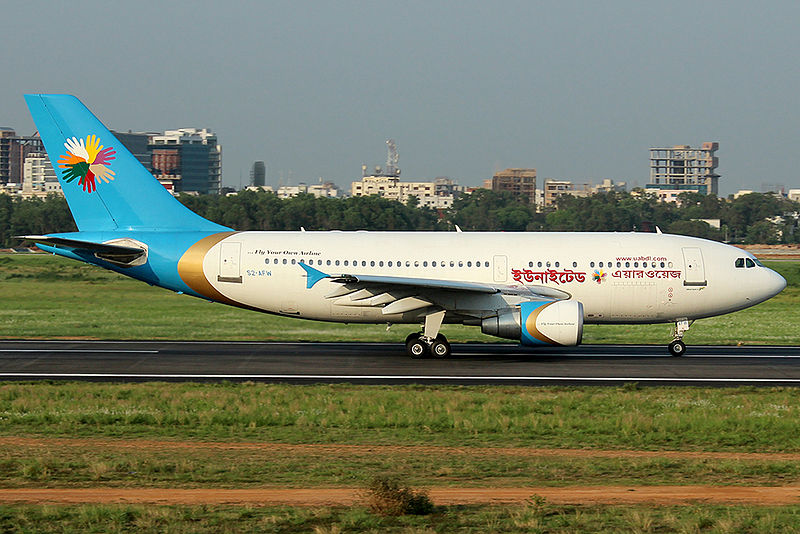
Courtesy Wikipedia. Image credit: Raihanspotter
Rapidly growing Bangladeshi private carrier United Airways has added two additional aircraft to its fleet. The aircraft are an ATR 72-200 registered as S2-AFU and a McDonnell Douglas MD-83 registered as S2-AEJ. The ATR 72-200 originated with LOT Polish Airlines, and then was transferred to LOT's regional subsidiary Eurolot before being sold to United Airways. Meanwhile, the MD-83 was delivered to US carrier Trans World Airlines (TWA) in 1995, became part of American Airlines' fleet after American acquired TWA in 2001, and then was sold to United Airways earlier this year after being parked in 2012.

The aircraft become the 10th and 11th airplanes in United Airways' fleet, composed of 2x Airbus A310-300s, 3x ATR 72-200s, 5x MD-83s, and 1x Bombardier Dash 8 Q100. The carrier also has 4x BAE Jetstream 31s on order to grow domestic operations, and a further A310-300 on order for longer haul flights.

Chairman and Managing Director of United Airways Capt. Tasbirul Ahmed Choudhury had this to say about the acquisitions:
These new addition of ATR-72 and MD-83 aircraft has increased the fleet strength of United Airways to Eleven. We definitely want to increase our fleet as this is the right time to procure desired aircraft to expand more domestic, regional and international destinations. The ATR-72 aircraft is having 64 economy class seats and the MD-83 aircraft 167 economy class seats.
United Airways serves 15 destinations (7 international) across Asia and the Middle East. It has its primary hub at Dhaka's Shajahlal International Airport.  
Read more »

American Airline's new transcontinental A321s feature full lie flat seats in premium classes

by BA Staff

Dallas-Fort Worth based American Airlines will soon become the first airline to utilise an Airbus A321 aircraft outfitted with a three-class cabin, including full lie-flat seats in business and first class when it receives Sharklets equipped A321ceo (current engine option) jetliners later this year
American Airlines new Airbus A321, first class. Image courtesy Airbus S.A.S.
In addition to the upgraded seat offerings in first and business class, passengers throughout the cabin will experience full Wi-Fi connectivity, as well as in-flight entertainment (IFE), 110v universal AC power outlets and USB jacks at every seat. For the first time on an A321, the interior also contains four full-service galleys.

American Airlines new Airbus A321, business class. Image courtesy Airbus S.A.S.

American Airlines plans to begin operations in early 2014 with this new aircraft, starting with the 2,500-mile route between New York’s John F. Kennedy International Airport (JFK) and Los Angeles International Airport (LAX), and later adding additional service on the nearly 2,600 mile JFK to San Francisco International Airport (SFO) route.
American Airlines new Airbus A321, economy class. Image courtesy Airbus S.A.S.

Earlier in July this year, American Airlines took delivery of its first A320 Family aircraft – a Sharklet equipped A319 – as part of the carrier’s fleet renewal plan.
Read more »

Delta ending Seattle-Osaka

by Vinay Bhaskara
A Delta Air Lines Boeing 767-300ER - Image Credit: Delta Air Lines

As per Airline Route, Atlanta-based full service carrier Delta Air Lines is cancelling its 4 weekly services between Seattle-Tacoma and Osaka-Kansai. The flight, which was scheduled to operate throughout the IATA Winter 2013/14 season with a Boeing 767-300ER, was started in 2010 and will now end November 4th. Over the past three years, the flight has operated using a mix of Boeing 767-300ER and Airbus A330-300 aircraft. The route was served by pre-merger Northwest Airlines using a Douglas DC 10-30. But that flight was canceled in 2001.

Since its merger with Northwest Airlines in 2009, Delta has steadily grown its long haul presence in Seattle (with help from domestic code share partner Alaska Airlines). The carrier now serves six long haul destinations excluding Osaka, and will begin its seventh on 29th March 2014 with new nonstop services to London Heathrow in conjunction with equity partner Virgin Atlantic. At the time of the Northwest merger, Delta only had intercontinental service to Amsterdam, and Tokyo-Narita.

The cancellation of Seattle services marks another stage in the slow decline of long haul services from Osaka-Kansai. Today, Osaka-Kansai is down to 13 flights per week to the mainland - a daily Boeing 787 Dreamliner from San Francisco on United, thrice weekly Boeing 777-300ER to Los Angeles on Thai Airways, and thrice weekly Boeing 747-400 to New York JFK on China Airlines. Osaka-Kansai once had services from Los Angeles on United, Detroit on Northwest, and Dallas-Fort Worth on American (twice). But high airport operating costs thanks to the high construction costs at Kansai rendered much of the service unprofitable. Operating costs are no longer the main challenge. Kansai has reduced its costs sharply since opening (5% in the last year alone), and the airport has even become a favored base for Japanese low cost carriers (LCCs). However, the Kansai area as a whole has stagnated economically in the past few years, and this reduced demand has curtailed possible long haul flights. 
Read more »

Routes Analysis: British Airways grows Hyderabad - London

by Vinay Bhaskara

British Airways wide-bodies on the ramp at their global hub at London Heathrow
From October 27th, London based full service carrier British Airways will be up-gauging its services between Hyderabad and its global hub at London Heathrow to daily flights utilizing Boeing 777-200ER aircraft configured in a 275 seat 3-class configuration (48J/24Y+/203Y), including flat beds in Club World. The flights are currently served with 3-class Boeing 767-300ER aircraft configured with 189 seats (24J/24Y+/141Y) 6 times per week, and an up-gauge was already planned to 6 weekly flights on the 777-200ER for IATA Winter 2013-14.

Said Christopher Fordyce, British Airways Regional Commercial Manager India:
For British Airways, Hyderabad is truly a key market in our South Asian network. We have witnessed tremendous growth in the market since 2008, resulting in concerted growth in the outbound business and leisure tourism.... Our customers from Hyderabad will now be able to enjoy daily service to the UK whilst enjoying British Airways' unmatched inflight services and flying experience,
British Airways is the only European carrier remaining with service to Hyderabad, where yields for long haul connections to Europe and North America are coming under increasing pressure from the MEB3 carriers Emirates, Etihad Airways, and Qatar Airways (plus potentially an entrance from Turkish Airlines). Since the Global Financial Crisis in 2008-9, business traffic to and from Hyderabad has largely plateaued while leisure and VFR traffic has continued to grow. But such traffic is by and large, too low-yielding to sustain the European carriers with their ever increasing cost bases. KLM ended its short-lived Hyderabad services in 2008 after launching in 2005, while Lufthansa ended its Frankfurt - Hyderabad flights in 2011.

Hyderabad is still a massive demand center for services to North America. In 2011, Hyderabad had 481,748 passengers worth of origin and destination demand (O&D) demand to and from the United States. With 21 North American destinations served through its London Heathrow hub (plus Raleigh Durham through the joint venture partnership with American Airlines) - British Airways appears to be doing good business connecting passengers between Hyderabad and the US, and it has an advantage over the MEB3 who only serve 7-8 passenger destinations in North America. 
Read more »

Photos and videos: American Airlines receives first Airbus A319

by Devesh Agarwal and Vinay Bhaskara

Dallas-Fort Worth headquartered American Airlines recieved its first Airbus narrow body aircraft, an A319-112(WL). MSN 5678 is registered N8001N, is the first A319 delivered, equipped with Sharklets, and the 100th A320 family aircraft delivered, fitted with the new wing-tip devices. The engines are from CFM.

Our Vinay Bhaskara captured these exclusive photos at the Hamburg delivery centre on behalf of airchive.com. You can read his story about the events of the delivery day here.


The videos are below the fold. All images are credit of airchive.com.

Read more »

BREAKING: US Airways Shareholders Approve Merger With American Airlines

by Vinay Bhaskara

Earlier today, at its annual general meeting for shareholders, the shareholders of Tempe, Arizona based US Airways voted to approve the merger between US Airways and Fort Worth, Texas based American Airlines. The merger, which would create the world's largest carrier by passengers carried, was announced on February 14, 2013.

Under the terms of the merger agreement, US Airways shareholders would get 28% of the combined shares in the company. The all-stock transaction would yield a company with annual revenues of nearly $38.7 billion, and headquartered in Dallas Fort Worth. The new board would include 5 AMR creditor representatives, 3 current AMR directors, and
4 US Airways representatives. US Airways shareholders did not question any component of the merger agreement proposal before voting.

According to US Airways CEO Doug Parker, the merger is still on track to close by the end of the 3rd quarter. Clearance for the merger is still required from the Department of Justice and the AMR bankrupcy court. Parker said at the meeting that if forced too, the new American will give up precious landing slots at Washington's Reagan National Airport, where the merged carrier will hold a dominant market share. However, Parker warned that the first markets to lose service as a result of divestment would be small cities. Parker said that the new American preferred to keep its entire slot holdings intact post merger;
There is no such standard in antitrust law that says airlines can't have that size of departures from any given airport.
Parker also tried to downplay any antitrust concerns surrounding the deal.
It [the new American] creates an important strong competitor to United, Delta and Southwest .... We will create a premier global airline.
Recent testimony from the US Government Accountability Office (GAO) before Congress warned that Philadelphia International Airport, currently US Airways' second largest hub and trans-Atlantic gateway, could lose service post merger to nearby New York JFK. However, Parker, in responding to a question from a Philadelhpia based frequent flyer and shareholder appeared to allay these concerns.
"Our hub [in Philadelphia] does well for US Airways... it will do even better as a part of American"
The new American will operate a mainline fleet of more than 940 aircraft, operating more than 6,700 flights per day to 336 destinations around the globe.

Read more »

Analysis: Qatar Airways to Philadelphia -- Etihad upgrades New York JFK


Major route announcements came from 2 Middle Eastern carriers yesterday, with Qatar Airways announcing plans to start new services to Philadelphia, Pennsylvania, USA (as well as Addis Ababa and Clark in the Philippines) and newly minted Jet Airways partner Etihad Airways revealing an up-gauge in capacity on its daily Abu Dhabi-New York JFK services to a Boeing 777-300ER.

For Qatar Airways, Doha-Philadelphia services will be launched in March of 2014. The airline had previously stated that its next US destination would be one of Atlanta, Boston, or Detroit. But the announcement of the mega-merger between US Airways and American Airlines, Qatar Airways’ oneworld partner, changed the calculus on US services. Philadelphia will be the new American’s gateway to the Northeast, and of current US destinations for Qatar Airways, one of two to offer serious connectivity through its oneworld partner American. When coupled with existing flights to American’s hub at Chicago’s O’hare International Airport, Qatar Airways has effectively bracketed the entire Eastern United States in terms of its network. There is also significant O&D traffic to support this route. While Philadelphia itself doesn’t have huge business travel demand to Asia, the Philadelphia metro area, especially the New Jersey suburbs, are home to huge numbers of Asians, primarily from the Indian subcontinent. When combined with the affluent base of South Asians in Central NJ, the Philly flight has a significant O&D base behind it, and allows Qatar Airways to bracket the South Asian VFR demand in New Jersey with flights on either end.

Meanwhile, rival Etihad Airways is up-gauging its own services Abu Dhabi – New York JFK to a daily Boeing 777-300ER from the current Airbus A340-500. The 777-300ER will offer a total of 328 seats (8F/40J/280Y), an increase of 36.6% over the current 240. The move can be tied in part to the recently born Jetihad, which will deliver increased demand from the Indian subcontinent for Etihad’s westbound intercontinental services. Jetihad will also result in services from Abu Dhabi to Newark, likely on a 777-300ER as well, and daily 777-300ERs to both Newark and JFK is a good bracketing strategy for the NYC area.

Read more »

Video: Pilot asked to hold for "VIP movement" responds "We're more important than they are"

A humorous way to start the week.

All of us in India has experienced a disruption in our lives due to "VIP movement".

This video from Jenf777 on a humorous exchange between the air traffic controller at Boston's Logan airport and the pilot of American Airlines 573. After hearing the exchange, all I could think, we need to get some more pilots like him in India, may then Indian airports will not be shut down for hours whenever there is a "VIP movement".
ATC: American 573 Roger. Uh...let's see. Hold your push [back]. Stay with me. You'll be number three to push ...... due to VIP movement ...... the airport's stopped.

AA573 Pilot: Due to what??

ATC: Uh..VIP movement.

AA573: What's that?

ATC: That's a Very Important Person that's moving and nobody else can move.

AA573. We're more important than they are.

ATC:  I wouldn't argue with you, but you've got to stop right there for now.

Another ATC controller (which the AA pilot can hear): Air Force One [The US President's plane] Boston Tower good morning. Winds three-two-zero at one three, runway four right, cleared for take-off.

Air Force One pilot: Air Force One cleared for take off four right, thanks.
What would be your rejoinder to the American Airlines pilot if you were the air traffic controller? Post a comment. Keep it humorous in the spirit of the story.

Read more »

American Airlines and US Airways to merge in $11 billion deal

American Airlines and US Airways officially announced their expected merger yesterday. Press release is below.

American Airlines, US Airways combined route map 


AMERICAN AIRLINES AND US AIRWAYS TO CREATE A PREMIER GLOBAL CARRIER --
THE NEW AMERICAN AIRLINES
Customers to Benefit from an Expanded Global Network and Investment in New Aircraft, Technology, Products, and Services

Combined Company to Enhance oneworld® Alliance, Offering a Seamless Global Network

Will Improve Loyalty Benefits by Expanding Member Opportunities to Earn and Redeem Miles

Combination Provides Path to Improved Compensation and Benefits with Greater Long-Term Opportunities for Employees of Both Companies

Combined Airline Expects to Maintain All Hubs and Service to All Destinations

Expected 2015 Annual Synergies of More Than $1 Billion, Creating Value for Stakeholders of
Both Companies

Enhances Recoveries for Stakeholders

AMR Stakeholders to Own 72% and US Airways Shareholders to Own 28% of
Combined Company’s Common Stock

Company to Retain Iconic, Globally Recognized American Airlines Brand

Company to Be Headquartered in Dallas-Fort Worth, with Significant Corporate and Operational Presence in Phoenix


FORT WORTH, TX, and TEMPE, AZ, February 14, 2013 – AMR Corporation (OTCQB: AAMRQ), the parent company of American Airlines, Inc., and US Airways Group, Inc. (NYSE: LCC) today announced that the boards of directors of both companies have unanimously approved a definitive merger agreement under which the companies will combine to create a premier global carrier, which will have an implied combined equity value of approximately $11 billion based on the price of US Airways’ stock as of February 13, 2013.

Operating under the American Airlines name, one of the most recognized brands in the world, the combined airline will have a robust global network and a strong financial foundation.  The merger will offer benefits to both airlines’ customers, communities, employees, investors, and creditors.  Customers will have access to more choices and increased service across the combined company’s larger worldwide network and through an enhanced oneworld® Alliance, of which American Airlines is a founding member.  With firm orders for more than 600 new mainline aircraft, the combined airline will have one of the most modern and efficient fleets in the industry, and a solid foundation for continued investment in technology, products, and services.

Thomas Horton, Chairman, President and Chief Executive Officer of American Airlines, will serve as Chairman of the combined airline’s Board of Directors through its first annual meeting of shareholders, and will also serve as the combined airline’s representative to the oneworld Alliance, of which he is currently chairman, and International Air Transport Association for the same duration.  Doug Parker, Chairman and CEO of US Airways, will serve as Chief Executive Officer and a member of the Board of Directors.  Mr. Parker will assume the additional position of Chairman of the Board following the conclusion of Mr. Horton’s service.  The Board of Directors will initially be made up of twelve members.  The Board will be comprised of three American Airlines representatives, including Tom Horton, four US Airways representatives, including Doug Parker, and five AMR creditor representatives.

Under the terms of the merger agreement, US Airways stockholders will receive one share of common stock of the combined airline for each share of US Airways common stock then held.  The aggregate number of shares of common stock of the combined airline issuable to holders of US Airways equity instruments (including stockholders, holders of convertible notes, optionees and holders of restricted stock units) will represent 28% of the diluted equity of the combined airline. The remaining 72% diluted equity ownership of the combined airline will be issuable to stakeholders of AMR and its debtor subsidiaries that filed for relief under Chapter 11 (the “Debtors”), American’s labor unions, and current AMR employees.

The merger is to be effected pursuant to a plan of reorganization (the “Plan”) for the Debtors in their currently pending cases under Chapter 11 of the United States Bankruptcy Code in the United States Bankruptcy Court for the Southern District of New York. The Plan is subject to confirmation and consummation in accordance with the requirements of the Bankruptcy Code.

In connection with the merger agreement, AMR has entered into a support agreement with certain unsecured creditors holding approximately $1.2 billion of prepetition unsecured claims against the Debtors.  Pursuant to the support agreement, the creditors party thereto have agreed, subject to certain conditions, to support a plan of reorganization implementing the merger and incorporating a compromise and settlement of certain intercreditor and intercompany claims issues.  Provisions of the support agreement relating to the treatment of prepetition unsecured claims against the Debtors and the treatment of existing equity interests in AMR are summarized further below.

The combined airline will offer more than 6,700 daily flights to 336 destinations in 56 countries.  The combined airline is expected to maintain all hubs currently served by American Airlines and US Airways, resulting in more travel options for customers.  Both airlines expect that the regional carriers they own – AMR Corporation’s American Eagle and US Airways’ Piedmont and PSA – will continue to operate as distinct entities, providing seamless service to the combined airline.  The company will be headquartered in Dallas-Fort Worth and will maintain a significant corporate and operational presence in Phoenix.

“Today, we are proud to launch the new American Airlines – a premier global carrier well equipped to compete and win against the best in the world,” said Tom Horton, Chairman, President, and Chief Executive Officer of American Airlines.  “Together, we will be even better positioned to deliver for all of our stakeholders, including our customers, people, investors, partners, and the many communities we serve.

“The combination of American and US Airways brings together two highly complementary networks with access to the best destinations around the globe and gives us a strong platform to provide our customers the most connected, comfortable travel experience available.  The operational and financial strength of the combined airline is expected to enable continued investment in new products and technologies and will create exciting new opportunities for our people, even as we deliver strong cash flow and sustainable profitability.

“Over the past year, the American team stood tall as we established a rock solid foundation for long-term success through an efficient and effective restructuring.  As part of this process, after months of exhaustive analysis and a thorough review of all alternatives, we concluded that this merger is the best outcome for our company, delivering not only the greatest value for our financial stakeholders, but also positioning us well for sustainable success over the long term.

“This merger provides enhanced potential for full recovery for our creditors.  In addition, I am pleased that we were able to obtain the support of a sizable portion of our unsecured creditors for a plan that provides a recovery of at least a 3.5% aggregate ownership stake in the combined airline for our shareholders.  It is unusual in Chapter 11 cases – and unprecedented in recent airline restructurings – for shareholders to receive meaningful recoveries.  I look forward to working closely with Doug Parker, whom I have known as a friend for more than 25 years, and with the leadership teams of both companies to assure a smooth integration and the creation of a new industry leader.”

Doug Parker, Chairman and Chief Executive Officer of US Airways, said, “Today marks an exciting new chapter for American Airlines and US Airways.  American Airlines is one of the world’s most iconic brands.  The combined airline will have the scale, breadth and capabilities to compete more effectively and profitably in the global marketplace.  Our combined network will provide a significantly more attractive offering to customers, ensuring that we are always able to take them where they want to travel, when they want to go.”

Parker continued, “Today’s announcement is possible only because of the important work carried out over the past year by Tom Horton and the American team.  No one cares more about the long-term success of American Airlines and its people than Tom.  Through a successful restructuring and this merger, Tom and the American team have established an excellent foundation for the new American Airlines to become a premier global airline.  I am grateful for all that Tom has done to ensure that American is in the best position possible for future success and am delighted he has agreed to remain on board to assist with the transition.

“I am particularly pleased for the employees of both US Airways and American.  This merger will create a stronger company, with the path to improved compensation and benefits and greater long-term opportunities for all our employees.  We are grateful to have the support of both companies’ unions and thank them and their leaders for their hard work and vision.  We look forward to a bright future for our employees and enhanced service and choice for our customers.  With today’s announcement, we start becoming one team and one new airline.”

More Choices, Increased Service, and an Enhanced Travel Experience for Customers

The transaction will combine American Airlines’ and US Airways’ complementary flight networks, increasing efficiency and providing more options for customers.  The result for consumers is a highly competitive alternative to other global carriers.  Importantly, the combined worldwide network will offer superior breadth of schedule to high value travelers.
The combined airline is expected to:
  • Provide the most service across the East Coast and Central regions of the U.S., including the East Coast shuttle, enhancing the combined carrier’s competitive position
  • Expand its presence and further strengthen the network in the Western U.S.
  • Bolster American’s industry-leading position in Latin America and the Caribbean
  • Enhance connectivity within the oneworld Alliance – including joint businesses with British Airways and Iberia across the Atlantic and with Japan Airlines and Qantas across the Pacific – creating more options for travel and benefits both domestically and internationally
  • Serve 21 destinations in Europe and the Middle East
  • Maintain current hubs of both American Airlines and US Airways, resulting in more choices for customers
  • Improve traffic flows through the existing hubs of both carriers
  • Expand service from those hubs to offer increased service to existing markets and service to new cities
  • Provide an industry-leading travel experience through innovative initiatives intended to increase comfort and connectivity for all customers
  • Improve valuable loyalty program benefits through expanded opportunities to earn and redeem miles across the combined network
In addition, American Airlines’ landmark agreements with Airbus and Boeing, designed to transform the American Airlines fleet over the next four years, will solidify the combined airline’s fleet plan into the next decade.  The combined airline is planning to take delivery of more than 600 new aircraft, including 517 narrowbody aircraft and 90 widebody international aircraft, most of which will be equipped with advanced in-seat inflight entertainment systems offering thousands of hours of programming, inflight Wi-Fi offering connectivity throughout the world, and “Main Cabin Extra” seating with 4-6 inches of additional legroom in the Main Cabin.  The combined carrier’s fleet will also feature fully lie-flat, all-aisle access premium seating on American’s new Boeing 777-300ER aircraft and Airbus 321 Transcontinental deliveries slated for later this year. Similar to US Airways’ Airbus A330 international Envoy service, American will also retrofit existing 777-200 and 767-300 aircraft to include fully lie-flat premium seating in an effort to provide a consistent experience for customers flying on the combined carrier.

Customers can continue to book travel and track and manage flights and frequent flyer activity through AA.com or USAirways.com, and will continue to enjoy all benefits and rewards of the AAdvantage and Dividend Miles frequent flyer programs.  At this time, there are no changes to the frequent flyer programs of either airline as a result of the merger agreement.  All miles in both programs will continue to be honored.  Upon merger approval, additional information will be provided to customers of both frequent flyer programs on any future program updates, including account consolidation or benefit alignment.

Employees to Benefit from Greater Long-Term Opportunities
Employees of the combined airline will benefit from being part of a company with a more competitive and stable financial foundation, which will create greater opportunities over the long term.  Each carrier’s employees will receive reciprocal travel privileges as quickly as possible.  The merger will also provide the path to improved compensation and benefits for employees.

“Together we will combine the proud histories of both airlines and create one team that recognizes the contributions of all employees to our airlines’ great customer service and financial success.  Our future has never looked brighter thanks to the outstanding people of both American Airlines and US Airways,” concluded Parker.

As previously announced, the unions representing American Airlines pilots, flight attendants and ground employees, as well as the union representing US Airways pilots, have agreed to terms for improved collective bargaining agreements effective upon the closing of the merger. In addition, the union representing US Airways flight attendants has reached a tentative agreement that includes support for the merger. The American Airlines unions representing pilots and flight attendants are working with their US Airways counterparts to determine representation and single agreement protocols.

Superior Value for Stakeholders

American Airlines stakeholders and US Airways shareholders are expected to benefit from the significant upside potential of the new combined airline, which is expected to have approximately $40 billion in revenues based upon the combination of each company’s projected 2013 performance.  The combination is expected to deliver enhanced value to American Airlines stakeholders and is projected to be significantly accretive to EPS for US Airways shareholders in 2014.

The transaction is expected to generate more than $1 billion in annual net synergies in 2015, including $900 million in network revenue synergies, resulting predominantly from increased passenger traffic, taking advantage of the combined carrier’s improved schedule and connectivity, an improved mix of high-yield business, and the redeployment of the combined fleet to better match capacity to customer demand.  Estimated cost synergies of approximately $150 million are net of the impact of the new labor combined contracts at American Airlines and US Airways.  The companies expect one-time transition costs for the merger of approximately $1.2 billion, spread over the next three years.

The abovementioned provisions of the support agreement relating to the treatment of prepetition unsecured claims against the Debtors and existing equity interests in AMR under a plan are summarized as follows:
  • Holders of existing AMR equity interests will receive an aggregate initial distribution of 3.5% of the common stock of the combined airline on the effective date of the plan, with the potential to receive additional shares if the value of common stock received by holders of prepetition unsecured claims would satisfy their claims in full;
  • So-called “double dip” creditors (i.e., holders of prepetition unsecured claims as to which both AMR and American Airlines are obligors, either directly or indirectly) will receive shares of mandatorily convertible preferred stock equal to the full amount of their claims.  These shares will convert into common stock of the combined airline at 30 day intervals during the 120 day period following the effective date of the plan, based on a formula tied to the market price of the common stock of the combined airline;
  • So-called “single dip” creditors (i.e., holders of prepetition unsecured claims that are not guaranteed) will receive a combination of shares of the same class of mandatorily convertible preferred stock as the “double dip” creditors will receive and shares of common stock of the combined airline;  and
  • American Airlines’ labor unions and other employees will receive an aggregate of 23.6% of the common stock of the combined airline ultimately distributed to holders of prepetition unsecured claims against the Debtors.
The support agreement can be terminated in certain instances, including the failure of the Debtors to achieve certain milestones toward confirmation and consummation of the plan.

Clear Roadmap to Completion
The merger is conditioned on the approval by the U.S. Bankruptcy Court for the Southern District of New York, regulatory approvals, approval by US Airways shareholders, other customary closing conditions, and confirmation and consummation of the Plan.  The combination is expected to be completed in the third quarter of 2013.  During the period between the signing and closing of the transaction, a transition-planning team comprised of leaders from both companies will develop a carefully constructed integration plan to help assure a smooth and sustainable transition.

Tax Benefit Preservation Plan

In conjunction with execution of the Merger Agreement, US Airways also announced today that its Board of Directors has adopted a tax benefit preservation plan designed to help preserve the value of the net operating losses and other deferred tax benefits of US Airways and the combined enterprise resulting from the merger with AMR.  The tax benefit preservation plan, which is effective immediately and will remain in place no longer than the closing of the merger, is designed to reduce the likelihood that changes in the US Airways investor base would limit the future use of the tax benefits by US Airways or the combined enterprise, which would significantly impair the value of the benefits to all shareholders.

As part of the plan, the US Airways Board of Directors has declared a dividend of one common stock purchase right, which are referred to as “rights,” for each outstanding share of US Airways common stock.  The rights will be exercisable if a person or group, without the approval of the US Airways board or other permitted exception, acquires beneficial ownership of 4.9% or more of US Airways’ outstanding common stock.  The rights also will be exercisable if a person or group that already beneficially owns 4.9% or more of the common stock of US Airways, without board approval or other permitted exception, acquires additional shares (other than as a result of a dividend or a stock split).  If the rights become exercisable, all holders of rights, other than the person or group triggering the rights, will be entitled to purchase US Airways common stock at a 50% discount.  Rights held by the person or group triggering the rights will become void and will not be exercisable.  The rights will expire immediately upon the occurrence of certain events, including the closing of the merger or the termination of the merger agreement.  In addition, the certificate of incorporation of the combined company will contain limitations on certain acquisitions and dispositions of shares effective from and after the closing of the merger, also with the objective of preserving the value of net operating losses and other deferred tax benefits.

US Airways shareholders with ownership positions near or above the 4.9% threshold specified in the tax preservation plan are urged to review its terms carefully.  Further details about the plan will be contained in a Form 8-K to be filed today by US Airways with the Securities and Exchange Commission.

Website

Additional information about the benefits of the transaction is available at a new joint website launched by the airlines at www.newAmericanarriving.com. Customers are also invited to learn more at www.aa.com/arriving and www.usairways.com/arriving.
Read more »

US Aviation Review 2012: Vinay vs. Cranky Flier


by Vinay Bhaskara and Brett Snyder

Earlier this month, I had a chance to do a little bit of back and forth with Brett Snyder (a.k.a Cranky Flier) about some of the biggest news stories in US aviation from last year. While the idea was that we’d do a lot of debating, it became mostly a discussion (what was that line about great minds….?).

We started off with the potential US Airways/American merger.

Vinay: From a network perspective I really like this merger more than most for American (and of course for US Air) because it really plugs a lot of holes.

Domestically, there is still a lot of incremental value in secondary NE markets (ALB, ROC, SYR, BDL, et. al) connecting them north to south along the East coast. Philadelphia is a strong and stable origin and destination (O&D) market with limited low cost carrier (LCC) penetration and little room for LCCs to expand b/c of terminal space in the medium term. And Philadelphia is a strong connecting hub with a good European network. It is consistently undervalued as a hub in my opinion, and adding Philly would allow American to flow connections to Europe over Philadelphia, leaving the valuable slots at New York JFK for premium O&D flights.

Charlotte is a unique hub that fills a huge hole for American (even United would highly value a Charlotte hub). From a pure network perspective, there is no other hub in American’s network that can serve the traffic flows that Charlotte can’t; Miami is too far South and Dallas Fort Worth too far west. While Northeast-Southeast flying isn't high yielding in the aggregate there is some high yield traffic there. Flying from the rest of the country to the Southeast is plenty high yield. Plus, demographic and economic trends point to a rosier future for the South as well as for Charlotte. O&D may be a little low in Charlotte at the moment for a hub its size, but it is fast growing thanks to the banking industry, and more importantly high yield. Some international overlap is present with Miami, but the domestic scale means that Charlotte is a viable hub (or at least 85-90% of its current capacity is).

Do I even need to describe the value of Reagan? It’s the preferred airport for DC business travel and of huge strategic value.

Phoenix has questionable value; cost creep from the merger pushes a lot of its flying to unprofitability. The one good thing is that the main competitor Southwest is facing heavy cost creep as well, but even so it’s heavily squeezed by Dallas Fort Worth to the East and Los Angeles to the West.
The Delta/Northwest merger proves that fleets don’t matter to a merger of this scale.

A lot of synergies in terms of consolidated negotiating of contracts, as well as increased attractiveness to frequent flyers are often ignored. These effects number into the hundreds of millions of dollars annually.

From a labor perspective, it has the potential to be a nightmare, though the toxicity of AMR employees seems mostly directed at Horton and current management. I do like that AMR is waiting to complete bankruptcy before merging; this allows them to merge from a lower cost base and not push up US Airways’ costs too much.

It’s also important to note that US Airways management team is amongst the best in the business. Doug Parker and co. have taken an imperfect and challenging situation and turned it into record profits. Bringing that kind of strategic vision to AA’s more powerful network and customer base can only mean good things.

In summary, I’d say that neither US Airways nor American needs to merge. Rather, it adds a lot of value for both parties and would create a stronger airline.

Cranky Flier: I agree with nearly all of what you've said, but I want to focus on that last point.  It might be true that neither American nor US Airways needs to merge, but I would say that US Airways needs it less.

US Airways has found a profitable niche over the last few years.  It has been consistently profitable with a lower revenue base because it has been able to achieve costs to match.  But that is really what the airline is - a niche player.  It can help to complement other larger airlines, as it does in Star Alliance today, but it is not a world leader.

American, on the other hand, is supposed to be one of the big three.  It's the North American anchor of oneworld and it has powerful partnerships.  But when it comes to being a network carrier that serves the US, it falls short of its competitors.  With mergers, Delta and United have created networks that serve the needs of the US.  They are actively working to build partnerships to make sure that Americans can get anywhere in the world without leaving the family.  American doesn't have that.

Sure American has good partnerships with strong airlines around the world, but it still can't get anyone from Providence to Atlanta.  In fact, it doesn't even fly to Providence.  It has a real lack of connectivity up and down the east coast and that is a big problem for an airline that needs to compete for high dollar traveler loyalty.  And while it dominates Latin America with its partners, its European network is very weak.  Delta and United both have powerful jumping off points in New York that allow for single stop connections from much of the US to much of Europe.  American is forced to double connect people more often than not.

A US Airways merger rectifies these problems.  No, it doesn't give American a hub as powerful as that of Delta or United in New York, but it does give the airline Philly, a respectable hub which, as you say, has little low cost penetration and a strong local traffic base.  That Philly hub combined with National in DC and Charlotte means that there is tremendous ability to connect small and large towns alike all along the east coast.  Charlotte provides the only natural competitor to Atlanta, and that would give American a rare leg up on United in that region.

And Phoenix, while likely to shrink in a merger, still provides a crucial point for connectivity throughout the West.  Dallas/Ft Worth can't serve everything west.  That's very clear in the fact that American no longer serves places like Burbank or Oakland.  This is where Phoenix can make a difference.

A merger doesn't solve everything, but no merger can.  Sure, it fails to give American a Pacific presence, but that's not the point.  The point is that it brings American so much that there's no need to focus on what it can't deliver.

Will there be labor unrest in a merger?  To some degree, sure.  Are mergers all difficult?  Yes, of course.  But if American really wants to compete with Delta and United, then it needs more strategic heft.  And a US Airways merger gives the airline exactly that.

We then moved on to the IT issues with the United/Continental merger.

Cranky Flier: I don't know that they [United] did anything wrong with the original physical integration itself.  There were some minor issues but in the end, it went fairly smoothly.  The problems that followed were two-fold.

First, they just couldn't be bothered to wait until they had a graphical interface for SHARES.  Instead, they forced all the United folks who used graphical interfaces before to learn command-driven SHARES.  From what I can tell, training wasn't adequate, so you have a lot of agents that just didn't know what to do.  I believe the new graphical interface has been introduced (or is in process), but there was a lot of unnecessary pain just because they were in too much of a hurry.

The other problem is that they didn't bother to find out if SHARES could handle everything it needed to do.  Upgrades became a nightmare early on.  Then there have been all kinds of issues with reservations not ticketing, especially with partner airline awards.  It simply doesn't seem like it can handle the tasks that it needs to handle.  This seems very surprising because US Airways seems to be running alright on SHARES.  Granted, it's not exactly the same system, but you would really hope these problems would have been discovered before making the switch.

The end results is that customers are very uneasy.  You have people wanting to reconfirm everything multiple times because of how many problems there have been.  And the problems seem to have gotten worse over the last couple months, at least for our clients.  This can't continue.  People will keep having miserable experiences due to tech problems and they won't keep flying the airline forever.

Vinay: I don’t really have much more to add. I find it interesting that it was a training malfunction in that they didn’t give the United employees either sufficient training to work with Continental’s interface or didn’t wait for the new interface; I think that’s on United management for not planning properly.

Empirically, I can empathize with everybody who had to go through some trouble with the whole United reservations mess. This past summer, my father and I were flying out to Kansas City and there was a thunderstorm that turned Newark into a mess. There were literally hundreds of disaffected elites (let alone customers as a whole) packed into Terminal A where United has less than 60 flights a day, and I can only imagine how bad it was over in Terminal C. And it was taking the United customer reps 20-25 minutes just to deal with each customer and so we got in line at around 9 pm, and didn’t get rebooked till closer to 1 am.

But the more interesting question  is how much this affects revenue and profitability for United. Their Q3 and Q4 financial performance was rather poor from a revenue and margin perspective. Even while the aggregate operational performance has gotten better over Q4, as you’ve mentioned the issues have not completely subsided. When as a corporate customer/business traveler do you start to book away from United because you’re afraid of a lack of reliability? Because even if they only lose a few such customers at the margin, it has a tangible impact on PRASM and profitability.

Cranky Flier: I think any bookaway will be temporary.  They will get this fixed and they will start firing on all cylinders.  It's just taking longer than it should have.  And longer than it did with Delta/Northwest.

Our focus then shifted to the Delta/Southwest deal for 717s

Vinay: Shifting gears a little bit, I’d like to talk a little bit about the Delta/Southwest 717 deal.
First, from a Delta perspective, it’s pretty much a continuation of the same strategy that brought them the MD-90s (and before that with Northwest the DC-9s and DC-10s) at dirt cheap rates. I know you described it as a “Moneyball” style of strategy earlier this year, and I’d agree. Delta is taking assets (airplanes) that are undervalued and thus relatively cheap on the world market, and then using them profitably. The strategy to minimize capital costs makes a lot of sense in the current environment and Delta is happily paying off its debt, even as the other US carriers commit to huge capital commitments in the form of massive aircraft orders (even Southwest). I also wonder if Delta will apply this strategy to A320s and 737NGs as those end up on the used market and their valuations fall in the face of the re-engined products? I know that the 737-900ER order is ostensibly supposed to partly replace the A320 fleet, but there is a chance that a deal too good to pass up on A320s will arise at some point over the next 3-5 years. Because of current trends in US and global oil production, especially the rise of alternative sources like shale oil and tar sands, the long run trend in oil prices looks to be declining, though oil prices are obviously quite volatile and there’s always the potential of environmental regulations driving up prices. So the downside risk for Delta of having a fuel inefficient fleet and being hit with a huge oil spike is relatively low in my opinion. From a network perspective, the 717s slot right in. They help backfill some of the lost capacity from the 50 seat regional jet reductions, and I think they’ll be especially useful for larger markets from La Guardia.

It’s the Southwest side of things that’s much more interesting in my opinion. Right after the merger, the thought was that AirTran’s international ops and the 717s would open up new windows of expansion for Southwest in international flying and smaller domestic markets. We're finally seeing some of the international flying, but the smaller cities have been a bust. In fact much of AirTran domestic has been culled. Atlanta is more than 40 daily departures off its AirTran Pre-merger levels. The 717s are cheap, paid off, and more fuel efficient than the 737-500s. Yet Southwest could not make them work because the CASM rose too high. And I think that comes back to Southwest's rising labor costs. For the past 30 years they've been granting steady pay and benefit increases to front line workers and offsetting that with steady growth and high productivity as well as fuel hedges. But now they've saturated the US, the hedges have expired, and productivity has slipped. And the end result is a rising cost base to such a degree that Southwest is now being forced to jack up fares; they aren't really an LCC anymore. And there's no real easy solution either. they could do what US legacies did and force wage freezes and benefit cuts down the unions' throats, but Southwest has extremely good labor relations and it's employees do tend to enhance service more than those at most US airlines (empirically). Another answer might be more fees a-la the legacies; but given Southwest's marketing strategy that's a no-go in the short term. More international flying and Hawaii flying will help buoy revenues but overall, the 717 deal points to broader structural issues within Southwest. Your thoughts?

Cranky Flier: Yeah, if we look at Delta, this acquisition really is just a continuation of a successful policy.  But I would argue that the 737-900ER is more of the same.  It's a new airplane but it's not the MAX, so I bet they were able to get a good deal simply because of that.  Delta really is opportunistic.  If the ability to pick up other airplanes for cheap arises, I'm sure it'll pounce.  But I would be shocked if they found something as sweet as this 717 which allows them to ditch a bunch of fuel inefficient 50-seaters and bring more flying in-house making employees happy.  The cherry on top is that Southwest is paying to outfit them in Delta's configuration, doing all maintenance, and painting them.  They'll be delivered like new to Delta ready to go.  Beautiful plan.

As for Southwest, I just don't know what to think.  I was excited about the possibility of Southwest being able to service smaller cities - it could open new opportunities I thought.  But Southwest pulled out of nearly every small city AirTran served.  It also went and ditched the 717, paying dearly for the privilege, effectively saying it can't do it at all.

So that puts all of Southwest's eggs in the international basket.  There is limited opportunity in the US for the airline.  Hawai'i and Caribbean/Latin are really the only growth opportunites that are big enough with high enough fares to support Southwest's higher costs.  That can tide them over for awhile, but it's sad to think that's the only thing out there.

You would imagine that Southwest would have to start adding new fees seriously at some point.  They have danced around that point with some minor fees like charging you if you no-show for a flight, but they haven't touched bag fees and change fees.  They've really dug themselves a hole if they even try at this point because marketing has really drilled it into people's heads.  I think they can still get away with charging for a 2nd bag, so that would be something.  But they are in a very sticky situation now.

Editors Note: After I wrote about Delta getting used A320s/NGs, Richard Anderson on Delta's Q4 earnings call:

"Given the glut of narrow-bodies coming on the market right now, we think that there is going to be significant opportunities because residual values on eight to ten year old narrow-body airplanes are on a significant downward slide. And we will continue to be with the glut of airplanes there."

And we finished up by discussing the drama surrounding United, Southwest, and the fight for international service at Houston Hobby.

Cranky Flier: The whole thing seemed absurd to me.  Southwest only flies to Hobby in Houston and it wants to push internationally.  It stands to reason that it would want to operate those flights out of Hobby instead of splitting its operation into two airports.  That would just be stupid.  But the response United gave to this plan was simply absurd.  It trotted out all these consultants to do studies saying how it would ruin the entire Houston area and United would have to slash and burn everything.  Oh please.  Southwest might do some Caribbean and Latin flying but that's about it.  Yet United acted like it would have to lay everyone off and stop flying to Houtson altogether.  (Yeah, that's only a slight exaggeration to how silly they sounded.)

Even after Southwest won the battle, United tried to blame flight cuts and staff lay offs that were in the works on the decision.  Southwest isn't even starting to fly for some time and nobody knows exactly where they'll go.  To blame the addition of a customs/immigration facility at Hobby for the cuts is just a joke.  I imagine United might pay for this for quite some time with local Houston politicians.  I don't think they should be expecting any favors.

Vinay: I agree that it was very much a knee-jerk reaction from United, and probably a bad one in terms of the Houston market moving forward. But it is important to point out that United is far and away the leader in the US-Latin America market in terms of profitability, with a superb 29.9% net margin (though American has the highest yields thanks to its Miami hub) as per DOT data for Q3. And for the most part, United’s Latin American network is through Houston. They command extremely high fares on some of the O&D monopoly markets to and from Latin America. When you throw Southwest into the equation, it takes away a lot of the VFR and leisure volume, as well as potentially some of the incremental business travel. And some of the connections to Mexico that are very competitive through Houston will be lost to Southwest at Hobby.  Will all of this kill United? No. But it is a significant threat to what is one of their cash cows. I think we all saw with the annual results last week that United is not in tip top financial shape. Regardless of their methods, I think it is understandable that United would strike out and try to shunt this in whatever way possible. Houston is a large and growing city with a large enough O&D base to sustain these two operations simultaneously. And we’ll likely see United manage its capacity allocation to Latin America better; large RJs versus mainline to Central American and Mexico for example. And all of this assumes that Southwest is able to get an international operation with all related reservations infrastructure in place by 2014; far from a sure bet.

Read more »

More information from American Airlines on their recent rebranding

by Vinay Bhaskara

Following American Airlines' announcement of a new livery and logo lost week, Bangalore Aviation contacted their PR department with a few questions about the driving factors behind the various brand decisions. Find our questions and the responses with American's spokesperson(s) below:

1)  Why was the Double A logo that has graced the tail of Americans planes for more more than 30 years not used in the new scheme?

The stripes flying proudly on our tail are a bold symbol of our origin and our name, reflecting the spirit of modern America:  innovative, progressive, and open to the world. It is inspired by our proud heritage and by what we make possible as a company.

2)  What is the re-branding meant to communicate about the new American?
Our new logo and livery symbolize our passion for progress and the soaring spirit that is uniquely American. As one of a few truly iconic American brands, we take great care in updating our new look with great focus and respect to our name, American. Our new logo is a refreshing update to the core icon of our company – the eagle.  Our new eagle -- or Flight Symbol – represents the soaring spirit and passion of our people to always move forward.  Our new logo incorporates the symbols and colors people have come to associate with American Airlines – the eagle, the star, the “A,” and red, white and blue – yet it is contemporary and clean. 
3) How will the new branding be integrated into the in-flight experience at American?

The process of changing our look will take time.  Some digital updates – like the look of our self-service machines and AA.com – have already begun, and will conclude with final details right away. Others, like our airport signage and plane livery, will take longer, up to several years, given the size and reach of our network.

As we prepare for the first two 777-300ER aircraft to enter service in just a matter of weeks, customers will see those aircraft flying in the new livery. As we take delivery of new aircraft, update additional digital assets and begin updating our terminals, customers will start to see more and more of the new look.

Read more »

American Airlines launches a new livery and branding

by Vinay Bhaskara

Yesterday, Dallas-Fort Worth based American Airlines announced a major re-branding effort, including an all-new logo and livery which it unveiled on its new flagship Boeing 777-300ER aircraft. This new branding will be expanded across American's entire fleet over the next 3-5 years, as well as into airports and other corporate venues.

The full press release from American is displayed below along with several images:

FORT WORTH, Texas – It’s a new year and a fresh new look for American Airlines as the company today unveils a new logo and exterior for its planes, including the already delivered Flagship Boeing 777-300ER aircraft set to fly on Jan. 31.  In addition, American plans to continue taking delivery of new planes this year as part of its historic orders for 550 new aircraft.  The unveiling of the new logo and livery is the latest step forward in American’s ongoing journey toward building a more modern travel experience for its customers.
New American Airlines logo


“Since placing our landmark aircraft order in July of 2011, we’ve been building anticipation toward a moment in time when the outside of our aircraft reflects the progress we’ve made to modernize our airline on the inside,” said Tom Horton, American’s Chairman and CEO. “While we complete the evaluation of whether a merger can build on American’s strengths, we remain steadfast in each step we take to renew our airline, a step we take with great respect for our name American.  Today marks important progress in that journey as we unveil a new and updated look for the first time in more than 40 years.”
New American Tails and Fuselage
American is preparing to take delivery of hundreds of new, lighter aircraft featuring composite materials that must be painted.  Since the polished metal look was no longer an option, the importance of the paint selection became critical to honoring American’s silver bird legacy.  Silver mica paint was chosen as a way to maintain the silver heritage which American’s people and customers are passionate about, yet progress ahead with a clean new look.
“Our new logo and livery are designed to reflect the passion for progress and the soaring spirit, which is uniquely American,” said Virasb Vahidi, American’s Chief Commercial Officer.  “Our core colors -- red, white and blue – have been updated to reflect a more vibrant and welcoming spirit. The new tail, with stripes flying proudly, is a bold reflection of American’s origin and name. And our new flight symbol, an updated eagle, incorporates the many icons that people have come to associate with American, including the ‘A’ and the star.”
"A new take on the eagle"
Since entering the restructuring process, American has made a series of strategic investments designed to place customers at the center of all it does and give employees the tools, training and leading technologies they need to provide customers with a uniquely American experience, while also creating growth and opportunity for its people.
Today’s news is a reminder that while there are still significant decisions that need to be made about the future of the company, American remains focused on continuing the forward movement of the many investments that have been announced in the past year, including:
The new American livery on their flagship: Boeing 777-300ER
  • Industry’s Most Modern Fleet: This year, American will take delivery of nearly 60 new aircraft, including the new Boeing 777-300ER which will enter into service on Jan. 31.  In July, American will begin taking delivery of Airbus aircraft made of lighter, more fuel efficient composite materials, which must be painted.  The airline continues investments to offer state-of-the-art inflight Wi-Fi, in-seat entertainment, universal AC power outlets at every seat, and Main Cabin Extra seating on all mainline aircraft. In addition, American has plans to offer fully lie-flat premium class seats on all of the airline’s widebody aircraft and transcontinental fleet.
  • Expanded International Service: American strengthens its network this year with expanded service to more destinations worldwide, including more international and domestic routes from Dallas/Fort Worth, more European and domestic service from Chicago O’Hare, new service to Europe from New York, and new service from Miami to Latin America and the Caribbean.  This year, American also will begin the following international services: Dallas/Fort Worth ─ Seoul, South Korea; Dallas/Fort Worth ─ Lima, Peru; Dallas/Fort Worth – Bogota, Colombia; Chicago O’Hare ─ Dusseldorf, Germany; New York JFK ─ Dublin, Ireland; Miami – Pointe-a-Pitre, Guadeloupe; Miami – Fort-de-France, Martinique; Miami – Curitiba, Brazil; and Miami – Porto Alegre, Brazil. 
  • Information in an Instant: The airline announced plans to supply flight attendants, pilots, and maintenance workers with their own tablet devices, designed to give them real-time information and better operational insights to do their job more efficiently. Beginning next month, employees will also be equipped with new technologies at the airport designed to make the travel experience easier and more convenient.
  • Top-Notch Onboard Experience: Earlier this month, the airline rolled out new enhancements in premium class cabins on international routes, including elegant new china, more menu choices, and a more personalized service similar to a restaurant. In addition, American will expand the availability of Samsung Galaxy tablets for entertainment use in the premium cabins to more routes later this year.
American Eagle and the AAdvantage® program also will get a new look as of today.  The first American Eagle plane will fly the new livery beginning in February.  Updating the new look across American’s network is a long process and will be rolled out over time to the airline’s airports, interiors and exteriors of aircraft, new uniforms, products and services, and technology platforms like AA.com and the American mobile apps.
Expanding the new brand to in-flight service
American’s new look was created with input from our customers and our people, and in partnership with FutureBrand – a leading global brand consultancy.  In addition, American today launches a new advertising campaign designed to showcase the new look.  The advertising campaign was developed with agency partner McCann Worldgroup.
For more information on American’s new look, and to keep up with progress as the brand rollout continues, visit aa.com/newamerican.
As we said before, American will be repainting these aircraft over the next 3-5 years. Not all of the current planes in American's fleet will be getting the new livery. Both the McDonnell Douglas MD-80 and Boeing 757 fleets are scheduled to be retired (at least in part) over that time-frame, so parts of those fleets could get the new livery, though American is still making decisions on that process. Meanwhile, the fleet of Boeing 767-200ERs, which are exclusively used on premium transcontinental services between New York’s John F. Kennedy International Airport (JFK) and San Francisco International Airport (SFO), and JFK and Los Angeles International Airport (LAX), will be phased out of the fleet between November 2013 and 2014, so they will not receive the new branding.

Public reaction, based on empirical observation of Twitter and the Web in general, is mixed towards American's new brand. The logo has gotten generally positive reviews, while the opinion on the livery skewed more negative, with a significant vocal group expressing dismay at the loss of iconic images like the eagle in the logo and the double "A"s on the tail. The old American livery has been around for more than 30 years, and it is one of the most recognizable liveries within the United States and around the globe.
Old American Airlines livery
My opinion is that I'll miss the old and iconic American Airlines livery but that it was time for a change. Unfortunately, the sad truth is that the current American Airlines branding was associated with a bankrupt and aging carrier. This new branding is bold and stylized, with a new take on the old American Airlines icons. Readers, what are your thoughts on the new brand for American?
Read more »