Showing posts with label Strategy Guide. Show all posts

High resolution photos: Indian Air Force C-130J Super Hercules lands at Daulat Beg Oldi

by Devesh Agarwal

Yesterday, we wrote about the world record breaking effort of the Indian Air Force landing one of its C-130J Super Hercules strategic air transporters at the world's highest airfield at Daulat Beg Oldi (DBO). Read the story here.

With a hat-tip to Shiv Aroor, we present some high resolution pictures of the 'Herc' at DBO. The aircraft was on the ground for 30 minutes and kept its engines on the entire time it was on the ground.

-- Story continues below the fold --


The C-130J is part of the six aircraft that India ordered from the U.S. Government, and is based at Hindon near the capital New Delhi, with the newly raised 77 Squadron IAF named ‘Veiled Vipers’, and is used by the special forces, including the famous NSG Black Cats.

The squadron's motto “Kill with Stealth”, signifies the all-weather, stealthy 'black-ops' mission capabilities in deploying the special forces to deal with many varieties of threats. India has realised the capabilities of this great aircraft and is ordering another six.

The important of Daulat Beg Oldi Advanced Landing Ground (ALG)

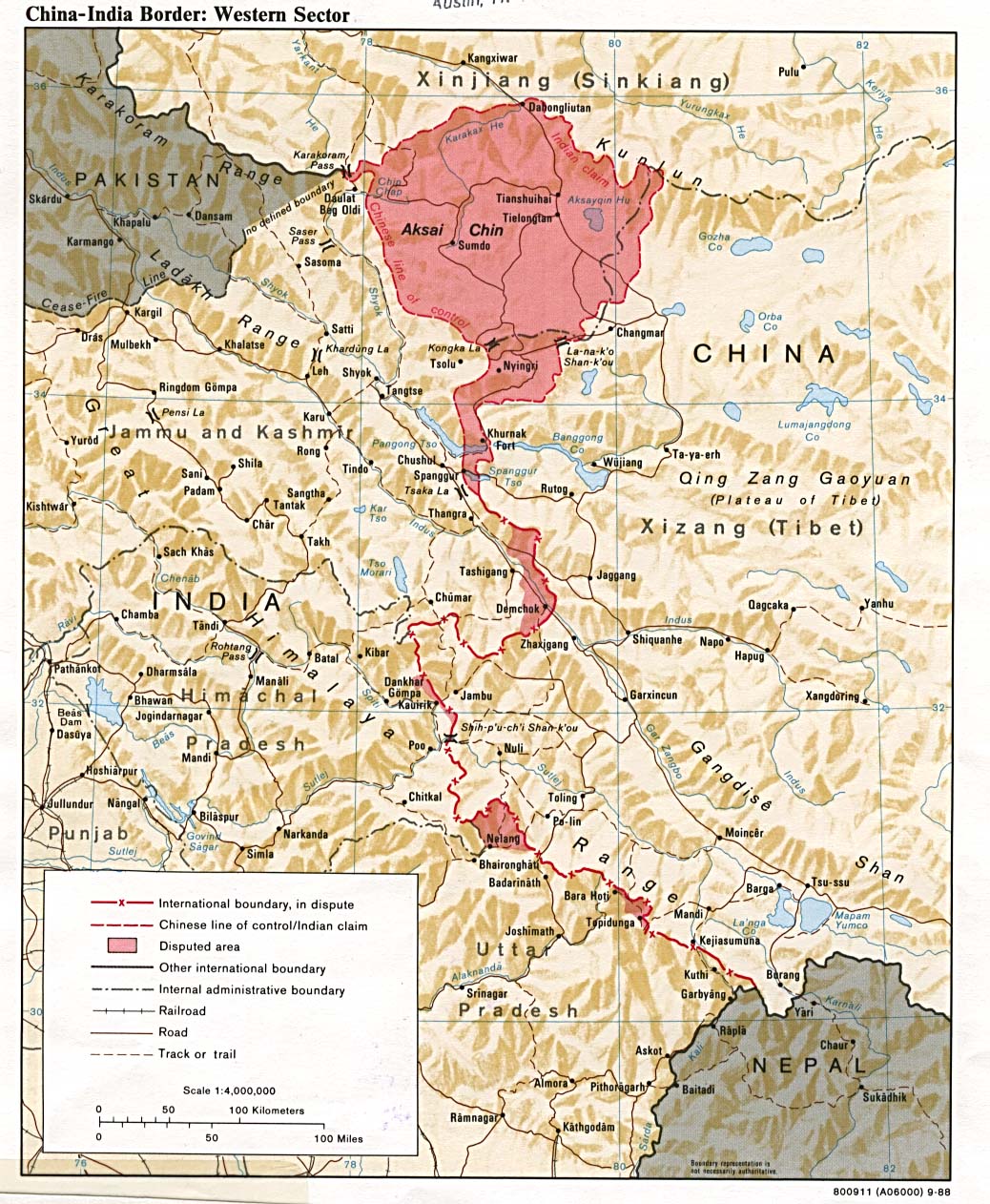
The Aksai Chin region of Ladakh is hotly contested by both India and China. India and China fought a border war in 1962 and in 1993 accepted the Line of Actual Control (LAC) as the de-facto international border.

Daulat Beg Oldi is located just 4.5 kms away from the Karakoram pass and supports Indian troops on the Siachen glacier, which a major thorn in China's strategic interests in the region. This map shows a clearer picture.

Western borders of India and China with Aksai Chin region. Image courtesy Wikipedia
While the Chinese side of Aksai Chin is easily approachable from the east, for India, it is extremely difficult, and involves traversing the highest motor-able road in the world, the Khardung La pass.

This paper in PDF format from the Institute for Defence Studies and Analysis gives significant insight on why this high altitude desert called DBO is so important.


Chinese troops have been repeatedly violating agreements with India, and have crossed the LAC (Line of Actual Control) more than 150 times this year alone.

On April 15th, Chinese troops blatantly crossed the border near DBO and pitched tents right in the face of the Indian army. This infographic shows what happened.

Instead of fighting back the aggression, the UPA2 government took no action, and even sent its foreign minister Salman Khurshid to Beijing, pretending nothing had happened. At that time, Parliament had to be adjourned when the government was cornered by the opposition for its spineless tactics.

The landing of the Hercules today with its ability to carry in 20 tons, is a definite signal to the Chinese of the unmuzzling of the Indian armed forces and their ability to respond.

In the longer term, expect India to upgrade the landing strip to accommodate the big daddy, the Boeing C-17 Globemaster III heavy airlifter.
Read more »

Video: IndiGo President Aditya Ghosh talks about why some airlines fail and some succeed

by Devesh Agarwal

Aditya Ghosh, President and Executive Director of Indigo Airlines says "Airlines fail because ego comes in the way of wisdom," (a reference to the flamboyant Dr. Vijay Mallya). "As any business matures, not just the airline industry, it tends to move away from the basics. We tend to forget what the customer really needs, versus what the customer really wants."

Ghosh was speaking at the recently concluded NASSCOM India Leadership Forum 2013.

Watch this video where he talks about how Indigo has managed to become the largest domestic carrier in India along with being one of the most popular. See his insight in to what will drive growth for IndiGo and the industry in general through the coming year.


Hat tip to Tarun Shukla at FlightDeck India for the lead.
Read more »

Strategic and execution failures make AirAsia scale back India operations

Earlier this year, many an Indian waited with expectation while all Indian carriers waited with trepidation as the Malaysian low cost behemoth AirAsia, announced and commenced flights to a slew of cities across the nation.

Fast forward six months, and the Indian carriers are breathing easy as AirAsia is quietly withdrawing or dramatically scaling back flight operations from many Indian cities. Hyderabad, Bangalore, Kolkata, Trivandrum, are just a few, even the Chennai-Penang flight where the carrier has a complete monopoly has been quietly withdrawn. No seats are available for booking as much as one month in advance, even though the flight is still officially listed on the time-table.

What caused this low fare juggernaut to falter in a value concious country like India? A market so well suited for a low cost carrier, a market in which domestic low fare carriers are doing so well. It appears to be a combination of an incorrect strategy married to poor execution and a failure to adapt the AirAsia business model to meet the expectations of the Indian passenger.

Not engaging travel agents
Unlike domestic travel, foreign travel involves a variety of services in addition to the air ticket. From passports, visas, hotels, tours, to insurance, there is a gamut of services travellers need when flying overseas, and for these they rely on the travel agent. Travel agents are responsible for over 83% of the international travel bookings.

Even the largest global carriers like Singapore Airlines and Lufthansa realised the power of the travel agent in the Indian market when they tried to impose a zero commission regime and were met with stiff resistance.

The typical passenger on AirAsia would be a first time international traveller, and not well versed with the myriad of documentation and other requirements of foreign travel. many carriers and choices available in the travel market. Unlike Indian low fare carriers SpiceJet and IndiGo, AirAsia has chosen not to engage the travel agents, instead relying on a single call centre.

Ignoring corporates
The Chennai Penang route is a perfect example of the airline's failure to engage with potential customers business. Even with a monopoly on this route, AirAsia was managing a woeful 50% passenger load factors.

There are strong social and business links between the two cities. Penang was the base for the British during colonial times and was the destination of choice for Indian immigrants primarily from the state of Tamil Nadu whose capital is Chennai, since the late 18th century. There are similar synergies in business as well. Penang is one of the largest electronics manufacturing areas in the world, and Chennai is the hub for electronics manufacturing in India. Dell, Flextronics, Jabil, Sanmina SCI, Nokia, Bosch, the list of potential customers, with facilities in both cities, is endless.

Time is valuable for everyone especially the business traveller. I used to fly this route regularly as it was a simple three hour day flight instead of a eight hour overnight ordeal via Kuala Lumpur, yet, I was probably the only business customer on the flight.

Visa pains
AirAsia' point to point model works against it, since Kuala Lumpur and Malaysia are not the final destination for many Indian travellers, and multiple tickets cause confusion for the first time and uninitiated traveller.

The decision of the Malaysian government to remove the visa on arrival facility has also hurt the carrier significantly since most passengers will not want to go through the travails of obtaining a Malaysian visa purely for transit, and after tickets, visas are the foremost services travellers obtain from travel agents, a segment AirAsia does not engage with.

Over-estimation of the AirAsia brand and model
AirAsia may be a household name in Malaysia, but not in India. The airline has chosen to rely more on word of mouth instead of advertising, and therefore remains relatively low on the recall level when someone wishes to travel.

With different value perceptions and expectations, the Indian market is not yet ready for a traditional low-cost carrier with the complete a-la-carte pricing. AirAsia has to learn the finer market nuances from Indian low cost carriers IndiGo, SpiceJet, and GoAir who have spent the last five years building a trust with their passengers. Recent incidents like the Delhi fiasco only lower the airline's brand equity.

To avoid being stuck with only the elderly or labour class passengers, it is important for AirAsia to develop a loyal clientèle of business and middle-class leisure travellers, and for that it needs to engage with them via advertising, brand-building, and the travel agent community.

IndiGo which has a no-fuss service model very similar to AirAsia has recognised the weakness of this model for its upcoming international operations and is modifying it to ensure success.

Impatience
AirAsia runs a very tight ship and expects quick results. Its skeleton teams in various cities are too busy running airport operations to network with potential clients and build business.

AirAsia also need to give its teams longer than the six months, before it downgrades or kills the route or its employees.

India has long been the graveyard of low cost international carriers. Jetstar Asia, Tiger Airways, Nok Air, and others have come, failed, and quietly left the Indian market. Much is expected of AirAsia, and the carrier has excellent business leaders, but if they repeat the mistakes of their predecessors they are doomed to the same failed results.
Read more »

Strategy guide for Airline Manager on Facebook

Over the last two weeks I discovered a nifty little airline simulator game called Airline Manager on Facebook. My airline is called Develish Airlines.

Coming across a variety of questions on the discussion boards, I have written this strategy guide that may help you get ahead in the game.

First and most importantly -- Forget conventional wisdom.
To make the game simpler and appealing to a wider audience the developers have taken a lot of liberties with the models of planes available, the airports, and timings.
  • You can operate any plane from any airport. For example an Airbus A380 on a runway only 3,000 feet long is no problem in the world of Airline Manager (or AM for short).
  • The size of the cities do not matter. AM only calculates the total number of flights operated by all players in the game to adjust demand. So you can operate multiple A380's in to the smallest town with the same demand effect as the largest metropolis.
  • Planes destined for delivery five years from today, such as the A350XWB are already available now.
  • Do not pay attention to brands. A Boeing aircraft has the same reliability as an Ilyushin or Antonov or Tupolev or Dassault or any of the other manufacturers.
  • Fuel consumption is meaningless.
Planes
Probably the most asked question in the game is "which is the best plane for use in Airline Manager?".

To answer this, I have prepared an Excel file which computes the ROI (return on investment) for various models of planes which I recommend you download from here.

Update - July 10, 2010.
The developers of Airline Manager have increased the maximum number of routes from 401 to 501, and you can purchase additional capacity using pax points to 601.

Update - March 29, 2010.
The developers of Airline Manager have changed some of the pricing for the aircraft. The spreadsheet can be modified. Just enter the new figures and the ROI figures will get calculated for you.

Airline Manager Facebook Aircraft ROI Strategy

When you first start the game you will get a Boeing 737-800. Sell this immediately. You need to start generating a good cash flow.

In the spreadsheet I have highlighted the aircraft which deliver high returns on investment. For this the best aircraft is the Dassault Mercure which will pay back your investment within 15 hours of operations.

Use the money generated by the sale of the 737-800 and buy multiple Mercures. The only drawback of this strategy is the short 1,700km range of the Mercure. To earn money quickly, you will need to play the game frequently, may be every 2 hours or so. Who said gamers need sleep?

As you progress in the game, you can induct the British Aerospace BAC-111-500 which has higher range (translate in to longer breaks between playing the game), and the McDonnell Douglas MD-81.

Once you reach about 100 Mercures, I recommend moving up to the McDonnell Douglas DC-10-10. It will give you a 250 passenger capacity and a range of 6,436km. Once you reach 200 aircraft, I recommend you start withdrawing the Mercures from your fleet and adding more DC-10-10's. The longer range of the DC-10-10's will allow you a 6 hour break from the game.

The IL-86 for short range (3,800km) high passenger count (350 pax) and IL-96-400 for medium range (10,000km) high passenger count (436 pax) can also be considered for select routes.

AM places an inordinate premium for high passenger capacity airplanes. It is better to put two aircraft on a route rather than one big passenger plane.

Since you are limited to 401 routes (an extension to 451 routes can be purchased) the end goal is to end up with a long distance fleet of 401 Airbus A380s. You can buy and sell a Boeing 747 and a Concorde for the achievement badges once you reach the top.

Income
In AM, the revenue calculation is simple. Gross income is $0.5 per passenger per km. i.e. the number of passengers x the route distance. From this subtract airport taxes which are 15.99% up to a maximum of $200,000. As you go up in the game and start inducting Boeing 787-8 (range 15,200km, 250 pax) and Airbus A380 (range 20,000km, 644pax) the tax element cap will add to your profit.

Fuel
Unlike the real world, the cost of fuel is actually very low in the overall scheme of things. In the spreadsheet you can change the numbers and do your own "what-if" analysis.

The cost of fuel varies on days of the week, and at times of the day. The lowest price of fuel is $400 per 1,000 pounds. At present the lowest priced day is Monday and the best time to purchase is right after 01:00GMT till about 04:00GMT. The developers of AM have recently tweaked the schedule and previously Thursdays were also a low cost day for fuel. Now it appears to have shifted to Wednesday and occasionally Fridays.

It is good to slowly start developing a reserve of fuel worth 4~5 days of consumption. At present I am at about 200 million pounds of consumption per day. So I typically stock up about 800~950 million pounds of fuel. The maximum you can store is 999,999,999 pounds.

Advertising
Simple rule -- always advertise, and always select billboards. With no advertising you will loose about 15%~20% of passengers. On a 250 seat DC-10-10 it translates to a loss of $75,000 per 6 hour flight.

Advertising costs vary from $5,000 per day to $40,000 per day, so you can see, that even on the most expensive day, your passenger losses far outstrip your advertising expenses.

The lowest priced day for advertising is Mondays and Thursdays, so I recommend taking a 3 day package on Mondays and a 4 day package on Thursdays.

Base Hub
Use the Profile button on the main overview page to select your hub city. Apart from getting an achievement, your hub will automatically show as the originating city.

Finding good routes
AM does not require connections for your flights; i.e. you can have a flight between any two cities. (Remember I told you to leave common airline wisdom at the front door of the game).

Use the "find route" on the flights tab to obtain a demand profile across the world. Click on the Demand column heading for a reverse sorting. Use high demand cities in your planning, but do keep in mind, other players are doing the same.

This website is great for finding routes. Just appreciate the fact that it is a labour of love and has no connection with the developers of AM (just like this guide). Drop him a note of thanks for his effort.

Catering
This has a very minor impact on your reputation and I recommend it purely as an option if you have the money. You do not loose by not catering, and as you go forward the income relevance drops even further. I transport some 150,000 passengers every day and have a daily cash flow of $500 million. Earning about $500,000 on catering does not hold much charm.

Maintenance
As you operate flights you will have incidents. I recommend opening a 2nd tab and performing repairs reasonably quickly, otherwise your reputation will suffer.

As your planes reach 400 flying hours, you will require them to undergo a C-Check. C-Checks can get expensive (up to $2 million) and will take your aircraft out of commission for anywhere from 6 to 16 hours depending on the aircraft. However, by this time you should be up to 401 routes and this will become just another chore in the game.

Do not miss your C-Checks. You can have a crash and nothing will impact your reputation and airline more.

Staff
Every once in a day or more frequently, visit the staff tab. Every so often the staff will move from "happy" to "talking" to "unhappy". Do not let the staff stay "unhappy" you will have a strike, and your reputation will start suffering. I normally let the staff be "talking" for a few hours and then give them a raise.

Airline Value and Pax Points
The best way to increase airline value and earn pax points is to add aircraft to your fleet. Unless absolutely necessary do not spend your pax points.

Business Jet
The Airbus A318 Elite is available for 3,000 Pax Points. Not worth it in my humble opinion.

Conclusion
I hope you find this guide useful and helpful, it is by no way full and complete. I request you to please add your own pearls of wisdom. If you find it helpful, feel free to drop in a thank you comment. If you find anything wrong, please feel free to add a correction via a comment.

Enjoy the game.

Devesh Agarwal
Read more »