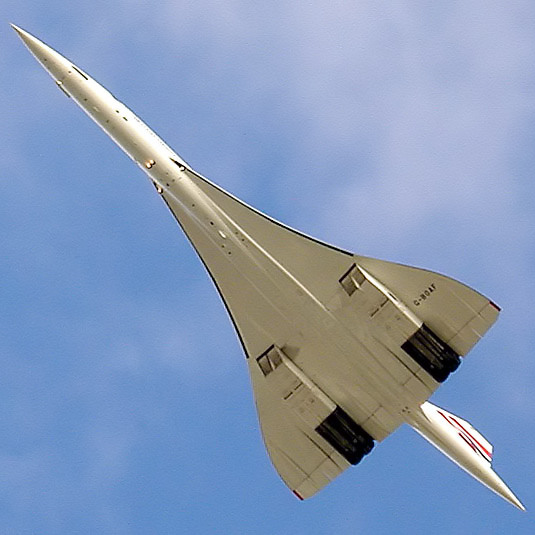
Over the weekend, 2nd March to be specific, was the 44th Anniversary of the maiden flight of Aérospatiale-BAC Concorde 001 back in 1969.
Concorde entered service in 1976, and flew the elite of the world, till
British Airways and Air France, ceased service on October 24, 2003.
Construction of the first prototype began in February 1965. Built by
Aerospatiale at Toulouse, Concorde 001 F-WTSS made its first test flight
from Toulouse on 2 March 1969, piloted by André Turcat. The second prototype was
built in Filton, Bristol in April. The two prototypes were presented to the
public for the first time at the Paris Airshow, on 7 and 8 June 1969.
Even today, "the giant leap backwards" continues. Ten years after its retirement, there is no plane, even planned, as a replacement for this magnificent flying machine.
Here is are some videos of those first flights.
For more videos of the first and last flights of Concorde, and some in between, read here.
Forty years ago as the 1969 Paris Air Show unfolded, the world was abuzz over the Boeing 747 and the BAC-Aerospatiale Concorde both whom had just made their first flights just a few months before.
At the same time, European aerospace companies were finalising a consortium to wrest back dominance of the United States in the commercial aviation market.
Within months of the show the European aerospace companies created Airbus Industrie which would take on the industry leaders of the day Boeing, Lockheed, and McDonnell Douglas. Today Airbus SAS and Boeing are the two survivors battling it out in an intense global duopoly.
In a two part series I take you on a look back at the rivalry over the past forty years and the one-upmanship practised by both companies reflected in the aircraft developed and produced.
1969 was clearly for Boeing. Its 747 Jumbo Jet reigned for more than 36 years as the Queen of the skies. It is among the world's most recognizable aircraft, and was the first wide body ever produced. As of May 2009, 1,416 aircraft have been built, with 107 more in various configurations remaining on order. The next version of the aircraft, the 747-8, is in production and scheduled to enter service in 2010 but the project is highly delayed. The 747 is supposed to be replaced by the Boeing Y3 (part of the Boeing Yellowstone Project) in the future. [Note: I have not covered my beloved Concorde since it is not an Airbus product per se.]
But just as Boeing was celebrating the 747 debut, France and Germany who were later joined by Spain and the United Kingdom set up the Airbus Industrie consortium in 1970 and launched their first plane, the A300. The first twin engine wide-body aircraft, the A300 entered service in 1974 with Air France. The A300 was the first airliner to use just-in-time manufacturing techniques. Complete aircraft sections were manufactured by consortium partners all over Europe. These were airlifted to the final assembly line at Toulouse-Blagnac. Incidentally, today Boeing uses the same technique, ferrying the wings and other parts of the soon to fly 787 Dreamliner from production facilities in the far east. Airbus sold 561 of the planes and the final production A300 an A300F freighter for FedEx, made its initial flight on 18 April 2007 and was delivered on 12 July 2007.
To counter the Airbus A300 and Boeing launched development of its twin-engine wide-body the 767 in 1978 which entered service in 1982. The 767 was conceived and designed in tandem with the narrow-body Boeing 757 twin-engine jet with both aircraft sharing common design features and flight decks. The 767 was followed the A300 cockpit and became the first Boeing wide-body airliner to enter service with a two-person crew flight deck, eliminating the need for a flight engineer. The first 767 entered service in 1982. Though orders started tapering off in the 1990s, updated versions of the plane are still in production, including the 767-400ER (extended range) model. American Airlines has outfitted many of its 767s with the Aviation Partners winglets in a bid to improve the fuel efficiency. There have been over 1,000 767s ordered with over 900 delivered as of 2009. The -300/-300ER models are the most popular variants, accounting for approximately two-thirds of all 767s ordered. As of 2009, Delta Air Lines operates the largest 767 fleet of any airline.
Airbus next widened its product offering and offered a replacement for the venerable Boeing 727 three-engine jet, the most popular aircraft at the time. At the same time the A320 also targeted Boeing's best seller the narrow-body 737. After the oil price shocks of the late 1970s, the new Airbus would be of the same size, yet offer vastly improved operating economics and significantly quieter engines. The digital technology in the A320 would herald a two generation technological leap over the all-analogue Boeing 727 and a generation ahead of the hybrid Boeing 737-300/-400/-500 series. The new Airbus was also wider than the 737s by almost eight inches providing passengers that crucial extra inch of shoulder space in the same six abreast seating layout. In 1984 Airbus launched the A320 and again Air France was the launch customer, The airliner became the best selling aircraft for Airbus, who quickly developed two shorter and smaller versions, the A319 and A318, and the longer and larger A321. By the end of May 2009 a total of 6,321 aircraft of the A320 family have been ordered and 3,893 delivered. The order tally went up today with Qatar Airways announcing an order for 20 Airbus A320s and four A321s. The A320 family is the second best-selling jet airliner family of all time after its primary competition, the Boeing 737 family which recently crossed the 6,000th aircraft delivery mark.
Do visit Bangalore Aviation tomorrow and read the continuation of this 40 year old rivalry.
She was always known by just her name. Never an article ahead of it. She was Concorde. Never THE Concorde or A Concorde or LE Concorde; and 40 years ago, she made her first flight from Toulouse in France, where the giant Airbus A380 is made today.
F-WSST took to the skies at 15:40 on March 2, 1969, coincidentally, just three weeks after the 747-100. The second prototype, built at Filton in Bristol, in the UK, took flight in April. 34 years later, the very final flight of Concorde was of G-BOAF as flight 216 on November 26, 2003, when she returned back home to Filton where she was built.
I have always been a great fan of Concorde. When she retired in 2003, BBC TV commentator Jeremy Clarkson called the occasion "A giant leap backwards for all mankind", building on the famous quote by Neil Armstrong when he stepped on the surface of the moon, also in 1969, probably the most influential year in aerospace history.
For 27 years Concorde truly represented the radio call sign of all British Airways flights -- Speedbird. She was "Speedbird Concorde ONE heavy" from London to New York, and "Speedbird Concorde TWO heavy" on her return.
In celebration of Concorde's 40th anniversary, I present a series of videos to celebrate this magnificent bird of the skies. If the Boeing 747 was the queen of the skies, surely Concorde was the graceful swan with her elongated neck, wide wings, and elegant posture.
May I also recommend my previous article which celebrated the fifth anniversary of Concorde's retirement from service, an event we have so sadly forgotten.
Between October 24th and November 26th, the five year anniversary of an event will pass; an event which Jeremy Clarkson described as "a giant leap backwards for all mankind".
For the first time in our history, we went backwards in aviation, retiring a plane, which had no replacement then, has no replacement even today, and has no replacement appearing on the horizon in the next 10 years.
Concorde was a supersonic passenger airliner or supersonic transport (SST); a product of the combined manufacturing efforts of Aérospatiale of France, and British Aircraft Corporation, with only 20 aircraft ultimately built.
At the time of her introduction, Concorde was heavily criticised. Environmentalists, the U.S. Senate and faceless bureaucrats -- highly intelligent people, so often found working in government, calling her a Golden Albatross.
The tens of thousands of people who flew her, over her 27 year history, have proved them completely wrong, giving Concorde a place in aviation history unmatched by any other aircraft.
Concorde G-BOAF.
When we see any other aircraft, we may say "there is A Boeing 747" or "A Triple-7" (Boeing 777), or even "AN Airbus 380 superjumbo", but not Concorde. For she was and still is, just that ... Concorde.
Flown by British Overseas Airways Corporation BOAC (later British Airways), Air France, and for some time by Singapore Airlines (painted half in BA livery and half in SQ livery), and Braniff International Airways, Concorde remains an icon of aviation history, known as "Concorde" rather than "the Concorde" or "a Concorde".
Whether standing at an airport, taking off, flying supersonic, or landing, Concorde was poetry, even giving a sense of supersonic motion when standing still; a majestic, supremely elegant bird. The drooped nose, delta wings, and undercarriage, uncannily resembling an eagle, whether soaring up towards, or in, the skies, or looking to grip the runway, while landing.
On the evening of 23 October 2003, the Queen consented to the illumination of Windsor Castle as Concorde's last west-bound commercial flight departed London and flew overhead, an honour normally reserved for major state events and visiting dignitaries.
British Airways retired its aircraft the next day, 24 October, 2003. G-BOAG left New York to a fanfare similar to that given for Air France's "F-BTSD", while two more made round trips, G-BOAF over the Bay of Biscay, carrying VIP guests including many former Concorde pilots, and G-BOAE to Edinburgh. The three aircraft then circled over London, having received special permission to fly at low altitude, before landing in sequence at Heathrow. The two round-trip aircraft landed at 4:01 and 4:03 p.m. BST, followed at 4:05 by the one from New York. All three aircraft then spent 45 minutes taxiing around the airport before finally disembarking the last supersonic fare-paying passengers. The captain of the New York to London flight was Mike Bannister.
For 27 years Concorde truly represented the radio call sign of all British Airways flights -- Speedbird. She was "Speedbird ONE heavy" from London to New York, and "Speedbird TWO heavy" on her return.
October 24th, was a poignant moment for me, along with the rest of world, who stopped and watched, this graceful bird take off from Runway 31L. Even today, my heart races, and then I sigh, with tears in my eyes, when I remember that I will never see Concorde in flight again, except in videos.
In tribute, the tower at JFK airport, had the same air traffic controller who issued the first landing clearance to her back in 1977, issue the final take-off clearance to Concorde.
The very final flight of Concorde was Concorde G-BOAF as flight 216 on November 26, 2003, when she returned home to Filton airport in Bristol, UK, where she was built.
As an American, I was very happy and proud that Concorde G-BOAD, which is Concorde with the most flight hours at 23,397, was to be displayed at the Intrepid Sea-Air-Space Museum in New York City.
But I was ashamed to read on NYCAviation Forum, that my fellow Americans, in New York, could not look after her well. The image below, from the forum, is shockingly disturbing.
For now, please enjoy some video's of Concorde's last day of commercial flight. If you would like to know more about Concorde, please visit www.ConcordeSST.com.
And to the bean-counters who cite economics, I give them a reason to have Concorde back .....
It is unmatched inspiration for the soul. Images courtesy Wikipedia