Showing posts with label United Arab Emirates. Show all posts

Emirates commences flights to Kabul

Photo courtesy Emirates
Dubai based Emirates airline commenced flights to Kabul, Afghanistan, its 138th destination and 78th country.

The route is operated by an Airbus A340-500 configured in a three class cabin configuration, offering 12 first, 42 business and 204 economy class seats.

EK 640 will depart Dubai daily at 09:55 and arrive in Kabul at 13:15. EK 641 will leave Kabul at 15:30 hours and arrive back in Dubai at 18:00.

The inaugural flight carried a VIP delegation of diplomats and senior airline staff, and was met by a high level delegation from the Afghan government.
Read more »

Analysis: Indian leaders should learn from the Dubai order bonanza

by Devesh Agarwal

Value of orders at the show exceed India's annual tax revenues

The recently concluded Dubai Air Show 2013 broke all records for aircraft orders placed at an air show. Driven by the “Gulf Big 3”, Emirates, Qatar Airways, and Etihad Airways, the show clocked orders exceeding a mind-boggling, $206 billion, underscoring the power shift in the commercial airline industry to the Gulf, and in the process toppling the crown long held by air shows like Farnborough and Paris.

These gulf carriers have long eclipsed their western competitors like Lufthansa, Air France, and British Airways, in fleets, passengers, and routes, and with their new swanky shopper paradise airports, are now, giving the highly respected Cathay Pacific and Singapore Airlines a run for their money. European governments are now resorting to restrictive tactics to slow the growth of these behemoths, while in the United States, aviation industry professionals are calling on their government to stop US Exim Bank funding of aircraft exports to these airlines.

How have these three gulf airlines come to become such a massive force in global commercial aviation? Several factors have led to this.

Over the last 50 years while the entire middle-east earned significant money from oil and gas, the three tiny city-states of Dubai, Qatar, and Abu Dhabi were relatively small players in the oil world compared to their neighbours Saudi Arabia, Kuwait, Iraq, and Iran.

Credit must go to rulers of these countries who realised, early on, the need to develop alternate industries to oil. Using the income from oil and the advantage of their geographic location, the Emirs and Sheikhs of these three Gulf states should be applauded for having the business acumen to rely on a history of trade going back millennia, and embarking on a long-term vision to link various countries together, this time transporting people not just goods.

Through a coordinated action plan, they recruited good industry professionals as leaders, invested in aviation infrastructure, not limiting themselves to airlines, aircraft, and airports, but slowly and surely entering in to all the support and peripheral businesses, an aviation hub requires. Ground handling, flight kitchens, maintenance, repair, engineering, aviation IT, and now aero components manufacturing. And many of these businesses are no longer confined to their home states.

The results are nothing short of astounding. Growing from just one leased aircraft, in less than 30 years, Emirates of Dubai has grown to become the largest airline in the world measured by scheduled international passenger-kilometres flown, and the third largest airline by capacity measured in available seat-kilometres (ASKs). dnata, part of the Emirates group, is today, one of the largest suppliers of air services in the world offering aircraft ground handling, cargo, travel, and flight catering services across five continents and 37 countries, and Dubai airport ranks up amongst the best.

In a “if they can do it, so can I” mode, Qatar Airways has also grown to become a member of the oneworld alliance, while fellow emirati carrier Etihad Airways is growing leaps and bounds, both organically, and inorganically. While their European competitors are shrinking, the Gulf Big 3 have all become members of the “six continents club”. Today, anyone can fly from almost any location to almost any destination, anywhere on the planet, on each of these three carriers, with just one stop in their gulf home base.

Another demonstration of the clout of these airlines is the way in which they have essentially forced the two large aircraft companies Boeing and Airbus to develop new aircraft specific to their requirements. The Boeing 777X is a classic example. The size of this mini-jumbo coupled with the long range is exactly what Tim Clark, the boss of Emirates, has been demanding from some time now. It may not suit 90% of Boeing’s customers, but for the Gulf Big 3, it is perfect. The 777X will carry up to 400 passengers from Clark's Dubai hub, to Los Angeles in west and Auckland in the east. Developing aircraft is a multi-billion dollar gamble, and buying aircraft worth hundreds of billion to be delivered only after six years shows the long term commitment and confidence these airlines and their sheikh/emir owners have.

India’s contribution

The politicians of India, along with other countries in South Asia and Africa should claim credit for the growth of these carriers.

Shackling their national carriers in subservience, they readily gave up their national markets, enabling these fledglings to grow in to behemoths carrying the ever increasing international travellers from these emerging economies to destinations in Europe and North America.

The three carriers have muscled their way, using any and all means, to gain massive seat allocations. As an example, with 189 flights and over 50,000 seats per week, Emirates is considered the unofficial national carrier of India. Its market share of India’s international traffic is over 14%, and India contributes at least 11% of Emirates' world-wide traffic. Qatar Airways with about 100 flights has similar demographics, and very recently, Etihad used its clout to get an almost 300% increase in seat allocations from India. One can expect Emirates and Qatar, to use Etihad as an example, and come back to the Indians demanding more.

Orders more than India’s tax revenues

To put $206 billion in perspective. At Rs. 61 to a dollar, it is Rs. 12,56,600 crores, compare this to Rs. 12,35,870 crores, the total amount of taxes the Government of India is hoping collect this fiscal year. Even at a 35% discount, the orders add up to Rs. 8,17,000 crore which is close to the total tax collected by central government, net of the share given to the states. Staggering is the only word that comes to mind.

Jobs and industry

The Gulf rulers ensure further development of the aviation industry in their countries. Boeing forecasts the region will require 40,000 pilots and 53,100 technicians, at an expected annual rate of 2,000 pilots and 2,600 technicians, over the next 20 years. Mubadala Development Company PJSC a wholly owned investment vehicle of the Government of Abu Dhabi, has obtained manufacturing ventures and purchase committments from both Airbus and Boeing of at least $5 billion each in new age technologies like carbon-fibre, special coatings, heat treatments, and other aerospace parts. Similar commitments were taken from major sub-system vendors like engine manufacturers GE Aviation and Rolls-Royce.

India’s civil aviation, foreign, and commerce ministers would serve their nation better by learning from the Gulf instead of spouting platitudes on how the massive increase in Etihad’s seat allocation will be good for the Indian consumer.

Share your thoughts on the power shift via a comment.
Read more »

Etihad Airways orders 115 Rolls Royce Trent engines

By BA Staff

Etihad Airways, has announced an order for 113 Rolls-Royce Trent XWB engines to power 50 new Airbus A350 XWB aircraft and two Trent 700 engines for an Airbus A330-200 freighter.

The order, unveiled at the Dubai Air Show 2013, includes 102 engines fitted onto the aircraft, 13 spare engines and long-term TotalCare® support services.

The Rolls-Royce Trent XWB engines will be fitted onto 40 A350-900 and 10 A350-1000 aircraft, Deliveries of the Etihad aircraft are scheduled to commence from 2020.

James Hogan, President and Chief Executive Officer of Etihad Airways, said: 
“We have a very successful track-record with Rolls-Royce engines, from the Trent 700 engines on our A330s to the Trent 500 engines on our A340s, and this latest order will further strengthen our relationship. The Airbus A350 XWB will play a fundamental role in the next phase of our international growth strategy and we are confident the Trent XWB engines will deliver exceptional lifecycle fuel-efficiency, maximise revenue potential, minimise disruption and reduce environmental impact.”
With thrust up to 97,000 pounds, the Rolls-Royce Trent XWB engines are the sole choice, as of now, for the Airbus A350 XWB.
Read more »

Etihad Airways orders CFM LEAP engine for its A321neo

By BA Staff

Etihad Airways, the national airline of the United Arab Emirates, announced that it has selected CFM International’s advanced LEAP-1A engine to power 26 Airbus A321neo scheduled to begin delivery in 2018. The order is valued at $2.8 billion U.S. at list price, including a long-term services agreement.

To support the new fleet, Etihad has signed a 15-year Rate per Flight Hour (RPFH) agreement, under the terms of which CFM will guarantee maintenance costs on a dollar per engine flight hour basis.

James Hogan, president and chief executive officer of Etihad Airways said:
“Etihad Airways prides itself on operating modern, state-of-the-art and highly efficient aircraft, with the Airbus A320 family at the heart of our narrow-body fleet. Through the introduction of the brand new Airbus A320neo family aircraft, we will benefit from even lower fuel consumption and environmental impact on short-haul and medium-haul flights. Much of these operational improvements will derive from the advanced LEAP-1A engine, which has been meeting all performance targets.”

Jean-Paul Ebanga, president and CEO of CFM International said:
"We are happy to welcome Etihad as a CFM customer. In just 10 years, this airline has built a reputation for excellence in every facet of its business, and we are honored to become part of this team"
Gaƫl Meheust, vice president of sales for CFM International said:
“We are obviously excited that Etihad chose to power its new A320neo fleet with the LEAP engine. We think this engine is going to be the best we’ve ever built and Etihad will realize the benefits from day one – lower fuel burn, lower noise and emissions, all with CFM’s legendary reliability and low cost of ownership."
Read more »

Boeing, flydubai announce historic single-aisle agreement

By BA Staff

Boeing and flydubai announced a commitment for up to 100 737 MAX 8 airplanes and 11 Next-Generation 737-800s at the Dubai Airshow.

The commitment from the airline of the emirate of Dubai, valued at $11.4 billion at list prices (including orders and purchase rights), is the largest ever Boeing single-aisle airplane purchase in the Middle East. flydubai operates an all-Boeing 737 fleet.

His Highness Sheikh Ahmed bin Saeed Al-Maktoum, Chairman of flydubai said:
"flydubai is pleased to continue its partnership with Boeing. We believe that the commitment for up to 111 Boeing 737 aircraft will give flydubai one of the best performing aircraft available in the single-aisle market. This will ensure that flydubai is well positioned to continue to set new standards in aviation and support the further economic development of the United Arab Emirates."
Boeing Commercial Airplanes President and CEO Ray Conner said:
"We are extremely proud of the confidence that flydubai continues to place in our products operating an all-Boeing fleet. We look forward to continue strengthening our partnership and seeing the Next-Generation 737-800 and subsequently the 737 MAX play a central role in flydubai's rapid expansion plans."

flydubai placed its first order for 50 Next-Generation 737-800s in 2008. The airline took delivery of its first airplane in 2009 and was the first airline in the world to debut the Boeing Sky Interior. To date, flydubai has taken delivery of 33 Next-Generation 737-800s. In the past two years, flydubai has more than doubled the number of destinations it flies to and has around 1,200 weekly flights. flydubai carried 5.1 million passengers in 2012 and has become the second largest carrier, by passenger numbers, operating out of Dubai International, after big brother and fellow group company Emirates airline.
Read more »

Etihad orders 87 Airbus aircraft

by Devesh Agarwal

Etihad Airways, of the United Arab Emirates, has announced a firm order on European airframer Airbus S.A.S. for 50 A350 XWBs, 36 A320neo aircraft and one A330-200F freighter worth $26.9 billion at list prices.

The contract was signed yesterday at the 2013 Dubai Airshow by James Hogan, Etihad Airways CEO and Fabrice BrƩgier, Airbus President and CEO.

The Airbus A350 XWB order will be equipped with Rolls-Royce Trent XWB engines and deliveries will commence in 2020. The 26 A321neo and 10 A320neo aircraft are scheduled for delivery from 2018, while the A330-200F will arrive in 2017. The neos will be powered by CFM LEAP-1A engines.

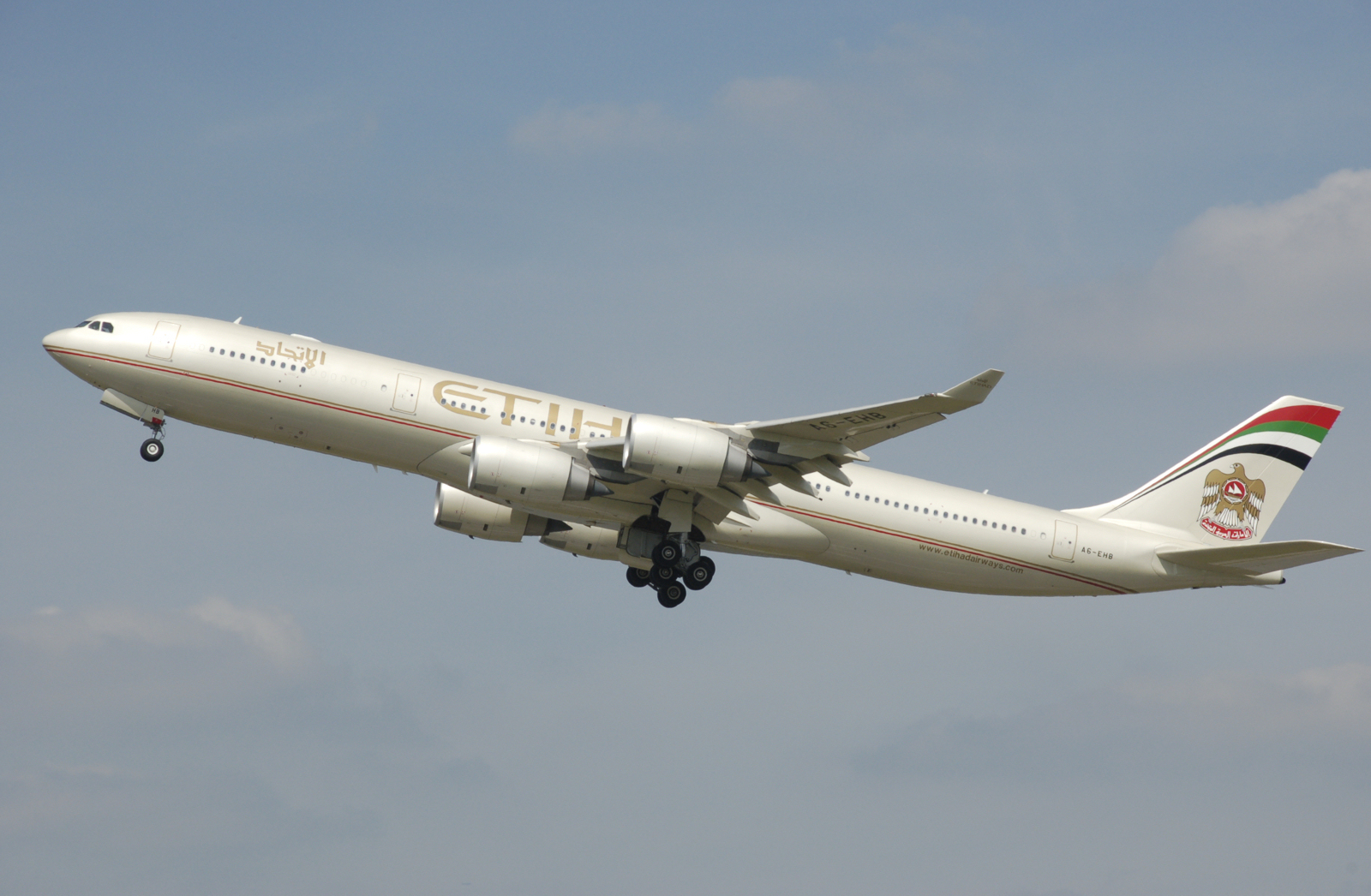
Etihad currently operates a fleet of 23 A320 Family aircraft, 25 A330s and 11 A340s.

James Hogan, President and Chief Executive Officer of Etihad Airways,
“Ten years ago this month, we celebrated our inaugural flight from Abu Dhabi using an Airbus A330. A decade later, we have grown into one of the world’s leading airlines and the importance of Airbus to our fast-growing operations has never been stronger. We have more than 60 Airbus aircraft in our fleet today, and this latest order is testament to the continued strength of our partnership. As one of the first airlines set to receive the much-awaited Airbus A350-1000, we look forward to benefiting from its operational efficiencies and cost savings.”
The A350 XWB (Xtra Wide-Body) is an all-new "mini jumbo" long range product line comprising three versions, the A350-800, A350-900, A350-1000. In a typical two-class configuration, the A350-900 can seat 315 passengers and the A350-1000 seats 369 passengers. The aircraft will offer the range for Etihad to expand its network around the world. On the same day as it ordered the A350, Etihad also ordered its biggest competition the Boeing 777-9X and 777-8X which can seat 400+ and 350 passengers respectively.

In comparison to the Boeing aircraft, which Etihad is expected to fit with 17 inch width economy class seats, the A350 fuselage cross-section is optimized to accommodate Airbus’ 18-inch economy seat-width for long range passenger comfort. Etihad's new order is expected to commence delivery in 2020, the same time as the Boeing 777-9X.

The A320neo is offered as an option for the A320 Family and incorporates new more efficient engines and large "Sharklet" wing tip devices, which together will deliver up to 15 percent in fuel savings. At the end of October 2013, firm orders for the NEO stood at 2,487 from 44 customers, making it the fastest selling commercial airliner ever.

The A330-200F is the freighter version of the A330. It can carry 70 tonnes of payload with a range capability of up to 4,000nm.
Read more »

Dubai Airshow 2013 starts with record breaking orders

As expected the Dubai Airshow opened today with a record breaking order book.

Within three hours of opening, the show’s order tally reached US $162.6 billion – surpassing its previous record of US $155 billion record set in 2007 – with deals coming from Etihad Airways, Emirates Airline, flydubai and Qatar Airways.

The opening order came from Abu Dhabi-based Etihad Airways which announced a deal for 56 new Boeing 777s valued at US$25.2 billion at list prices, including related GE engines. The deal also sees Etihad become the launch customer for the 777-8X which is expected to enter service in 2022.

The airline also ordered 30 Boeing 787-10 Dreamliners, making Etihad the largest customer for the composite aircraft.

James Hogan, President and CEO, Etihad Airways said
“We rarely make announcements at air shows, but when we do the world listens,”
Dubai-headquartered Emirates Airline rapidly re-wrote the Dubai Airshow record with news of a US$99 billion purchase of Boeing and Airbus planes – which industry experts dubbed the largest-ever aircraft order in civil aviation.

The Emirates headline deal was for 150 Boeing 777X, plus 50 purchase rights, and an additional 50 Airbus A380 superjumbos - of which Emirates is currently the largest fleet operator.

Low-cost airline FlyDubai weighed in with a US$11.4 billion order for 111 Boeing 737s and 738s, and then Qatar Airways topped off the morning’s historic agreements with the signing of a US$19 billion letter of intent for 54 Boeing 777s.
Read more »

Dubai International’s passenger traffic up 13.1 per cent in September

By BA Staff

Courtesy of Wikipedia
Passenger traffic at Dubai International, the world’s second busiest airport for international passengers, rose 13.1 per cent in September, according to the latest traffic statistics issued yesterday by operator Dubai Airports.

Passenger traffic in September totaled 5,407,326, an increase of 13.1 per cent compared to 4,780,394 during the corresponding month in 2012. Year to date traffic is up 16 per cent to 49,379,165 compared to 42,565,340 recorded during the first nine months of 2012. Aircraft movements totaled 30,746 during September, an increase of 10.2 per cent from the 27,909 recorded during the same period last year. Passengers per aircraft movement in September came in at 193.

All regions recorded positive growth in September with the exception of South America (-6.9 per cent).  Among the strongest markets in terms of percentage* passenger growth were Eastern Europe (+65.1 per cent), driven by flydubai expansion to multiple destinations in the region and Emirates’ new service to Warsaw. Passenger traffic to and from Australasia rose 38.6 per cent as a result of Emirates' expansion and Qantas’ new operation connecting Australia and London through Dubai. On a country level, Australia (+41.7 per cent), France (+23.7 per cent), Saudi Arabia (+22.4 per cent), Thailand (+21.8 per cent) and the UK (+21.7 per cent) saw the largest increases.

In terms of overall passenger numbers, Western Europe traffic took over as the top market thanks to robust growth (+14.8 per cent) during the month. AGCC came in second thanks to 15 per cent year-on-year passenger traffic growth. The Indian subcontinent, which took third spot, continued to show positive growth (+9.8 per cent) due to the expansion of several Indian carriers including Indigo, Spice Jet and Air India Express.

Air freight volumes rose 1.8 per cent in September with volumes of 196,823 tonnes compared to 193,261 recorded during the same period last year. Year-to-date cargo traffic totalled 1,785,539 tonnes, up 6.6 per cent from the 1,674,997 tonnes shipped during the same period last year.

Paul Griffiths, CEO of Dubai Airports said:
“Passenger and cargo traffic growth continue unabated and Dubai International is on track to eclipse our projections for 65.4 million passengers and 2.7 million tonnes of cargo. With the opening of our new passenger terminal at Al Maktoum International at Dubai World Central, and the ongoing expansion at Dubai International, Dubai’s aviation infrastructure continues to make it an attractive destination for tourism, trade and commerce.”
Read more »

Ethiad Airways increases stake in Virgin Australia to 19.9 percent

By BA Staff

Etihad Airways, the national airline of the United Arab Emirates, confirmed its equity stake in Virgin Australia Holdings had reached 19.9%.

This follows a series of on-market purchases of Virgin Australia shares over recent weeks. The Abu Dhabi-based airline now holds more than 515 million shares in the airline.

At 19.9%, Etihad Airways has reached the threshold approved by Australia’s Foreign Investment Review Board in June 2013.

James Hogan, President and Chief Executive Officer of Etihad Airways, said: 
“We are delighted to have reached this milestone. It reflects our strong support for the business strategy and management team of Virgin Australia and our enduring commitment to the Australian market. It also reflects the close working relationship between our two airlines and we look forward to strengthening its commercial foundations. The strategic partnership continues to deliver significant revenue streams and other benefits to each airline. Increasing our equity in Virgin Australia will further enrich the commercial benefits which the partnership delivers for both airlines as well as increasing the benefits to Australian travellers and visitors to Australia.”"
Etihad Airways and Virgin Australia signed a ten year strategic partnership agreement in August 2010 that includes code-sharing on flights, joint sales and marketing activities, and reciprocal earn-and-burn on their respective frequent flyer programs.

Those benefits include seamless connectivity to more than 40 codeshare destinations in Australia, New Zealand, Indonesia and Thailand and loyalty program privileges such as priority baggage handling, priority boarding and airport lounge access for top tier program members.

Combined, Etihad Airways (25) and Virgin Australia (3) operate 28 flights a week between Abu Dhabi and Australia and passengers have access to a combined global network of more than 280 destinations.

Etihad Airways began flying to Australia in March 2007, when it launched services to Sydney. Flights to Melbourne and Brisbane followed in 2009. The airline has carried more than 2.5 million passengers between Abu Dhabi and these three Australian gateways in the past six years. The airline plans to operate services to Perth in Western Australia in the future.

Etihad Airways also holds equity investments in airberlin, Air Seychelles, Virgin Australia and Aer Lingus, will acquire 49% of Air Serbia from January 2014, and, subject to regulatory approval, will acquire 24% of India’s Jet Airways. It also has codeshare partnerships with 47 airlines worldwide.
Read more »

Etihad Airways to commence Los Angeles flights using Air India 777-200LRs?

by Devesh Agarwal

Etihad Airways Boeing 777-300ER
Etihad Airways, the national airline of the United Arab Emirates (UAE), today announced the launch of direct non stop flights between its home base of Abu Dhabi (AUH) to Los Angeles, California, USA (LAX), from June 1, 2014, subject to regulatory approvals.

The announcement goes on to say,
Etihad will deploy a three class ultra-long haul (ULH) Boeing 777-200LR on the Los Angeles route. The aircraft will be configured to carry 237 guests, with 8 Diamond First Class suites, 40 Pearl Business Class flatbed seats, and 189 Coral Economy Class seats.
This is interesting since the airline does not have any 777-200LR's in its fleet, nor does it have any on order with airframer Boeing. It appears that Etihad will commence the Los Angeles services using 777-200LR (77L) aircraft it is expected to buy from national carrier Air India which has been trying to sell five of its 77Ls for some time now, without success

The purchase of the 77Ls could be a quid-pro-quo on the part of the UAE government for the recent approval of the 400% increase in seat allocation between India and Abu Dhabi under the bilateral air services agreement (BASA) and approval of the 24% stake purchase by Etihad in Jet Airways.

The Air India 77Ls are configured in an eight first class (non-suite), 35 business class and 195 economy class cabin, and this will imply that Etihad re-configure and upgrade the cabin to its specifications after completing the purchase.

When compared to fellow UAE carrier Emirates' 77L configuration of 8/42/216 seats, it appears that Etihad will opt for a more comfortable nine-abreast economy class configuration.

Schedule

Flight EY171 will depart daily from Abu Dhabi at 08:45 and arrive in Los Angeles at 14:15 the same day. The return flight, EY170, will the depart Los Angeles at 16:15 and arrive in Abu Dhabi at 19:35 the following day. The timings are designed to provide onward connectivity to the Indian sub-continent.

Los Angeles will be the airline's fourth destination in the United States, joining Chicago, New York and Washington D.C, all of which see a daily non stop from Abu Dhabi.

Etihad Airways will extend its code-share partnership, in place since September 2009, with American Airlines on the Los Angeles flights. Etihad markets its EY code on American flights through its current gateways of Chicago, New York and Washington DC to more than 70 US cities. American places its AA code on all Etihad Airways flights between the US and UAE.

Visit the Etihad for more details.

What are your thoughts? Share them via a comment.

Read more »

Etihad Airways introduces 'Flying Nanny' service aboard long duration flights.

by BA Staff

Etihad Airways has introduced 'Flying Nanny' service, a dedicated in-flight child care assistance program for families, on its long-haul flights, Identified by a bright orange apron, the Flying Nanny provides a 'helping hand' to families and unaccompanied minors.

Video below the fold

During the past two months 300 Etihad Airways cabin crew members have completed enhanced training for the role. A further 60 will be trained in September and 500 Flying Nannies will be working across Etihad Airways flights by the end of 2013. The course includes in-depth training, from the world renowned Norland College, concentrating on child psychology and sociology, enabling the Flying Nannies to identify different types of behaviour and developmental stages that children go through and how to appreciate the perspective and needs of travelling families.

In addition the course also covers many different creative ways the Flying Nanny can entertain and engage with children during flights. The airline said
“The Flying Nanny will liaise with parents and use their experience and knowledge to make the travel experience easier. This includes helping serve children’s meals early in the flight and offering activities and challenges to help entertain and occupy younger guests.”
Many of these activities derive from a special kit which contains straws, stickers, cardboard and other items which the Flying Nanny uses to teach simple arts and crafts such as creating special greeting cards for friends and family.

The Flying Nanny will also frequently use service items such as paper cups which can be made into hats and the Japanese art of origami to fold paper into sculptures. All activities are designed so the Flying Nanny can leave the children to produce and complete on their own.

A key on-board highlight is set to be the creation of sock puppets which uses stickers from the Flying Nanny kit as eyes and the socks from the guest’s travel pack.

In addition to the arts and crafts, the Flying Nannies can also teach children simple magic tricks which helps retain their focus and interest while seated.

For older children, the Flying Nanny is equipped with simple quizzes and challenges to keep them occupied as well as taking them on tours of the galley during quieter moments of the flight.

Towards the end of the flight the Flying Nanny will help parents by replenishing milk bottles, and offering items such as water, fruit and other snacks especially if the family is transiting to another flight.

The Flying Nanny will also advise families that are transiting at Abu Dhabi about the various baby changing and child facilities at the airport, as well as informing them that there is a children’s play area at Gate 32 in Terminal 3, and in the premium lounges.

Read more »

Have your say: Question of the week: Will the Jet Etihad deal fructify? Will Jet survive?

by Devesh Agarwal

We welcome your feedback and comments on the Jet-Etihad deal.

Without a doubt the humongous increase in seat capacity offered to the Abu Dhabi government by India has some quid-pro-qua links to the Jetihad deal. There is also talk that the bilaterals seat increase was to pacify the UAE government after their telecom company allegedly lost over $1 billion in the recent 2G scam, and get foreign investment flowing in to India from that country.

Regardless of the reasons, the new proposed bilateral air services agreement (ASA) has come under severe flak from many political quarters. At the focal point of attacks is the Prime Minister, who had given his approval to the Group of Ministers (GoM) comprising P. Chidambaram (Finance), Anand Sharma (Commerce), Salman Khurshid (External Affairs) and Ajit Singh (Civil Aviation), to proceed and conclude the ASA.

Dr. Manmohan Singh is regarded as an honourable man, but his reputation has taken a hit following the 2G telecom scam and Coalgate, where national resources like spectrum and coal were doled out to political supports for cheap. A weak Congress, facing a multitude of elections, is now desperately trying to protect the image of the Prime Minister and the memorandum of understanding (MoU) signed with the UAE government on the ASA is now being questioned. To help weather the political story, give cover to the Prime Minister, and justify the deal, a note from the civil aviation ministry is being prepared for perusal and overall approval of the MoU, the Cabinet.

The suave and politically connected Naresh Goyal is reportedly pacing the corridors of power, and doing all he can to keep the Jetihad deal alive.

On the side, news reports indicate Etihad is waiting for the outcome of the cabinet meeting, and the decision on the MoU. Indirectly, it has been reported, that if it does not get the massive increase in traffic rights, Etihad make walk away from the deal.

Jet is facing a debt of over 12,000 Crore ($2 billion), higher than even Kingfisher Airlines, and its very survival is at stake.

Do you think the Jetihad deal will fructify? Under what circumstances? If the deal does not fructify, will the baniya Naresh Goyal be able to prevent Jet Airways experiencing the same fate as Kingfisher Airlines?

Share your thoughts and views via a comment.
Read more »

Opinion: The Etihad-Jet Airways-Kingfisher Airlines love triangle. Who should Etihad choose?

by Devesh Agarwal

Two days ago, two Times of India group newspapers, The Bangalore Mirror and The Economic Times reported UAE national carrier Etihad buying a 48% in financially disabled and grounded Indian carrier Kingfisher Airlines. The Bangalore Mirror may be a tabloid, but The Economic Times is no slouch when it comes to financial matters.

This went against the news of on-going and advanced discussions between Etihad and India's Jet Airways for a possible stake sale by the latter, discussions on which Vinay Bhaskara has posted an analysis.

Curiously, on Wednesday, in another report The Economic Times surreptitiously distanced itself from its own Tuesday report saying
There were reports on Tuesday in certain section of the media that Etihad would pay Rs 3,000 crore for a 48% stake in Kingfisher.
and the question on everyone's minds - what is going on with this love triangle of sorts? Etihad, the groom, is being wooed by two brides, both of whom need Etihad's money; one for expansion, one for revival. Is it a done deal between Kingfisher and Etihad or not? What about Jet and Etihad? Who will Etihad choose? Who should Etihad chose? When Jet and Etihad have been in talks for a while, and there are signs of significant progress, why is Etihad talking to Kingfisher about a stake sale?

Before we go further, in the interests of full disclosure, I own shares, albeit a very small number, in all three publicly listed airlines in India - Jet Airways, Kingfisher Airlines, and SpiceJet.

Firstpost hints at a possible reason why Kingfisher has suddenly popped up in middle of the Etihad Jet courtship. The aggressive demands and arrogant approach by Jet Airways, led by its Chairman Mr. Naresh Goyal, is well known in aviation circles. Despite being publicly ambivalent about foreign direct investment in civil aviation (some say even opposing), Mr. Goyal has been trying his hand out, trying to drum up investors and partners. Nothing wrong there. As a shareholder of Jet, I would want the company's leadership trying to get the best deal. However, it is possible that Jet started discussions and partnerships with one too many a partner, without sealing and fructifying previous deals, and this has soured the situation in more than one boardroom, from the middle east to Europe.

Reports also suggest Jet has been demanding a huge 65% premium, from its current share price, meaning Etihad will have to fork out almost $300 million for a measly 24% stake in Jet, and still get no management control. Furthermore, it appears that Jet has demanded Etihad pay over 50% of the planned investment upfront. These demands, and a possible arrogance of "we are the only airline worth dealing with in India", have queered the pitch, somewhat, prompting Etihad to consider Kingfisher.

So, who should Etihad choose? Jet Airways or Kingfisher Airlines? We welcome your comments and thoughts.

In my humble opinion Etihad should choose Kingfisher.

Etihad is a relative new comer to the airline world, having started just nine years ago, on November 12, 2003, but it is one of the fastest growing airline in the entire history of commercial aviation, under the leadership of James Hogan.

For strategic growth, Etihad has taken stakes in airlines in key markets around the world. 29.21% stake in Air Berlin, a member of oneworld, 40% in Air Seychelles, 2.987% in Irish carrier, Aer Lingus, and 10% in Virgin Australia.

Like the other two of the famous MEB3 (middle east big 3) carriers, Emirates airline of Dubai, and Qatar Airways of Doha, Etihad heavily depends on sixth freedom traffic, connecting passengers across the world, in and out of its Abu Dhabi hub, but due to its late entry, Etihad though does not enjoy the sheer seat volumes in the air services bilateral agreements, Abu Dhabi has signed with various countries, India especially, and in South Asia generally.

At 54,200 seats in over 189 wide body flights a week, Emirates is sarcastically considered the 'unofficial flag carrier of India'. India contributes almost 11% of Emirates' 33+ million annual passengers. Qatar Airways at 101 flights is not too far behind. Now Emirates is trying to renegotiate its India capacity to cross 89,000 weekly seats. The situation is similar in Pakistan, Bangladesh and Sri Lanka.

Etihad needs India for its growth story. Abu Dhabi is limited to about 25,000 seats a week, and Etihad has maxed it out.

Unlike Dubai, which is well served by Indian carriers, IndiGo alone offers 72 weekly flights with 12,960 seats, SpiceJet is at 48 flights and 9,072 seats, Air India, Air India Express, and Jet Airways too having a large number of flights, Abu Dhabi does not see much service by Indian carriers.

With Kingfisher, Etihad will get a 49% stake, and unquestioned management control. It can easily leverage Kingfisher to feed Indian and South Asian passengers to its Abu Dhabi hub, and in a fell swoop, can double its India capacity. From a network perspective also, Etihad today, needing to broad-base its India network, still flies A320 narrow bodies to most of its Indian destinations, Ahmedabad, Bangalore, Chennai, and Hyderabad. Only Delhi and Mumbai are served by wide-body aircraft. Etihad can deploy Kingfisher's A320s which are well equipped with in-flight amenities on these routes, while increasing wide-body capacity at strategic Indian destinations to better compete with both Emirates and Qatar.

Unlike Jet, Kingfisher also does not have an international network, especially to London, a prized destination for all the MEB3 carriers.

With Jet, Etihad gets a running airline, but only a non-controlling stake, and a stake sale will involve untangling the knotty issues of Naresh Goyal Jet Airways' ownership, which is routed through Tailwinds in the tax haven of the Channel Islands, and which is currently in violation of Indian securities laws.

By choosing Kingfisher, Etihad will have to essentially revive the airline, but it has significant assets, routes and slots. With total control, Etihad can remould Kingfisher to closer suit its strategic goals. Keeping in mind its stake in airberlin, control of Kingfisher would also allow Etihad an additional entry in to the oneworld alliance, something that Qatar Airways may not like too much.

On the financial front, while Etihad will get a controlling stake for not much money, it will have to deal with the significant accumulated losses and over Rs. 7,000 Cr. debt, of Kingfisher, owed to banks. This debt though, can be dealt with. Dr. Mallya will use some of the gains from the sale of United Spirits to Diageo to pay down that part of the debt for which he has given personal guarantees. On the whole, lenders will be relieved to see Kingfisher revive, which will enable them to slowly recover their money. Better to get a 50% haircut, than being shaved bald.

To pull this recast of Kingfisher Airlines off, Etihad will need political clout, and that is where Dr. Vijay Mallya scores over Naresh Goyal. While there is no doubt Goyal is THE formidable political force in the Indian airline industry, Mallya has the clout of the liquor industry, the grease pipe of Indian politics. National elections are coming in 2014, and the Indian politicians know they need to dance with the person who brung yah.

Read more »

UAE GCAA releases preliminary information in UPS Boeing 747-400F N571UP crash at Dubai

The General Civil Aviation Authority (GCAA) of the United Arab Emirates (UAE) has released preliminary information on the crash of UPS Airlines Boeing 747-400F freighter registration N571UP at Dubai on September 3, 2010. In parallel UPS has released a statement identifying the two crew who perished in this crash.
GCAA Announces the Preliminary Report on the ACCIDENT INVOLVING UPS6 Boeing 747 – 400 on 3rd September, 2010

Category : GCAA, Date : Sep, 05 2010

The UAE General Civil Aviation Authority (GCAA), announced today the preliminary report on the fatal accident of Boeing 747 - 400 Cargo airplane on 3rd September 2010.
The UPS6 B744 had departed from Dubai International Airport at 14:53 UTC (6:53pm local time) headed to Koln-Bonn (Cologne) - Germany. At 15:15 UTC (7:15pm local time) information was received from Bahrain that the aircraft was returning to Dubai Airport with a smoke in the cockpit, unable to maintain altitude and requested the airport for landing.

The UAE ATC Centre issued a clearance when aircraft was approximately 40 kilometer from touchdown. The aircraft was high on the approach and was at 8500ft at 24 kilometer from touchdown. It passed the overhead the airfield very high and made a right turn. Position reports were passed the tower as well as advising that all runways were available for the aircraft to land on. The aircraft tracked south west and rapidly lost altitude. At approximately 15:42 UTC (7:42pm local time), radar contact was lost. The B744 crashed in in an unpopulated area between the Emirates Road and Al Ain Highway after 50 minutes from departure and after returning back from Bahrain FIR (Flight Information Region).

The GCAA responded by launching an immediate investigation team who are currently on site collecting evidence, analyzing the initial onsite evidence, coordinating with all of the emergency services to secure the accident site, liaising with the aircraft manufacturer technical specialists and international accident investigation bodies who have invited to assist the GCAA onsite in the UAE under the provisions of ICAO Annex 13.

The investigation team recovered the Cockpit Voice Recorder (CVR) approximately 6 hours after the accident; the onsite GCAA investigation team is continuing the recovery effort to locate the Digital Flight Data Recorder (DFDR), while investigating the aircraft structure, systems, engines and flight controls as part of the forensic evidence collecting and data capturing activities associated with major air accident investigation.

A team from the National Transportation Safety Board (NTSB) will arrive to UAE today to assist the GCAA team in the crash investigation.

Coordination activities with the regional (ANS) is also continuing in the retrieval of important communications and flight planning material crucial to the successful conclusion of this investigation.
The UPS statement identifies the two dead crew members and provides technical details on the airframe.
Atlanta, September 04, 2010

A UPS cargo plane has been involved in an accident in Dubai.

Updated 4:15 PM EDT (20:15 UTC)

At the request of the families, UPS can now confirm that two of our crewmembers, Captain Doug Lampe of Louisville, Kentucky, and First Officer Matthew Bell of Sanford, Florida, lost their lives in the crash of Flight 6 yesterday, Sept. 3, in Dubai, United Arab Emirates.

The two pilots were flying a 747-400 en route to Cologne, Germany, when it crashed near Dubai International Airport shortly after takeoff.

"This is a terrible tragedy, and all of us at UPS extend our deepest sympathies to the families and friends of both of these crewmembers," said UPS CEO Scott Davis. "Our thoughts and prayers will continue to be with them during this difficult time."
The UPS Family Assistance Team is working with the victims' families to help them in their time of need.

Captain Lampe, 48, has been with UPS since 1995. First Officer Bell, 38, has been with UPS since 2006. Both crewmembers flew out of UPS's Anchorage, Alaska domicile, or pilot base.

The aircraft, tail number N571UP, was just three years old, entering UPS service off the Boeing production line in September 2007. The airframe had flown 9977 hours, completing 1764 takeoffs and landings. It was up to date on all maintenance, having just completed a major inspection in June 2010.

UPS owns 12 747-400s, eight of which are new, and four of which have been purchased from other carriers and adapted for UPS use. The aircraft, which has a payload capacity of nearly 258,600 pounds, is used on long-range international routes, such as the regular Dubai-Cologne routing.

The National Transportation Safety Board (NTSB) is dispatching an aviation investigation team to assist the General Civil Aviation Authority (GCAA) of the United Arab Emirates in the crash investigation. The GCAA will take the lead on the investigation and release all information on the progress of the investigation.

NTSB Chairman Deborah Hersman has designated senior air safety investigator Bill English as the U.S. accredited representative. His team will include NTSB specialists in the areas of human performance, fire, operations and systems. The team will also include technical advisors from the FAA, Boeing, UPS, GE and the Independent Pilots Association.

A UPS team has arrived in Dubai at this time and will cooperate with authorities in the investigation.

"We established an internal command center within minutes of learning of this tragedy. It will be staffed around the clock with experts from every part of our operation," said UPS Airlines President Bob Lekites. "Safe, secure operations are our top priorities for our employees, our customers, and our public stakeholders."

Blue skies forever Captain Lampe and First Officer Bell, 38. RIP.
Read more »