Showing posts with label Etihad. Show all posts

Jet Airways to lease three A330-200s to Turkish Airlines

by Devesh Agarwal and Vinay Bhaskara

In a December 12th filing with the Borsa Istanbul stock exchange (BIST), national carrier Turkish Airlines has said it will lease three Airbus A330-200 aircraft from India's Jet Airways for a period of six years. The financial details of the proposed lease were not made available. The middle-eastern giant will lease another five A330s from Dutch lessor AerCap for a period of eight years.
Bulk of Jet's A330s sitting on the ground. Photo copyright 2012 Devesh Agarwal.


Turkish Airlines (THY) has been leasing aircraft from Jet Airways since 2008 and once again in 2013, as the Indian carrier found it difficult to fill most of its international wide-body fleet. At one point 70% of Jet's Boeing 777-300ER fleet was leased out, with four aircraft leased to Turkish Airlines and three to Thai Airways. Jet even sold one of its Boeing 777s, strangely a money spinner for most of the world's airlines, but not for Jet.

Till recently, much of Jet's A330-200 fleet was grounded at Indian airports thanks to aggressive route rationalisation by the airline. In the second quarter of this fiscal year, Jet lost a whopping Rs.123 crores, just on the costs of keeping its aircraft on the ground.

Five of the ten grounded A330-200 aircraft have been leased by Jet, though on a short term basis, to 24% stake-holder, Abu Dhabi based Etihad Airways PJSC. The deal with Turkish was expected, after a deal to sell the remaining five A330s to Kuwait Airways fell through last month.

Repeated requests to Jet Airways for comments on this story were not answered.

It is an economically sensible deal for Jet Airways. In one stroke it is addressing a major cash drain, and ensuring long term dollar denominated revenue for itself. While a sale which would have brought in one-time income which would have reduced long-term lower cost debt, a lease will give Jet a long term hedge against potential rupee devaluations and the ability to pay off its $400 million high interest rate debt. Jet is reeling under a total debt load of about $1.9 billion.

As Jet Airways continues to turn over its long haul operations to Etihad and Abu Dhabi via the Jetihad partnership, look for the carrier to continue to seek out incremental opportunities to earn rent on its under-utilised assets.
Read more »

Etihad to commence Abu Dhabi to Jaipur flights

by Devesh Agarwal

Etihad Airways, the national airline of the United Arab Emirates, will launch a daily service from Abu Dhabi to Jaipur commencing on April 1, 2014. With Jaipur, Etihad will serve ten destinations in India Ahmedabad, Bangalore, Chennai, Hyderabad, Kochi, Kozhikode, Mumbai, New Delhi and Trivandrum.

Etihad will operate the service with an Airbus A320 aircraft in a two-class configuration, 16 Pearl Business Class seats and 120 Coral Economy Class seats.

Flight EY208 will depart Abu Dhabi at 23:00 arrive Jaipur 03:45 next morning
Flight EY207 will depart Jaipur at 04:45 arrive Abu Dhabi 06:45

The schedule is targeted to carry passengers onwards to African, European and North American destinations.

Post its 24% stake purchase in Jet Airways, which was coincidentally at the same time the Indian UAE (Abu Dhabi) bilateral air services agreement increased seat allocation by 300%, Etihad has been aggressively expanding to new destinations in India, and increasing the frequency and aircraft on its existing services to the country. It has already tripled the number of seats on the prime Abu Dhabi – Mumbai and Abu Dhabi – New Delhi routes.

The gulf carrier also intends to codeshare on a wide range of Jet Airways flights operated within India, and between India and Abu Dhabi, subject to regulatory approval.
Read more »

Etihad triples seats to Mumbai and Delhi, announces massive increase in India flights

by Devesh Agarwal

Etihad Airways has wasted no time in capitalising on its recent bonanza of seat quota increase under the new India UAE (Abu Dhabi) bi-laterial air services agreement (BASA).

It has announced a massive increase in flights to most of its destinations in India. Specifically
  • Mumbai and New Delhi: from 7 to 14 flights per week with immediate effect
  • Kochi: from 7 to 14 flights per week from June 2014
  • Bangalore and Chennai: from 7 to 14 flights per week from July 2014
  • Hyderabad: from 7 to 14 flights per week from October 2014
Cocking a snoot at the on-going legal proceedings challenging the BASA and Etihad's 24% stake investment in Jet Ariways, the gulf carrier has doubled the number of flights and tripled the number of seats between Abu Dhabi and Mumbai and New Delhi.

Etihad Airbus A330-200. Image copyright Vedant Agarwal. All rights reserved. Used with permission.


Under the expanded schedules, effective immediately, new mid-afternoon services to Mumbai and New Delhi are operated with single-aisle Airbus A320s, each seating 136 passengers, and existing late evening departures have been upgraded to larger aircraft.

On the Abu Dhabi-Mumbai route, the evening flight is now operated with 292-seat Airbus A340-600 aircraft, seating 12 passengers in Diamond First Class, 32 in Pearl Business Class and 248 in Coral Economy. This will add 2,044 seats per week from Abu Dhabi to Mumbai, taking the total from 952 to 2,996 seats in each direction – just over triple the previous capacity.

On the Abu Dhabi – New Delhi route, the evening service has been upgraded to a 254-seat Airbus A330-200 aircraft, seating 18 guests in Business Class and 236 in Economy. This will add 1,778 seats per week to and from New Delhi, increasing from 952 seats to 2,730 in each direction – almost triple the previous capacity.

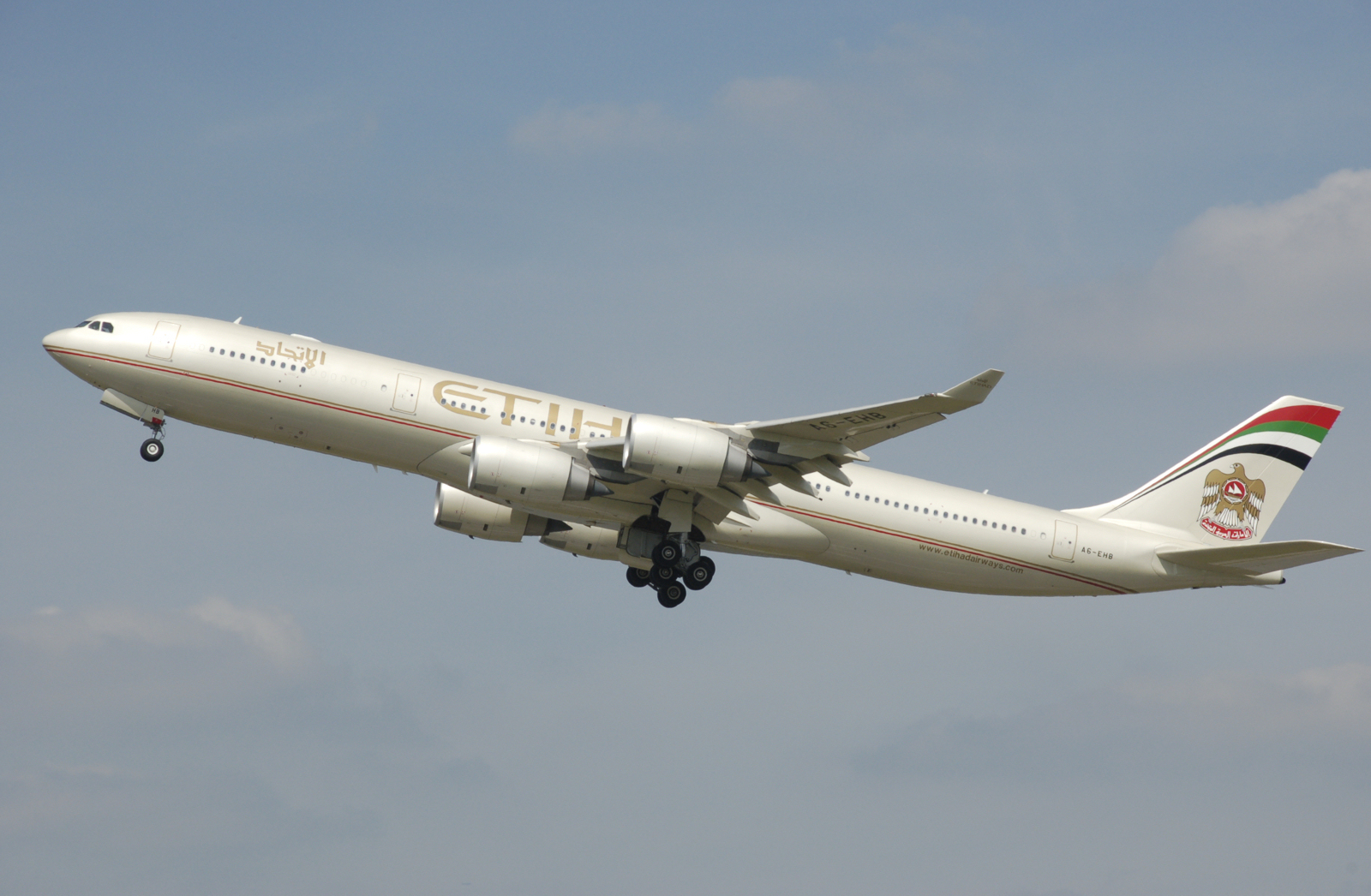
Etihad A340-600. Photo courtesy Wikipedia. Photo copyright Maarten Visser. Used under CC license.

On the Chennai and Kochi routes, from June 2014 Etihad will upgrade its aircraft to Airbus A321s, seating 174 passengers from the existing A320s which seat 136 passengers. There is no mention of any aircraft change at Bangalore where Etihad operates a daily A320, where both its fellow gulf competitors Emirates and Qatar Airways operate A330 and Boeing 777 wide-body services.

Outlining a strategy to use Abu Dhabi as a hub to funnel-in passengers from India on to Europe, US, middle-east and Africa, James Hogan, President and Chief Executive Officer of Etihad Airways said
“India is one of the world’s largest and fastest-growing air travel markets, and will play an increasingly important role in our growth,” “Subject to receiving regulatory approvals, we will continue to expand our Abu Dhabi – India operations and work with our growing stable of partners to accommodate strong growth and deliver much greater choice for travel to and from India.” “Through our purchase of 24 per cent of Jet Airways – the first foreign investment permitted in an Indian airline – we have laid the foundations for major and exciting growth in air services between Abu Dhabi and India, and beyond throughout our global network,”
The new Etihad Airways flights will also be marketed by Jet Airways as an extension of the airlines’ existing codeshare partnership.

This is just a preview of what India can expect from all three gulf carriers in the years to come. With their hundred billion dollar aircraft orders, one shudders to think of the sheer capacity these airlines will add in the next decade; and the capacity they will be able to dump in the Indian market.

Etihad's actions are bound to have impact on national carrier Air India who is trying to expand services to Europe and North America in its revival efforts. Fellow gulf majors Emirates and Qatar Airways will also start feeling the pinch. It remains to be seen what strategy Etihad adopts to start filling those 200% extra seats, though pricing is a sure-fire way to the Indian passenger's heart.

Share your thoughts on this development via a comment.

Read more »

Analysis: Indian leaders should learn from the Dubai order bonanza

by Devesh Agarwal

Value of orders at the show exceed India's annual tax revenues

The recently concluded Dubai Air Show 2013 broke all records for aircraft orders placed at an air show. Driven by the “Gulf Big 3”, Emirates, Qatar Airways, and Etihad Airways, the show clocked orders exceeding a mind-boggling, $206 billion, underscoring the power shift in the commercial airline industry to the Gulf, and in the process toppling the crown long held by air shows like Farnborough and Paris.

These gulf carriers have long eclipsed their western competitors like Lufthansa, Air France, and British Airways, in fleets, passengers, and routes, and with their new swanky shopper paradise airports, are now, giving the highly respected Cathay Pacific and Singapore Airlines a run for their money. European governments are now resorting to restrictive tactics to slow the growth of these behemoths, while in the United States, aviation industry professionals are calling on their government to stop US Exim Bank funding of aircraft exports to these airlines.

How have these three gulf airlines come to become such a massive force in global commercial aviation? Several factors have led to this.

Over the last 50 years while the entire middle-east earned significant money from oil and gas, the three tiny city-states of Dubai, Qatar, and Abu Dhabi were relatively small players in the oil world compared to their neighbours Saudi Arabia, Kuwait, Iraq, and Iran.

Credit must go to rulers of these countries who realised, early on, the need to develop alternate industries to oil. Using the income from oil and the advantage of their geographic location, the Emirs and Sheikhs of these three Gulf states should be applauded for having the business acumen to rely on a history of trade going back millennia, and embarking on a long-term vision to link various countries together, this time transporting people not just goods.

Through a coordinated action plan, they recruited good industry professionals as leaders, invested in aviation infrastructure, not limiting themselves to airlines, aircraft, and airports, but slowly and surely entering in to all the support and peripheral businesses, an aviation hub requires. Ground handling, flight kitchens, maintenance, repair, engineering, aviation IT, and now aero components manufacturing. And many of these businesses are no longer confined to their home states.

The results are nothing short of astounding. Growing from just one leased aircraft, in less than 30 years, Emirates of Dubai has grown to become the largest airline in the world measured by scheduled international passenger-kilometres flown, and the third largest airline by capacity measured in available seat-kilometres (ASKs). dnata, part of the Emirates group, is today, one of the largest suppliers of air services in the world offering aircraft ground handling, cargo, travel, and flight catering services across five continents and 37 countries, and Dubai airport ranks up amongst the best.

In a “if they can do it, so can I” mode, Qatar Airways has also grown to become a member of the oneworld alliance, while fellow emirati carrier Etihad Airways is growing leaps and bounds, both organically, and inorganically. While their European competitors are shrinking, the Gulf Big 3 have all become members of the “six continents club”. Today, anyone can fly from almost any location to almost any destination, anywhere on the planet, on each of these three carriers, with just one stop in their gulf home base.

Another demonstration of the clout of these airlines is the way in which they have essentially forced the two large aircraft companies Boeing and Airbus to develop new aircraft specific to their requirements. The Boeing 777X is a classic example. The size of this mini-jumbo coupled with the long range is exactly what Tim Clark, the boss of Emirates, has been demanding from some time now. It may not suit 90% of Boeing’s customers, but for the Gulf Big 3, it is perfect. The 777X will carry up to 400 passengers from Clark's Dubai hub, to Los Angeles in west and Auckland in the east. Developing aircraft is a multi-billion dollar gamble, and buying aircraft worth hundreds of billion to be delivered only after six years shows the long term commitment and confidence these airlines and their sheikh/emir owners have.

India’s contribution

The politicians of India, along with other countries in South Asia and Africa should claim credit for the growth of these carriers.

Shackling their national carriers in subservience, they readily gave up their national markets, enabling these fledglings to grow in to behemoths carrying the ever increasing international travellers from these emerging economies to destinations in Europe and North America.

The three carriers have muscled their way, using any and all means, to gain massive seat allocations. As an example, with 189 flights and over 50,000 seats per week, Emirates is considered the unofficial national carrier of India. Its market share of India’s international traffic is over 14%, and India contributes at least 11% of Emirates' world-wide traffic. Qatar Airways with about 100 flights has similar demographics, and very recently, Etihad used its clout to get an almost 300% increase in seat allocations from India. One can expect Emirates and Qatar, to use Etihad as an example, and come back to the Indians demanding more.

Orders more than India’s tax revenues

To put $206 billion in perspective. At Rs. 61 to a dollar, it is Rs. 12,56,600 crores, compare this to Rs. 12,35,870 crores, the total amount of taxes the Government of India is hoping collect this fiscal year. Even at a 35% discount, the orders add up to Rs. 8,17,000 crore which is close to the total tax collected by central government, net of the share given to the states. Staggering is the only word that comes to mind.

Jobs and industry

The Gulf rulers ensure further development of the aviation industry in their countries. Boeing forecasts the region will require 40,000 pilots and 53,100 technicians, at an expected annual rate of 2,000 pilots and 2,600 technicians, over the next 20 years. Mubadala Development Company PJSC a wholly owned investment vehicle of the Government of Abu Dhabi, has obtained manufacturing ventures and purchase committments from both Airbus and Boeing of at least $5 billion each in new age technologies like carbon-fibre, special coatings, heat treatments, and other aerospace parts. Similar commitments were taken from major sub-system vendors like engine manufacturers GE Aviation and Rolls-Royce.

India’s civil aviation, foreign, and commerce ministers would serve their nation better by learning from the Gulf instead of spouting platitudes on how the massive increase in Etihad’s seat allocation will be good for the Indian consumer.

Share your thoughts on the power shift via a comment.
Read more »

Jet Airways cancellation of Colombo-Chennai tied to Jetihad?

by BA Staff

Earlier today, it was announced that Indian full service carrier Jet Airways would be cancelling its longstanding daily flights between its Southern hub at Chennai, and Colombo from 3rd January, 2014. The route, which was operated with Boeing 737-800 equipment, had schedules as follow:

9W252 ~ MAA - CMB ~ 0055 – 0210 ~ 738 ~ Daily
9W253 ~ CMB - MAA ~ 0310 – 0430 ~ 738 ~ Daily

Jet Airways will continue to serve Colombo from its largest hub at Mumbai. The move comes as a bit of a surprise, given that the India-Sri Lanka market, especially with regards to inbound medical tourism at Chennai, remains robust. And at a time when Jet continues to incur massive losses on its domestic network, it makes little sense for Jet Airways to cancel a route of roughly domestic length, but with fares 30% higher. There are however, a pair of countervailing factors that could be the reason behind the move. The first is that SriLanka Airlines is planning a major Indian expansion, which could drive down fares and yields. But even more importantly, with the Jetihad partnership recently finalized, Etihad now has the ability to dictate Jet Airways' international route decisions. Is Etihad behind this route cancellation? Let us know in the comments below. 
Read more »

Etihad Airways orders 115 Rolls Royce Trent engines

By BA Staff

Etihad Airways, has announced an order for 113 Rolls-Royce Trent XWB engines to power 50 new Airbus A350 XWB aircraft and two Trent 700 engines for an Airbus A330-200 freighter.

The order, unveiled at the Dubai Air Show 2013, includes 102 engines fitted onto the aircraft, 13 spare engines and long-term TotalCare® support services.

The Rolls-Royce Trent XWB engines will be fitted onto 40 A350-900 and 10 A350-1000 aircraft, Deliveries of the Etihad aircraft are scheduled to commence from 2020.

James Hogan, President and Chief Executive Officer of Etihad Airways, said: 
“We have a very successful track-record with Rolls-Royce engines, from the Trent 700 engines on our A330s to the Trent 500 engines on our A340s, and this latest order will further strengthen our relationship. The Airbus A350 XWB will play a fundamental role in the next phase of our international growth strategy and we are confident the Trent XWB engines will deliver exceptional lifecycle fuel-efficiency, maximise revenue potential, minimise disruption and reduce environmental impact.”
With thrust up to 97,000 pounds, the Rolls-Royce Trent XWB engines are the sole choice, as of now, for the Airbus A350 XWB.
Read more »

Etihad Airways orders CFM LEAP engine for its A321neo

By BA Staff

Etihad Airways, the national airline of the United Arab Emirates, announced that it has selected CFM International’s advanced LEAP-1A engine to power 26 Airbus A321neo scheduled to begin delivery in 2018. The order is valued at $2.8 billion U.S. at list price, including a long-term services agreement.

To support the new fleet, Etihad has signed a 15-year Rate per Flight Hour (RPFH) agreement, under the terms of which CFM will guarantee maintenance costs on a dollar per engine flight hour basis.

James Hogan, president and chief executive officer of Etihad Airways said:
“Etihad Airways prides itself on operating modern, state-of-the-art and highly efficient aircraft, with the Airbus A320 family at the heart of our narrow-body fleet. Through the introduction of the brand new Airbus A320neo family aircraft, we will benefit from even lower fuel consumption and environmental impact on short-haul and medium-haul flights. Much of these operational improvements will derive from the advanced LEAP-1A engine, which has been meeting all performance targets.”

Jean-Paul Ebanga, president and CEO of CFM International said:
"We are happy to welcome Etihad as a CFM customer. In just 10 years, this airline has built a reputation for excellence in every facet of its business, and we are honored to become part of this team"
Gaël Meheust, vice president of sales for CFM International said:
“We are obviously excited that Etihad chose to power its new A320neo fleet with the LEAP engine. We think this engine is going to be the best we’ve ever built and Etihad will realize the benefits from day one – lower fuel burn, lower noise and emissions, all with CFM’s legendary reliability and low cost of ownership."
Read more »

Jetihad is born. Jet Airways completes 24% stake sale to Etihad Airways

Abu Dhabi-based Etihad Airways and Mumbai-based Jet Airways today announced that they have closed the transaction of a 24% equity stake by Etihad Airways in Jet Airways.

Jet Airways' Boeing 777-300ER


In a release they said
"All requisite Indian regulatory approvals had been obtained by November 12th, 2013. Jet Airways has, on November 20th, 2013, issued and allotted 27,263,372 equity shares of a face value of Rs. 10 each at a price of Rs. 754.7361607 per equity share on a preferential basis to Etihad Airways.

Consequent to the above allotment, the paid up share capital of Jet Airways stands increased to 11,35,97,383 equity shares of Rs. 10 each. Following this issue and allotment of the said equity shares on a preferential basis to Etihad Airways, Etihad Airways holds 24 per cent of the post issue paid up share capital of Jet Airways (on a fully diluted basis)."
Mr. James Hogan, CEO, and Mr. James Rigney, CFO of Etihad Airways have been appointed as additional directors on the board of directors of Jet Airways as from November 20th, 2013.

Mr. Goyal and Mr. Hogan confirmed that the collaboration between the airlines would commence immediately with a view to delivering network and service benefits to customers as soon as possible.
Read more »

Etihad orders 87 Airbus aircraft

by Devesh Agarwal

Etihad Airways, of the United Arab Emirates, has announced a firm order on European airframer Airbus S.A.S. for 50 A350 XWBs, 36 A320neo aircraft and one A330-200F freighter worth $26.9 billion at list prices.

The contract was signed yesterday at the 2013 Dubai Airshow by James Hogan, Etihad Airways CEO and Fabrice Brégier, Airbus President and CEO.

The Airbus A350 XWB order will be equipped with Rolls-Royce Trent XWB engines and deliveries will commence in 2020. The 26 A321neo and 10 A320neo aircraft are scheduled for delivery from 2018, while the A330-200F will arrive in 2017. The neos will be powered by CFM LEAP-1A engines.

Etihad currently operates a fleet of 23 A320 Family aircraft, 25 A330s and 11 A340s.

James Hogan, President and Chief Executive Officer of Etihad Airways,
“Ten years ago this month, we celebrated our inaugural flight from Abu Dhabi using an Airbus A330. A decade later, we have grown into one of the world’s leading airlines and the importance of Airbus to our fast-growing operations has never been stronger. We have more than 60 Airbus aircraft in our fleet today, and this latest order is testament to the continued strength of our partnership. As one of the first airlines set to receive the much-awaited Airbus A350-1000, we look forward to benefiting from its operational efficiencies and cost savings.”
The A350 XWB (Xtra Wide-Body) is an all-new "mini jumbo" long range product line comprising three versions, the A350-800, A350-900, A350-1000. In a typical two-class configuration, the A350-900 can seat 315 passengers and the A350-1000 seats 369 passengers. The aircraft will offer the range for Etihad to expand its network around the world. On the same day as it ordered the A350, Etihad also ordered its biggest competition the Boeing 777-9X and 777-8X which can seat 400+ and 350 passengers respectively.

In comparison to the Boeing aircraft, which Etihad is expected to fit with 17 inch width economy class seats, the A350 fuselage cross-section is optimized to accommodate Airbus’ 18-inch economy seat-width for long range passenger comfort. Etihad's new order is expected to commence delivery in 2020, the same time as the Boeing 777-9X.

The A320neo is offered as an option for the A320 Family and incorporates new more efficient engines and large "Sharklet" wing tip devices, which together will deliver up to 15 percent in fuel savings. At the end of October 2013, firm orders for the NEO stood at 2,487 from 44 customers, making it the fastest selling commercial airliner ever.

The A330-200F is the freighter version of the A330. It can carry 70 tonnes of payload with a range capability of up to 4,000nm.
Read more »

Boeing launches 777X program - images and video

by Devesh Agarwal

Boeing 777-9X. Boeing image.
The Dubai Airshow is known for releasing multi-billion dollar orders from the major Gulf carriers, and yesterday was no exception.

Boeing was the clear winner on day one of the show, and the star was the yet to be commenced Boeing 777X program which is an upgrade of the already ultra-popular Boeing 777 twin engine wide body jetliner which today commands 71% of the in-service fleet worldwide.

Video at the end of the story

Despite receiving a order for 34 777-9X from German carrier Lufthansa two months ago, Boeing formally launched the 777X program at the 2013 Dubai Airshow, in deference to its largest 777 customer, Dubai-based Emirates airline, whose CEO, Tim Clark, has been the biggest demander of the new aircraft. (Watch a video of Tim Clark talking about wide body aircraft including the 777X).

Reflecting customer faith in the yet to be developed aircraft, Boeing took in orders and commitments for a whopping 225 aircraft, racking up its tally to 259, making the 777X, the largest product launch in commercial jetliner history by value.

Boeing image
Boeing received orders and commitments from Etihad Airways with 25 77X aircraft (17 777-9X and 8 777-8X), Qatar Airways with 50 777-9X; and Emirates with 150 777X (115 777-9X and 35 777-8X), with an option for 50 more. The combined value of the agreements is more than $95 billion at list prices.

The consistent large orders from the Gulf majors is not unexpected. As Sheikh Ahmed bin Saeed Al-Maktoum, Chairman of Emirates, explained
"In recent years, much of the action in global aviation has shifted to the Middle East because countries like the U.A.E. and Qatar have tapped into our geographical advantage to build new air transport connections for the world,"
The 777X will build on the market leading 777 and will introduce new technologies in multiple places. A new composite wing similar to the 787 Dreamliner and 747-8 Jumbo will feature folding raked wingtips, allowing the new plane to fit into existing gates at airports. The new GE9X is touted as the most advanced commercial engine ever. Giving airlines what they desire most, lower seat-mile costs.

Mini-jumbo battle

Boeing 777-9X and 777-8X CGI. Boeing image.
The existing 777-300ER (77W) will be upgraded to the 777-9X with a list price of $377.2 million, an expected entry in to service (EIS) date of 2020, range of 8,200 nm (15,185 km), and passenger capacity of 406. The 777-200LR will be upgraded to the ultra-long-haul (ULH) 777-8X with a list price of $349.8 million, an EIS about 18 months after the -9X, range of 9,300 nm (17,220 km), and passenger capacity of 350 which is close to that of the existing 777-300ER.


The "mini-jumbo" segment is hotly contested, pitting the 777X against the A350 XWB from European major, Airbus.

While Boeing claims "the 777-8X competes directly with the A350-1000, while the 777-9X is in a class by itself", Airbus counters saying Boeing has driven up passenger numbers to justify operating economics using the ultra-dense 17 inch width seating, as practised by Emirates and Etihad, when compared to the wider 18 inch seat width used by Airbus to arrive at its 350 seat A350-1000, which is due to enter service in 2017.

Video of 777X

Read more »

In new strategy Etihad invests in Darwin Airlines, re-brands it Etihad Regional

by Devesh Agarwal

Etihad Airways, the national carrier of the United Arab Emirates, today announced what it calls a ‘step-change in global aviation’ with the launch of its first branded regional operation, after taking a 33.3 per cent stake in Swiss carrier Darwin Airline.

(Left to right) James Rigney, Etihad Airways’ Chief Financial Officer; Maurizio Merlo, Chief Executive Officer of Darwin Airline; James Hogan, Etihad Airways’ President and Chief Executive Officer; Emilio Martinenghi, President of Darwin Airline, celebrate the launch of Etihad Regional at the Dubai Air Show 2013.
Following completion of the minority investment, which is subject to regulatory approval, Darwin Airline will rebrand its operations as Etihad Regional and align its network to connect passengers from secondary European markets onto the main networks of Etihad Airways and its equity alliance partners in Europe, airberlin and Air Serbia.

Part of the strategy will see Etihad Airways launching daily services on June 1, 2014 from Abu Dhabi to Zurich, which will become one of Darwin Airline’s main operating hubs. The flight will depart Abu Dhabi at 2am and arrive early morning in to Zurich, enabling connections on to Regional's flights.

James Hogan, Etihad Airways’ President and Chief Executive Officer, said
“This is a step-change for Etihad Airways. With our new partner Darwin Airline, we are creating a unique approach to network development for global airlines. European travellers will now be able to connect from a far, far wider range of European towns and cities on Etihad-branded aircraft, through Abu Dhabi to our destinations worldwide. We are also linking the new Etihad Regional network into the key hubs of our equity alliance partners, bringing benefits to the customers of airberlin and Air Serbia. This is not just a great new offer for European travellers. It is also great news for Darwin Airline, which will see increased investment, greater sales and marketing opportunities, and the chance to benefit from Etihad Airways’ global network.”
Darwin Airlines Saab 2000 in current livery. Photo Devesh Agarwal
Darwin Airline is headquartered in Lugano, Switzerland, with its major hub in Geneva, to which Etihad already operates flights. Darwin currently offers scheduled flights to 21 destinations in Europe using a fleet of 10 50-seat Saab 2000 turboprop aircraft. Its flights operate under the IATA designator code 0D, which will continue past the re-branding.

After the 33% stake investment by Etihad, Darwin Airline will become he seventh member of the Etihad Airways equity airline alliance. Etihad Airways has minority shareholdings of 29% in airberlin, 40% in Air Seychelles, 19.9% in Virgin Australia and 3% in Aer Lingus. Etihad has received approval to acquire 24 per cent of India’s Jet Airways, and from January 2014, will acquire 49 per cent of Air Serbia.

Darwin, will continue to focus on secondary markets, and become the first airline to operate using a new sub-brand called ‘Etihad Regional’. Darwin Airline will also adopt the Etihad Guest frequent flier program.

The investment will give Etihad Airways access to regional markets in Europe, and enable a major expansion of Darwin Airline’s operations.

Darwin Airlines Saab 2000 in new Etihad Regional livery. CGI.
Darwin's fleet will be re-painted in the new ‘Etihad Regional’ livery which sees the logo displayed prominently on each side of the fuselage of the aircraft, while the rear of the plane will carry the words “Operated by Darwin Airline”, and the Darwin Airline’s present logo. The Swiss flag will be displayed on the dorsal tail fin, though the E of the Etihad logo will take prominence on the tail.

By mid-2014, Darwin Airline will add 21 new routes and 18 new destinations. Its network will then include six European gateways served by Etihad Airways – Geneva, Amsterdam, Paris, Düsseldorf, Belgrade and, commencing in June, Zurich.

Darwin Airline will be able to connect to the network of airberlin, Etihad Airways’ equity partner, through new and existing routes to Berlin, Düsseldorf and Zurich. Berlin and Düsseldorf provide excellent connections to the United States with airberlin.

Darwin Airline will also be able to connect to the network of Air Serbia, through its hub at Belgrade.
Subject to regulatory approval, Etihad Airways, airberlin and Air Serbia will codeshare on Darwin Airline routes, while Darwin Airline will codeshare on Etihad Airways, airberlin and Air Serbia flights from a range of European gateways. This will provide deeper access to Europe for the three larger carriers and significant new international connectivity and feeder traffic for Darwin Airline.

Maurizio Merlo, Chief Executive Officer of Darwin Airline, believes the Etihad Airways partnership will enable Darwin Airline to build upon its success to date and enjoy significant growth, not only by providing a larger network for customers within Europe but also greater access to Europe for travellers from around the world.

Darwin Airline’s expanded network, to be implemented in stages from April 2014, will provide significant new opportunities for travellers to fly between major regional centres in Europe and the global network of Etihad Airways, via its hub in Abu Dhabi, capital of the UAE.
  • In April 2014, Darwin Airline will launch nine new routes, from Dusseldorf to Berlin, Cambridge and London City; from Berlin to Poznan and Wroclaw; from Geneva to Toulouse; from Zurich to Leipzig; and from Rome to Tirana and Zagreb.
  • In May 2014, it will start flights from from Zurich to Geneva, Florence and Turin; and from Geneva to Belgrade.
  • In June 2014, it will launch flights from Zurich to Linz, Graz, Verona and Lyon; and from Geneva to Bordeaux, Marseille, Nantes and Verona.
What are your thoughts on this new strategy by Etihad? Post a comment.
Read more »

Dubai Airshow 2013 starts with record breaking orders

As expected the Dubai Airshow opened today with a record breaking order book.

Within three hours of opening, the show’s order tally reached US $162.6 billion – surpassing its previous record of US $155 billion record set in 2007 – with deals coming from Etihad Airways, Emirates Airline, flydubai and Qatar Airways.

The opening order came from Abu Dhabi-based Etihad Airways which announced a deal for 56 new Boeing 777s valued at US$25.2 billion at list prices, including related GE engines. The deal also sees Etihad become the launch customer for the 777-8X which is expected to enter service in 2022.

The airline also ordered 30 Boeing 787-10 Dreamliners, making Etihad the largest customer for the composite aircraft.

James Hogan, President and CEO, Etihad Airways said
“We rarely make announcements at air shows, but when we do the world listens,”
Dubai-headquartered Emirates Airline rapidly re-wrote the Dubai Airshow record with news of a US$99 billion purchase of Boeing and Airbus planes – which industry experts dubbed the largest-ever aircraft order in civil aviation.

The Emirates headline deal was for 150 Boeing 777X, plus 50 purchase rights, and an additional 50 Airbus A380 superjumbos - of which Emirates is currently the largest fleet operator.

Low-cost airline FlyDubai weighed in with a US$11.4 billion order for 111 Boeing 737s and 738s, and then Qatar Airways topped off the morning’s historic agreements with the signing of a US$19 billion letter of intent for 54 Boeing 777s.
Read more »

Etihad kicks off Dubai airshow with mamomth Boeing 777-9X, 777-8X and 787-10 order

by Devesh Agarwal

From top, clockwise, Boeing CGI of Etihad 787-10, 777-8X, 777-9X
United Arab Emirates' (UAE) national carrier, Etihad Airways PJSC, kicked off the Dubai Air Show with a massive order for 56 wide-body Boeing aircraft with options to purchase for an additional 26 aircraft taking the quantity up to 82 at a list price valuation of $25.2 billion.

The Abu Dhabi-based carrier's order includes 25 777X airplanes, comprising 17 777-9Xs and eight 777-8Xs, subject to program launch. Etihad Airways is the first airline to order the 777-8X and will be a launch customer of the airplane, which is expected to enter service around the end of the decade. The order includes options and purchase rights for 12 additional 777X airplanes.

The airline also ordered 30 Boeing 787-10 Dreamliners, the high-capacity, medium-haul, and longest member of the Dreamliner family. Combined with the carrier's previous orders for 41 787-9s, today's order makes Etihad the world's largest airline customer for the Dreamliner family with a total of 71 787s on order. The order includes options and purchase rights for an additional 12 787-10s.

Today’s announcement also includes the milestone 1,000th Boeing 787 Dreamliner to be ordered.

Etihad also ordered one Boeing 777F freighter which is based on the 777-200LR.

The 777X is the upgrade of the venerable Boeing 777 family featuring new composite wings as seen on the 747-8 and 787 family aircraft, along with new GEnx engines which GE promises will be about 10% more fuel efficient. The 777X

The Boeing 777-9X is a stretched, more fuel-efficient version of Boeing ultra-popular 777-300ER. Typically seating 400 passengers, the 777-9X will be capable of flying the same distances as its predecessor, but with up to 40 more passengers, with lower operating costs and reduced fuel consumption per seat. The 777-9X was launched less than two months ago with an order from German flag carrier Lufthansa. Eithad is expected to start receiving its 777-9X from 2020.

The Boeing 777-8X is an upgraded version of the ultra long-haul Boeing 777-200LR, which Etihad recently purchased from Indian flag carrier Air India, to serve the Abu Dhabi – Los Angeles route. The -8X will replace the LRs when the start arriving in 2022. [Read our analysis on why the 777-200LR is ill-suited to Air India's operations]

The Boeing 787-10 is the largest and latest version of the Dreamliner family, typically carrying more than 320 passengers, up to 50 more than the 787-9 which Etihad Airways will introduce late in 2014. The aircraft will be capable of flying between Abu Dhabi and medium-haul destinations such as Dublin or Johannesburg, and it is expected to be deployed on high capacity medium haul routes by the airline. Final assembly and flight test of the 787-10 are set to begin in 2017, with first delivery targeted for 2018. Boeing launched the 787-10 earlier this year, at the Paris Air Show.

All the aircraft in this order will be powered by General Electric GE9X, GEnx and GE90 engines. Etihad ordered 57 GE9X engines which will power Etihad Airways’ 25 new Boeing 777X aircraft, 68 GEnx-1B engines for the airline’s 30 new Boeing 787-10 aircraft, and two GE90-115B engines which will be used on its new Boeing 777-200F freighter.

Etihad Airways currently has 86 aircraft in operation, with more than 80 aircraft on firm order. Its last major aircraft deal was made at the Farnborough Air Show in 2008, where Etihad Airways announced firm orders for 100 aircraft, including 45 Boeing aircraft, in a long-term order which was at the time one of the largest in aviation history.
Read more »

A detailed behind the scene insight on the making of the Jet Etihad deal

by Devesh Agarwal

The aviation enthusiast community may not have too much respect for The Economic Times newspaper when it comes to technical accuracy when reporting aviation related stories, but hats off to a great article that goes in to the depths on how the deal for a 24% stake by Etihad Airways in Jet Airways was negotiated and struck.

The article goes behind the scenes, giving insight in to the motivations, events, players, and tactics involved in the negotiations. A definitely must read.

One crucial observation, Jet Airways first met Etihad in June 2012, a full three months before the government announced the new liberalised policy of allowing foreign airlines to invest in Indian carriers. Quite clearly, Mr. Naresh Goyal's connections served him well.

Read the article here.
Read more »

As Competition Commision clears Jet-Etihad merger, it is goodbye Jet and hello Jetihad

by Devesh Agarwal

On Tuesday, beleaguered Indian carrier, Jet Airways cleared its final hurdle in its $397 million quest to sell a 24% stake to Abu Dhabi based Etihad Airways PJSC, when the Competition Commission of India (CCI), cleared the deal paving the way for the Naresh Goyal promoted Jet to receive desperately needed cash from the deal.

The Union cabinet had already cleared the deal last month on October 4, the CCI approval now means that the deal, the first since the government announced a liberalised policy allowing foreign airlines to invest in domestic carriers, can be fully operational within, as little as, the next fortnight.

Keeping public sentiment on the fear of the two airlines monopolising the India Abu Dhabi routes, the CCI has cautioned
"This approval should not be construed as immunity in any manner from subsequent proceedings before the Commission for violations of other provisions of the Act. It is incumbent upon the parties to ensure that this ex-ante approval does not lead to ex-post violation of the provision of the Act,”
This deal could not have come a moment too soon for Jet Airways, which is literally running on fumes. The airline which is reeling under a debt of almost $2 billion, desperately needs cash to retire high cost debt.

In addition to the cash from the stake sale, Etihad has purchased Jet's landing slots at Heathrow, will buy the airline's frequent flier programme JetPrivilege, and will provide/arrange for loans under soft and discounted rates, which will used by Jet Airways to retire its high cost debt.

The measure of financial need at Jet is visible in the performance of the carrier in the second quarter of this fiscal, where it posted an eye-popping loss of nearly Rs. 1,000 Crores.

Jet Airways A330-200s grounded at New Delhi IGI airport. Photo copyright Devesh Agarwal.
The operations performance analysis show an airline which is seriously lacking clarity. The international operations which were the bulk of revenue, have seen much of the airline's Airbus A330-200 fleet grounded as non-profitable routes were withdrawn or curtailed. In the second quarter alone, the airline lost over Rs. 123 Crore ($205 million), or the cost of one new wide-body,  just keeping the aircraft grounded.

The airline was expecting to lease a couple of aircraft to Etihad, but could not do so due to "various reasons". Can we attribute this lack of clarity to the transition in operational control from Jet to Etihad?

Etihad is extracting its pound of flesh for its money. While both Jet and Etihad may publicly say otherwise, there is a clear re-alignment and re-organisation of operational strategy and divestiture of control to Etihad. Senior executives have resigned, including the CEO Nikos Kardassis, and Vice President Network Planning K.G. Vishwanath.

Recently the Business Standard reported that Rajeev Nambiar, sales head of Etihad, is likely to replace Sonu Kripalani, Jet’s vice-president (Sales). We had Bangalore Aviation had earlier reported the expected departure of Jet's Chief Commercial Officer, Sudheer Raghavan. The Business Standard report confirms our report saying
In another move Willy Boulter, Etihad’s vice-president (commercial and network planning), is likely to take over as Jet’s chief commercial officer, replacing Sudheer Raghavan. Sources say Raghavan is leaving the organisation, as his powers and responsibilities are being curtailed.
The commercial cooperation agreement (CCA) between the two airlines places enormous burden on Jet, requiring it to re-route its profitable and short-haul direct India-Dubai and India Sharjah routes via Abu Dhabi. One has to ask, why would someone replace a two or three hour direct flight with a four to five hour one-stop one? The CCA further goes to require Jet to re-route most of its international destinations via Abh Dhabi, with the exception of London, South-East Asia, and Australia-New Zealand.

Reports are of Jet mounting flights to Newark, Toronto, and Chicago via Abu Dhabi. Agreement aside, Abu Dhabi Chicago is almost 7,300 miles just 50 miles less than New Delhi New York, a route, that the Jet Airways Boeing 777-300ER was not flying non-stop due to its ultra-heavy first class suites. Is Jet going to modify its cabins to achieve Etihad's dreams?

The agreement will also require Jet to dilute its scissor hub at Brussels, not operate flights in competition to Etihad, with the reverse not being true, not operate and discontinue existing bilateral relations and code-shares with other airlines which may be in competition to Etihad.

In another Business Standard report
According to the terms of the CCA-a copy of which has been reviewed by Business Standard-Jet would have to route its services from India to Sharjah and Dubai through Abu Dhabi as soon as it becomes economically viable.

In what may additionally water down Jet's operations out of its hub in Brussels (Belgium), the Indian airline would have to develop Abu Dhabi as an exclusive hub for flights to North America, South America, Africa and the United Arab Emirates ('exclusive territories'). Canada too would be included in the list of "exclusive territories" once relevant amendments are made to bilateral air-services agreements to permit Jet to fly to Toronto via Abu Dhabi. Jet currently flies to New York and Toronto via its hub in Brussels.

The agreement, however, says exceptions can be made to allow Jet to mount non-stop operations between India and destinations in the 'exclusive territories' if Etihad agrees that it would be economically viable to do so. A Jet spokesperson, while declining to share details of specific plans, says, "As the Jet and Etihad alliance is being examined by the concerned regulatory authorities and their consequent approvals are awaited, it would be inappropriate for Jet to respond at this stage."

The CCA also restrains the Indian carrier from entering into code-share arrangements with third-party airlines, the impact of which may result in Abu Dhabi being bypassed as a hub for traffic to and from the exclusive territories.

According to the terms of the CCA, Jet would have to exit existing joint ventures or code-share arrangements with other airlines which can adversely impact business prospects of the alliance it has forged with Etihad. Jet can form code-share arrangements with third parties to destinations within exclusive territories not served by Etihad or its affiliates - but only till such time as they do not commence operations on these routes.
The two airlines have set up a coordination committee to "study" and implement "better cooperation" between themselves.

Quite clearly, it is goodbye Jet Airways and welcome to Jetihad Airways.

What are your thoughts? Share a comment?
Read more »

United States grants approval to Etihad-Jet Airways code share request

by Devesh Agarwal

On September 4th, Etihad Airways and Jet Airways had petitioned the United States Department of Transportation (USDOT) to authorise them to code share i.e. put their marketing codes on each other airlines' flights. Download the original petition in PDF format here or scroll to end of the article to view it and the approval letter.
Etihad requests a blanket Statement of Authorization to permit it to display Jet Airways' "9W*" designator code on any current or future US-United Arab Emirates services operated by Etihad (These may be either nonstop services or services operated via an intermediate point or points; as such, codesharing will not necessarily take place on segments directly to/from the operating carrier's homeland).

Jet Airways requests a blanket Statement of Authorization to permit it to display Etihad's "EY*" designator code on any current or future US-India services operated by Jet Airways.

Initially, Etihad will display the 9W* code on flights operated by Etihad between Abu Dhabi on the one hand and Chicago, New York (JFK) and Washington, DC (IAD) on the other hand, for purposes of carrying Jet Airways' traffic between India and the United States on a blind-sector basis. Jet Airways will display the EY* code on flights operated by Jet Airways between Brussels, which is served as an intermediate point on its India-US services, and Newark, for purposes of carrying Etihad's traffic between the United Arab Emirates and the United States on a blind-sector basis.
The USDOT has provided its approval to the request.

The request though seems to be in conflict with the commercial cooperation agreement that is signed between the two airlines. The agreement reportedly states that Jet Airways will not fly to those destinations already served by Etihad, especially on the west-bound direction, except via Abu Dhabi, the base of Etihad.

The lucrative United States is one of the territories that fall under this. Jet has proposed flights from Mumbai, Delhi, and Bangalore via Abu Dhabi to New York, Newark, and Chicago. So will Jet Airways' current service from Brussels to the United States continue in the future? In a conference call the senior Jet Airways management called their Brussels hub a "long term engagement".

What are your thoughts? Share a comment.


Read more »

Etihad Airways and Korean Air expand codeshare agreement

By BA Staff

Etihad Airways, the national airline of the United Arab Emirates, has expanded its codeshare agreement with Korean Air, South Korea’s largest airline, to include six new destinations.

In the second phase of cooperation, Etihad Airways will place its EY code on Korean Air services from Seoul Incheon to Honolulu, Vancouver and Hong Kong. Korean Air will place its KE code on Etihad Airways’ flights from Abu Dhabi to Johannesburg, Muscat and, subject to government approval, Khartoum.

The new arrangements augment the airlines’ existing codeshare services between Abu Dhabi and Seoul Incheon.

Etihad Airways’ President and Chief Executive Officer James Hogan said the expanded codeshare with Korean Air would enable both airlines to grow their networks in a mutually beneficial way and broaden their appeal to world travellers:
“The three new codeshare destinations enhance Etihad Airways’ business and leisure travel offering to the Asia Pacific and North America. The flights to Honolulu and Vancouver, in particular, will provide convenient one-stop access from Abu Dhabi to these two popular North American destinations. This is a natural development of the codeshare agreement with Korean Air which we signed in July this year, and we look forward to broadening the scope of cooperation even further in the future.” 
Mr Hogan noted that Etihad Airways’ strategy of partnerships with airlines such as Korean Air was helping grow tourism from around the world to its Abu Dhabi home and hub:
 “The introduction of new codeshare routes enables us to rapidly expand our network and drive more leisure and business traffic to and through our Abu Dhabi hub. Last year alone, Etihad Airways carried 10.2 million passengers through Abu Dhabi. Increasing international visitors to Abu Dhabi is key to enabling economic growth in the Emirate and helping realise the Government’s visionary Abu Dhabi 2030 plan. We forecast this trend will continue with the opening of new routes from Asia and North America.”
Etihad Airways and Korean Air have had a successful commercial partnership since August 2009 when the airlines signed a special pro rata agreement and interline partnership. The airlines commenced codeshare operations between Abu Dhabi and Seoul Incheon on July 22, 2013.

Members of Etihad Airways’ Etihad Guest and Korean Air’s SKYPASS loyalty programs enjoy reciprocal benefits. These include lounge access, priority check-in and excess baggage allowances for top tier program members and the ability to earn and burn frequent flyer points on Etihad Airways and Korean Air flights.
 
Read more »

Ethiad Airways increases stake in Virgin Australia to 19.9 percent

By BA Staff

Etihad Airways, the national airline of the United Arab Emirates, confirmed its equity stake in Virgin Australia Holdings had reached 19.9%.

This follows a series of on-market purchases of Virgin Australia shares over recent weeks. The Abu Dhabi-based airline now holds more than 515 million shares in the airline.

At 19.9%, Etihad Airways has reached the threshold approved by Australia’s Foreign Investment Review Board in June 2013.

James Hogan, President and Chief Executive Officer of Etihad Airways, said: 
“We are delighted to have reached this milestone. It reflects our strong support for the business strategy and management team of Virgin Australia and our enduring commitment to the Australian market. It also reflects the close working relationship between our two airlines and we look forward to strengthening its commercial foundations. The strategic partnership continues to deliver significant revenue streams and other benefits to each airline. Increasing our equity in Virgin Australia will further enrich the commercial benefits which the partnership delivers for both airlines as well as increasing the benefits to Australian travellers and visitors to Australia.”"
Etihad Airways and Virgin Australia signed a ten year strategic partnership agreement in August 2010 that includes code-sharing on flights, joint sales and marketing activities, and reciprocal earn-and-burn on their respective frequent flyer programs.

Those benefits include seamless connectivity to more than 40 codeshare destinations in Australia, New Zealand, Indonesia and Thailand and loyalty program privileges such as priority baggage handling, priority boarding and airport lounge access for top tier program members.

Combined, Etihad Airways (25) and Virgin Australia (3) operate 28 flights a week between Abu Dhabi and Australia and passengers have access to a combined global network of more than 280 destinations.

Etihad Airways began flying to Australia in March 2007, when it launched services to Sydney. Flights to Melbourne and Brisbane followed in 2009. The airline has carried more than 2.5 million passengers between Abu Dhabi and these three Australian gateways in the past six years. The airline plans to operate services to Perth in Western Australia in the future.

Etihad Airways also holds equity investments in airberlin, Air Seychelles, Virgin Australia and Aer Lingus, will acquire 49% of Air Serbia from January 2014, and, subject to regulatory approval, will acquire 24% of India’s Jet Airways. It also has codeshare partnerships with 47 airlines worldwide.
Read more »

Analysis: Air India sells Boeing 777-200LRs to Etihad. Aircraft ill-suited for its operations.

by Devesh Agarwal

Air India Boeing 777-200LR.
Two days ago, when gulf major, Etihad Airways, announced its intention to fly between Abu Dhabi and Los Angeles, we at Bangalore Aviation were the first to indicate that Etihad's announcement was a pre-cursor to its purchase of Boeing 777-200LRs from Air India.

Yesterday, it was confirmed that Air India will indeed sell five of its eight Boeing 777-200LRs to the gulf carrier.

As per an Etihad statement
the aircraft will be delivered to Etihad Airways from the beginning of 2014 and each will be re-fitted in a three class cabin configuration consistent with similar aircraft in the Etihad Airways fleet. It is expected the first aircraft will enter service in April 2014.
Etihad currently does not have any 777-200LRs in its fleet. On its 777-300ERs, Eithad follows the lead of its fellow UAE carrier Emirates and has a bone crunching ten abreast 17 inch wide economy class seating. For the LR, Etihad has announced a configuration of eight first class suites, 40 business class flat beds, and 189 economy class seats. This is similar to Air India's current configuration of 8/35/195 which features a more comfortable nine abreast 18.5 inch wide economy class seating. Emirates which has the narrow ten abreast seating even in its LRs has 42 business class and 216 economy class seats. So it appears that Etihad will continue with the nine abreast seating.

Etihad is expected to pay an estimated sum of $500 million. For aircraft that are about six years old, while this is a reasonable price, for Air India it is a distress sale. We should thank a former civil aviation minister, for whose failed flights of fancy, we tax-payers, are ultimately paying for.Despite the haircut, this is a beneficial development for Air India as it will help the carrier reduce about $60 million a year in expenses, but this is a drop in the veritable ocean of losses for the mismanaged carrier whose debt now tops a whopping $6.7 billion, well ahead of the entire health department's budget of the nation for this year.

Etihad Airways Boeing 777-300ER
For reasons best known only to it, Air India will still retain three 777-200LR aircraft. One is hard pressed to understand why, since Air India had these five LRs on the tender list for a long long time.

Most likely, to operate Newark, which is essentially the only long haul flight in Air India's system that is profitable. Air India also operates LRs to Tokyo, Osaka, Seoul, and Hong Kong, which is akin to taking our money and setting it on fire.

The 777-200LR is a niche aircraft, called WorldLiner because of its ultra long haul (ULH) mission profile. It can fly close to 20 hours non-stop. However, to fly so long, the LR needs to carry a lot of fuel which takes up the weight of fare carrying passengers. The Air India LRs have the same engines, GE90-115B, as bigger brother, the 777-300ER, and hence similar fuel burn characteristics, yet the LR is about one-thirds smaller than its bigger brother. Additionally, the LR sacrifices weight and cargo space for the additional fuel tanks required to carry that additional fuel. The LR carries only around 235 passengers which is only 58% i.e. almost half, of the 400 carried in the ER. All these factors force an airline to earn more per passenger-kilometre flown.

To achieve this income, the plane has to be virtually filled to capacity with high fare paying passengers. Part of the higher fare comes from the "front of the bus" i.e. premium class passengers. Unfortunately with years of sloth, indifferent service, and unreliable schedules, Air India has completely lost the trust of the corporate flyer who pay for these premium seats.

For the shorter missions like Delhi Hong Kong Japan or Korea, the additional fuel tanks, become dead-weight, further burdening the carrier, which requires the airline to fill to at least 95% of the seats just to break-even. An impossibility for an inefficient state carrier like Air India. So one should ask why is the carrier burning money operating these routes? and what are the solutions?

As to why the carrier operating these routes with a clearly mismatched aircraft. From within Air India the answer is likely to be, "We need to operate this route and we do not have any other wide body medium capacity aircraft". So why not lease an A330 or a Boeing 777-200 which will provide better economics? Here the ugly head of corruption rears itself. The carrier's record is poor to say the least.

Another solution could be with Jet Airways, India's other wide body carrier. Jet has its fleet of A330s parked and under-utilised. Some are due to be leased to Etihad. Air India can outsource these routes to Jet on a wet lease? May be Jet, with its Etihad partnership, is not too keen at this moment, but more likely, Jet knows that such a proposal will not be able to overcome the farce of sympathy that will be created by the politicians?

Then of course is the much hyped Boeing 787 Dreamliner. However, as Boeing boss Dinesh Keskar told us "the 787 is not the airplane to go to Dubai and back", the 787 delivers fuel savings only when flying medium to long distances. Not short regional routes like New Delhi Dubai or New Delhi Hong Kong or onwards from Hong Kong to Korea or Japan.

What are your thoughts on the 200LR situation? Share them with a comment.
Read more »

Etihad Airways to commence Los Angeles flights using Air India 777-200LRs?

by Devesh Agarwal

Etihad Airways Boeing 777-300ER
Etihad Airways, the national airline of the United Arab Emirates (UAE), today announced the launch of direct non stop flights between its home base of Abu Dhabi (AUH) to Los Angeles, California, USA (LAX), from June 1, 2014, subject to regulatory approvals.

The announcement goes on to say,
Etihad will deploy a three class ultra-long haul (ULH) Boeing 777-200LR on the Los Angeles route. The aircraft will be configured to carry 237 guests, with 8 Diamond First Class suites, 40 Pearl Business Class flatbed seats, and 189 Coral Economy Class seats.
This is interesting since the airline does not have any 777-200LR's in its fleet, nor does it have any on order with airframer Boeing. It appears that Etihad will commence the Los Angeles services using 777-200LR (77L) aircraft it is expected to buy from national carrier Air India which has been trying to sell five of its 77Ls for some time now, without success

The purchase of the 77Ls could be a quid-pro-quo on the part of the UAE government for the recent approval of the 400% increase in seat allocation between India and Abu Dhabi under the bilateral air services agreement (BASA) and approval of the 24% stake purchase by Etihad in Jet Airways.

The Air India 77Ls are configured in an eight first class (non-suite), 35 business class and 195 economy class cabin, and this will imply that Etihad re-configure and upgrade the cabin to its specifications after completing the purchase.

When compared to fellow UAE carrier Emirates' 77L configuration of 8/42/216 seats, it appears that Etihad will opt for a more comfortable nine-abreast economy class configuration.

Schedule

Flight EY171 will depart daily from Abu Dhabi at 08:45 and arrive in Los Angeles at 14:15 the same day. The return flight, EY170, will the depart Los Angeles at 16:15 and arrive in Abu Dhabi at 19:35 the following day. The timings are designed to provide onward connectivity to the Indian sub-continent.

Los Angeles will be the airline's fourth destination in the United States, joining Chicago, New York and Washington D.C, all of which see a daily non stop from Abu Dhabi.

Etihad Airways will extend its code-share partnership, in place since September 2009, with American Airlines on the Los Angeles flights. Etihad markets its EY code on American flights through its current gateways of Chicago, New York and Washington DC to more than 70 US cities. American places its AA code on all Etihad Airways flights between the US and UAE.

Visit the Etihad for more details.

What are your thoughts? Share them via a comment.

Read more »