Showing posts with label Dubai Air Show. Show all posts

Analysis: Indian leaders should learn from the Dubai order bonanza

by Devesh Agarwal

Value of orders at the show exceed India's annual tax revenues

The recently concluded Dubai Air Show 2013 broke all records for aircraft orders placed at an air show. Driven by the “Gulf Big 3”, Emirates, Qatar Airways, and Etihad Airways, the show clocked orders exceeding a mind-boggling, $206 billion, underscoring the power shift in the commercial airline industry to the Gulf, and in the process toppling the crown long held by air shows like Farnborough and Paris.

These gulf carriers have long eclipsed their western competitors like Lufthansa, Air France, and British Airways, in fleets, passengers, and routes, and with their new swanky shopper paradise airports, are now, giving the highly respected Cathay Pacific and Singapore Airlines a run for their money. European governments are now resorting to restrictive tactics to slow the growth of these behemoths, while in the United States, aviation industry professionals are calling on their government to stop US Exim Bank funding of aircraft exports to these airlines.

How have these three gulf airlines come to become such a massive force in global commercial aviation? Several factors have led to this.

Over the last 50 years while the entire middle-east earned significant money from oil and gas, the three tiny city-states of Dubai, Qatar, and Abu Dhabi were relatively small players in the oil world compared to their neighbours Saudi Arabia, Kuwait, Iraq, and Iran.

Credit must go to rulers of these countries who realised, early on, the need to develop alternate industries to oil. Using the income from oil and the advantage of their geographic location, the Emirs and Sheikhs of these three Gulf states should be applauded for having the business acumen to rely on a history of trade going back millennia, and embarking on a long-term vision to link various countries together, this time transporting people not just goods.

Through a coordinated action plan, they recruited good industry professionals as leaders, invested in aviation infrastructure, not limiting themselves to airlines, aircraft, and airports, but slowly and surely entering in to all the support and peripheral businesses, an aviation hub requires. Ground handling, flight kitchens, maintenance, repair, engineering, aviation IT, and now aero components manufacturing. And many of these businesses are no longer confined to their home states.

The results are nothing short of astounding. Growing from just one leased aircraft, in less than 30 years, Emirates of Dubai has grown to become the largest airline in the world measured by scheduled international passenger-kilometres flown, and the third largest airline by capacity measured in available seat-kilometres (ASKs). dnata, part of the Emirates group, is today, one of the largest suppliers of air services in the world offering aircraft ground handling, cargo, travel, and flight catering services across five continents and 37 countries, and Dubai airport ranks up amongst the best.

In a “if they can do it, so can I” mode, Qatar Airways has also grown to become a member of the oneworld alliance, while fellow emirati carrier Etihad Airways is growing leaps and bounds, both organically, and inorganically. While their European competitors are shrinking, the Gulf Big 3 have all become members of the “six continents club”. Today, anyone can fly from almost any location to almost any destination, anywhere on the planet, on each of these three carriers, with just one stop in their gulf home base.

Another demonstration of the clout of these airlines is the way in which they have essentially forced the two large aircraft companies Boeing and Airbus to develop new aircraft specific to their requirements. The Boeing 777X is a classic example. The size of this mini-jumbo coupled with the long range is exactly what Tim Clark, the boss of Emirates, has been demanding from some time now. It may not suit 90% of Boeing’s customers, but for the Gulf Big 3, it is perfect. The 777X will carry up to 400 passengers from Clark's Dubai hub, to Los Angeles in west and Auckland in the east. Developing aircraft is a multi-billion dollar gamble, and buying aircraft worth hundreds of billion to be delivered only after six years shows the long term commitment and confidence these airlines and their sheikh/emir owners have.

India’s contribution

The politicians of India, along with other countries in South Asia and Africa should claim credit for the growth of these carriers.

Shackling their national carriers in subservience, they readily gave up their national markets, enabling these fledglings to grow in to behemoths carrying the ever increasing international travellers from these emerging economies to destinations in Europe and North America.

The three carriers have muscled their way, using any and all means, to gain massive seat allocations. As an example, with 189 flights and over 50,000 seats per week, Emirates is considered the unofficial national carrier of India. Its market share of India’s international traffic is over 14%, and India contributes at least 11% of Emirates' world-wide traffic. Qatar Airways with about 100 flights has similar demographics, and very recently, Etihad used its clout to get an almost 300% increase in seat allocations from India. One can expect Emirates and Qatar, to use Etihad as an example, and come back to the Indians demanding more.

Orders more than India’s tax revenues

To put $206 billion in perspective. At Rs. 61 to a dollar, it is Rs. 12,56,600 crores, compare this to Rs. 12,35,870 crores, the total amount of taxes the Government of India is hoping collect this fiscal year. Even at a 35% discount, the orders add up to Rs. 8,17,000 crore which is close to the total tax collected by central government, net of the share given to the states. Staggering is the only word that comes to mind.

Jobs and industry

The Gulf rulers ensure further development of the aviation industry in their countries. Boeing forecasts the region will require 40,000 pilots and 53,100 technicians, at an expected annual rate of 2,000 pilots and 2,600 technicians, over the next 20 years. Mubadala Development Company PJSC a wholly owned investment vehicle of the Government of Abu Dhabi, has obtained manufacturing ventures and purchase committments from both Airbus and Boeing of at least $5 billion each in new age technologies like carbon-fibre, special coatings, heat treatments, and other aerospace parts. Similar commitments were taken from major sub-system vendors like engine manufacturers GE Aviation and Rolls-Royce.

India’s civil aviation, foreign, and commerce ministers would serve their nation better by learning from the Gulf instead of spouting platitudes on how the massive increase in Etihad’s seat allocation will be good for the Indian consumer.

Share your thoughts on the power shift via a comment.
Read more »

Iraqi Airways signs letter of intent for up to 16 Bombardier CS300 aircraft

By BA Staff

Bombardier Aerospace announced that Iraqi Airways, the national carrier of Iraq, has signed a letter of intent (LOI) to acquire five CS300 mainline jetliners. The LOI also includes options on 11 CS300 aircraft.

Based on CS300 airliner list price, a firm order would be valued at approximately $387 million US and could increase to $1.26 billion US if the 11 options are converted to firm orders.

Iraqi Airways operates six CRJ900 NextGen regional jets.
Read more »

Air Algérie orders three A330 passenger aircraft

By BA Staff


Air Algérie has signed a Memorandum of Understanding for three A330-200 passenger aircraft as part of the carrier’s continued growth plans. This order has been placed at Dubai Airshow 2013.

The new aircraft will be deployed on medium and long haul routes from the Air Algérie hub in Algeria. Air Algérie has already ordered a total of five Airbus A330, which have all been delivered to date.

Read more »

Etihad Airways orders 115 Rolls Royce Trent engines

By BA Staff

Etihad Airways, has announced an order for 113 Rolls-Royce Trent XWB engines to power 50 new Airbus A350 XWB aircraft and two Trent 700 engines for an Airbus A330-200 freighter.

The order, unveiled at the Dubai Air Show 2013, includes 102 engines fitted onto the aircraft, 13 spare engines and long-term TotalCare® support services.

The Rolls-Royce Trent XWB engines will be fitted onto 40 A350-900 and 10 A350-1000 aircraft, Deliveries of the Etihad aircraft are scheduled to commence from 2020.

James Hogan, President and Chief Executive Officer of Etihad Airways, said: 
“We have a very successful track-record with Rolls-Royce engines, from the Trent 700 engines on our A330s to the Trent 500 engines on our A340s, and this latest order will further strengthen our relationship. The Airbus A350 XWB will play a fundamental role in the next phase of our international growth strategy and we are confident the Trent XWB engines will deliver exceptional lifecycle fuel-efficiency, maximise revenue potential, minimise disruption and reduce environmental impact.”
With thrust up to 97,000 pounds, the Rolls-Royce Trent XWB engines are the sole choice, as of now, for the Airbus A350 XWB.
Read more »

flyDubai orders engines for its 737 MAX order

by BA Staff

flydubai today announced that it has signed an agreement with CFM International to purchase up to 200 LEAP-1B engines to power Boeing 737 MAX aircraft. The airline has also ordered 22 CFM56-7BE engines to power up to an additional 11 Boeing Next-Generation 737-800 aircraft. The order is not surprising since CFM International, a 50/50 joint company between Snecma (Safran) and GE Aviation, is the sole engine supplier for the Boeing 737 family of aircraft.

This total includes a 10-year Rate per Flight Hour (RPFH) agreement for the LEAP-1B engine, under the terms of which CFM will guarantee maintenance costs on a dollar per engine flight hour basis. This service is also called "Power by the Hour".

flydubai has been a CFM customer since it launched operations in mid-2009 and currently operates a fleet of 33 CFM56-7B-powered Boeing Next-Generation 737 aircraft. The airline has outstanding deliveries for CFM56-7B-powered aircraft from its 2008 order; these airplanes will be delivered by 2015.

CFM recently completed ground testing of the first LEAP engine, accumulation of 310 hours and more than 400 cycles with exceptional results. The first full LEAP-1B engine is currently being built in preparation for the launch of ground testing in mid-2014. The engine is scheduled for certification in 2016 and entry into service on the 737 MAX aircraft in 2017.

All of flydubai’s new CFM56-7B engines are the “E” variant, introduced in 2011. The CFM56-7BE-powered Next-Generation 737 enhanced airplane/engine combination is providing a 2% improvement in fuel consumption, which, in turn, equates to a 2% reduction in carbon emissions. Additionally, the enhanced -7BE engine will provide up to 4% lower maintenance costs, depending on the thrust rating.
Read more »

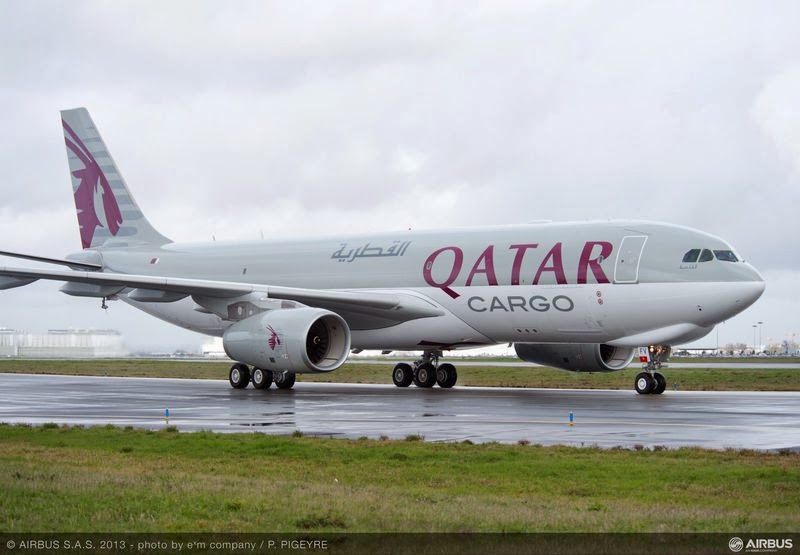
Qatar Airways Cargo order five new Airbus A330-200F freighters

By BA Staff

Qatar Airways A330-200F. Image courtesy Airbus S.A.S.
Qatar Airways has placed a firm order for five new Airbus A330-200 Freighter aircraft in an agreement signed at the Dubai Airshow 2013.

These new aircraft will complement the airline's rapidly growing network, which includes more than 40 routes that have dedicated freighter services.

Included in the order are eight additional A330-200F options – which would make the deal potentially worth over $2.8bn at list prices for a total of 13 aircraft.

Qatar Airways Cargo already operates three A330-200Fs since earlier this year.

Akbar Al Baker, Qatar Airways CEO said:
“The A330 Family has demonstrated outstanding operational reliability and performance for both our passenger and cargo transport operations. It is with this in mind that we chose to expand our freighter fleets with more A330-200Fs. We aim to be the best in everything we do, the air cargo market is no different, which is why we ordered the most modern and economic cargo aircraft available in its category.”
Airbus President and CEO, Fabrice Brégier said:
“Qatar Airways is one of our key partners in the region, and its selection of the A330-200F illuminates its ambitious plans as the airline expands and invests in new freighter aircraft. The A330-200F, with up to 70 metric tonnes of payload, is the only viable alternative to large freighters in today’s fast changing market, making it an ideal choice for a constantly evolving carrier.”
Qatar Airways received its first Airbus aircraft in 1997. Today Airbus aircraft form an ever more essential cornerstone of Qatar Airways’ global operations with more than 200 aircraft directly ordered across all modern Airbus product families, from the single-aisle A320 all the way up to the flagship A380.

Aimed at replacing ageing mid-sized freighters, the A330-200F offers an alternative to larger freighters within fleets. It builds on the successful A330 twin-jet platform and can carry 70 tonnes of payload, with a range capability of up to 4,000nm.
Read more »

Boeing selects Bombardier business jet for maritime surveillance aircraft program

By BA Staff

Boeing has selected Bombardier's Challenger 605 business jet as the platform for its Maritime Surveillance Aircraft (MSA) program.

Tim Peters, Boeing vice president and general manager, Mobility, Surveillance and Engagement, said at the Dubai Airshow:
"The Challenger 605 is an ideal platform to host MSA's mission system, sensors and communications equipment. It also provides the power, payload capacity, range, speed and endurance that our customers tell us they need for missions such as anti-piracy; coastal and border security; and long-range search and rescue."
Boeing team-mate Field Aviation will modify the Challenger 605's structure and air vehicle systems into the MSA configuration.

Peters said:
"Field Aviation has extensive experience engineering and modifying the Challenger family of aircraft for a variety of missions, including maritime surveillance."
Field Aviation is currently modifying a Boeing-owned Challenger 604 jet into an MSA demonstrator aircraft that will complete ground and flight testing of the mission systems and be presented to potential customers in 2014.

MSA incorporates technologies developed for the P-8A Poseidon, the U.S. Navy’s newest anti-submarine warfare, anti-surface warfare and Intelligence, Surveillance and Reconnaissance system based on the Boeing Next-Generation 737 commercial airplane.  

Read more »

Boeing, flydubai announce historic single-aisle agreement

By BA Staff

Boeing and flydubai announced a commitment for up to 100 737 MAX 8 airplanes and 11 Next-Generation 737-800s at the Dubai Airshow.

The commitment from the airline of the emirate of Dubai, valued at $11.4 billion at list prices (including orders and purchase rights), is the largest ever Boeing single-aisle airplane purchase in the Middle East. flydubai operates an all-Boeing 737 fleet.

His Highness Sheikh Ahmed bin Saeed Al-Maktoum, Chairman of flydubai said:
"flydubai is pleased to continue its partnership with Boeing. We believe that the commitment for up to 111 Boeing 737 aircraft will give flydubai one of the best performing aircraft available in the single-aisle market. This will ensure that flydubai is well positioned to continue to set new standards in aviation and support the further economic development of the United Arab Emirates."
Boeing Commercial Airplanes President and CEO Ray Conner said:
"We are extremely proud of the confidence that flydubai continues to place in our products operating an all-Boeing fleet. We look forward to continue strengthening our partnership and seeing the Next-Generation 737-800 and subsequently the 737 MAX play a central role in flydubai's rapid expansion plans."

flydubai placed its first order for 50 Next-Generation 737-800s in 2008. The airline took delivery of its first airplane in 2009 and was the first airline in the world to debut the Boeing Sky Interior. To date, flydubai has taken delivery of 33 Next-Generation 737-800s. In the past two years, flydubai has more than doubled the number of destinations it flies to and has around 1,200 weekly flights. flydubai carried 5.1 million passengers in 2012 and has become the second largest carrier, by passenger numbers, operating out of Dubai International, after big brother and fellow group company Emirates airline.
Read more »

Etihad orders 87 Airbus aircraft

by Devesh Agarwal

Etihad Airways, of the United Arab Emirates, has announced a firm order on European airframer Airbus S.A.S. for 50 A350 XWBs, 36 A320neo aircraft and one A330-200F freighter worth $26.9 billion at list prices.

The contract was signed yesterday at the 2013 Dubai Airshow by James Hogan, Etihad Airways CEO and Fabrice Brégier, Airbus President and CEO.

The Airbus A350 XWB order will be equipped with Rolls-Royce Trent XWB engines and deliveries will commence in 2020. The 26 A321neo and 10 A320neo aircraft are scheduled for delivery from 2018, while the A330-200F will arrive in 2017. The neos will be powered by CFM LEAP-1A engines.

Etihad currently operates a fleet of 23 A320 Family aircraft, 25 A330s and 11 A340s.

James Hogan, President and Chief Executive Officer of Etihad Airways,
“Ten years ago this month, we celebrated our inaugural flight from Abu Dhabi using an Airbus A330. A decade later, we have grown into one of the world’s leading airlines and the importance of Airbus to our fast-growing operations has never been stronger. We have more than 60 Airbus aircraft in our fleet today, and this latest order is testament to the continued strength of our partnership. As one of the first airlines set to receive the much-awaited Airbus A350-1000, we look forward to benefiting from its operational efficiencies and cost savings.”
The A350 XWB (Xtra Wide-Body) is an all-new "mini jumbo" long range product line comprising three versions, the A350-800, A350-900, A350-1000. In a typical two-class configuration, the A350-900 can seat 315 passengers and the A350-1000 seats 369 passengers. The aircraft will offer the range for Etihad to expand its network around the world. On the same day as it ordered the A350, Etihad also ordered its biggest competition the Boeing 777-9X and 777-8X which can seat 400+ and 350 passengers respectively.

In comparison to the Boeing aircraft, which Etihad is expected to fit with 17 inch width economy class seats, the A350 fuselage cross-section is optimized to accommodate Airbus’ 18-inch economy seat-width for long range passenger comfort. Etihad's new order is expected to commence delivery in 2020, the same time as the Boeing 777-9X.

The A320neo is offered as an option for the A320 Family and incorporates new more efficient engines and large "Sharklet" wing tip devices, which together will deliver up to 15 percent in fuel savings. At the end of October 2013, firm orders for the NEO stood at 2,487 from 44 customers, making it the fastest selling commercial airliner ever.

The A330-200F is the freighter version of the A330. It can carry 70 tonnes of payload with a range capability of up to 4,000nm.
Read more »

Dubai Airshow 2013 starts with record breaking orders

As expected the Dubai Airshow opened today with a record breaking order book.

Within three hours of opening, the show’s order tally reached US $162.6 billion – surpassing its previous record of US $155 billion record set in 2007 – with deals coming from Etihad Airways, Emirates Airline, flydubai and Qatar Airways.

The opening order came from Abu Dhabi-based Etihad Airways which announced a deal for 56 new Boeing 777s valued at US$25.2 billion at list prices, including related GE engines. The deal also sees Etihad become the launch customer for the 777-8X which is expected to enter service in 2022.

The airline also ordered 30 Boeing 787-10 Dreamliners, making Etihad the largest customer for the composite aircraft.

James Hogan, President and CEO, Etihad Airways said
“We rarely make announcements at air shows, but when we do the world listens,”
Dubai-headquartered Emirates Airline rapidly re-wrote the Dubai Airshow record with news of a US$99 billion purchase of Boeing and Airbus planes – which industry experts dubbed the largest-ever aircraft order in civil aviation.

The Emirates headline deal was for 150 Boeing 777X, plus 50 purchase rights, and an additional 50 Airbus A380 superjumbos - of which Emirates is currently the largest fleet operator.

Low-cost airline FlyDubai weighed in with a US$11.4 billion order for 111 Boeing 737s and 738s, and then Qatar Airways topped off the morning’s historic agreements with the signing of a US$19 billion letter of intent for 54 Boeing 777s.
Read more »

Etihad kicks off Dubai airshow with mamomth Boeing 777-9X, 777-8X and 787-10 order

by Devesh Agarwal

From top, clockwise, Boeing CGI of Etihad 787-10, 777-8X, 777-9X
United Arab Emirates' (UAE) national carrier, Etihad Airways PJSC, kicked off the Dubai Air Show with a massive order for 56 wide-body Boeing aircraft with options to purchase for an additional 26 aircraft taking the quantity up to 82 at a list price valuation of $25.2 billion.

The Abu Dhabi-based carrier's order includes 25 777X airplanes, comprising 17 777-9Xs and eight 777-8Xs, subject to program launch. Etihad Airways is the first airline to order the 777-8X and will be a launch customer of the airplane, which is expected to enter service around the end of the decade. The order includes options and purchase rights for 12 additional 777X airplanes.

The airline also ordered 30 Boeing 787-10 Dreamliners, the high-capacity, medium-haul, and longest member of the Dreamliner family. Combined with the carrier's previous orders for 41 787-9s, today's order makes Etihad the world's largest airline customer for the Dreamliner family with a total of 71 787s on order. The order includes options and purchase rights for an additional 12 787-10s.

Today’s announcement also includes the milestone 1,000th Boeing 787 Dreamliner to be ordered.

Etihad also ordered one Boeing 777F freighter which is based on the 777-200LR.

The 777X is the upgrade of the venerable Boeing 777 family featuring new composite wings as seen on the 747-8 and 787 family aircraft, along with new GEnx engines which GE promises will be about 10% more fuel efficient. The 777X

The Boeing 777-9X is a stretched, more fuel-efficient version of Boeing ultra-popular 777-300ER. Typically seating 400 passengers, the 777-9X will be capable of flying the same distances as its predecessor, but with up to 40 more passengers, with lower operating costs and reduced fuel consumption per seat. The 777-9X was launched less than two months ago with an order from German flag carrier Lufthansa. Eithad is expected to start receiving its 777-9X from 2020.

The Boeing 777-8X is an upgraded version of the ultra long-haul Boeing 777-200LR, which Etihad recently purchased from Indian flag carrier Air India, to serve the Abu Dhabi – Los Angeles route. The -8X will replace the LRs when the start arriving in 2022. [Read our analysis on why the 777-200LR is ill-suited to Air India's operations]

The Boeing 787-10 is the largest and latest version of the Dreamliner family, typically carrying more than 320 passengers, up to 50 more than the 787-9 which Etihad Airways will introduce late in 2014. The aircraft will be capable of flying between Abu Dhabi and medium-haul destinations such as Dublin or Johannesburg, and it is expected to be deployed on high capacity medium haul routes by the airline. Final assembly and flight test of the 787-10 are set to begin in 2017, with first delivery targeted for 2018. Boeing launched the 787-10 earlier this year, at the Paris Air Show.

All the aircraft in this order will be powered by General Electric GE9X, GEnx and GE90 engines. Etihad ordered 57 GE9X engines which will power Etihad Airways’ 25 new Boeing 777X aircraft, 68 GEnx-1B engines for the airline’s 30 new Boeing 787-10 aircraft, and two GE90-115B engines which will be used on its new Boeing 777-200F freighter.

Etihad Airways currently has 86 aircraft in operation, with more than 80 aircraft on firm order. Its last major aircraft deal was made at the Farnborough Air Show in 2008, where Etihad Airways announced firm orders for 100 aircraft, including 45 Boeing aircraft, in a long-term order which was at the time one of the largest in aviation history.
Read more »

Qatar Airway's capricious CEO Akbar Al Baker throws another tantrum in public at Dubai air show

The recently concluded Dubai Airshow on November 15th, became the Akbar Al Baker public tantrum show.

The capricious boss of Qatar Airways is known for his mercurial temper, and public beration of airframe manufacturers.

At the Paris 2009 airshow, it was Boeing that was at the receiving end of his verbal broadsides. At this moment, in Dubai, Boeing is his best friend, while announcing Qatar Airways will buy two additional Boeing 777 freighters, Mr. Al Baker called it the "best freighter aircraft" in the world today. Just a month ago, CargoLux, in which Qatar has a sizeable ownership share, gave Boeing a whole lot of grief, refusing to take delivery of their 747-8F freighters at the very last moment.

Just when the world thought the Qatar chief had quietened down, he reminded the world with a public broadside at Dubai 2011; this time aimed right at European airframer Airbus S.A.S.

Qatar Airways is the lead customer for the A350XWB with orders for about 80 aircraft in the series, and has been disturbed by the recently announced delays in the schedule by Airbus which pushes the aircraft's entry into service (EIS) in to 2014. Zoom back to 2009, Paris, Boeing and the 787 delays, and now the potential of a similar delay for the A350 and there is understandable concern at the airline.

Qatar Airways has also been trying to force Airbus to develop a conversion program for its large Airbus A330 passenger aircraft fleet, in to a cargo version. Again, Airbus has not been obliging.

So, at the very last minute, Qatar Airways walked away from a deal it was negotiating with Airbus for the A320neo (new engine option) and some additional A380s, leaving Airbus to call off the press conference at the very last minute. In addition to the above issues, it is understood that Al Baker wants Qatar Airways to be the launch customer of the A320neo. This, after Airbus has already booked over a 1,000 aircraft orders from customers acorss the world. Is there no limit to expectations?

As if the walk-away was not enough, while signing the deal for two Boeing 777 frieghters, Al Baker publically announced his unhappiness with Airbus, leaving everyone assembled, including the Boeing officials, mouths agape and their jaws on the floor at this complete breach of protocol, but they then remembered Paris 2009 when Al Baker called Boeing a company run by "bean counters" and "lawyers".

Al Baker unloaded on Airbus
“As far as Airbus is concerned, we have reached an impasse. We thought we would conclude our agreement and make a very large announcement today. Unfortunately I feel that Airbus is still learning how to make aeroplanes.”
He went to announce that Qatar Airways will take Boeing 767 converted freighters and dispose of its A330 fleet claiming "Airbus can't make up their mind."

A few hours later, Qatar Airways signed the deal with Airbus.

Al Baker is becoming the lauging stock of the industry. Now, completely irritating Airbus, les than a month after thoroughly doing the same to Boeing, he is rapidly approaching persona non-grata status. Even journalists started laughing loudly when someone mentioned Al Baker's "professionalism".

At another press conference Airbus Chief Operating Officer John Leahy said “Some people negotiate in the press, some negotiate in conference rooms, and some do both,” In a polished rebuttal to Al Baker’s accusation that Airbus needs to learn how to build aircraft, Leahy said “we learn very fast.”

Mr. Al Baker is buying quite a few airplanes, but it appears he is in a race with another large airplane buyer, who has managed to irritate aircraft manufacturers, Michael O'Leary of RyanAir, who is now locked at the mercy of Boeing since Airbus refuses to deal with him.

Keep it up Mr. Al Baker, you are almost at the top of the "do not supply" list, from there you can then migrate to the top of the "sell only at retail price" ladder. Both these titles will serve your airline and nation very well in the years to come.


What are your thoughts and views? Is Al Baker justified in his outbursts? Is he behaving professionally? In the best interests of his airline? his nation? Do Boeing and Airbus need to be put in their place? Or is he heading for a disaster of sorts?

Post a comment.
Read more »

Emirates places largest order in Boeing history for 50 777-300ER at Dubai air show

Inaugurating the Dubai air show 2011, Dubai-based Emirates Airline, already the world's largest operator of Boeing 777s, announced an an order for another 50 777-300ER aircraft with an option for a further 20 more.
The order, with a value of $18 billion, makes this the single largest commercial airplane order in Boeing's history by dollar value. It also makes 2011 the best-selling year for the 777 program, surpassing the previous record of 154 orders set in 2005. With the Emirates order, the 2011 net order book for the 777 currently stands at 182. The options for 20 additional airplanes is valued at $8 billion.

Emirates has a fleet of 94 777s, and a further 41 on order. Having taken delivery of its first 777 in 1996, Emirates is also the only airline in the world to operate every model in the Boeing 777 family, including the 777 Freighter.

The management of the airline is often credited with making Boeing incorporate several performance enhancements on the 777, especially the 777-300ER, extending its range and payload capabilities.
Read more »

Airbus commences Dubai Air Show with a slew of orders

Toulouse, France based Airbus S.A.S. has commenced the Dubai Air Show 2009 with a slew of orders.

Ethiopian Airlines has today ordered 12 Airbus A350 XWB aircraft, bringing total orders for the A350 XWB family to 505. The airline will operate the A350s from their hub in Addis Ababa on routes to Europe, the US and Asia.

Luxury charter company Comlux the largest Airbus Corporate Jetliner ACJ family customer, has ordered a third ACJ, taking its total orders for ACJs to ten aircraft - 4 A318s, 3 Airbus ACJs, 2 A320 Prestiges and one A330-200 Prestige.

Yemenia, the official carrier of the state of Yemen, based in Sanaa, signed a Memorandum of Understanding (MoU) for 10 Airbus A320 Family aircraft.

Yemenia’s A320s will be configured in a two-class configuration with seating for 12 passengers in Business Class and 138 in Economy. The aircraft will be deployed to enhance and expand services on regional, African, Indian and European routes.

Yemenia’s fleet includes two A330-200s and three A310s. During the 2007 Dubai airshow, Yemenia placed an order with Airbus for ten Airbus A350 XWB.

Indian carriers who made a tremendous splash back in 2005 but a reeling with industry leading losses are not expected to place any orders. There are rumours that regional player Paramount Airways may place an order for turbo-props with either Bombardier or ATR.

Images courtesy Airbus
Read more »