Showing posts with label Bangalore. Show all posts

Opinion: The Rahul Gandhi "close shave" - Sensationalism rules at Indian media

by Devesh Agarwal

It appears that exaggeration driven sensationalism still rules the Indian media world, especially at the leading newspapers.

On Tuesday, a private Cessna Citation business jet carrying the ruling family scion Rahul Gandhi had to do a "go-around" when landing at New Delhi's Indira Gandhi International Airport (coincidentally named after his grandmother). An Indian Air Force Ilyushin Il-76 transporter took some extra time to clear the runway ahead of Gandhi's jet which precipitated this action. There is confusion on whether the Il-76 Gajraj was taking off or landing.

Screams The Times of India
Congress vice-president Rahul Gandhi narrowly escaped a disaster........
Not to be left behind The Hindustan Times blared
Close shave for Rahul at Delhi's IGI airport
Even the normally sober Firstpost joined the sensationalist bandwagon saying
Congress Vice President Rahul Gandhi reportedly had a close shave while landing at the Delhi airport
One of the only news organisations to take a sober and factual approach to this incident was NDTV whose headline ran
Rahul Gandhi's aircraft aborted landing to avoid collision, probe ordered
While separation between aircraft of 45 seconds is common at the ultra-busy airports around the world, in India, even New Delhi, there is a still a five nautical mile separation rule. In the case of Gandhi's bizjet, the separation was maintain at eight nautical miles (about 15 kilometres) due to "wake turbulence" caused by the Il-76.

Across the world, at the busy airports like New York, London, etc., air traffic controllers are under pressure, especially during peak hours, to maximise the utilisation of the runway. Aviation safety rules say that no two aircraft can occupy the runway at the same time, and ever so-often an aircraft takes some extra time and is not able to clear the runway in time. Thus a landing aircraft will be ordered to perform a "go-around". Sometimes due to cross winds or turbulence, the pilot is not comfortable in the approach and will chose to go-around rather than risk an unsafe landing. Whatever be the reason, the go-around is a fairly routine action, and pilots train for it.

See this video involving a Finnair MD-11 flight 5 being ordered to "go-around" at New York's JFK airport. Around 2m45s in to the video, you can head the tower controller ordering American Airlines flight 116 or 160 (one sixteen or one sixty) to taxi quickly and vacate the runway. When the American flight does not do so, at about 3m10s, when the Finnair is almost over the top of the runway threshold the controller orders it to "go-around". Everything in the cockpit is calm and plane goes around and lands. Its a routine matter.


In this video Qatar Airways flight QR1 goes around at the last minute on the choice of its pilots. Keep in mind, the Airbus A340-600 is not known for its power and climb capabilities. The whole incident is routine.


In this video from Japan's Narita airport, the massive 747-400, an aircraft that weighs over 350 tons at take-off, goes around while midway down the runway. It appears the approach was not stable, and pilot chooses to go-around rather than risk an unsafe landing. Again very routine.


In August 2010, we witnessed a Jet Airways Boeing 737-800 which touched down hard at Bangalore airport and as a result the aircraft was de-stabilised. The pilot did a "go-around" and landed ten minutes later. While Bangalore Aviation reported it in a routine manner, the newspapers went around with their scaremongering headlines of "close shave", "narrowly averted disaster", etc.

One has to question the motives and capabilities of the Indian media, which tries to make mountains out of grains of sand, not just molehills.

Almost every one in the aviation world knows that The Times of India is more of a tabloid than a newspaper. Is their scaremongering tactics a reflection on the hypocrisy of its readers who derive vicarious pleasure in these sensationalist headlines? It appears so, since other papers and news organisations are forced to descend to these low levels in order to compete. After all The Times of India is the most widely circulated paper in the world, not just India.

Isn't it time we took the high road?

Do share your comments and thoughts via a comment.

Read more »

DragonAir takes advantage of expanded Bangalore airport terminal capacity to improve flight schedules

by Devesh Agarwal

The new expanded terminal at the Bengaluru International Airport (BIA) will be inaugurated this Saturday, December 14th. At the same time the airport will be re-named in honour of the founder of Bangalore, as Kempegowda International Airport, Bengaluru (KIAB).

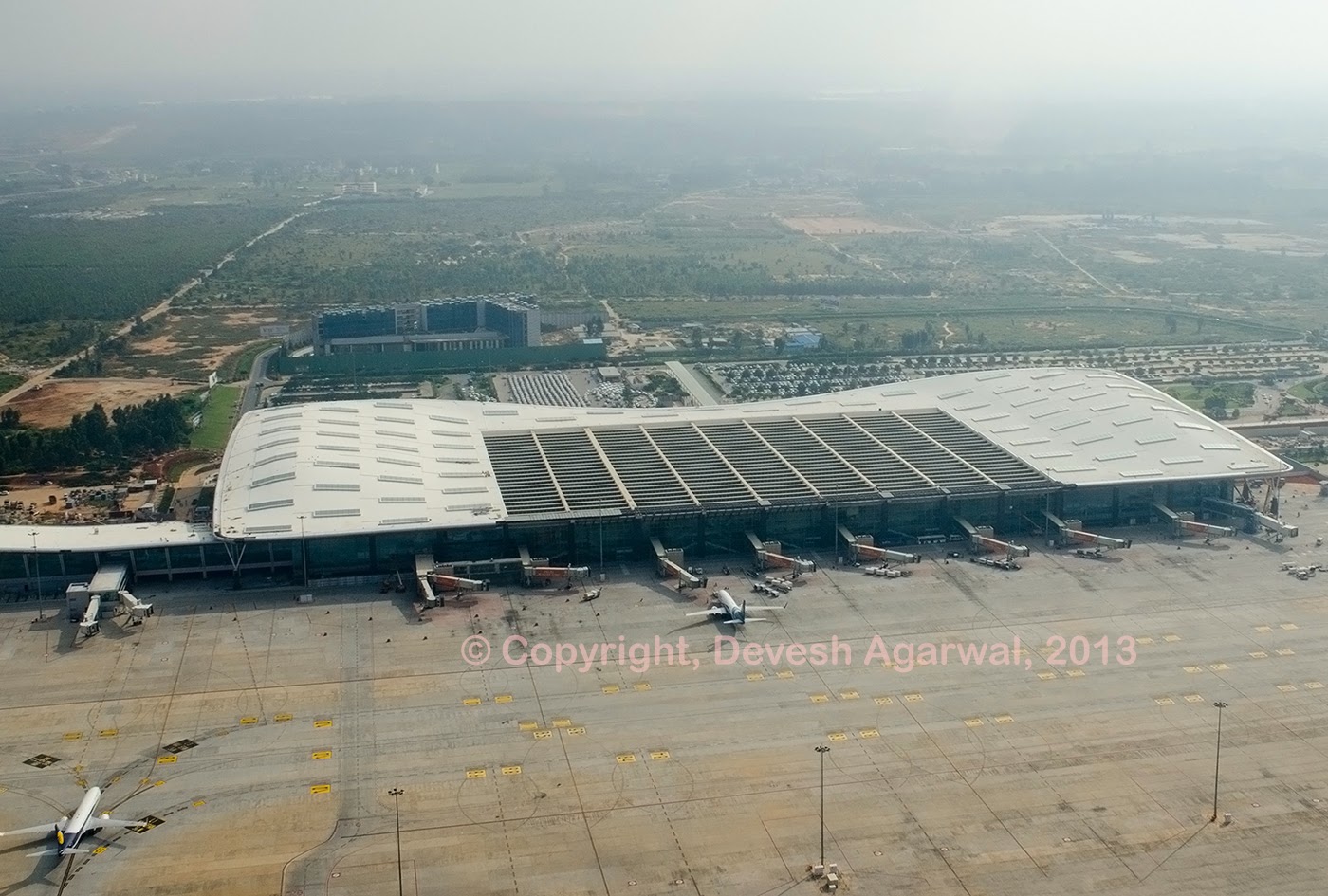
Aerial view of the expanded terminal at Bangalore airport.
Aerial view of the expanded terminal at Bangalore airport. Photo copyright Devesh Agarwal. All rights reserved.
With the addition of four international gates on the east pier (in the picture above, only the first gate is visible on pier on the left of the photo), airlines have improved access during the prime desired time from 11pm to 1am.

Cathay Pacific's subsidiary DragonAir, which operates a daily A330 service between the city and Hong Kong is one of the first airlines that will take advantage of the expanded capacity of the new terminal.

Its existing poor time slot departs Bangalore at 02:40 and arrives in Hong Kong around 11:00 causing many passengers to miss the morning connections to many onward destinations.

From the Summer 2014 schedule DragonAir will pull forward its schedule. As per Rakesh Raicar, Sales and Marketing Manager - South Asia for the airline group,
“We have already revised our timings from Bengaluru and effective 30 March 2014, Dragonair will depart at 0130 from Bengaluru to Hong Kong. This decision to revise the timings was taken to offer our passengers an early arrival into Hong Kong and greater access to our extensive network. With a departure time of 0130, we will be able to offer better connections to the various cities we operate to, in China, Japan, Korea, North America and Australia.“
With this departure, arrival will be at 10:00. Better than the current 11:00, but still not ideal. In our opinion, DragonAir should try to advance their departure another hour, depart by 00:30 and arrive into Hong Kong by 09:00. To achieve this, the airline will have to advance their Hong Kong departure from the current very late 22:40 to around 20:30, which is still a very good time for both business and trade passengers.

Which other airlines, if any, do you feel should change their schedule at Bangalore? Share your thoughts via a comment.
Read more »

Etihad triples seats to Mumbai and Delhi, announces massive increase in India flights

by Devesh Agarwal

Etihad Airways has wasted no time in capitalising on its recent bonanza of seat quota increase under the new India UAE (Abu Dhabi) bi-laterial air services agreement (BASA).

It has announced a massive increase in flights to most of its destinations in India. Specifically
  • Mumbai and New Delhi: from 7 to 14 flights per week with immediate effect
  • Kochi: from 7 to 14 flights per week from June 2014
  • Bangalore and Chennai: from 7 to 14 flights per week from July 2014
  • Hyderabad: from 7 to 14 flights per week from October 2014
Cocking a snoot at the on-going legal proceedings challenging the BASA and Etihad's 24% stake investment in Jet Ariways, the gulf carrier has doubled the number of flights and tripled the number of seats between Abu Dhabi and Mumbai and New Delhi.

Etihad Airbus A330-200. Image copyright Vedant Agarwal. All rights reserved. Used with permission.


Under the expanded schedules, effective immediately, new mid-afternoon services to Mumbai and New Delhi are operated with single-aisle Airbus A320s, each seating 136 passengers, and existing late evening departures have been upgraded to larger aircraft.

On the Abu Dhabi-Mumbai route, the evening flight is now operated with 292-seat Airbus A340-600 aircraft, seating 12 passengers in Diamond First Class, 32 in Pearl Business Class and 248 in Coral Economy. This will add 2,044 seats per week from Abu Dhabi to Mumbai, taking the total from 952 to 2,996 seats in each direction – just over triple the previous capacity.

On the Abu Dhabi – New Delhi route, the evening service has been upgraded to a 254-seat Airbus A330-200 aircraft, seating 18 guests in Business Class and 236 in Economy. This will add 1,778 seats per week to and from New Delhi, increasing from 952 seats to 2,730 in each direction – almost triple the previous capacity.

Etihad A340-600. Photo courtesy Wikipedia. Photo copyright Maarten Visser. Used under CC license.

On the Chennai and Kochi routes, from June 2014 Etihad will upgrade its aircraft to Airbus A321s, seating 174 passengers from the existing A320s which seat 136 passengers. There is no mention of any aircraft change at Bangalore where Etihad operates a daily A320, where both its fellow gulf competitors Emirates and Qatar Airways operate A330 and Boeing 777 wide-body services.

Outlining a strategy to use Abu Dhabi as a hub to funnel-in passengers from India on to Europe, US, middle-east and Africa, James Hogan, President and Chief Executive Officer of Etihad Airways said
“India is one of the world’s largest and fastest-growing air travel markets, and will play an increasingly important role in our growth,” “Subject to receiving regulatory approvals, we will continue to expand our Abu Dhabi – India operations and work with our growing stable of partners to accommodate strong growth and deliver much greater choice for travel to and from India.” “Through our purchase of 24 per cent of Jet Airways – the first foreign investment permitted in an Indian airline – we have laid the foundations for major and exciting growth in air services between Abu Dhabi and India, and beyond throughout our global network,”
The new Etihad Airways flights will also be marketed by Jet Airways as an extension of the airlines’ existing codeshare partnership.

This is just a preview of what India can expect from all three gulf carriers in the years to come. With their hundred billion dollar aircraft orders, one shudders to think of the sheer capacity these airlines will add in the next decade; and the capacity they will be able to dump in the Indian market.

Etihad's actions are bound to have impact on national carrier Air India who is trying to expand services to Europe and North America in its revival efforts. Fellow gulf majors Emirates and Qatar Airways will also start feeling the pinch. It remains to be seen what strategy Etihad adopts to start filling those 200% extra seats, though pricing is a sure-fire way to the Indian passenger's heart.

Share your thoughts on this development via a comment.

Read more »

IndiGo adds Bagdogra as a destination. New Ahmedabad Mumbai Guwahati flight.

by Devesh Agarwal

India's largest domestic airline is adding Bagdogra as its 30th domestic destination from December 1, 2013.

With its 71st A320 joining the fleet, IndiGo will operate 448 daily flights to 30 domestic and five international destinations.

Flight 6E-434 commences an almost 12 hour duty cycle at 05:45 starting at Ahmedabad to Mumbai to Guwahati to Bagdogra to Kolkata to Bangalore. In reverse flight 6E-433 starts at 11:05 in Bangalore and ends at 23:20 at Ahmedabad.

Thus, the new schedule sees introduction of new daily non-stop flights to Bagdogra from Guwahati and Kolkata. Bagdogra will also be connected to Mumbai via Guwahati, and to Bangalore via Kolkata.

IndiGo will also launch a seventh daily non-stop flight between Delhi and Kolkata and also a daily non-stop flight between Mumbai and Guwahati, offering a same plane one-stop service from Ahmedabad to Guwahati. It is not clear if a passenger can take a two-stop same plane service from Ahmedabad to Bagdogra.

Aditya Ghosh, President, IndiGo said,
“We are extremely pleased about adding Bagdogra as our 35th destination of operations as it is a landmark moment for us. Bagdogra is going to be an important part of our destination network because it holds good prospect for commercial business apart from the region of Darjeeling, Siliguri and New Jalpaiguri. We are committed to providing maximum connectivity from Bagdogra on our network by catering to various segments and we are confident that these additional services will prove immensely popular with our passengers. We are planning to increase the connectivity to and from Bagdogra and expand our operations with additional flights. It is our constant endeavour to provide more flexibility of choice for our customers as IndiGo continues to offer them on time, hassle free and always affordable flying experience.”
Read more »

Mahindra Aerospace inaugurates new aerostructures facility in Bangalore

By BA Staff

Mahindra Aerospace inaugurated its state-of-the-art 25,000 sq.m. aerostructures manufacturing facility at the Narsapura Industrial Estate near Bangalore. This service-oriented facility has the ability to accurately craft large, complex sheet metal parts using CNC routing, stretch-forming, bladder press, heat treatment and other specialized equipment.


Mahindra Aerospace today also announced the signing of a technology partnership with the Aernnova Group, a leading aerostructures Tier 1 supplier that is headquartered in Spain with facilities around the globe. Aernnova specializes in the design and manufacture of major airframe assemblies and is a key supplier on numerous civil and military aircraft programs for several global aircraft OEMs. This technology partnership is Aernnova’s first with an Indian aerostructures manufacturer. Aernnova and Mahindra Aerospace will work together to develop capabilities and meet market demand for mutual benefit.

The new plant has been established at a total cost of approximately Rs. 150 crore and has the capacity to deliver about Rs. 250 crores in revenue per annum when operating at peak capacity. Initially the company plans to commence manufacturing activities with smaller parts and sub-assemblies, and then ramp up to larger, more complex assemblies.

Commenting on this initiative, Anand Mahindra, Chairman, Mahindra Group, said:
“Our aerospace vision is to build a robust business encompassing both aircraft and component manufacture for Indian and global markets. With its unique capabilities and skilled teams, this new facility will accelerate Mahindra Aerospace on its mission to strengthen India’s place in the global Aerostructures supply chain.”

According to Hemant Luthra, President – Mahindra Systech:
“This facility demonstrates our commitment to aerospace and to strengthening our domestic eco-system. We will deliver complex, build-to-print parts and assemblies out of this facility and offer cost-competitive, world-class aerospace manufacturing capabilities. The plant will be a service provider that can service multiple OEMs and their supply chains. With our Group’s strength in aerospace engineering, we would like to progress from ‘build-to-print’ towards ‘design-to-delivery’ offerings in the future.”
According to Inaki Gandasegui, Chairman, Aernnova Group:
“This facility has been designed to be world-class, and is an excellent addition to India’s supply chain. We believe it will play a strong role in the regional eco-system and also help address capacity challenges for the OEMs as they ramp up production rates. We are proud to be associated with the Mahindra Group and look forward to a vibrant, mutually beneficial partnership.”
Read more »

Analysis: Etihad announces huge increase in flights and seats between Abu Dhabi and India

Bangalore-Abu Dhabi-Chicago, Mumbai-Abu Dhabi-New York, Delhi-Abu Dhabi-Newark amongst new flights requested

by Devesh Agarwal and Vinay Bhaskara

Image Credit: Etihad Airways

On the back of the new bilateral air services agreement which has almost quadrupled capacity, Etihad Airways, the national carrier of the United Arab Emirates, will greatly increase both seats and flights for travel to and from India, introducing more flights and wide-bodied jets by the end of this year, and further increases and new routes next year, subject to regulatory approval.

From 1 November this year, Etihad Airways plans to more than triple the number of seats it now offers on the prime Abu Dhabi – Mumbai and Abu Dhabi – New Delhi routes, reflecting the growing importance of the Indian market, and delivering significant economic benefits to the economies of India and Abu Dhabi.

Enriching the expanded schedules will be new connection opportunities between Etihad’s global network and its expanded Indian services, via the airline’s Abu Dhabi hub.

The President and Chief Executive Officer of Etihad Airways, James Hogan, said: “India is one of the world’s fastest-growing destinations, and a key market in the growth strategy of Etihad Airways.
“Following the recent signing of a new air services agreement between India and the UAE, we now have the opportunity to add significant capacity between the two countries, not only meeting existing demand for trade and tourist travel but also ensuring that we can meet the continued strong growth which is expected between our two countries. The big winners will be our passengers and freight customers and the economies of India and Abu Dhabi.”
By 31 December, 2013, Etihad Airways plans to:
  • Increase from daily to double-daily its Abu Dhabi-Mumbai and Abu Dhabi-New Delhi flights;
  • Use wide-bodied Airbus A340-600 aircraft on one of the daily Abu Dhabi – Mumbai flights, offering First, Business and Economy Classes, replacing a Jet Airways A330-200
  • Use wide-bodied Airbus A330-200 aircraft on one of the daily Abu Dhabi - New Delhi flights, offering Business and Economy Class, replacing an Etihad A320
  • Upgrade daily Abu Dhabi – Chennai flights from 136-seat Airbus A320s to new Airbus A321s, seating 174 passengers with an expected two class configuration of (12J / 162Y)
  • Subject to regulatory approval, Etihad also intends to codeshare on a wide range of flights operated within India by Jet Airways. Jet will feed Abu Dhabi from eight cities initially: Ahmedabad, Mumbai, Delhi, Bangalore, Hyderabad, Chennai, Thiruvananthapuram and Cochin
Specific details of new routes between Abu Dhabi and India and codeshare services with Jet Airways will be announced progressively, as approvals are received and operational details are finalised.

Separately, Jet Airways is set to move its international scissors hub for services to the United States to Abu Dhabi from Brussels. Jet will launch Mumbai-Abu Dhabi-Newark, Bangalore-Abu Dhabi-Chicago, and Delhi-Abu Dhabi-New York JFK. Interestingly, no mention has yet been made of services to Toronto, which Jet Airways currently serves as the final leg of its New Delhi - Brussels - Toronto services. However, Toronto-India traffic is notoriously low yielding. Furthermore, the UAE and Canada have a tense bilateral agreement, so it's likely that Jet might not even be allowed to operate to Toronto via Abu Dhabi.

Either way, the massive expansion from Jetihad brings the carrier to parity in the Indian market with Middle Eastern rival Emirates, who generates 12% of its network traffic from India. As the Jetihad partnership continues to solidify, expect to see more Indian expansion from both carriers.
Read more »

SpiceJet to launch Bangalore - Bangkok flights

by Devesh Agarwal

Delhi based low fare carrier SpiceJet will commence international flights from Bangalore on October 28. The first destination is Bangkok with four flights per week.

The carrier will be the only Indian carrier to service this route.

As per the SpiceJet website on which tickets which are available for purchase, the schedule is on Mondays, Wednesdays, Fridays, and Sundays,

SG091 departs Bangalore 03:35 arrives Bangkok Suvarnabhumi 09:05
SG092 departs Bangkok Suvarnabhumi 20:10 arrives Bangalore 22:35

The airline will use a Boeing 737-800 to service the flights.
Read more »

Singapore Airline's passengers suffer consequences of IndiGo accident

by Devesh Agarwal

Its Friday, the 13th, and many a frequent flyer will sympathise with the bad-luck of the passengers on Singapore Airlines flight SQ503 from Bangalore to Singapore earlier this morning.

The inbound flight SQ502 from Singapore scheduled to arrive at Bangalore around 10pm, was diverted to Chennai due to the runway closure at Bengaluru International Airport following the accident of IndiGo airline flight 6E-125 around 8pm last night.

The in-bound passengers waited and finally the runway at Bangalore was opened around 11pm. SQ502 finally arrived in Bangalore around 2am early this morning.

The return flight SQ503, left around 3am, about four hours behind schedule. The crew realised that they would exceed their Flight Duty Time Limit (FDTL). Hurried parleys were made with headquarters, and a decision was taken to divert to Bangkok. In the mean time, a stand-by crew was flown from Singapore to Bangkok to crew SQ503 back to Singapore.

The aircraft was on the ground in Bangkok for less than a hour, and SQ503 finally arrived in Singapore at 1pm, seven hours behind schedule.

Image courtesy Google maps.
All I can do is shake my head and sympathise with the passengers, but at the same time, give credit to the crew for thinking up of a solution.

If they had continued even to Kuala Lumpur, they would be in breach of the regulations.

Had they stayed back in Bangalore, the earliest a replacement crew could come would be on the morning SilkAir flight. This would mean the SQ503 flight would reach Singapore only around 5:30pm, and connections to the US west coast would be missed.

Already the existing delay meant that the morning connections to the United States, Asia, and Australia were missed. The Bangkok diversion allow the airline to try and make up some of the connections in the evening. However, considering this is the weekend, the airline staff in Singapore has their work cut out for them.

What are your thoughts? Share your frequent flyer gaffs via a comment.

Read more »

Bangalore airport shut down as IndiGo flight veers off runway

by Devesh Agarwal
IndiGo Airbus A320 VT-IGV at Bengaluru International Airport. Photo copyright Vedant Agarwal. Used with permission.
At approximately 20:10 (14:40Z), an IndiGo Airbus A320-232 registration VT-IGV performing flight 6E-125 from New Delhi to Bangalore, with 110 passengers and six crew (two pilots, four cabin crew), veered off the runway 27 while attempting to land at Bengaluru International Airport (BIA) during heavy rains and cross-winds.

The aircraft damaged five runway lights and suffered burst tyres, finally stopping near taxiway Foxtrot, and blocking the sole runway 09/27. There were no injuries.

All flight operations at the airport were suspended till repairs to the aircraft were carried out and it was towed to the apron. Flight operations resumed almost three hours later at 22:55 (17:25Z).

A number of flights both domestic and international were diverted to neighbouring airports like Chennai.

The airline released this statement
IndiGo flight 6E–125 from Delhi to Bengaluru, while landing on runway 27 at the Bengaluru airport at 20:10 pm, landed to the right of the center line, while experiencing heavy rains upon landing. The aircraft veered to the right and contacted 5 runway edge lights which led to deflation of the right main tyres. The aircraft was controlled and was taxied off the runway onto taxi track ‘’Foxtrot” and stopped.

All 110 passengers and six crew on board are safe with no injuries reported and have been de-planed safely from the aircraft to the terminal.

As per the operating procedure, the aircraft will be grounded for maintenance work. The matter has been reported to the DGCA and the safety department of IndiGo and DGCA will inquire further into the matter at the earliest.

At IndiGo, we are committed to passenger comfort, and safety is our highest priority. Hence, there can be absolutely no compromise on safety.
In April 2009, in a very similar incident, a Kingfisher Airlines Airbus A320-232 VT-KFT also veered off runway 27 in heavy rain and winds, and damaged runway lights. (Read that story here). At that time the runway was shut for less than 55 minutes. A shut down of three hours with the aircraft stopping on the taxiway suggests significantly more damage to the aircraft than IndiGo is claiming.
Read more »

Mysore Bangalore airport direct 'FlyBus' service now operational

by Devesh Agarwal

On Wednesday, the Karnataka State Road Transport Corporation (KSRTC) inaugurated its luxury 'FlyBus' service which will connect the city of Mysore direct to the Bengaluru / Kempe Gowda International Airport in Bangalore.

The service will be operated by a 40 seat luxury Volvo B9R twin-rear-axle bus, complete with a pantry, chemical toilets, 2+2 semi-sleeper seating with 70 channels of in-seat video.

The bus will be equipped with GPS tracking systems which will provide up to date bus arrival information. The bus will also have a facility to display real-time flight arrival and departure information.

The bus will operate two services 12 hours apart in each direction. The bus departs Bangalore airport at 09:45 and 21:45 arrives in Mysore at 13:45 and 01:30 respectively. On the return, the bus shall depart Mysore at 02:00 and 14:00 to arrive at Bangalore airport at 05:45 and 18:00 respectively.

The fare for the service including snacks on board is Rs. 995. The FlyBus help line at the airport is +91 99722-13726. The main call centre is at +91 (80) 4455-4422. You can book FlyBus tickets online at the KSRTC website.

Visit here for a slide-show on the features of the FlyBus.
Read more »

Visa on arrival service now operational at Bangalore

by Devesh Agarwal

The Visa on Arrival service is now operational at the Bengaluru International Airport. Visitors from 11 countries, Japan, Singapore, New Zealand, Philippines, Indonesia, Luxembourg, Finland, Laos, Vietnam, Myanmar and Cambodia are eligible for this service.

The visa will be issued at the immigration desk and will be valid for a maximum period of 30 days. The airport authorities BIAL, will provide separate desks, special seating arrangements and appropriate signage. In the future, the facility will have an enclosure for photographing foreign nationals and currency exchange counters.

Visa on Arrival shall be granted to foreign nationals who are visiting India on recreation, sightseeing, short duration medical treatment or casual business visit. The tourist must hold a valid passport with minimum six months validity. Documents required to be presented at the counter are:
  • passport
  • two passport size photographs
  • photocopy of passport
  • hotel booking confirmation (if possible)
  • return ticket.

A fee of US $60/- or an equivalent amount in Indian rupees per passenger (including children) will be charged for the grant of Visa-on-Arrival. Travellers will be able to obtain single-entry tourism visas, which will be valid for 30 days, which can be extended, in special cases, to 60 days.

More information can be obtained from the Bureau of Immigration website.
Read more »

Qatar Airways bringing its 787 Dreamliner to Bangalore and New Delhi

AirlineRoute is reporting
As per 10AUG13 GDS timetable/inventory display, QATAR Airways plans to operate Boeing 787 aircraft on flights to Bangalore and Delhi, during the month of September 2013. Planned operation as follow.

Doha – Bangalore 01SEP13 – 29SEP13 1 daily (BLR departure 02SEP13 – 30SEP13)
QR226 DOH 2020 – 0310+1 BLR 788 Daily
QR227 BLR 0440 – 0625 DOH 788 Daily

Doha – Delhi 01SEP13 – 29SEP13 QR232/233 1 daily (DEL departure 02SEP13 – 30SEP13)
QR232 DOH 2100 – 0325+1 DEL 788 Daily
QR233 DEL 0450 – 0630 DOH 788 Daily
Pity we plane spotters will not be able to photograph this bird at night.
Read more »

Air China ends Shanghai-Chengdu-Bangalore

by Vinay Bhaskara

Yesterday, Sunday, August 4th, marked the final nonstop flight for Air China limited, the world’s 10th largest airline by passenger traffic, between Bangalore and Chengdu. Flights have been zeroed out from the global distribution system (GDS) and are no longer bookable via AirChina.com. The nonstop flights, which began in early 2010, had actually been increased in frequency by Air China from twice to thrice weekly on March 31st, and had been planned to operate as thrice weekly flights until late October. Service was offered on 128 seat Airbus A319 equipment in a 2-class configuration (8C/120Y), and was structured as Bangalore-Chengdu-Shanghai Pudong and return. Flights departed Bangalore Wednesday, Friday, and Sunday and arrived in Bangalore on those same days of the week after departing Shanghai Tuesday, Thursday, and Saturday. The same plane journey from Shanghai to Bangalore took over 7 hours and 40 minutes to complete in either direction.

It is surprising that Air China elected to cancel services between Bangalore and Chengdu given the strong business ties between the two cities. Bangalore is India’s information technology (IT) hub, while Chengdu is China’s electronics manufacturing center; and several multinational tech corporations have major operations in both cities. In particular, this route was often dubbed the "Cisco-Huawei Express". Networking Equipment Manufacturer Cisco’s “East” Headquarters are located in Bangalore while their largest manufacturing base in China is located in Chengdu. Meanwhile, electronics manufacturer Huawei has a major IT research and development (R&D) center in Bangalore and massive manufacturing operations in Chengdu (as does rival Chinese telecom firm ZTE). These firms often formed the base of demand for the nonstop services, and when combined with the incremental demand between Bangalore and China’s financial capital of Shanghai, the route seemed to be a strong performer for Air China.

But global macroeconomic conditions have certainly shifted in the past few months. Both India and China are seeing slowdowns in growth that are causing tapering in travel demand between the 2 nations – as firms scale back expansion plans and begin to curtail employment growth. India’s projected GDP growth for 2014 has fallen to a new low of 5.2% (after running at 8% or above for nearly the last decade; even through the global financial crisis) tied to a similarly projected GDP growth for China of just 6.9% in 2014, the lowest total in more than 20 years. In addition to these macroeconomic factors, Cisco, a major US manufacturer of Telecom equipment, is also facing a major slowdown in its core market, the US, as firms increasingly turn away from its services and put off purchasing new network equipment due to uncertain economic conditions. Even in India, the economic slowdown is contributing to a reduction in demand for telecom equipment. All of these factors certainly contributed to a reduction in demand for the route.

Beyond the macroeconomic forces, there is increasing tension between China and India thanks to labor disputes and border issues in India’s Northeast. Additionally, ZTE and Huawei are coming increasingly under suspicion of playing a role, if only indirectly, in increased Chinese hacking of Indian government web servers, thanks to their close ties to the Chinese government. The added security concerns have led to increased scrutiny for ZTE and Huawei – and forced the two firms to cut back on their Indian operations. Given the relatively close ties between the Chinese government and Air China, these political disputes may have also played a role in the cancellation of the route.

Air China will continue to service India with 7 flights per week; 4 weekly Mumbai-Chengdu-Shanghai Pudong on board the same Airbus A319 equipment, and 3 weekly Beijing-Delhi on-board 301 seat Airbus A330-300 equipment in a 2-class configuration (30C/271Y). Beijing-Delhi had previously been increased to 4 weekly till October 26th, but those plans appear to have been scrapped.

Read more »

Bengaluru International Airport renamed as Kempe Gowda International Airport

The renaming of Bangalore's Bengaluru International Airport (BIA) to Kempegowda International Airport received approval from the Union Cabinet yesterday.

The lower house of the state legislature, the Karnataka Legislative Assembly, passed a unanimous resolution on December 10, last year and the upper house, the Karnataka Legislative Council, also passed a similar resolution two days later to rename the airport.

Hiriya Kempe Gowda commonly known as Kempe Gowda I or Bengalooru Kempe Gowda was a ruler under the Vijayanagara Empire, who is considered to be the founder of the metropolis of Bangalore, the capital of the Indian state of Karnataka. Kempe Gowda was a well educated and successful ruler. Noted for his progressive thinking, he ushered the foundations of a modern city with successful planning and building the current city building many temples and water reservoirs in Bangalore.

Bengaluru International Airport (BIA) is the sole airport serving the Bangalore region. It was commissioned and became operational on May 24, 2008. It is owned and operated by Bengaluru International Airport Pvt. Limited (BIAL) a conglomerate majority (74%) held by GVK Group, Siemens Projects, and Zurich Airport, along with two government bodies, the Karnataka State Industrial and Infrastructure Development Corporation KSIIDC, representing the state of Karnataka, and the Airports Authority of India, representing the Government of India, each owning 13%.
Read more »

Analysis: Emboldened by Etihad deal, Turkish Airlines seeks additional flying rights to India

by Vinay Bhaskara

Late last week, The Times of India reported Turkish Airlines, one of the world’s fastest growing airlines in the world, wanted to more than quintuple its Indian footprint, requesting an increase in weekly seat allocation from 4,000 to 20,000 seats per week, and gain access to Bangalore, Kolkata, Chennai, Hyderabad, Amritsar, and Ahmedabad.

Turkish is also requesting an increase in its weekly frequency allocation from 14 weekly flights (one daily each to Mumbai and Delhi), to 70 flights per week.

Reportedly, Turkish Airlines’ Indian general manager Adnan Aykac made the following statements with regards to his carrier’s requests:
We currently fly 14 flights a week — a daily from Delhi and Mumbai each to Istanbul. This is very limited capacity. We have asked the government for more destinations as we want to fly to all the six metros [Bangalore, Chennai, Delhi, Hyderabad, Kolkata and Mumbai], Amritsar and Ahmedabad. We want to have 70 weekly flights from eight cities in India. We are ready to mount the flights that we seek to and from the new cities as early as possible. Delhi and Mumbai are among the most expensive airports in the world, with Delhi being costlier than Mumbai. But these are the two gateways to India and generate almost 70% of all international traffic to and from India. Indian carriers can start flights to Turkey whenever they want. This will be a commercial decision. There are many places whose airlines fly to India without an Indian carrier going there like Amsterdam, from where KLM flies without any Indian carrier going to Holland. 
Turkish Airlines may have some weight behind its request thanks to the timing. As a condition of the recent purchase of a 24% stake in full service carrier Jet Airways by Etihad Airways (with the Abu Dhabi government behind it), Etihad asked for and received a massive increase in seat allocation through the bilateral air service agreement (ASA). Etihad now controls more than 92,000 seats per week between India and Abu Dhabi, while other Middle Eastern rivals like Emirates (54,000) and Qatar Airways (24,292) control more than the 20,000 seats requested by Turkish Airlines. However, Turkish Airlines lacks the political clout of Jet Airways head Naresh Goyal, which might affect its chances of getting an expanded bilateral. And the so-called Jetihad deal is under further review by concerned parties in the Indian government.

Regardless of the outcome of its request, Turkish Airlines already has a strong presence in the Indian market. As with much of its route network, the success is predicated on connectivity across its global hub at Istanbul. Currently, Turkish operate daily services to both Delhi and Mumbai, and each destination is primarily utilized for connecting Indian passengers westbound to Europe, Africa, North America, and (now) Latin America. In 2012, only 24% of Turkish Airlines passengers at Mumbai (where it had a seat factor of 82%) were origin and destination (O&D) passengers from Istanbul, while the figure was 23% at Delhi (on seat factors of 75%).

The five largest origin points for Turkish Airlines service to Mumbai in 2012 were Tel Aviv (despite nonstop service from Israeli national carrier), Stockholm Arlanda, London Heathrow, Washington Dulles, and Chicago O’hare. Arlanda, Dulles and O’hare all lack nonstop service from Mumbai. The market between Washington DC and Mumbai was sized at 38,232 passengers in 2011, while Chicago – Mumbai had nearly 62,367 annual passengers. The five largest origin points for the Delhi flights were Tel Aviv, Barcelona, Washington Dulles (an annual market size of nearly 61,235 passengers), Berlin Tegel, and Copenhagen. Mumbai and Delhi were of course the two largest inbound feeder markets for Turkish Airlines’ services to Washington Dulles, and both airports were amongst the top 5 feeders for Turkish Airlines service to Tel Aviv and Berlin. Delhi was a top 5 feeder market for Turkish Airlines flights to Sao Paulo, Barcelona, Bremen, Dusseldorf, Hamburg, Madrid, Nuremberg, Milan and Venice, while Mumbai was a top 5 feeder market for Chicago, Los Angeles, London Heathrow, and Rome. It is interesting to note that Turkish Airlines has won a large share of traffic between Germany and Delhi, despite the presence of German national carrier Lufthansa in Delhi with the largest aircraft available; the Boeing 747-8 Intercontinental. Perhaps this lost traffic is behind Lufthansa’s long standing request to operate the Airbus A380 to Delhi?

The services to Bangalore, Chennai, Kolkata, Chennai, Hyderabad, Amritsar, and Ahmedabad will likely follow much of the same pattern. While Bangalore and Chennai are reasonably well served to Europe, the remaining destinations all lack connectivity. Africa and Latin America are un-served, as is the United States, to which these destinations had more than 1.7 million passengers worth of annual demand in 2011 (436,881 – Bangalore, 481,748 – Hyderabad, 398,941 – Chennai, 244,185 – Ahmedabad, 108,581 – Kolkata, and 100,000 – Amritsar).

Turkish Airlines currently serves 235 destinations worldwide on a fleet of 218 passenger aircraft (carrying 39 million passengers in 2012), including 38 in Africa, seven in North America, two in Latin America, and 87 in Europe (with several more in each region announced). Its hub at Istanbul’s Ataturk International is one of the fastest growing airports in the world, with traffic having more than quadrupled to nearly 45 million passengers in 2012 from 11.3 million in 2002.

However, space is constrained at Ataturk, and the airport is now heavily congested, with airline on-time performance in June of 2013 at Istanbul Ataturk registering at an abysmal 38.02%. Turkish has already begun to develop Istanbul’s second airport, Sahiba Gokcen, as a secondary hub. Traffic there hit 14.5 million annual passengers in 2012, but these growth pressures should be resolved by the end of the decade, as Turkey has broken ground on the world’s largest airport in Istanbul.

Analyst's views are individual and may not necessarily reflect the views of Bangalore Aviation.

Read more »

Emergency services at Indian airports capable of handling Asiana San Francisco type crash

by Devesh Agarwal

The recent crash of Asiana Airlines flight OZ-214 at San Francisco International airport showcased the quick and heroic efforts of both the airport's emergency fire and rescue services and the cabin crew. Praise has flowed to both of these sets of people for their actions which resulted in minimal loss of life and injuries.

Prompted by this crash, Bangalore Aviation reader Anil Arvindam, wrote in the other day
"How prepared are our airports in India? Are our fire-fighters trained to respond like this San Francisco did?"
The short answer is a resounding YES. The details though are worth exploring.

ARFF / RFFS / CFR

DIAL_ARFF_Fire_FighterThere are many acronyms given to this specialised fire-fighting service. In the United Kingdom it is RFFS (Rescue and Fire Fighting Services), in India and the United States it is ARFF (Aircraft Rescue and Fire Fighting), in some parts of the US and in the Philippines it is Crash Fire Rescue (CFR). In this article we'll follow the Indian standard of ARFF. ARFF is a very specialised category of fire-fighting that involves the response, hazard mitigation, evacuation and rescue of passengers and crew of an aircraft involved in an emergency at, or near, an airport.

Rescue and fire-fighting services at airports in member countries are governed by standards of the International Civil Aviation Organisation (ICAO), pronounced "Eye Kay Oh". For example, ICAO Document 9137-AN/898, Airport Services Manual, Part 1 guives unform guidance in an effort to provide standardised levels of emergency services, across the world. The respective national civil aviation regulators like the Directorate General of Civil Aviation (DGCA) in India, or the US Federal Aviation Administration (FAA), in turn publish and enforce the rules and requirements.

ARFF normally will respond to all aircraft emergencies within an airport's boundaries and will also respond to emergencies outside the airport boundaries, typically in a six degree cone from the end of each runway, out to about eight kilometres and there is an defined understanding with the city emergency services on the respective roles and responsibilities to an 'off-airport' incident.

ARFF will also respond to non-aircraft emergencies within airport boundaries, but ARFF will not respond to non-aircraft emergencies outside the airport as this will leave the airport without adequate protection.

All the major airports in India are compliant with ICAO and DGCA norms for emergency services and are audited regularly. By rules if an airport has inadequate or no ARFF cover, it has to close its runways to passenger paying aircraft unless in an emergency, and even then, use of the airport is at the discretion of the commander of the aircraft.

The trend to modern ARFFs was initiated by the private airports of Bangalore, Hyderabad, New Delhi and Mumbai. Soon after, even the Airports Authority of India (AAI) run airports like Kolkata, Chennai, Ahmedabad, Amritsar, etc., migrated from their vintage Tata-Leyland trucks to modern ARFF stations and equipment.

Airport Category and ARFF capacity

The size of the ARFF facility at an is determined by the airport's category rating. The number of fire-stations at the airport are determined by the response time requirement which is detailed in the next section.

The category of the airport is based on the size of the largest aircraft that lands at the airport and is also tied in to the number of runways. The table below shows how category is determined, and then for each category what is the requirement of fire tenders, water, chemicals, foams, etc.

The British system is from Category 1 to 10. This system is also followed in India. The US FAA mandates a category system from A to E, and is also tied in to the number of daily departures of the largest size aircraft. FAR Part 139, Sec. 139.315, and FAR Part 139, Sec. 139.317 provide full details.

How an airport's fire-fighting capabilities and capacities are determined.

Bangalore's airport is single runway and is rated 'Cat-9' since it regularly handles flights up to a 747-400 i.e. Code E size. However, since 2012, the airport also regularly handles one daily flight of a Lufthansa Boeing 747-8i which is Code F size, the same as the A380, and this requires the airport to temporarily increase capability to the highest category, 'Cat-10', rating for the duration of that one flight. As airport spokesperson Anjana explains
ARFF scales up to Cat 10 for the period of operations of 747-8 by augmenting additional manpower out of the shifts during this period)

Response Times / Airfield Crash Fire Tenders

Fire is a major risk during any aircraft emergency. With wide-body aircraft now carrying over 300 passengers regularly, the potential of an emergency turning in to a mass casualty has increased in recent years. Keeping the fire risk in mind, safety regulations require an aircraft should have enough exits to be able to evacuate all passengers within 90 seconds.

Similarly, the arrival of the ARFF team(s) at the scene is of paramount importance. In air traffic control (ATC) towers around the world, there are emergency push-buttons within close reach of controllers which set off alarms blaring. The response time norms require ARFF teams to arrive at the scene within two minutes, for 'on runway' incidents, and within three minutes for 'off-runway' incidents anywhere within the airport perimeter.

This response time requirement has resulted in the development of specialised Airfield Crash Fire Tenders (ACFTs) which can only be described as "super trucks". Weighing well over 25~30 tons, twice more than a regular road truck, these tenders can accelerate to 100 kmph in under 30 seconds, thanks to special engines developing between 700 BHP to 1,000+ BHP, about the same power as a Formula 1 car. Taking a leaf from the racing cars, these trucks make extensive use of high strength, low weight, composite and fibre-glass parts.

Rosenbauer Panthers of Bangalore International Airport ARFF. The floor spray extinguishes ground fires ahead of the tender.

ACFTs are fitted with specialised suspensions that allow them to corner at high speeds like a sports car, go up slopes of over 60 degrees, or travel on a tilted embankment sloped up to 30 degrees. These trucks incorporate latest technology and automation. Forward looking infra-red (FLIR) allowing the fire-fighters to see in complete darkness, whether at night or in the black smoke of a fire, multiple spray nozzles, with individual remote controls, enabling fire-fighters to fight fires from inside the tender cabin, and much much more.

In India, due to the number of runways and its sheer size, Delhi's IGI airport has four fire stations. Bangalore airport has one station equipped with four Rosenbauer Panthers.


There are many vendors of ACFTs in the world. Rosenbauer of Austria, Iveco of Italy, and Oshkosh of the United States are major players. In India the Rs. 5 Crore Rosenbauer Panther 6x6 (6 wheels driving, 6 wheels total) is the preferred ACFT. At San Francisco Airport the ACFT of choice is the Oshkosh Striker 4500 8x8 which is a bigger and more expensive tender. Scroll down to see a video of the Striker in action at Dallas-Fort Worth International airport.

Oshkosh Striker 4500 of San Francisco International Airport ARFF.

In addition to the ACFTs, ARFFs and airports have other rescue equipment like high-lift turn-table ladders, ambulances, mobile intensive care units, power and hydraulic rescue tools, and special suits enabling fire-fighters to enter in to fires. Bangalore airport even has inflatable motor-boats just in case the emergency occurs on one the many lakes around the airport.

The airports have triage centres within the airport premises for trauma victims. Bangalore airport has special tie-ups with area hospitals like M.S. Ramaiah and emergency ambulance services to handle large scale trauma events.

Fire-fighters and Training

Human beings are a critical component of the airport's ARFF capabilities. At Bangalore Airport, with one ARFF station the team consists of 134 personnel working 24x7 in four watch shifts. Due to multiple runways, the ARFF at Delhi IGI airport has four stations and a significantly bigger team.

Continuous on-going training is a critical part of the ARFF operations. ICAO Annex 14, § 9.2.34 directs that: All rescue and fire fighting personnel shall be properly trained to perform their duties in an efficient manner and shall participate in live fire drills commensurate with the types of aircraft and type of rescue and fire fighting equipment in use at the aerodrome, including pressure-fed fuel fires.

In India, the Airports Authority of India (AAI) operates two ICAO approved training centres in New Delhi and Kolkata which trains ARFF personnel from across the country.

The fire fighters have to know by memory every aspect of the airport, and also the details for every aircraft that operates at the airport. Come an emergency, there is no time to be looking up books and charts. ARFF charts for Airbus aircraft can be downloaded here, and for Boeing aircraft here.

You can read a detailed paper on the various ARFF training methods across the world and their differences here.


In conclusion, we at Bangalore Aviation invite you to travel safely and with confidence. Air travel is the safest means of travel, and the heroes of the ARFF are on duty looking out for you.

If you would like to say thanks to them, post a comment. The PR teams at both BIAL and DIAL read Bangalore Aviation regularly and we are confident they will be happy to carry your compliments to their respective ARFF teams.
Read more »

Air France and KLM partner with Jet Airways to expand India connectivity

Air France and KLM Royal Dutch Airlines, have entered in to a unilateral code-share agreement with India's Jet Airways which will allow them to extend their connectivity to Indian cities which are currently not served by them.

At present Air France and KLM operate 27 flights a week to India. Air France has flights from Paris Charles De Gaulle (CDG) to Bangalore, Mumbai and New Delhi, while KLM operates from Amsterdam Schipol to New Delhi. From June 19, 2013, Air France will place its marketing code (AF) on Jet Airways’ domestic flights to Chennai from Bangalore, New Delhi or Mumbai and Kolkata and Hyderabad via Bangalore and Mumbai. Likewise, KLM will place its marketing code (KL) on Jet Airways’ domestic flights to Bangalore, Chennai, Hyderabad and Mumbai via New Delhi.

The three airlines already have a full fledged network-wide accrual and redemption partnership for their frequent flyer programs, Jet Airways’ JetPrivilege and Air France-KLM’s Flying Blue, for many years.

The announcement did not indicate if there will be a reciprocal code-share arrangement where Jet Airways would put its flight numbers on Air France and KLM operated flights between India and Europe. A spokesperson for Air France indicated the agreement was unilateral. Jet Airways did not respond.

Read more »

What are "Hot and High" operations? Why airlines prefer four engined jets.

by Vinay Bhaskara

Image Credit - International Airlines Group (IAG)
One of the most interesting challenges in aviation arises from operations in severe conditions, extreme cold, short runways, and more commonly, operations from so-called “hot and high” airports; airfields with high temperatures that are situated at a high altitude.

This curious phenomenon is actually the impetus behind several seemingly incongruous strategic decisions by airlines. It is the reason that Iberia has not yet abandoned its gas-guzzling fleet of Airbus A340s, and the reason that Aeromexico’s Asian flights originate in Mexico City but make a technical stop along the way in Tijuana.

The problem occurs primarily due to constraints on take-offs and landings, which harken back to the basic physics of aerodynamics. Aircraft generate lift by using power from the engine to flow air over the wings. More specifically on takeoff, the engine burns fuel to heat up the air and flow a large mass of air through the engines; generating thrust, which allows the aircraft to speed up down the runway and climb away from the airfield.

However, hot and high operating conditions change this simple calculus in several ways. Firstly, if the airport is located in a region of high altitude, the air pressure is lower and the air is less dense. This means that, at any given speed (all else being equal), a smaller mass of air is flowing through the engines; so a higher airspeed is required to develop enough thrust to take off with a given payload versus at a sea-level airport. The easiest way for an aircraft to make up for this deficit is to roll further down the runway before taking off; thus high-altitude airports tend to have some of the longest runways in the world (e.g. Denver International Airport, with an altitude of more than 1,655 meters, has a 16,000 foot runway designed to handle larger aircraft with high payloads). Even after taking off, aircraft will struggle to climb away from the airfield due to the lower density of the air (again relating to a dearth of thrust).

A similar problem plagues airports with high temperatures. Once again heating air decreases its density, which causes the same mass of air limitations driven by high altitudes. However, high temperatures present an additional challenge in that jet engines have a maximum temperature that they can heat gas up until (The exhaust gas temperature or EGT). On hotter days, there is less difference between the air temperature and the EGTs, meaning the engine adds less heat through the air than in cooler conditions, once again affecting thrust. Thus, airports in high temperature regions also tend to require longer runways (examples include airports in the Southwestern United States, the middle east, North Africa, and the Indian sub-continent). The current standard estimates that the adverse effects of high temperatures kick in en-mass when temperatures rise above 30 degrees Celsius.

It is when these two conditions are combined, that a particularly dangerous cocktail arises; the hot and high airport. When temperatures are high at high altitudes, engine thrust performance deteriorates heavily because the air density is even lower. It is little wonder that such conditions are amongst the most challenging in the world for airlines to operate to and from, even more so when their central hub is located at such an airport. Perhaps the most famous hot and high airports in the world are Mexico City and Johannesburg, home to Aeromexico and South African Airways respectively, as well as several airports in Africa and South America (the core markets for Iberia’s long haul operations).

Bangalore, the home to this site, is another challenging airport for hot and high operations. Located at an altitude of 3,000 ft and thanks to indiscriminate development which has denuded the green cover, the former temperate paradise, frequently tops 35 degrees Celsius or 95 degrees Fahrenheit. It is not uncommon to see smaller Code-C aircraft (Boeing 737s and Airbus A320s) have take-off runs exceeding 3,000 meters (approx. 10,000 ft) during the peak hot hours from around noon to 4pm.

This explains why Iberia and South African Airways have held onto their fleets of 4-engined Airbus A340 aircraft longer than other airlines; quad-jets perform better in hot and high conditions. The reason is mainly due to a worst case scenario; loss of power in one engine.

It really comes down to the fact that if a quad-jet loses one engine, it still has 75% of its maximum thrust, while twin-jets like the Boeing 777s and A330s in the same situation will have only 50% of their engine power available in a failure scenario. Thus the quad-jets can carry more payload given runway length constraints at many of these airports (this used to be a major problem at Mariscal Sucre Airport in Quito).
Read more »

Emirates' business class sale

To boost flagging passenger loads, Dubai based Emirates airline, has announced a sale on its’ Business Class fares worldwide ending on June 6, 2013 for travel between July 12, and August 4, 2013.

Ex Bangalore, tickets prices start at Rs. 72,356 for Dubai, Rs. 141,916 for London, and Rs. 206, 871 for New York.

Mr. Essa Sulaiman Ahmad, Vice President, India and Nepal, said
“Emirates provides specially tailored products and service to its Business Class passengers to accommodate their requirements while on the move; from priority check-in to baggage handling, chauffeur drive service and dedicated lounges and excellent onboard catering"

"This Business Class sale offers added extra value that further enhances the entire premium package making it even more rewarding to choose Emirates.”
Read more »

University of Applied Sciences Frankfurt launches MBA in Aviation Management course in India


The Fachhochschule Frankfurt am Main (FH FFM) in collaboration with the University of Petroleum and Energy Studies (UPES), head-quartered in Dehradun has launched a course offering an MBA in aviation management. 28 students have taken up their studies in programme launched in Indian aviation’s metro hubs Delhi and
Mumbai.
EU to India ambassador - Mr. João Cravinho lighting the inaugural lamp with fellow project authorities for the start of Delhi batch

A third batch of students is scheduled to begin in Bangalore in early summer. The programme is being supported by a grant from the European Union until 2015. In team teaching sessions, professors from FH Frankfurt and from UPES are preparing the gradual transition to an Indian faculty-led sessions. While in Mumbai German professors present 90% of the lectures, in Delhi it will be 50%.

Prof. Dr. Yvonne Ziegler, Dean and Project Director, Frankfurt University of Applied Sciences, Business and Law Division said
"Aviation industry interest in the Master's programme is tremendous,"

"The degree course was co-developed with partners from the industry and is therefore adapted to their needs and requirements.”
The four-semester, part-time MBA is aimed at aviation professionals with a minimum of two years of professional experience and offers them an internationally oriented curriculum. Subjects of the curriculum include strategic expertise in aviation, international management and leadership skills as well as consulting and project management.

Rhetoric and press training, airport tours and meetings with industry lobbyists, as well as a focus on the students’ personality development complete the programme. One-to-one career coaching, 360-degree feedback, business etiquette sessions and fireside chats with political and business leaders will prepare students to deal with the professional challenges of a leadership position.

The main objective of the programme "European Indian Institutional Capacity Building for the Civil Aviation Sector - Aviation Diploma Project" is to strengthen the booming Indian aviation sector by educating highly qualified employees and establishing an institutional network between German and Indian universities and business communities.

The application deadline for prospective students of the MBA Aviation Management taking place in Bangalore is May 22, 2013; the programme starts on 4 June. For more information, log on to: www.aviation-mba.in or contact Ms. Himani Raghwani, Project PR and Marketing, FH FFM: Tel:+91-8743-842-145, E-Mail: himani.raghwani@aviation-mba.in
Read more »